


Imagine opening a search engine and typing:
“Can my brother collect my medicine for me?”
A simple keyword-matching system may focus on words such as brother, medicine, and collect. But that is not enough. The real meaning depends on how these words are connected. You are not asking where to buy medicine. You are asking whether another person can collect it on your behalf.
Understanding that difference is exactly the kind of language problem that made models like BERT so important.
BERT does not simply look at individual words. It tries to understand a word by looking at the words around it and the role each word plays in the complete sentence.
That sounds simple because humans do it naturally. For a machine, however, understanding context is one of the hardest parts of language.
BERT became an important milestone in Natural Language Processing because it showed how a Transformer could learn strong language representations from huge amounts of text and then be adapted to many different tasks.
In this guide, we will break down the BERT model architecture, how BERT learns, why bidirectional context matters, how its input is prepared, what masked language modeling means, how fine-tuning works, and where BERT can be used in real applications.
No complicated explanation is required to understand it. We will build the idea one layer at a time.
What Is BERT?
BERT stands for Bidirectional Encoder Representations from Transformers.
Google researchers introduced BERT as a language representation model built using the encoder side of the Transformer architecture.
The easiest way to understand BERT is to think of it as a powerful language reader.
Give it a sentence, and instead of treating every word as an isolated item, BERT creates a contextual representation for each token.
Consider these two sentences:
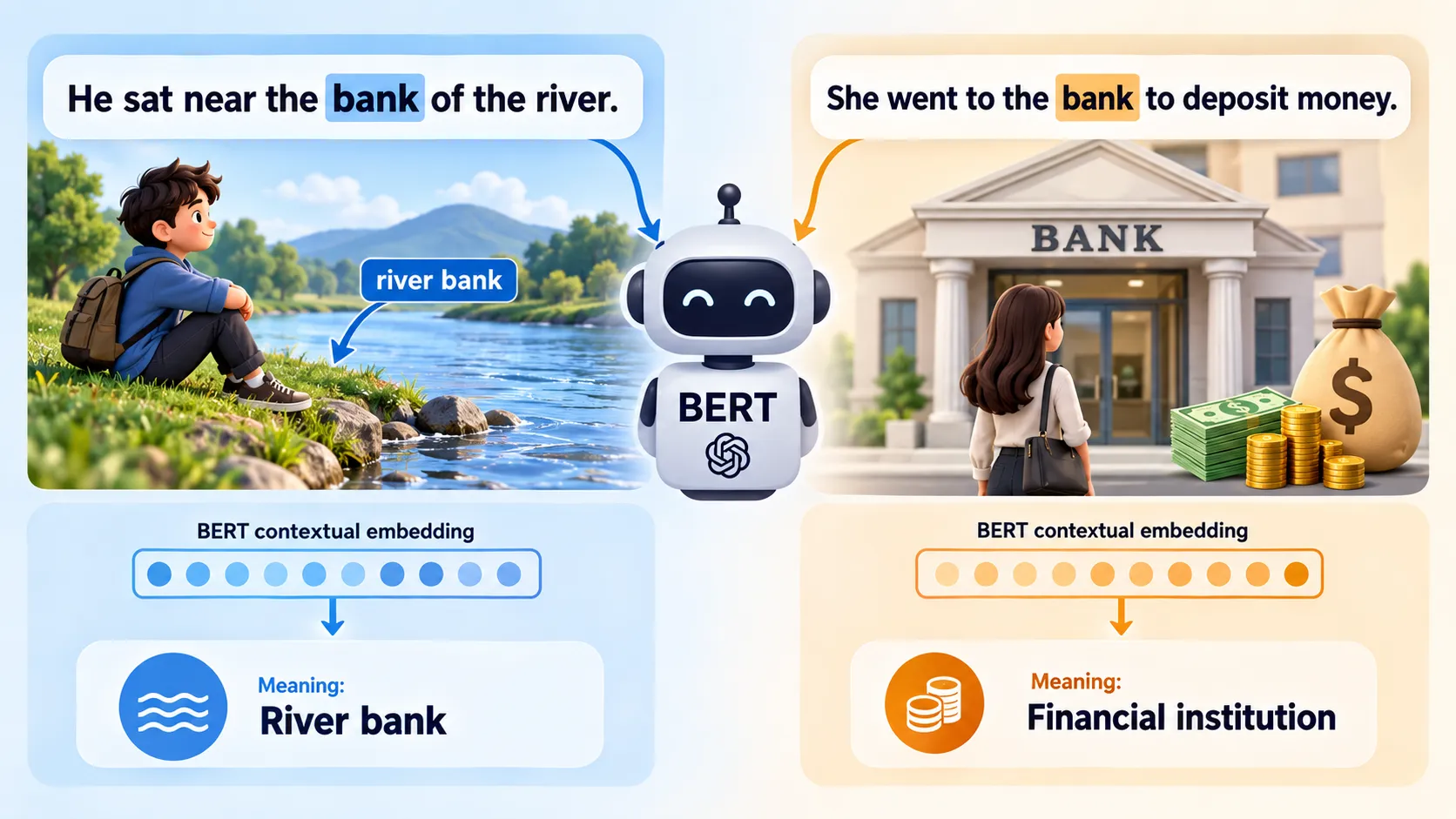
“He sat near the bank of the river.”
“She went to the bank to deposit money.”
The word bank appears in both sentences, but it has two completely different meanings.
A basic word representation may struggle because the word itself is identical.
BERT looks at the surrounding context.
Words like river help BERT understand that the first “bank” refers to land beside water.
Words like deposit and money help it understand that the second “bank” refers to a financial institution.
That ability to change the meaning of a word according to its context is one reason BERT became so useful in NLP.
If you want to understand the architecture underneath BERT before going deeper, read our Transformer Architecture Deep Dive. It explains the encoder and self-attention foundation that BERT builds upon.
Why Was BERT Needed?
Before Transformer-based language models became common, many NLP systems processed language mainly in sequence.
A model could move through a sentence from left to right, or in some approaches from right to left.
The problem is that language is rarely that simple.
Look at this sentence:
“The delivery driver could not leave the parcel at the door because it was locked.”
What does “it” refer to?
Most people immediately understand that “it” refers to the door.
To make that decision, we use information from different parts of the sentence.
Language depends on context, relationships, word order, grammar, intention, and sometimes information several words away.
BERT was designed to create representations using information from both sides of a token.
That is what the word bidirectional in BERT is pointing toward.
Why Is BERT Called Bidirectional?
Suppose we have:
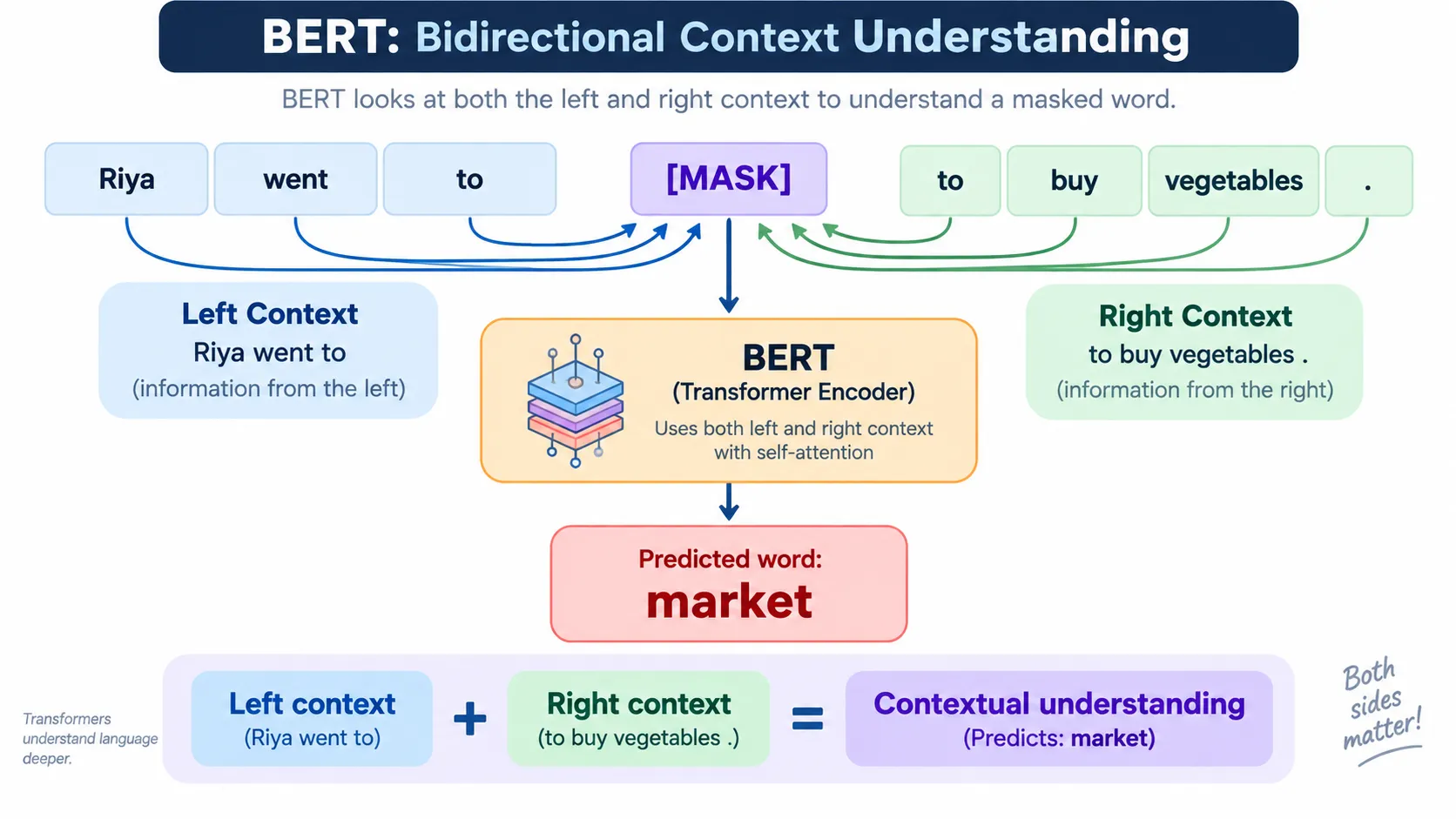
“Riya went to the ____ to buy vegetables.”
Even before seeing the missing word, you might predict market or store.
You use the words before the blank:
“Riya went to the...”
But you also use the words after it:
“...to buy vegetables.”
BERT is trained in a way that allows it to use surrounding context rather than being restricted to only the previous words.
That makes its representation of a token highly dependent on the complete surrounding sentence.
This should not be confused with simply running one model forward and another backward and joining the answers. BERT's Transformer encoder allows tokens to interact through self-attention, producing representations that can capture information from across the input.
To understand this mechanism separately, our Attention Mechanism Explained guide is the best next read because self-attention is at the heart of every BERT encoder layer.
BERT Architecture Explained for Beginners
Now we can look inside the model.
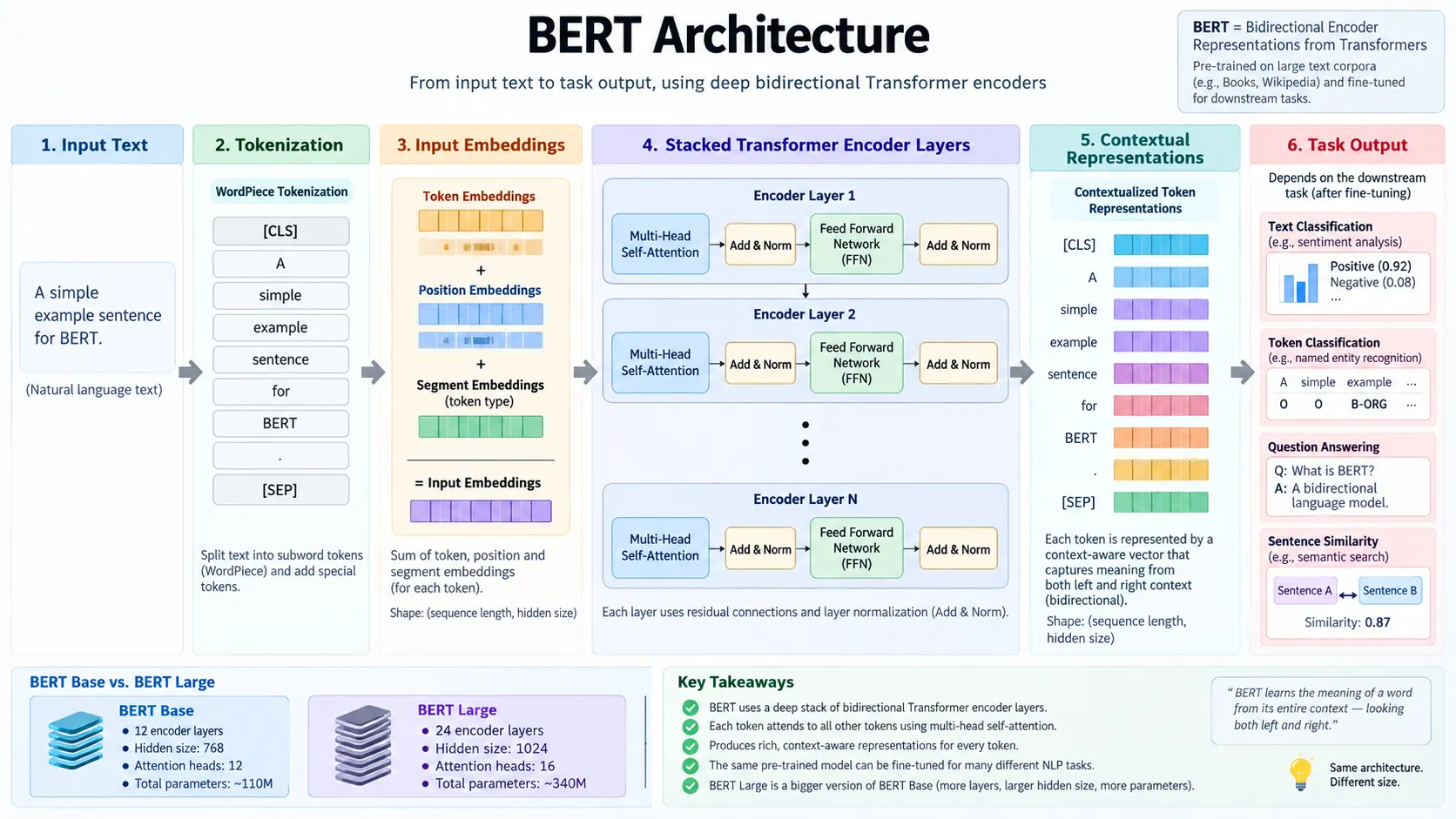
BERT uses a stack of Transformer encoder layers.
The original BERT work introduced two well-known configurations: BERT Base and BERT Large.
BERT Base uses 12 Transformer encoder layers, a hidden representation size of 768, and 12 attention heads.
BERT Large increases this to 24 encoder layers, a hidden size of 1024, and 16 attention heads.
You do not need to memorize these numbers to understand BERT.
The important idea is this:
Text enters the model, passes through multiple Transformer encoder layers, and each layer progressively builds richer contextual representations.
What Happens Inside a BERT Encoder?
A simplified flow looks like this:
Input tokens → embeddings → multi-head self-attention → feed-forward processing → next encoder layer → contextual output
Self-attention allows each token to decide which other tokens are useful when building its representation.
Imagine the sentence:
“Amit returned the laptop because it was overheating.”
While processing “it,” the model can assign stronger attention to “laptop” than to less relevant words.
With multiple attention heads, the model can learn different types of relationships at the same time.
One head might capture grammatical relationships. Another may focus more heavily on nearby context. Another may help connect a pronoun with the noun it refers to.
The real learned behavior is more complex than assigning a fixed human-readable job to every attention head, but this mental model is useful for beginners.
How BERT Converts a Sentence Into Model Input
A neural network cannot directly process normal written language.
The text first has to be converted into tokens and then into numerical representations.
BERT therefore uses several important input components.
WordPiece Tokenization
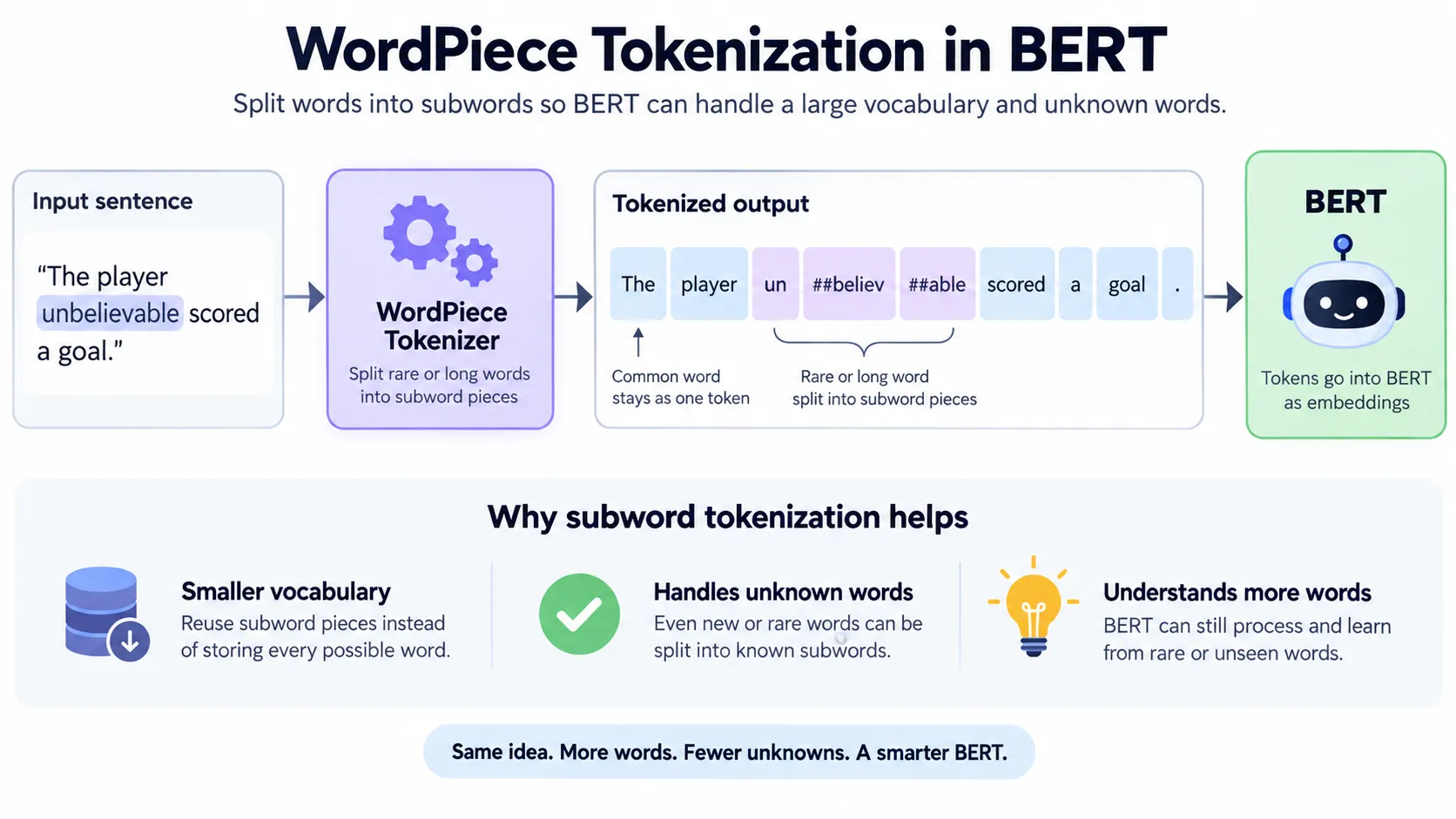
BERT commonly uses WordPiece tokenization.
Instead of requiring every possible complete word to exist in the vocabulary, WordPiece can break less common words into smaller pieces.
For example, a rare or complex word may become several subword tokens.
This is useful because human language contains huge numbers of words, spelling variations, names, and word forms.
Subword tokenization gives the model a practical way to represent many words without storing every possible word independently.
The [CLS] Token
BERT commonly places a special [CLS] token at the beginning of an input sequence.
For classification tasks, the representation associated with this position can be passed into a classification layer.
Suppose we want to decide whether a product review is positive or negative.
The complete review passes through BERT, and the resulting representation can then help the classification head predict the category.
The [SEP] Token
The [SEP] token is used to mark separation between sequences.
This is especially useful when two pieces of text are provided together.
For example:
Question: Which phone has the better battery?
Passage: Phone A lasts 18 hours while Phone B lasts 13 hours.
BERT needs a clear way to distinguish the different text segments. Special tokens help create that structure.
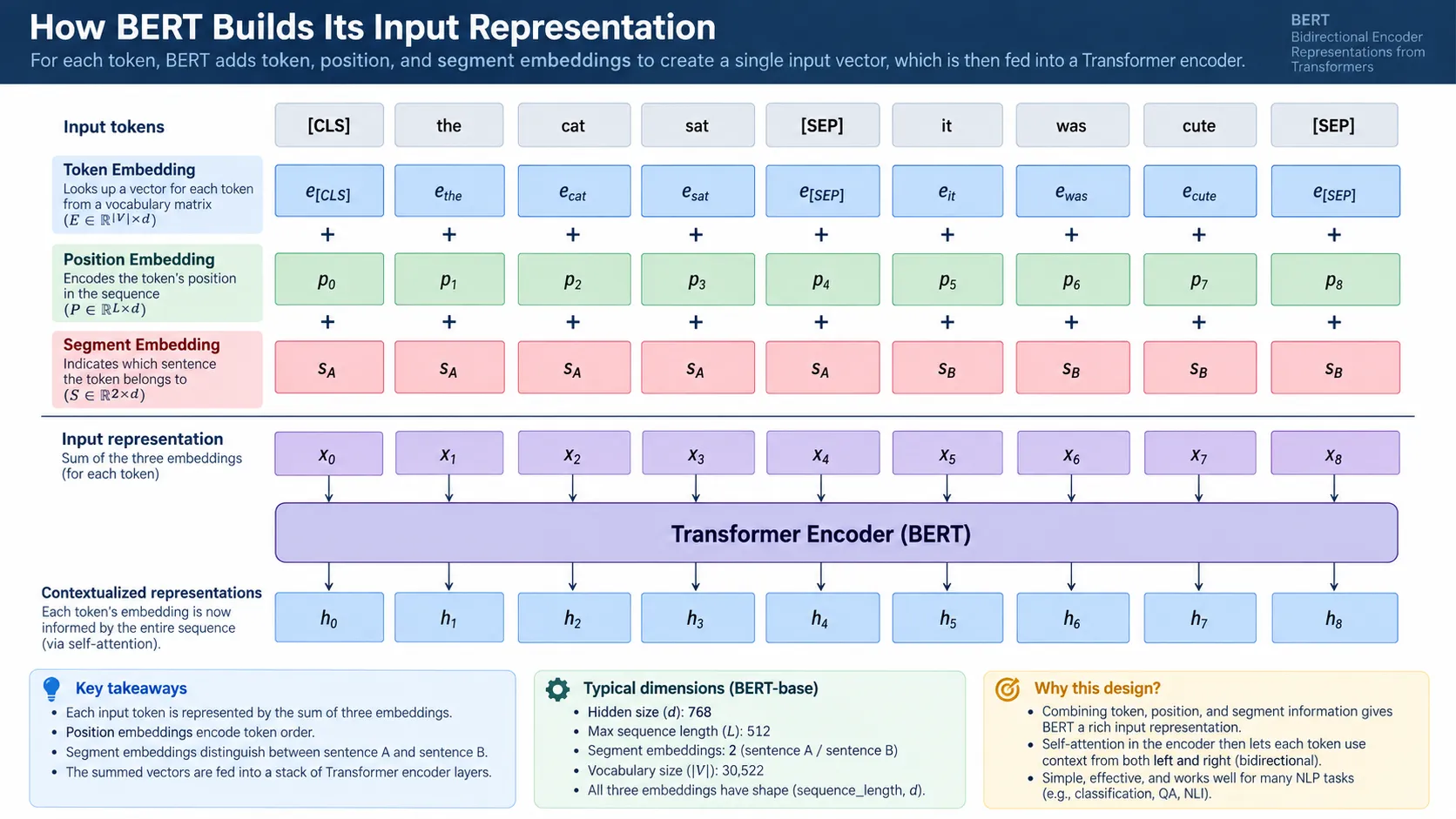
Token, Position, and Segment Information
Knowing a token is not enough.
The model also needs information about where it appears and, when applicable, which segment it belongs to.
BERT therefore combines multiple forms of input representation.
Token embeddings represent token identity.
Position embeddings provide information about location in the sequence.
Segment or token-type embeddings can distinguish one sequence from another in paired inputs.
These representations are combined before the sequence enters the Transformer encoder stack.
How Does BERT Learn Language?
Understanding BERT becomes much easier once you separate its training into two stages:
pre-training and fine-tuning.
During pre-training, the model learns general language patterns from large amounts of text.
During fine-tuning, that general knowledge is adapted to a particular task.
Think about a student who spends years learning English and then prepares specifically for a legal exam.
The student does not learn English again from zero.
They already understand language. They simply adapt that knowledge to a specialized task.
BERT follows a similar idea.
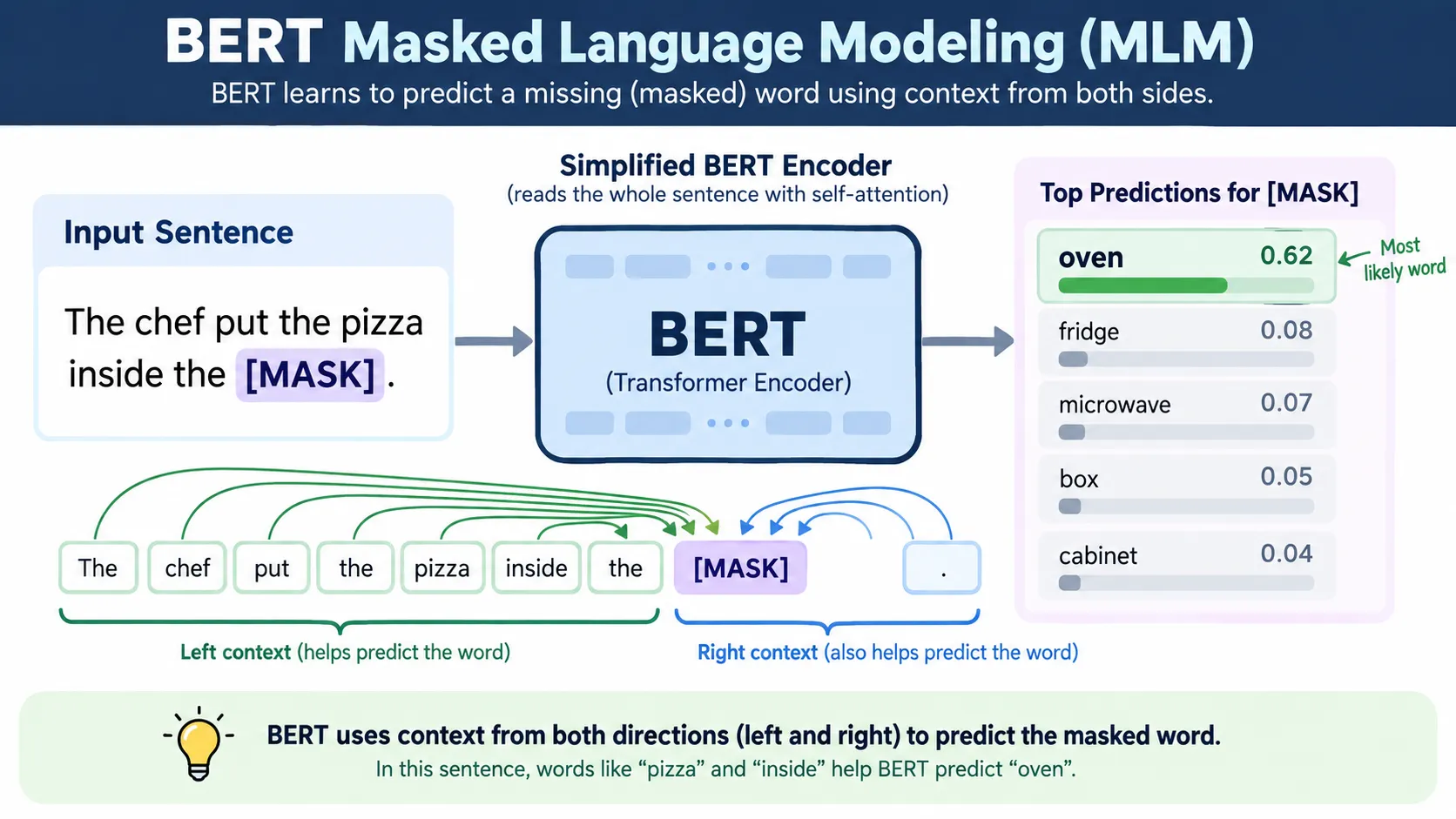
Masked Language Modeling in BERT
One of the original BERT training objectives is called Masked Language Modeling, or MLM.
During training, some tokens are selected and the model has to recover the original tokens using context.
Imagine:
“The chef put the pizza inside the [MASK].”
Possible words could include oven, box, kitchen, or fridge.
But once the full context is considered, oven may be the strongest prediction.
The interesting part is that BERT can use words on both sides of the masked position.
That forces the model to build representations that understand relationships within the complete context.
In the original BERT training procedure, 15% of token positions were selected for this prediction task. The selected positions were not always replaced by the visible [MASK] token; the training procedure also used random replacements or left some selected tokens unchanged.
That detail helps reduce the gap between training and later use, because real sentences do not normally contain a [MASK] symbol everywhere.
What Is Next Sentence Prediction?
The original BERT model also used Next Sentence Prediction, usually shortened to NSP.
The idea was to show the model two text segments and ask whether the second originally followed the first.
For example:
Sentence A: “Arjun ordered a new monitor online.”
Sentence B: “It arrived at his home two days later.”
These sentences form a sensible continuation.
Now compare:
Sentence A: “Arjun ordered a new monitor online.”
Sentence B: “Mount Everest is located in the Himalayas.”
Both sentences are individually correct, but the second one is unrelated to the first.
NSP was designed to help BERT learn relationships between sentences.
Later Transformer models explored different pre-training recipes, and not every BERT-style model kept NSP. That is useful to remember: BERT started an important direction, but NLP research continued evolving after it.
Pre-Training vs Fine-Tuning
This distinction is one of the most useful ideas to understand.
Pre-Training
Pre-training teaches the model broad language patterns.
The training does not begin with one narrow business problem such as “detect spam emails.”
Instead, the goal is to learn useful representations of language itself.
This stage requires large datasets and substantial computing resources.
Fine-Tuning
Fine-tuning adapts the already pre-trained model to a specific downstream task.
Suppose your company receives thousands of customer reviews.
You want to classify them as:
positive, negative, or neutral.
Training a powerful language model from zero would be extremely expensive.
Instead, you can start with a pre-trained BERT model, add an appropriate task-specific output layer, and train it on your labeled review data.
That process allows the system to reuse language knowledge that BERT already learned.
If fine-tuning and optimization are new concepts for you, read our Hyperparameter Tuning Guide after this section. It explains how model settings affect training and performance.
Real-World BERT Use Cases
The easiest way to understand the importance of BERT is to look at problems where context matters.
Search Intent Understanding
Suppose someone searches:
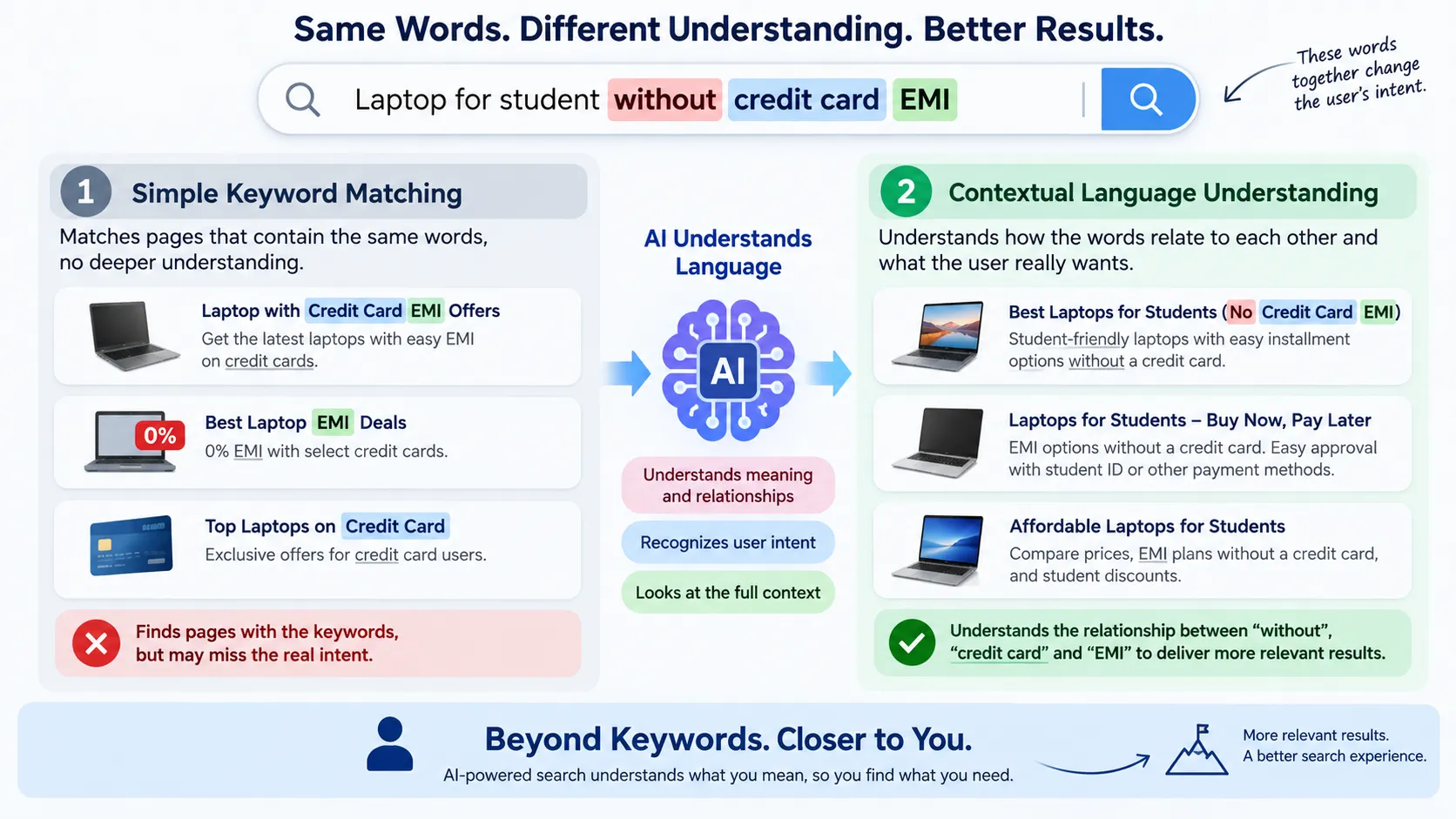
“Laptop for student without credit card EMI”
A useful system must understand more than individual words such as laptop, student, credit card, and EMI.
The relationship between without and credit card changes the user's requirement.
This type of contextual language understanding is exactly where Transformer models such as BERT became valuable.
Google publicly explained that BERT helped Search better understand conversational queries and small words such as prepositions when those words changed the meaning of a query.
Sentiment Analysis
Consider:
“The camera is excellent, but the battery completely ruins the experience.”
Simply spotting the positive word excellent would give the wrong overall impression.
A contextual model has a better chance of representing the contrast between the two parts of the sentence.
That makes BERT useful as a base model for sentiment classification.
Question Answering
Imagine a support system containing a long policy document.
A user asks:
“How many days do I have to return a damaged product?”
A BERT-based question-answering system can process the question together with the relevant passage and help identify the span of text containing the answer.
This became one of the classic applications used to demonstrate contextual Transformer representations.
Text Classification
BERT can be adapted for problems such as:
spam detection, intent classification, support-ticket routing, topic classification, and content moderation.
A business could automatically classify a message such as:
“My payment was deducted twice.”
into a billing or payments category before the ticket reaches a support agent.
Named Entity Recognition
Consider:
“Rohit joined Microsoft in Hyderabad in July.”
An NLP system may need to recognize:
Rohit as a person, Microsoft as an organization, Hyderabad as a location, and July as a date reference.
Contextual representations make BERT useful as the foundation for these sequence-labeling tasks.
How BERT Changed Google Search
One of the most famous real-world stories around BERT came from Google Search.
Search queries are messy.
People do not always write perfect sentences.
They may type incomplete thoughts, include small connecting words, or ask questions exactly as they would speak.
Those small words can completely change meaning.
For example:
“Jobs for students without degree”
and
“Jobs for students with degree”
contain almost the same major keywords.
Yet the user intent is very different.
A system that mainly matches important-looking words can easily miss the difference.
Contextual language models can pay attention to the relationships among those words instead.
Google explained that introducing BERT improved its ability to understand longer and more conversational searches, particularly cases where the relationship between words matters.
This is an important lesson beyond Google Search.
Modern NLP is not simply about finding whether a keyword exists.
It is about understanding what the words mean together.
BERT vs Traditional Word Embeddings
Older word embedding approaches were an important step forward because words could be represented as meaningful numerical vectors.
However, a major limitation appears when the same word has multiple meanings.
Take “mouse.”
In:
“The mouse ate the food.”
mouse means an animal.
In:
“My wireless mouse stopped working.”
mouse means a computer device.
A static representation may begin with essentially the same word vector in both situations.
BERT creates contextual representations.
The representation produced for “mouse” can therefore change according to the sentence.
That difference is fundamental.
BERT vs GPT: What Is the Basic Difference?
BERT and GPT are both connected to the Transformer family, but their original designs and training goals are different.
BERT is fundamentally encoder-based and was designed especially for understanding and representing input text.
GPT-style models are decoder-based autoregressive models, predicting text token by token and making them naturally suited to text generation.
So if your task is:
“Understand what this sentence means and classify it,”
an encoder model such as BERT can be a natural fit.
If your task is:
“Continue this paragraph and generate new text,”
a generative decoder model is designed for that kind of behavior.
The modern AI landscape is much broader than this simple comparison, but the distinction gives beginners a strong starting point.
Advantages of BERT
BERT's biggest strength is contextual understanding.
It can create different representations for the same word depending on surrounding language.
It also benefits from transfer learning: instead of building a language model from zero for every project, developers can start with a pre-trained model and adapt it.
The same general architecture can support classification, question answering, entity recognition, similarity tasks, and many other NLP applications.
And because BERT became widely adopted, it also helped build an enormous ecosystem of research, tutorials, libraries, checkpoints, and BERT-derived models.
Limitations of BERT
BERT is powerful, but it is not a perfect solution for every NLP problem.
Large BERT models require significant memory and computing resources compared with much smaller traditional models.
Input length is also limited in standard BERT implementations, which creates challenges when working with very long documents.
BERT is not primarily a free-form text-generation architecture either. Its design is much better aligned with language understanding tasks than with generating long passages one token at a time.
Model bias is another concern.
A language model learns from training data, which means unwanted patterns present in that data can also appear in its behavior.
And most importantly, BERT does not “understand” language exactly like a human does. It learns highly useful statistical representations of language from data.
That difference should always remain clear when designing real applications.
Should You Learn BERT in the Age of Modern LLMs?
Yes—especially if you want to understand NLP properly.
You may work with much newer language models in real projects, but BERT teaches several concepts that remain essential:
Transformer encoders, self-attention, contextual embeddings, tokenization, pre-training, fine-tuning, transfer learning, and task-specific language models.
Once these ideas become clear, newer Transformer architectures are much easier to understand.
BERT is therefore not just another old model to memorize.
It is one of the clearest ways to learn how modern contextual NLP developed.
If you have reached this point, continue with our Transformer Architecture Deep Dive and Attention Mechanism Explained guides. Together, those topics will give you a much stronger picture of what actually happens inside BERT.
Final Thoughts
The real breakthrough behind BERT is easier to understand than the name makes it sound.
Language depends on context.
The meaning of one word often depends on what appears before it, what appears after it, and how the complete sentence is structured.
BERT was designed to learn those contextual relationships using a stack of Transformer encoders.
Its pre-training teaches broad language representations. Fine-tuning adapts those representations to real tasks such as search understanding, sentiment analysis, text classification, entity recognition, and question answering.
So whenever you see a machine correctly understand that “bank” can mean a financial institution in one sentence and the side of a river in another, you are looking at the type of contextual language problem that models such as BERT were built to solve.
Understanding that single idea gives you the foundation for understanding much more of modern NLP.
Frequently Asked Questions About BERT
What is the BERT model in simple words?
BERT is a Transformer-based language model designed to create contextual representations of text. Instead of deciding what a word means on its own, BERT considers the surrounding words. This makes it useful for tasks such as text classification, question answering, sentiment analysis, and search-query understanding.
How does BERT work?
BERT tokenizes input text, converts the tokens into embeddings, and processes them through multiple Transformer encoder layers. Self-attention allows tokens to use information from other relevant tokens in the input. BERT is first pre-trained on general language data and can later be fine-tuned for a specific NLP task.
Why is BERT called bidirectional?
BERT is called bidirectional because its training allows representations to use context from both sides of a token. For example, when predicting a hidden word, BERT can use words appearing before and after that position rather than relying only on the previous text.
Is BERT an encoder or decoder model?
BERT is an encoder-based Transformer model. It uses a stack of Transformer encoder layers. This differs from GPT-style language models, which use decoder-based autoregressive architectures designed for next-token prediction and text generation.
What is Masked Language Modeling in BERT?
Masked Language Modeling is a pre-training objective where selected tokens are hidden or altered and BERT tries to predict their original values using surrounding context. This encourages the model to learn useful contextual relationships between words.
What is the difference between BERT and GPT?
BERT is primarily designed around an encoder architecture for understanding and representing input text. GPT-style models use decoder-only autoregressive architectures and predict tokens sequentially, making them especially suited to text generation. Both come from the Transformer family but solve language problems differently.
What is BERT used for?
BERT can be fine-tuned for text classification, sentiment analysis, question answering, named entity recognition, search-query understanding, intent detection, semantic similarity, and several other Natural Language Processing tasks.
How did BERT help Google Search?
Google introduced BERT into Search to improve language understanding, particularly for conversational queries where context and relationships between words matter. This helped Search better interpret cases where even small words could significantly change the user's intended meaning.
BERT Architecture Explained for Beginners
Now that we understand why BERT reads language in both directions, the next question is simple: what actually happens inside the BERT model?
At its core, BERT is built using the encoder side of the Transformer architecture.
Think of the Transformer encoder as a group of smart reading layers. A sentence enters the first layer, where the model starts understanding basic relationships between words. The output then moves to the next layer, where those relationships become richer. This continues through several encoder layers until BERT has a strong contextual representation of the complete input.
The original BERT model was released mainly in two sizes: BERT Base and BERT Large.
BERT Base contains 12 Transformer encoder layers, 12 attention heads, and a hidden size of 768.
BERT Large goes further with 24 encoder layers, 16 attention heads, and a hidden size of 1024.
You do not need to memorize these numbers.
The important idea is that more encoder layers allow the model to build deeper representations of language.
A simple flow looks like this:
Text → Tokens → Embeddings → Transformer Encoders → Contextual Representations → Task Output
--- IMAGE 3 ---
What Happens Inside a Transformer Encoder?
Every BERT encoder contains two major ideas that beginners should understand:
Self-attention and a feed-forward neural network.
Self-attention helps BERT decide which words in a sentence are important to each other.
Take this sentence:
“Rahul dropped his phone because it was slippery.”
When BERT processes the word “it,” the model needs to understand what “it” refers to.
The word could theoretically refer to Rahul or the phone.
But by looking at the full context, BERT can build a stronger relationship between “it” and “phone.”
This is where self-attention becomes powerful.
Instead of processing every word independently, each token can interact with other relevant tokens in the sentence.
If you want to understand this mechanism in more depth, read our Attention Mechanism Explained guide.
Why Does BERT Use Multi-Head Attention?
BERT does not use only one attention calculation.
It uses multi-head attention.
You can imagine several attention heads looking at the same sentence from different angles.
For example, in:
“Priya gave Neha her notebook because she needed it.”
One attention pattern may help understand relationships between people.
Another may focus on the object, notebook.
Another may capture grammatical relationships.
Another may connect words that are far apart in the sentence.
This does not mean every attention head always has one fixed human-readable job. In real models, learned attention patterns can be much more complex.
But for a beginner, the key idea is simple:
Multiple attention heads allow BERT to capture different relationships inside the same sentence at the same time.
How BERT Converts Text Into Numbers
A neural network cannot directly understand the words we type.
If you write:
“BERT understands context.”
the model does not receive those words exactly as you see them.
First, the text must be converted into smaller units called tokens.
Then those tokens are transformed into numerical representations that the neural network can process.
This process begins with tokenization.
WordPiece Tokenization in BERT
BERT commonly uses a method called WordPiece tokenization.
Instead of keeping every possible word in its vocabulary, WordPiece can break uncommon words into smaller pieces.
Imagine the model sees a rare word that is not available as one complete vocabulary item.
Rather than treating it as completely unknown, the tokenizer may divide it into smaller subword units that it already knows.
This is useful because languages contain an enormous number of words, names, spelling variations, prefixes, suffixes, and technical terms.
A vocabulary containing every possible complete word would become extremely large.
Subword tokenization gives BERT a more flexible solution.
For example, a complex word may be represented approximately as:
play + ##ing
or another combination of known subword pieces, depending on the vocabulary being used.
The exact token split can vary, but the concept remains the same: BERT can work with pieces of words instead of depending only on complete words.
--- IMAGE 4 ---
What Is the [CLS] Token?
BERT uses a few special tokens.
One of the most important is:
[CLS]
The [CLS] token is normally placed at the beginning of an input sequence.
For many classification tasks, its final representation can be used as an overall representation of the input.
Suppose we want BERT to analyze this review:
“The phone is fast, the camera is excellent, and the battery easily lasts a full day.”
We may want the model to classify it as:
Positive
or
Negative
The sequence passes through BERT, and the final representation associated with the [CLS] position can be passed to a classification layer.
That layer then predicts the final category.
This idea makes BERT useful for tasks such as:
sentiment analysis, spam detection, topic classification, intent detection, and support-ticket categorization.
What Is the [SEP] Token?
Another special token is:
[SEP]
SEP stands for separator.
It helps BERT identify boundaries between different pieces of text.
For example, imagine a question-answering system receives:
Question: “When will my order arrive?”
and
Passage: “Standard delivery normally takes three to five working days.”
The model needs to understand that the question and the passage are two separate pieces of text.
The [SEP] token helps define this structure.
A simplified input may look like:
[CLS] Question [SEP] Passage [SEP]
This structure is especially useful when BERT receives sentence pairs or a question together with a passage.
Understanding BERT Embeddings
Tokenization tells BERT what tokens exist, but the model still needs additional information.
BERT's input representation combines different types of embeddings.
The three important ones for beginners are:
Token Embeddings
Token embeddings represent the identity of each token.
For example, tokens related to “phone,” “battery,” and “camera” receive numerical representations that BERT can process.
Position Embeddings
Word order matters.
Consider:
“Dog bites man.”
and:
“Man bites dog.”
The words are almost identical, but the meaning is very different because their positions changed.
Position embeddings provide information about where each token occurs in the input sequence.
Without position information, the model would have a much harder time understanding sentence order.
Segment Embeddings
BERT can also process two text segments together.
Segment or token-type embeddings help indicate which tokens belong to the first segment and which belong to the second.
This is useful for tasks involving sentence pairs, questions with passages, or text comparison.
So before the actual Transformer processing begins, BERT is already working with information about:
what the token is, where it appears, and which segment it belongs to.
--- IMAGE 5 ---
How Does BERT Learn Language?
Knowing BERT's architecture is only half the story.
The bigger question is:
How does BERT actually learn what words and sentences mean?
Its original training process can be understood through two major stages:
Pre-training and Fine-tuning.
Pre-Training
During pre-training, BERT learns general language patterns from a large amount of text.
At this stage, the model is not being trained only for one task such as sentiment analysis or spam detection.
It is learning reusable language representations.
Think of someone learning English for years before choosing a profession.
First they learn vocabulary, sentence structure, relationships between words, and how language works.
Later, they may specialize in law, medicine, marketing, or engineering.
BERT follows a similar idea.
It first develops broad language representations.
Then those representations can be adapted for a specific NLP task.
If you want to understand the Transformer foundation behind this process, read our Transformer Architecture Deep Dive.
In the next section, we will see one of the most important tricks that made BERT training work: Masked Language Modeling, where BERT learns by predicting missing words using context from both sides.
Masked Language Modeling: How BERT Learns From Missing Words
One of the most important ideas behind BERT is Masked Language Modeling, usually called MLM.
The concept is surprisingly simple.
During pre-training, some tokens in a sentence are selected, and BERT has to predict what the original token was by looking at the surrounding context.
Imagine this sentence:
“The chef put the pizza inside the [MASK].”
A human can probably guess that the missing word is oven.
Why?
Because we understand the relationship between chef, pizza, inside, and the missing word.
BERT learns in a similar way.
It looks at the words before the masked position and the words after it.
That is one of the reasons BERT can build strong bidirectional contextual representations.
--- IMAGE 6 ---
In the original BERT training process, around 15% of token positions were selected for prediction.
However, not every selected token was simply replaced with [MASK].
Some selected tokens were replaced with another token, while some were left unchanged.
This training strategy helped BERT learn useful contextual patterns without becoming dependent only on seeing the special [MASK] token.
The main idea is simple:
BERT learns by using context to recover missing information.
This helps it understand how words relate to one another inside sentences.
What Is Next Sentence Prediction in BERT?
The original BERT model also used another training objective called Next Sentence Prediction, or NSP.
The goal was to help the model learn relationships between two text segments.
Consider:
Sentence A: “Aman ordered a new laptop online.”
Sentence B: “It arrived at his home two days later.”
These sentences naturally belong together.
Now compare this:
Sentence A: “Aman ordered a new laptop online.”
Sentence B: “The Pacific Ocean is the largest ocean on Earth.”
Both sentences are correct individually, but the second sentence does not logically continue the first.
During original BERT pre-training, the model learned to predict whether one sentence actually followed another.
This helped BERT learn relationships across sentence boundaries.
It is worth noting that later Transformer models experimented with different training approaches, and not every BERT-style model continued using NSP.
That is normal in machine learning.
BERT was a major step forward, but research did not stop with BERT.
Pre-Training vs Fine-Tuning in BERT
One of BERT's biggest advantages is that we do not need to train it from zero every time we have a new NLP problem.
Instead, we can start with a pre-trained BERT model and adapt it.
This adaptation process is called fine-tuning.
Imagine that an e-commerce company receives thousands of customer reviews.
Some reviews are positive:
“The phone is fast and the battery easily lasts all day.”
Others are negative:
“The camera is poor and the phone keeps overheating.”
The company wants an AI system that automatically classifies each review.
Training a huge language model from scratch would require a large amount of data, computing power, and time.
Instead, developers can start with pre-trained BERT.
They add a small task-specific output layer and train the model on labeled review examples.
BERT already knows a lot about language.
Fine-tuning simply teaches it how to use that language knowledge for a particular task.
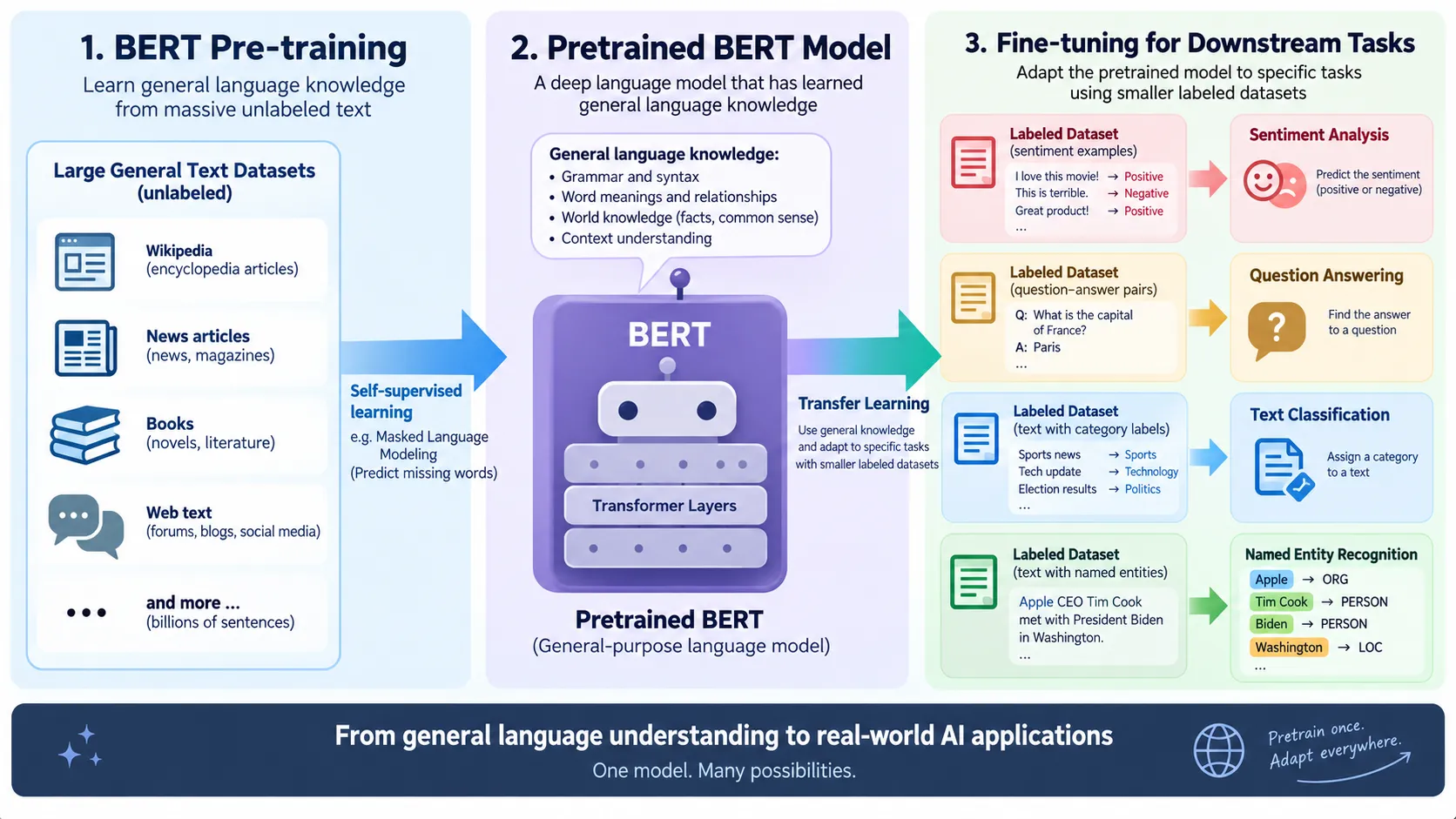
This concept is known as transfer learning.
The model transfers knowledge learned during general pre-training to a more specific problem.
If you want to understand how training settings such as learning rate and batch size affect model performance, read our Hyperparameter Tuning Guide.
Real-World Uses of BERT
BERT is useful whenever understanding the meaning and context of text matters.
Search Intent Understanding
Imagine somebody searches:
“Laptop for student without credit card EMI.”
A simple keyword-based system may notice:
laptop, student, credit card, and EMI.
But the word “without” changes the user's requirement completely.
The user is specifically looking for an option that does not require a credit card.
Context-aware language models are much better suited to understanding this relationship.
Google publicly introduced BERT into Search to help understand more conversational queries and cases where the relationship between words affects meaning.
Sentiment Analysis
Consider this review:
“The display is beautiful, but the battery life is terrible.”
A simple system might notice the positive word beautiful and incorrectly classify the entire review as positive.
BERT can use the complete sentence context to better represent the contrast between the display and the battery experience.
This makes BERT useful for customer feedback analysis and review classification.
Question Answering
Suppose a company's return policy says:
“Damaged products can be returned within 14 days of delivery.”
A customer asks:
“How long do I have to return a damaged item?”
A BERT-based question-answering system can process the question together with the passage and identify the relevant answer:
14 days.
This type of system can be useful in support portals, documentation systems, knowledge bases, and help centers.
Named Entity Recognition
Consider:
“Rohit joined Microsoft in Hyderabad in July.”
An NLP system may need to identify:
Rohit → Person
Microsoft → Organization
Hyderabad → Location
July → Date
BERT's contextual representations can be fine-tuned for this type of Named Entity Recognition, commonly called NER.
BERT vs GPT: What Is the Difference?
BERT and GPT both come from the Transformer family, but their original designs focus on different types of problems.
BERT is primarily an encoder-based model.
Its strength is understanding and representing input text.
GPT-style models are primarily decoder-based autoregressive models.
They are designed to predict the next token repeatedly, which makes them naturally suited to generating text.
A simple way to remember the difference is:
BERT → Understand text
GPT → Generate text
This is a simplified explanation, but it gives beginners the right starting point.
If you want to understand why encoder and decoder architectures behave differently, read our Transformer Architecture Deep Dive.
Advantages of BERT
BERT brought several important advantages to NLP.
First, it produces contextual word representations.
The meaning of a word can change depending on the sentence around it.
Second, BERT supports transfer learning.
Developers can begin with a pre-trained model instead of training a language model from scratch.
Third, the same BERT foundation can be adapted to many tasks, including:
text classification, sentiment analysis, question answering, named entity recognition, intent detection, and semantic similarity.
This made powerful NLP systems much more practical for researchers and developers.
Limitations of BERT
BERT is powerful, but it is not perfect.
Large BERT models require considerable computing power and memory compared with simpler machine-learning models.
Standard BERT also has an input-length limit, which can become a problem when processing very long documents.
Another limitation is that BERT is not primarily designed for long-form text generation.
Its encoder architecture is much better suited to understanding text than generating paragraphs one token at a time.
BERT can also inherit unwanted patterns or bias from its training data.
For that reason, real-world AI systems still need testing, monitoring, and responsible deployment.
Most importantly, BERT should not be thought of as understanding language exactly like a human.
It learns powerful statistical patterns and contextual relationships from text.
That distinction matters.
Should You Still Learn BERT?
Yes.
Even with today's much larger language models, BERT remains one of the best models for learning the foundations of modern NLP.
By understanding BERT, you also learn:
Transformer encoders, self-attention, tokenization, embeddings, contextual representations, pre-training, fine-tuning, transfer learning, and task-specific NLP.
These ideas appear again and again across modern AI systems.
BERT is therefore more than a model to memorize.
It is a bridge between traditional NLP and the modern Transformer era.
Final Thoughts
The biggest idea behind BERT is actually very simple:
Words do not have meaning in isolation. Context gives them meaning.
The word “bank” can describe a financial institution or the side of a river.
The word “mouse” can describe an animal or a computer device.
Humans understand these differences almost instantly because we read the complete sentence.
BERT was designed to help machines build this kind of contextual representation using Transformer encoders and bidirectional context.
From Masked Language Modeling to fine-tuning, every major part of BERT supports the same goal:
understand what the text means, not just which words appear inside it.
Once you understand that idea, BERT's architecture becomes much easier to understand—and so does a huge part of modern Natural Language Processing.
Frequently Asked Questions About BERT
What is BERT in simple words?
BERT is a Transformer-based language model designed to understand the meaning of words by looking at their surrounding context. Instead of treating a word as having one fixed meaning, BERT considers the complete sentence.
For example, the word “bank” means something different in “river bank” and “bank account.” BERT can create different contextual representations for the word depending on the words around it.
BERT stands for Bidirectional Encoder Representations from Transformers.
How does the BERT model work?
BERT first breaks text into tokens. These tokens are converted into numerical representations and passed through multiple Transformer encoder layers.
Inside these layers, self-attention allows each token to interact with other relevant tokens in the input.
Because BERT can use surrounding context from both directions, it can build a deeper representation of what a sentence means.
After pre-training, the model can be fine-tuned for tasks such as sentiment analysis, text classification, question answering, and named entity recognition.
Why is BERT called bidirectional?
BERT is called bidirectional because it can use context from both sides of a token when creating its representation.
Consider:
“Rohan went to the [MASK] to buy vegetables.”
Words before the missing position tell us something:
“Rohan went to the…”
But the words after it provide another important clue:
“…to buy vegetables.”
Using both sides makes “market” a sensible prediction.
This ability to use surrounding context is one of the main ideas behind BERT.
Is BERT an encoder or decoder model?
BERT is an encoder-based Transformer model.
It uses stacked Transformer encoder layers to understand and represent input text.
This is different from decoder-only models such as GPT-style models, which are mainly designed to predict the next token repeatedly and generate text.
A simple way to remember it is:
BERT → strong focus on understanding input text
GPT-style models → strong focus on generating text
What is Masked Language Modeling in BERT?
Masked Language Modeling, or MLM, is one of the original BERT pre-training objectives.
During training, selected token positions are hidden or changed, and BERT tries to recover the original token using surrounding context.
For example:
“The chef placed the pizza inside the [MASK].”
By looking at words such as chef, pizza, and inside, BERT may predict “oven.”
This process helps BERT learn relationships between words and build contextual language representations.
What is Next Sentence Prediction in BERT?
Next Sentence Prediction, or NSP, was another objective used in the original BERT training process.
BERT received two text segments and learned to predict whether the second segment actually followed the first in the original text.
For example:
Sentence A: “Aman purchased a new laptop.”
Sentence B: “It was delivered the following day.”
These sentences are logically connected.
NSP was intended to help BERT learn relationships between text segments. Later Transformer models experimented with different training approaches, so not every BERT-based architecture uses NSP.
What is BERT used for?
BERT can be fine-tuned for many Natural Language Processing tasks.
Common applications include sentiment analysis, question answering, text classification, named entity recognition, search-query understanding, intent detection, semantic similarity, and support-ticket classification.
For example, a customer-support system could automatically understand that:
“Money was deducted twice from my account.”
belongs to a payment or billing issue.
What is the difference between BERT and GPT?
BERT and GPT both come from the Transformer family, but their architecture and original training goals are different.
BERT is mainly an encoder-based model that creates contextual representations of input text.
GPT-style models are decoder-only autoregressive models that predict the next token and are naturally suited to text generation.
So a simplified comparison is:
BERT → understanding and representing text
GPT → predicting and generating text
Modern AI systems have become far more advanced, but this difference is still useful when learning Transformer architecture.
How is BERT used in Google Search?
Google introduced BERT into Search to improve its understanding of conversational and context-dependent queries.
Consider:
“Jobs for students without a degree.”
A keyword-matching system may focus heavily on jobs, students, and degree.
But the word “without” changes the search intent.
Contextual language understanding helps a search system understand relationships between these words instead of treating them as unrelated keywords.
What is fine-tuning in BERT?
Fine-tuning means adapting an already pre-trained BERT model to a specific task.
Suppose you want to classify customer reviews as positive or negative.
Instead of training an entire language model from zero, you can start with pre-trained BERT and train it further using your labeled review dataset.
BERT already contains general language representations, while fine-tuning teaches it how to perform your specific task.
Is BERT still useful today?
Yes.
Newer language models have appeared since BERT, but BERT remains extremely useful for learning and for many specialized NLP tasks.
Understanding BERT teaches you several foundations of modern AI, including Transformers, self-attention, contextual embeddings, tokenization, pre-training, transfer learning, and fine-tuning.
These concepts make newer language models much easier to understand.


