


Imagine someone tells you:
“The delivery driver called the customer because he could not find the address.”
When you read this sentence, your brain immediately tries to understand what “he” refers to.
Was it the customer?
Or the delivery driver?
Based on the surrounding words, you probably understand that “he” refers to the delivery driver.
Humans perform this kind of contextual reasoning almost automatically. We do not give equal importance to every word in a sentence. Instead, our brain focuses on the words that are most relevant for understanding the current meaning.
Artificial intelligence models need something similar.
This is where the attention mechanism becomes important.
Attention allows a neural network to identify which parts of the input are most relevant while processing information. Instead of treating every word equally, the model can assign different levels of importance to different words.
This simple idea became one of the most important developments in modern artificial intelligence and eventually became the foundation of Transformer models.
Today, technologies used for translation, text generation, question answering, summarization, and many other language tasks rely heavily on attention.
What Is an Attention Mechanism?
An attention mechanism is a technique that allows a neural network to focus on the most relevant parts of an input while producing an output.
Think about how you read a long paragraph.
You technically see every word, but when answering a specific question, your attention shifts toward only the information that matters.
For example, consider this sentence:
“Riya placed the ice cream inside the freezer because the kitchen was very warm.”
Suppose an AI model wants to understand why the ice cream was placed in the freezer.
Words such as:
ice cream
freezer
kitchen
warm
are highly relevant.
Other grammatical words still matter, but they may receive less importance.
The attention mechanism helps the model calculate these relationships mathematically.
Instead of compressing an entire sentence into one fixed representation, the model can dynamically decide which words deserve more attention at a particular moment.
Attention is one of many techniques used in modern neural networks, so understanding the fundamentals of deep learning can make these concepts much easier to follow
Why Do Neural Networks Need Attention?
Before attention became popular, many sequence-based AI systems relied heavily on architectures such as Recurrent Neural Networks (RNNs) and Long Short-Term Memory networks (LSTMs).
These models processed sentences sequentially.
For example, if the input sentence were:
“The engineer who designed the new security system arrived at the office early.”
an RNN would typically process it roughly like this:
The → engineer → who → designed → the → new → security → system → arrived → at → the → office → early
Each step depended partly on information from previous steps.
This approach worked reasonably well for shorter sequences.
However, longer sentences created a major challenge.
Important information appearing near the beginning of a sequence could become harder for the network to preserve by the time it reached the end.
Imagine reading a 100-word paragraph and being forced to remember everything using only one continuously updated note.
Eventually, some details would become difficult to preserve.
Attention provided a different approach.
Before Transformers became dominant in many sequence tasks, RNNs and LSTMs were widely used to process text, time-series data, and other sequential information.
Instead of relying only on a compressed memory of earlier words, the model could directly look back at different parts of the sequence and determine which information was relevant.
If concepts such as layers, weights, and information flow are new to you, our guide on how neural networks work explains these foundations with simple examples.
A Simple Real-World Example of Attention
Consider this sentence:
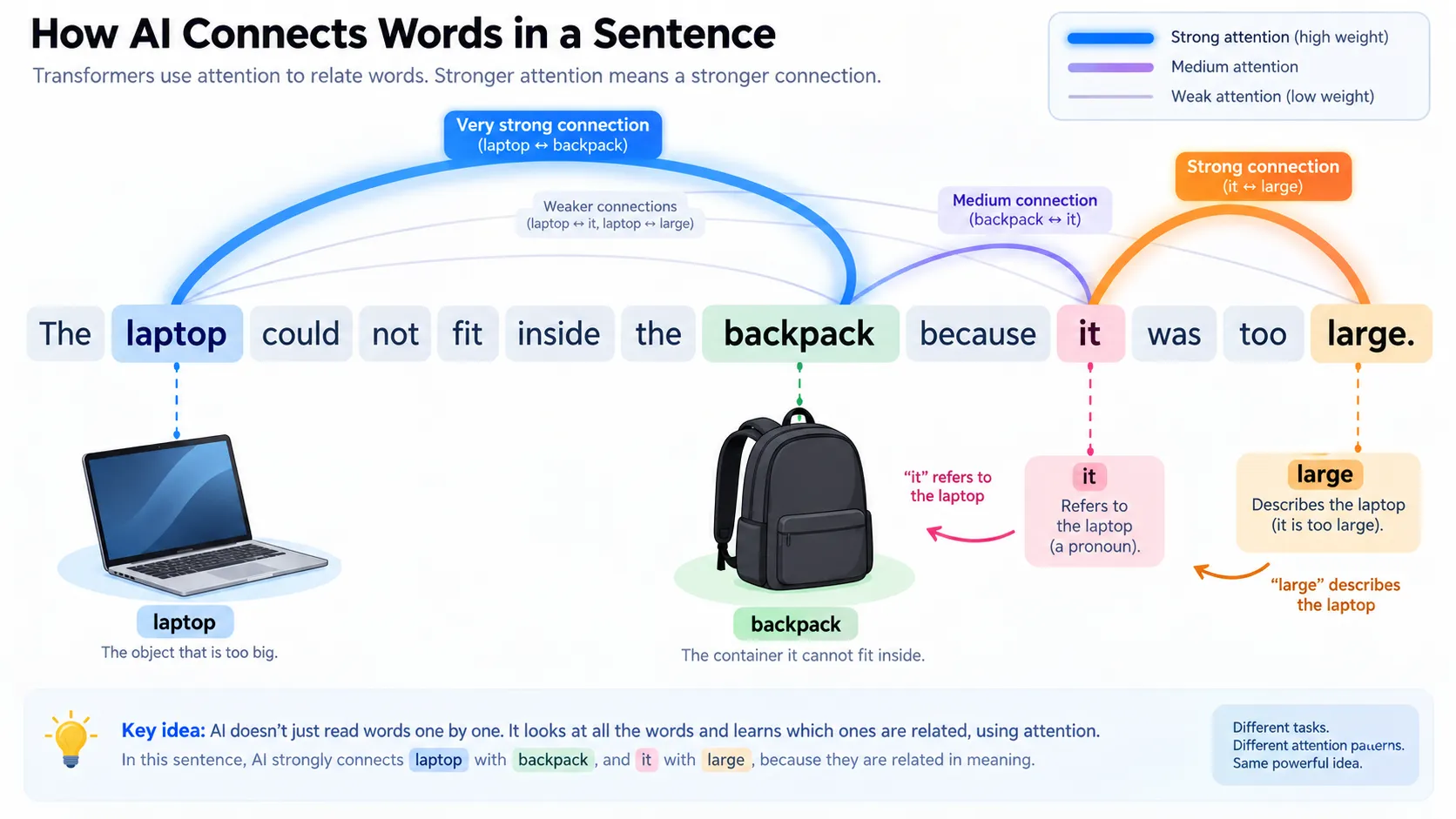
“The laptop could not fit inside the backpack because it was too large.”
What does “it” refer to?
Most people would probably connect “it” with the laptop.
Now consider:
“The laptop could not fit inside the backpack because it was too small.”
Here, “it” most likely refers to the backpack.
Notice something interesting.
The sentence structure is almost identical.
Only one word changed:
large → small
Yet that change influences how we interpret the relationship between several other words.
An AI system therefore cannot understand language simply by reading words independently.
It needs to understand relationships between them.
The attention mechanism helps create those relationships.
When processing the word “it”, the model can examine words such as:
laptop
backpack
large
small
and calculate which relationships appear most useful for understanding the sentence.
This ability to dynamically focus on relevant information is one reason attention became so powerful in natural language processing.
The Core Idea Behind Attention
At a simplified level, attention works through three steps.
First, the model compares pieces of information.
Second, it calculates how strongly they are related.
Third, it gives more influence to the information that appears most relevant.
You can think of it as assigning an importance score.
Imagine the model is analyzing this sentence:
“Aman bought a new camera because he wanted to start photography.”
While processing “he,” the model may compare it with other words.
A simplified conceptual example might look like this:
WordPossible Attention ImportanceAmanHighboughtLowcameraMediumbecauseLowheHighphotographyMedium
These are not actual model values, but they illustrate the basic idea.
The model does not simply read words.
It learns relationships between them.
Attention Scores
The numerical importance assigned between pieces of information is commonly called an attention score.
Higher attention scores indicate that two pieces of information may be strongly related for the current computation.
For example:
“Sara gave Priya her notebook because she needed the notes.”
When the model processes “she,” it needs context to determine which person may be relevant.
The attention mechanism compares representations of different words and produces scores.
Those scores are then normalized so the model can decide how much influence each word should have.
This allows the resulting representation of a word to contain information from other relevant words in the sentence.
In other words, a word's meaning inside the model is no longer based only on the word itself.
Its representation can also incorporate its context.
From Fixed Meaning to Contextual Meaning
This is extremely important because words often have multiple meanings.
Consider the word “bank.”
Sentence one:
“She deposited money at the bank.”
Sentence two:
“They sat beside the river bank.”
The word is spelled exactly the same way, but its meaning changes completely.
A useful language model needs to understand that difference.
Attention helps the model examine surrounding words.
In the first sentence, words such as:
deposited
money
provide strong clues.
In the second sentence:
river
sat beside
provide a completely different context.
Therefore, the internal representation of “bank” can change depending on the sentence.
This idea of creating context-aware representations is one of the fundamental reasons attention-based models perform so well on language tasks.
Where Attention Is Used
Attention mechanisms are now used across many areas of artificial intelligence.
Some common examples include:
machine translation
chatbots and conversational AI
text summarization
question answering
sentiment analysis
speech processing
image understanding
document analysis
multimodal AI systems
One of the most influential uses of attention appears inside the Transformer architecture.
Transformers rely heavily on a specific form known as self-attention, where different elements of the same sequence examine their relationships with one another.
For example, every word in a sentence can potentially evaluate its relationship with every other relevant word.
This gives Transformers a powerful way to understand context.
But to understand how self-attention actually performs these calculations, we need to introduce three important concepts:
Queries, Keys, and Values.
These are the mathematical building blocks behind the attention process.
In the next part, we will break them down using simple examples and then see how attention scores, softmax, weighted values, and context vectors work together inside a Transformer.
How Does the Attention Mechanism Work?
Now that we understand why attention is useful, let us look at how it actually works.
At first, terms such as Query, Key, and Value may sound complicated. However, the basic idea is surprisingly simple.
Imagine that you are searching for a book inside a library.
You have a question in mind:
“Which book explains deep learning?”
Your question represents what you are looking for.
The library contains many books, and each book has information describing its topic.
You compare your question with those descriptions and choose the books that appear most relevant.
Attention works in a similar way.
The model asks:
“Which pieces of information are most relevant to what I am currently processing?”
To answer this, attention commonly uses three components:
Query
Key
Value
Understanding Query, Key, and Value
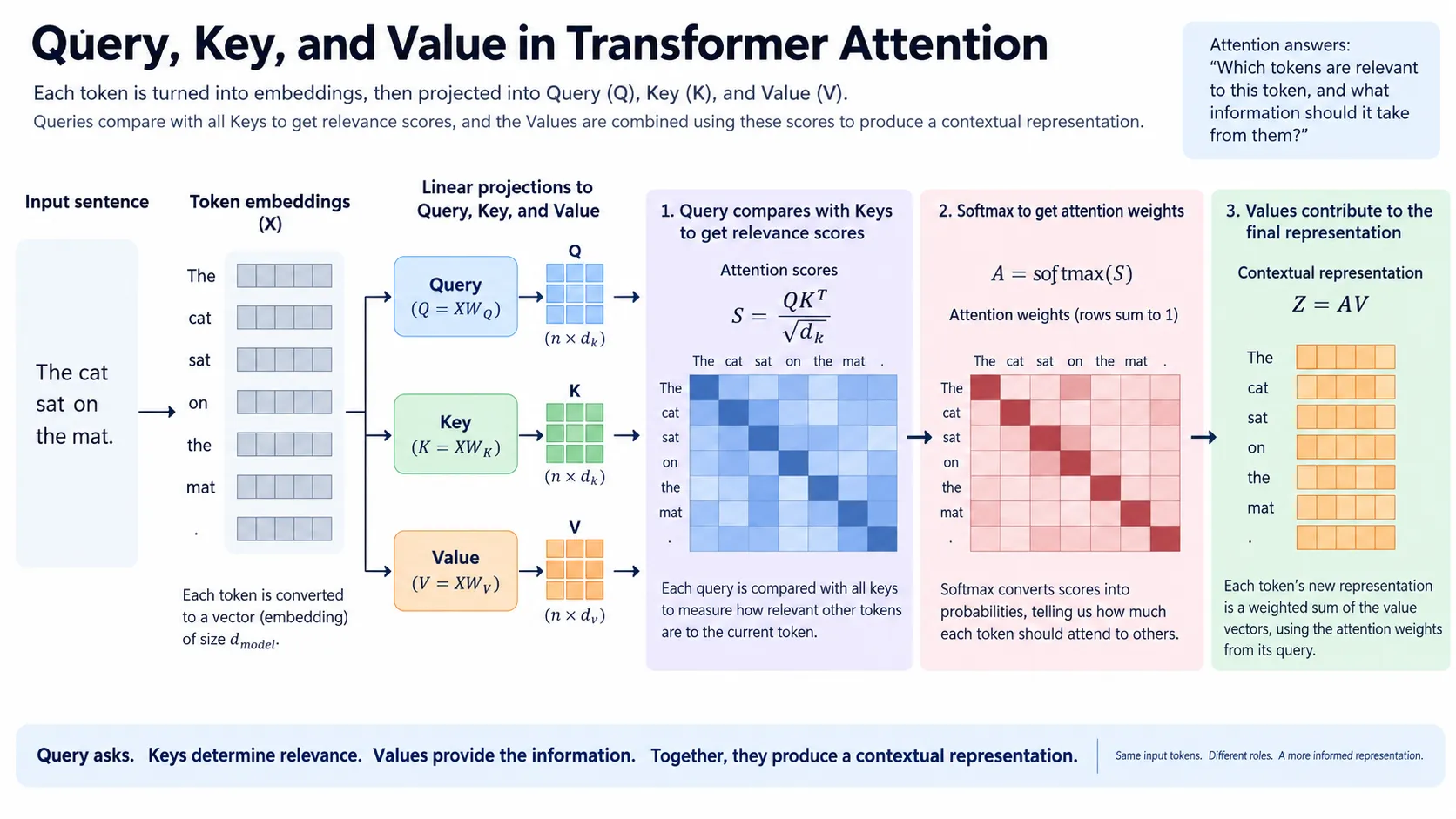
The Query, Key, and Value, often written as Q, K, and V, are mathematical representations created from the input.
Each word in a sentence can produce its own Query, Key, and Value vectors.
Let us understand them conceptually.
What Is a Query?
A Query represents the information the model is currently looking for.
You can think of it as a question.
Suppose we have the sentence:
“The dog chased the ball because it was moving.”
When the model processes the word “it,” it needs to determine what “it” refers to.
The Query representation for “it” can be thought of as asking:
“Which word in this sentence is most relevant to me?”
The model then compares this Query with the Keys of other words.
What Is a Key?
A Key represents information that helps the model determine whether a word is relevant to the Query.
Think of a Key as a label or description attached to each piece of information.
In our sentence:
“The dog chased the ball because it was moving.”
the words “dog,” “ball,” “chased,” and “moving” all have their own Key representations.
The Query from “it” is compared with these Keys.
If the Query and a particular Key are highly compatible, that word may receive a higher attention score.
What Is a Value?
A Value contains the actual information that will be passed forward if a word is considered important.
The Key helps answer:
“Is this word relevant?”
The Value answers:
“What information should I take from this word?”
This distinction is important.
The model first uses Queries and Keys to calculate relevance.
Then it uses the attention scores to combine the Values.
Query, Key, and Value With a Simple Example
Consider the sentence:
“Anita opened the umbrella because the rain was heavy.”
Suppose the model is processing the word “umbrella.”
Its Query may interact with Keys from words such as:
Anita
opened
umbrella
rain
heavy
The model may discover a strong relationship between:
umbrella ↔ rain
This relationship makes sense because umbrellas are strongly associated with rain in this context.
The attention mechanism assigns a larger score to relevant relationships and smaller scores to less useful relationships.
The model then uses those scores to gather information from the corresponding Value vectors.
As a result, the final representation of “umbrella” can contain contextual information about “rain.”
Step 1: Creating Query, Key, and Value Vectors
Transformers do not work directly with raw words.
Words are first converted into numerical representations known as embeddings.
Suppose we have:
“AI understands context.”
Each word is converted into a vector.
Conceptually:
AI → numerical vector
understands → numerical vector
context → numerical vector
These vectors are then transformed using learned weight matrices.
A simplified representation is:
Q = Input × Wq
K = Input × Wk
V = Input × Wv
Here:
Q represents Query
K represents Key
V represents Value
Wq, Wk, and Wv are learned weight matrices
During training, the model learns how these transformations should behave.
The result is that each token obtains different Query, Key, and Value representations.
These weight matrices are learned during training, where techniques such as gradient descent and optimizers help the network gradually improve its parameters.
Step 2: Calculating Attention Scores
Once Queries and Keys are available, the model compares them.
In Transformer models, this comparison commonly involves a dot product.
A simplified formula is:
Attention Score = Query · Key
A larger score generally means stronger relevance.
Imagine the model is processing:
“The teacher explained the lesson because the students were confused.”
While processing “confused,” the model may produce stronger relationships with:
students
lesson
explained
and weaker relationships with less relevant words.
The exact relationships are learned during training rather than manually programmed.
Step 3: Scaling the Attention Scores
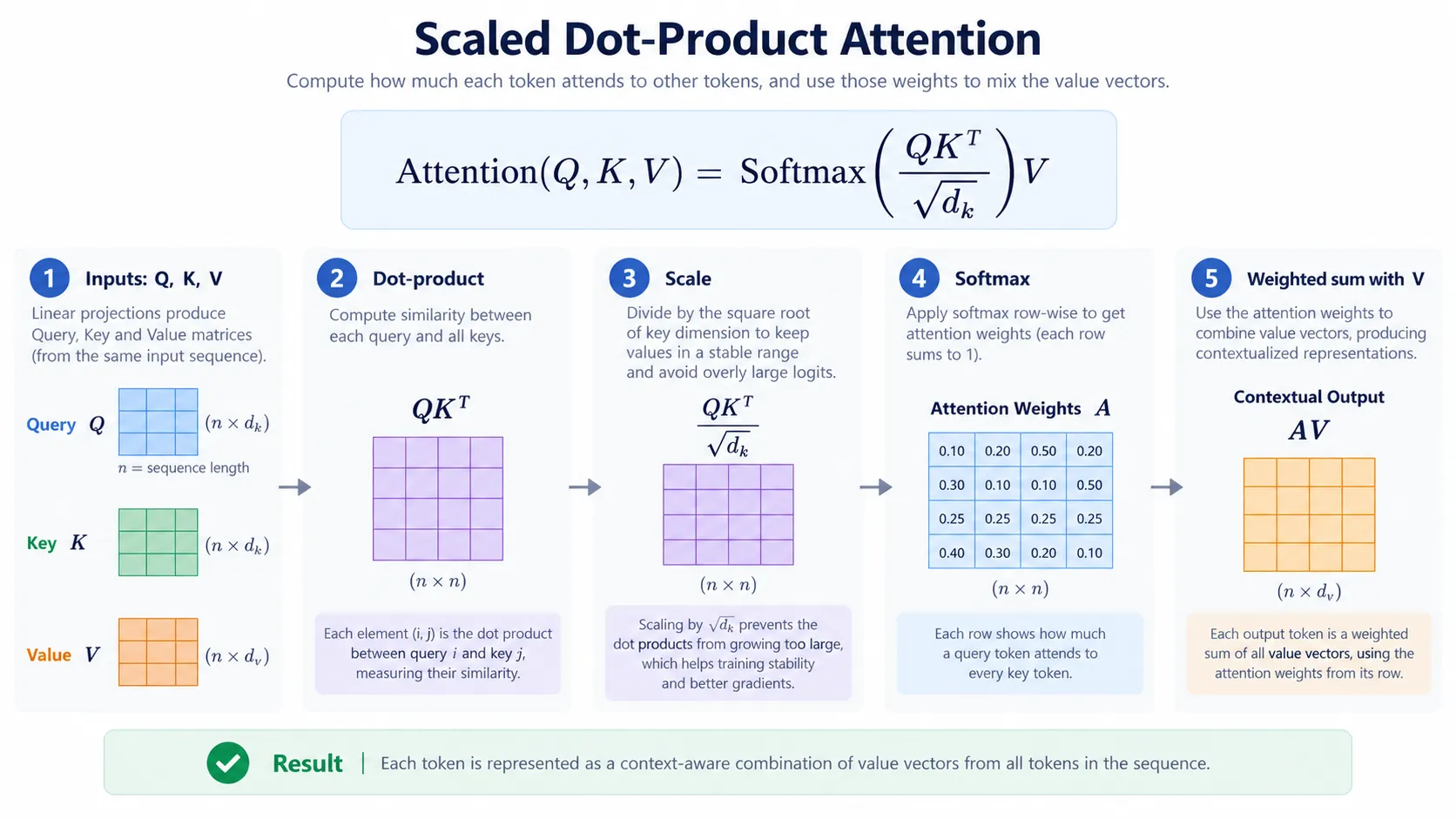
Transformer attention uses a technique called scaled dot-product attention.
Instead of using the raw dot-product score directly, the score is divided by the square root of the Key vector dimension.
The formula is commonly written as:
Score = (QKᵀ) / √dₖ
Here:
Q = Query
K = Key
Kᵀ = Transposed Key matrix
dₖ = Dimension of the Key vectors
Why is scaling necessary?
When vectors become large, dot-product values can also become very large.
Very large values may cause the next step, the Softmax function, to produce extremely sharp probabilities.
Scaling helps keep the values within a more stable numerical range.
Step 4: Applying Softmax
After attention scores are calculated, the model applies the Softmax function.
Softmax converts the raw scores into normalized weights.
The weights generally add up to 1.
For example, imagine the model calculates the following attention values:
WordAttention Weightteacher0.10lesson0.20students0.55confused0.15
The word “students” receives the highest attention weight.
This means it contributes more strongly to the resulting representation.
Softmax therefore turns raw relevance scores into understandable proportions of attention.
Softmax is also an important neural network activation function, and you can explore ReLU, Sigmoid, and Softmax activation functions in more detail in our dedicated guide.
Step 5: Creating the Weighted Sum
After Softmax produces attention weights, those weights are applied to the Value vectors.
Higher-weighted Values contribute more.
Lower-weighted Values contribute less.
The model then combines them into a new representation.
Conceptually:
Output = Attention Weights × Values
Suppose the model assigns:
60% attention to one word
25% attention to another
10% to another
5% to another
The resulting representation contains more information from the word receiving 60% attention.
This process creates a context-aware representation.
The Complete Attention Formula
Putting the main steps together, scaled dot-product attention is commonly written as:
Attention(Q, K, V) = Softmax(QKᵀ / √dₖ)V
At first, this formula may look intimidating.
But it is simply describing the process we already discussed:
Compare Queries with Keys.
Calculate relevance scores.
Scale those scores.
Convert them into normalized weights using Softmax.
Use those weights to combine the Values.
That is the basic attention process.
What Is Self-Attention?
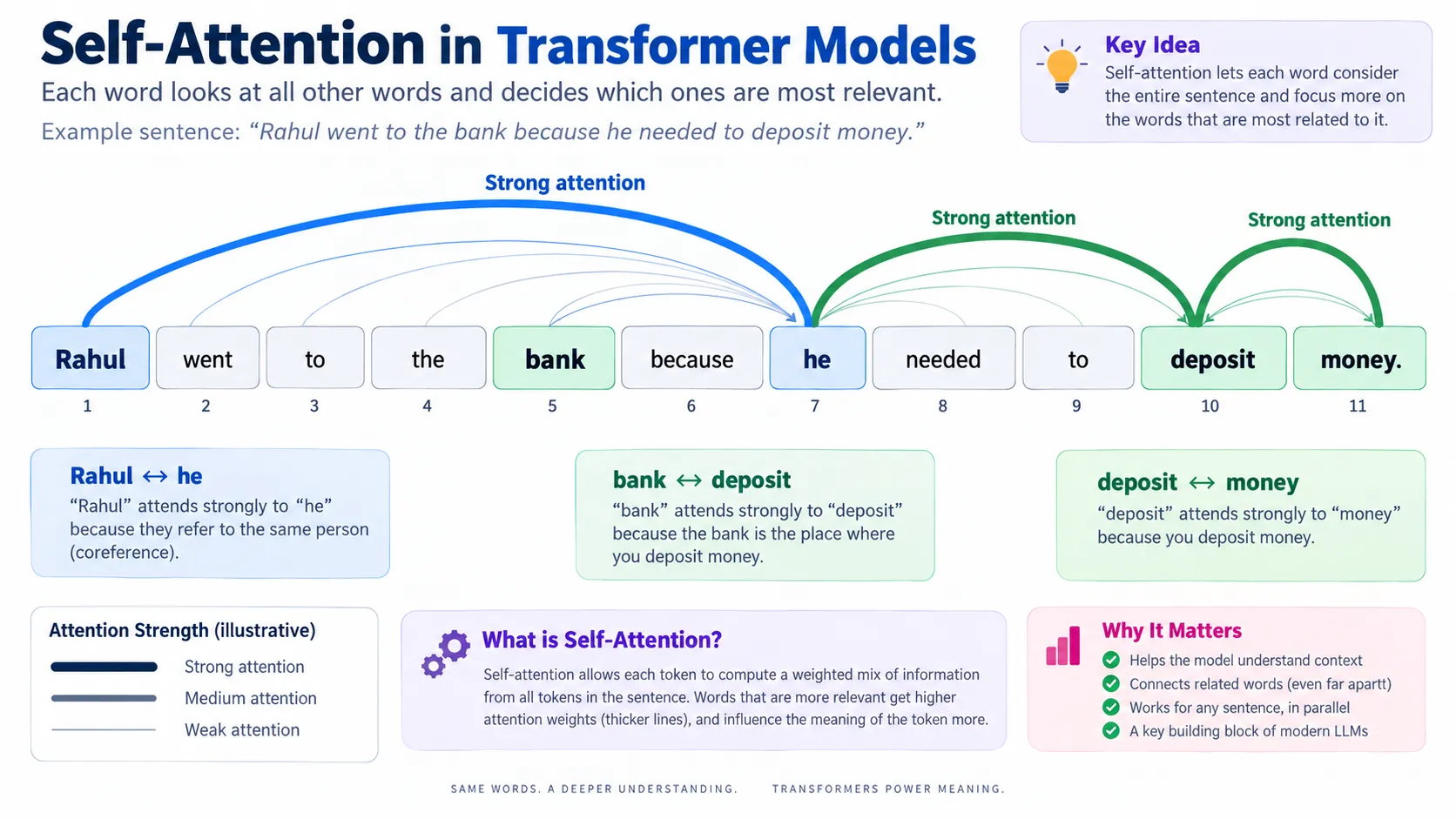
Self-attention is a form of attention where elements inside the same sequence attend to one another.
For example, consider:
“Rahul went to the bank because he needed to deposit money.”
Each word can examine relationships with other words in the same sentence.
The word “bank” may strongly attend to:
deposit
money
This helps the model understand that “bank” refers to a financial institution rather than the side of a river.
Similarly, the word “he” may attend strongly to:
Rahul
This helps the model understand the reference.
The important idea is that every token can gather contextual information from other tokens in the same sequence.
Why Self-Attention Is Powerful
Self-attention provides several major advantages.
First, it helps models understand long-distance relationships.
Consider:
“The book that I bought after visiting several stores last weekend was excellent.”
The word “was” relates back to “book,” even though many words appear between them.
Self-attention can directly model this relationship.
Second, self-attention allows different words to interact without relying entirely on sequential processing.
Traditional RNNs process tokens one after another.
Transformers can analyze many relationships more directly.
Third, self-attention helps create rich contextual representations.
The meaning of a word can change based on surrounding words, and self-attention makes those contextual relationships easier for the model to learn.
Self-Attention vs Traditional Sequence Processing
Traditional recurrent networks pass information step by step through a sequence.
Self-attention takes a different approach.
Instead of asking only:
“What information came before me?”
it can effectively ask:
“Which parts of this sequence are most relevant to me?”
This difference helped Transformers become highly effective for tasks involving large amounts of text.
However, one attention calculation is often not enough.
A sentence can contain many different types of relationships simultaneously.
One relationship may involve grammar.
Another may involve meaning.
Another may involve references between pronouns and nouns.
To capture several types of relationships at the same time, Transformers use another important technique:
Multi-Head Attention.
In the next part, we will explore multi-head attention, positional information, masking, encoder-decoder attention, and how attention works inside the complete Transformer architecture.
What Is Multi-Head Attention?
A single attention mechanism can learn useful relationships between words, but language often contains many different relationships at the same time.
For example, consider this sentence:
“The manager who approved the project told the team that it would start Monday.”
Different parts of the sentence contain different types of information.
The model may need to understand:
who approved the project
who told the team
what “it” refers to
when the project will start
A single attention pattern may not capture all of these relationships effectively.
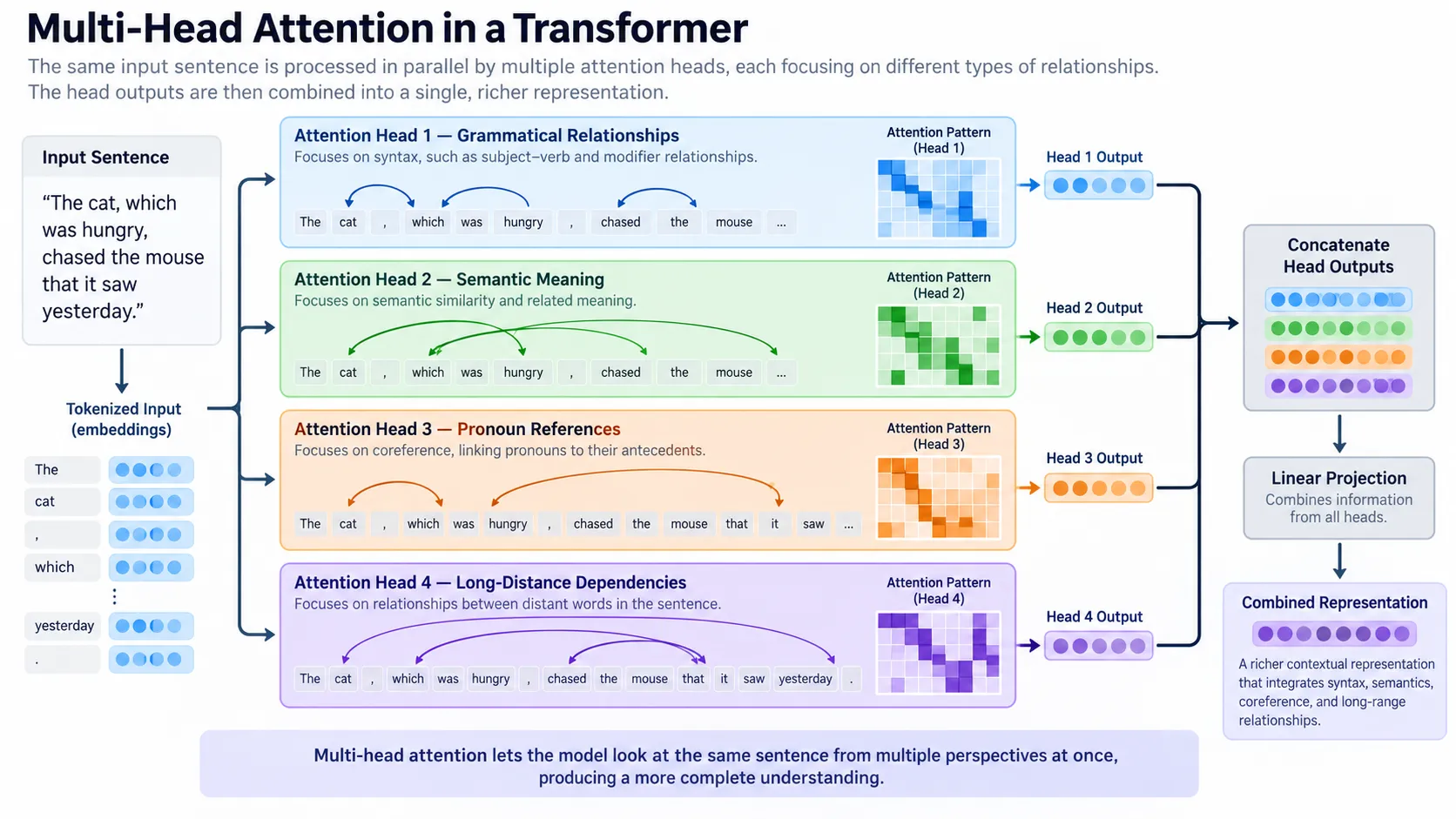
This is why Transformers use multi-head attention.
Multi-head attention allows the model to perform several attention calculations in parallel.
Each attention head can focus on a different type of relationship.
One head may focus on grammatical structure.
Another may focus on subject-object relationships.
Another may focus on long-distance dependencies.
Another may focus on semantic meaning.
The outputs from these attention heads are then combined.
This gives the model a richer understanding of the input.
How Multi-Head Attention Works
Suppose a Transformer uses eight attention heads.
The model does not simply calculate attention once.
Instead, it creates separate Query, Key, and Value projections for each head.
Conceptually:
Head 1 → Q1, K1, V1
Head 2 → Q2, K2, V2
Head 3 → Q3, K3, V3
and so on.
Each head performs its own scaled dot-product attention.
A simplified representation looks like this:
Headᵢ = Attention(Qᵢ, Kᵢ, Vᵢ)
Once all attention heads finish their calculations, their outputs are combined.
This is commonly written as:
MultiHead(Q, K, V) = Concat(head₁, head₂, ... headₕ)Wᵒ
Here:
h represents the number of attention heads
Concat means combining the outputs
Wᵒ is another learned weight matrix
The important point is that multiple heads allow the Transformer to examine the same sentence from several perspectives at once.
A Simple Multi-Head Attention Example
Consider:
“Neha gave the doctor the report because she wanted an explanation.”
Different attention heads may learn different relationships.
One head may connect:
she → Neha
Another may connect:
report → doctor
Another may connect:
explanation → report
These attention patterns are not manually programmed.
The model learns useful relationships during training.
This ability to model several relationships simultaneously is one of the major strengths of Transformer architecture.
Why Transformers Need Positional Information
Attention introduces another challenge.
Unlike RNNs, Transformers do not naturally process words strictly one after another.
That improves parallel processing, but word order is extremely important in language.
Consider:
“The dog chased the cat.”
Now compare it with:
“The cat chased the dog.”
The words are almost identical.
But the meaning is completely different because their positions changed.
Self-attention alone needs a way to know where each token appears in the sequence.
This is why Transformers require some form of positional information.
What Is Positional Encoding?
Positional encoding provides information about the position of each token in a sequence.
Suppose a sentence contains:
AI learns from data
The model needs to distinguish:
AI → Position 1
learns → Position 2
from → Position 3
data → Position 4
In the original Transformer architecture, positional encodings based on sine and cosine functions were added to token embeddings.
Conceptually:
Final Input Representation = Token Embedding + Positional Encoding
This allows the model to understand both:
what the token means
where the token appears
Modern Transformer architectures may use different positional techniques, but the underlying goal remains the same: preserve information about sequence order.
What Is Masked Attention?
Another important variation is masked attention.
Masked attention prevents a token from accessing certain other tokens.
This is particularly useful during text generation.
Imagine a model is learning from the sentence:
“Machine learning is changing technology.”
While predicting the word “changing,” the model should not be allowed to look ahead and directly see the answer.
It should only use information that comes before that position.
For example:
Machine → visible
learning → visible
is → visible
changing → being predicted
technology → hidden
A mask is applied to block future tokens.
This is often called causal attention or causal masking.
Why Causal Masking Matters
Without causal masking, a language model could cheat during training.
If the model could see future words while predicting the current word, the learning objective would no longer match real text generation.
During actual generation, the future does not exist yet.
If the model has generated:
“Artificial intelligence can”
it must predict what comes next using only the tokens already available.
Therefore, causal masking ensures that training behaves more like real autoregressive generation.
This technique is especially important in decoder-style language models.
What Is Cross-Attention?
Self-attention compares tokens within the same sequence.
Cross-attention, on the other hand, allows one sequence to attend to information from another sequence or representation.
A classic example is machine translation.
Suppose the input is:
“How are you?”
and the model needs to generate the French translation.
The decoder generating the French sentence can use cross-attention to examine relevant representations from the English input.
In this setup:
Queries may come from the decoder
Keys come from the encoder
Values come from the encoder
The decoder can therefore ask:
“Which parts of the source sentence are relevant to the word I am generating now?”
This makes cross-attention extremely useful for tasks where one input must guide the generation of another output.
Self-Attention vs Cross-Attention
The difference is simple.
Self-attention:
Tokens attend to other tokens inside the same sequence.
Example:
A sentence analyzes relationships among its own words.
Cross-attention:
One sequence attends to information from another sequence.
Example:
A translated sentence attends to representations of the original sentence.
Both techniques use the same general Query-Key-Value idea, but the source of Q, K, and V can differ.
How Attention Works Inside a Transformer
Let us now connect everything together.
Suppose the input is:
“The customer returned the phone because the screen was damaged.”
First, the sentence is divided into tokens.
Each token is converted into an embedding.
Positional information is then added so the model understands token order.
Next, self-attention allows every token to examine relevant relationships with other tokens.
For example:
screen → damaged
phone → screen
returned → phone
The attention outputs then pass through additional neural network layers.
Transformers usually include components such as:
multi-head attention
feed-forward neural networks
residual connections
layer normalization
These operations are repeated across multiple Transformer layers.
As information passes through deeper layers, the model can learn increasingly complex representations.
In practical deep learning projects, Transformer and attention-based models are commonly implemented using frameworks such as PyTorch and TensorFlow.
A Simplified Transformer Attention Flow
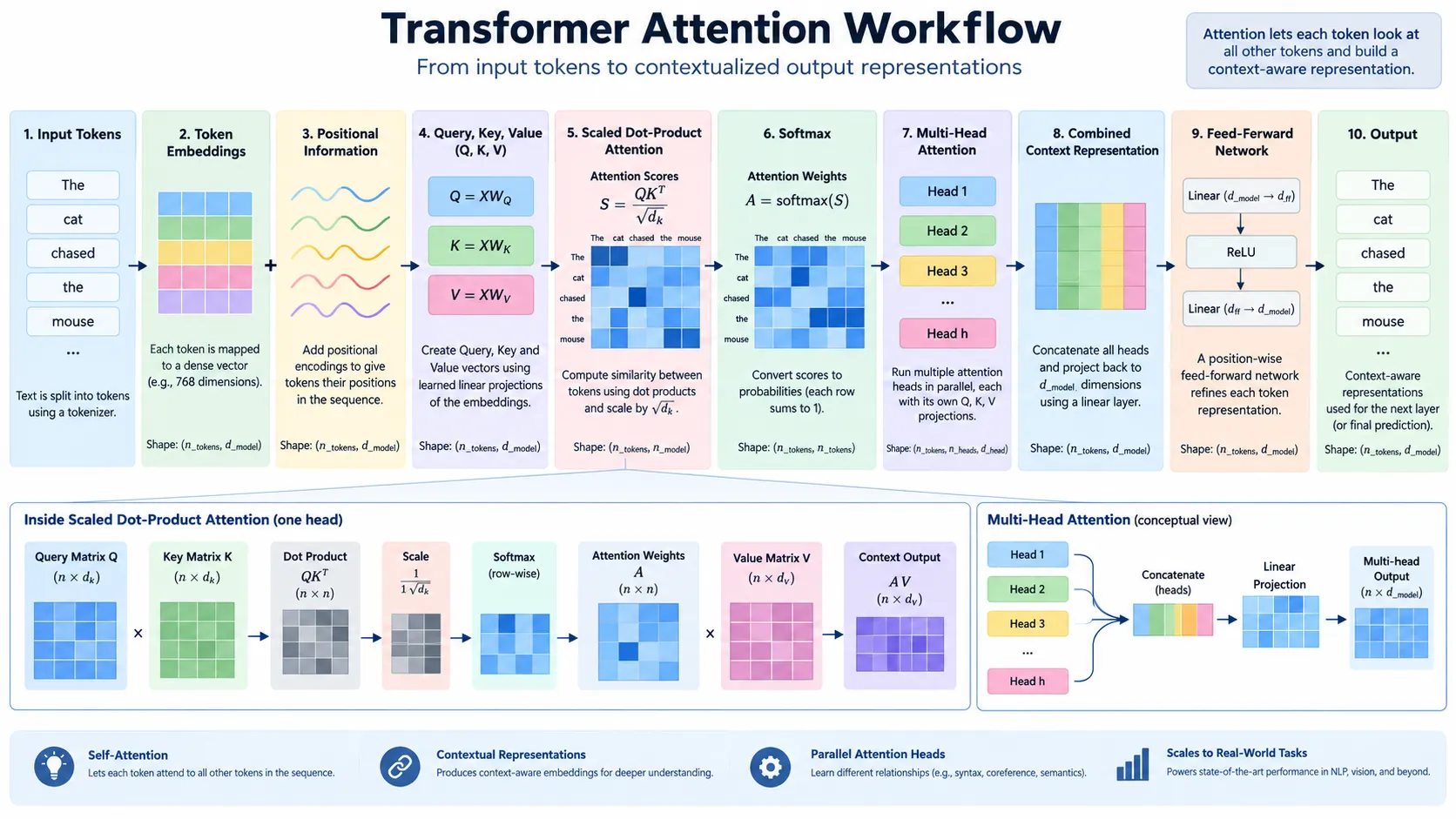
The complete process can be understood like this:
Step 1: Convert tokens into embeddings.
Step 2: Add positional information.
Step 3: Create Query, Key, and Value vectors.
Step 4: Compare Queries with Keys.
Step 5: Scale the attention scores.
Step 6: Apply Softmax.
Step 7: Combine Value vectors using attention weights.
Step 8: Repeat the process across multiple attention heads.
Step 9: Combine the outputs of all attention heads.
Step 10: Pass the result through the remaining Transformer layers.
This process happens repeatedly throughout the network.
Why Attention Changed Modern AI
Attention solved several limitations that made earlier sequence models difficult to scale.
It improved the ability of models to capture long-range relationships.
It also made parallel computation more practical compared with strictly sequential recurrent architectures.
Most importantly, attention allowed models to construct highly contextual representations.
A word is no longer understood only from its isolated meaning.
Its representation can depend on many other relevant tokens.
This principle became the foundation of modern Transformer-based systems used for:
text generation
translation
summarization
question answering
code generation
document understanding
speech processing
multimodal AI
Attention does not mean that a model understands language exactly like a human.
It is a mathematical mechanism for calculating useful relationships between representations.
Even so, this mechanism has proven powerful enough to become one of the central building blocks of modern artificial intelligence.
In the final section, we will cover the major advantages and limitations of attention, practical use cases, common beginner questions, and an easy summary of the entire mechanism.
During training, the model also needs a way to measure how far its predictions are from the expected output, which is where loss functions become important.
Advantages of the Attention Mechanism
The attention mechanism became one of the most important ideas in modern deep learning because it gives models a flexible way to identify relationships between different parts of the input.
Better Understanding of Long-Range Relationships
One major advantage of attention is its ability to connect words that appear far apart in a sentence.
Consider:
“The laptop that John purchased during his trip to Singapore stopped working yesterday.”
The word “stopped” is strongly connected to “laptop,” even though several words appear between them.
Self-attention can directly model this relationship instead of relying only on information being passed step by step through a sequence.
Context-Aware Word Representations
Attention also helps AI models understand words according to their context.
Take the word “bat.”
In:
“The player hit the ball with a bat.”
the word refers to sports equipment.
But in:
“A bat flew out of the cave.”
the same word refers to an animal.
Attention allows surrounding words such as “player,” “ball,” “flew,” and “cave” to influence the representation of “bat.”
This makes the model better at understanding contextual meaning.
Supports Parallel Processing
Traditional recurrent architectures such as RNNs usually process sequences step by step.
Transformers can process many token relationships in parallel during training.
This makes Transformer-based models more suitable for large-scale training on modern hardware.
Multiple Relationships Can Be Learned
With multi-head attention, a Transformer can examine different relationships simultaneously.
One attention head may learn grammatical relationships while another captures semantic connections or long-distance dependencies.
This gives the model a richer representation of the input.
Limitations of the Attention Mechanism
Although attention is powerful, it is not perfect.
High Computational Cost
Standard self-attention compares tokens with other tokens in the sequence.
As sequence length increases, the number of token-to-token comparisons can grow quickly.
This makes processing very long documents computationally expensive.
For example, analyzing a short sentence is relatively simple.
Analyzing thousands of tokens requires substantially more computation and memory.
Researchers have developed many techniques to make attention more efficient, especially for long-context applications.
Attention Does Not Equal Human Understanding
Attention scores indicate relationships between internal representations.
They should not automatically be interpreted as proof that an AI model understands information exactly as humans do.
A model may produce convincing text while still making factual or logical mistakes.
Attention is therefore better understood as a mathematical mechanism for information routing and contextual representation.
Training Requires Large Computational Resources
Large Transformer models may contain millions or billions of parameters.
Training such systems can require:
large datasets
powerful GPUs or specialized accelerators
significant memory
substantial computing resources
Attention is only one part of this cost, but it is an important component of Transformer computation.
Choosing suitable model settings can also affect training efficiency and performance, which is why hyperparameter tuning is an important part of building effective deep learning systems.
Real-World Applications of Attention
Attention mechanisms are used across many areas of artificial intelligence.
Machine Translation
Attention became especially influential in machine translation.
When translating a sentence, the model can focus on the most relevant source words while generating each output word.
For example:
English: “I am learning machine learning.”
While generating a translation, the model can align different parts of the source sentence with relevant output tokens.
Text Summarization
Summarization systems need to identify the most important information inside long documents.
Attention helps the model focus on relevant sentences, concepts, and relationships while generating a shorter summary.
Question Answering
Suppose an AI receives a long passage and the question:
“Who founded the company?”
The system does not need every word equally.
Attention helps it identify the parts of the passage that are most relevant to the question.
Conversational AI
Modern conversational systems rely heavily on Transformer architectures.
Attention helps the model connect information across a conversation, interpret relationships between words, and generate contextually appropriate responses.
Code Generation
Programming languages also contain long-range relationships.
A variable may be defined in one part of a program and used much later.
Attention helps code models capture relationships between:
variables
functions
classes
parameters
code blocks
Computer Vision
Attention is not limited to text.
Vision Transformers can divide images into patches and learn relationships between different parts of an image.
For example, a model may connect visual information from different areas to recognize an object or understand a scene.
Multimodal AI
Modern AI systems may work with several types of information simultaneously, including:
text
images
audio
video
Attention can help these systems learn relationships across different modalities.
For example, a multimodal model may connect a written description with relevant regions inside an image.
Attention Mechanism vs Self-Attention
Beginners often confuse these two terms.
The attention mechanism is the broader concept of assigning different importance to different pieces of information.
Self-attention is a specific type of attention where elements within the same sequence attend to one another.
For example:
Attention: A decoder examines relevant information from an encoder.
Self-attention: Words inside the same sentence examine relationships with other words in that sentence.
Therefore:
Self-attention is a type of attention mechanism.
Attention Mechanism vs Multi-Head Attention
Standard attention calculates one set of attention relationships.
Multi-head attention performs several attention operations in parallel.
This allows different heads to potentially capture different patterns.
In simple terms:
Attention = One perspective
Multi-head attention = Multiple learned perspectives
The outputs from those heads are combined before being passed deeper into the Transformer.
Attention Mechanism Explained in Simple Words
If you remember only one idea from this guide, remember this:
Attention helps an AI model decide which information matters most for the current calculation.
For a sentence such as:
“The child dropped the glass because it was slippery.”
the model does not need to treat every word as equally important.
While processing one token, it can calculate relationships with other tokens and assign stronger weights to useful information.
Queries describe what the model is looking for.
Keys help determine which information is relevant.
Values contain the information that can be passed forward.
Softmax converts attention scores into normalized weights.
Self-attention allows tokens in the same sequence to interact.
Multi-head attention allows several sets of relationships to be learned simultaneously.
Together, these ideas form one of the key foundations of Transformer architecture.
Training deep neural networks also involves techniques for improving stability and controlling overfitting, including methods such as batch normalization and dropout.
Conclusion
The attention mechanism changed the way neural networks process sequences.
Earlier sequence models often depended heavily on information being carried from one step to the next. Attention gave models a more direct way to identify relevant relationships across a sequence.
The core process can be summarized simply:
Query → Key comparison → Attention scores → Softmax → Weighted Values → Contextual representation
Transformer models build on this idea using self-attention, multi-head attention, positional information, masking, and multiple neural network layers.
Understanding attention is therefore one of the most important steps toward understanding modern Transformer-based AI systems.
Once Query, Key, Value, self-attention, and multi-head attention make sense, the broader Transformer architecture becomes much easier to understand.
Frequently Asked Questions About Attention Mechanism
What is an attention mechanism in deep learning?
An attention mechanism is a technique that allows a neural network to assign different levels of importance to different parts of its input. Instead of treating every token equally, the model calculates which information is most relevant to the current computation.
How does the attention mechanism work?
The attention mechanism typically creates Query, Key, and Value representations. Queries are compared with Keys to calculate attention scores. These scores are normalized using Softmax and then used to create a weighted combination of the Value vectors.
What are Query, Key, and Value in attention?
A Query represents what the model is looking for. A Key helps determine whether a piece of information is relevant to that Query. A Value contains the information that is passed forward according to the calculated attention weight.
What is self-attention?
Self-attention is a type of attention where tokens inside the same sequence calculate relationships with one another. This allows each token to build a contextual representation using information from other relevant tokens in the sequence.
What is the difference between attention and self-attention?
Attention is the general mechanism of assigning importance to information. Self-attention specifically refers to attention occurring among elements of the same sequence.
What is multi-head attention?
Multi-head attention runs several attention operations in parallel. Each attention head can learn different types of relationships, and their outputs are later combined into a richer representation.
Why is Softmax used in attention?
Softmax converts raw attention scores into normalized weights. These weights help determine how strongly different Value vectors should contribute to the final contextual representation.
Why do Transformers use attention?
Transformers use attention because it helps them model relationships between tokens, capture long-distance dependencies, create contextual representations, and process sequences efficiently during training.
Is attention used only in NLP?
No. Attention is also used in computer vision, speech processing, multimodal AI, code generation, recommendation systems, and other machine learning applications.
What is the main limitation of self-attention?
Standard self-attention can become computationally expensive for very long sequences because it calculates relationships between many pairs of tokens. This increases memory and computational requirements as the sequence becomes longer.


