


Think about the last time your phone unlocked just by looking at your face. Or when YouTube suggested a video you actually wanted to watch. Maybe you spoke to a voice assistant and it understood you without typing a single word.
These things may feel normal today, but behind many of them is a powerful technology called deep learning.
If the term sounds complicated, do not worry. You do not need advanced math or years of coding experience to understand the main idea. In simple words, deep learning is a way of teaching computers to learn patterns from large amounts of data. Instead of giving a computer a long list of fixed rules, we show it many examples and allow it to improve through training.

What Is Deep Learning?
Deep learning is a part of machine learning that uses artificial neural networks with multiple layers to learn from data.
Imagine you want to teach a child to recognize a dog. You probably would not explain every possible rule about ears, fur, tail length, body shape, and size. You would show the child many dogs. Over time, the child starts noticing common patterns and becomes better at recognizing dogs they have never seen before.
Deep learning works in a similar way.
A deep learning model can be shown thousands or even millions of examples. During training, it looks for useful patterns in those examples. The model then uses what it has learned to make a prediction when new data arrives.
For example, an image recognition model might learn that certain combinations of shapes, edges, and textures are often connected with a cat. When it sees a new photo, it can estimate whether the image contains a cat, even if that exact photo was never part of its training data.
Modern neural networks are built from layers of connected units, often called neurons or nodes. Layers between the input and output are called hidden layers, and adding more layers allows a network to learn more complex patterns.
Deep Learning vs Machine Learning vs Artificial Intelligence
Beginners often get confused because artificial intelligence, machine learning, and deep learning are sometimes used as if they mean the same thing. They are connected, but they are not identical.
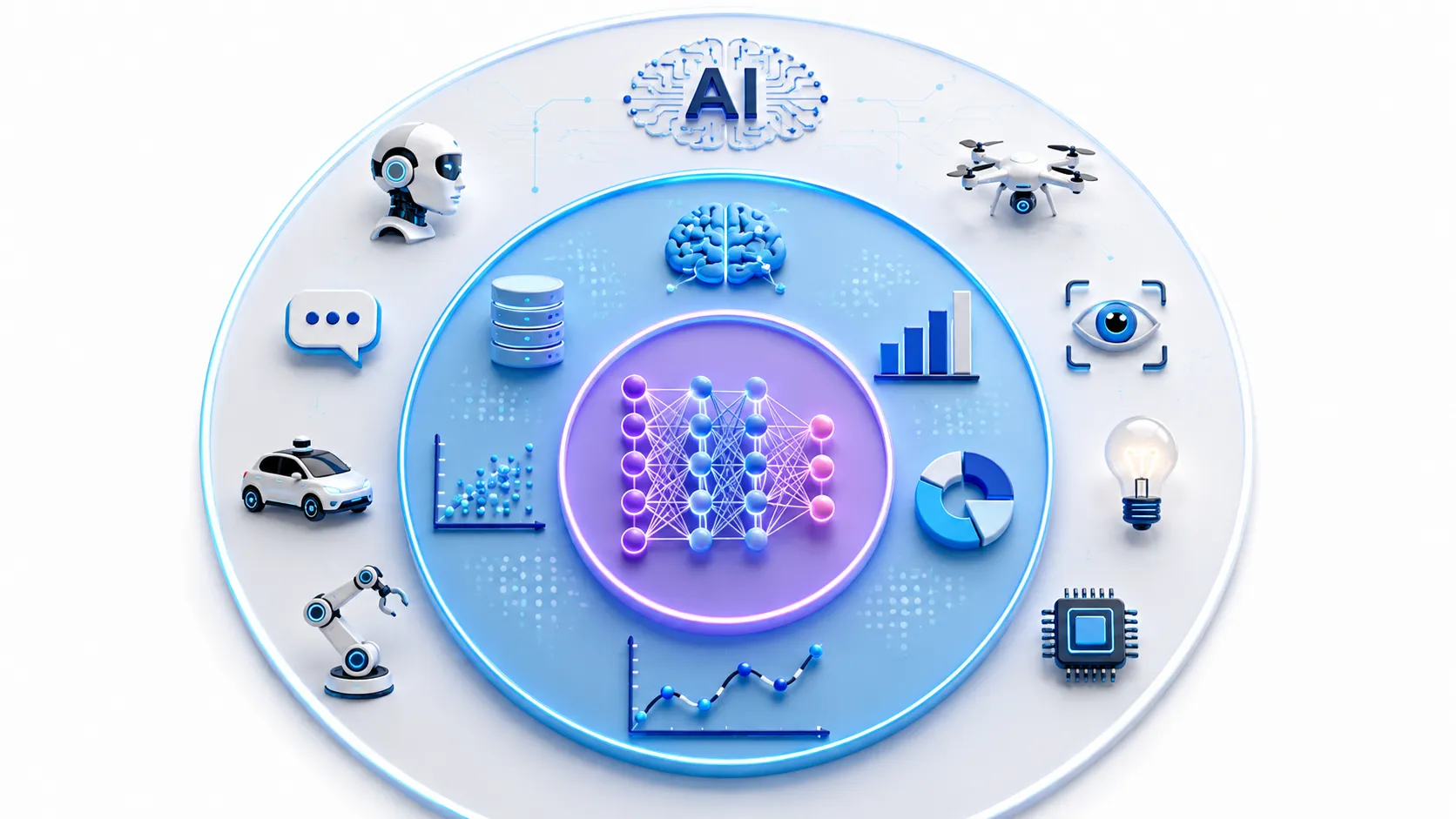
Artificial Intelligence (AI) is the broad field of building computer systems that can perform tasks we connect with human intelligence, such as understanding language, recognizing objects, making predictions, or solving problems.
Inside AI, we have machine learning. Machine learning allows a system to learn patterns from data instead of depending only on rules written manually by a programmer.
Inside machine learning, we have deep learning. Deep learning uses multi-layer neural networks to learn complex patterns, especially from images, audio, video, and large amounts of text.
A simple way to remember it is:
AI is the big field → Machine Learning is a part of AI → Deep Learning is a part of Machine Learning.
Why Is It Called “Deep” Learning?
The word “deep” does not mean the computer is thinking deeply like a human. It refers to the number of layers used inside a neural network.
A simple neural network may have an input layer, one hidden layer, and an output layer. A deep neural network has multiple hidden layers between the input and final output.
Each layer can learn a different level of information.
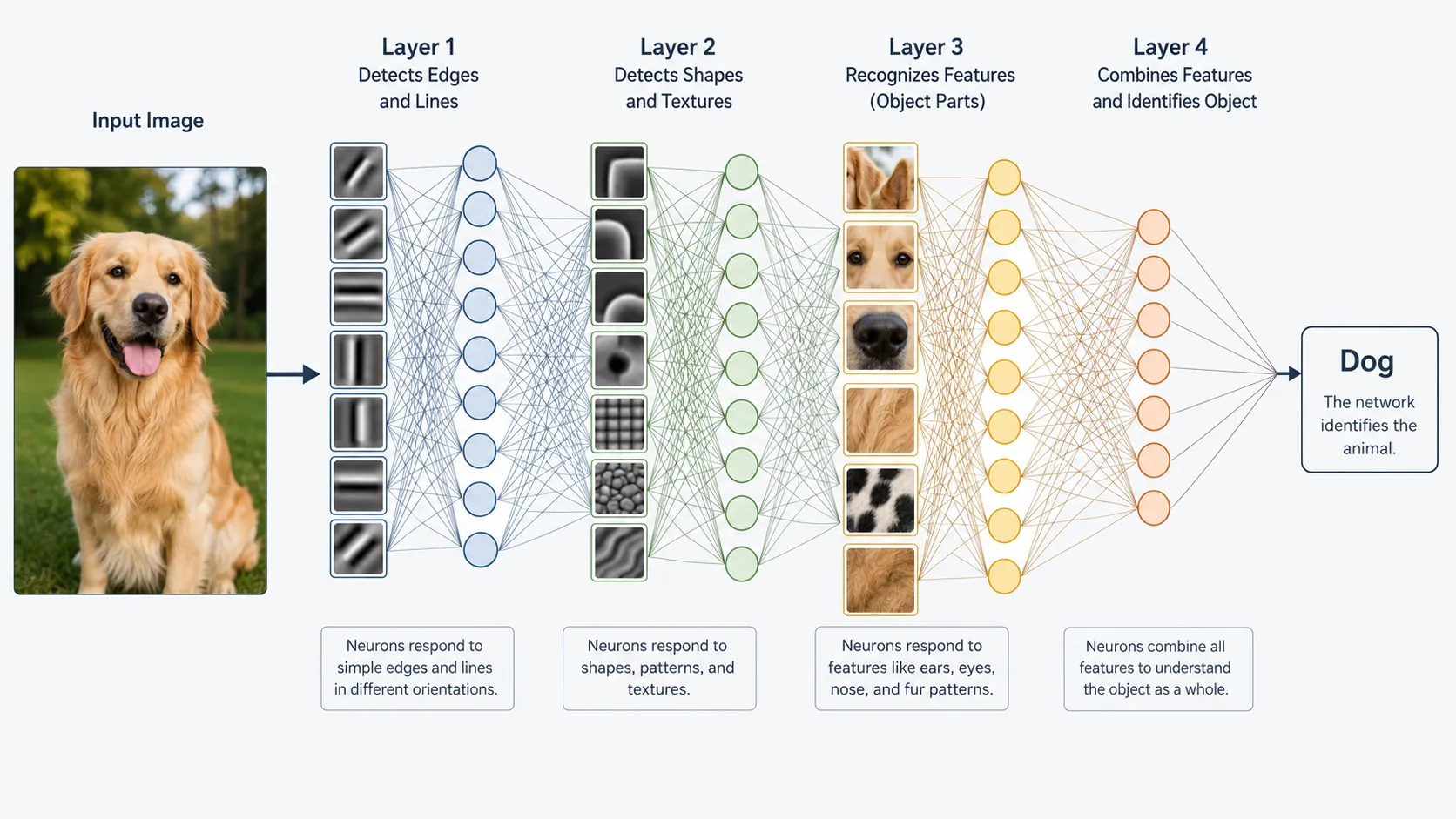
Imagine a deep learning system learning to recognize a face in a photo. An early layer may respond to simple edges and lines. A later layer may learn patterns related to eyes, noses, or face shapes. Deeper layers can combine those smaller patterns into more useful information for the final prediction.
Google's machine learning material describes hidden layers as the layers between the input and output, while frameworks such as PyTorch organize neural networks as connected layers or modules that perform operations on data.
A Simple Real-Life Example: Teaching a Computer to Recognize Shoes
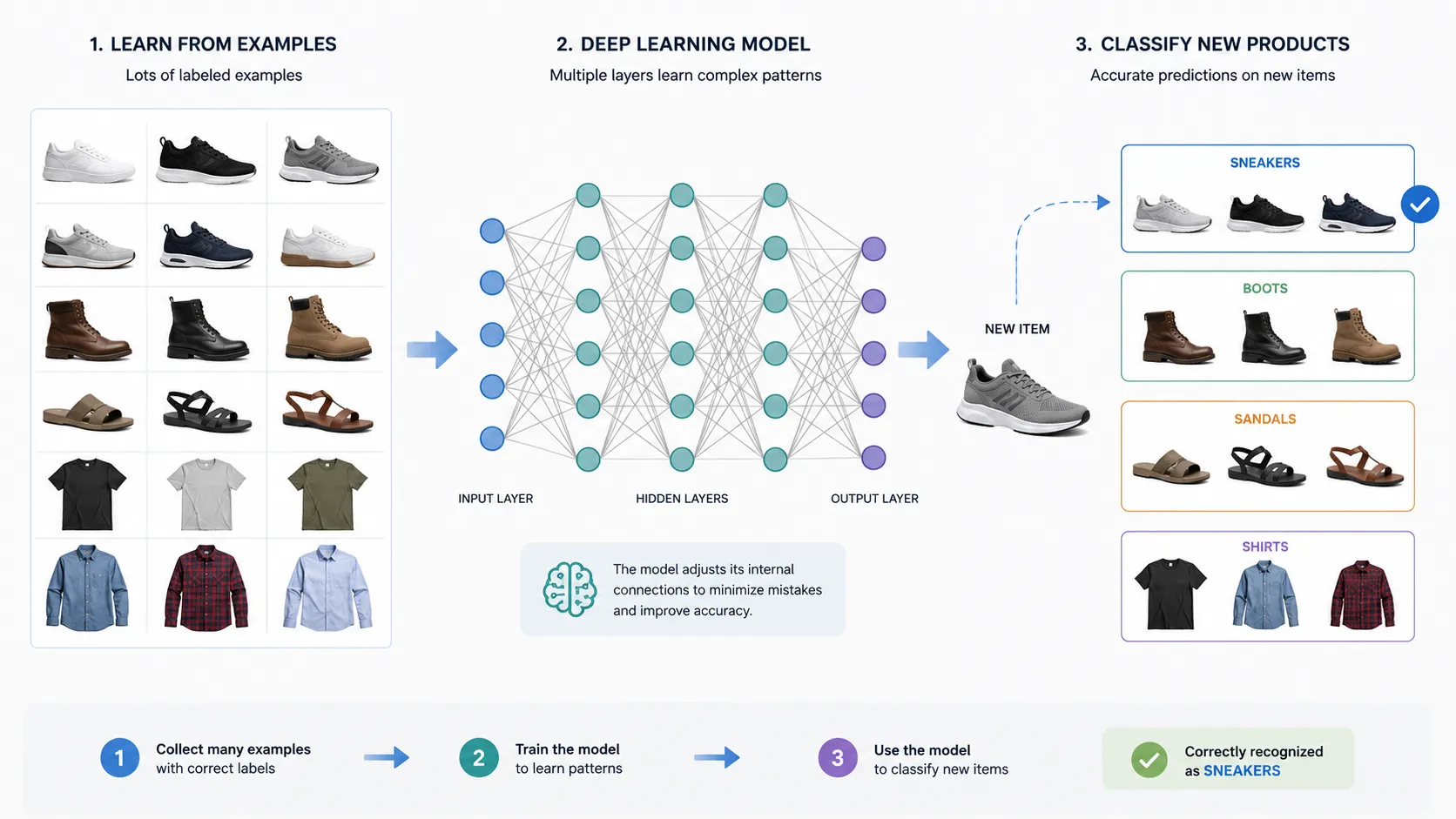
Suppose you are building an online shopping app and want the system to tell whether an uploaded image shows a sneaker, sandal, boot, or shirt.
With a rule-based approach, you might write a rule such as:
“If the object has a sole and laces, it may be a sneaker.”
But real images are messy. Shoes appear from different angles. Lighting changes. Colors vary. Sometimes the laces are not visible.
A deep learning model takes another approach.
You give it many labeled images. Each image has the correct answer, such as “sneaker,” “boot,” or “shirt.” The model makes a prediction, compares it with the correct answer, measures the error, and adjusts its internal weights. This process repeats many times.
Little by little, the model becomes better at finding useful visual patterns.
TensorFlow's beginner tutorials use this same general flow: load example data, build a neural network, train it, and evaluate how well it classifies images.
Where Do You Already Use Deep Learning?
You may already interact with deep learning applications every day.
Face recognition uses visual patterns. Speech-to-text works with audio and language patterns. Recommendation systems can study activity and other signals to predict which video, song, product, or post may interest a user.
Deep learning is also used in areas such as image classification, natural language processing, recommendation systems, fraud detection, medical imaging research, and autonomous driving research.
The key point is that deep learning is not magic. It is a trainable system. Its performance depends on the data, model design, training process, evaluation, and the problem being solved.
Once you understand that idea, the rest becomes easier:
Data goes in, the neural network learns patterns through training, and the trained model uses those patterns to make predictions.
How Does Deep Learning Work?
Now we know what deep learning is. But the more interesting question is: how does deep learning actually learn?
A computer does not look at a photo the way you do. If you see a picture of a dog, you instantly notice the face, ears, fur, legs, and shape. A computer receives numerical data.
Deep learning helps the computer turn that raw data into useful patterns.
The easiest way to understand the process is to follow one simple example.
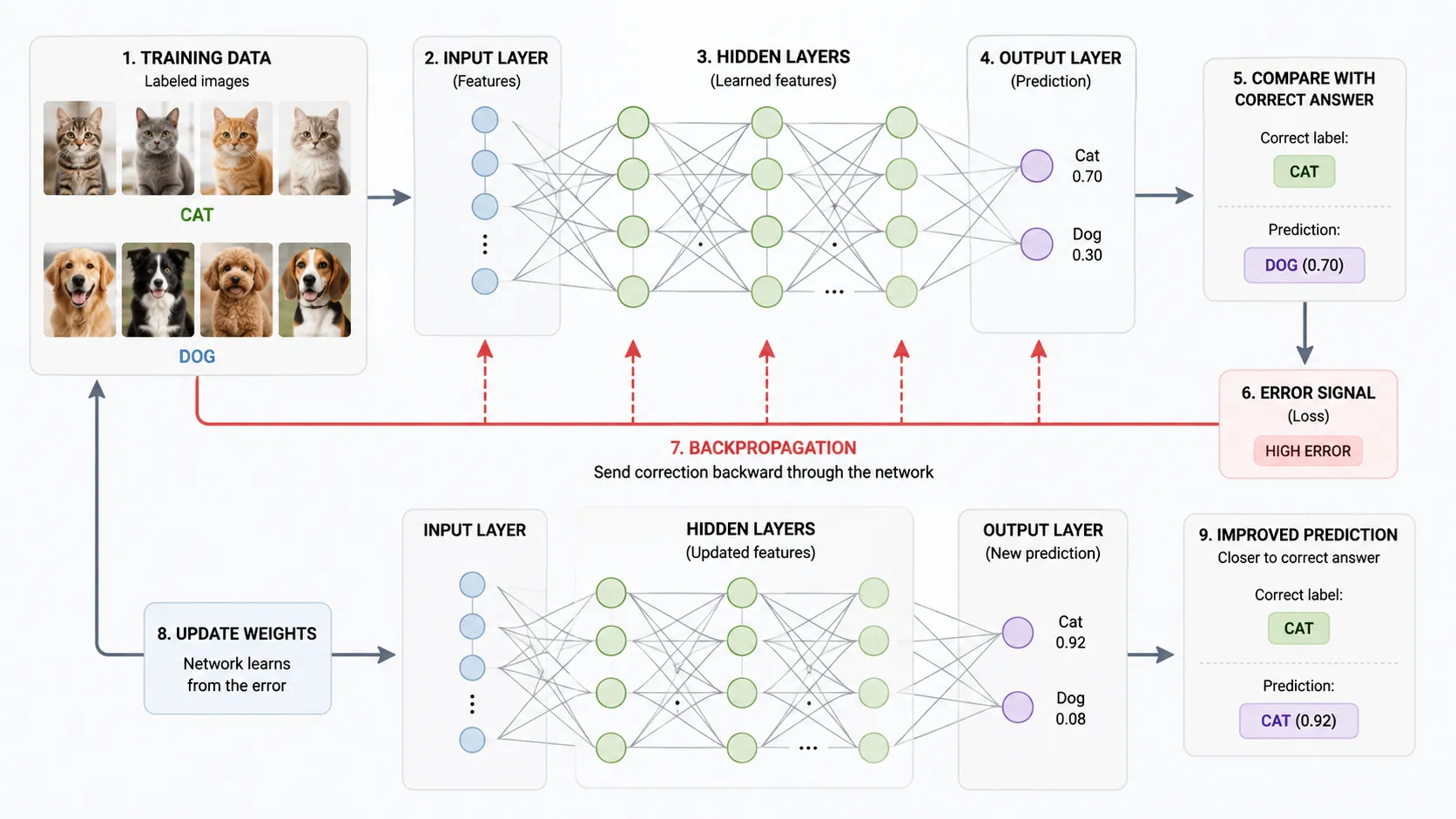
Imagine we want to build a system that can look at a photo and decide whether it contains a cat or a dog.
The learning process would look something like this.
Step 1: Give the Model Training Data
The first thing a deep learning model needs is data.
We may collect thousands of images of cats and dogs. Each image has a correct label.
A cat photo is labeled “cat.”
A dog photo is labeled “dog.”
These examples become the model's training data.
During training, the neural network sees these examples again and again and tries to understand which patterns are useful for separating cats from dogs.
This is one reason data quality matters so much.
If many images are wrongly labeled, unclear, duplicated, or unrelated to the task, the model may learn the wrong patterns.
Think of it like preparing for an exam using incorrect notes. Studying more hours does not solve the problem if the learning material itself is wrong.
Step 2: Data Enters the Input Layer
The first part of a neural network is called the input layer.
This is where information enters the model.
For an image, the input may come from pixel values. For audio, it may come from numerical representations of sound. For text, words or pieces of words can first be converted into numerical representations that a model can process.
The important idea is simple:
Neural networks work with numbers.
The input layer receives those numbers and passes information forward through the network.
Step 3: Hidden Layers Search for Patterns
After the input layer, information moves through one or more hidden layers.
This is where much of the learning happens.
Suppose our neural network is looking at a dog photo.
One early layer might become useful for detecting simple visual patterns such as edges.
Another layer may combine those patterns into more useful shapes.
Later layers can use combinations of earlier signals to help identify more complex features that matter for the final prediction.
This layered processing is one of the key ideas behind deep neural networks. Multiple hidden layers allow the network to model nonlinear and increasingly complex relationships in data.
What Are Weights and Biases?
Connections inside a neural network have adjustable values called weights.
You can think of a weight as a way of telling the model:
“How important is this signal?”
Suppose one pattern is very useful when recognizing a dog. During training, the network may adjust its internal values so that this pattern has a stronger effect on the final prediction.
Another internal value called a bias helps neurons adjust when they become active.
You do not need to memorize the mathematics yet.
For a beginner, remember this:
Weights and biases are values the neural network changes while learning.
Training a neural network is largely about finding better values for these parameters.
What Is an Activation Function?
If neural networks only performed simple linear calculations across many layers, adding more layers would not provide the expressive power we normally want from deep networks.
That is where activation functions help.
An activation function transforms the signal produced by a neuron and introduces nonlinearity into the network.
One commonly used activation function is ReLU, short for Rectified Linear Unit. Other activation functions include sigmoid and tanh.
You do not need to calculate them manually to understand deep learning.
Just remember:
Activation functions help neural networks learn more complex patterns instead of behaving like one large simple linear calculation.
Step 4: The Model Makes Its First Prediction
At first, our model has not learned much.
We show it a dog image.
The network processes the image through its layers and may produce something like:
Cat: 70%
Dog: 30%
But the correct answer is dog.
So the prediction is poor.
This mistake is actually useful because the model now has information it can use to improve.
Step 5: Measure the Mistake With a Loss Function
The model needs a way to measure how far its prediction is from the correct answer.
That is the job of a loss function.
A larger loss generally means the model's prediction is further from the target according to the chosen loss function. Training aims to reduce this loss over many examples.
Think of loss like a score showing the model how wrong its current prediction is.
The objective is not simply to memorize every training example. The real goal is to learn patterns that also work well on new, unseen data.
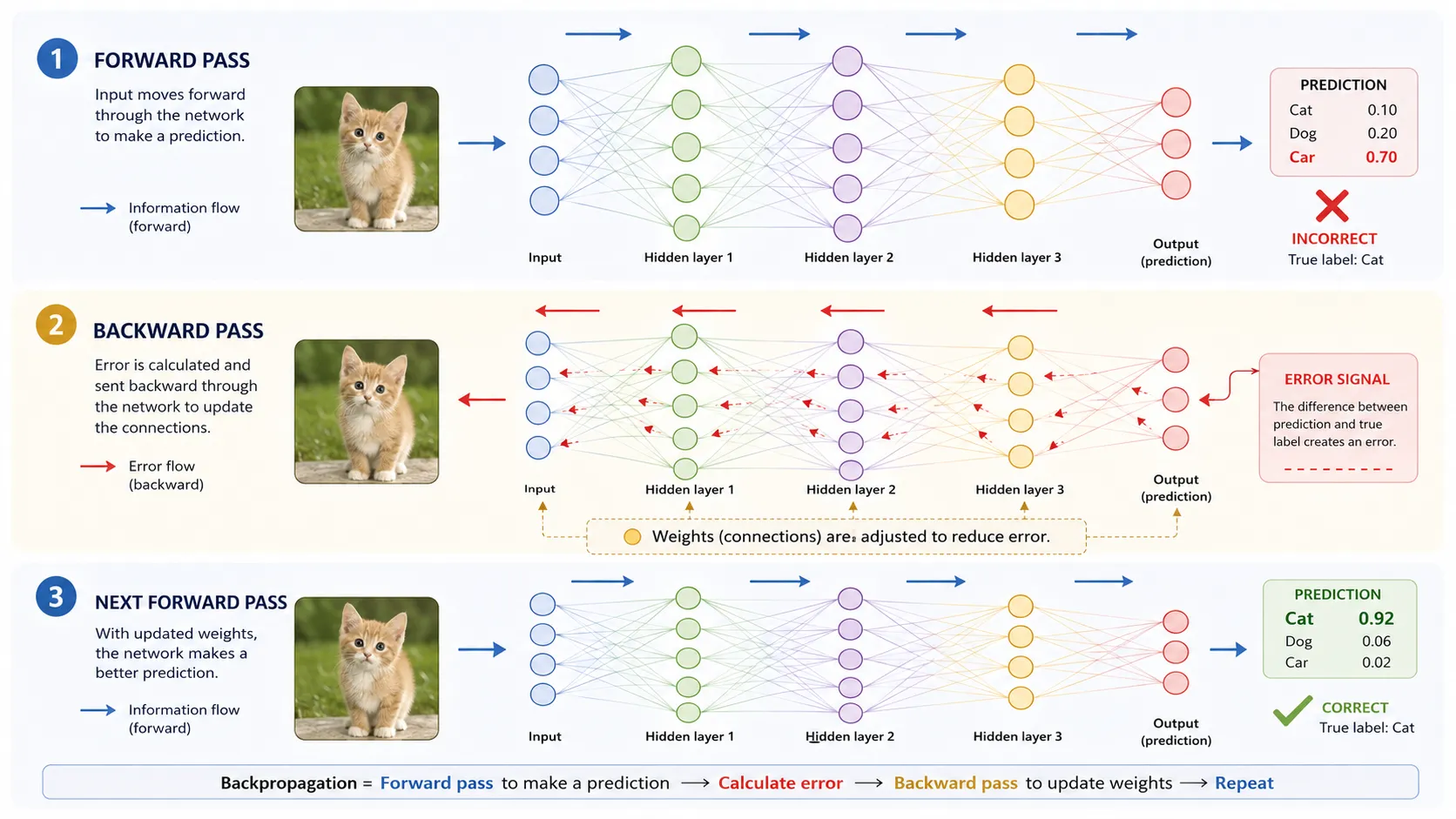
Step 6: Backpropagation Finds What Needs to Change
Now we reach one of the most important ideas in deep learning training: backpropagation.
After calculating the loss, the training process works backward through the network to calculate how different parameters contributed to that error.
Those signals are called gradients.
Backpropagation makes it practical to calculate these gradients across multi-layer neural networks. Modern libraries normally handle these calculations automatically.
A beginner-friendly way to imagine it is this:
You take a practice test and get several answers wrong.
You do not simply say, “My score was bad.”
You check which answers were wrong, understand where the mistakes happened, and change how you prepare for the next attempt.
Backpropagation plays a similar role during neural network training.
Step 7: The Optimizer Updates the Model
Once the gradients are known, an optimizer uses them to update the model's parameters.
The changes are usually small.
The model predicts.
It measures the loss.
Gradients are calculated.
The optimizer updates the parameters.
Then the process repeats.
TensorFlow describes the basic training cycle in the same general order: get training data, define a model and loss function, calculate loss, calculate gradients, update model variables with an optimizer, and evaluate the result.
What Is an Epoch in Deep Learning?
A model normally does not learn everything after seeing the training data once.
When the model goes through the complete training dataset one time, that full pass is called an epoch.
Training may continue for multiple epochs.
Imagine learning to play a song on a guitar.
The first attempt may sound terrible.
After several rounds of practice, your timing improves, your fingers move more naturally, and you make fewer mistakes.
Training a neural network follows a similar idea.
However, simply training for more epochs does not always mean a better model. A model can eventually start fitting the training data too closely and perform worse on new data. This problem is called overfitting.
That brings us to an important question:
How do we know whether a deep learning model has truly learned useful patterns instead of simply becoming good at its training examples?
To answer that, we need to understand training data, validation, testing, different types of neural networks, and where deep learning works best in the real world.
How Do We Know a Deep Learning Model Has Actually Learned?
Training a model is only half the job. The next question is more important:
Can the model handle data it has never seen before?
Imagine a student who memorizes every answer from one practice paper. They may score perfectly on that paper, but struggle when the real exam asks the same ideas in a different way.
A deep learning model can face the same problem.
When a model performs very well on its training data but poorly on new data, this is called overfitting. A useful model should generalize, which means it should learn patterns that also work on new examples.
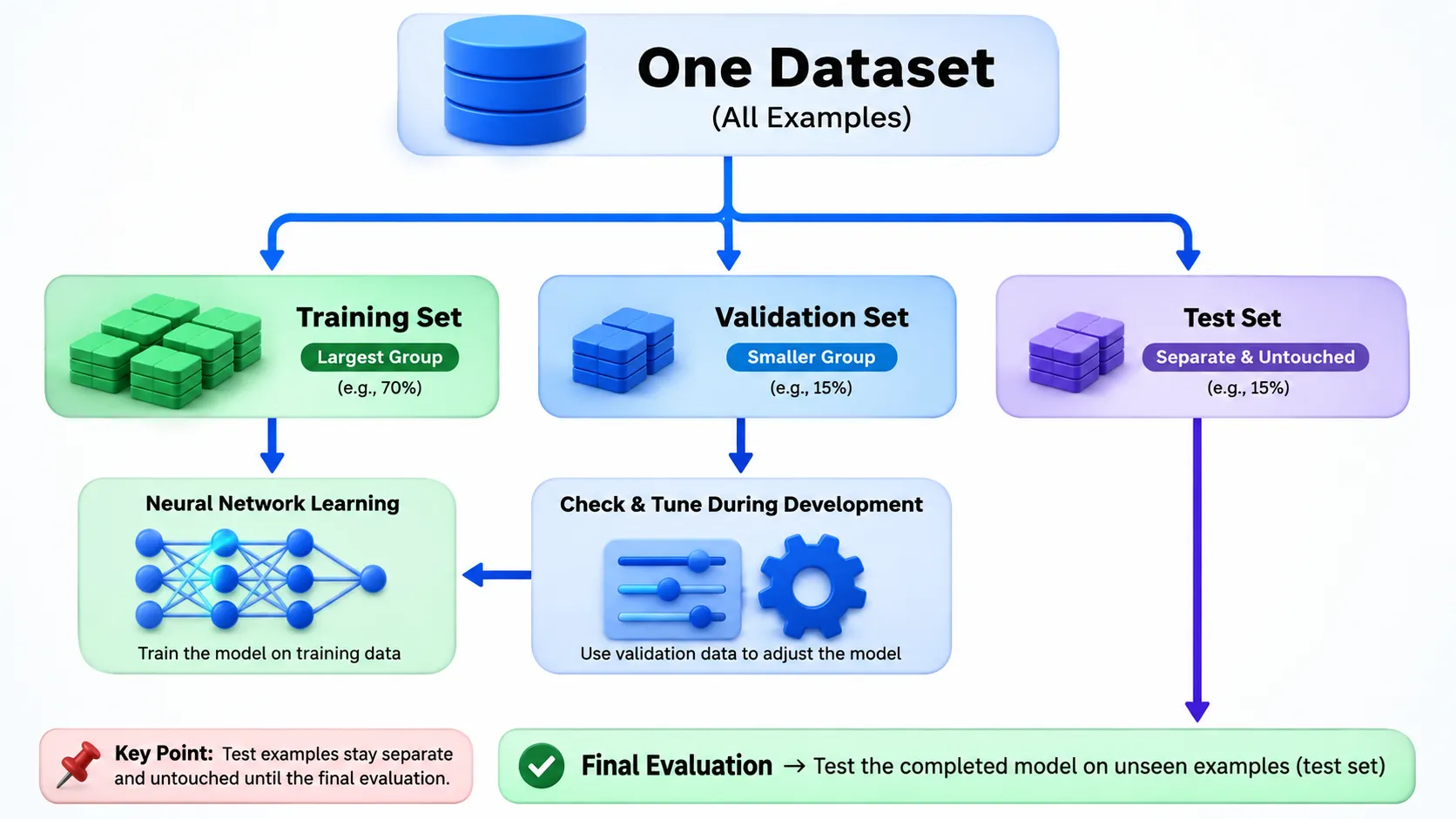
That is why datasets are commonly divided into training, validation, and test data.
The training set teaches the model.
The validation set helps developers check performance and make decisions while building the model.
The test set stays separate so the finished model can be checked on examples it did not train on.
Common Types of Deep Learning Models
Deep learning is not one single model. Different neural network architectures are useful for different types of problems.
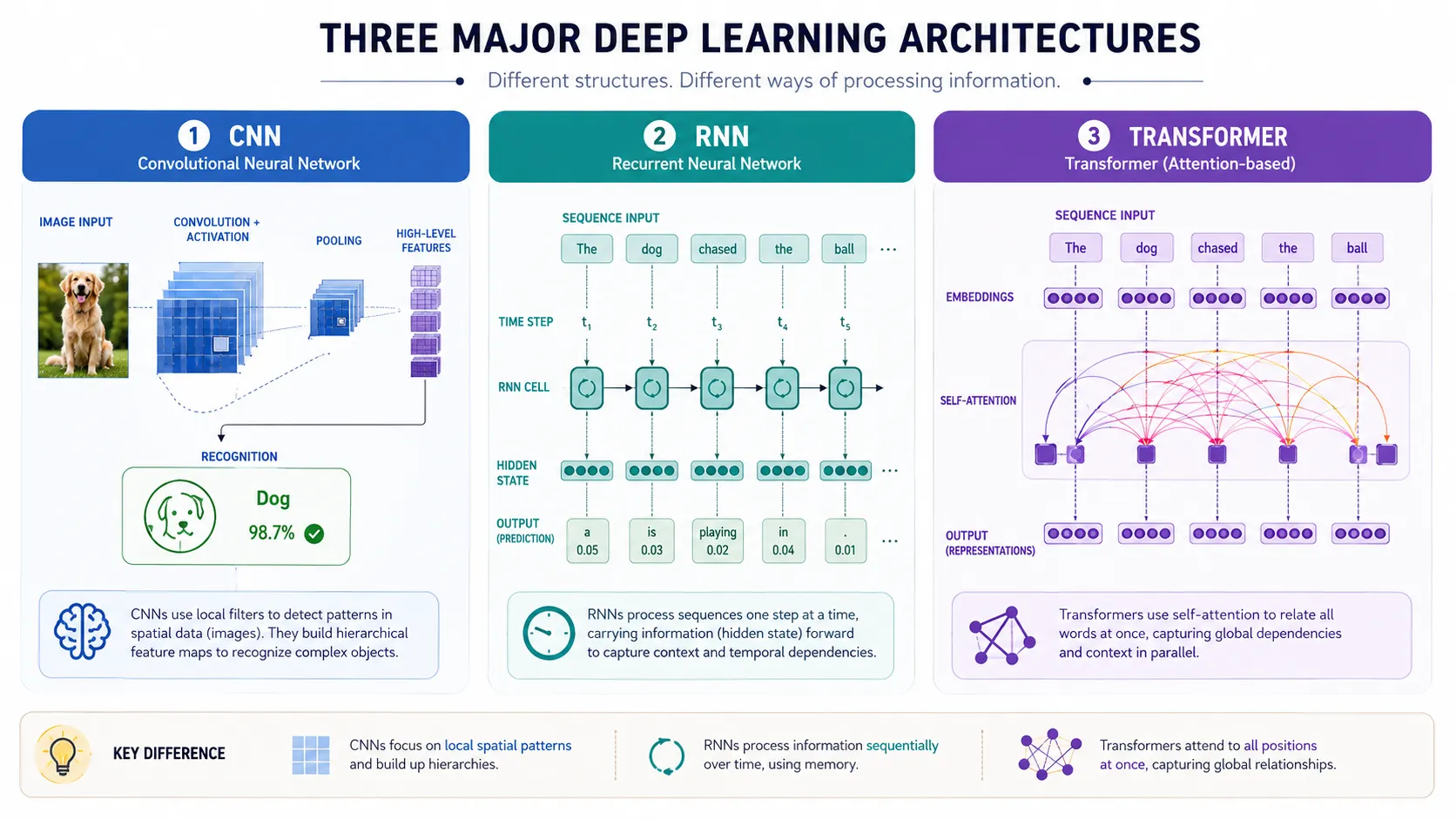
Convolutional Neural Networks (CNNs)
Convolutional Neural Networks, usually called CNNs, are strongly linked with computer vision and image-related tasks.
Think about an app that needs to identify whether a photo contains a car, dog, shoe, or person.
A CNN can learn useful visual patterns from images and combine simpler patterns into more meaningful features.
CNN-based systems can be used for tasks such as image classification, object recognition, medical-image analysis, and other computer-vision problems. TensorFlow, for example, demonstrates CNNs by training them to classify images from the CIFAR dataset.
Recurrent Neural Networks (RNNs)
Recurrent Neural Networks, or RNNs, were designed for sequence data, where the order of information matters.
For example, the meaning of a word in a sentence can depend on the words that appeared before it.
The same idea can apply to speech, time-series data, and other ordered information.
RNNs and variants such as LSTM networks became widely used for language and sequence-based problems. PyTorch describes sequence models as useful when inputs have some form of dependence through time.
Today, many modern language systems use another architecture: the Transformer.
Transformers
Transformers have become one of the most important architectures in modern deep learning.
Instead of processing information only in a simple step-by-step sequence, transformers use an idea called attention to learn relationships between different parts of the input.
The original Attention Is All You Need research introduced the Transformer architecture using attention mechanisms rather than recurrence or convolution for its main sequence-processing design.
Transformer-based models are now widely connected with natural language processing, large language models, text generation, translation, question answering, and many other AI tasks.
Where Is Deep Learning Used in Real Life?
The easiest way to understand deep learning applications is to look at situations you already know.
When a photo application recognizes or groups similar faces, computer vision may be involved.
When your phone converts your voice into text, deep learning models can help recognize patterns in audio.
When an online platform recommends a video, song, product, or other content, machine learning systems can study different signals and predict what may be useful or interesting next.
Deep learning is also used in areas such as:
Image recognition
Speech recognition
Natural language processing
Document understanding
Language translation
Fraud detection
Medical imaging research
Search systems
Robotics
Autonomous-driving research
The important point is that there is no single neural network that is automatically best for every problem.
The model should match the problem, data, available computing resources, and final goal.
Why Is Deep Learning So Powerful?
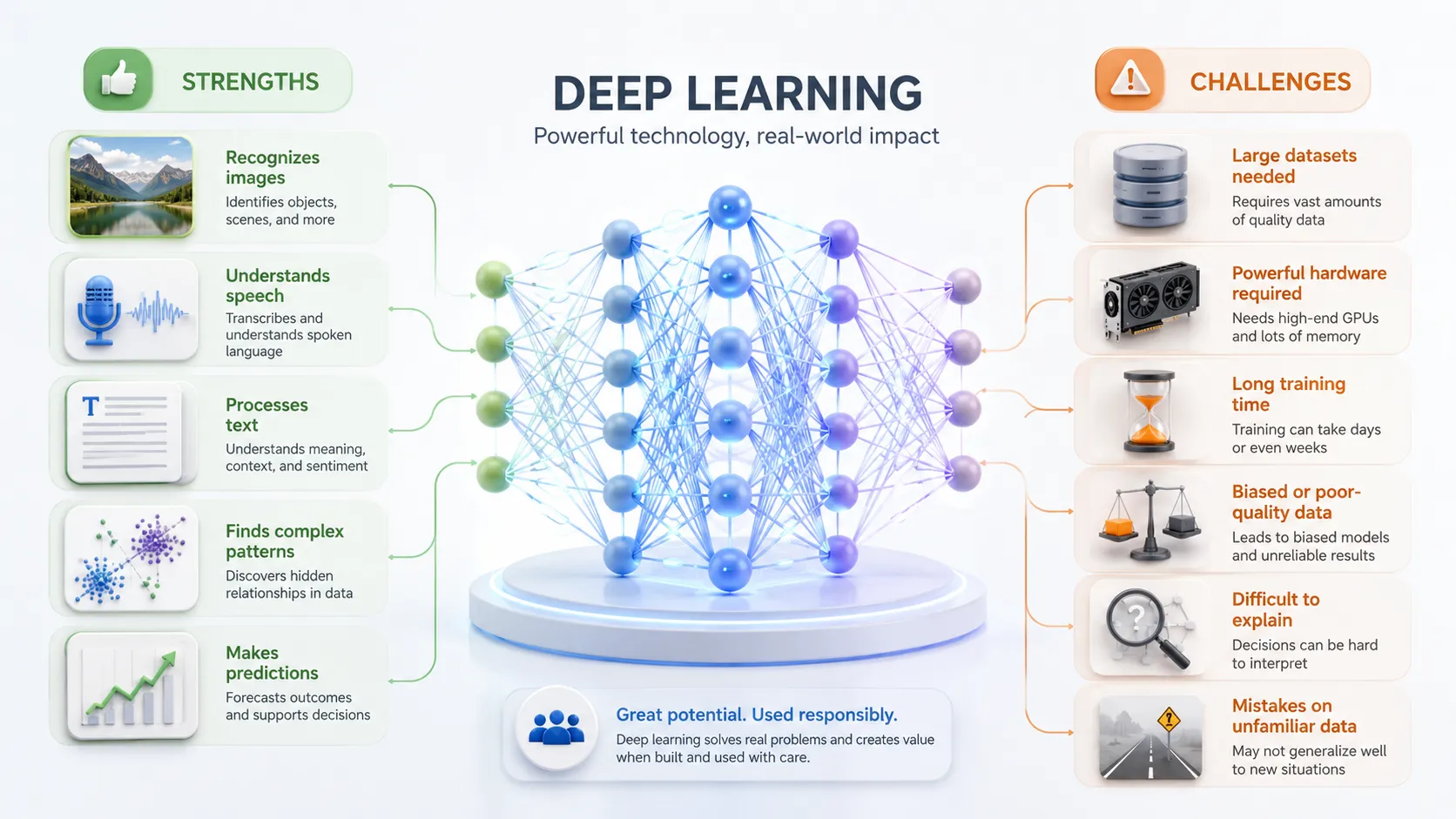
One major advantage of deep learning is its ability to learn useful representations from large amounts of complex data.
In traditional machine learning, developers may spend significant time deciding which features should be given to the model.
Deep learning can learn many useful features during training.
For an image, it may learn visual patterns.
For text, it can learn relationships between words or tokens.
For audio, it can learn patterns connected with sound.
This ability makes deep neural networks useful for problems where creating every important feature manually would be difficult.
Deep learning can also scale to highly complex tasks when suitable data, model design, and computing resources are available.
But that power comes with a cost.
Limitations of Deep Learning
Deep learning is impressive, but it is not the right solution for every problem.
Training large deep learning models can require a lot of data, computing power, memory, and time.
Data quality is another major concern.
If training data contains incorrect labels, missing information, poor examples, or unfair patterns, the model may learn those problems as well. Google's machine-learning guidance specifically warns that bias can enter models through the way training data is selected and prepared.
Deep neural networks can also be difficult to explain.
A model may make an accurate prediction without giving a simple human-readable explanation of every internal step that produced it.
Models can also overfit, make confident mistakes, or struggle when real-world data is very different from the data they learned from.
That is why model evaluation, data quality, testing, monitoring, and human judgment remain important.
Deep Learning in One Simple Example
Imagine an email system that needs to recognize spam.
It receives many examples of spam and normal emails.
The information is converted into numbers.
The neural network processes those numbers through its layers.
It makes a prediction.
The loss function measures the mistake.
Backpropagation calculates what needs to change.
The optimizer updates the weights.
The process repeats across many examples.
Finally, the trained model is tested on emails it has never seen before.
That simple example captures the basic idea behind how deep learning works.
Final Thoughts
Deep learning sounds difficult when it is introduced through formulas and technical terms. But its foundation is easier to understand than it first appears.
A model receives data, passes it through layers of a neural network, makes a prediction, measures its error, adjusts itself, and repeats the process until it becomes better at the task.
Its real power comes from learning complex patterns from data at scale.
You do not need to understand every equation on day one.
Start with this simple flow:
Data → Neural Network → Prediction → Error → Learning → Better Prediction
Once this flow makes sense, ideas such as CNNs, Transformers, backpropagation, neural network training, overfitting, and model evaluation become much easier to understand.
And that is the best place for any beginner to start their journey into deep learning.


