


What AI, Machine Learning, and Deep Learning Actually Mean
1. The Jargon Frustration
Search for the difference between Artificial Intelligence, Machine Learning, and Deep Learning, and you will probably find one of two things.
The first is an academic explanation filled with equations, probability notation, neural network diagrams, and technical terms that assume you already understand the topic.
The second is a marketing article where almost everything is called “AI,” including basic automation, conditional logic, chatbots, recommendation systems, and sometimes even a normal software filter.
Most content online is either written by academics with scary math or marketers using buzzwords. Let's fix that today.
The confusion is understandable because these terms are closely related. They are not three completely separate technologies competing with each other.
They describe different levels of the same broad field.
A spam filter can use Machine Learning.
A voice assistant may use Deep Learning.
A chess-playing program can be considered Artificial Intelligence even if it does not learn from data.
And a modern multimodal assistant can combine language models, vision models, retrieval systems, external tools, memory, rules, and agentic workflows inside one larger AI product.
That is why saying “this product uses AI” does not tell you much.
It is like saying a vehicle uses engineering. Technically true, but not specific enough to explain whether it is a bicycle, an electric car, or a commercial aircraft.
To understand these terms properly, forget the intimidating definitions for a moment.
Start with one simple mental model.
2. The Russian Doll Mental Model
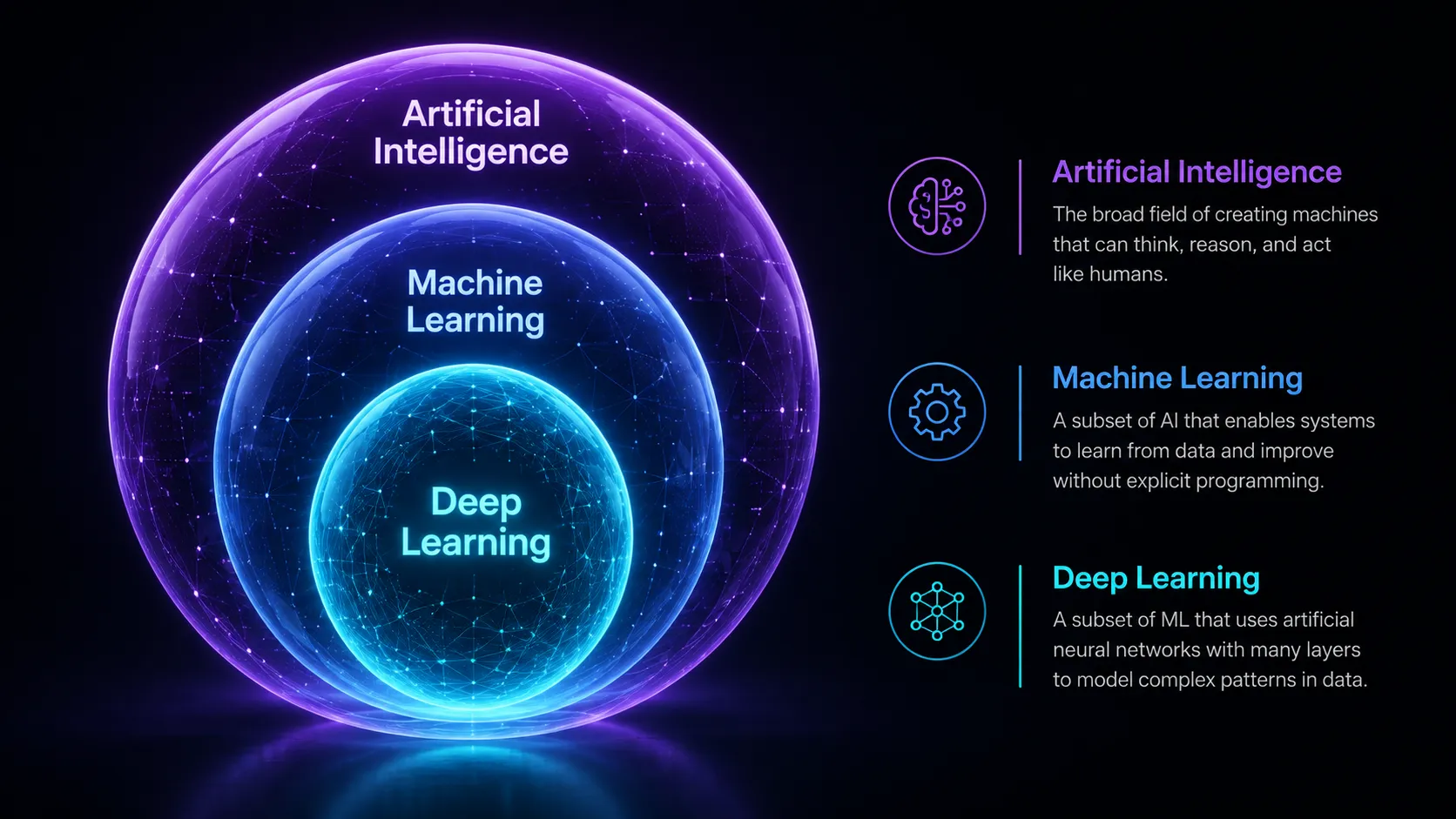
Think of AI, Machine Learning, and Deep Learning as three Matryoshka Russian dolls placed inside one another.
The outer doll: Artificial Intelligence
The largest doll is Artificial Intelligence.
AI is the broadest category. It includes any technique used to make a computer perform tasks that appear to require human-like intelligence.
That could include:
Planning a delivery route
Understanding a spoken command
Detecting fraud
Playing chess
Recommending a hotel
Generating an image
Answering questions
Taking actions across multiple software tools
Some AI systems learn from data. Some do not.
A rule-based medical expert system can be AI. A machine-learning fraud detector can also be AI. A modern agent that reads emails, checks a calendar, calls APIs, and completes a workflow is also an AI system.
So AI describes the overall goal: making machines behave intelligently.
The middle doll: Machine Learning
Inside AI sits Machine Learning.
Machine Learning is one way of building AI systems.
Instead of manually programming every decision, we give the system examples or historical data and allow it to learn useful patterns.
For example, imagine writing a fraud-detection system manually.
You might create rules such as:
Flag transactions above ₹1,00,000
Flag purchases from a new country
Flag five transactions within ten minutes
Flag transactions made at unusual hours
These rules may work initially, but fraud patterns keep changing. Legitimate customers may also trigger these rules.
A Machine Learning model takes a different approach.
You provide thousands or millions of past transactions marked as fraudulent or legitimate. The model studies the relationships between transaction amount, time, device, location, customer behaviour, merchant type, and many other signals.
It then learns a pattern that can estimate whether a new transaction looks suspicious.
So Machine Learning describes the approach: learning patterns from data rather than manually writing every rule.
The innermost doll: Deep Learning
Inside Machine Learning sits Deep Learning.
Deep Learning is a specialized type of Machine Learning built mainly around multi-layer neural networks.
It becomes especially useful when the data is messy, complex, or unstructured.
Examples include:
Text
Images
Audio
Video
Medical scans
Satellite imagery
Sensor streams
Traditional Machine Learning usually works best when humans first decide which features matter.
For a house-price model, we might provide structured features such as:
Number of bedrooms
Property size
Location
Building age
Distance from the city centre
Deep Learning can often learn useful representations directly from raw or lightly processed data.
Give a vision model enough labelled images, and it can learn visual patterns such as edges, textures, shapes, objects, and eventually complete scenes.
Give a language model enough text and multimodal training data, and it can learn relationships between words, concepts, images, instructions, code, and actions.
So Deep Learning describes a specialized tool: using layered neural networks to learn complex representations, especially from unstructured data.
The relationship looks like this:
All Deep Learning is Machine Learning.
All Machine Learning falls under Artificial Intelligence.
But not all AI is Machine Learning, and not all Machine Learning is Deep Learning.
3. Clear Breakdown Without Academic Fluff
Let us reduce each term to one practical sentence.
Artificial Intelligence: The Big Goal
Artificial Intelligence is the goal of making computers perform tasks that normally require intelligent decision-making.
AI is an umbrella term, not one specific algorithm.
It can include:
Rule-based systems
Search and planning algorithms
Machine Learning models
Deep Learning models
Large language models
Computer vision systems
Robotics
Agentic workflows
Hybrid systems combining models, tools, memory, and business rules
Consider a travel-booking assistant.
The complete product may need to understand a customer’s request, search flights, compare hotels, apply company policies, call booking APIs, ask for missing details, and create an itinerary.
The entire system is an AI application.
However, different parts of it may use different techniques. Language understanding may use Deep Learning. Price prediction may use Machine Learning. Refund eligibility may use fixed business rules.
AI is therefore the destination, not always the method.
Machine Learning: The Data-Driven Approach
Machine Learning is an approach where software learns patterns from data and uses those patterns to make predictions or decisions.
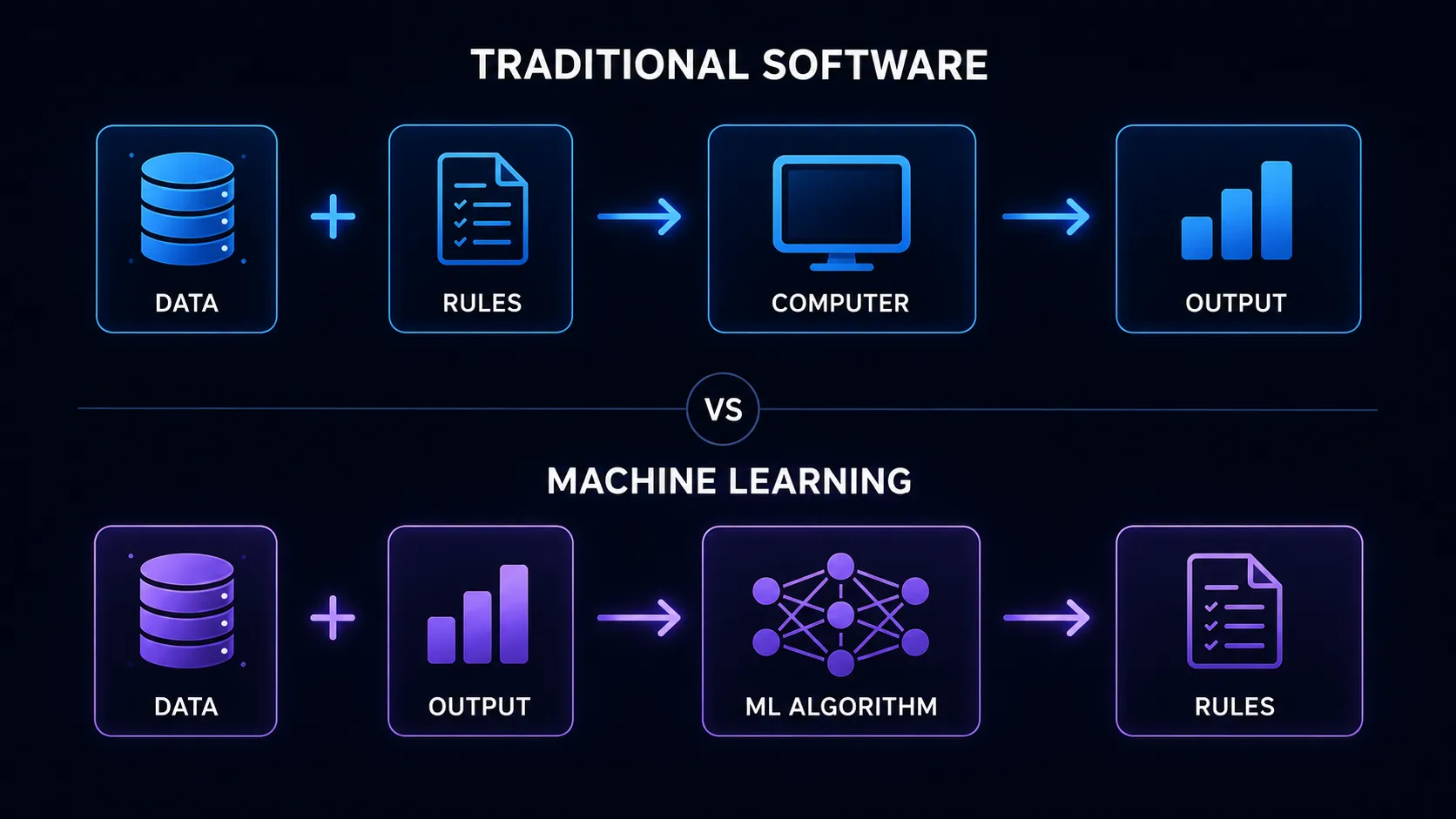
Traditional programming usually looks like this:
Rules + Data → Answer
Machine Learning looks more like this:
Data + Correct Answers → Learned Model
Then:
New Data + Learned Model → Prediction
Suppose you want to predict whether a customer will cancel a hotel booking.
Instead of manually defining every condition, you can train a model using historical information such as booking lead time, destination, price, customer history, cancellation policy, travel dates, and payment behaviour.
The model learns which combinations are associated with cancellations.
This works well for structured problems involving rows, columns, categories, numbers, and historical outcomes.
Common Machine Learning use cases include:
Credit-risk scoring
Demand forecasting
Customer churn prediction
Dynamic pricing
Sales forecasting
Fraud detection
Product recommendations
Predictive maintenance
Machine Learning is not automatically intelligent in every situation.
A model trained to predict hotel cancellations cannot suddenly identify objects in an image or write a travel itinerary. It learns a specific statistical relationship for a specific task.
Deep Learning: The Specialist for Complex Data
Deep Learning uses neural networks with many processing layers to learn complex patterns from large amounts of data.
Its main strength is representation learning.
That means the system can learn which features are useful instead of depending entirely on humans to define them beforehand.
For example, a traditional image-classification pipeline might require engineers to manually calculate shapes, colours, edges, and textures.
A Deep Learning model can learn many of these representations during training.
Early layers may detect simple edges.
Middle layers may detect textures, curves, or object parts.
Later layers may recognise faces, vehicles, animals, landmarks, or complete scenes.
Modern language and multimodal models apply the same broad idea at much larger scale. They learn internal representations that help them process text, code, images, audio, video, and combinations of these inputs.
Deep Learning is powerful, but it usually requires more data, more compute, more memory, and more careful training than simpler Machine Learning methods.
It is not always the best choice.
For a small spreadsheet containing 5,000 customer records, a gradient-boosted tree may outperform a large neural network while being cheaper, faster, and easier to explain.
The correct tool depends on the problem, not on which term sounds more advanced.
4. AI vs Machine Learning vs Deep Learning: High-Level Comparison
Feature
Artificial Intelligence
Machine Learning
Deep Learning
Main purpose
Make systems perform intelligent tasks
Learn patterns from data
Learn complex representations using neural networks
Primary input
Rules, goals, knowledge, data, tools, or models
Mostly structured or labelled historical data
Large volumes of text, images, audio, video, or other complex data
Learning style
May learn from data, but learning is not required
Learns statistical relationships from examples
Learns features and patterns through multi-layer neural networks
Human involvement
Humans may define rules, goals, workflows, and constraints
Humans usually select data and useful features
The model can learn many useful features automatically
Simple example
A rule-based chess system
A model predicting customer churn
A neural network recognising objects in photos
Typical strength
Planning, reasoning, automation, and intelligent behaviour
Prediction on structured business data
Language, vision, speech, generation, and multimodal understanding
Typical limitation
The term is broad and says little about implementation
Depends heavily on data quality and feature selection
Often needs significant compute, data, testing, and infrastructure
The easiest way to remember the difference is:
AI is the ambition.
Machine Learning is one approach for achieving that ambition.
Deep Learning is a specialized Machine Learning technique for handling complex patterns and unstructured data.
Once this hierarchy is clear, many confusing technology discussions become much easier to decode.
How Software Went from Following Rules to Learning Patterns
Now that the hierarchy is clear, the next question is obvious:
How does a machine actually become “intelligent”?
The answer depends on how the system is built.
Some systems follow rules written by humans. Others learn patterns from historical data. Modern AI products often combine both approaches.
To understand why Machine Learning became such a major shift, we first need to look at how traditional software works.
5. Rule-Based AI: When Humans Write Every Decision
Traditional software is built around explicit instructions.
A developer studies the problem, writes the logic, gives the program some input, and the system produces an output.
The basic formula looks like this:
Human-written rules + Input data → Output
For example, imagine a bank deciding whether a transaction should be sent for additional verification.
A simple rule-based system might contain logic like:
IF transaction amount is above ₹1,00,000
AND the device is new
AND the transaction location is unusual
THEN request additional verification
The software does not learn why these conditions matter.
It simply checks whether the conditions are true.
This is the same basic idea behind normal application logic:
If the password is incorrect, reject the login.
If the account balance is too low, block the payment.
If the user is under the required age, deny access.
If a document has expired, reject the application.
If a refund request is outside the allowed window, mark it ineligible.
There is nothing wrong with this approach.
In fact, rule-based systems are often the correct solution.
Why Expert Systems Still Matter
Before modern Machine Learning became popular, many AI systems were built as expert systems.
An expert system tries to capture human expertise using:
Rules
Decision trees
Knowledge bases
Conditions
Exceptions
Recommended actions
A medical expert might define symptoms and possible diagnoses.
A tax specialist might define compliance rules.
A banking team might define risk thresholds and approval conditions.
These systems may sound old-fashioned, but rule-based engines still power critical parts of banking, insurance, taxation, identity verification, and regulatory compliance.
Why?
Because regulated industries often need decisions that are:
Predictable
Auditable
Explainable
Reproducible
Easy to validate
Easy to update when regulations change
If a bank blocks a transaction, it may need to explain exactly why.
A rule such as “country risk score exceeded the approved threshold” is easier to audit than a black-box model that produces a suspiciousness score without a clear explanation.
Rules are also useful when the requirements are absolute.
A passport is either expired or it is not.
A customer either meets the minimum age requirement or does not.
A transaction either exceeds a legal reporting threshold or stays below it.
You do not need a neural network to solve every problem. Sometimes an if-else statement is more reliable, cheaper, and easier to maintain.
Where Rule-Based Systems Become Painful
The problem starts when the number of possibilities becomes too large.
Imagine manually writing fraud rules for millions of customers across different countries, devices, merchants, payment methods, and behaviour patterns.
One customer may spend ₹2,00,000 regularly.
Another customer may usually spend ₹2,000.
The same transaction can look normal for one person and suspicious for another.
Rules quickly start multiplying:
If this happens, check that.
Unless the customer is in this category.
Except when the merchant has this status.
But only if the transaction happened during this period.
Unless the account has already been verified.
Eventually, the system becomes a maze of conditions.
Every new exception creates more code. Different rules begin to conflict. Teams become afraid to modify anything because one small change can break another workflow.
This is where Machine Learning changed the paradigm.
6. How Machine Learning Flipped the Formula
Traditional software asks humans to discover the rules and write them into code.
Machine Learning takes a different route.
Instead of giving the machine the complete decision logic, we give it examples of previous inputs and the correct outputs.
The system then tries to identify the pattern connecting them.
The formula becomes:
Input data + Target outputs → Learned rules
Those learned rules are stored inside a model.
Once the model is trained, the process becomes:
New input + Learned model → Predicted output
Let us use spam detection as an example.
With a traditional rule-based approach, a developer may write rules such as:
If the email contains “WIN CASH,” mark it as spam.
If it contains ten links, mark it as spam.
If the sender is unknown, increase the spam score.
If the subject contains too many capital letters, increase the spam score.
The problem is that spammers adapt.
They change words, insert spaces, use images, modify links, and avoid known patterns.
With Machine Learning, we collect thousands or millions of emails already labelled as:
Spam
Not spam
The model then studies signals such as:
Words used
Sender reputation
Link structure
Message length
Formatting patterns
User behaviour
Attachment type
Previous complaints
The machine is not given one perfect spam rule.
It learns a statistical boundary based on many examples.
This was the real shift.
Developers no longer had to manually describe every possible pattern. They could train a system to discover useful relationships from data.
Of course, the machine does not magically understand the world.
It learns only from the examples, labels, features, and objectives that humans provide.
That brings us to the three main ways Machine Learning systems learn.
7. The Three Main Flavours of Machine Learning
Most classic Machine Learning problems fit into three broad categories:
Supervised Learning
Unsupervised Learning
Reinforcement Learning
Each one solves a different type of problem.
7.1 Supervised Learning: Learning with Labelled Answers
Supervised Learning means training a model using examples where the correct answer is already known.
Think of it like studying with an answer sheet.
The model receives:
Input data
Correct output labels
It then learns the relationship between them.
For a spam-detection model, each training email might have a label:
Label
“Your invoice is attached”
Not Spam
“Claim your free reward now”
Spam
“Meeting moved to 4 PM”
Not Spam
“You have won ₹10 lakh”
Spam
After studying enough examples, the model predicts whether a new email is likely to be spam.
Supervised Learning is commonly used for two types of tasks.
Classification
Classification predicts a category.
Examples include:
Spam or not spam
Fraudulent or legitimate
Customer will churn or stay
Loan application approved or rejected
Image contains a dog or a cat
Support ticket is urgent or normal
Regression
Regression predicts a number.
Examples include:
House price
Hotel demand
Delivery time
Customer lifetime value
Monthly sales
Electricity consumption
Supervised Learning works well when you have enough high-quality labelled examples.
The catch is that creating those labels can be expensive, slow, and sometimes subjective.
A human may need to review every medical scan, support ticket, image, or document before the model can learn from it.
7.2 Unsupervised Learning: Finding Hidden Patterns
Unsupervised Learning works with data that has no predefined answers.
There is no label saying:
This customer belongs to Group A.
This customer belongs to Group B.
This behaviour is normal.
This behaviour is unusual.
The model tries to discover structure on its own.
A common example is customer segmentation.
Imagine an online travel company with millions of customers.
The company may have data such as:
Average booking value
Travel frequency
Preferred destination type
Hotel category
Booking lead time
Refund frequency
Flight class
Device type
Response to discounts
Nobody has manually labelled customers as “luxury traveller,” “budget explorer,” or “last-minute business traveller.”
An unsupervised model can group customers based on behavioural similarity.
It may discover clusters such as:
Frequent premium travellers
Seasonal family travellers
Discount-sensitive users
Last-minute corporate travellers
Infrequent high-value customers
The system does not automatically know what these groups mean.
Humans still need to inspect the clusters and interpret them.
Common unsupervised-learning tasks include:
Clustering
Anomaly detection
Dimensionality reduction
Pattern discovery
Data compression
Behaviour segmentation
This approach is useful when labelled data is unavailable or when you do not yet know what patterns exist.
But the results are not always clean.
A model may find mathematically valid groups that have little business value. Human judgement is still required.
7.3 Reinforcement Learning: Learning Through Trial and Error
Reinforcement Learning, often shortened to RL, is based on actions, rewards, and consequences.
The model, called an agent, interacts with an environment.
It takes an action, observes what happens, and receives a reward or penalty.
Over time, it learns which actions produce better long-term outcomes.
The basic loop looks like this:
State → Action → Reward → Updated strategy
Game AI is the classic example.
Imagine an agent learning to play a racing game.
At first, it may:
Crash into walls
Miss turns
Drive in the wrong direction
Move too slowly
Fail to finish the race
The system receives rewards for useful behaviour, such as:
Staying on the track
Increasing speed
Overtaking another vehicle
Completing a lap
Winning the race
It receives penalties for:
Crashing
Going off-track
Losing time
Failing the objective
After many attempts, the agent learns a strategy that maximises its total reward.
Reinforcement Learning has also been used in:
Robotics
Game-playing systems
Resource allocation
Recommendation optimisation
Industrial control
Traffic-signal management
Model alignment and reasoning optimisation
The difficult part is designing the reward correctly.
If the reward is badly designed, the agent may discover shortcuts that technically maximise the score while violating the real goal.
For example, a game agent told only to “survive as long as possible” may learn to hide in one corner instead of actually playing well.
This is called reward hacking.
The model follows the objective you define, not necessarily the intention in your head.
8. The Feature Engineering Barrier
Machine Learning reduced the need to manually write every decision rule.
But classic ML still depends heavily on humans deciding what information the model should examine.
This process is called feature engineering.
A feature is a measurable input used by the model.
For a house-price model, features may include:
Property size
Number of rooms
Location
Building age
Floor number
Distance from a metro station
For fraud detection, features may include:
Transaction amount
Time of transaction
Device age
Country mismatch
Number of recent transactions
Difference from normal spending behaviour
The model does not automatically understand the raw world.
Humans usually need to convert reality into structured numbers and categories.
Teaching a Model What a Cat Looks Like
Suppose you want a classic Machine Learning system to recognise cats in images.
You cannot simply hand it raw pixels and expect reliable results.
An engineer may need to create features for:
Ear shape
Ear angle
Whisker patterns
Eye spacing
Fur texture
Face symmetry
Body outline
In simple terms, humans must tell the model:
“Cat ears often have this shape.”
“Whiskers look like this.”
“A cat face usually has these geometric patterns.”
This becomes tedious very quickly.
What happens when:
The cat is facing sideways?
The image is dark?
Part of the cat is hidden?
The animal has unusual fur?
The photo is blurry?
The background contains similar shapes?
Engineers have to keep creating more features and exceptions.
The same difficulty appears in text, audio, and video.
For text classification, humans may manually calculate:
Word frequency
Sentence length
Keyword counts
Punctuation patterns
Positive and negative terms
For audio, they may extract:
Pitch
Frequency
Energy
Rhythm
Spectral patterns
Before training even begins, teams spend huge amounts of time cleaning data, selecting variables, creating labels, handling missing values, and designing features.
A large part of real Machine Learning work is not model training.
It is data preparation.
9. Where Classic Machine Learning Hits a Wall
Classic Machine Learning performs extremely well on structured data.
Give it a clean table with useful columns, enough historical examples, and a clear target, and it can be hard to beat.
Problems begin when the input is unstructured.
Unstructured data includes:
Natural language
Images
Audio recordings
Video
Medical scans
Handwritten documents
Satellite imagery
Long software codebases
A spreadsheet has predefined columns.
An image is just a grid containing millions of pixel values.
An audio file is a changing waveform.
A video contains images, motion, sound, timing, objects, and interactions.
A paragraph contains words whose meaning depends on context, grammar, tone, previous sentences, and sometimes external knowledge.
Classic ML models usually need humans to compress this complex input into carefully designed features.
That works for smaller problems, but it becomes fragile at scale.
Consider the sentence:
“The bank approved my loan after reviewing my bank statements.”
The word bank appears twice, but it refers to two different concepts:
A financial institution
Financial records associated with an account
A simple keyword-based model may struggle with this distinction.
Modern language tasks require systems to track context, relationships, sentence structure, intent, and meaning across long sequences.
LLM-style text generation is even harder.
The system does not simply classify a sentence as positive or negative. It must predict and generate coherent sequences while maintaining:
Context
Tone
Grammar
Factual relationships
Instructions
Conversation history
Code structure
Long-range dependencies
Classic ML was not designed to learn these complex representations directly from massive volumes of raw text.
The same applies to vision.
A traditional model may recognise objects under controlled lighting and fixed camera angles but fail when the object rotates, moves, becomes partially hidden, or appears in an unfamiliar environment.
This feature-engineering wall created the need for a different approach.
Instead of asking humans to manually define every useful feature, researchers began building systems that could learn the features themselves.
That approach became Deep Learning.
Why Deep Learning Became the Engine Behind Modern AI
Classic Machine Learning did something important: it allowed software to learn patterns instead of depending entirely on hand-written rules.
But it still left humans with a difficult job.
Before training a model, someone had to decide which features mattered, convert raw information into numbers, label the data, and remove irrelevant noise.
Deep Learning reduced that dependency.
10. Why Deep Learning Changed the Game
The biggest practical advantage of Deep Learning is not simply that it uses larger models.
It is that a deep neural network can learn useful features directly from raw or lightly processed data.
With classic Machine Learning, the usual pipeline looks like this:
Raw data → Human-designed features → ML model → Prediction
With Deep Learning, it looks closer to this:
Raw data → Neural network learns features → Prediction
Consider image recognition.
A traditional Machine Learning engineer might manually define features such as:
Edge direction
Colour distribution
Shape boundaries
Texture patterns
Corners
Object proportions
A deep neural network can learn many of these features during training.
The early layers may learn to detect basic lines and edges.
The middle layers may combine those edges into textures, curves, eyes, wheels, or ears.
The deeper layers may combine those smaller patterns into complete objects such as a cat, face, vehicle, tumour, or traffic sign.
The model builds its own internal representation of what matters.
The same idea works with text.
Instead of manually creating features such as keyword counts, sentence length, punctuation frequency, and sentiment dictionaries, a Deep Learning model can learn relationships between words, phrases, context, intent, grammar, and meaning.
For audio, it can learn patterns related to frequency, rhythm, pronunciation, speaker characteristics, and background noise.
For video, it can learn from images, motion, time, audio, and interactions between objects.
This ability is called representation learning.
It does not completely eliminate human work. Engineers still choose the data, architecture, training objective, evaluation method, safety constraints, and deployment setup.
But it removes much of the need to manually describe every visual, linguistic, or acoustic pattern.
That is why Deep Learning succeeded where classic ML often struggled: it could handle the complexity of raw, unstructured data at scale.
11. Neural Networks Demystified
A neural network can look intimidating when presented as a diagram containing hundreds of circles and connecting lines.
The basic idea is much simpler.
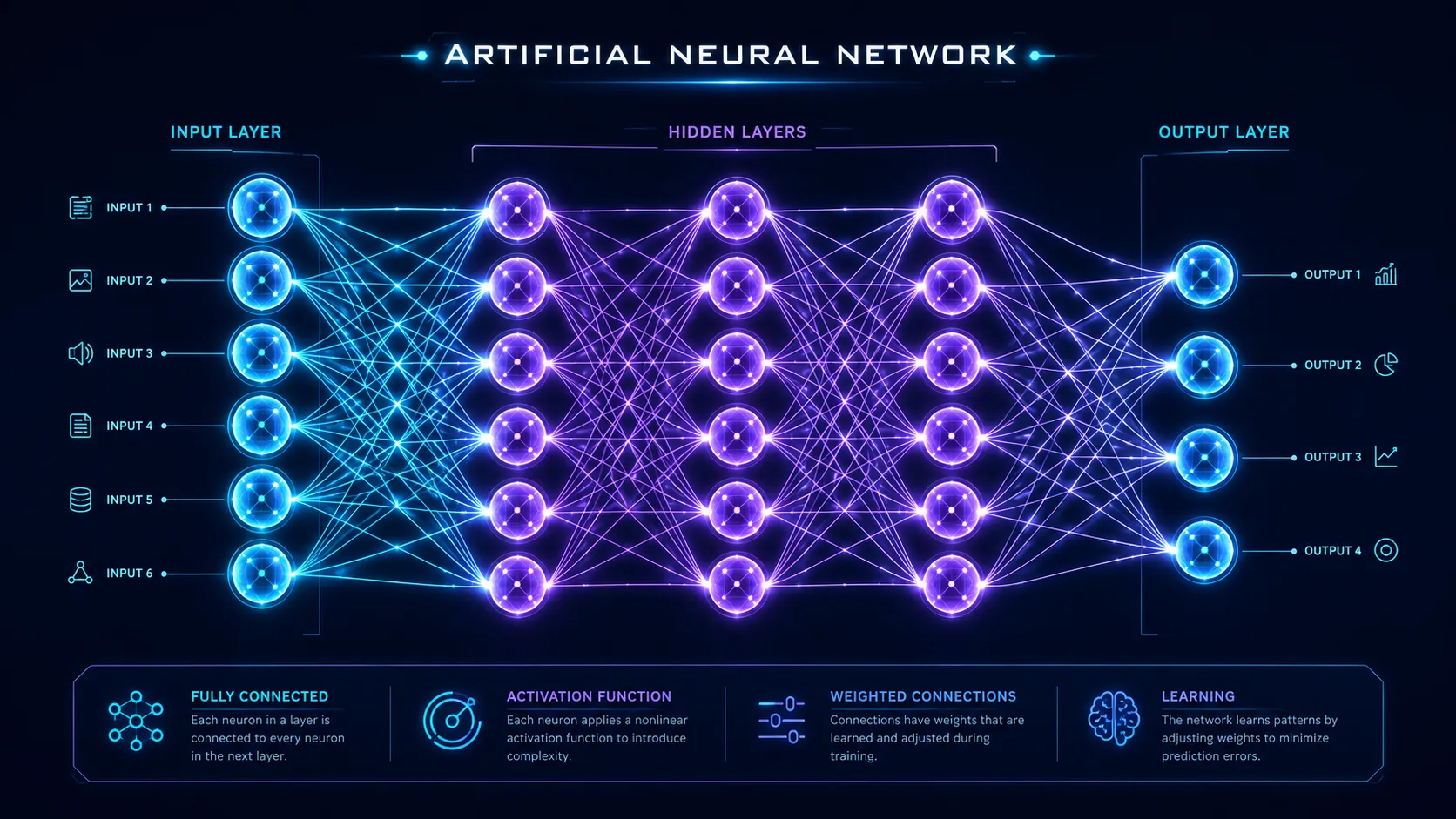
A neural network takes several inputs, gives different importance to those inputs, combines them, and produces an output.
Imagine that you are deciding whether to buy a new phone.
Your decision may depend on:
Price
Camera quality
Battery life
Performance
Display quality
Software support
These factors do not have equal importance.
Maybe camera quality matters a lot to you, battery life matters slightly less, and gaming performance barely matters.
In neural-network language, each factor receives a weight.
A higher weight means that the factor has more influence on the final decision.
The Input Layer
The input layer receives the initial information.
For the phone decision, the inputs might be:
Price score: 7/10
Camera score: 9/10
Battery score: 8/10
Performance score: 8/10
Software-support score: 9/10
The input layer does not make the final decision.
It simply passes these values into the network.
The Hidden Layers
The hidden layers process and combine the inputs.
One hidden unit might estimate:
Is this phone good value for money?
Another might estimate:
Is it suitable for long-term use?
A third might evaluate:
Is the camera improvement large enough to justify upgrading?
Each hidden unit performs a mathematical calculation using the input values, learned weights, and an activation function.
You do not need to memorise the mathematics to understand the practical idea.
The hidden layers are building intermediate conclusions.
In an image model, these intermediate conclusions may be:
This region contains an edge.
These edges form a curved shape.
This shape resembles an eye.
Two eyes and a nose-like pattern may form a face.
In a language model, they may represent relationships involving syntax, context, entities, instructions, tone, and meaning.
A deep neural network simply has multiple hidden layers, allowing it to learn increasingly complex representations.
The Output Layer
The output layer produces the final result.
For the phone example, it might return:
Buy: 82%
Do not buy: 18%
For another system, the output might be:
Cat
Dog
Fraud probability
Predicted house price
Next word or token
Recommended action
Training adjusts the weights across the network so that its predictions become closer to the correct answers.
The network makes a prediction, measures the error, and updates its weights repeatedly.
After enough useful examples, it learns which signals should matter and how strongly they should influence the result.
12. Where Deep Learning Shines in 2026
By August 2026, Deep Learning is not limited to image classification or basic text prediction.
It powers systems that perceive, generate, reason, communicate, and act across multiple software environments.
Computer Vision
Computer Vision allows machines to process and interpret visual information.
Common examples include:
Face authentication
Medical-image analysis
Manufacturing defect detection
Document scanning
Retail inventory monitoring
Satellite-image analysis
Robotics
Autonomous-driving perception
Face authentication systems do not simply compare two photographs pixel by pixel.
Deep neural networks learn a compact facial representation that can remain useful despite changes in lighting, angle, expression, hairstyle, or camera quality.
Autonomous-vision systems have an even harder job.
They may need to identify vehicles, pedestrians, road boundaries, traffic signals, signs, obstacles, and movement patterns while processing continuous camera and sensor data.
Deep Learning is useful here because these environments contain far too many visual variations to describe through hand-written rules.
Natural Language Processing
Natural Language Processing, or NLP, includes tasks such as:
Translation
Search
Summarisation
Sentiment analysis
Speech recognition
Document extraction
Question answering
Content moderation
Older NLP systems depended heavily on manually designed language rules and features.
Modern systems use neural networks to model context and relationships across long sequences.
The word “charge,” for example, can refer to a payment, an accusation, electrical energy, or an instruction to move forward.
A Deep Learning model uses surrounding context to estimate which meaning is relevant.
Large Language and Multimodal Models
Modern Large Language Models, or LLMs, use Deep Learning architectures to process and generate language, code, structured data, and tool instructions.
By 2026, leading model platforms are increasingly multimodal rather than text-only. They can work across combinations of text, images, documents, audio, and video, sometimes mapping these formats into shared representation spaces.
This allows a single application to handle workflows such as:
Reading an invoice image
Extracting structured fields
Checking the values against company policy
Asking for missing information
Updating an ERP or CRM
Drafting a response for human approval
That is much more than text generation.
It is perception, reasoning, structured extraction, and action working together.
Agentic Workflows
An AI agent combines a model with tools, instructions, memory, context, and a control loop.
Instead of returning one answer and stopping, it can plan a multi-step task, call APIs, search files, use software interfaces, inspect results, correct mistakes, and continue until it reaches an acceptable outcome.
Modern agent platforms now expose built-in mechanisms for tool calling, web or file search, computer use, workflow orchestration, and multi-agent handoffs.
For example, a travel-support agent might:
Read the customer’s complaint.
Extract the booking ID.
Retrieve the booking.
Check the travel date and issue type.
Calculate ticket priority.
Review cancellation or change rules.
Create a CRM ticket.
Escalate urgent cases to a human.
The neural model handles language and decision support, but the complete agent also depends on APIs, permissions, validation rules, business logic, and monitoring.
An LLM alone is not an agent.
It becomes part of an agentic system when it can interact with tools and operate inside a controlled workflow.
13. The Hidden Costs and Trade-Offs of Deep Learning
Deep Learning removed much of the manual feature-engineering barrier.
It did not remove engineering cost.
Massive Data Requirements
Deep neural networks usually contain many adjustable parameters.
To train those parameters reliably, the model needs enough diverse examples to learn useful patterns instead of memorising the training set.
Large foundation models may be trained on internet-scale collections of text, code, images, audio, or video.
However, “Deep Learning always needs millions of labelled examples” is too simplistic.
Transfer learning, pretrained models, synthetic data, data augmentation, fine-tuning, and retrieval can reduce the amount of task-specific data required.
A company may not need to train a vision or language model from scratch.
It may start with a pretrained model and adapt it using a smaller, carefully selected dataset.
Even then, data quality matters more than raw volume.
Millions of duplicated, biased, incorrectly labelled, or irrelevant examples can produce a worse system than a smaller, well-curated dataset.
Compute-Heavy Training and Inference
Training modern deep models requires huge numbers of matrix calculations.
That work is usually accelerated using GPUs or other specialised AI hardware.
Large training runs may require clusters containing hundreds or thousands of connected accelerators, high-bandwidth networking, large memory pools, substantial storage, and serious power and cooling infrastructure.
As of 2026, production AI infrastructure includes systems built around accelerator platforms such as NVIDIA Blackwell and Blackwell Ultra, including rack-scale configurations intended for large training, long-context inference, and agentic workloads.
Training is not the only cost.
Running the model after deployment, known as inference, can become expensive when:
The model is large
Prompts contain long context
Millions of users send requests
The system processes images, video, or audio
Agents repeatedly call the model during multi-step workflows
Low latency is required
This is why production teams use techniques such as quantisation, distillation, caching, batching, smaller specialist models, model routing, and edge inference.
The biggest model is not automatically the best production model.
The Black-Box Problem
A Deep Learning model may produce an accurate prediction without providing a simple explanation of how every internal calculation contributed to it.
Its behaviour is distributed across large numbers of parameters, layers, activations, and learned representations.
This creates the black-box problem.
Suppose a model rejects a loan application.
A regulator, customer, or compliance team may reasonably ask:
Why was this application rejected?
“Because the neural network returned 0.82” is not an acceptable explanation.
The organisation may need to show which factors influenced the decision, whether protected characteristics affected the result, whether the model behaves consistently, and whether the decision can be appealed.
Interpretability remains a major challenge for high-stakes Deep Learning systems, particularly in medicine, finance, insurance, employment, and other regulated domains. Research into explainable AI and mechanistic interpretability tries to understand model predictions and internal computations, but fully explaining large neural networks remains difficult.
That is why production systems often use hybrid architectures.
Deep Learning handles complex perception or language tasks.
Traditional software handles hard constraints, approvals, permissions, calculations, and compliance rules.
Humans review decisions when the cost of an error is too high.
Deep Learning is powerful because it can learn patterns humans cannot practically encode by hand.
But it is not magic.
It trades manual feature engineering for greater demands in data, compute, evaluation, governance, and operational control.
Choosing the Right Tool and Building the Right Skills
After all these definitions, architectures, and trade-offs, one practical question remains:
Which approach should you actually use?
The answer is rarely “use the most advanced model available.”
A system is good when it solves the problem accurately, safely, quickly, and at a reasonable cost. Sometimes that means a neural network. Sometimes it means a small ML model.
And sometimes the best “AI solution” is a 12-line SQL query.
14. The Ultimate AI, ML, and Deep Learning Cheat Sheet
Factor
Rule-Based AI
Classic Machine Learning
Deep Learning
How it works
Humans explicitly write the decision logic
The model learns relationships from structured examples
Neural networks learn features and complex representations from data
Data needed
Little or no training data; requires clear rules and domain knowledge
Usually hundreds to hundreds of thousands of useful records
Often requires large datasets, pretrained models, synthetic data, or transfer learning
Typical data type
Policies, thresholds, conditions, database fields
Tables, categories, numerical values, historical business records
Text, images, audio, video, code, sensor streams, and multimodal data
Compute cost
Low
Low to moderate
Moderate to extremely high
Training cost
No traditional model training
Usually manageable on a laptop, workstation, or small cloud instance
May require GPUs, distributed training, specialised hardware, or paid model APIs
Speed and latency
Usually extremely fast and predictable
Usually fast, especially for tabular predictions
Depends heavily on model size, hardware, input length, and optimisation
Transparency
High; each rule can be inspected directly
Moderate; many models support feature importance or interpretable coefficients
Often low; internal reasoning is distributed across many parameters
Ease of debugging
High until the rule system becomes too large
Moderate; errors can often be traced to data, features, or model behaviour
Difficult; failures may come from training data, model architecture, prompts, context, or deployment conditions
Best use cases
Eligibility checks, compliance rules, calculations, permissions, workflow routing
Fraud scoring, forecasting, churn prediction, pricing, risk models, tabular classification
Vision, speech, language, generation, multimodal understanding, and complex pattern recognition
Main weakness
Becomes difficult to maintain when exceptions multiply
Depends on feature engineering and clean structured data
Expensive, harder to explain, and operationally complex
Simple example
IF refund_window_expired THEN reject
Predict whether a customer will cancel a booking
Read a customer’s message, understand the issue, and extract booking details
The important lesson is not that one column is better than the others.
These approaches solve different kinds of problems.
Production systems often combine all three.
A travel-support platform, for example, might use:
Deep Learning to understand the customer’s message
Machine Learning to predict urgency or escalation risk
Rules to enforce refund policies and booking restrictions
That hybrid structure is often more reliable than asking one massive model to control every decision.
15. The Three-Question Decision Framework
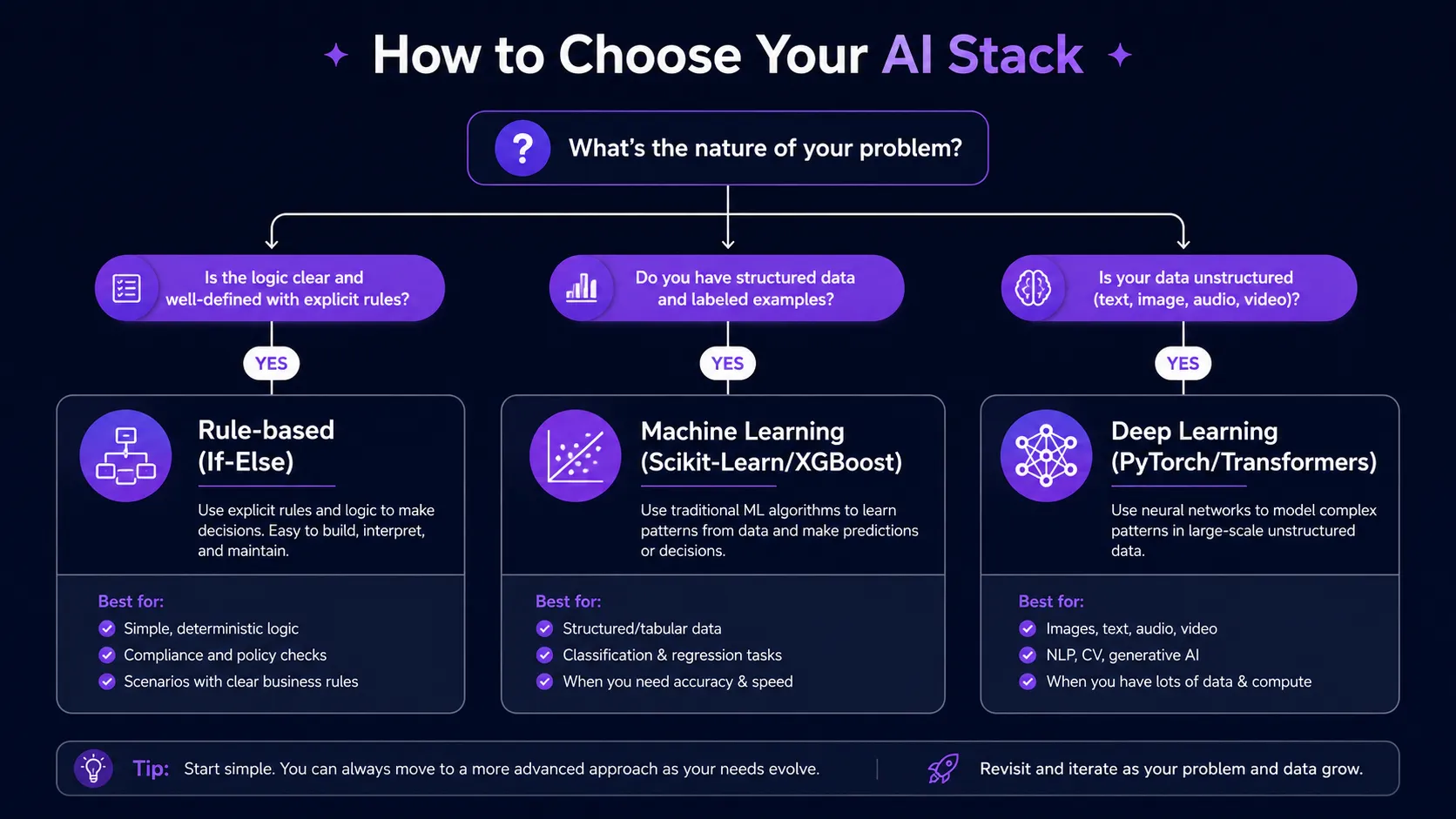
Before creating a model, ask these three questions in order.
Question 1: Can I Describe the Correct Decision as a Stable Rule?
Ask yourself:Can the expected output be determined using clear conditions, calculations, thresholds, or policies?
Examples:
Is the passport expired?
Is the booking refundable?
Does the amount exceed the approved limit?
Is check-in less than 24 hours away?
Does this user have permission to access the record?
These problems usually do not need Machine Learning.
Use:
SQL conditions
Application-level if-else logic
Database constraints
Decision tables
A rules engine
A simple rule is easier to test, explain, audit, and maintain.
Do not replace deterministic business logic with a probabilistic model just because “AI” sounds more impressive.
Question 2: Do I Have Structured Historical Data and a Clear Target?
Suppose the decision cannot be expressed using a few stable rules.
Now ask:Do I have past examples stored in rows and columns, along with the outcome I want to predict?
Examples include:
Customer information → Churned or stayed
Transaction details → Fraudulent or legitimate
Booking history → Cancelled or completed
Property attributes → Final selling price
Campaign data → Converted or did not convert
This is where classic Machine Learning is usually the right starting point.
Use tools such as:
Scikit-Learn
Gradient-boosted trees
Logistic regression
Random forests
Clustering algorithms
Time-series models
Start with a baseline model before trying anything complicated.
A well-prepared tabular dataset and a properly evaluated gradient-boosted tree can outperform a neural network while costing far less to train and serve.
Question 3: Is the Core Input Unstructured or Too Complex for Manual Features?
Finally, ask:
Does the system need to understand raw text, images, audio, video, code, or relationships that would be painful to define manually?
Examples:
Detecting objects in camera footage
Understanding customer-support conversations
Transcribing and analysing calls
Generating or reviewing software code
Extracting information from scanned documents
Building a multimodal assistant
Creating an agent that selects and uses tools
This is where a Deep Learning pipeline or pretrained foundation model becomes useful.
But even here, training from scratch should rarely be your first move.
Begin with:
A pretrained model
An existing model API
Embeddings and retrieval
Prompting and structured outputs
Lightweight fine-tuning only when justified
Strong evaluation before production deployment
The decision flow is therefore simple:
Stable logic? Use rules.
Structured predictive data? Use classic ML.
Complex unstructured data? Consider Deep Learning.
When two approaches appear equally capable, start with the simpler one.
16. A Practical Learning Roadmap for August 2026
The AI ecosystem is noisy. New models, frameworks, benchmarks, and agent tools appear constantly.
Your foundation should be much less volatile.
As of August 2026, Python, SQL, pandas, Scikit-Learn, and PyTorch remain a sensible core stack for learning data work, classic Machine Learning, and Deep Learning. Their current official documentation continues to provide maintained learning paths and production APIs.
Stage 1: Learn Python Properly
Focus on:
Variables and data types
Conditions and loops
Functions
Lists, dictionaries, and sets
Classes
Exceptions
File handling
Virtual environments
Package management
Basic testing
Do not rush directly into neural networks while struggling to write a clean function.
You do not need to become a Python language expert, but you should be able to read errors, structure a small project, and debug your own code.
Stage 2: Learn SQL and pandas
Most real AI work begins with data preparation, not model architecture.
Learn how to:
Query tables
Join datasets
Filter and aggregate records
Handle missing values
Remove duplicates
Reshape data
Work with dates
Detect incorrect types
Build reproducible cleaning pipelines
Use SQL for retrieving and transforming database data.
Use pandas for exploration, cleaning, analysis, and preparing datasets in Python.
This stage will probably improve your real-world effectiveness more than memorising ten neural-network architectures.
Stage 3: Learn Machine Learning Fundamentals
Use Scikit-Learn to understand:
Classification
Regression
Clustering
Feature preprocessing
Train, validation, and test splits
Cross-validation
Overfitting and underfitting
Data leakage
Class imbalance
Evaluation metrics
Model pipelines
Build small projects using structured data.
Predict churn. Classify support tickets. Estimate prices. Detect suspicious transactions.
The goal is not merely to call .fit().
You should understand why the model performs well, where it fails, and whether the evaluation reflects real production conditions.
Stage 4: Move into PyTorch and Deep Learning
Once the ML basics are clear, learn:
Tensors
Matrix operations
Automatic differentiation
Loss functions
Optimisers
Training loops
Neural-network modules
Data loaders
Embeddings
Convolutional networks
Attention and transformers
Fine-tuning
GPU memory management
PyTorch remains designed around tensor computation on CPUs and accelerators, with tooling for constructing, training, and deploying neural networks.
Do not begin by training a billion-parameter model.
Train a small image classifier. Build a text classifier. Fine-tune a compact pretrained model. Measure latency, memory use, accuracy, and cost.
Then move toward retrieval systems, multimodal applications, model serving, and controlled agentic workflows.
17. Final Verdict
Here is the distinction worth remembering:
Rule-based AI follows logic created by humans.
Machine Learning discovers predictive rules from structured examples.
Deep Learning learns complex representations from raw data using neural networks.
None of them is automatically smarter, more professional, or more suitable for your project.
The best engineers do not start by asking:
“How can I use AI here?”
They ask:
“What is the simplest reliable system that can solve this problem?”
Learn the fundamentals. Build small systems. Measure real behaviour. Increase complexity only when the simpler approach genuinely stops working.
That mindset will take you further than chasing every new model announcement.
What to Read Next?
Now that you know the difference between AI, ML, and DL, learn how to pick the right tech stack for your next project.
Check out our guide on Best AI Frameworks for 2026


