


You unlock your phone with your face. A music app suggests a song you end up liking. Your email quietly moves a strange message into the spam folder. Behind many of them is a system making many small calculations: a neural network.
The name can make the topic sound harder than it really is. At its core, a neural network learns by looking at examples, finding useful patterns, making a prediction, checking how wrong that prediction was, and slowly improving.
Once you understand what happens to one piece of information as it moves through the network, the bigger idea becomes much easier.
So instead of starting with heavy mathematics, let us follow the journey of a simple prediction.
What Is a Neural Network?
A neural network in machine learning is a model made of connected processing units called neurons or nodes. These neurons are arranged in layers. Each layer receives numbers, changes them in some way, and passes the result forward.
Imagine you are trying to decide whether you should carry an umbrella.
You may look at the dark clouds, weather forecast, humidity, and whether it rained earlier. You do not treat every clue equally. A 90% rain forecast matters more than the fact that the sky looks slightly grey.
A neural network works with a similar idea.
It receives several pieces of information, gives different importance to them, combines them, and produces an output.
For example, a spam detector may look at words, the sender, unusual links, and other signals, then learn which signals deserve more attention.
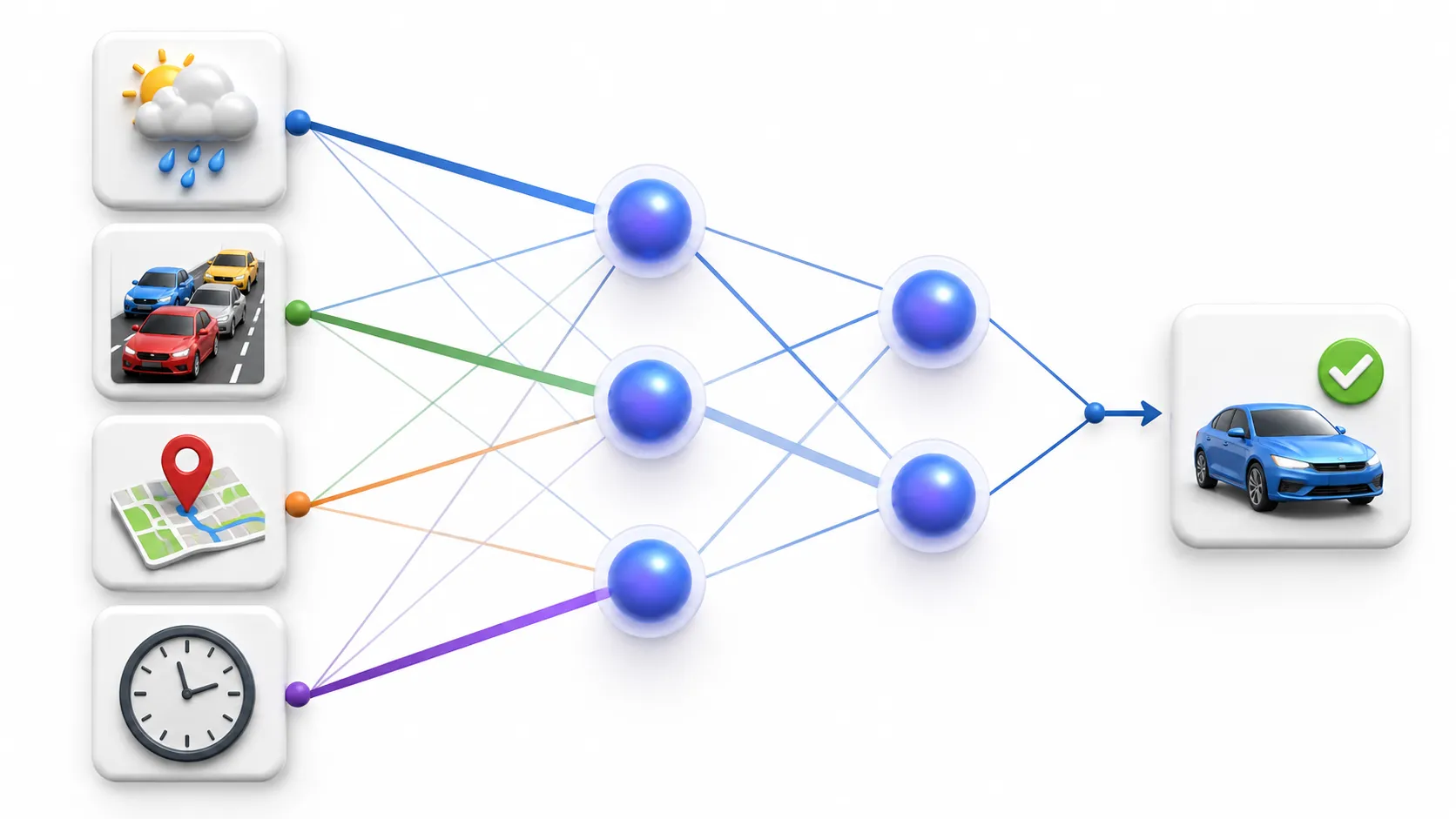
Google's Machine Learning Crash Course describes neural networks as model architectures that can learn nonlinear patterns in data, while IBM and AWS describe them as layered systems of connected artificial neurons that learn useful relationships from examples.
Neural Networks Are Inspired by the Brain, Not Copies of It
You will often hear that an artificial neural network works like a human brain.
That is useful as a starting analogy, but it should not be taken literally.
A human brain is far more complex. Artificial networks only borrow the broad idea of connected units passing signals. In software, those signals are numbers.
This simpler view is enough to understand how neural networks recognize images, process language, and make predictions.
The Three Main Layers of a Neural Network
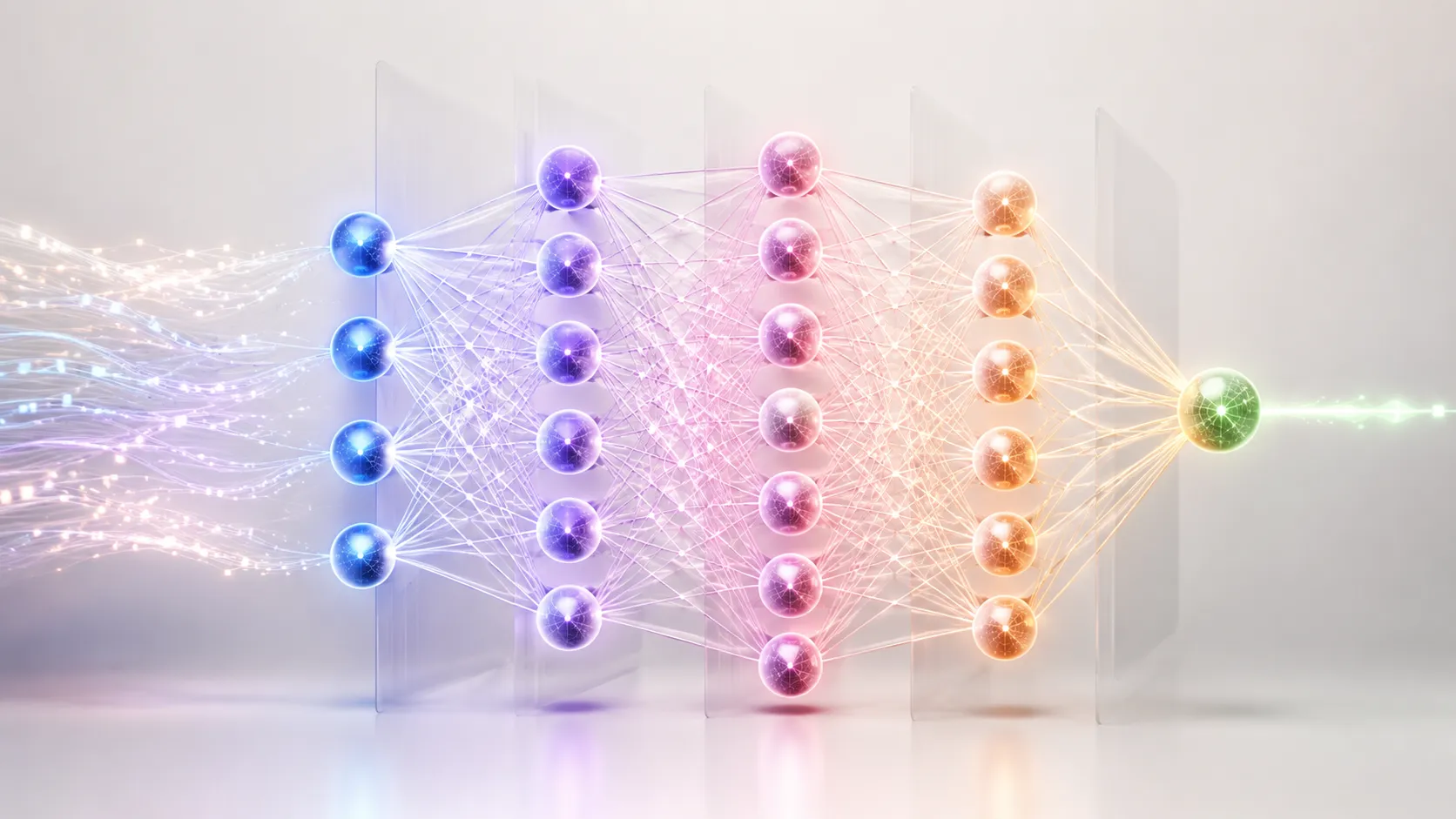
A basic neural network usually has an input layer, one or more hidden layers, and an output layer.
Input Layer
The input layer is where the data enters.
Suppose a food delivery app wants to estimate whether an order will arrive late.
The input may include:
Distance from the restaurant
Current traffic
Weather
Food preparation time
Time of day
The network does not understand “traffic” or “rain” like a person. These details must be represented as numbers.
Those numbers become the starting information for the network.
Hidden Layers
The hidden layers do most of the pattern building.
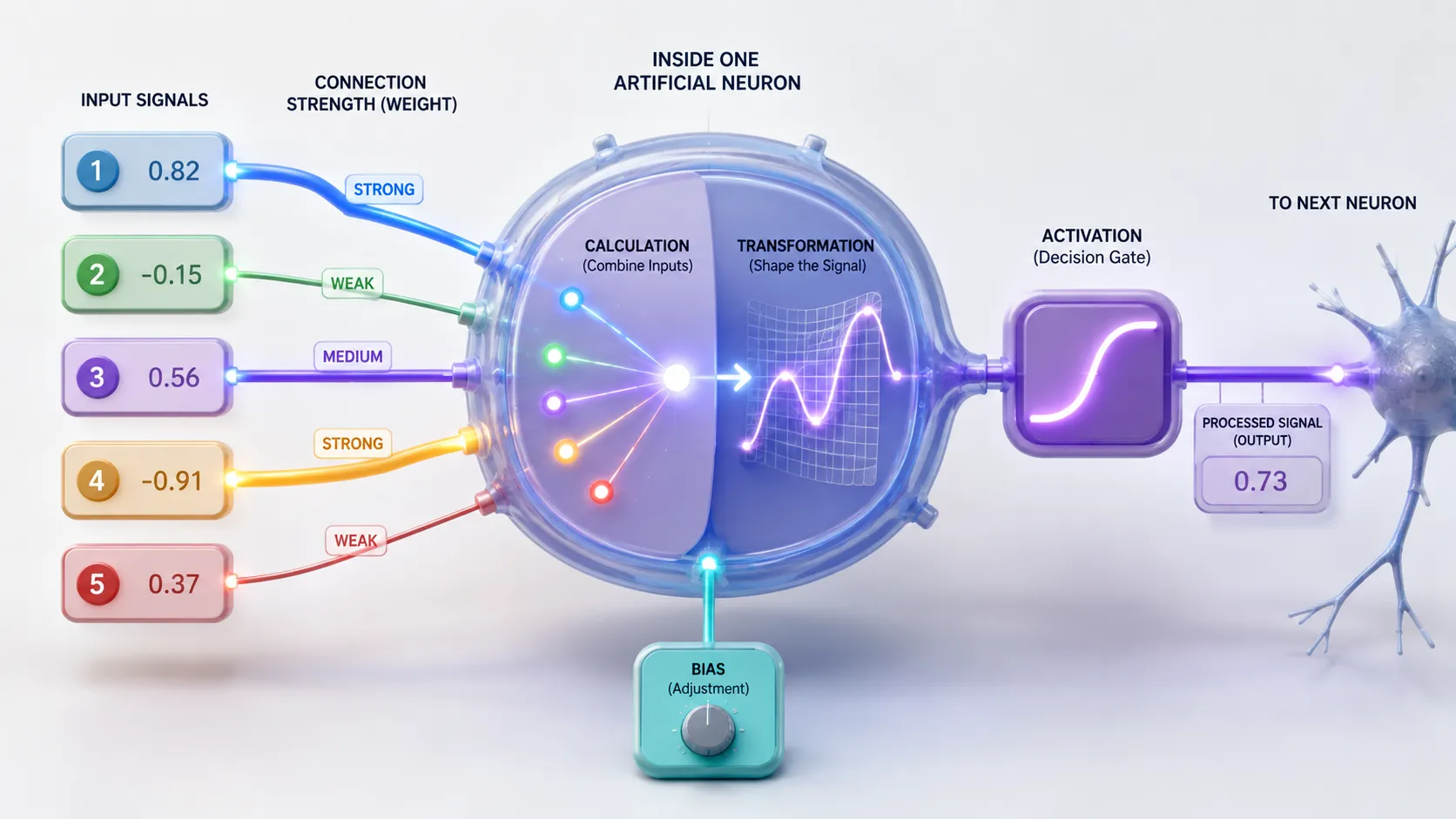
A hidden neuron receives values from the previous layer, gives each value a certain level of importance, combines them, and sends a new value forward.
For example, one hidden layer might learn that:
Long distance + heavy traffic = higher chance of delay
Another layer may discover something more specific:
Heavy traffic + rain + evening rush hour = even higher delay risk
Nobody needs to manually write every possible combination as a rule.
The network can learn useful relationships from training examples.
That ability is one of the biggest reasons neural networks are useful for problems where simple rules are not enough.
When a neural network contains many hidden layers, it is commonly described as a deep neural network. This is where the term deep learning comes from.
Output Layer
The output layer gives the final answer.
For our delivery example, the result might represent a high or low probability that the order will be late.
For an image recognition system, the output might represent the probability that an image contains a dog, cat, car, person, or another object.
For another system, the output could be a predicted price, number, word, or category.
So the output changes depending on the problem the network is built to solve.
What Happens Inside One Artificial Neuron?
Now we reach one of the most important parts of understanding how neural networks work.
Inside an artificial neuron, three ideas matter a lot:
weights, bias, and activation functions.
Think about the delivery prediction again.
Current traffic should probably have a strong effect on the result. The day of the week might matter too, but perhaps not as much.
A neural network handles this difference using weights.
What Is a Weight?
A weight controls how strongly an input affects the calculation.
Imagine traffic has a strong connection with late deliveries. During training, the network may learn to give traffic a stronger weight.
Another input that has little connection with delays may receive a smaller weight.
You can think of weights as importance controls.
The network eventually learns:
“Pay more attention to this signal and less attention to that one.”
What Is Bias?
The next piece is called bias.
Bias is an extra adjustable value added to a neuron's calculation.
An easy way to think about it is as a small adjustment that gives the neuron more freedom when making its decision.
Without getting into heavy mathematics, weights decide how strongly inputs matter, while bias helps shift the point at which a neuron responds.
Both values are changed while the network learns.
What Is an Activation Function?
After the neuron combines its inputs, weights, and bias, the result usually passes through an activation function.
Why do we need another step?
Because real-world relationships are rarely simple straight lines.
Traffic may have little effect at 2 PM but a much stronger effect during rush hour. Rain may matter differently depending on distance, road conditions, and traffic.
Activation functions help neural networks learn these more complex, nonlinear patterns instead of behaving like one giant simple equation.
Google's neural network material identifies hidden layers and activation functions as core components that help networks model nonlinear relationships.
How Information Moves Through the Network
Now put everything together.
The input data enters the network.
Each neuron performs its calculation.
The result moves into the next layer.
That layer performs more calculations.
The process continues until the information reaches the output layer and the network produces a prediction.
This movement from input toward output is called forward propagation, or simply a forward pass.
At the beginning of training, however, the network is not magically intelligent.
Its internal weights have not yet learned which patterns are useful, so its first predictions may be poor.
That creates an important question:
If the network gives the wrong answer, how does it know what to change?
That is where the real learning begins.
The network compares its prediction with the correct answer, measures how wrong it was, and then works backward to find which connections contributed to the mistake.
This introduces four ideas that make neural network training possible:
loss, backpropagation, gradient descent, and repeated training.
Understanding those four ideas will show us how a neural network turns mistakes into learning.
How Does a Neural Network Learn?
A neural network does not become useful just because we connect several layers together.
It has to learn from data.
This learning happens through a repeated cycle:
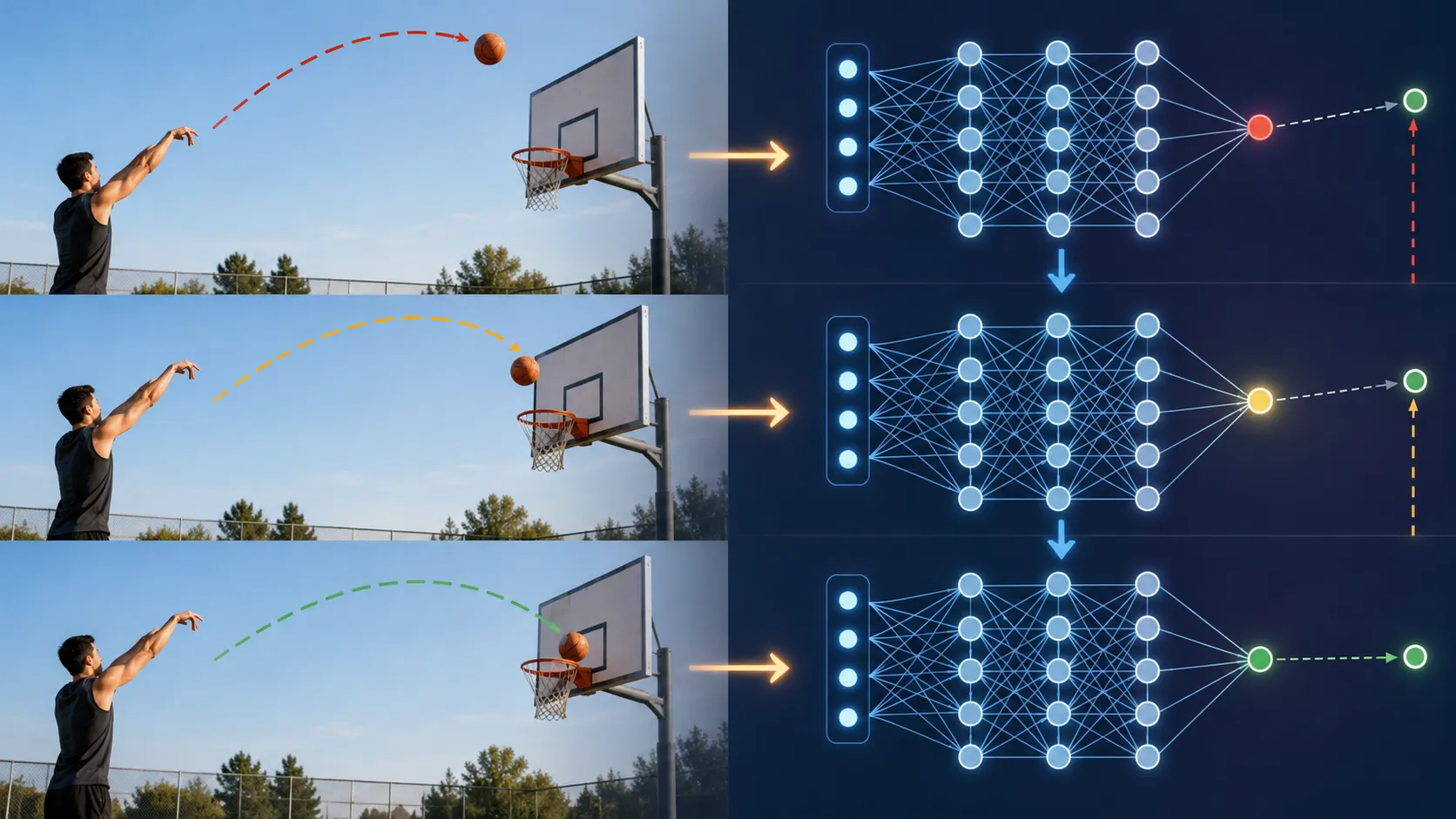
The network makes a prediction, checks how wrong that prediction is, adjusts itself, and tries again.
It may repeat this process thousands or even millions of times.
A simple everyday example can make this much easier to understand.
Imagine you are learning to throw a basketball into a hoop.
Your first shot goes too far to the left.
On the next attempt, you slightly change your angle.
This time the ball hits the front of the rim.
You adjust again.
After many attempts, your brain begins to understand how much force and direction you need.
A neural network learns in a similar way.
It makes mistakes, measures those mistakes, and adjusts its internal values to improve the next prediction.
Step 1: The Neural Network Makes a Prediction
Let us continue with our food delivery example.
Suppose the network receives this information:
The delivery distance is long, traffic is heavy, rain has started, and the restaurant is busy.
The network processes these inputs through its layers.
Each neuron performs calculations using its weights, bias, and activation function.
Finally, the output layer might predict:
“There is a 70% chance this order will be late.”
This prediction is created during the forward pass.
But making a prediction is only the beginning.
The network now needs to know whether that prediction was good or bad.
Step 2: The Network Measures Its Mistake
Suppose the order was actually delivered late.
The prediction was reasonably good.
But imagine the network had predicted only a 10% chance of delay.
That would be a much bigger mistake.
A neural network needs a way to measure how far its prediction is from the correct answer.
This is where a loss function comes in.
What Is a Loss Function?
A loss function gives the network a number that represents how wrong its prediction is.
You can think of it as a mistake score.
A smaller loss generally means the prediction is closer to the correct result.
A larger loss means something needs more adjustment.
Suppose a network is trying to recognize cats in photos.
If an image clearly contains a cat and the network predicts:
Cat: 95%
the loss may be small.
But if the same image receives:
Cat: 8%
the loss will be much larger.
The goal of training is therefore simple:
Reduce the loss as much as possible.
But there is still a problem.
The network may contain thousands, millions, or even billions of adjustable values.
How does it know which values caused the mistake?
That is where backpropagation becomes important.
What Is Backpropagation?
Backpropagation is the process a neural network uses to work backward through the network and understand how its internal parameters contributed to an error.
The name sounds technical, but the basic idea is straightforward.
Imagine four friends are cooking dinner together.
The final dish tastes too salty.
Instead of throwing everything away, they try to find out where the problem came from.
Was too much salt added to the sauce?
Was the stock already salty?
Was another ingredient responsible?
They trace the problem backward.
A neural network does something similar.
It starts with the error at the output and moves backward through the layers.
During this process, it calculates how much different weights contributed to the final mistake.
Weights that had a stronger effect on the error may need a larger correction.
Weights that had little effect may need only a small correction.
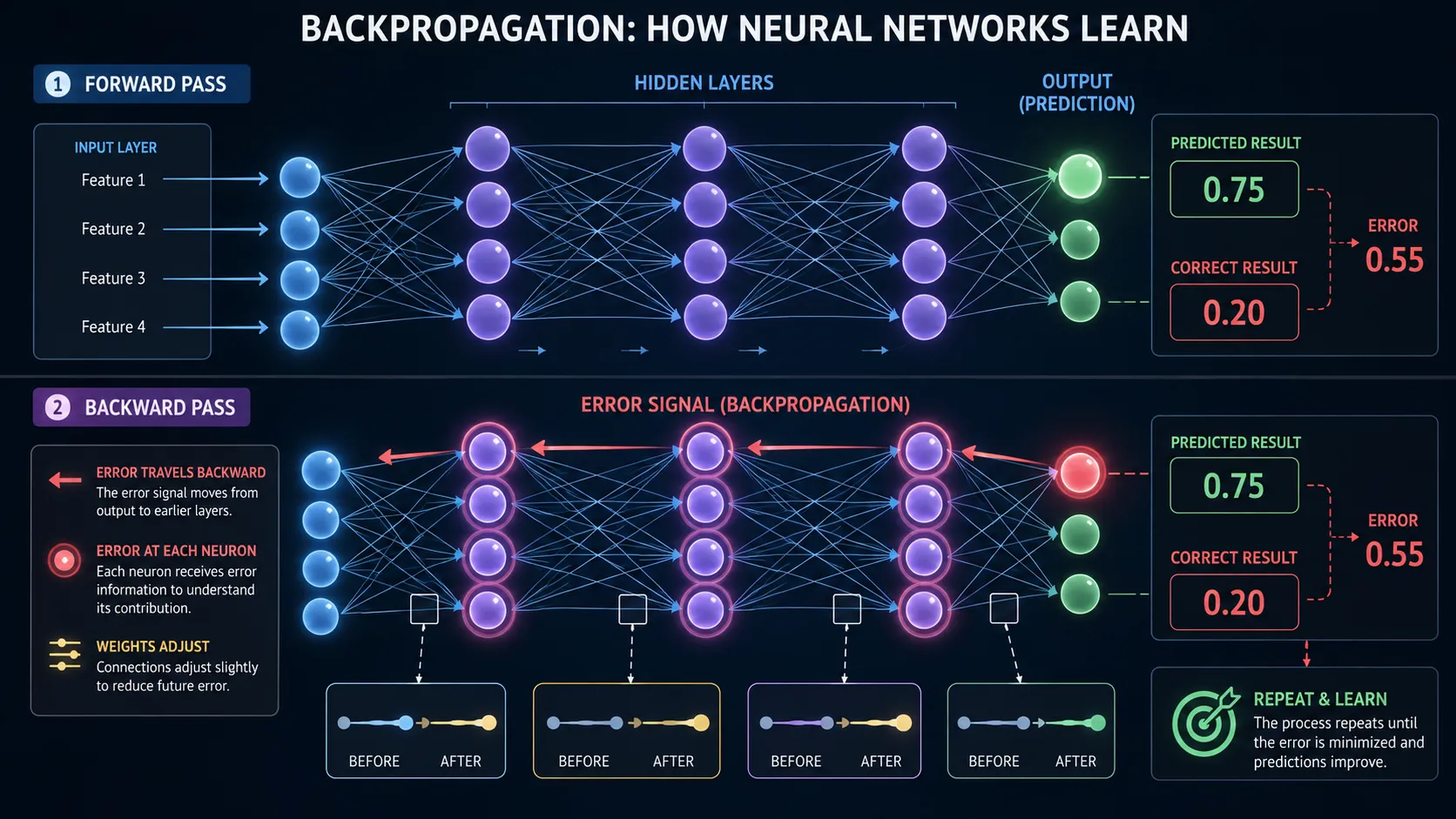
This ability to assign responsibility for an error is a major reason neural networks can learn complex patterns.
How Gradient Descent Improves the Network
Once the network understands which values need adjustment, it still needs to decide how to change them.
This is where gradient descent is commonly used.
Think about standing on a hill in thick fog.
Your goal is to reach the lowest point.
You cannot see the entire hill, but you can feel which direction slopes downward.
So you take a small step downhill.
Then another.
Then another.
Eventually, you move closer to the bottom.
In neural network training, the “height” of the hill represents the loss.
Gradient descent tries to find changes to the network's parameters that reduce that loss.
The network:
Makes a prediction.
Calculates the loss.
Uses backpropagation to find which parameters influenced the error.
Uses gradient descent to adjust those parameters.
Makes another prediction.
This cycle keeps repeating.
Over time, the network hopefully becomes better at the task.
What Is the Learning Rate?
There is another important idea called the learning rate.
The learning rate controls how large each adjustment should be.
Return to our hill example.
If your steps are too large, you might keep jumping past the lowest point.
If your steps are extremely small, you may move in the right direction but take a very long time to get there.
Neural network training faces the same challenge.
A learning rate that is too high can make training unstable.
The network may keep overshooting useful parameter values.
A learning rate that is too low may make learning painfully slow.
Finding a suitable learning rate is therefore an important part of training a neural network.
What Is an Epoch?
A neural network normally learns from a training dataset containing many examples.
Suppose you are training an image classifier using 50,000 images.
When the model has gone through the entire training dataset once, that complete pass is called an epoch.
Training often uses multiple epochs.
Why?
Because seeing the data once may not be enough.
Think about learning a new language.
Reading a vocabulary list once rarely means you remember every word.
Seeing and practising the same concepts several times helps you improve.
Neural networks also improve through repeated exposure.
But more training is not always better.
If a network trains too closely on the same examples, another problem can appear: overfitting.
We will come back to that soon.
A Real-Life Example: Training a Spam Email Detector
Suppose we want to train a neural network to identify spam emails.
We collect many examples of emails that are already labelled:
Some are spam.
Some are normal messages.
The network may receive signals such as:
Words used in the message, unusual links, sender information, message structure, and other useful features.
At first, the model may make many mistakes.
It might classify a normal email as spam.
The loss function measures the mistake.
Backpropagation works backward through the network.
Gradient descent updates the weights.
The model tries again.
After seeing many examples, it may begin learning useful patterns.
Certain combinations of suspicious phrases and links may increase the chance of spam.
Other patterns may suggest that a message is legitimate.
Notice what makes this different from a simple rule-based system.
We do not necessarily have to write a rule such as:
“If this exact sentence appears, mark the message as spam.”
Instead, the network learns combinations and relationships from examples.
That ability becomes extremely useful when the number of possible patterns is too large to describe manually.

Why Training Data Matters So Much
A neural network can only learn from the information it receives.
If the training data is poor, incomplete, incorrect, or heavily biased, the model can learn the wrong patterns.
Imagine teaching someone to recognize dogs but showing them only photos of Golden Retrievers.
They may become very good at recognizing Golden Retrievers while struggling with Huskies, Pugs, or German Shepherds.
The same issue can happen with AI.
A strong neural network therefore needs more than a clever architecture.
It also needs useful, relevant, and reasonably representative training data.
This leads to an important lesson:
A powerful model cannot automatically fix bad data.
Training data, model design, and evaluation all work together.
Training Is Not the Same as Understanding
Neural networks can become extremely good at finding patterns.
But we should be careful with the word “understand.”
If a network identifies a dog in an image, it does not necessarily understand a dog in the same rich way a person does.
It has learned numerical patterns that are useful for making the prediction.
That distinction becomes important when we talk about what neural networks can do well, where they fail, and why deeper networks can solve more complex problems.
Next, we can connect all of this to deep neural networks, image recognition, language models, overfitting, real-world applications, and the limits of neural networks.
What Makes a Neural Network “Deep”?
A neural network becomes a deep neural network when it contains multiple hidden layers between the input and output.
That is the basic idea behind deep learning.
But adding more layers is not just about making the network bigger.
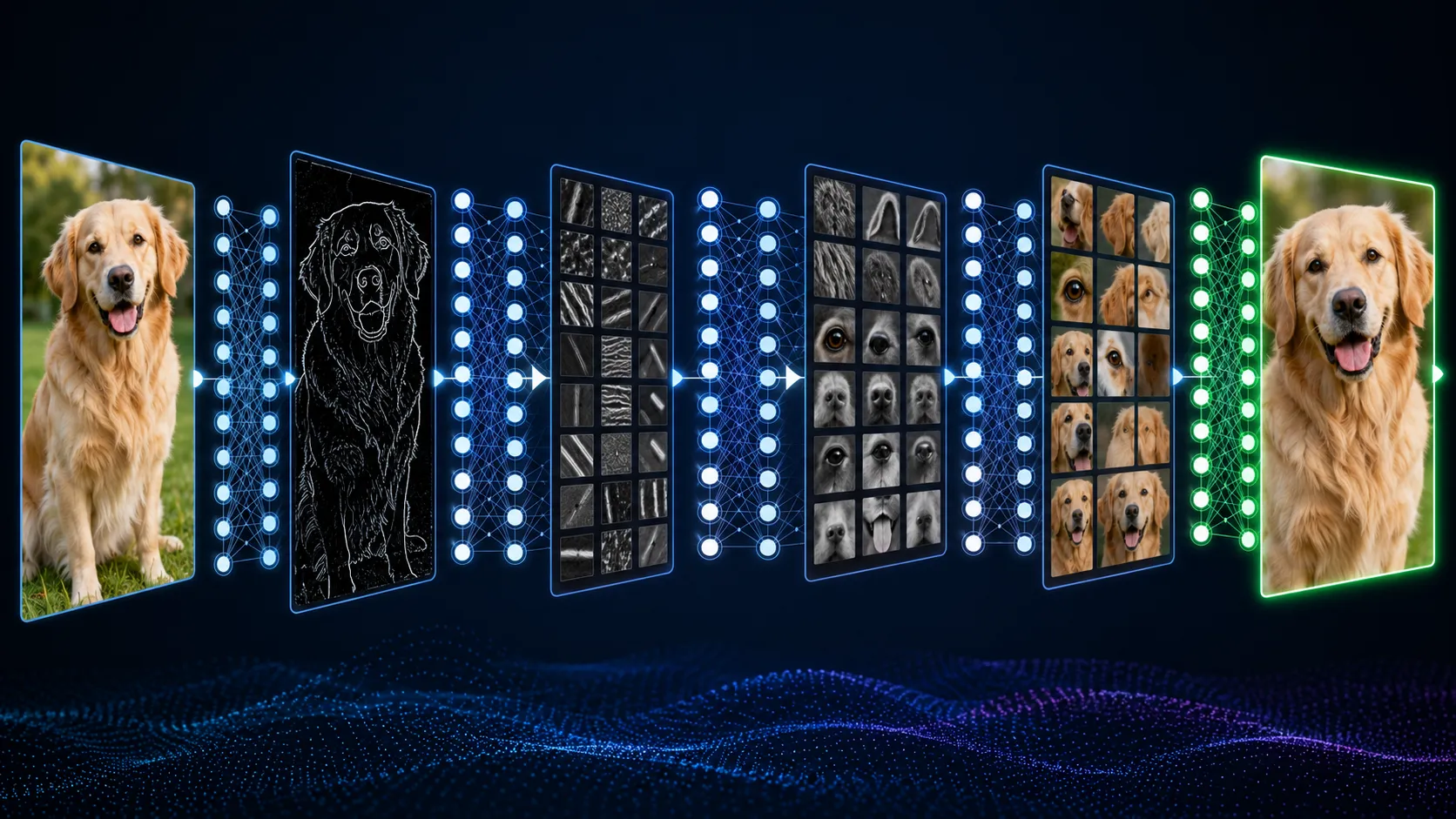
Different layers can learn different levels of patterns.
Imagine a neural network looking at a photo of a dog.
The first hidden layers may notice simple details such as:
Edges, lines, colours, and shapes.
Deeper layers may combine those patterns and notice:
Eyes, ears, fur, or the outline of a face.
Even deeper layers may combine those features and finally recognize:
“This looks like a dog.”
This layered learning is one reason deep neural networks became so useful for images, speech, text, and other complex forms of data.
How Neural Networks Recognize Images
Image recognition is one of the easiest ways to understand the power of neural networks.
Suppose we want to build a system that can recognize cats and dogs.
A computer sees an image as numbers representing pixel values.
At first, those numbers do not mean “cat” or “dog.”
During training, the neural network sees many labelled examples.
It slowly learns which patterns are useful.
For example, it may learn combinations of:
Ear shapes, facial structure, fur patterns, body shape, and other visual details.
Importantly, the network does not need one fixed rule such as:
“If the ears are pointed, it must be a cat.”
That rule would fail quickly because some dogs also have pointed ears.
Instead, the model learns many patterns together.
This is why neural networks are useful when a problem is too complex for a small set of handwritten rules.
How Neural Networks Work With Language
Neural networks are also heavily used in systems that process text.
Think about autocomplete on your phone.
You type:
“I will call you…”
and the keyboard may suggest:
“later.”
The system has learned patterns from language data.
Modern language models use much more advanced neural network architectures to learn relationships between words, phrases, sentences, and longer pieces of text.
They work with numerical representations rather than seeing words exactly as humans do.
During training, the model learns patterns such as which words often appear together and how context can change meaning.
This idea is part of what powers systems used for:
Translation, text generation, search, summarization, chat assistants, and many other language tasks.
The architecture may be much more advanced than our basic neural network example, but the core learning idea is still familiar:
Input → prediction → error → adjustment → improvement
Where Neural Networks Are Used in Everyday Life
You probably interact with neural networks more often than you realize.
Recommendation Systems
Streaming and shopping platforms can use machine learning models to understand patterns in user behaviour.
Your activity may help the system estimate which movie, song, video, or product you might prefer.
The system is not reading your mind.
It is finding patterns in data and predicting what is likely to interest you.
Voice Assistants and Speech Recognition
When you speak to a voice assistant, the system has to turn sound waves into useful information.
Neural networks can help recognize speech patterns, sounds, pronunciation, and language.
Fraud Detection
Banks and payment companies can use machine learning to find unusual transaction patterns.
For example, a transaction that looks very different from someone's normal activity may receive more attention.
Healthcare
Neural networks can help analyse certain medical images and other healthcare data.
However, healthcare is a high-stakes area, so an AI prediction should not automatically be treated as a replacement for qualified medical judgement.
Navigation and Transport
Machine learning can also help with traffic predictions, estimated arrival times, and other transport-related decisions.
All these examples may look very different on the surface, but underneath them is the same broad idea:
Learn useful patterns from data and use those patterns to make predictions.

Why Neural Networks Sometimes Fail
Neural networks are powerful, but they are not perfect.
Understanding their weaknesses is just as important as understanding their strengths.
Overfitting
One common problem is overfitting.
Overfitting happens when a model learns the training data too closely but struggles with new data.
Imagine a student who memorizes every answer from one practice paper.
If the real exam contains slightly different questions, the student may struggle.
A model can face the same problem.
Good machine learning is not just about performing well on data the network has already seen.
The real goal is to perform well on new, unseen data.
Poor Training Data
If the training data contains bad information, the neural network can learn bad patterns.
This is why data quality matters so much.
A model trained on incomplete or unrepresentative examples may perform poorly in real situations.
Bias in Data
Data can also contain existing biases.
If those patterns are learned without careful evaluation, the model can repeat or even strengthen them.
This becomes especially serious when AI is used in important decisions.
Neural Networks Can Be Hard to Explain
Some neural networks contain millions or billions of parameters.
When such a model produces an answer, it may be difficult to explain every internal calculation that led to that exact prediction.
This is sometimes described as the black box problem.
Researchers use many techniques to understand model behaviour better, but interpretability can still be challenging.
Neural Networks vs Traditional Programming
Traditional programming often works like this:
Rules + Data → Answer
A developer writes instructions, the computer follows them, and an output is produced.
Machine learning changes that relationship.
You provide examples, and the model learns useful patterns from those examples.
A simplified view looks like this:
Data + Correct Examples → Learned Model
The learned model can then receive new data and make predictions.
For example, writing every possible rule for recognizing a dog would be almost impossible.
Dogs can appear in different sizes, colours, positions, lighting conditions, and backgrounds.
A neural network can instead learn from many examples.
This is one reason neural networks became so important for problems involving complex patterns.
Neural Network Training in One Complete Example
Let us connect everything using one final scenario.
Imagine we want to train a neural network to recognize whether a photo contains a dog.
First, the image is converted into numbers the network can process.
Those numbers enter the input layer.
The information moves through the hidden layers.
Neurons combine inputs using weights and bias.
Activation functions help the network learn nonlinear patterns.
The network produces an answer through the output layer.
Suppose it predicts:
“20% chance of dog.”
But the image actually contains a dog.
The loss function measures how wrong that prediction was.
Backpropagation calculates how different parameters contributed to the error.
Gradient descent adjusts those parameters.
The network receives more examples and repeats the process.
After enough useful training, it may become much better at recognizing dogs it has never seen before.
The Simple Way to Remember How Neural Networks Work
You do not need to memorize dozens of formulas to understand the main idea.
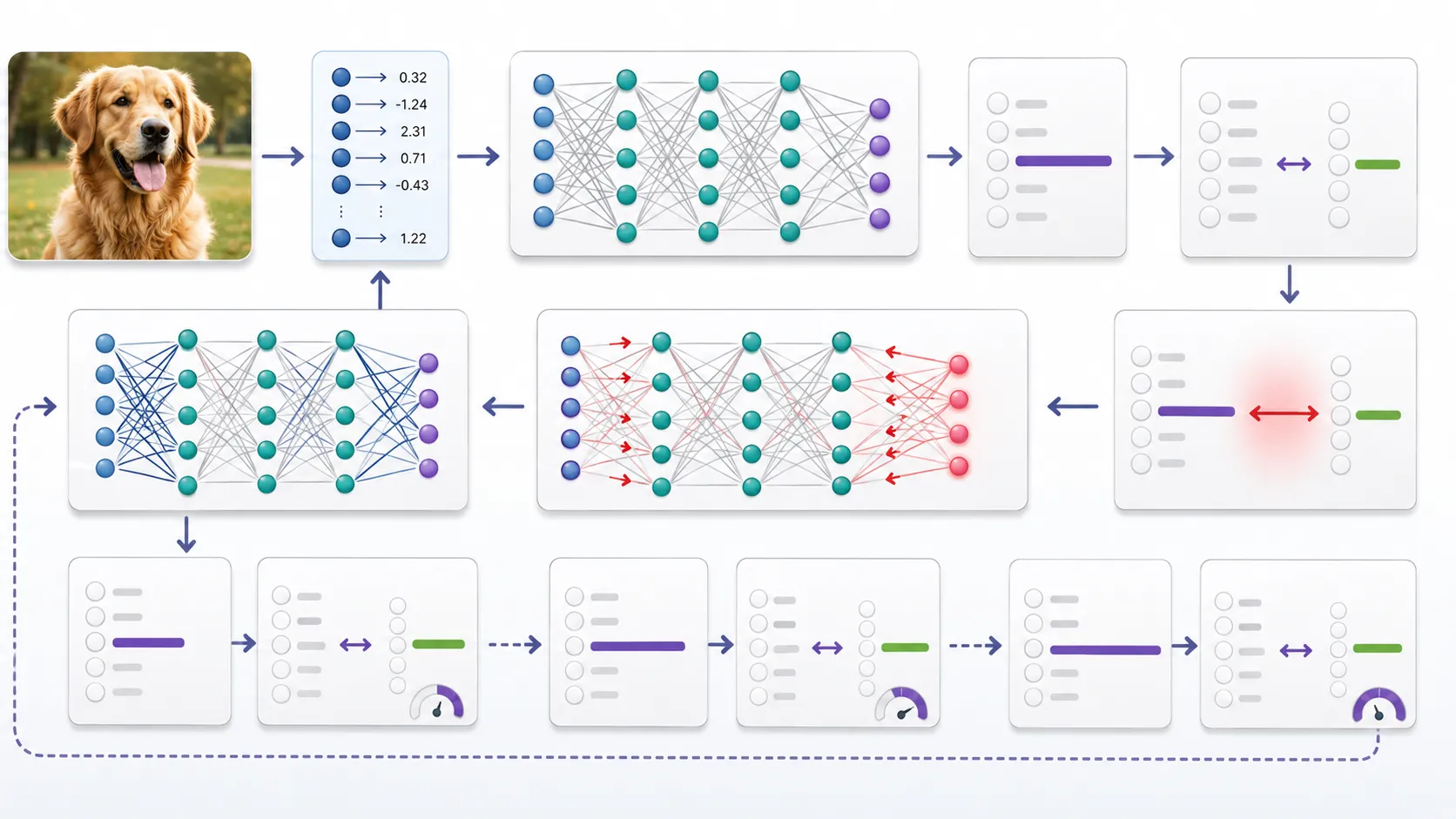
Remember this flow:
Data enters → neurons process it → layers build patterns → the network makes a prediction → the error is measured → weights are adjusted → the process repeats
That is the heart of how neural networks learn.
Modern neural networks can be extremely large and complex, but they are still built around these basic ideas.
Final Thoughts
The term “neural network” can sound intimidating when you first hear it.
But once the process is broken into small steps, the idea becomes much easier.
A neural network receives data, passes it through connected layers, makes predictions, learns from mistakes, and gradually improves its internal parameters.
The real power comes from repetition.
One example teaches almost nothing.
Thousands or millions of useful examples can help the network discover patterns that would be extremely difficult to describe with traditional rules.
That is why neural networks sit behind so many modern AI systems.
And if you remember only one thing from this guide, remember this:
A neural network does not start intelligent. It becomes useful by repeatedly making predictions, learning from errors, and adjusting the connections inside the network.
Once you understand that cycle, you already understand the foundation of neural networks and a large part of how modern deep learning works.
Frequently Asked Questions About Neural Networks
What Is a Neural Network?
A neural network is a machine learning model that learns patterns from data. It is made of connected artificial neurons arranged in input, hidden, and output layers. Data enters the network, moves through these layers, and is turned into a prediction or result. Neural networks are commonly used for tasks such as image recognition, speech recognition, recommendations, and language processing.
How Does a Neural Network Learn?
A neural network learns by making predictions and checking them against the correct answers. When its prediction is wrong, a loss function measures the error. The network then uses backpropagation and methods such as gradient descent to adjust its weights. This process repeats many times, helping the network make better predictions as training continues.
What Do Hidden Layers Do in a Neural Network?
Hidden layers help a neural network discover useful patterns inside the input data. Early hidden layers may learn simple patterns, while deeper layers can combine them into more complex patterns. For example, in image recognition, one layer may notice edges while later layers may recognize eyes, ears, shapes, or complete objects.
What Are Weights in Neural Networks?
Weights control how important each input or connection is to a neural network's prediction. A stronger weight means that a particular signal has more influence on the result, while a smaller weight gives it less influence. During training, the network continuously adjusts these weights so its predictions become more accurate.
What Is Bias in Neural Networks?
Bias is an extra adjustable value used inside an artificial neuron. It helps the neuron shift its calculation instead of depending only on the input values and their weights. In simple terms, weights decide how strongly different inputs matter, while bias gives the neuron more flexibility when deciding how to respond.
How Does AI Learn Patterns?
AI learns patterns by studying many examples in training data. A neural network makes a prediction, measures its error, and adjusts its internal weights and biases. After repeating this process across many examples, the model can discover relationships in the data and use them to make predictions about new information it has not seen before.


