


Have you ever wondered how Google Photos finds pictures of your dog, how Netflix guesses what you may watch next, or how your email moves suspicious messages into spam?
None of these systems were born knowing what a dog, a movie taste, or a spam email looks like.
They learned by seeing data, finding patterns, making mistakes, and adjusting.
That simple idea is the heart of how AI learns from data.
The word “learns” can make artificial intelligence sound almost human. But an AI model does not understand a lesson the way you do. In most machine learning systems, learning means changing internal numbers—often called parameters—so the model becomes better at producing the right output.
Once you understand this, AI stops feeling like magic.
It starts looking like a process.
What Does “Learning From Data” Really Mean?
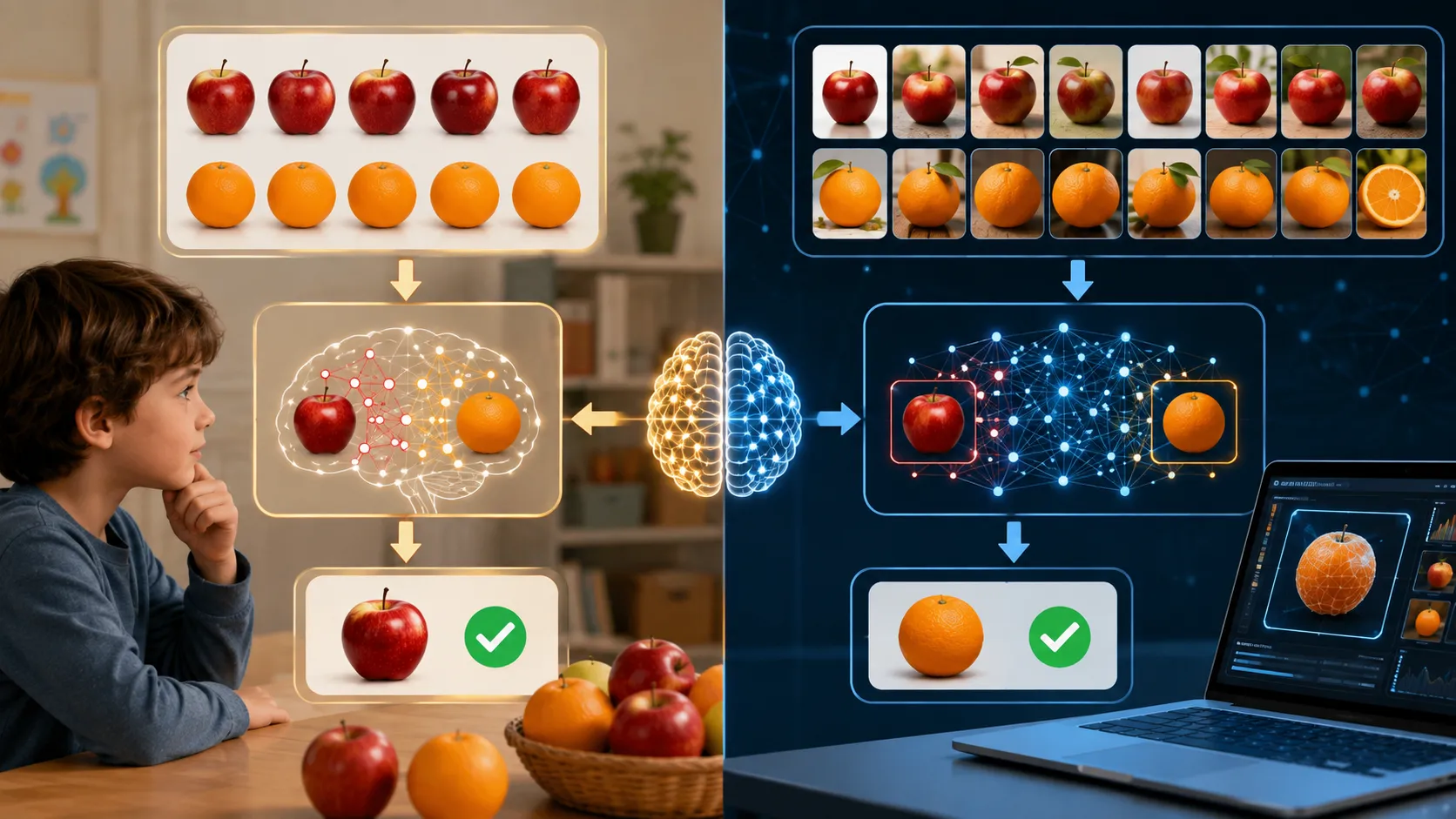
Imagine you want to teach a child the difference between an apple and an orange.
You show several examples. After seeing enough of them, the child starts recognizing a new fruit without needing a fresh explanation every time.
Machine learning follows a similar high-level idea, although the mechanism is mathematical.
A model receives examples, uses information from them as input, makes a prediction, compares that prediction with the expected result when one is available, and changes during training.
Google’s Machine Learning Crash Course explains model training as an iterative process in which parameters are adjusted to reduce prediction error. Scikit-learn also describes model fitting as learning from supplied data.
AI Starts With Data, Not Intelligence
Before a model can learn anything useful, it needs data connected to the problem we want it to solve.
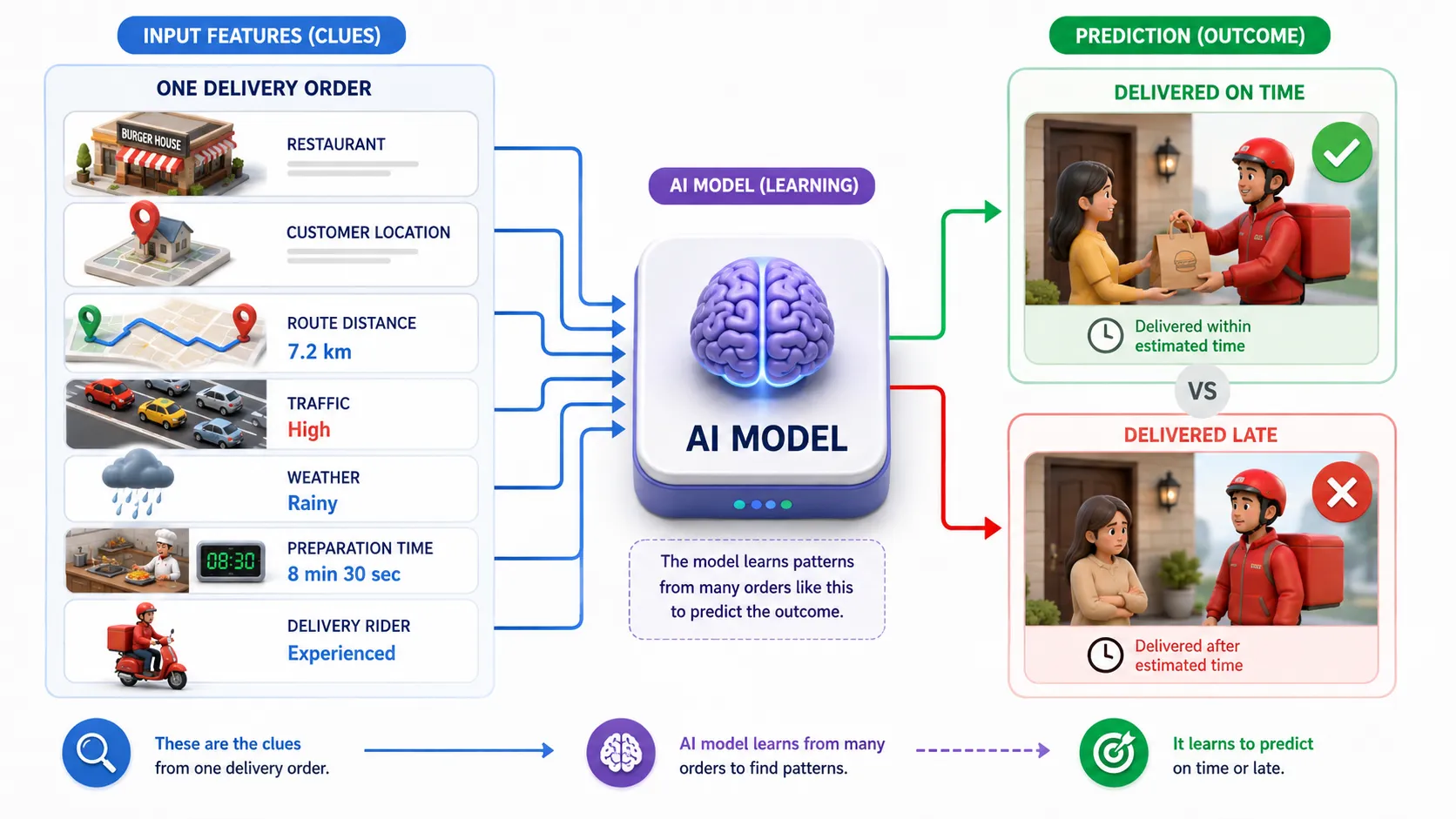
Suppose a food delivery company wants to predict whether an order will arrive late.
Past orders might contain details such as:
distance between the restaurant and customer
restaurant preparation time
traffic conditions
weather
order time
whether the order actually arrived late
Those past records become learning material.
This is why training data in machine learning matters so much.
A model can only discover patterns represented in the data it receives. If records are incomplete, outdated, wrongly labeled, or heavily biased toward one situation, the model may learn a distorted picture.
More data is not automatically better data.
Relevant, clean, and representative examples matter too. Google’s machine-learning guidance recommends checking data quality and testing models against examples that properly represent the real-world problem.
Think of it this way.
Imagine preparing for a driving test using only examples of completely empty roads.
You may learn how a car works, but the first busy intersection will expose everything your practice data failed to teach you.
AI can face the same problem when its AI training data does not match reality.
Raw Data Becomes Useful Signals
A dataset may contain many details, but a model needs those details in a form it can use.
In supervised machine learning, input information is commonly called a feature, while the answer we want the model to predict is called a label.
Return to our delivery example.
“Distance from restaurant to customer” could be one feature.
“Traffic level” could be another.
The label could simply be:
Late or on time?
So the learning question becomes:
Given these details about an order, what usually happens next?
A spam filter follows the same basic idea.
Words in an email, sender information, links, message structure, and other signals can become features. Historical emails already marked as “spam” or “not spam” can provide labels.
Google also uses spam filtering as an example of learning from labeled email data.
This gives us an easy way to understand features and labels in machine learning:
Features provide the clues.
The label provides the answer the model is trying to learn.
The Model Starts Finding Patterns
Now comes the part that feels intelligent.
Imagine our delivery dataset contains thousands of past orders.
The model may discover that long-distance orders are not always late.
But perhaps long-distance orders placed during rush hour and prepared by slower restaurants are late more often.
Nobody necessarily has to write that exact rule by hand.
During training, the algorithm changes the model so useful signals have the right influence on its predictions.
This is AI pattern recognition in a practical sense.
A beginner-friendly way to imagine the process is to picture several adjustable importance knobs.
At first, the model does not know how much each signal should matter.
Maybe distance gets too much importance.
Maybe traffic gets too little.
The model makes a prediction, checks how wrong it was, and training gradually changes those internal settings.
In many machine-learning models, these adjustable values are called weights.
An error measurement called loss tells the training process how wrong a prediction is. Optimization methods such as gradient descent can then adjust model parameters in a direction designed to reduce that loss.
We will unpack this complete AI model training process in the next section without turning it into a mathematics class.
A Live Example: How a Spam Filter Learns
Suppose we give a model thousands of historical emails labeled as spam or not spam.
At first, its predictions may be poor.
It might treat the word “Congratulations” as a strong sign of spam.
Then it sees genuine birthday messages containing the same word.
Now one clue is no longer enough.
Across many examples, stronger combinations can become useful: suspicious links, unusual sender patterns, repeated sales language, strange formatting, or other signals.
The important point is that the model is not simply keeping a fixed dictionary saying:
“this word = spam.”
Instead, it learns statistical relationships between input patterns and outcomes.
Then a completely new email arrives.
The model has never seen that exact message before.
Yet if its learned patterns generalize well, it can estimate whether the new message is likely to be spam.
This ability to work on unseen examples is one of the most important goals of machine learning. That is also why proper model evaluation uses separate validation and test examples instead of simply testing the model on the same data it trained on.
And that gives us the most important idea so far:
AI learning is not about memorizing every example. Good learning means finding patterns that still work when the next example is new.
How Does an AI Model Actually Learn?
We now know that AI needs data and that useful information inside that data becomes features.
But one important question is still left:
How does the model improve itself after seeing those examples?
Imagine you are learning to throw a basketball into a hoop.
Your first shot goes too far to the left.
On the next attempt, you change your aim slightly.
The ball now goes too far to the right.
You adjust again.
After many attempts, your shots become more accurate because each mistake gives you information about what should change.
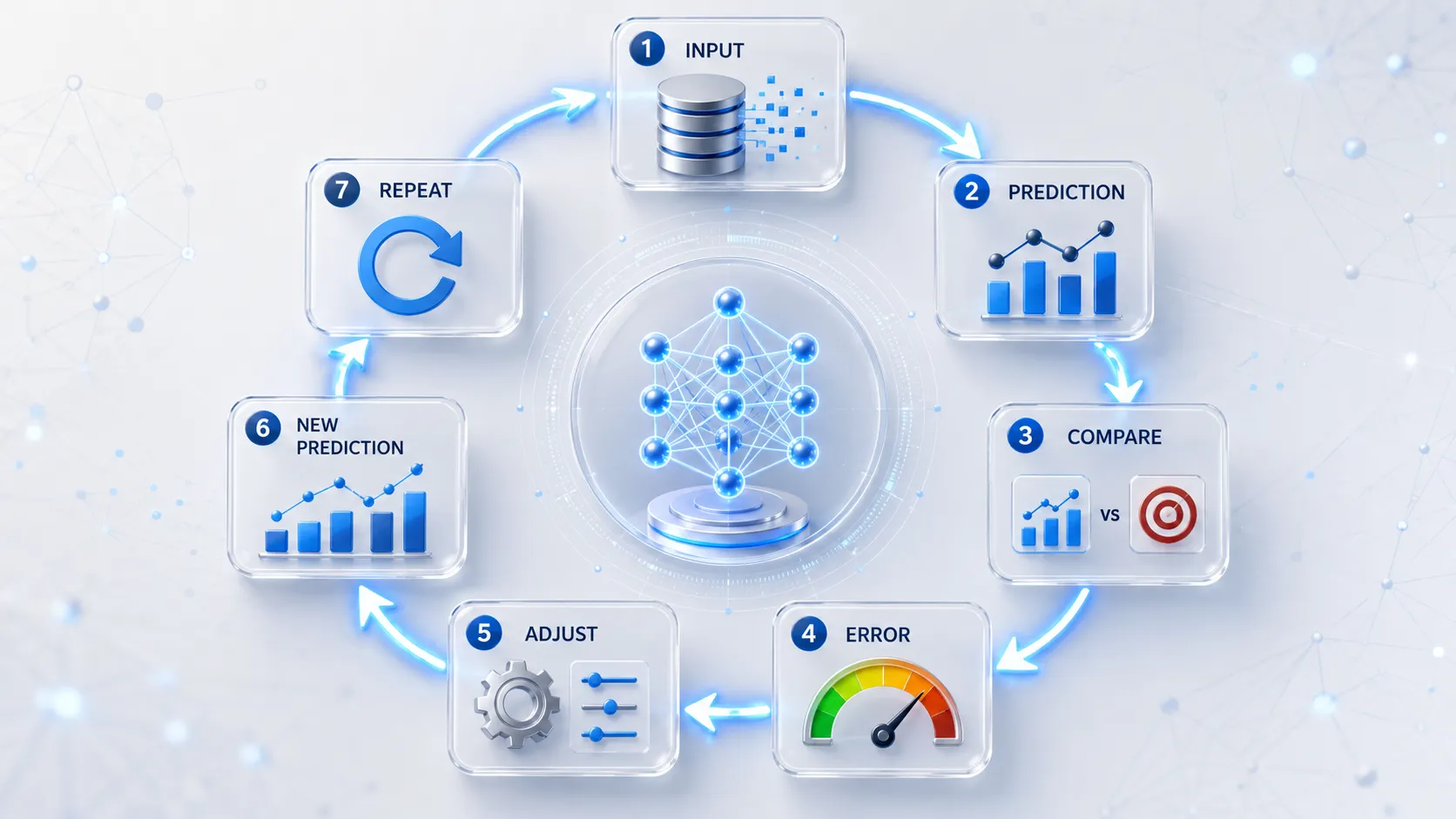
Many machine learning systems follow a similar learning loop:
Make a prediction → measure the mistake → adjust → try again.
That repeated correction process is one of the simplest ways to understand how machine learning models learn.
Step 1: The Model Makes Its First Prediction
Let us use a real-life example.
Suppose we want to create an AI model that predicts the price of a house.
Our historical data contains details such as:
house size
number of bedrooms
location
age of the property
nearby facilities
actual selling price
Imagine a house with an actual selling price of $300,000.
The model sees its features and predicts:
$240,000
The prediction is wrong.
But that mistake is useful.
During training, the model needs a way to measure how wrong its prediction was.
That is where a loss function in machine learning becomes important.
Step 2: Loss Tells the Model How Wrong It Was
Loss is a numerical measure of prediction error.
In simple terms:
A poor prediction usually produces higher loss.
A better prediction usually produces lower loss.
Google’s Machine Learning Crash Course describes loss as a numerical measure showing the difference between a model’s prediction and the actual label. Training aims to reduce that loss.
You do not need to memorize the mathematics to understand the idea.
Suppose the real house price is $300,000.
If Model A predicts $295,000 and Model B predicts $180,000, Model A is clearly closer to reality.
The loss function gives the training process a mathematical way to represent that difference.
But simply knowing that a prediction is wrong is not enough.
The model also needs to change something.
That brings us to weights.
Step 3: AI Adjusts Its Weights
Remember the adjustable importance knobs we discussed earlier?
Those are a useful way to imagine model weights.
Suppose our house-price model looks at:
house size, bedrooms, property age, and location.
At the beginning of training, the model might give too much importance to the number of bedrooms and too little importance to location.
So its predictions may be inaccurate.
Training gradually changes these internal weights.
For example, the model may learn that an extra bedroom matters, but location has an even stronger relationship with price in the available training data.
These changes are not normally written manually as thousands or millions of individual rules.
The learning algorithm adjusts model parameters during training so that future predictions can produce lower loss.
Step 4: Gradient Descent Helps Find Better Settings
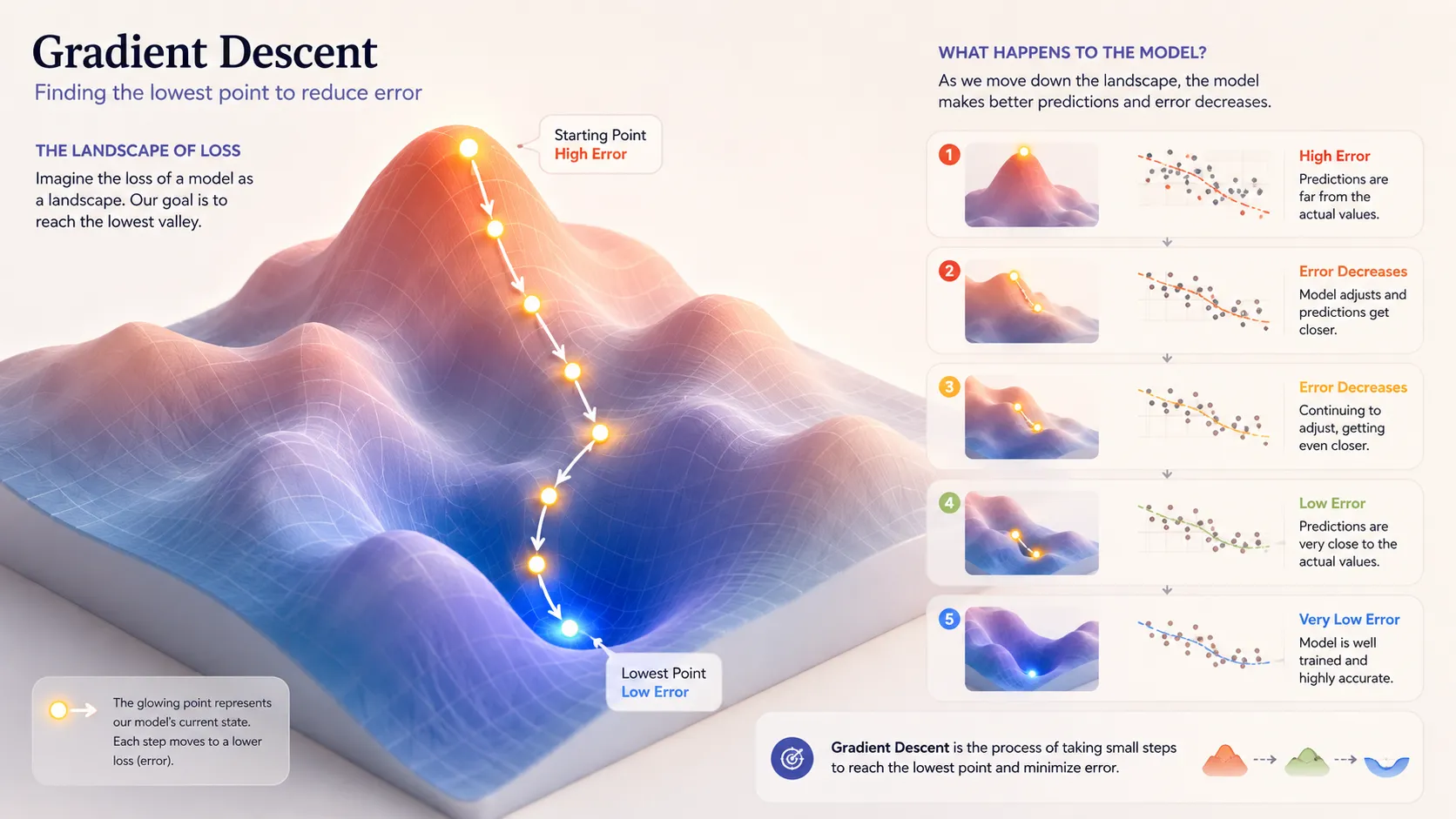
One common method used to improve model parameters is called gradient descent.
The name sounds complicated, but the basic idea is surprisingly simple.
Imagine standing somewhere on a hill while surrounded by fog.
Your goal is to reach the lowest point.
You cannot see the complete landscape, so you check which nearby direction slopes downward and take a step.
Then you check again.
Step by step, you move toward a lower position.
Gradient descent does something similar with model loss.
It repeatedly adjusts weights and bias in a direction intended to reduce the model’s loss. Google describes gradient descent as an iterative technique for finding weights and bias that produce lower loss.
So our learning cycle now looks like this:
Input data → prediction → calculate loss → adjust weights → make another prediction.
Then the cycle repeats.
Why Does Training Repeat Again and Again?
A model rarely becomes useful after looking at every example only once.
Training often involves repeated passes through data.
A complete pass through the training dataset is commonly called an epoch. Settings such as the learning rate, batch size, and number of epochs affect how the training process runs.
Think again about learning basketball.
One shot tells you very little.
Hundreds of attempts provide much more information.
The same idea applies to an AI model, although simply training for longer does not guarantee a better model.
At first, repeated training may reduce mistakes.
But eventually another problem can appear.
The model may become extremely good at the examples it has already seen while becoming less useful on new examples.
This problem is called overfitting.
Training Data Is Not Enough
Imagine a student gets 100 practice questions before an exam.
Instead of understanding the subject, the student memorizes the answers.
During practice, the student scores almost 100%.
Then the real exam contains different questions.
Suddenly, the score drops badly.
That student did not truly learn how to solve the problem.
They memorized the practice set.
AI models can do something similar.
Google defines overfitting as a situation where a model matches the training data so closely that it performs poorly on new data.
That is why good machine learning training does not evaluate success only on examples the model has already seen.
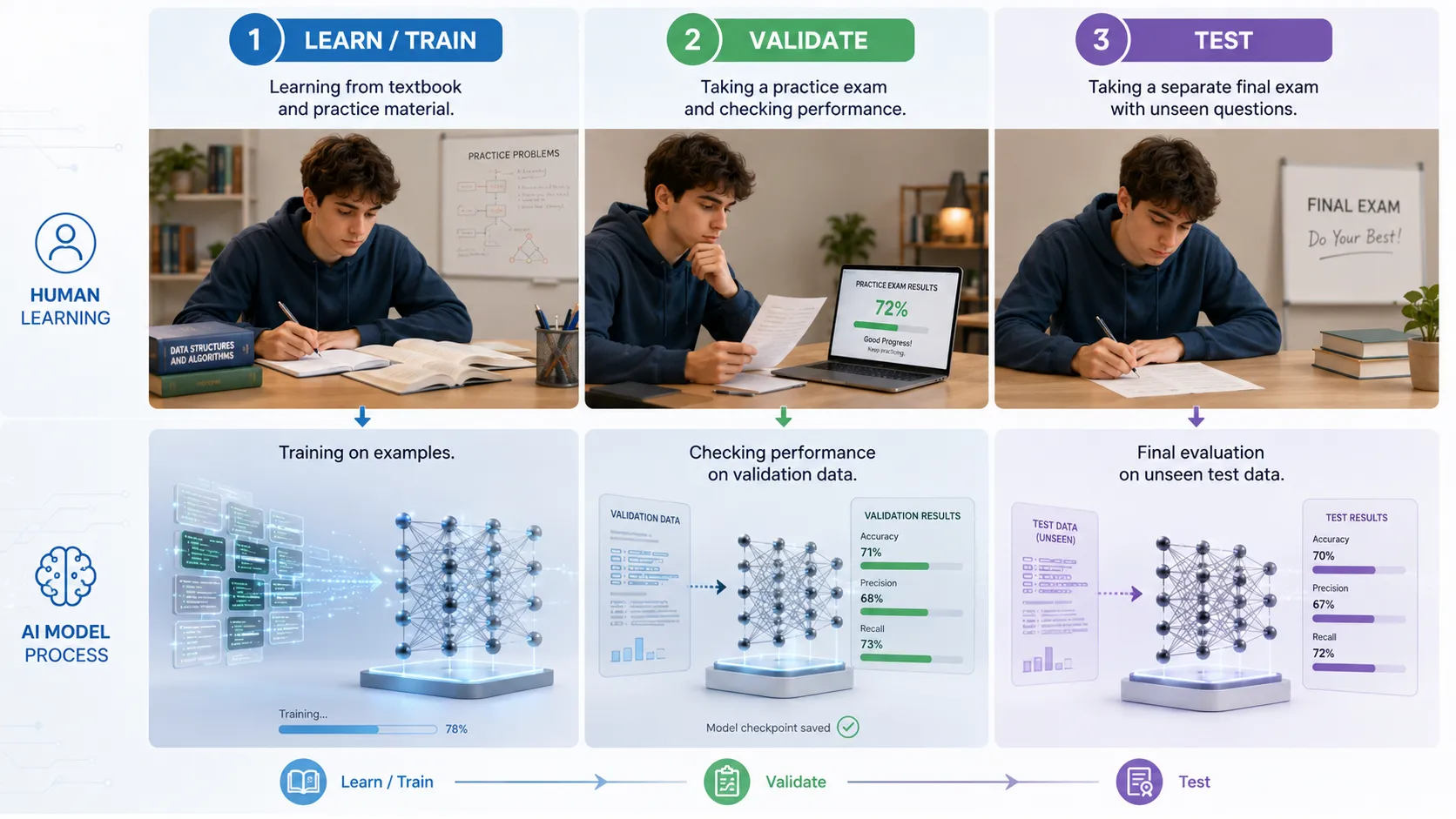
Training, Validation, and Test Data
A common approach is to divide available data into separate groups.
The training set is used to teach the model.
The validation set helps developers check the model during development and make decisions about settings or model versions.
The test set is kept separate so the final model can be evaluated on unseen examples.
Google’s machine-learning guidance recommends separating training, validation, and test data because evaluating only on training examples does not provide a fair picture of how the model will behave on new data.
Here is an easy way to remember it:
Training data is like your textbook.
Validation data is like a practice exam.
Test data is like the final exam.
The final exam matters because the real purpose of most machine learning models is not to perform perfectly on the past.
It is to make useful predictions about the future or about new information it has never seen before.
A Real-World Example: Predicting Food Delivery Time
Now combine everything we have learned.
Imagine a delivery app wants to estimate how many minutes your food will take to arrive.
The model receives past order data.
It looks at useful features such as distance, restaurant preparation time, traffic, order time, and previous delivery results.
It makes a prediction.
Suppose the model predicts 25 minutes, but the real delivery takes 38 minutes.
The prediction error creates loss.
The training process adjusts model parameters.
The model tries again across many other orders.
Over repeated training, useful patterns can become stronger.
But the company cannot simply celebrate because the model performs well on old orders.
It must test whether the model also works on orders it did not train on.
That difference between remembering old examples and performing well on unseen data is called generalization, and it is one of the central goals of machine learning. Google’s guidance emphasizes evaluating models on new examples rather than duplicated training examples.
So when someone says:
“The AI learned from the data,”
what often happened behind the scenes was much closer to this:
The model made predictions, measured errors, adjusted internal parameters, repeated the process many times, and was finally tested on data it had not already seen.
That is learning in machine learning.
But not every AI system learns in exactly the same way.
Some learn from labeled answers. Some find hidden groups without labels. Others learn by trying actions and receiving rewards or penalties.
And understanding those different learning styles is where the next part becomes especially interesting.
Different Ways AI Can Learn From Data
So far, we have followed one common learning process: give a model examples, let it make predictions, measure its mistakes, and improve those predictions over time.
But there is an important detail.
Not every AI system learns in the same way.
The type of data available—and the problem we want to solve—changes how the learning process works.
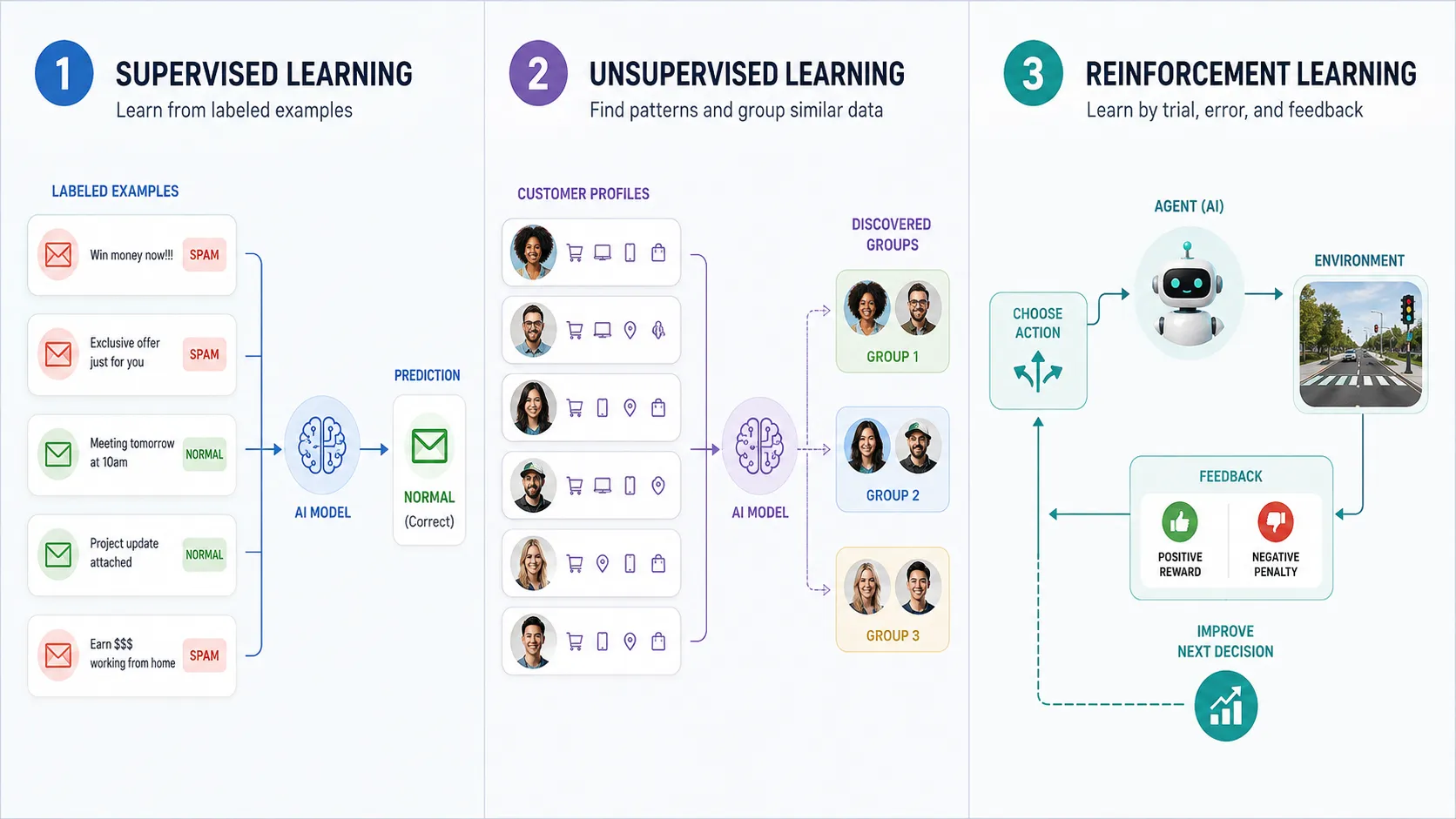
For beginners, the three most useful learning styles to understand are:
supervised learning
unsupervised learning
reinforcement learning
Once you understand these three, many AI systems you see in daily life become much easier to understand.
Supervised Learning: Learning With Correct Answers
Supervised learning is probably the easiest type of machine learning to understand.
In supervised learning, the model trains on examples where the correct answer is already known.
Remember our spam email example?
Each past email may already have a label such as:
Spam
or
Not Spam
The model studies the relationship between the email's features and the correct label.
Over time, it learns patterns that can help it classify a completely new email.
Think of supervised learning like studying with a teacher who gives you both the question and the answer.
You try to understand the pattern so that when a new question appears, you can solve it yourself.
Real-Life Example: Detecting Fraudulent Payments
Imagine a bank has millions of past card transactions.
Some are marked as genuine.
Others are confirmed fraud.
Each transaction may contain information such as purchase amount, location, time, merchant type, device information, and previous customer activity.
A supervised machine learning model can learn from these labeled examples.
Then, when a new transaction appears, the model can estimate whether its pattern looks normal or suspicious.
The important point is that AI does not simply search for an identical old transaction.
It tries to use patterns learned from previous examples to make a prediction about a new one.
Supervised learning is widely used for tasks such as classification and prediction.
House-price prediction, spam detection, image classification, credit-risk prediction, and many other applications can be built using this approach.
Unsupervised Learning: Finding Patterns Without Answers
Now imagine we remove the labels.
Nobody tells the AI what each example means.
The model simply receives data and tries to find useful structure inside it.
That is the basic idea behind unsupervised learning.
Suppose an online shopping company has millions of customers.
It knows:
how often they shop
what types of products they buy
how much they usually spend
when they shop
which categories they visit
But there is no column saying:
“This person is a bargain shopper.”
or
“This customer is a premium buyer.”
An unsupervised learning algorithm can search the data for groups of customers with similar behaviour.
This process is often known as clustering.
The system might discover that certain customers buy frequently but spend small amounts, while another group shops rarely but places expensive orders.
The AI did not receive these group names beforehand.
It found patterns inside the data.

A Simple Everyday Example
Imagine walking into a room containing hundreds of mixed objects.
Nobody tells you their names.
You may still start grouping them based on similarities.
Round objects go together.
Metal objects form another group.
Soft objects form another.
Unsupervised learning works with a similar basic idea.
Instead of learning from known answers, the system looks for relationships, similarities, unusual cases, or hidden structures.
This is why unsupervised machine learning can be useful when large amounts of data exist but labeled answers do not.
Reinforcement Learning: Learning Through Actions and Feedback
The third major learning style feels very different.
In reinforcement learning, an AI agent learns by interacting with an environment.
It performs an action.
Something happens.
Then it receives feedback, often represented as a reward or penalty.
Over many attempts, the system learns which actions tend to produce better long-term results.
Imagine teaching someone to play a video game without explaining every rule.
At first, they press random buttons.
Some actions lose points.
Some help them survive.
Others produce rewards.
After enough experience, they start learning which actions are useful in different situations.
That is a good beginner-friendly picture of reinforcement learning.
Real-Life Scenario: A Warehouse Robot
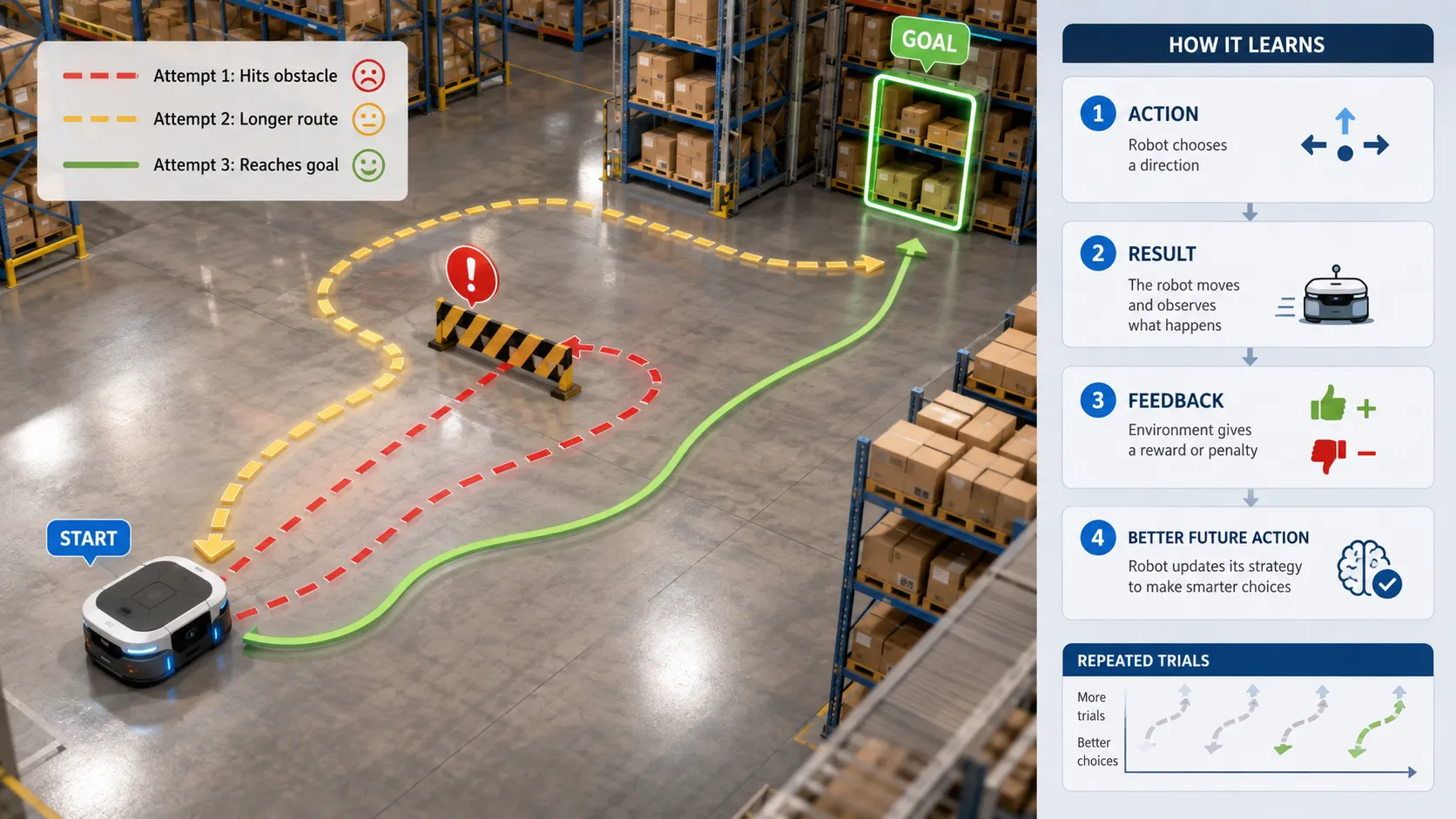
Imagine a robot moving products inside a warehouse.
It needs to reach a shelf efficiently without hitting obstacles.
At first, some routes may be poor.
A safe and fast route can receive a better reward.
A collision or unnecessary movement can receive a poor result.
Through repeated interaction, the system can learn a better strategy.
This is different from supervised learning because the robot is not necessarily given the correct move for every possible situation.
It learns from the results of its actions.
Where Does Deep Learning Fit Into This?
Another term you will hear constantly is deep learning.
Deep learning is not a completely separate idea from machine learning.
It is a branch of machine learning that uses neural networks with multiple layers to learn complex patterns.
These models can work with information such as:
images
audio
text
video
large collections of numerical data
For example, imagine building a system that recognizes dogs in photos.
Older approaches might require humans to carefully design many useful features.
A deep learning system can learn useful visual representations from large numbers of examples during training.
Early layers may respond to simpler visual patterns, while later parts of the network can combine information into more complex representations.
This ability is one reason deep learning from data has become important in computer vision, speech recognition, language systems, and generative AI.
But deep learning still depends heavily on something we have discussed throughout this article:
data.
A powerful model cannot magically repair every problem in poor training data.
Bad Data Can Teach AI the Wrong Lesson
This is one of the most important things beginners should understand.
AI learns relationships from the examples it receives.
That means problems inside the data can influence what the model learns.
Imagine a company wants to train an AI system to recognize different types of flowers.
But 90% of the training images contain only roses.
The model may become very good at roses while struggling with less represented flowers.
Now imagine some images are wrongly labeled.
A sunflower is marked as a rose.
A tulip is marked as a sunflower.
Those mistakes can also confuse training.
This is why data quality in AI matters so much.
Useful training data should usually be relevant to the real problem, reasonably accurate, and representative of the situations where the system will actually be used.
More data is helpful only when that data adds useful information.
Ten million poor examples are not automatically better than one million carefully prepared examples.
Can AI Learn Bias From Data?
Yes.
If patterns of unfairness, imbalance, or historical bias exist in training data, a machine learning model may learn some of those patterns as well.
Suppose a hiring dataset mainly contains successful examples from one narrow group because of past hiring decisions.
A model trained carelessly on that history could treat those old patterns as signals of future success.
The system does not automatically know which historical patterns are fair and which should not be repeated.
That is why responsible AI development requires more than simply training a model and checking its accuracy.
Teams also need to examine the data, model behaviour, errors, and impact on different groups.
This is an important reminder:
AI learns patterns from data, but patterns are not automatically truth.
From Data to a Useful AI System
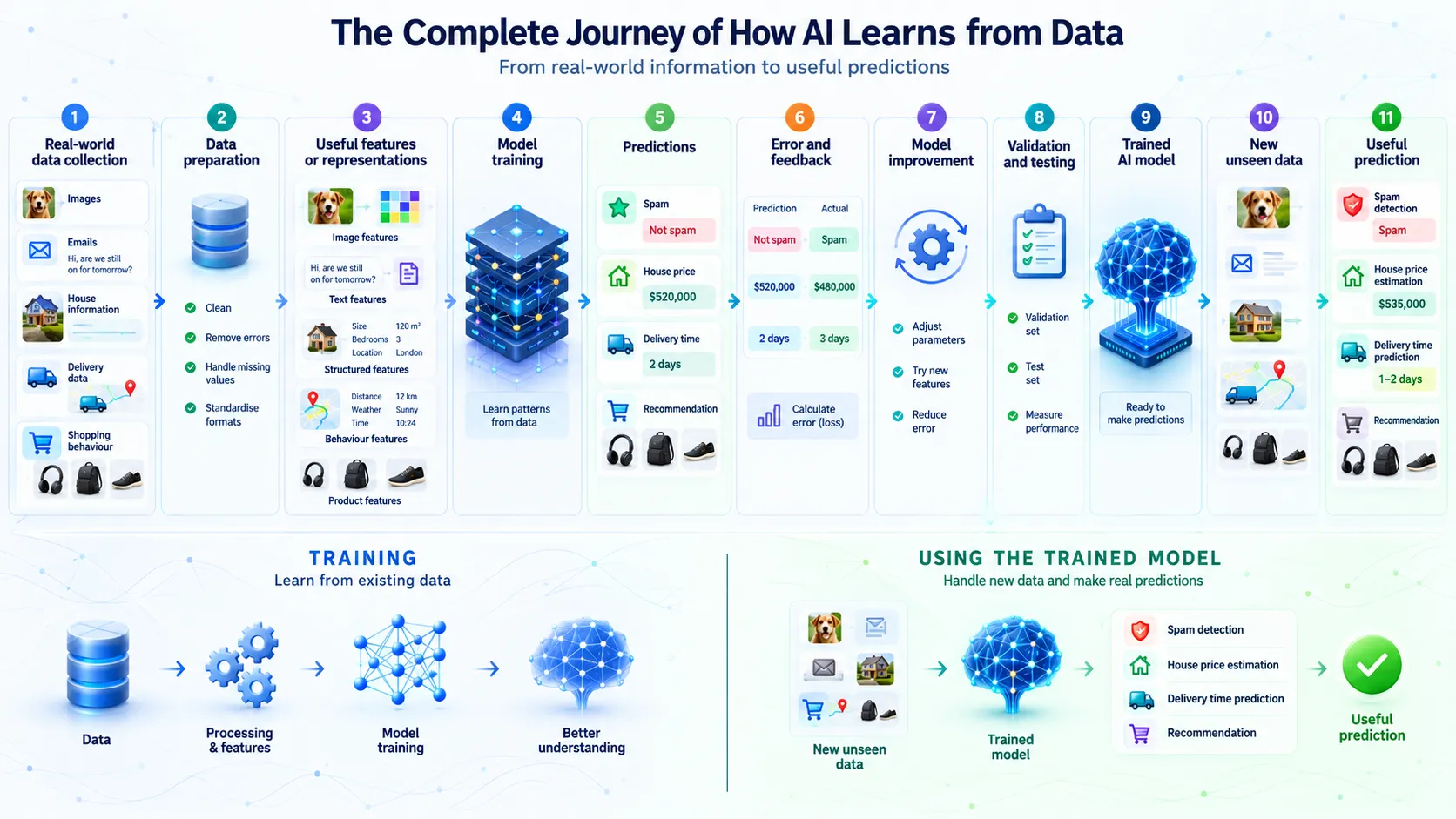
We can now connect the full journey.
Raw data is collected.
Useful features or representations are prepared.
A learning method is chosen.
The model trains on examples.
It makes predictions or takes actions.
Its performance is measured.
Parameters improve through training.
The system is tested on unseen data.
And even after deployment, its performance may need continued evaluation because real-world conditions can change.
This is why saying that “AI thinks like a human” can be misleading.
In machine learning, what looks like intelligence often comes from a powerful combination of data, algorithms, optimization, pattern recognition, and repeated evaluation.
The next time Netflix recommends a movie, a navigation app predicts traffic, or your email blocks spam, you will know there is no tiny person inside the computer making the decision.
There is a trained model using patterns learned from data to estimate what should happen next.
And that is the central idea behind how artificial intelligence learns from data:
AI improves by learning useful patterns from examples and applying those patterns to situations it has not seen before.
Final Thoughts
You do not need advanced mathematics to understand the foundation of AI.
Start with one simple idea:
Data gives AI examples. Training helps it discover patterns. Testing tells us whether those patterns actually work.
From there, concepts like supervised learning, neural networks, deep learning, recommendation systems, and generative AI become much easier to understand.
AI may look incredibly complex from the outside.
But underneath many systems is the same basic goal:
learn something useful from past data so the model can make a better decision about new data.


