


Introduction
You may have used artificial intelligence before breakfast without realising it.
Your phone may have unlocked after recognising your face. A navigation app may have predicted traffic. Your email service may have moved a suspicious message into the spam folder. A shopping website may have recommended a product based on what you viewed yesterday.
These systems look different, but they share one basic idea: they use computers to find patterns, make predictions, generate content, or choose an action.
Understanding what artificial intelligence is matters because AI is moving from specialist laboratories into schools, offices, hospitals, banks, vehicles, creative tools, and everyday software. It can save time and solve difficult problems, but it can also make mistakes, repeat bias, expose private information, or produce convincing false content.
This guide explains artificial intelligence in clear language. You will learn what AI means, how it works, where it is used, what its limits are, and how it may develop beyond 2026.

What Is Artificial Intelligence?
Artificial intelligence, usually shortened to AI, is a field of computer science that develops machines and software capable of performing tasks commonly linked with human intelligence.
These tasks can include:
Recognising objects in an image
Understanding spoken or written language
Learning patterns from examples
Solving problems
Making predictions
Recommending actions
Generating text, images, audio, video, or code
Controlling machines or digital tools
Google Cloud describes AI as a collection of technologies that helps computers learn, reason, analyse information, and perform advanced tasks that once required human intelligence. IBM uses a similar definition, describing AI as technology that allows machines to simulate abilities such as learning, problem-solving, decision-making, creativity, and autonomy.
Artificial intelligence in simple words
AI is a way of teaching a computer to perform a useful task without writing a separate instruction for every possible situation.
Imagine teaching a child to recognise apples. You could explain every detail of every apple, but that would be difficult. A better approach is to show the child many examples.
Over time, the child notices common features such as shape, colour, texture, and size. The child can then recognise an apple that was not part of the original examples.
Many AI systems work in a similar way. They study data, identify useful patterns, and apply those patterns to new information.
A more technical explanation
An AI system usually receives an input, processes it using an algorithm or trained model, and produces an output.
AI systemInputOutputSpam filterEmail messageSpam probabilityImage recognitionPhotographObject labelsNavigation appMap and traffic dataSuggested routeRecommendation engineUser activityRanked suggestionsAI chatbotWritten promptGenerated responseFraud detectorTransaction detailsRisk score
A model contains adjustable numerical values called parameters. During training, these parameters are changed so the model becomes better at producing useful outputs.
AI, machine learning, deep learning, and generative AI
These terms are related, but they do not mean the same thing.
Term Meaning Artificial intelligence The broad field of building systems that perform intelligent tasks Machine learning A branch of AI in which systems learn patterns from data Deep learning A branch of machine learning based on multi-layer neural networks Generative AI. AI that produces new content such as text, images, audio, video, or code Large language model deep-learning model trained to process and generate language
Think of AI as a large umbrella. Machine learning sits under that umbrella. Deep learning is a type of machine learning, and many modern generative AI systems use deep learning.
Artificial intelligence is not the same as human intelligence. Current AI can perform some tasks extremely well, but it does not automatically possess human judgement, emotions, consciousness, values, or real-world understanding.

How Artificial Intelligence Works
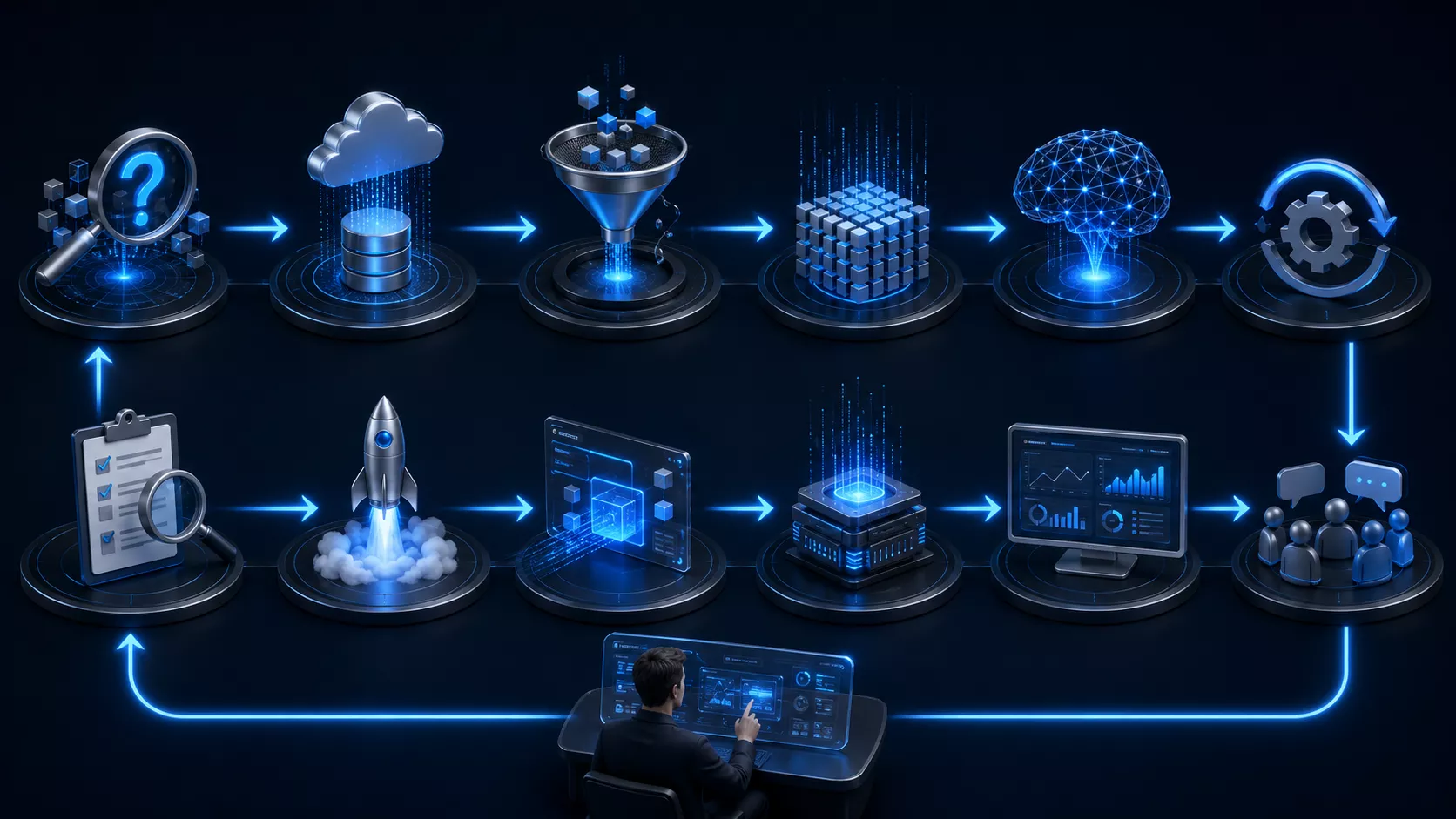
AI systems can be simple rule-based programs or highly complex neural networks. However, most modern machine-learning systems follow a similar lifecycle.
1. A problem is defined
The process begins with a clear goal.
For example:
Detect fraudulent card payments
Predict tomorrow’s product demand
Recognise damaged items in a factory
Answer customer questions
Recommend a suitable film
A useful AI problem needs a defined input, output, success measure, and acceptable level of risk.
2. Data is collected
The system needs examples related to the task.
A fraud model may study past transactions. An image model may study labelled photographs. A language model may learn from large collections of text and other content.
Data quality is critical. A large dataset filled with errors, missing groups, or outdated information can produce a poor model.
3. Data is prepared
Raw data is rarely ready for training. Teams may need to:
Remove duplicates
Correct errors
Standardise formats
Label examples
Protect personal information
Balance underrepresented groups
Separate data into training, validation, and test sets
The training set teaches the model. The validation set helps developers improve it. The test set checks how well it performs on unseen examples.
4. Information is converted into numbers
Computers calculate using numbers.
Images can be represented as pixel values. Audio can be represented as waveforms. Business records can become numerical features.
Text is often split into smaller units called tokens. These tokens are converted into numerical representations that the model can process.
5. The model is trained
During training, the model receives an example and makes a prediction.
Its prediction is compared with the expected answer. A mathematical function measures the error, and an optimisation process adjusts the model’s parameters.
The cycle repeats many times:
Receive an input
Produce an output
Measure the error
Adjust the parameters
Try again
A neural network commonly uses backpropagation to determine how different parameters contributed to an error.
6. The model is tested
A model should not simply memorise its training data. It should work on new examples.
This ability is called generalisation.
Teams may measure accuracy, precision, recall, response quality, fairness, speed, robustness, or cost. The correct metric depends on the situation. Missing a dangerous medical condition is more serious than recommending a film someone dislikes.
7. The model is deployed
After testing, the model is connected to a product or workflow. It may run on a server, in a cloud platform, inside a phone, or directly on a machine.
8. The model performs inference
Inference is the stage in which a trained model processes a new input.
When you ask a chatbot a question, upload an image, or request a recommendation, the model is usually performing inference.
9. The system is monitored
The real world changes. Customer behaviour shifts, language evolves, new fraud methods appear, and sensors become less accurate.
Teams must monitor performance, errors, security, bias, response time, and operating cost. Some models need to be retrained, restricted, updated, or retired.
Stage main purpose problem definition decide what the system should achieve data collection gather relevant examples data preparation clean, label, and organise information Training adjust model parameters validation and testing measure performance on unseen data deployment connect the model to a real productnInferencen process new inputs monitoring detect problems and changing conditions
Types of Artificial Intelligence
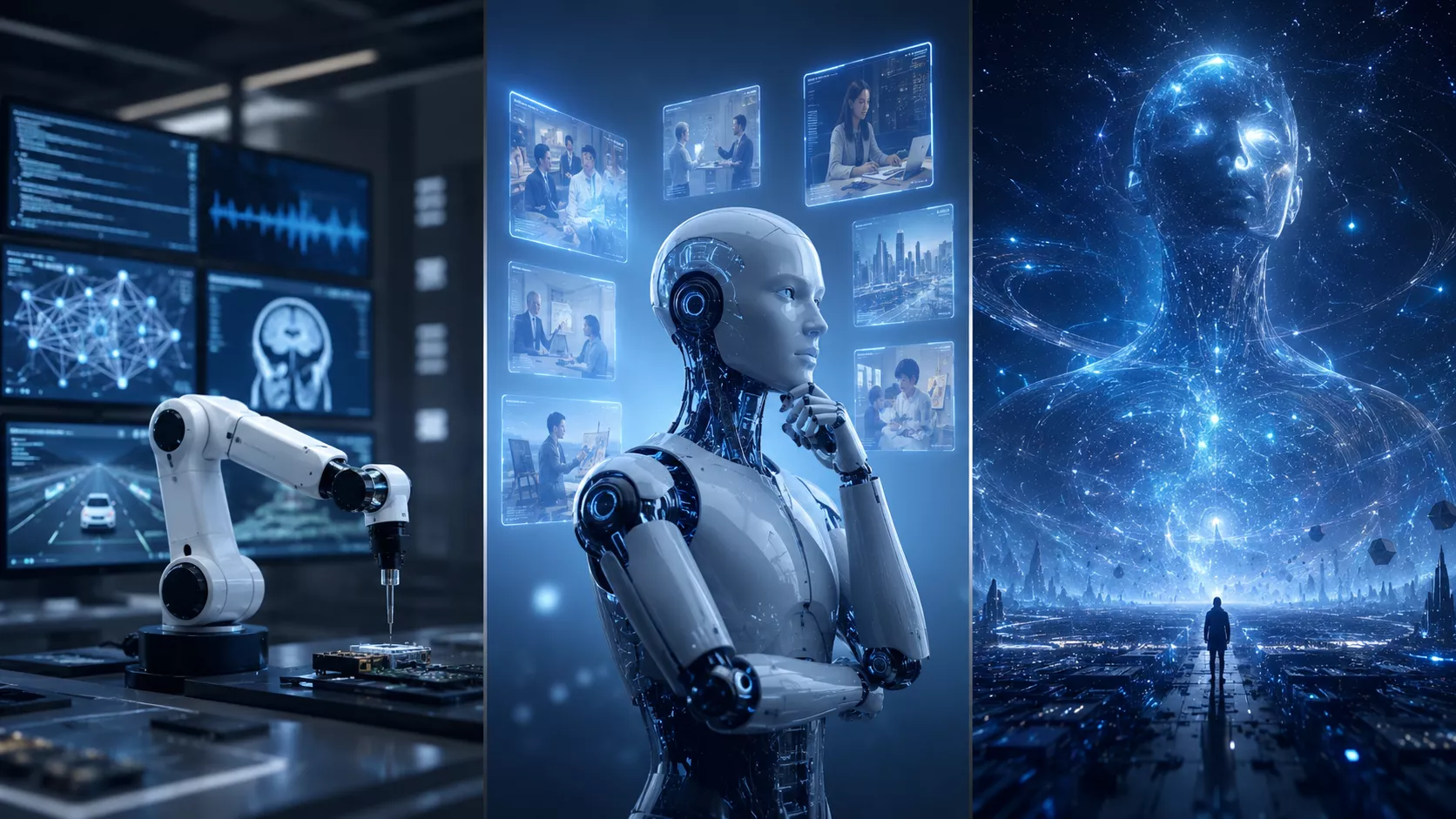
Artificial intelligence is often grouped by the range of tasks it can perform.
Narrow AI
Narrow AI, also called weak AI, is designed for a specific task or limited group of tasks.
Examples include:
Spam filters
Recommendation engines
Translation tools
Voice assistants
Image recognition systems
Fraud detection software
Generative AI chatbots
A chess system may defeat a world champion but cannot automatically diagnose an illness or manage a business. Its intelligence is limited to its design and training.
Nearly all AI in practical use today belongs to this category.
Artificial general intelligence
Artificial general intelligence, or AGI, refers to a theoretical system that could learn, understand, and apply knowledge across many different tasks at a level comparable to a capable human.
An AGI system would not be limited to one narrow job. It could transfer knowledge between domains and adapt to unfamiliar situations.
As of July 2026, there is no confirmed, generally accepted AGI system. IBM describes strong AI or AGI as theoretical and notes that no known system has reached this level.
Artificial superintelligence
Artificial superintelligence, sometimes called super AI, is the idea of a system that would exceed the best human abilities across most intellectual fields.
It might outperform people in scientific research, strategy, engineering, creativity, and decision-making.
Super AI remains hypothetical. Predictions about whether or when it will exist vary widely and should not be presented as established fact.
Type capability current status narrow AI performs specific tasks widely used general AI works across tasks like a capable humanTheoretical super AI exceeds human intelligence across most fields hypothetical
Real-World Applications of Artificial Intelligence
AI is already built into many services that people use every day.
Healthcare: AI can support medical-image analysis, drug research, patient monitoring, administrative work, and clinical documentation. It should support qualified professionals rather than silently replace medical judgement.
Education: AI tutors can explain concepts, create practice questions, translate lessons, and give personalised feedback. Teachers still need to check accuracy and ensure students develop independent thinking.
Business: Companies use AI for forecasting, document processing, customer support, quality control, inventory planning, and workflow automation.
Cybersecurity: AI can identify unusual network activity, suspicious login behaviour, malware patterns, and possible attacks. Attackers can also use AI, so automated defence must be combined with strong security controls.
Finance: Banks and payment providers use AI for fraud detection, credit analysis, customer support, market research, and compliance monitoring. High-impact decisions require fairness testing, transparency, and human accountability.
Transportation: AI supports traffic prediction, route planning, driver-assistance systems, fleet maintenance, and autonomous machines. Physical safety requires strict testing and clear operating limits.
Marketing: AI helps teams segment audiences, analyse campaigns, recommend products, generate drafts, and predict customer needs. Poor data or aggressive personalisation can create privacy and trust problems.
Daily life: Search engines, phone cameras, autocorrect, streaming recommendations, smart-home devices, translation apps, and email filters all use forms of AI.
Application what AI analyses useful output medical imaging scans and labelled cases possible findings fraud detection payments and account activity risk alert education student responses personalised feedback navigation maps and traffic faster route customer service questions and account data answer or escalation predictive maintenance sensor readings failure warning online shopping user and product activity recommendations Cyber security network and login behaviour threat detection
AI creates the most value when it is connected to a real problem, reliable data, a clear workflow, and a measurable outcome.

Advantages of Artificial Intelligence
Artificial intelligence can provide several important benefits when it is used responsibly.
Speed: AI can process large amounts of information quickly.
Scale: One system can support many users or transactions.
Consistency: AI can apply the same process repeatedly.
Pattern detection: Models may notice relationships that are difficult to find manually.
Automation: Routine tasks can be completed with less human effort.
Personalisation: Services can adapt recommendations or learning material to individual needs.
Accessibility: Speech recognition, translation, captioning, and assistive tools can make information easier to use.
Decision support: AI can organise evidence and highlight risks for human experts.
Scientific discovery: AI can help researchers analyse complex data and explore possible solutions.
Productivity: Workers can use AI to create first drafts, summarise documents, analyse data, and generate ideas.
The main advantage is not that AI “replaces thinking”. Its strongest role is often to increase human capacity.
A doctor may review more information before making a decision. A teacher may create learning material faster. A small company may provide customer support outside normal working hours.
The benefit depends on accuracy and workflow design. A fast system that creates unreliable work may add more correction time than it saves.

Disadvantages and Risks of Artificial Intelligence
AI also has serious limitations. A balanced understanding requires looking beyond impressive demonstrations.
Inaccurate or invented information
Generative AI can produce statements that sound confident but are false. These errors are often called hallucinations.
The model may generate a fake source, incorrect date, invented quotation, or unsafe instruction because it is producing a likely response rather than automatically checking every claim.
Bias and unfair decisions
AI learns from data created in the real world. That data may contain historical discrimination, missing groups, incorrect labels, or unequal representation.
A model can repeat or amplify these problems, especially in hiring, lending, education, healthcare, policing, or insurance.
Privacy risks
AI systems may process personal, confidential, or commercially sensitive information.
Users should not upload private data unless they understand how the service stores, uses, and protects it.
Security threats
AI systems can face:
Prompt injection
Data poisoning
Model theft
Malicious files
Unsafe tool access
Manipulated inputs
Unauthorised actions
A chatbot that can only draft text creates less risk than an agent that can send payments, delete files, or change customer accounts.
Job disruption
AI can automate some tasks and reshape many roles. It may reduce demand for certain activities while creating demand for new technical, supervisory, creative, and governance skills.
The effect will differ by profession. Most jobs contain a mixture of routine work, human judgement, relationships, physical activity, and responsibility.
Lack of explainability
Some advanced models are difficult to interpret. A user may receive a prediction without a simple explanation of how the system reached it.
This is particularly important when an output affects health, money, education, employment, safety, or legal rights.
Cost and environmental impact
Training and running large AI models can require expensive hardware, data centres, electricity, cooling, and network infrastructure.
The largest model is not always the best choice. Smaller or specialised models may be cheaper, faster, and easier to control.
NIST recommends a risk-based approach that considers testing, evaluation, security, bias, explainability, and responsible governance across the AI lifecycle.

Common Myths About Artificial Intelligence
AI is surrounded by exaggerated promises and fears. Separating myths from reality helps people make better decisions.
Myth reality AI thinks exactly like a human current AI processes patterns and numerical relationships; it does not automatically have human understanding AI is always correct AI can make factual, logical, and contextual mistakes every AI tool searches the live internet many models rely mainly on training data unless connected to search or retrieval AI learns permanently from every chat Ai conversation may provide temporary context without changing the model’s core parameters more data always creates better AI data quality, relevance, permission, and representation matter AI will replace every job AI is more likely to automate particular tasks and reshape roles unevenly AI is completely objective models can inherit bias from data, labels, objectives, and deployment choices AI and robots are the same AI is software intelligence; robots are physical machines that may or may not use AI A fluent answer proves understanding clear language can still contain incorrect or unsupported claims AGI already exists current systems are powerful narrow AI; accepted AGI has not been demonstrated
The safest approach is neither blind trust nor automatic rejection. AI should be judged by evidence, testing, context, and consequences.

Future of Artificial Intelligence in 2026 and Beyond
Artificial intelligence is developing quickly, but progress is not limited to making models larger.
Multimodal AI
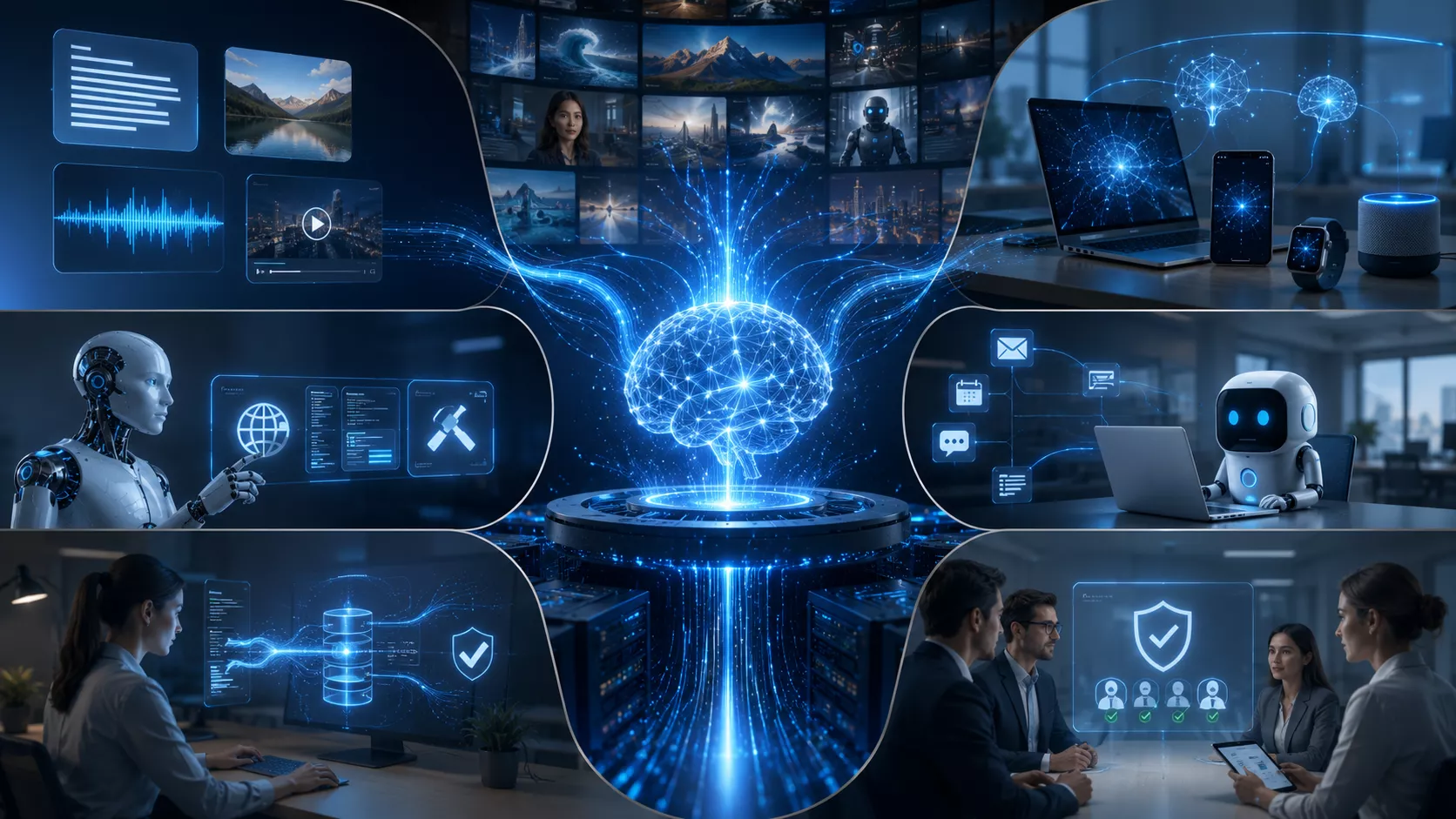
Multimodal models can process several types of information, such as text, images, audio, video, and sensor data.
A multimodal assistant might inspect a photograph, listen to a spoken question, read a document, and provide one combined answer.
Smaller and on-device models
More AI systems are being designed to run on phones, laptops, vehicles, cameras, and industrial equipment.
On-device AI can reduce response time, work with limited internet access, and sometimes improve privacy because less information needs to leave the device.
AI agents
AI agents combine a model with tools, goals, memory, and a repeated decision loop.
An agent may search a database, prepare a report, update software, or complete parts of a workflow. This creates new opportunities but also increases the need for access controls, approval steps, logs, and recovery systems.
Better grounding
Generative systems are increasingly connected to verified documents, databases, calculators, search engines, and business software.
This approach can improve accuracy and provide current information, but the system can still retrieve the wrong source or interpret correct evidence badly.
Wider adoption and education
The 2026 Stanford AI Index reports that generative AI reached 53% population adoption within three years. It also found that more than 80% of US high-school and college students use AI for school-related tasks, while clear institutional policies remain less common.
These figures show why AI literacy is becoming a basic skill. People need to know how to use AI, verify it, question it, and recognise its limits.
Stronger rules and transparency
Governments and standards organisations are placing more attention on transparency, safety, privacy, accountability, and human rights.
The European Union’s AI Act follows a risk-based approach. Its transparency rules require certain AI-generated content and AI interactions to be identified, with important provisions applying from August 2026.
The future of AI will therefore depend on more than model capability. Progress will also depend on trustworthy data, secure infrastructure, useful products, skilled people, strong evaluation, and responsible governance.
Expert Opinion
Trusted organisations broadly agree that AI should be developed and used with human oversight, ongoing testing, transparency, security, and accountability.
NIST treats AI as a risk-management challenge across the full lifecycle rather than a tool that is judged only by accuracy. Its work highlights testing, evaluation, validation, security, bias, and explainability.
The OECD’s AI Principles promote systems that support human rights, fairness, privacy, transparency, robustness, safety, and accountability. The principles also state that people affected by AI should receive useful information and should be able to challenge harmful outputs where appropriate.
Stanford’s 2026 AI Index shows that adoption and investment are moving quickly, while education, governance, and institutional readiness do not always move at the same speed.
The shared message is clear: powerful AI is not automatically trustworthy AI. Trust must be earned through evidence, controls, monitoring, and responsible human decisions.
My Observation
Editorial opinion: The most useful way to think about AI is not to ask whether a machine “looks intelligent”. The better question is whether the system is reliable for a particular task.
A chatbot may write a beautiful paragraph and fail at a simple fact. A medical model may perform well in one hospital and poorly in another. A recommendation engine may increase sales while creating a frustrating customer experience.
AI quality depends on the entire system:
The goal chosen by people
The data used for learning
The model and training method
The information available at the moment of use
The interface shown to the user
The permissions given to the system
The way mistakes are reported and corrected
The human or organisation responsible for the outcome
The smartest-looking model is not always the most useful one. A smaller model connected to reliable information and a clear workflow may create more value than a powerful model operating without evidence or control.
AI will likely become less visible over time. Instead of opening a separate “AI tool”, people will find AI built into ordinary software, devices, vehicles, customer services, and professional systems.
That makes basic AI understanding more important, not less.
Frequently Asked Questions
What is artificial intelligence in simple words?
Artificial intelligence is technology that helps computers perform tasks that normally require human abilities, such as recognising images, understanding language, finding patterns, making predictions, or generating content.
What is the main purpose of AI?
The purpose of AI is to help machines perform useful tasks more effectively. These tasks may involve automation, analysis, prediction, recommendation, communication, or control.
How does artificial intelligence learn?
Many AI systems learn by studying data. The model makes predictions, measures its errors, and adjusts its parameters until its performance improves.
What are the three main types of artificial intelligence?
The three common capability-based categories are narrow AI, artificial general intelligence, and artificial superintelligence. Narrow AI exists today, while AGI and superintelligence remain theoretical or hypothetical.
What is narrow AI?
Narrow AI is designed for a particular task or limited set of tasks. Spam filters, recommendation engines, translation tools, and current AI chatbots are examples.
Is ChatGPT artificial intelligence?
Yes. ChatGPT is a generative AI application based on a large language model. It processes prompts and generates responses using patterns learned during training and information available in its current context.
What is the difference between AI and machine learning?
AI is the broad field of creating intelligent computer systems. Machine learning is a branch of AI in which systems learn patterns from data.
Is AI the same as automation?
No. Automation follows a process to complete work automatically. AI may be part of automation when the process requires prediction, recognition, generation, or adaptive decisions.
Does AI think like a human?
Current AI does not think like a human. It processes numerical patterns and can imitate parts of human communication or problem-solving without human consciousness or lived experience.
Can AI make mistakes?
Yes. AI can misunderstand instructions, use poor data, produce biased results, invent information, or fail when it faces an unfamiliar situation.
Is artificial intelligence dangerous?
AI can cause harm when it is inaccurate, insecure, biased, poorly controlled, or given excessive authority. The level of danger depends on its capability, permissions, use case, and consequences.
Will AI replace human jobs?
AI will automate some tasks and change many jobs, but the impact will vary. Roles involving judgement, responsibility, empathy, negotiation, physical work, and human relationships may change rather than disappear completely.
What are common examples of AI?
Common examples include navigation apps, spam filters, product recommendations, face recognition, voice assistants, translation tools, fraud detection, chatbots, and image generators.
Can AI become smarter over time?
A model can improve through retraining, better data, fine-tuning, feedback, or updated tools. It does not necessarily improve its core capabilities simply because a user has one conversation with it.
How can beginners use AI safely?
Use clear instructions, protect private information, verify important facts, check sources, understand the tool’s limits, and keep qualified human judgement for decisions involving health, money, safety, employment, or rights.
Key Takeaways
Artificial intelligence enables computers to perform tasks linked with human intelligence.
Most practical AI today is narrow AI designed for specific tasks.
Machine learning systems learn patterns from data.
AI models must be trained, tested, deployed, and monitored.
AI can improve speed, scale, accessibility, personalisation, and productivity.
AI can also make mistakes, repeat bias, create security risks, and expose private information.
AGI and artificial superintelligence have not been confirmed as existing systems.
Responsible AI requires reliable data, testing, transparency, security, human oversight, and accountability.
Conclusion
Artificial intelligence is not magic, a single machine, or a digital version of the human mind. It is a broad collection of technologies that helps computers recognise patterns, understand information, generate content, make predictions, and support decisions.
Its value is already visible in healthcare, education, finance, cybersecurity, transportation, business, and daily life. Its limitations are equally important. AI can be wrong, biased, insecure, expensive, or difficult to explain.
The best way to use AI is with informed curiosity. Explore what it can do, but verify important outputs. Use its speed, but do not surrender human responsibility. Welcome innovation, but demand evidence, privacy, safety, and accountability.
The natural next step is to learn how AI works, including data preparation, model training, neural networks, inference, and the systems that turn a model into a useful product.


