


What Is Machine Learning? Types, How It Works, Real Examples, and Future Trends (2026 Guide)
Featured snippet: Machine learning is a way of teaching software to find patterns in examples, then use those patterns to predict, classify, recommend, or make decisions when it receives new data. Instead of programmers writing every rule, the system learns useful rules from data.
Before you finish your morning coffee, machine learning may have already influenced several decisions around you.
Netflix may have reordered its recommendations based on your viewing history. Spotify may have selected songs that resemble music you previously enjoyed. Your bank may have checked a card payment against patterns linked to fraud. A navigation app may have recalculated your route using current and historical traffic data.
These systems do not understand films, music, money, or roads in the human sense. They process data, measure patterns and calculate which output is statistically most likely to be useful.
That is the practical answer to what is machine learning in simple words: it is a method that allows computers to learn patterns from data rather than relying only on manually written instructions.
Google defines machine learning as a way to train software, known as a model, to make predictions or generate content using data. The model learns relationships from examples and applies those relationships to information it has not previously seen.
Traditional Programming vs Machine Learning
Traditional programming begins with rules written by a developer.
For example, a programmer building a basic loan-eligibility system might write:
Input data + Human-written rules = Output
The system could contain rules such as:
Reject the application if income is below a fixed threshold.
Approve it if the credit score is above a certain number.
Request further review if existing debt exceeds a set percentage.
The program follows those instructions exactly. It does not automatically discover new relationships unless a developer changes the rules.
Machine learning changes the process:
Input data + Known outcomes = Learned rules
Instead of manually describing every sign of fraud, developers provide past transactions labelled as fraudulent or legitimate. A training algorithm searches for relationships involving transaction size, location, merchant type, device history, timing and other features.
The resulting model can then estimate whether a new transaction resembles earlier fraudulent activity.
The “rules” learned by a model are usually mathematical parameters rather than readable statements. A simple model may learn a handful of coefficients. A large neural network may learn millions or billions of numerical weights.
Key takeaway: Traditional software follows rules written by people. Machine learning estimates useful rules from data.
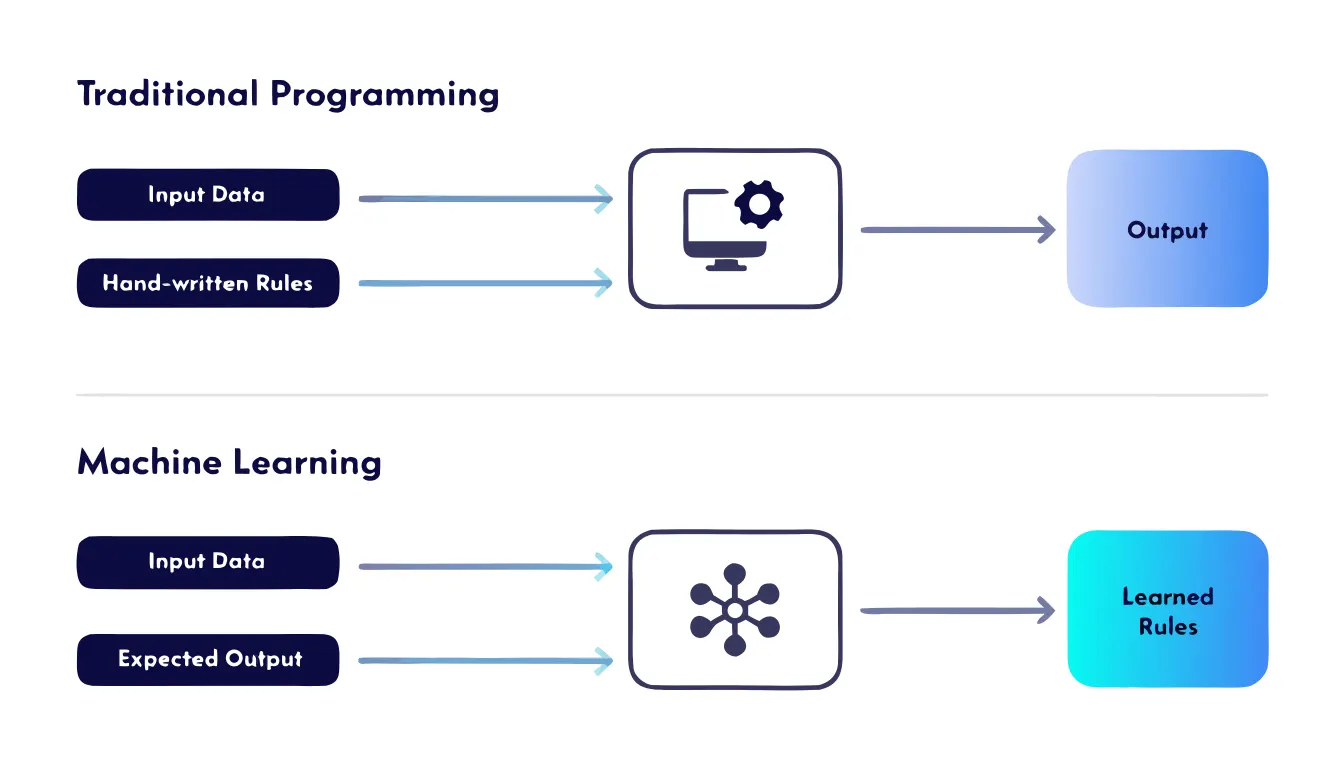
Machine learning is valuable when the required rules are too numerous, subtle or changeable to write by hand. It is less useful when a problem can be solved reliably with a few clear instructions.
A tax calculation with fixed rates may need ordinary programming. Detecting suspicious tax filings across millions of records may benefit from machine learning.
AI vs Machine Learning vs Deep Learning
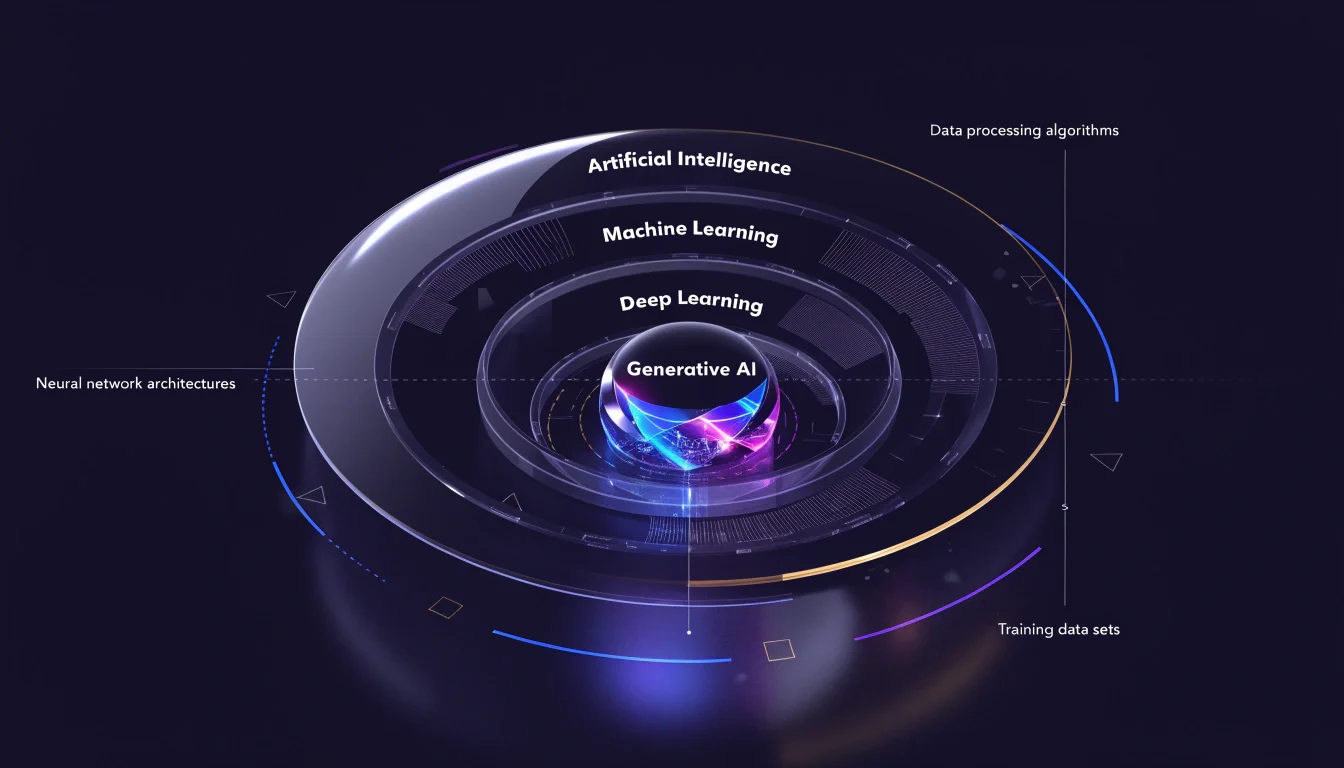
The terms artificial intelligence, machine learning, deep learning and generative AI are often treated as synonyms. They describe related but different concepts.
Artificial intelligence , or AI, is the broad field concerned with building computer systems that perform tasks associated with human intelligence, such as reasoning, perception, language processing, planning and decision-making.
Machine learning is one approach used to build AI systems. It focuses on learning patterns from data.
Deep learning is a specialised area of machine learning based on multilayer neural networks. It is widely used for image recognition, speech processing, language models and other tasks involving large, complex datasets.
Generative AI refers to systems that create new content, such as text, images, audio, video or code. Most leading generative systems in 2026 use deep-learning architectures, although “generative AI” describes what a system produces rather than one single training method.
AI, Machine Learning, and Deep Learning Compared
Artificial intelligence (AI): The broad goal of making machines perform tasks associated with human intelligence.
Analogy: A complete hospital containing many departments.
Example: A system that plans delivery routes.
Machine Learning (ML): A method that learns patterns from data rather than relying only on explicit rules.
Analogy: A doctor improving their skills through past patient cases.
Example: A fraud-detection model.
Deep Learning (DL): A subset of machine learning using neural networks with multiple processing layers.
Analogy: A specialist analyzing many subtle health signals together.
Example: An image-recognition model.
Generative AI: AI designed to produce brand new content (such as text, images, audio, or code).
Analogy: A writer creating a new draft from learned language patterns.
Example: A text or image generator.g a new draft from learned language patternsA text or image generator
A system can be AI without using machine learning. An old chess program based entirely on manually designed search rules still qualifies as AI.
Machine learning is therefore a subset of AI, while deep learning is a subset of machine learning.
The relationship is usually shown as:
Artificial intelligence
└── Machine Learning
    └── Deep Learning
        └── Many modern Generative AI systems
This hierarchy is useful, but it is not mathematically perfect. Some generative techniques existed before modern deep learning, and not every deep-learning model generates content.
Key takeaway: The clearest way to understand machine learning vs artificial intelligence is that AI is the wider objective, while machine learning is one major technique used to achieve it.
How Machine Learning Works: The Seven-Stage Lifecycle
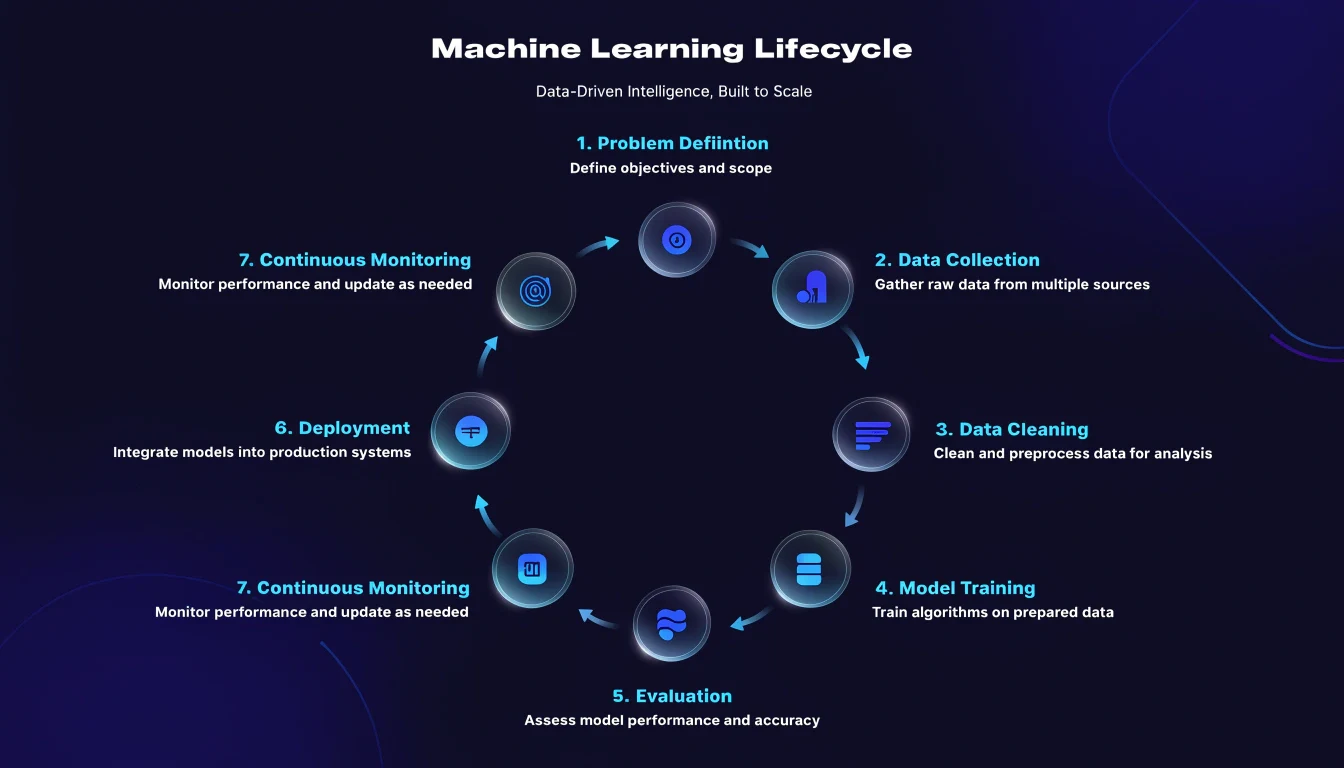
Understanding how machine learning works requires looking beyond model training. A production system includes data collection, evaluation, deployment, monitoring and repeated correction.
This end-to-end process is known as the machine learning lifecycle.
1. Problem Formulation and Objective
Every successful project begins with a clearly defined problem.
“Use AI to improve sales” is too vague. “Predict which customers are likely to cancel their subscriptions within the next 30 days” is specific enough to measure.
A team must define:
What should the model predict?
Who will use the prediction?
What action will follow?
What type of error is most costly?
How will success be measured?
Can the problem be solved more safely with ordinary rules?
Suppose a hospital wants to identify patients at risk of readmission. Missing a high-risk patient may be more harmful than incorrectly flagging a low-risk patient.
That difference affects the evaluation metric, threshold and human-review process.
2. Data Collection and Cleaning
A model learns from examples. If those examples are inaccurate, incomplete or unrepresentative, the model will learn unreliable relationships.
Data cleaning may include:
Removing duplicate records.
Correcting invalid values.
Standardising dates and measurement units.
Handling missing information.
Checking labels for mistakes.
Detecting data leakage.
Reviewing whether important populations are represented.
Google’s machine-learning guidance defines a high-quality dataset as one that helps a model accomplish its intended goal. It also notes that dataset construction and transformation can consume most of the work in a typical ML project.
Consider a restaurant recommendation model trained only on reviews from tourists. It may perform poorly for local residents, even if the algorithm itself is technically correct.
Plain-English analogy: Choosing a powerful algorithm cannot rescue poor data, just as an expensive oven cannot fix spoiled ingredients.
3. Feature Engineering, Tokenisation and Vectorisation
A feature is an input signal used by a model.
For a house-price model, features might include:
Floor area
Location
Number of bedrooms
Building age
Distance from public transport
Raw information often needs to be converted into numerical form.
Feature engineering means creating or transforming variables so that useful patterns become easier to learn. A date may be converted into day of week, month or holiday status. A customer’s purchase history may become total spending, average order value and days since the last purchase.
For text, tokenisation breaks language into smaller units called tokens. These may be words, word fragments, characters or other learned units.
Vectorisation converts information into arrays of numbers. A text embedding, for example, represents words or sentences as numerical coordinates so that a model can compare their meanings or usage patterns.
Plain-English analogy: A model cannot directly read a customer review as a person does. Tokenisation cuts the review into manageable pieces; vectorisation translates those pieces into the model’s numerical language.
4. Model Training
During training, a model makes predictions using its current parameters.
The predictions are compared with the correct answers. A loss function calculates how wrong the model is.
For a house-price prediction, the loss may reflect the difference between the predicted and actual price. For classification, it may measure how much probability the model assigned to the wrong category.
The training process then adjusts the model’s parameters to reduce that loss.
Gradient descent is a common optimisation method. Imagine standing on a foggy hillside and trying to reach the lowest point. You check which direction slopes downward, take a step and repeat.
The “height” is the loss. Each step changes the model’s parameters.
In a neural network, backpropagation calculates how much each weight contributed to the error. The optimiser then adjusts those weights in directions expected to reduce future error.
Plain-English analogy: Backpropagation resembles a coach reviewing a failed team play. The coach traces the mistake backwards, estimates how each decision contributed and adjusts the players’ instructions for the next attempt.
5. Evaluation and Validation
A model should not be judged only on data it used during training.
Datasets are commonly separated into:
Training set: Used to learn parameters.
Validation set: Used to compare models and tune settings.
Test set: Used for a final evaluation on unseen examples.
Using duplicates across these sets can produce misleading results. Google’s guidance states that a fair test requires genuinely new examples rather than copies of training records.
The correct evaluation metric depends on the business problem.
Yeh raha Evaluation Metrics section ka ekdum clean, crisp, aur easy-to-read format. Is broken table text ki jagah direct ise copy-paste kar lein:
Key Evaluation Metrics Explained
Accuracy:
What It Measures: Overall percentage of correct predictions
Useful Example: Balanced image categories
Precision:
What It Measures: How many predicted positives were actually positive
Useful Example: Avoiding false fraud accusations
Recall:
What It Measures: How many real positives were detected
Useful Example: Finding as many cancer cases as possible
F1 Score:
What It Measures: Balance between precision and recall
Useful Example: Imbalanced classification
Mean Absolute Error (MAE):
What It Measures: Average size of numerical errors
Useful Example: Delivery-time prediction
AUC (Area Under Curve):
What It Measures: Ability to rank positives above negatives across thresholds
Useful Example: Risk scoring
Accuracy can be deceptive. If only 1% of transactions are fraudulent, a model that labels everything legitimate achieves 99% accuracy while detecting no fraud.
Google recommends metrics such as precision, recall and F1 when class imbalance makes raw accuracy insufficient.
6. Deployment and Inference
Once validated, the model is integrated into a working product or process.
Inference is the act of using a trained model to produce an output from new input.
A deployed model might:
Score a transaction in milliseconds.
Rank products on an online store.
Identify an object in a camera feed.
Estimate delivery time.
Flag a medical image for specialist review.
Deployment also requires software engineering, security, logging, capacity planning, version control and fallback behaviour. A highly accurate model is not useful if it is too slow, expensive or unreliable for the target environment.
7. Monitoring and Model Drift
A model’s performance can decline after deployment because the world changes.
Data drift occurs when incoming data changes. Customer behaviour, devices, prices or language may shift.
Concept drift occurs when the relationship between inputs and outcomes changes. Fraudsters, for example, alter their methods in response to detection systems.
Monitoring should track:
Prediction quality
Input-data distributions
Error rates
Latency
Cost
Fairness across groups
Security incidents
Human overrides
NIST’s AI risk guidance recommends continuous monitoring of system performance and trustworthiness, followed by remediation or retirement when a system exceeds accepted risk levels.
The Four Main Types of Machine Learning
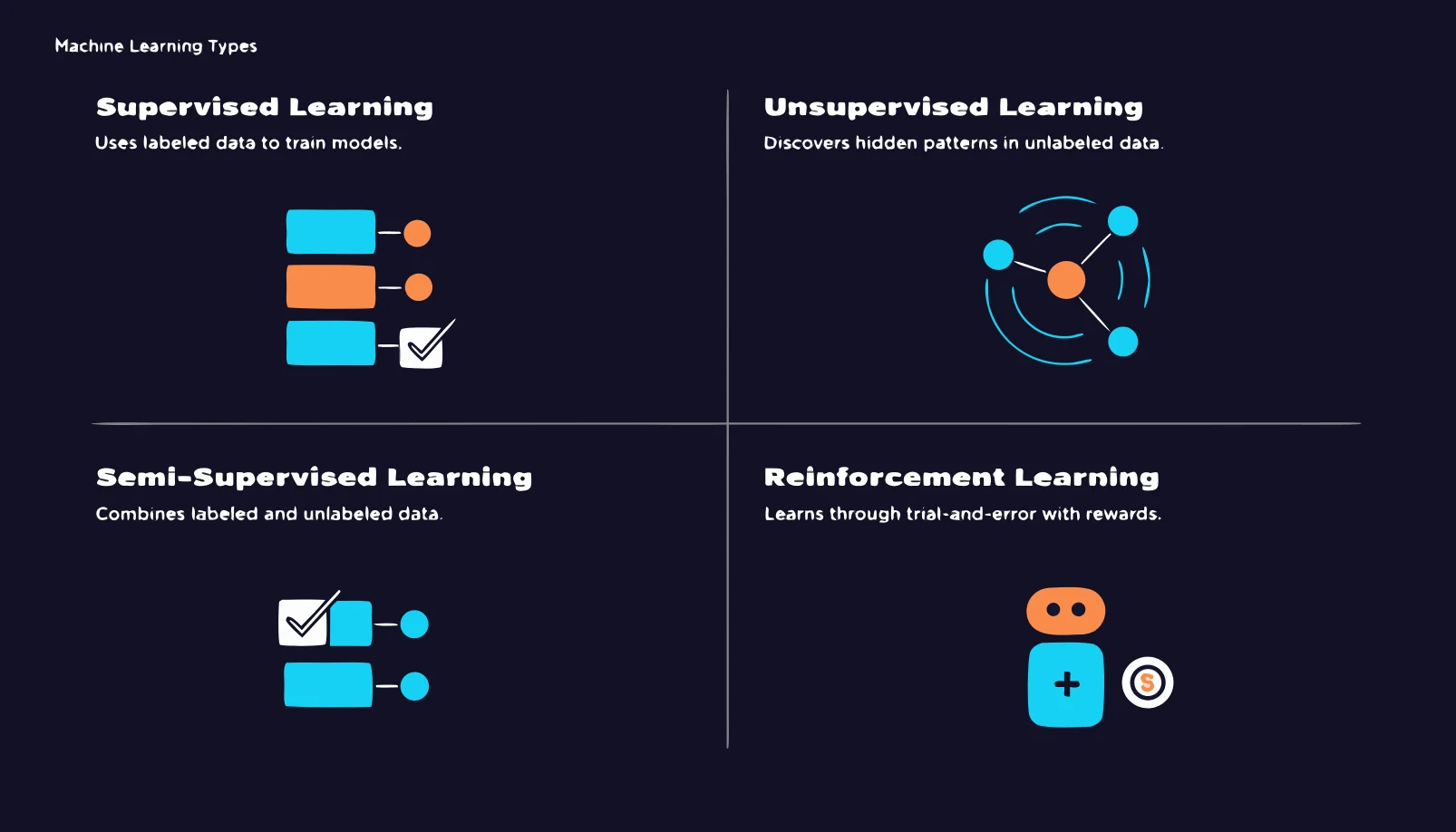
The types of machine learning are usually distinguished by the feedback available during training.
1. Supervised Learning
Supervised learning uses labelled examples.
Each training record contains:
Input features
A known correct output, called a label or target
A model learns a relationship between the inputs and the target.
For example:
InputsLabelEmail subject, sender, links and wordingSpamHouse size, area and ageSale priceMedical scan pixelsAbnormal or normal
Supervised learning usually handles two main tasks:
Classification
Classification predicts a category.
Examples include:
Fraud or legitimate
Spam or not spam
Customer likely or unlikely to cancel
Image containing a dog, cat or bird
Logistic regression, decision trees, random forests, support vector machines and neural networks can all perform classification.
Regression
Regression predicts a continuous number.
Examples include:
House price
Delivery time
Energy consumption
Expected demand
Linear regression, regression trees and neural networks are common options.
Plain-English analogy: Supervised learning is like studying with an answer key. The learner attempts each question, compares its answer with the correct one and adjusts.
2. Unsupervised Learning
Unsupervised learning works with data that has no provided target labels.
The model is not told what the correct groups or structures should be. It searches for useful patterns based on similarity, distance, density or variation.
Clustering
Clustering groups similar records.
A retailer might cluster customers based on spending frequency, product preferences and average basket size. The resulting groups could represent bargain seekers, occasional premium buyers or frequent loyal customers.
Common clustering methods include:
K-means
Hierarchical clustering
DBSCAN
Gaussian mixture models
Dimensionality Reduction
High-dimensional data may contain hundreds or thousands of variables.
Dimensionality-reduction methods compress those variables while preserving important structure. Common techniques include principal component analysis, or PCA, and neural-network-based autoencoders.
These methods can support visualisation, noise reduction and faster modelling.
Google describes clustering as one of the most common applications of unsupervised machine learning.
Plain-English analogy: Imagine organising an unlabelled box of mixed buttons. You might naturally group them by colour, shape, size or material without anyone giving you the official categories.
3. Semi-Supervised Learning
Labelled data can be expensive.
A medical scan may require a radiologist’s review. A legal document may need classification by a lawyer. Speech recordings may require manual transcription.
Semi-supervised learning combines a relatively small labelled dataset with a larger amount of unlabelled data. The goal is to benefit from the structure in the unlabelled examples while still using trusted labels to guide the task.
A company might have:
5,000 manually labelled support tickets
500,000 unlabelled support tickets
A semi-supervised approach can learn general representations from the larger collection and then use the smaller labelled set to support accurate classification.
Plain-English analogy: A student receives detailed feedback on ten practice questions, then applies the same patterns while working through hundreds of unmarked questions.
4. Reinforcement Learning
Reinforcement learning, or RL, trains an agent through interaction.
The main components are:
Agent: The decision-maker
Environment: The system in which it operates
Action: A choice made by the agent
Reward: Feedback indicating whether the choice was useful
Policy: The strategy used to choose actions
The agent aims to maximise its long-term cumulative reward.
A robot may receive a positive reward for reaching a destination and a penalty for hitting an obstacle. A game-playing system may receive a reward for winning rather than being shown the correct move for every position.
AlphaGo combined deep neural networks, search, supervised learning from expert games and reinforcement learning through self-play. AlphaGo Zero later learned through self-play without relying on human game records.
Reinforcement learning is also researched for robotics, industrial control, scheduling and autonomous-vehicle components. Real-world safety constraints make physical applications harder than games because unsafe exploration cannot simply be ignored.
Plain-English analogy: Reinforcement learning resembles learning to play a video game by trying actions, observing the score and gradually discovering which strategies work over time.
Supervised vs Unsupervised vs Reinforcement Learning
Supervised Learning:
Training Signal: Correct labels
Primary Goal: Predict known targets
Typical Output: Category or continuous number
Example: Fraud detection
Main Strength: Clear objective and measurable performance
Main Limitation: Requires labeled data
Unsupervised Learning:
Training Signal: No labels
Primary Goal: Discover hidden structure and patterns
Typical Output: Clusters or representations
Example: Customer segmentation
Main Strength: Finds hidden patterns
Main Limitation: Patterns may be hard to interpret
Semi-Supervised Learning:
Training Signal: Some labels mixed with unlabeled data
Primary Goal: Predict using limited labels
Typical Output: Category or continuous number
Example: Medical-image classification
Main Strength: Reduces labeling requirements
Main Limitation: Depends on reliable assumptions
Reinforcement Learning:
Training Signal: Rewards and penalties
Primary Goal: Learn a decision strategy
Typical Output: Policy or sequence of actions
Example: Robot navigation
Main Strength: Handles sequential decisions
Main Limitation: Training can be unstable or expensive
Popular Machine Learning Algorithms Explained Simply
A machine learning algorithm is the method used to learn patterns from training data. The trained result is the model.
Linear Regression
Linear regression fits a line or plane that estimates a numerical value.
It may learn that house price tends to rise with floor area and fall with distance from a city centre.
The model assigns a coefficient to each feature:
Predicted price =
base value
+ size coefficient
+ location coefficient
+ bedroom coefficient
It is fast, interpretable and useful when relationships are approximately linear.
Logistic Regression
Despite its name, logistic regression is commonly used for classification.
It calculates a probability between 0 and 1. A fraud model might estimate a 0.82 probability that a transaction is fraudulent, after which a threshold converts that probability into an action.
Decision Trees
A decision tree splits data using a sequence of questions.
Is the transaction unusually large?
├── Yes: Is the device new?
│   ├── Yes: Higher fraud risk
│   └── No: Moderate risk
└── No: Lower risk
Trees are relatively easy to explain but may overfit when they become too deep.
Random Forests
A random forest trains many decision trees on different samples and features. Their predictions are combined through voting or averaging.
Plain-English analogy: Instead of asking one adviser, you ask a committee. Individual opinions may be imperfect, but their combined decision can be more reliable.
K-Nearest Neighbours
K-nearest neighbours, or KNN, predicts an output by examining the most similar training examples.
To classify a new fruit, the model might look at nearby examples based on weight, colour and shape.
KNN is simple but can become slow with very large datasets and is sensitive to how distance is measured.
Support Vector Machines
A support vector machine, or SVM, finds a boundary that separates classes while keeping the widest possible margin between them.
Imagine placing the widest possible road between red houses and blue houses on a map. The centre of that road becomes the decision boundary.
Neural Networks
A neural network contains connected layers of numerical units.
Each connection has a weight. Data passes through the network, and the model combines those weights to detect increasingly complex patterns.
In image recognition, early layers may respond to edges. Later layers may respond to textures, shapes and object-level structures.
Neural networks are flexible and powerful, but they often require more data, computing resources and monitoring than simpler models. Google’s ML curriculum covers linear models, classification, neural networks, embeddings and advanced architectures as related tools rather than one universal solution.
Key takeaway: The best algorithm is not automatically the newest or most complex. It is the one that meets the required accuracy, speed, cost, explainability and risk constraints.
Machine Learning Examples in Real Life
The most useful machine learning examples in real life are often systems that quietly rank, filter or predict rather than visibly “think.”
Machine Learning in Healthcare
Machine learning in healthcare can analyse medical images, electronic health records, laboratory measurements and physiological signals.
Common applications include:
Identifying suspicious areas in X-rays, CT scans or MRIs
Predicting patient deterioration
Estimating readmission risk
Supporting pathology-image analysis
Prioritising cases for specialist review
Forecasting hospital demand
Recent medical-imaging research covers applications across radiology, pathology, ultrasound and other imaging modalities. Research also warns that performance may not transfer equally across hospitals, devices and patient populations.
A model should not be treated as a doctor. Clinical usefulness depends on prospective validation, workflow integration, representative data, human oversight and a clear plan for handling uncertain outputs.
Machine Learning in Finance
Financial institutions use ML for:
Card-fraud detection
Anti-money-laundering analysis
Credit-risk support
Document processing
Customer-service routing
Market and liquidity forecasting
Cybersecurity monitoring
Fraud detection is especially suitable because transaction patterns change quickly and involve interactions among many variables.
However, a model trained on historical lending decisions may reproduce unfair patterns found in those decisions. Financial models therefore require documentation, bias testing, access controls and appeal or review processes.
Machine Learning in Daily Life
Everyday applications include:
Navigation: Predicting traffic speed and arrival time
Recommendation systems: Ranking films, music, products and posts
Autocorrect: Estimating the intended word from context
Spam filtering: Classifying unwanted messages
Search: Ranking results by likely relevance
Smartphone photography: Reducing noise and improving images
Translation: Mapping text or speech between languages
Predictive maintenance: Detecting signs that equipment may fail
A recommendation system does not need to know why a song feels emotional. It can learn that users with similar listening histories often play the same songs.

Advantages and Disadvantages of Machine Learning
The advantages and disadvantages of machine learning depend on the system, data and deployment context.
Pros vs Cons of Machine Learning
AdvantagesDisadvantagesProcesses large datasets quicklyMay require significant computing resourcesDetects patterns humans may missCan learn bias from historical dataAutomates repetitive predictionsOften requires large quantities of reliable dataAdapts through retrainingPerformance can decline as conditions changeSupports personalisation at scaleComplex models may be difficult to explainProduces consistent scoringPrivacy and security risks can be substantialCan improve operational efficiencyAutomation can disrupt roles and workflows
Key Advantages
Speed and Scale
A model can score millions of records faster than a human team. This is useful for fraud screening, search ranking and industrial monitoring.
Pattern Detection
ML can detect subtle combinations of signals that may not be obvious through manual analysis.
Adaptive Improvement
A monitored system can be retrained as new data becomes available. This allows it to respond to changing conditions, although retraining must be controlled and validated.
Personalisation
The same platform can rank different content, products or services for each user based on behaviour and context.
Key Disadvantages and Risks
Computational Cost
Large models may consume substantial energy, hardware and cloud capacity. Stanford’s 2026 AI Index reports that the field is placing greater emphasis on cost, reliability and real-world usefulness as technical capabilities converge.
Privacy
Training data may contain personal, financial, behavioural or medical information. Poor data governance can expose individuals to surveillance, misuse or security breaches.
Historical Bias
A model may learn discrimination or structural inequality present in its source data.
Job and Workflow Disruption
Machine learning often changes tasks before it removes entire occupations. Stanford’s 2026 economic analysis reports rising demand for AI skills, measurable gains in some narrow tasks and uneven workforce effects, while broader productivity evidence remains early and mixed.
Challenges, Limitations and Ethics
Overfitting and Underfitting in Machine Learning
Overfitting occurs when a model learns the training data too closely, including noise and accidental details. It performs well on familiar examples but poorly on new ones.
Underfitting occurs when a model is too simple or insufficiently trained to capture important patterns. It performs poorly on both training and unseen data.
Student analogy: An overfitting student memorises the exact answers from one practice test but cannot handle differently worded questions. An underfitting student studies only the chapter titles. A well-generalised student understands the underlying ideas.
Google defines overfitting as matching or memorising the training set so closely that predictions fail on new data. Techniques such as validation, regularisation, simpler models, better data and early stopping can reduce the problem.
The Black-Box Problem
Some models can produce accurate predictions without providing a simple human-readable explanation.
This creates tension between predictive performance and explainability. A slightly less accurate but interpretable model may be preferable when decisions affect medical treatment, employment, credit or legal rights.
Data Bias and Algorithmic Fairness
Bias can enter through:
Unrepresentative samples
Incorrect labels
Historical discrimination
Proxy variables
Unequal measurement quality
Deployment in a population different from the training population
Fairness cannot be fixed with one universal metric. Teams must define which harms matter, test outcomes across relevant groups and provide channels for review and correction.
The Future of Machine Learning in 2026 and Beyond
The future of machine learning is likely to be shaped less by a single algorithmic breakthrough and more by improvements in efficiency, evaluation, deployment and governance.
Edge Machine Learning
Edge ML runs models on smartphones, cameras, vehicles, sensors and microchips instead of sending every input to a remote server.
Local inference can offer:
Lower latency
Reduced network dependence
Better offline operation
Lower cloud costs
Greater privacy when data remains on the device
The trade-off is that edge devices have limited memory, battery capacity and processing power. Model compression, quantisation, pruning and dedicated accelerators are therefore important.
Google’s 2025–2026 edge research describes hardware designed for low-energy, private, on-device AI in wearables and sensors.
Automated Machine Learning
Automated machine learning, or AutoML, automates parts of model development, such as:
Feature selection
Algorithm comparison
Hyperparameter tuning
Architecture search
Pipeline configuration
AutoML can make experimentation faster, but it does not remove the need for problem definition, data governance, evaluation or domain expertise. Automating model selection cannot decide whether a prediction should be used in the first place.
Smaller and More Energy-Efficient Models
The industry is placing increased attention on models that deliver acceptable performance with less computation.
Techniques include:
Quantisation
Pruning
Knowledge distillation
Sparse architectures
Efficient attention
Specialised hardware
Retrieval systems that reduce repeated computation
Efficiency is becoming a product requirement rather than only a research metric. Organisations must consider inference cost, latency, energy use and hardware availability alongside benchmark scores.
Quantum Machine Learning
Quantum machine learning studies whether quantum computers can accelerate or improve parts of learning and optimisation.
The subject remains experimental. A 2025 systematic review of QML in digital health found no consistent evidence that quantum models outperform classical approaches under realistic conditions, with many studies relying on idealised simulations.
Quantum ML should therefore be treated as a research direction, not a near-term replacement for ordinary machine learning.
Changes to Jobs and Industries
Over the next five to ten years, ML is likely to automate portions of work involving:
Document classification
Quality inspection
Forecasting
Customer routing
Data extraction
Risk scoring
Routine analysis
Content ranking
Human work will increasingly include checking model outputs, handling exceptions, improving data, defining policies and accepting responsibility for high-impact decisions.
The central workforce question is not simply, “Will this job disappear?” It is, “Which tasks will be automated, which tasks will become more valuable and who will be accountable when the system fails?”
Expert Opinion and Industry Standards
NIST’s AI Risk Management Framework organises responsible AI work around four functions: Govern, Map, Measure and Manage.
The framework treats risk management as an ongoing process covering system design, deployment, monitoring and retirement. It identifies characteristics such as validity, reliability, safety, security, transparency, explainability, privacy and fairness as important parts of trustworthy AI.
The OECD AI Principles call for systems that respect human rights, democratic values, privacy, fairness, transparency, robustness and accountability. They also support safeguards that preserve meaningful human determination.
Stanford’s 2026 AI Index highlights a widening gap between improving technical capability and society’s ability to evaluate and govern deployed systems. It also reports that benchmark reliability and real-world measurement remain major concerns.
Human-in-the-loop oversight is not a universal legal requirement for every model. It is, however, an essential risk control when errors can affect health, liberty, employment, credit or financial security.
Human reviewers must have enough authority, expertise and information to challenge a prediction. A person who can only click “approve” is not meaningful oversight.
Editorial Take: Machine Learning Is Statistics With Operational Consequences
Machine learning is often described as though a computer develops intuition or consciousness. That description creates unrealistic expectations.
A machine-learning model is a statistical system. It estimates relationships between variables based on examples, an objective function and a chosen training process.
Its output may be impressive without being understood in a human sense. A model can classify a medical image without experiencing illness. It can generate fluent text without holding beliefs. It can recommend a film without enjoying cinema.
The practical risks begin when organisations confuse prediction with truth.
A risk score is not a fact. It is an estimate produced under assumptions about data, labels, populations and costs.
The strongest ML systems are not necessarily those with the largest models. They are systems with clear objectives, reliable data, realistic testing, secure deployment, continuous monitoring and accountable human ownership.
Machine learning is not magic. It is a powerful engineering and statistical tool whose value depends on the surrounding system.
Frequently Asked Questions
1. What is machine learning in simple words?
Machine learning is a method that teaches software to recognise patterns in data and use those patterns to make predictions or decisions. Instead of writing a separate rule for every situation, developers train a model using examples.
2. Can machine learning work without data?
Machine learning cannot learn without some form of data or experience. Even reinforcement-learning systems require interactions, states, actions and rewards that generate training information.
A pretrained model can be used without training it on your own dataset, but it still depends on data used during its original training.
3. What is the difference between AI and machine learning?
Artificial intelligence is the broad field of building systems that perform tasks associated with intelligence. Machine learning is one method within AI that develops those capabilities by learning patterns from data.
AI can also use manually written rules, search algorithms, planning systems and other methods.
4. What are the four types of machine learning?
The four commonly taught types are:
They differ mainly in the type of feedback available during training: labels, no labels, limited labels or rewards.
5. What are the main advantages and disadvantages of machine learning?
The main advantages include fast processing, scalable automation, pattern detection, forecasting and personalisation.
The disadvantages include data dependency, computational cost, privacy risk, bias, limited explainability and declining performance when real-world conditions change.
6. Is Python mandatory for learning machine learning?
Python is not mandatory, but it is the most widely used beginner-friendly language for ML because of libraries such as NumPy, pandas, scikit-learn, PyTorch and TensorFlow.
Machine learning can also be developed using R, Java, C++, Julia, JavaScript and specialised platforms. The mathematical and data concepts matter more than one programming language.
7. What is the future of machine learning?
Machine learning is moving towards more efficient, specialised and locally deployed systems. Edge ML, AutoML, smaller models, stronger monitoring and responsible-AI controls are likely to receive greater attention.
Quantum machine learning remains experimental, while human oversight will become increasingly important in high-impact applications.
Key Takeaways
Machine Learning Summary Checklist
Machine learning learns patterns from data rather than relying only on fixed rules.
ML is a subset of artificial intelligence ; deep learning is a subset of ML.
The four main types are supervised, unsupervised, semi-supervised and reinforcement learning.
Data quality, problem definition and evaluation often matter more than algorithm complexity.
A model must be monitored after deployment because data and behaviour change.
Overfitting means memorising training data; underfitting means failing to learn enough.
ML can support healthcare, finance, navigation, recommendations and industrial systems.
Privacy, bias, explainability and accountability must be addressed throughout the lifecycle.
Machine learning is best understood as a disciplined method for turning data into predictions, rankings, classifications and decisions.
A strong next step is to learn basic statistics, Python, data preparation, linear regression and classification. From there, study evaluation metrics and build a small end-to-end project that includes training, testing, deployment and monitoring, following official standards like the NIST AI Risk Management Framework.


