


“I opened the fridge because I was…”
Before you even finish it, your brain may expect words like “hungry”, “looking for food”, or something similar.
GPT does something surprisingly close to this idea.
It does not write an entire answer in one magical step. Instead, it repeatedly asks one basic question:
“Given everything I have seen so far, what token should probably come next?”
That simple idea sits at the heart of GPT architecture.
But behind that one prediction is a carefully designed system involving tokens, embeddings, positional information, causal self-attention, Transformer blocks,Transformers Architecture Deep Dive , neural networks, and probability calculations.
Once you understand how those pieces connect, GPT stops looking like a mysterious AI machine and starts looking like a system that can be understood step by step.
What Is GPT Architecture?
GPT stands for Generative Pre-trained Transformer.
Each word tells us something important about the model.
Generative means the model can generate new text.
Pre-trained means it learns patterns from a large amount of text before it is adapted or used for specific tasks.
Transformer refers to the neural network architecture behind the original GPT family.
The original Transformer architecture introduced in 2017 relied on attention rather than recurrent processing. GPT later used a Transformer-based approach for language modeling, with the public GPT family becoming strongly associated with an autoregressive, decoder-style architecture.
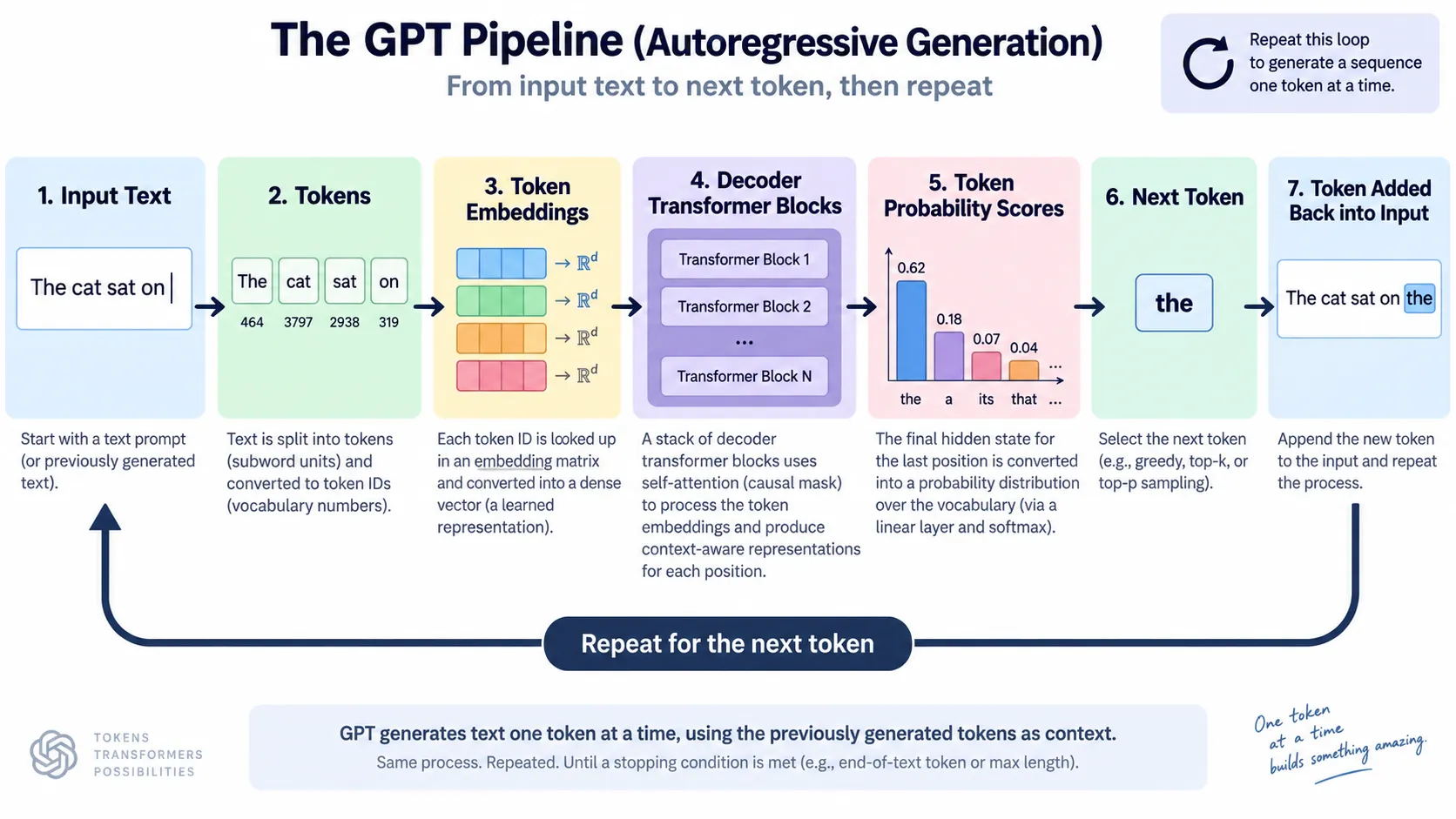
In simple terms, a classic GPT-style pipeline looks like this:
Text → Tokens → Embeddings → Transformer Blocks → Token Scores → Next Token
And then the process repeats.
Imagine you give the model:
“The sky is”
GPT processes those tokens and produces scores for many possible next tokens.
For example, conceptually it might consider:
blue
clear
dark
falling
beautiful
The actual model works with tokens and numerical probabilities rather than thinking about these options like a person.
One token is selected according to the model's decoding method.
Suppose it selects:
“blue”
The input is now effectively:
“The sky is blue”
The model runs the next prediction and continues again.
That repeated process is called autoregressive text generation.
GPT-3, for example, was explicitly described by its researchers as an autoregressive language model.
Why GPT Uses a Decoder-Style Transformer
The original Transformer contained two major sides:
Encoder and Decoder.
An encoder can build representations using information from across an available input sequence. A GPT-style language model instead needs to generate text from left to right without secretly looking at future tokens.
This is why GPT-style architectures use causal attention.
Consider this training sentence:
“Akanshu ordered pizza for dinner.”
When the model is learning to predict “pizza”, it can use the earlier context:
“Akanshu ordered”
But it should not be allowed to peek ahead at:
“for dinner”
If it could see the future answer during prediction, the learning task would become meaningless.
A causal mask prevents that.
It allows each position to attend only to the tokens that are permitted before it.
This seemingly small rule is one of the most important ideas behind autoregressive GPT text generation.
How GPT Processes Text Before Understanding Context
GPT cannot directly perform neural-network calculations on a sentence such as:
“I need coffee before work.”
Neural networks operate on numbers.
So before the Transformer can process language, the text must go through several transformations.
Step 1: Tokenization
The first stage is tokenization.
A tokenizer breaks text into smaller units called tokens.
A token does not always mean one complete word.
Depending on the tokenizer, a common word may become one token, while another word can be divided into several smaller pieces.
For example, think of a sentence such as:
“Learning transformers is exciting.”
Conceptually, a tokenizer may break it into units representing pieces of:
Learning | transformers | is | exciting | .
The exact split depends on the tokenizer being used.
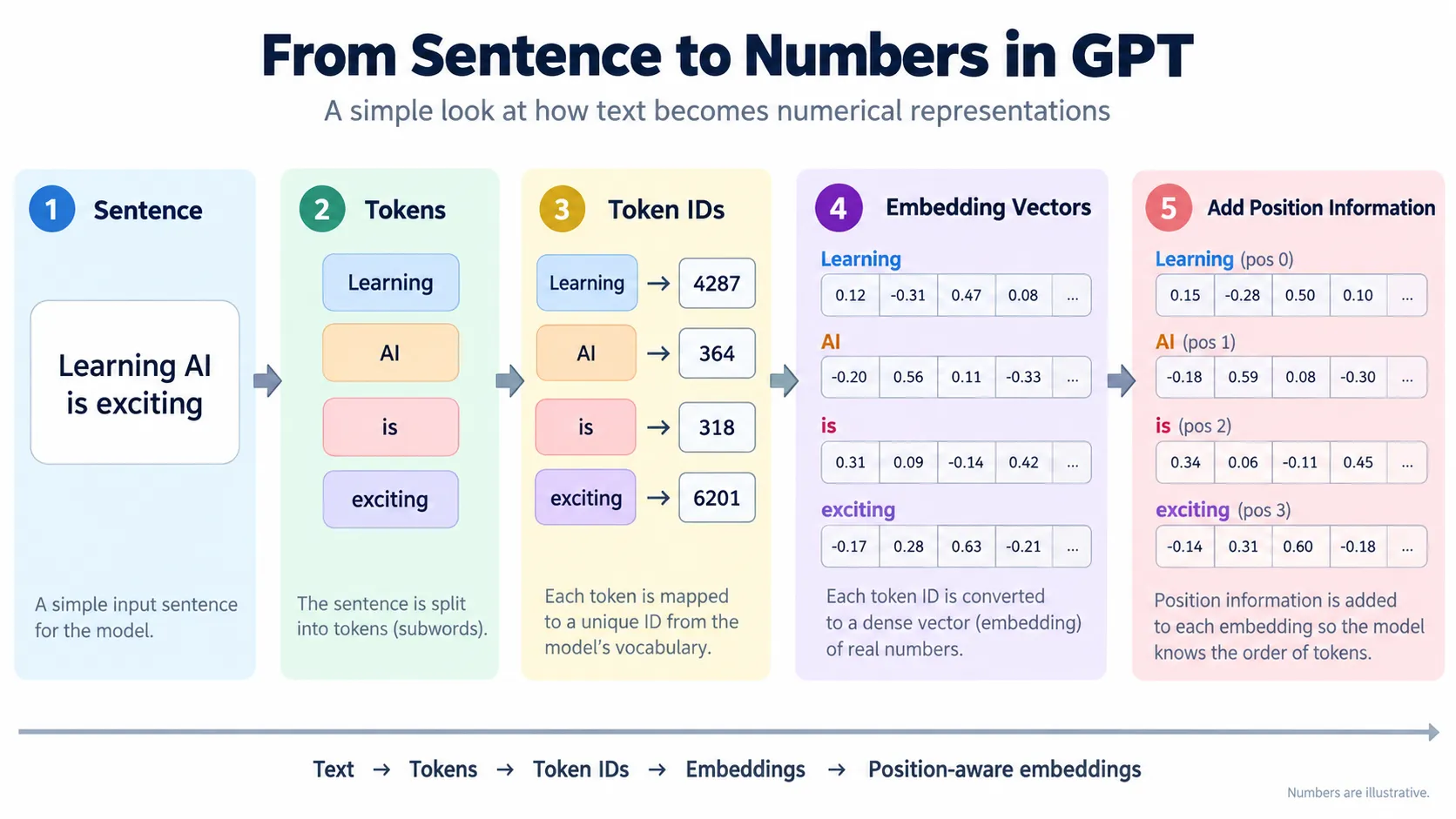
Every token is then mapped to a numerical token ID.
So human-readable text becomes a sequence of numbers that the model can process.
Step 2: Token Embeddings
A token ID by itself does not contain useful meaning.
Imagine assigning:
coffee = 8241
and
tea = 3917
The fact that 8241 is numerically larger than 3917 tells the model nothing meaningful about coffee or tea.
So GPT converts every token into a learned vector called an embedding.
An embedding is simply a list of numbers representing information in a mathematical space.
During training, these representations are adjusted so the network can use them to process relationships and context.
You can think of token IDs as library book numbers, while embeddings are closer to a rich internal representation of the book.
Step 3: Adding Position Information
There is one more problem.
Look at these sentences:
“Dog bites man.”
“Man bites dog.”
They contain almost the same words, but their meanings are very different because the order changed.
A Transformer therefore needs information about where tokens appear in the sequence.
Classic GPT models combine token representations with positional information so the network can distinguish an early token from a later one.
Without position information, word order would be much harder for the model to represent correctly.
At this point, our simple sentence has gone through an important transformation:
Raw text → Tokens → Token IDs → Embeddings + Position Information
Now it is finally ready to enter the main engine of GPT:
the Transformer block.
And this is where the architecture becomes especially interesting, because inside those blocks GPT begins deciding which earlier tokens matter most, how different parts of the sentence relate to each other, and what contextual representation should be passed deeper into the network.
Inside a GPT Transformer Block
Once tokens have been converted into embeddings and position information has been added, they enter the main processing system of GPT: the Transformer blocks.
A GPT model does not usually contain only one Transformer block.
Instead, many similar blocks are stacked one after another.
You can imagine it like a team of editors reviewing the same sentence.
The first editor notices basic relationships. The next editor works with that improved understanding. Another may capture longer connections, and the representation becomes richer as it moves through the network.
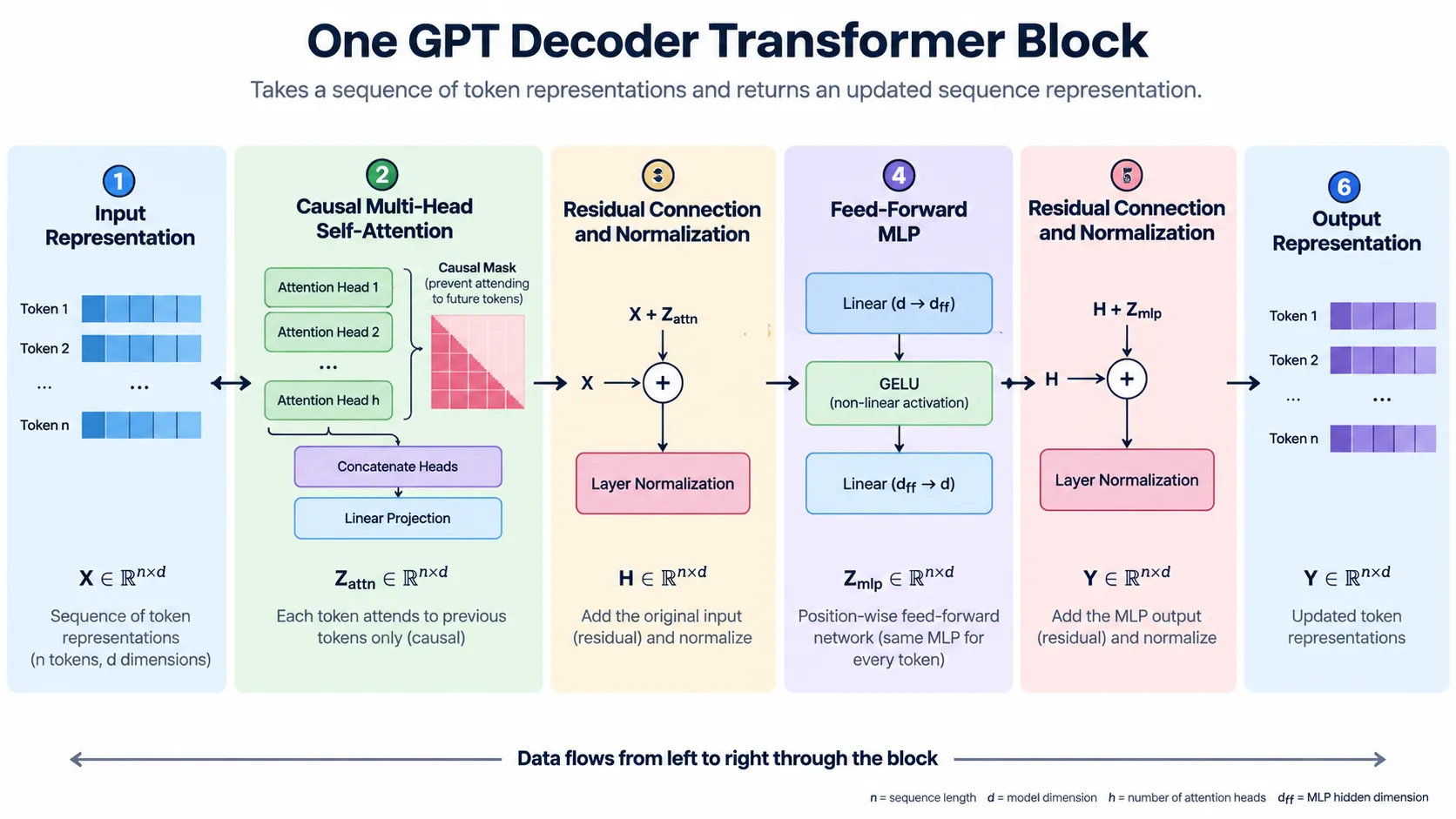
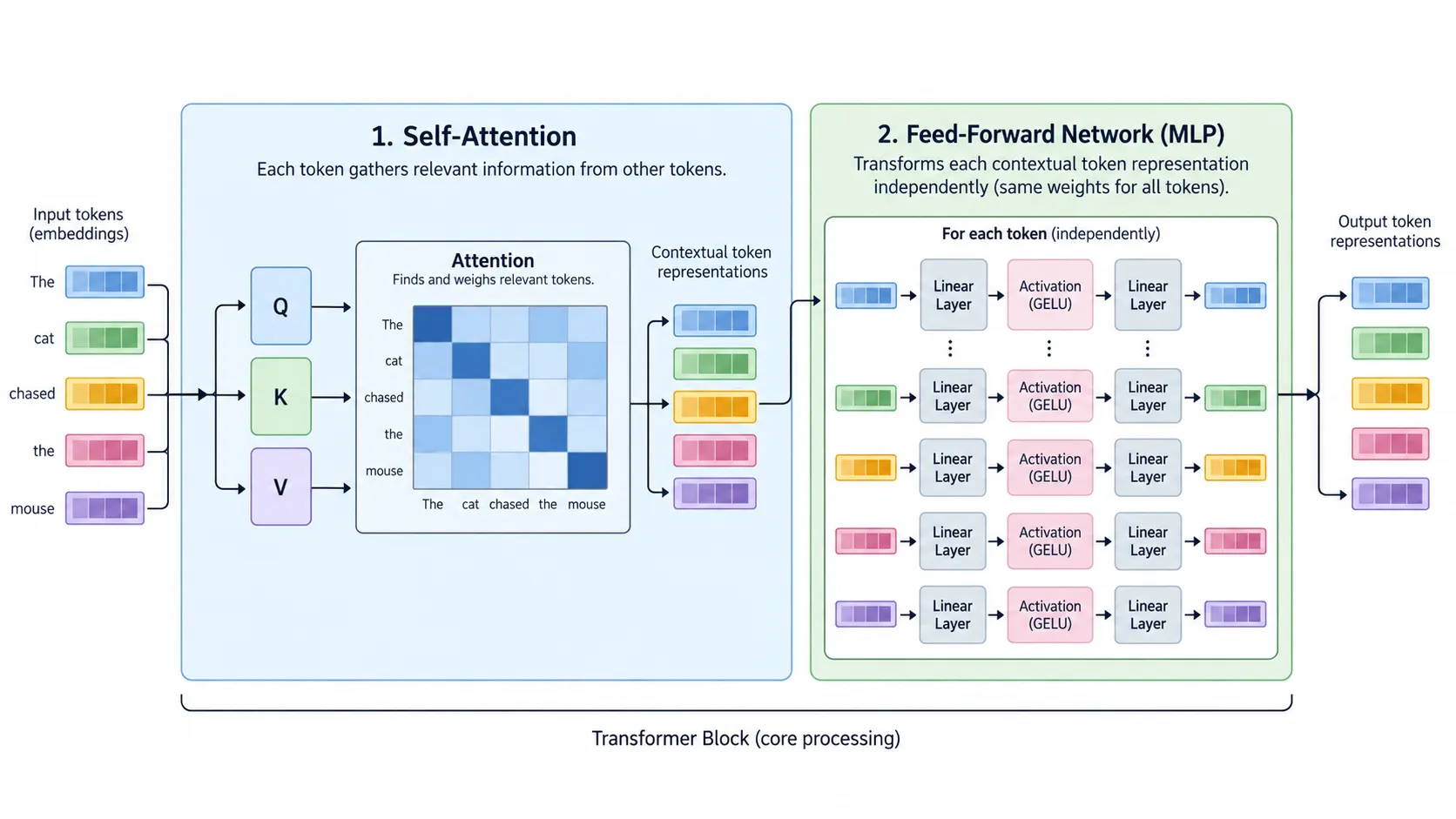
A simplified GPT Transformer block contains two major processing stages:
Causal Self-Attention
and
Feed-Forward Neural Network
Residual connections and normalization are also used around these components to help information move through a deep network efficiently.
Let us understand the most important part first.
How Self-Attention Helps GPT Understand Context
Suppose you type:
“Riya went to the bank to deposit her salary.”
The word “bank” can have different meanings.
It could mean:
a financial institution
the side of a river
How does the model know which meaning makes sense here?
It looks at the surrounding context.
Words such as “deposit” and “salary” strongly connect the word “bank” with money.
Self-attention gives the model a mathematical way to measure such relationships between tokens.
Instead of treating every previous word as equally important, the model can assign different levels of attention to different tokens.
This is one reason Transformer-based language models can handle context much better than simply processing words independently.
Query, Key, and Value: The Core of Attention
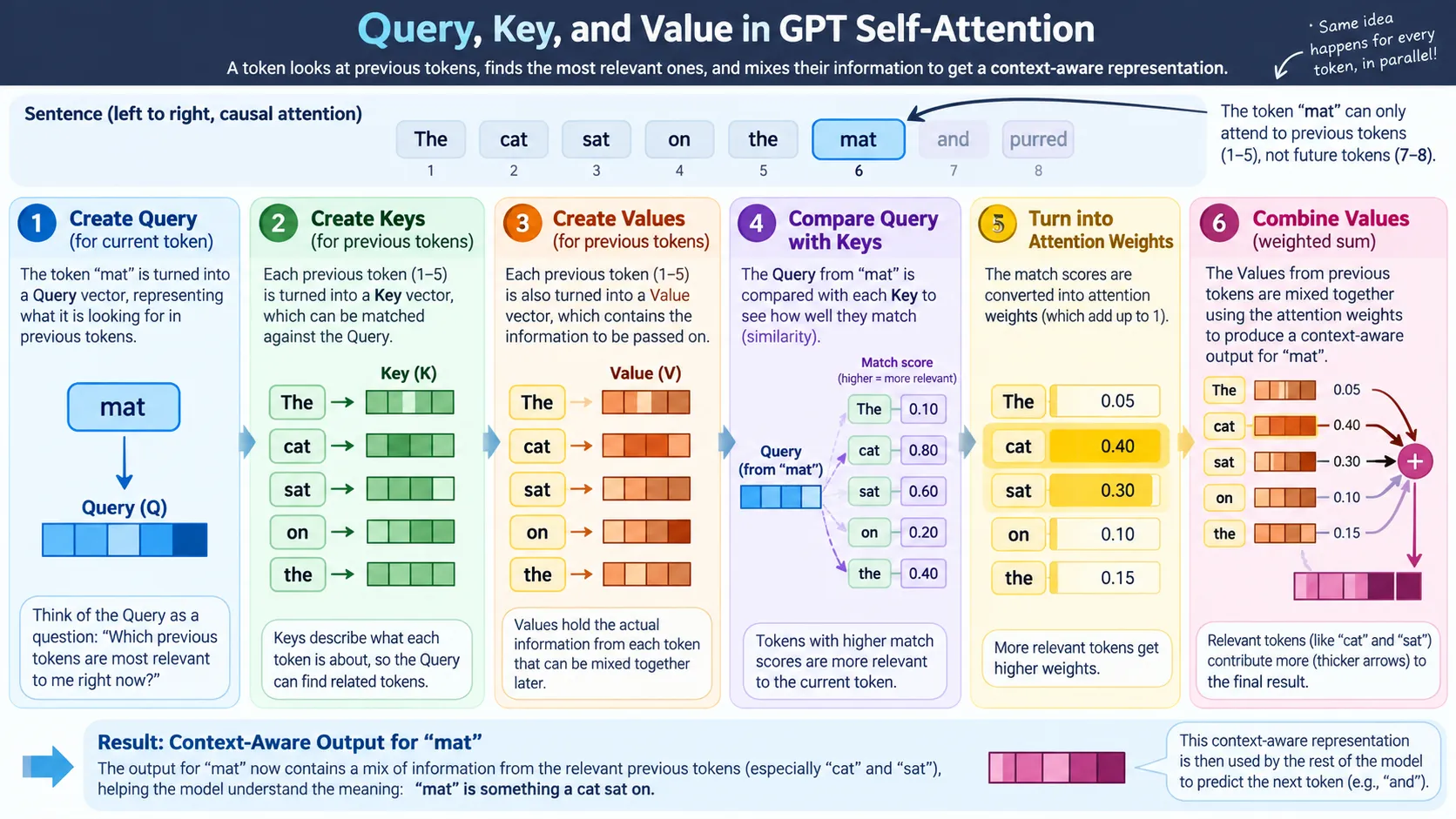
Inside self-attention, each token is transformed into three different mathematical representations:
Query
Key
Value
These are usually called Q, K, and V.
At first, these names may sound technical, but the basic idea is easier than it looks.
Think about searching for a book in a library.
Your Query represents what you are looking for.
The Keys act like labels that help determine which books are relevant.
The Values contain the useful information you finally retrieve.
GPT performs a mathematical version of this process.
For every token, the model creates Query, Key, and Value vectors using learned weight matrices.
The Query of one token is compared with the Keys of other allowed tokens.
If the match is strong, that token can receive more attention.
Its Value then contributes more strongly to the new representation being created.
Imagine this sentence:
“The laptop became slow because it was overheating.”
When GPT processes the token “overheating”, earlier information related to “laptop” and “slow” may become especially useful.
Attention helps the model combine those relationships instead of looking at each word in isolation.
Scaled Dot-Product Attention
GPT does not compare Query and Key vectors randomly.
A common Transformer attention calculation begins by taking the dot product between Queries and Keys.
In simplified form:
Attention(Q, K, V) = Softmax(QKᵀ / √d) V
You do not need to memorize this formula to understand GPT architecture.
The important idea is this:
First, the model measures how strongly one token relates to other allowed tokens.
Then those scores are scaled.
Next, softmax converts the scores into attention weights.
Finally, those weights are used to combine the Value vectors.
The result becomes a new context-aware representation of the token.
So instead of representing only the word itself, a token can now carry information influenced by the relevant context around it.
Why GPT Uses Causal Masked Self-Attention
Normal self-attention can allow a token to look at tokens on both sides.
That would be a problem for autoregressive text generation.
Consider:
“I drink coffee every ___.”
Suppose the correct next token in the training example is:
“morning”
When predicting that token, the model should use only the information that appears before it.
It should not secretly look at future tokens.
GPT therefore applies a causal mask.
Conceptually, the rule looks like this:
Token 1 can see Token 1.
Token 2 can see Tokens 1–2.
Token 3 can see Tokens 1–3.
Token 4 can see Tokens 1–4.
A token cannot use information from positions that come after it.
This creates the left-to-right prediction behavior required for next-token prediction.
Why Multi-Head Attention Is Used
GPT does not rely on only one attention calculation.
Transformer architectures use multi-head attention, where several attention heads process relationships in parallel.
Think about reading this sentence:
“The developer fixed the server because it had crashed overnight.”
One attention head might focus strongly on the relationship between:
server → crashed
Another could capture:
developer → fixed
Another may focus on the wider sentence structure.
The heads do not receive manually assigned jobs like this. These patterns are learned during training.
Using multiple attention heads allows the model to capture different kinds of relationships at the same time.
Their outputs are eventually combined into a single representation before moving forward.
The Feed-Forward Network
After the attention stage, the representation moves through another important component: the feed-forward network, often shortened to FFN or called an MLP.
Attention mainly helps tokens exchange contextual information.
The feed-forward network performs additional transformation on the representation of each token.
A simplified view is:
Input → Linear Layer → Activation → Linear Layer → Output
You can think of attention as gathering useful information from the conversation, while the feed-forward network further processes what has been gathered.
Both components are necessary.
Attention handles relationships between tokens.
The MLP provides extra nonlinear computation that helps the network learn more complex patterns.
Residual Connections and Layer Normalization
Deep neural networks can become difficult to train if information must pass through many transformations without a direct path.
Transformers address this partly using residual connections.
Instead of completely replacing the previous representation, the model can add the original input back to the transformed output.
Conceptually:
New Representation = Original Representation + Learned Transformation
This gives information a more direct route through the network.
Layer normalization is also used to keep internal activations in a manageable range and support stable training.
The exact placement of normalization can differ between Transformer variants and GPT generations, but the general purpose remains similar: helping deep networks train more reliably.
What Happens When Transformer Blocks Are Stacked?
Now imagine everything we just discussed happening repeatedly.
The representation passes through:
Attention → MLP → Next Transformer Block → Attention → MLP → Next Block...
Each block receives representations produced by the previous block and transforms them again.
Earlier layers may capture simpler patterns, while deeper processing can build increasingly contextual representations.
Suppose the input is:
“Amit forgot his umbrella, and when he stepped outside…”
At the beginning, the model receives token and position information.
After passing through many Transformer blocks, the representation contains much richer contextual information about concepts such as:
Amit
umbrella
outside
and the relationships among them.
That final contextual representation can then be used for the most important step in generation:
predicting what token should come next.
And this is where GPT moves from understanding the available context to actually generating text.
How GPT Predicts the Next Token
After the input has passed through all the Transformer blocks, GPT has a rich contextual representation of every token it has processed.
But the model still has one final job:
Which token should come next?
Suppose you type:
“I am going to the airport to catch my…”
After processing this sentence, GPT may consider many possible next tokens.
Conceptually, some possibilities could be:
flight
plane
friend
taxi
The model does not simply choose a word because it “sounds right.”
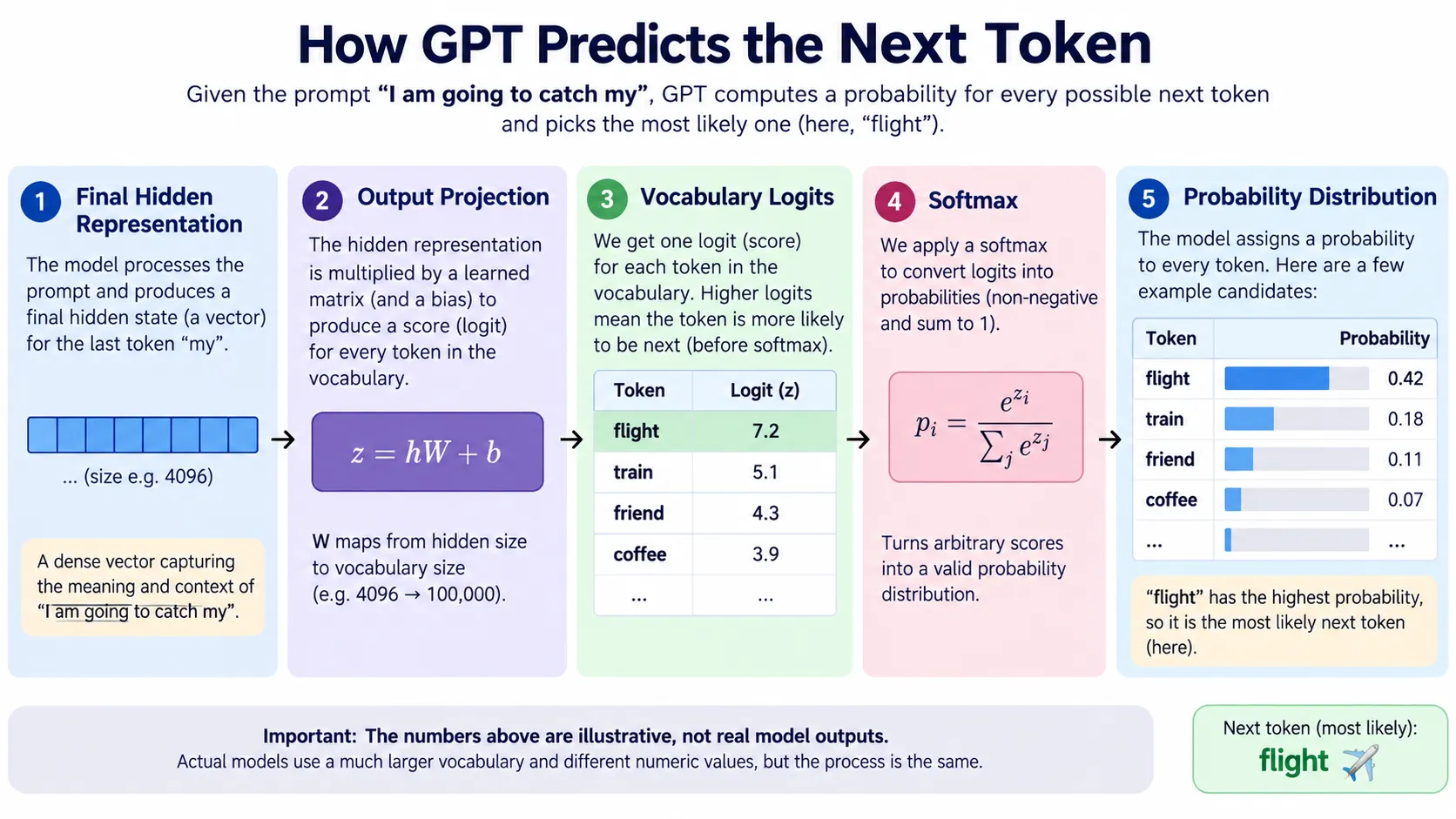
Instead, the final hidden representation is converted into scores for tokens in the model's vocabulary.
These raw scores are commonly called logits.
The higher the logit for a token, the more strongly the model currently favors that token before probability conversion.
From Hidden Representation to Vocabulary Logits
Imagine GPT has a vocabulary containing thousands of possible tokens.
The final Transformer representation is passed through an output projection that produces one score for each possible token.
Conceptually:
Final Transformer Output → Vocabulary Scores → Logits
You can imagine a tiny example like this:
flight → high score
plane → medium score
coffee → very low score
banana → extremely low score
These are not yet probabilities.
For that, GPT needs another mathematical operation.
Softmax Converts Scores Into Probabilities
The softmax function converts the raw logits into a probability distribution.
After softmax, the possible next tokens might conceptually look like:
flight → 55%
plane → 22%
taxi → 8%
friend → 5%
other tokens → remaining probability
These numbers are only a simple illustration, but they show the basic idea.
The model now has a probability distribution over possible next tokens.
A common misunderstanding is that GPT always chooses the token with the highest probability.
It can, but text generation systems often use different decoding strategies to control how predictable or varied the output becomes.
Temperature: Controlling How Predictable the Output Feels
One common generation setting is temperature.
Temperature changes the shape of the probability distribution before a token is selected.
At a lower temperature, high-probability tokens become more dominant.
This usually makes the output more focused and predictable.
At a higher temperature, lower-probability options receive relatively more chance.
That can make the output more varied, but it can also increase the chance of unusual or less reliable text.
Imagine asking:
“Give me a professional subject line for a payment reminder.”
A low-temperature generation may repeatedly produce safe options such as:
Payment Reminder
or
Reminder: Outstanding Payment
But if you ask:
“Give me creative names for a futuristic AI game.”
A little more variation may be useful.
Temperature does not make the model more knowledgeable.
It mainly changes how the existing probability distribution is used during generation.
Top-K and Top-P Sampling
Two other common decoding ideas are Top-K and Top-P sampling.
Top-K Sampling
With Top-K sampling, the system keeps only a limited number of the highest-scoring token choices.
For example, if K = 5, generation may select only among the five strongest candidates at that step.
Lower-ranked options are excluded.
This helps prevent very unlikely tokens from being selected.
Top-P Sampling
Top-P, also called nucleus sampling, works differently.
Instead of keeping a fixed number of tokens, it keeps a group of high-probability tokens whose combined probability reaches a chosen threshold.
This means the number of available candidates can change from one generation step to another.
If the model is very confident, only a few tokens may be needed.
If the prediction is uncertain, a larger group may remain available.
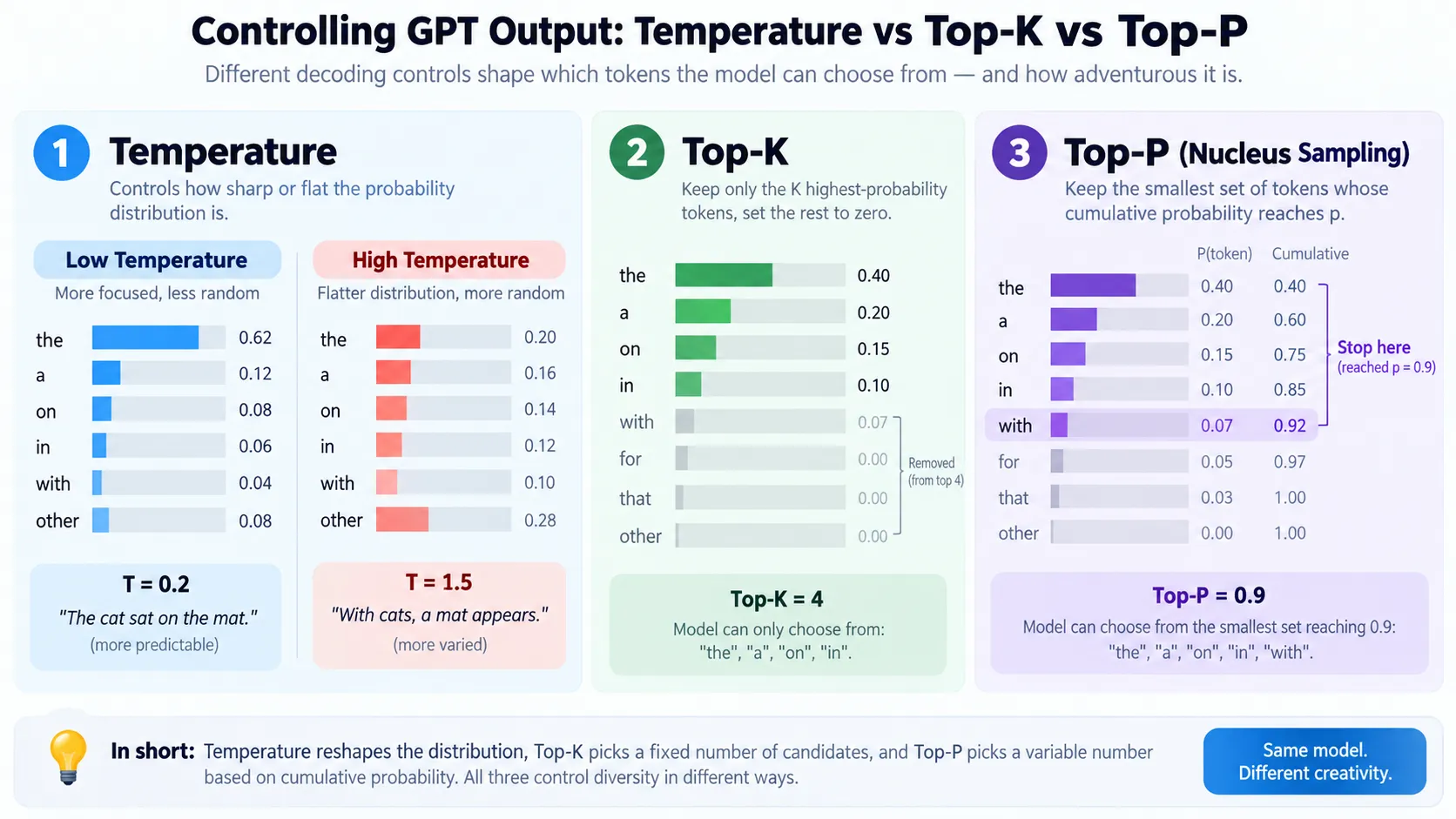
Temperature, Top-K, and Top-P are generation controls.
They are not the core Transformer architecture itself, but they strongly affect how generated text feels to the user.
Autoregressive Generation: One Token at a Time
Now we can connect everything.
Suppose you ask GPT:
“Write one sentence about morning coffee.”
The model begins with the tokens already present in your prompt.
It processes them through the Transformer.
Then it predicts a next token.
Suppose the generated sequence begins:
“Morning”
Now “Morning” becomes part of the context.
GPT processes the updated sequence and predicts again:
“coffee”
The context becomes:
“Morning coffee”
Then:
“makes”
Then:
“the”
Then:
“day”
Then:
“feel”
Then:
“easier.”
What looks to you like one smoothly written sentence was actually generated through repeated next-token predictions.
Conceptually:
Prompt → Predict token → Add token → Predict again → Add token → Repeat
This is why GPT is called an autoregressive language model.
Every newly generated token becomes part of the context used for the next prediction.
Training and Text Generation Are Not the Same Thing
It is also important to separate training from inference.
During training, a GPT-style model learns by repeatedly trying to predict tokens from examples and adjusting its parameters when its predictions are wrong.
Consider:
“Delhi is the capital of India.”
The model may receive earlier tokens and learn to predict the following tokens.
Its prediction is compared with the expected token.
The difference contributes to a loss value.
An optimization algorithm then updates the model parameters so future predictions can improve.
This process happens across enormous amounts of training data.
During inference, however, the model is no longer learning from every prompt by performing standard training updates.
Instead, the already-trained parameters are used to process the provided context and generate predictions.
A simple way to remember the difference is:
Training = learning the patterns.
Inference = using the learned patterns.
A Complete Real-World GPT Architecture Example
Let us connect the full architecture using something you may actually type every day:
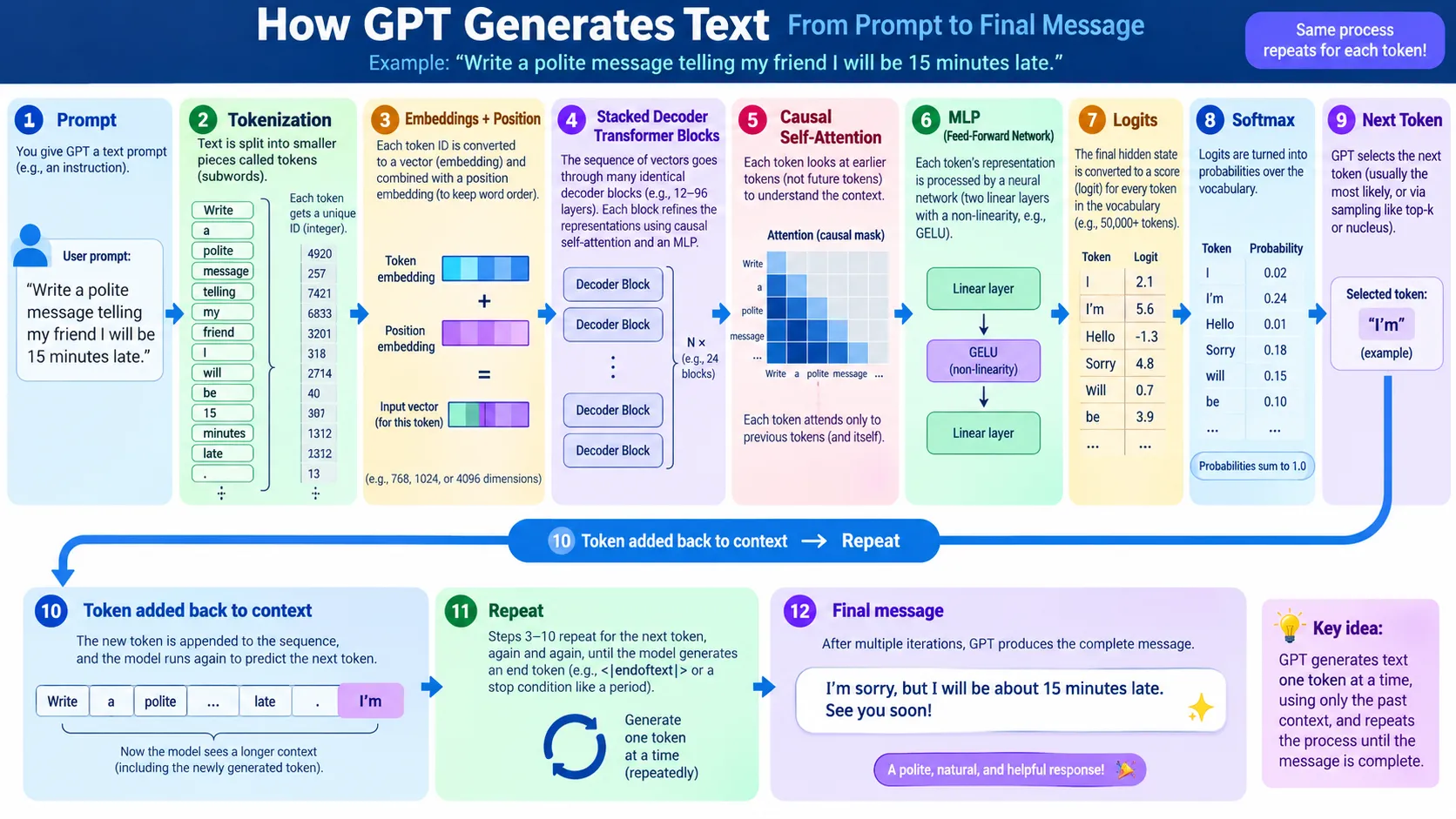
“Write a polite message telling my friend I will be 15 minutes late.”
Step 1: The Prompt Is Tokenized
The text is broken into tokens and converted into token IDs.
Step 2: Tokens Become Embeddings
The token IDs are transformed into learned vector representations.
Position information is added so the model knows the order of the sequence.
Step 3: Tokens Enter Transformer Blocks
The representations pass through multiple decoder-style Transformer blocks.
Step 4: Causal Self-Attention Connects the Context
The model can connect ideas such as:
polite
friend
15 minutes
late
while respecting the causal attention rule.
Step 5: The MLP Further Processes the Representations
Feed-forward layers transform the information after attention.
Residual connections and normalization help information move through the deep network.
Step 6: GPT Produces Next-Token Scores
The final representation is mapped to vocabulary logits.
Softmax converts these scores into probabilities.
Step 7: A Token Is Selected
The decoding method chooses a token.
For example:
“Hey”
Now that token becomes part of the context.
The model predicts again.
Eventually, you might receive something like:
“Hey, I’m running about 15 minutes late. Sorry for the delay—I’ll see you soon!”
To you, that appears almost instantly as a complete message.
Inside the model, however, it came from a sequence of repeated token predictions.
The Complete GPT Architecture in One Flow
At this point, the whole architecture can be understood as one connected pipeline:
Prompt
↓
Tokenization
↓
Token IDs
↓
Token Embeddings + Position Information
↓
Causal Multi-Head Self-Attention
↓
Feed-Forward Network
↓
Residual Connections + Normalization
↓
Repeated Transformer Blocks
↓
Final Hidden Representation
↓
Vocabulary Logits
↓
Probability Distribution
↓
Next Token
↓
Token Added Back to Context
↓
Process Repeats
This is the core idea behind GPT-style autoregressive text generation.
The architecture may look complicated when each technical term is viewed separately.
But when you follow the path from one sentence to one predicted token, the system becomes much easier to understand.
GPT is not writing an entire paragraph in one step.
It is repeatedly processing context, calculating relationships between tokens, estimating what should come next, and extending the sequence one token at a time.
That simple loop, powered by the Transformer architecture and scaled across many parameters and layers, is what turned next-token prediction into one of the most powerful ideas in modern artificial intelligence.
Final Thoughts
The most useful way to understand GPT is not to think of it as a machine that stores ready-made answers.
Think of it as a powerful context-processing and next-token prediction system.
Tokens give language a numerical form.
Embeddings create usable representations.
Position information preserves sequence order.
Causal self-attention connects relevant context.
Transformer blocks repeatedly refine that context.
The output layer produces token scores.
And autoregressive generation keeps repeating the process until the response is complete.
Once these pieces are clear, many advanced topics—including LLMs, instruction tuning, context windows, fine-tuning, retrieval-augmented generation, and AI agents—become much easier to understand.
Because underneath many of those systems, the same fundamental question remains:
Given everything that came before, what should come next?
Frequently Asked Questions About GPT Architecture
What is GPT architecture in simple words?
GPT architecture is a Transformer-based system designed to process previous text and predict what token should come next. Text is first converted into tokens and embeddings. Those representations pass through multiple Transformer blocks containing causal self-attention and feed-forward networks. The model then calculates scores for possible next tokens and continues generating text one token at a time.
Is GPT an encoder or decoder architecture?
Classic GPT models are commonly described as decoder-only Transformer models. Unlike models such as BERT, which use an encoder-style architecture and can process context from both directions during its standard pretraining tasks, GPT uses causal attention so a token cannot access future tokens during autoregressive prediction.
Why does GPT use causal self-attention?
Causal self-attention prevents the model from looking ahead at future tokens while predicting the next token. If GPT is processing “I drink coffee every,” it can use the words that came before but cannot secretly access the token it is supposed to predict. This makes left-to-right autoregressive generation possible.
What are Query, Key, and Value in GPT?
Query, Key, and Value are mathematical representations used by the attention mechanism. A Query represents what information a token is looking for, Keys help determine which previous tokens are relevant, and Values contain information that can be combined into the token's updated representation.
How does GPT predict the next token?
After the input passes through the Transformer blocks, the final hidden representation is converted into scores called logits for tokens in the vocabulary. These scores can be transformed into a probability distribution, and the decoding process selects a token. That token is added to the existing context, and the process repeats.
Does GPT generate an entire answer at once?
No. A GPT-style autoregressive model generates its response sequentially. It predicts a token, adds that token to the context, and then predicts another token. Repeating this process creates sentences, paragraphs, code, or longer responses.
What is the difference between GPT and BERT architecture?
GPT and BERT are both based on Transformer ideas, but their classic architectures and training objectives are different. GPT is associated with causal, decoder-style autoregressive generation. BERT uses an encoder-style architecture with bidirectional contextual processing during masked-language-model pretraining. This makes their traditional use cases and information flow different.
What is multi-head attention in GPT?
Multi-head attention allows several attention calculations to happen in parallel. Different heads can learn different relationships between tokens. Their outputs are combined, allowing the model to build richer contextual representations than relying on a single attention pattern.
What is the role of the feed-forward network in GPT?
After the attention mechanism exchanges contextual information between tokens, the feed-forward network performs additional transformations on each token's representation. Attention and feed-forward processing work together throughout the stacked Transformer blocks.
What is the difference between GPT training and inference?
During training, the model learns by predicting tokens, calculating an error or loss, and updating its parameters through optimization. During inference, the trained parameters are used to process a new prompt and generate tokens without performing the normal training process after every prediction.


