


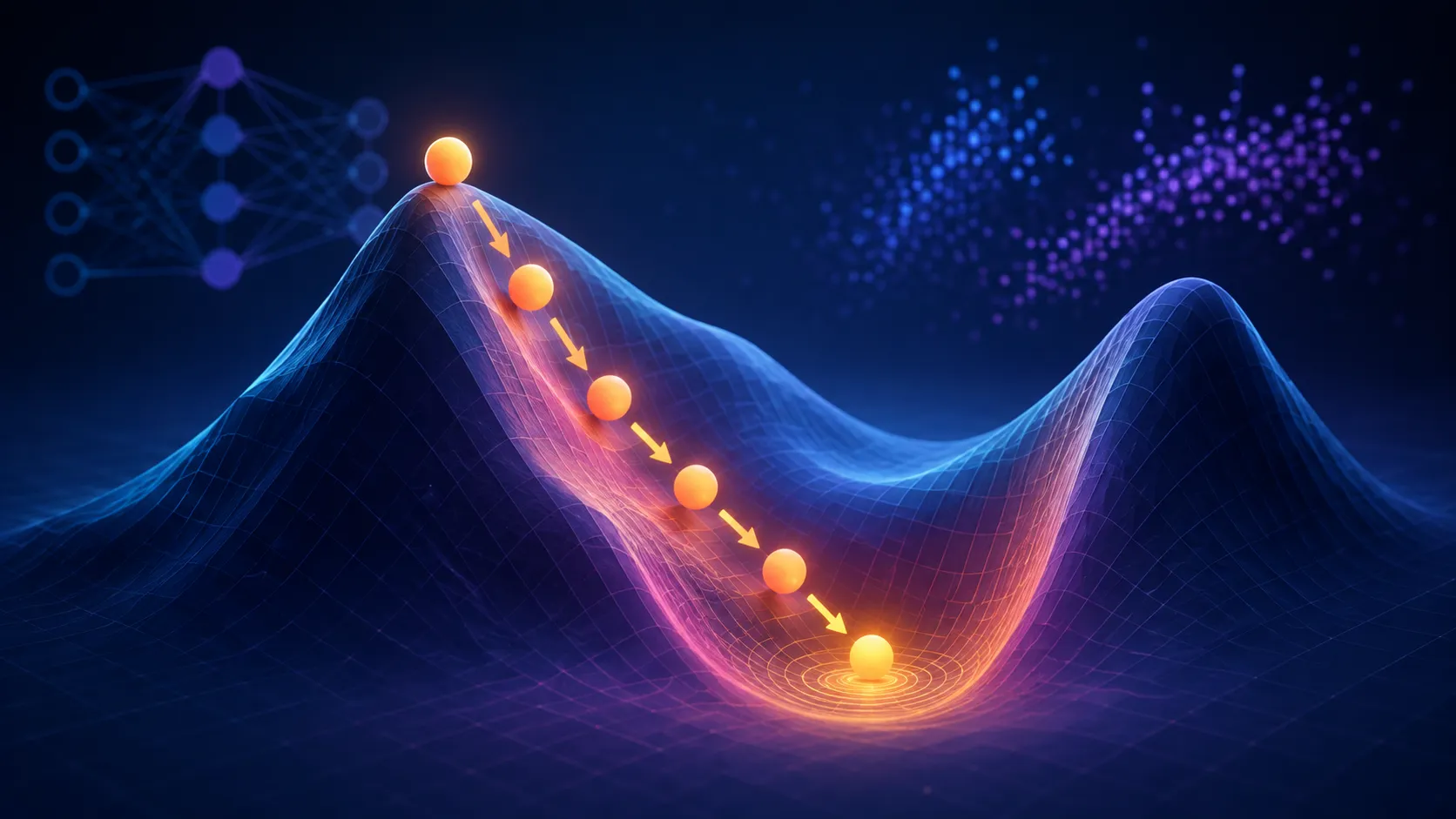
Imagine you are standing on a mountain at night. You cannot see the whole landscape, but you want to reach the lowest point in the valley. You check the slope under your feet, take a small step downhill, check again, and keep moving.
That simple idea is very close to how gradient descent works in Deep learning.
A neural network starts with weights that are mostly wrong. It makes a prediction, measures the error, and then adjusts those weights. Gradient descent tells the model which direction the weights should move.
Once this idea is clear, terms like learning rate, SGD optimizer, Adam optimizer, loss function, and neural network convergence become much easier.
What Is Gradient Descent?
Gradient descent is an optimization algorithm used to reduce a model’s error during training. In simple words, it helps a machine learning model move from bad predictions toward better predictions one update at a time.
A neural network contains trainable values called parameters, mainly weights and biases. These values affect how the model turns an input into an output.
Suppose a model is predicting house prices. It looks at size, rooms, location, and other features. At first, its prediction may be far from the real price. A loss function measures that mistake.
A large loss means the prediction is poor. A smaller loss means the model is getting closer.
Gradient descent asks:
Which small change in the model’s parameters will reduce the loss?
The gradient shows how the loss changes when a parameter changes. The model then moves the parameter in the opposite direction of that gradient because the goal is to move toward lower error.
How Does Gradient Descent Work in a Neural network?
The gradient descent algorithm is a repeated learning cycle:
The neural network receives training data.
It makes a prediction using its current weights.
The loss function compares the prediction with the correct answer.
Backpropagation calculates how each weight affected the error.
The optimizer uses those gradients to update the weights.
The process repeats with more training data.
This can happen thousands or millions of times during training.
The goal is not one huge correction. The model makes many controlled corrections until its loss becomes smaller and its predictions improve.
A Real-Life Example: Predicting Food Delivery Time
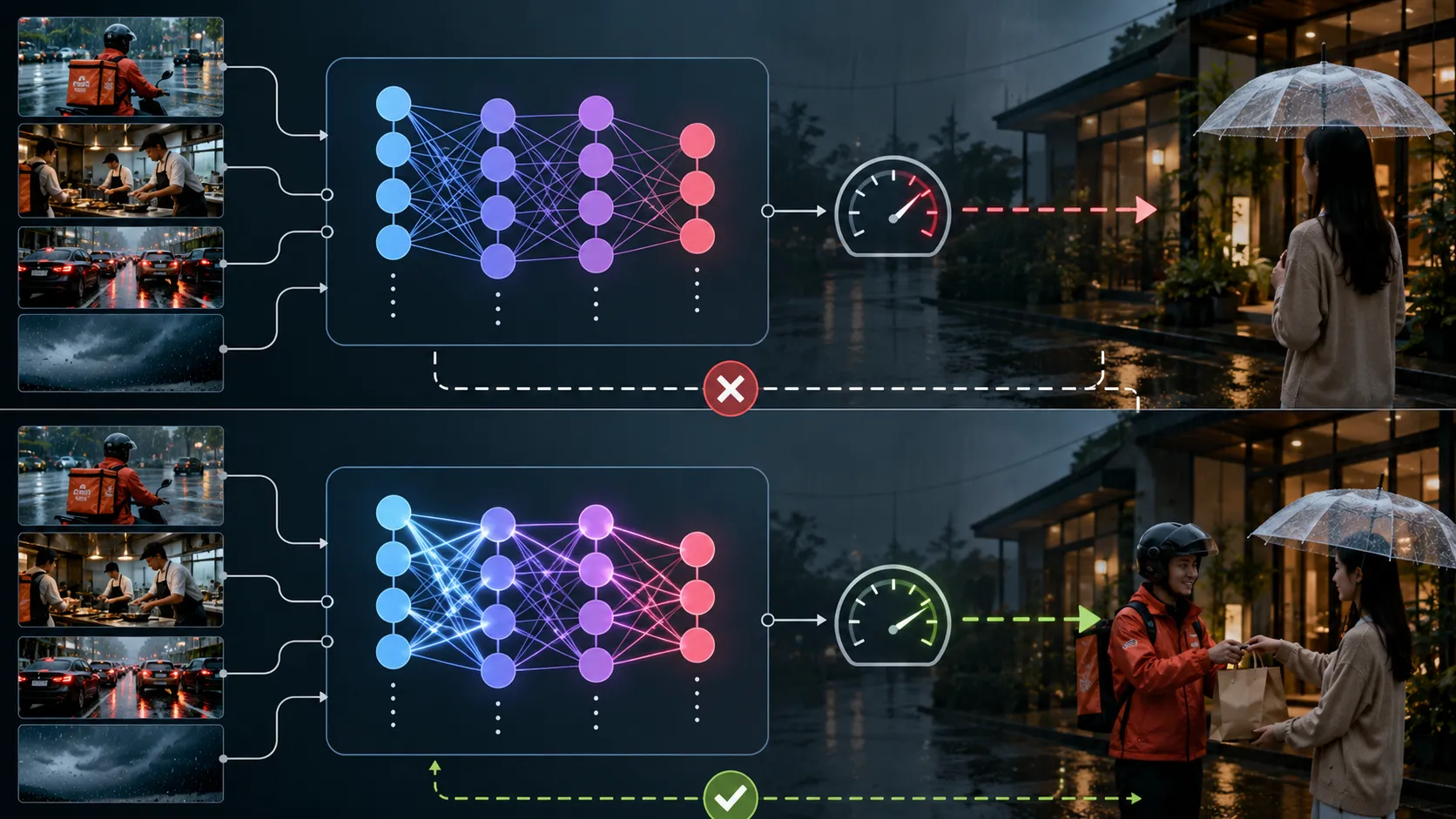
Imagine a delivery app trying to predict whether your order will arrive in 25, 40, or 60 minutes.
The model may use restaurant preparation time, distance, traffic, weather, rider availability, and past delivery data.
Suppose it predicts 25 minutes, but the order actually takes 42 minutes. That creates an error.
During training, the model checks which internal weights pushed the prediction too low. Backpropagation calculates the gradients, and gradient descent adjusts those weights slightly.
After learning from many deliveries, the model may discover that heavy rain, evening traffic, and slow restaurant preparation should increase the predicted delivery time.
That is why gradient descent in machine learning is more than a formula. It is the correction process that helps the model learn from mistakes.
Why Is the Learning Rate So Important?
The learning rate controls how large each parameter update will be.
Think again about the mountain.
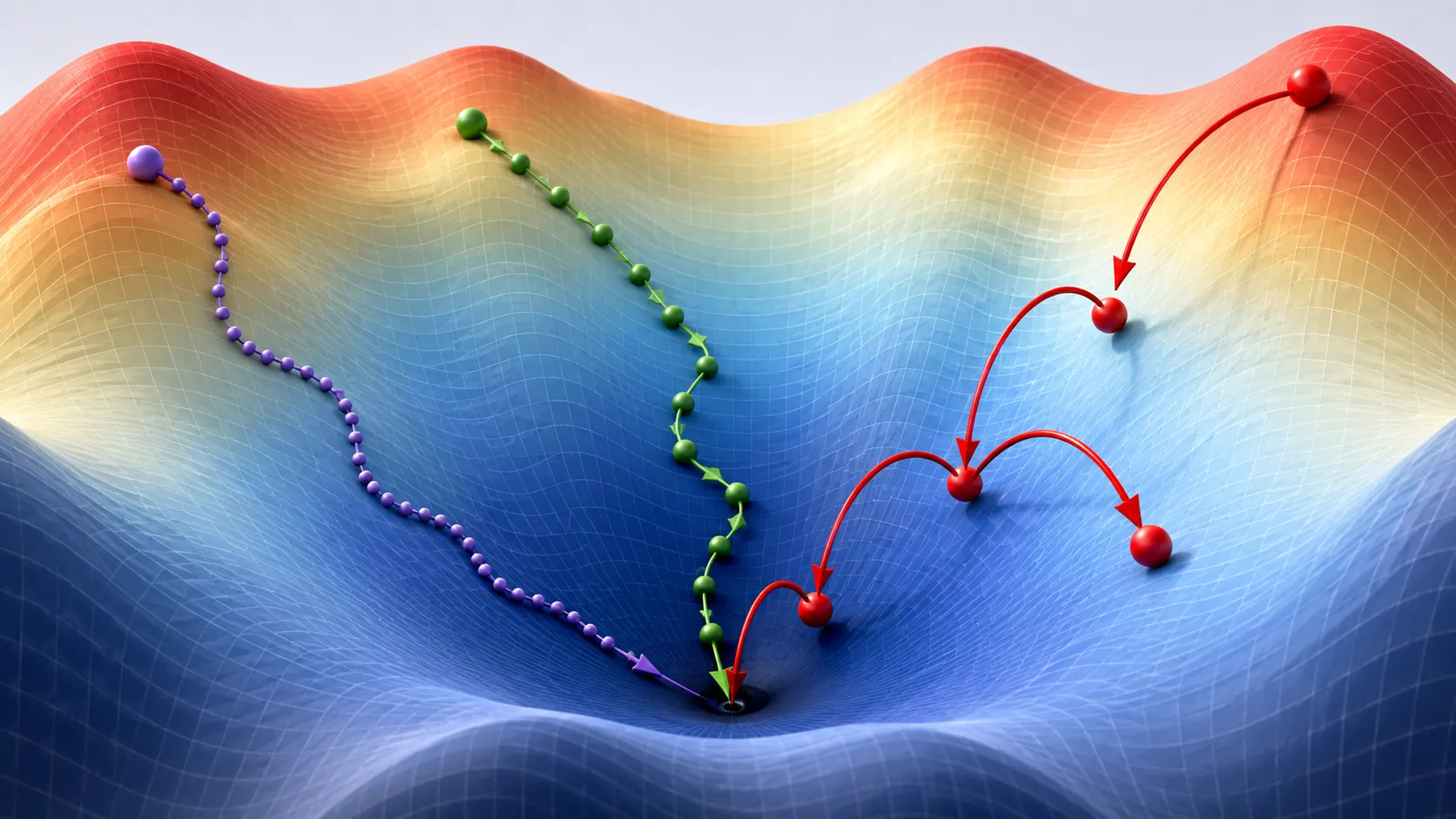
If your steps are extremely small, you may move in the right direction but take a very long time to reach the bottom. In neural network training, this means slow convergence.
If your steps are too large, you may jump from one side of the valley to the other and miss the lowest area. The loss can bounce, become unstable, or increase.
A good learning rate balances speed and control.
It is similar to steering a moving car. Tiny corrections may respond too slowly. Huge corrections can make the car unstable. The right amount depends on the road.
This is also why deep learning optimizers matter. Different optimizers handle parameter updates differently when gradients are noisy or changing.
Batch vs Stochastic vs Mini-Batch Gradient Descent
Not every type of gradient descent uses the same amount of data before making an update.
Batch gradient descent calculates the gradient using the full training dataset before updating the model. It can give a stable direction, but it becomes expensive with very large datasets.
Stochastic gradient descent (SGD) traditionally updates the model using one training example at a time. Updates happen quickly, but they can be noisy.
In modern deep learning, mini-batch gradient descent is more common. The model uses a small group of examples for each update.
For example, it may process 32 or 64 images, calculate the gradient for that mini-batch, update the weights, and continue with the next group.
You will also often hear people say “SGD” when an SGD optimizer is being used with mini-batches, so the wording can overlap in practical Deep learning.
What Is an Optimizer in Deep Learning?
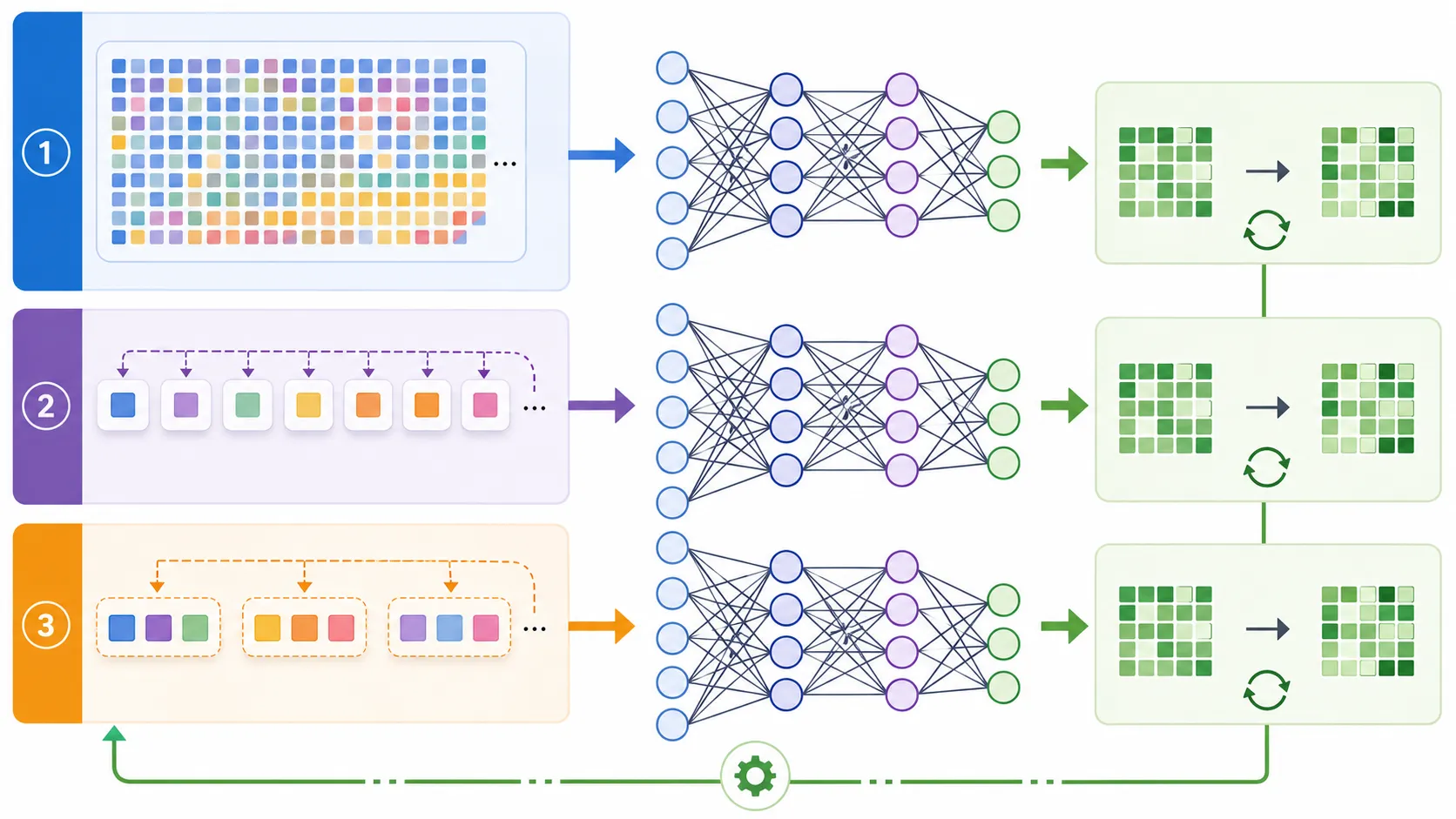
Gradient descent gives the basic direction for reducing loss. A neural network optimizer decides how that direction should be used to update parameters efficiently.
Think of gradient descent as knowing you need to travel downhill. The optimizer is the driving strategy.
Plain SGD follows the gradient more directly. SGD with momentum also remembers some previous movement, helping it build speed in useful directions.
Adam optimizer goes further. It uses information from past gradients to adapt updates for different parameters. This can make Adam convenient for fast experimentation and problems where gradients behave differently across the network.
But “Adam is always better than SGD” is not a good rule. SGD can still perform extremely well when its learning rate and momentum are tuned carefully.
The real question is not simply Adam vs SGD: which is better? It is: which optimizer reaches a strong solution efficiently for your model, data, and training goal?
What Is Stochastic Gradient Descent (SGD)?
Stochastic Gradient Descent, usually called SGD, is one of the simplest and most important optimizers used to train neural networks.
Its basic idea is easy to understand.
The model calculates the gradient, checks which direction can reduce the loss, and updates its parameters in that direction.
You can think of SGD like learning to throw a basketball into a hoop.
Your first shot may fall short. You add more force. The next shot goes too far, so you reduce the force slightly. After several attempts, your body begins to find the right movement.
SGD trains a neural network in a similar way. Each update tells the model:
“The previous parameters were not perfect. Move them slightly in this direction.”
Over many updates, the model can gradually reach a region where the loss is much lower.
Why Is SGD Still Used?
You may wonder why we still use SGD when newer optimizers such as Adam exist.
The answer is simple: newer does not automatically mean better for every problem.
SGD is simple, requires less optimizer state than Adam, and can produce excellent results when the learning rate, momentum, and training schedule are tuned properly.
It is especially useful when you have enough time to experiment with training settings and want strong final model performance.
But plain SGD has one important weakness.
It can sometimes move slowly or keep changing direction when the loss surface is difficult.
That is where momentum becomes useful.
What Is Momentum in Gradient Descent?
Imagine pushing a shopping cart.
When you first push it, the cart moves slowly. If you continue pushing in the same direction, it gains speed.
Even if you stop pushing for a moment, the cart does not immediately stop because it already has momentum.
SGD with momentum uses a similar idea.
Instead of making every parameter update based only on the current gradient, momentum also considers the direction of previous updates.
If gradients keep pointing in roughly the same direction, momentum can help the optimizer move faster.
If the gradients keep jumping left and right, momentum can reduce some of that unnecessary movement.
A Simple Mountain Example
Imagine walking down a long valley.
The valley slopes strongly forward, but its sides are steep.
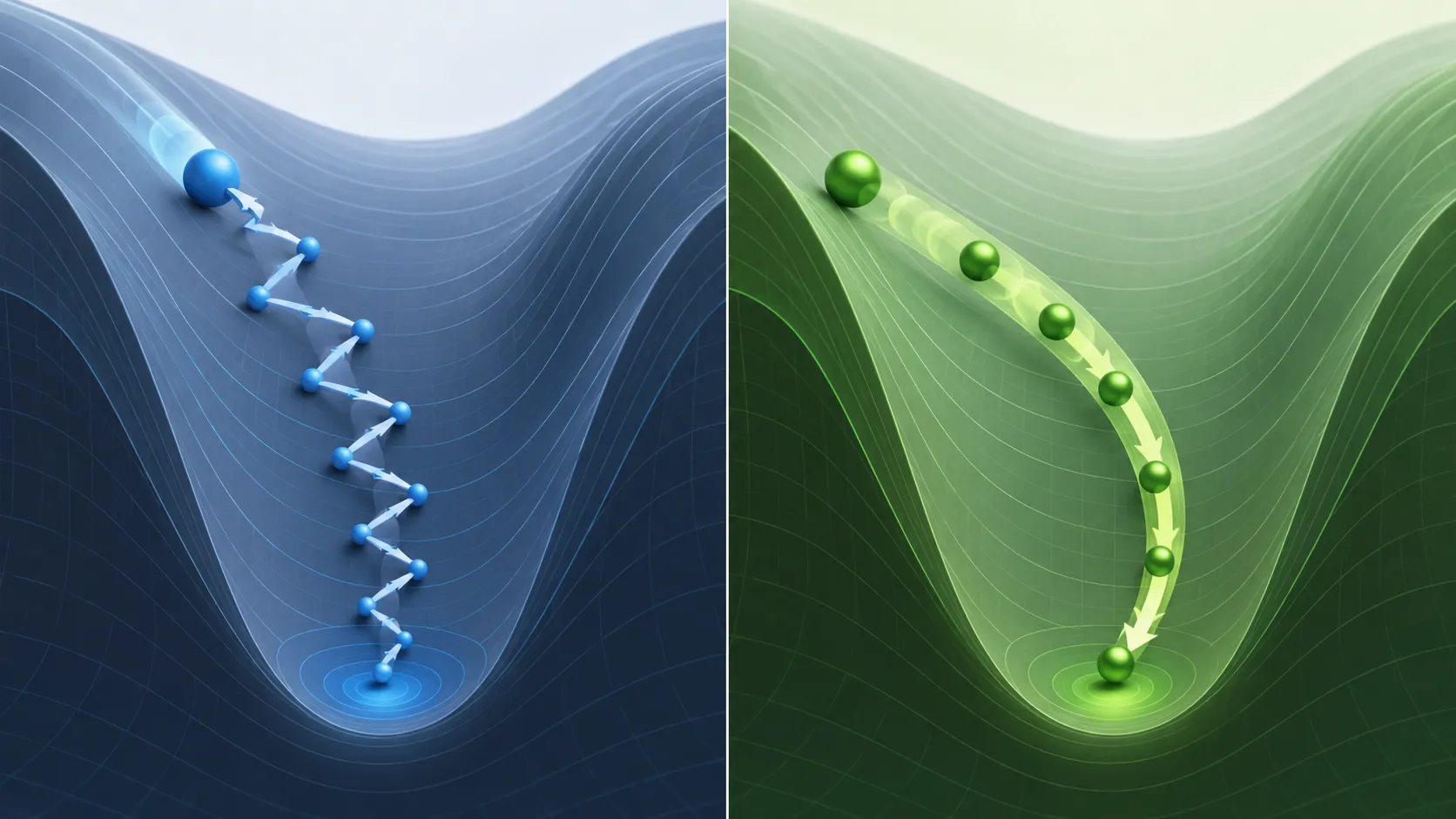
Without momentum, you might move:
left → forward → right → forward → left → forward.
You are still going downhill, but a lot of your movement is wasted from side to side.
With momentum, your previous forward movement helps you continue moving forward instead of reacting too strongly to every small change in the slope.
This is one reason momentum in gradient descent can help neural networks converge faster.
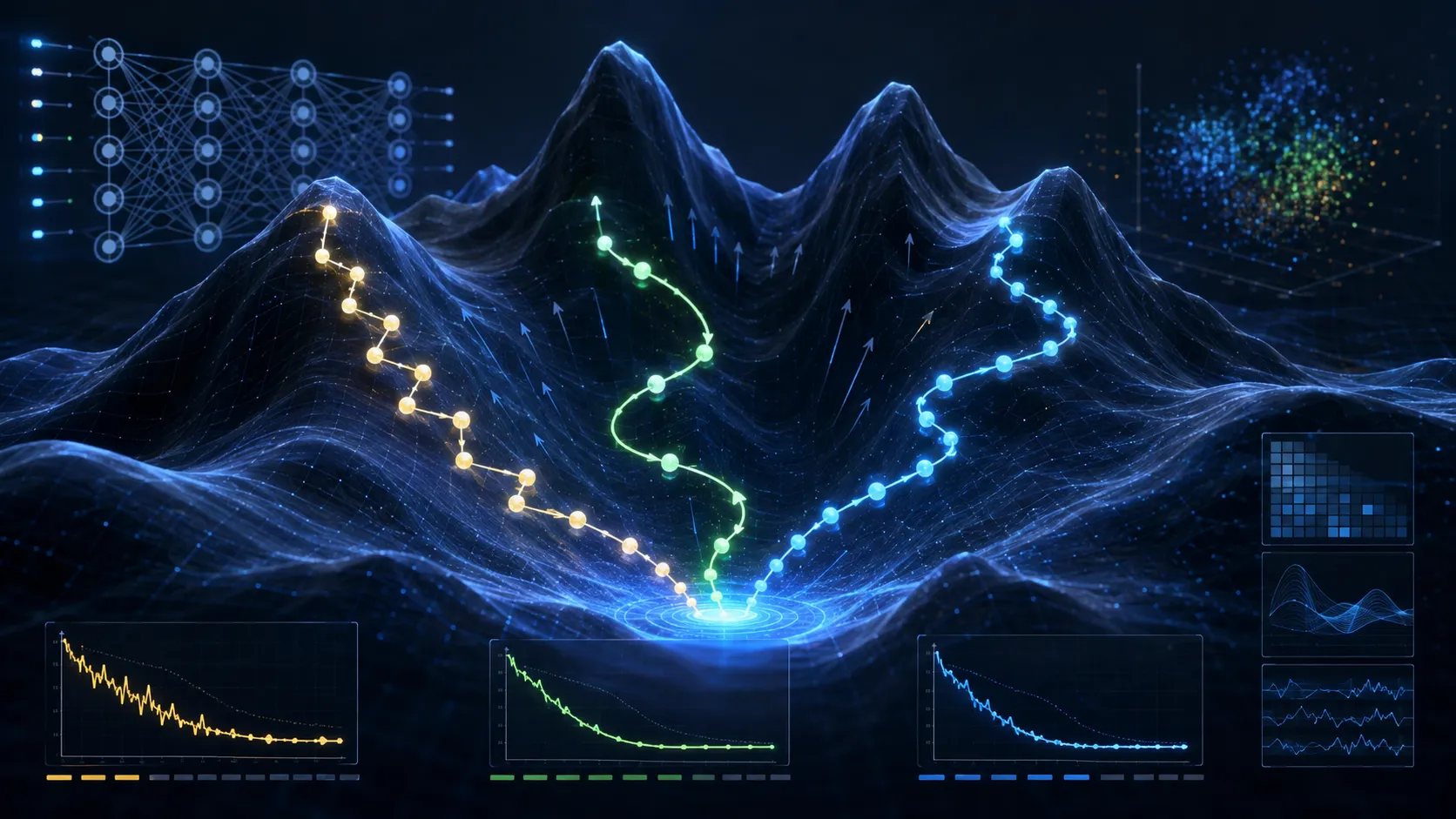
What Is the Adam Optimizer?
Adam, short for Adaptive Moment Estimation, is another widely used optimization algorithm for training neural networks.
Adam was designed to make parameter updates more adaptive.
Instead of treating every parameter in exactly the same way, Adam keeps running information about the gradients and uses it to adjust the updates.
At a high level, Adam tracks two things:
the recent direction of gradients;
the recent size of squared gradients.
This allows Adam to create different effective updates for different parameters.
The original Adam method combines adaptive estimates of these first and second moments of the gradients.
You do not need to memorize the mathematics to understand why this matters.
Think about learning to drive.
On a wide, empty road, you may make larger steering corrections comfortably.
On a narrow road, you make smaller and more careful corrections.
Adam behaves somewhat like an optimizer that can adjust how aggressively different parameters are updated instead of relying only on the same raw step size everywhere.
How Does Adam Optimizer Work?
Imagine a neural network with millions of weights.
Some weights may receive strong gradients regularly.
Others may receive smaller or less frequent gradients.
Using exactly the same style of update everywhere may not always be efficient.
Adam keeps moving averages of gradient information and uses them while deciding each update. Current PyTorch implementations expose these controls through parameters such as the learning rate and beta values.
In simple terms, the training process looks like this:
The model makes a prediction.
The loss function measures the mistake.
Backpropagation calculates gradients.
Adam looks at the current gradients along with information collected from earlier gradients.
It then adjusts the parameters.
The process repeats.
Because Adam adapts its updates, it often works well as a practical starting point when training a new neural network.
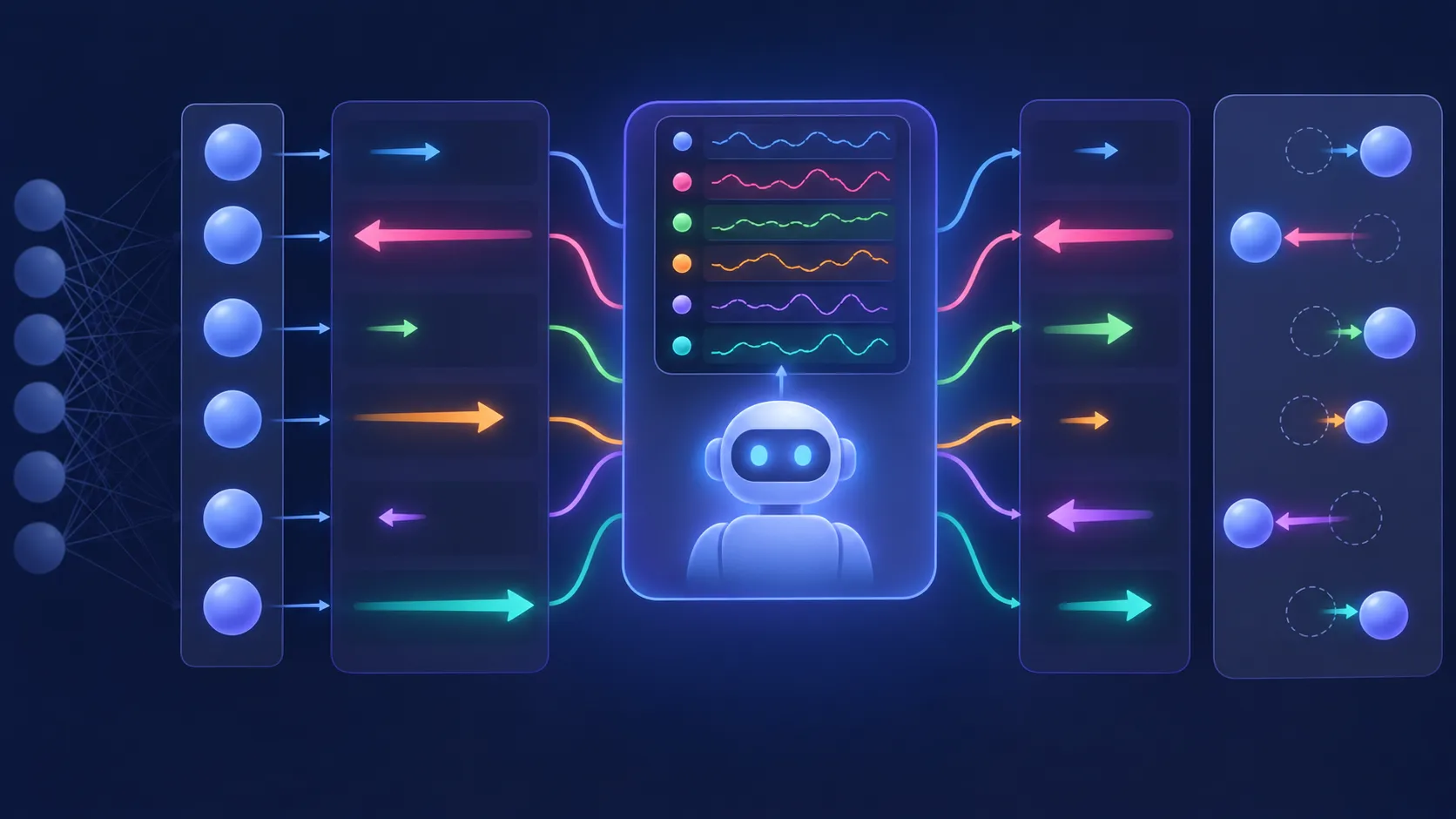
Adam vs SGD: What Is the Difference?
The difference between Adam and SGD is not that one learns and the other does not.
Both use gradients to improve a model.
The difference is mainly in how they use those gradients to update the parameters.
SGD follows a relatively direct update strategy. Add momentum, and it also carries information from previous movement.
Adam goes further by maintaining adaptive gradient statistics for individual parameters.
Imagine two people trying to reach the bottom of an unfamiliar mountain.
The SGD traveller checks the current slope and moves downhill. With momentum, the traveller also remembers the direction they have been moving.
The Adam traveller checks the slope but also keeps more information about how the terrain has behaved during earlier steps and adjusts movements accordingly.
This can make Adam convenient when you want training to start effectively without spending too much time manually tuning the optimizer.
However, that does not mean you should automatically replace SGD with Adam in every project.
Is Adam Better Than SGD?
There is no universal winner in the Adam vs SGD optimizer debate.
Adam can be a strong choice when you are experimenting with a new model, dealing with noisy or sparse gradients, or want an optimizer that adapts its updates automatically.
SGD with momentum can be a strong choice when you can carefully tune the learning rate and training schedule and care about the final performance of the model.
So instead of asking:
“Which optimizer is the best?”
Ask:
“Which optimizer works best for this model, dataset, training budget, and goal?”
That small change in thinking is important.
In machine learning, the optimizer is not a magic button. It is one part of a complete training system.
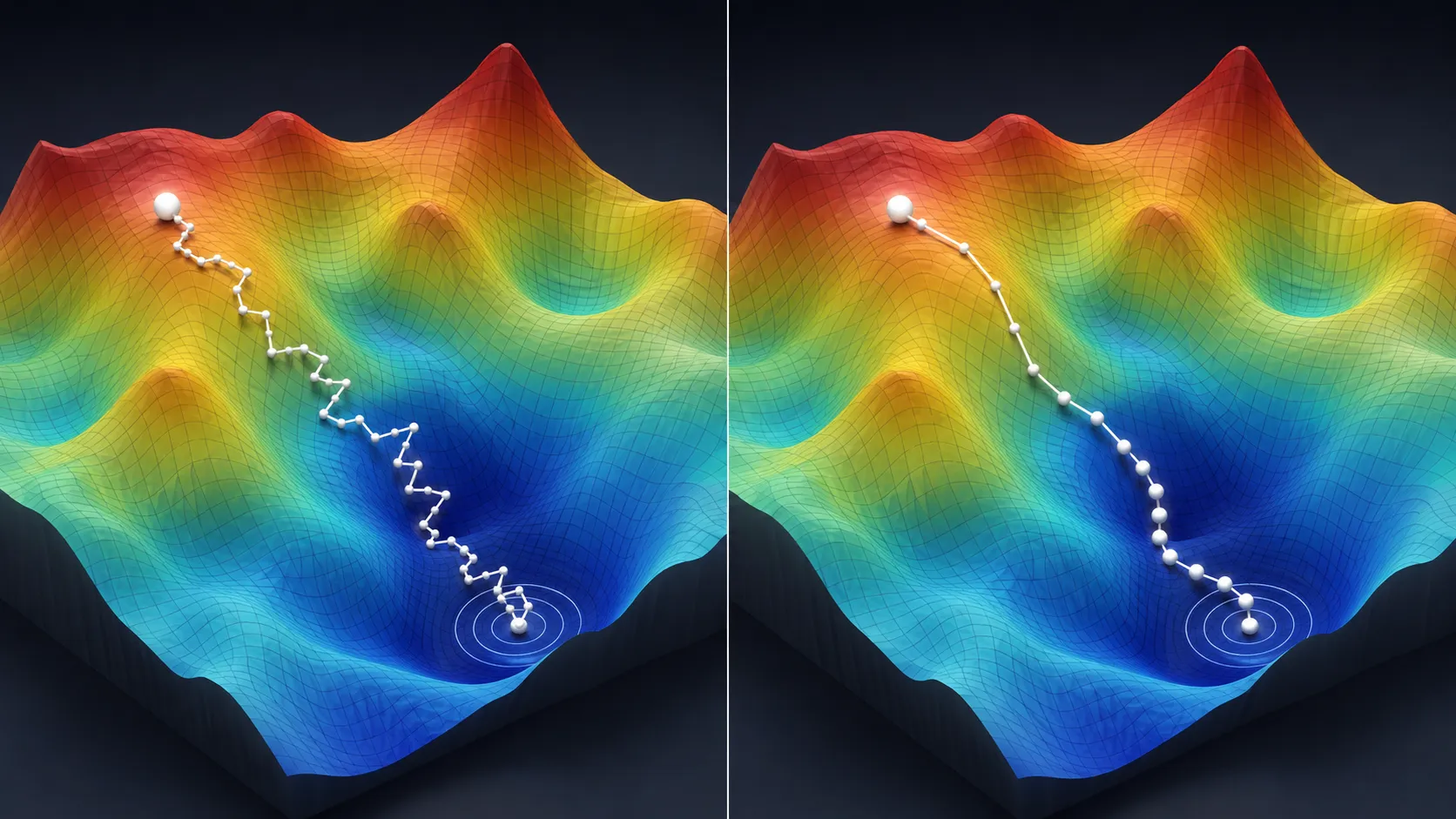
A Real-World Scenario: Training an Image Recognition Model
Suppose you are building a neural network that identifies damaged products in a factory.
You have thousands of images showing normal and damaged products.
You begin training with Adam.
The loss starts falling quickly, and within a reasonable number of epochs the model begins identifying useful visual patterns.
This makes Adam valuable during early experiments because you can test your model architecture and training pipeline quickly.
Later, you may experiment with SGD with momentum and a carefully planned learning-rate schedule.
Perhaps SGD learns more slowly at the beginning but eventually reaches validation performance that works better for your production goal.
The important lesson is that optimizer selection should be tested, not guessed.
Two optimizers can follow different paths through the same loss landscape and still produce useful models.
And there is one setting that can completely change both paths:
the learning rate.
Choosing Adam or SGD is only half the story. Understanding how to control the learning rate, recognize slow or unstable convergence, and tune training correctly is what turns gradient descent from a simple idea into an effective neural network training strategy.
How Does the Learning Rate Affect Convergence?
The learning rate is one of the most important settings in neural network training.
Even a powerful optimizer such as Adam or SGD can perform badly when the learning rate is poorly chosen.
Remember the mountain example from earlier.
If you take very small steps, you may eventually reach the bottom, but it could take a long time.
If you take huge steps, you may keep jumping across the valley instead of moving toward the lowest point.
Neural networks behave in a similar way.
A learning rate that is too low can make training painfully slow. The loss may decrease, but only a little after every update.
A learning rate that is too high can make training unstable. The loss may jump up and down, or the model may fail to learn useful patterns.
The goal is to find a learning rate that allows the optimizer to move quickly while still keeping training under control.
PyTorch describes the learning rate as the value that controls the size of the optimizer's parameter updates, which directly affects training speed and convergence.
What Is Neural Network Convergence?
You will often hear people say:
“The model has converged.”
But what does that actually mean?
Neural network convergence usually means the training process has reached a stage where further updates are producing only small improvements.
Imagine studying for an exam.
During your first few study sessions, your score might improve from 40% to 60%, then from 60% to 75%.
Later, you may improve from 90% to 91%.
You are still learning, but the improvement is becoming smaller.
Something similar can happen during neural network training.
At the beginning, gradient descent may reduce the loss quickly because the model's parameters are far from useful values.
Later, improvements often become smaller as the optimizer reaches a better region of the loss landscape.
The goal is not simply to make training loss as low as possible.
You also want the model to perform well on new data it did not see during training.
That is why validation loss and validation accuracy should also be monitored.
How Can We Make Gradient Descent Converge Faster?
There is no single button that makes every neural network train faster.
However, several choices can make optimization more effective.
1. Start With a Sensible Learning Rate
Do not treat the learning rate as a random number.
If training loss barely changes, the learning rate may be too small.
If loss changes wildly or becomes unstable, it may be too large.
Adam is commonly started with relatively small learning rates. For example, PyTorch's current Adam implementation uses 0.001 as its default learning rate, although the best value still depends on the model and dataset.
2. Use Momentum With SGD
Plain SGD can move slowly when gradients keep changing direction.
Momentum helps carry useful movement from previous updates.
For example, instead of reacting completely to every small bump in the loss landscape, the optimizer keeps some memory of where it has been moving.
This can reduce unnecessary back-and-forth movement and help SGD convergence.
3. Change the Learning Rate During Training
The learning rate does not have to remain fixed from the first epoch to the last.
You may begin training with a larger learning rate so the model can make faster progress.
Later, you can reduce it so the optimizer makes smaller and more careful updates.
This approach is called a learning rate schedule.
For example, cosine annealing gradually changes the learning rate following a cosine-shaped schedule during training.
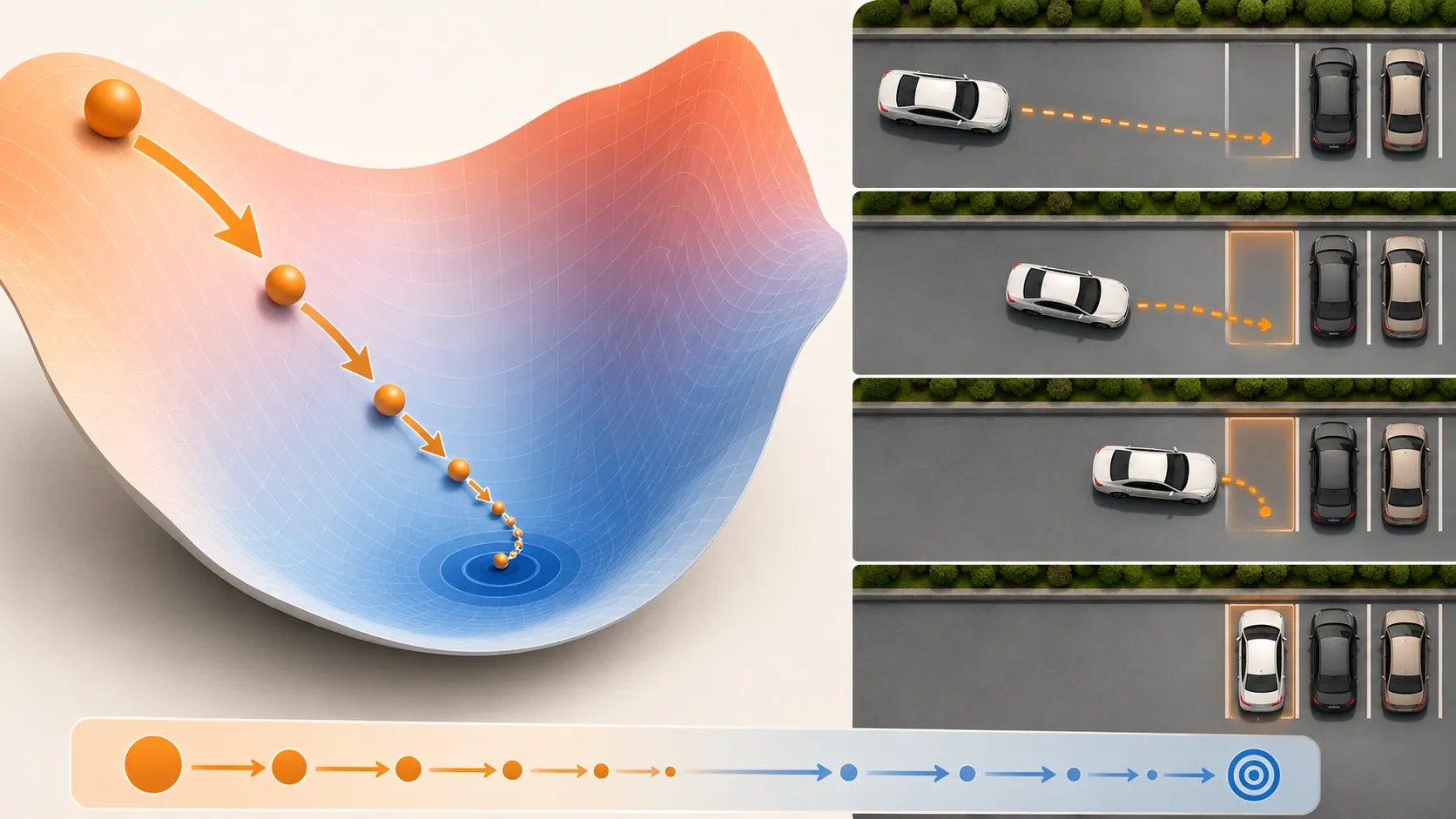
A Simple Real-Life Example of a Learning Rate Schedule
Imagine you are looking for a parking space in a large parking lot.
When you are far from the area where you want to park, you drive at a normal speed.
Once you see an empty space, you slow down.
As your car gets closer to the final position, your movements become smaller and more careful.
That is similar to what a learning rate schedule can do.
At the beginning of training, larger updates may help the model move quickly.
Later, smaller updates can help it fine-tune its parameters without jumping too far away from a useful solution.
Common Gradient Descent Mistakes Beginners Make
Understanding these mistakes can save hours of failed training.
Using a Very High Learning Rate
A large learning rate does not automatically mean faster training.
If the steps are too large, the optimizer may repeatedly overshoot useful parameter values.
Using a Very Low Learning Rate
The opposite problem is also common.
Your model may appear to be learning correctly, but improvement is so slow that training becomes inefficient.
Choosing Adam and Never Testing Anything Else
Adam is a very useful optimizer, but it should not become an automatic choice for every project.
When final model performance matters, experimenting with SGD with momentum can be worthwhile.
Changing Too Many Settings at Once
Suppose you change the optimizer, learning rate, batch size, model architecture, and regularization at the same time.
Your accuracy improves.
What actually caused the improvement?
You do not know.
Change important settings in a controlled way whenever possible.
Adam or SGD: Which Optimizer Should a Beginner Use?
If you are building your first neural network and want a practical starting point, Adam is often easier to begin with.
Its adaptive updates can make early experiments convenient, and it generally requires less manual tuning to get training moving.
Adam keeps running estimates related to both the gradients and their squared values, which it uses during parameter updates.
But once your model is working, do not stop experimenting.
Try SGD with momentum.
Test different learning rates.
Observe training loss.
Observe validation performance.
Measure how long the model takes to reach useful accuracy.
Your final optimizer choice should come from results, not popularity.
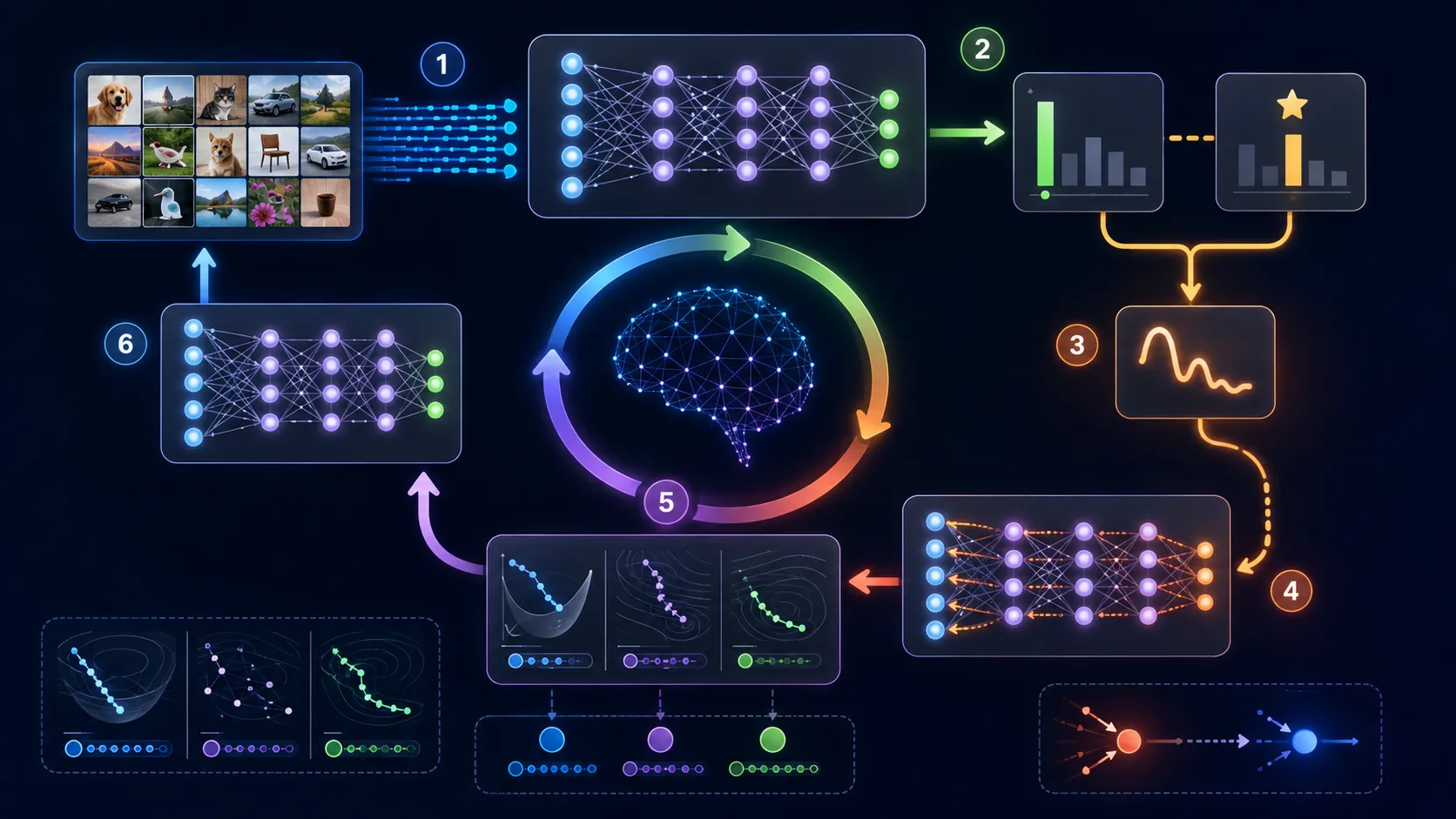
Gradient Descent, Adam, and SGD in One Simple Story
Imagine teaching a child to throw a ball into a basket.
The first throw misses badly.
You observe the mistake.
The child changes the throw.
The second attempt gets closer.
Another correction is made.
Eventually, the child learns how much force and direction are needed.
A neural network follows the same basic pattern.
The loss function measures the mistake.
Backpropagation calculates how the parameters contributed to that mistake.
The gradient points toward how the loss changes.
The optimizer decides how the parameters should be updated.
The learning rate controls the size of those updates.
SGD follows a relatively simple update strategy.
Momentum helps SGD carry useful movement from previous steps.
Adam adapts parameter updates using information collected from past gradients.
Together, these ideas form one of the most important learning processes in deep learning.
Final Thoughts
Gradient descent may look mathematical when you first see it, but the core idea is surprisingly human:
make an attempt, measure the mistake, correct it, and try again.
That cycle is repeated millions of times while modern neural networks are trained.
The real skill is not memorizing whether Adam or SGD is “better.”
It is understanding how gradient descent, optimizers, learning rates, momentum, loss, and convergence work together.
Once you understand that relationship, optimizer names stop feeling confusing.
You start seeing what they really are:
different strategies for helping a neural network learn from its mistakes and reach a better solution.
Frequently Asked Questions About Gradient Descent, Adam and SGD
What is gradient descent in simple words?
Gradient descent is a method used to reduce errors in a machine learning model. It checks how the model’s parameters affect the loss and then changes those parameters step by step in a direction that can improve predictions.
What is the difference between gradient descent and an optimizer?
Gradient descent is the basic idea of moving model parameters toward lower loss. An optimizer is the strategy that decides how those updates should happen. SGD and Adam are two common optimizers used during neural network training.
What is SGD in deep learning?
SGD stands for Stochastic Gradient Descent. It updates a neural network using gradients calculated from training examples or, more commonly in modern deep learning, small mini-batches of data. It is simple, efficient, and can perform very well when tuned properly.
What is the Adam optimizer?
Adam stands for Adaptive Moment Estimation. It uses information from current and previous gradients to adjust parameter updates. Because it adapts updates for different parameters, Adam is often a convenient optimizer for beginners and early model experiments.
Adam vs SGD: which optimizer is better?
There is no single winner for every neural network. Adam often learns quickly and requires less initial tuning, while SGD with momentum can achieve excellent final performance when the learning rate and training schedule are carefully tuned. The best choice depends on your dataset, model, and goal.
Why is the learning rate important in gradient descent?
The learning rate controls how large each model update will be. If it is too small, training can become very slow. If it is too large, the optimizer may overshoot good parameter values and make training unstable. A balanced learning rate helps the model converge efficiently.
What is momentum in SGD?
Momentum helps SGD remember part of its previous movement. If gradients continue pointing in a similar direction, momentum can help the optimizer move faster. It can also reduce unnecessary back-and-forth movement during training.
What does convergence mean in neural networks?
Convergence means the training process has reached a stage where additional updates produce only small improvements. The loss may stop decreasing quickly, and the model begins to settle around a useful set of parameters.
Can Adam converge faster than SGD?
Adam often makes faster progress during the early stages of training because it adapts its updates automatically. However, faster early convergence does not always mean better final model performance. In some tasks, carefully tuned SGD can match or outperform Adam.
Which optimizer should beginners use first?
Adam is usually a practical starting point because it works well across many neural network tasks with relatively little tuning. Once the model is working, beginners should also test SGD with momentum and compare validation performance, training stability, and convergence speed.


