


Imagine this.You have finally decided to learn deep learning. You install Python, open your laptop, watch a few tutorials, and then reach the first confusing question:
Should I learn PyTorch or TensorFlow?
One YouTube video tells you PyTorch is the future. Another says TensorFlow is still better for serious production systems. A Reddit discussion recommends PyTorch for beginners, while an old course tells you every machine learning engineer should know TensorFlow.
Now you have not even trained your first neural network, and you are already choosing sides.
The good news is that you do not need to.
The PyTorch vs TensorFlow debate in 2026 is very different from what it was a few years ago. Both frameworks have become faster, easier to use, and much more flexible. At the same time, their ecosystems have changed enough that choosing the right one depends more on what you want to build than on which framework is universally “better.”
By the end of this guide, you should be able to choose a framework without guessing.
What Are PyTorch and TensorFlow?
PyTorch and TensorFlow are open-source frameworks used to build, train, test, and run machine learning and deep learning models.
Think of them as two large toolboxes.
If you want to build an image recognition system, language model, recommendation engine, fraud detector, medical AI model, or another neural-network-based application, these frameworks give you many of the tools required to do it.
Instead of manually writing every mathematical operation required by a neural network, you can work with ready-made layers, optimizers, loss functions, GPU support, automatic differentiation, and training tools.
Both can handle serious deep learning.
The difference is mainly in how they let developers work and what surrounding tools they provide.
PyTorch in Simple Words
PyTorch has traditionally felt very close to normal Python.
You create tensors, define a model, send data through it, calculate the error, and update the model.
That simple workflow is one reason PyTorch became extremely popular among researchers, students, AI engineers, and people experimenting with new model architectures.
Modern PyTorch also goes far beyond experimentation.
PyTorch 2.x introduced tools such as torch.compile, which can optimize model code while allowing developers to keep much of the normal PyTorch programming style. The current PyTorch documentation continues to position torch.compile as a central way to optimize PyTorch programs.
So the old idea that “PyTorch is only useful for research” is no longer accurate.
TensorFlow in Simple Words
TensorFlow was developed with large-scale machine learning systems in mind.
It gives developers tools for model building, training, distributed computing, model export, and deployment.
For beginners, TensorFlow is commonly used through Keras, which provides a simpler way to create neural networks.
For example, instead of manually handling every small part of a model, Keras can let you connect layers and train the model using a cleaner high-level API.
TensorFlow can also turn Python-based model logic into optimized computational graphs through tools such as tf.function, while XLA compilation can be used for further optimization in suitable workloads.
But something important has changed.
The PyTorch vs TensorFlow Debate Has Changed
A few years ago, the common advice was easy:
Use PyTorch for research. Use TensorFlow for production.
That rule is now too simple.
PyTorch has developed a much stronger production and deployment ecosystem, while TensorFlow continues to be useful far beyond traditional enterprise systems.
Even more importantly, Keras 3 is multi-backend.
A Keras workflow can now run on TensorFlow, PyTorch, or JAX backends. That means developers do not always have to treat Keras and PyTorch as completely separate worlds.
This is one of the biggest changes beginners should understand in 2026.
The framework you use to describe a model and the backend that finally executes that model can sometimes be different choices.
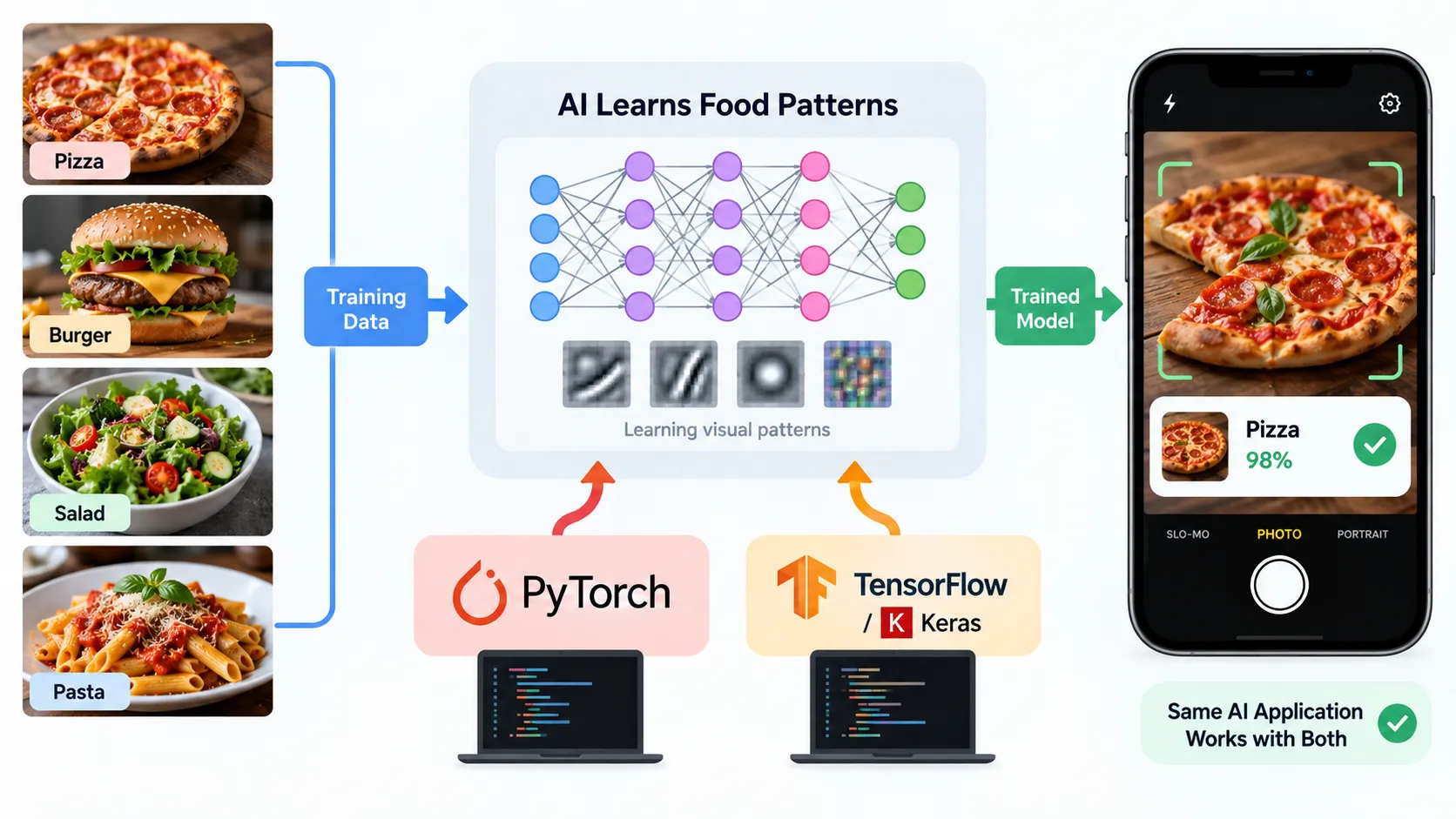
A Real-Life Example: Building a Food Recognition App
Suppose you and your friend want to create an app that looks at a food photo and predicts whether it contains pizza, pasta, burgers, salad, or another dish.
The machine learning problem itself is almost identical whether you choose PyTorch or TensorFlow.
You still need to:
collect images,
clean the data,
prepare training and validation sets,
build or reuse a neural network,
train it,
measure its accuracy,
and finally put the model inside an application.
With PyTorch, you may enjoy the direct Python-style workflow while experimenting with the model.
With TensorFlow and Keras, you may prefer the high-level model-building workflow and the surrounding deployment ecosystem.
But neither framework magically creates a better model.
Your data quality, model architecture, training process, hardware, optimization, and deployment requirements can matter far more than the framework name.
That is why asking “Is PyTorch better than TensorFlow?” without explaining the project is similar to asking:
“Which vehicle is better?”
A sports car may be perfect for one person and completely wrong for someone who needs to move furniture.
The better question is:
Which framework fits the job I actually want to do?
What Has Changed in PyTorch in 2026?
PyTorch's compiler and deployment story continues to improve.
PyTorch 2.13, released in July 2026, includes improvements around distributed training, compiler infrastructure, memory efficiency, and newer hardware workflows.
torch.compile can optimize supported PyTorch code through technologies such as TorchDynamo and TorchInductor while keeping the normal development experience relatively familiar.
PyTorch is also expanding on-device AI through ExecuTorch.
ExecuTorch became part of PyTorch Core in 2026 and is designed to help run PyTorch models on devices such as phones, laptops, embedded hardware, and other edge systems.
This matters because deployment used to be one of the strongest arguments against PyTorch.
That argument is becoming weaker.
However, there is an important detail developers should know: the old TorchServe project is no longer actively maintained, so a modern PyTorch production plan should not automatically assume TorchServe is the default answer.
That single change shows why a 2026 comparison needs current information instead of advice copied from older tutorials.
And TensorFlow has its own important changes too.
Those changes become especially interesting when we compare ease of learning, coding experience, performance, debugging, GPU training, research workflows, and production deployment.
PyTorch vs TensorFlow: Which Is Easier for Beginners?
If you are completely new to deep learning, this is probably the question that matters most.
Not:
“Which framework has more advanced features?”
But:
Which one will help me understand deep learning without making everything feel harder than it already is?
For many beginners, PyTorch feels easier at the start because its code usually looks and behaves more like normal Python.
You create some data, pass it through a model, calculate the loss, run backpropagation, and update the weights.
The flow is visible.
That matters when you are learning concepts such as tensors, gradients, loss functions, optimizers, and training loops.
When something goes wrong, you can often inspect variables directly and understand what happened.
TensorFlow is also beginner-friendly when used through Keras.
In fact, for someone who wants to create a basic neural network with very little code, Keras can sometimes feel even simpler.
You can define layers, compile the model, and start training with model.fit() without manually writing the full training loop.
So there are really two different meanings of “easy.”
PyTorch can be easier for understanding what is happening.
Keras can be easier for getting a model running quickly.
That small difference becomes important later.
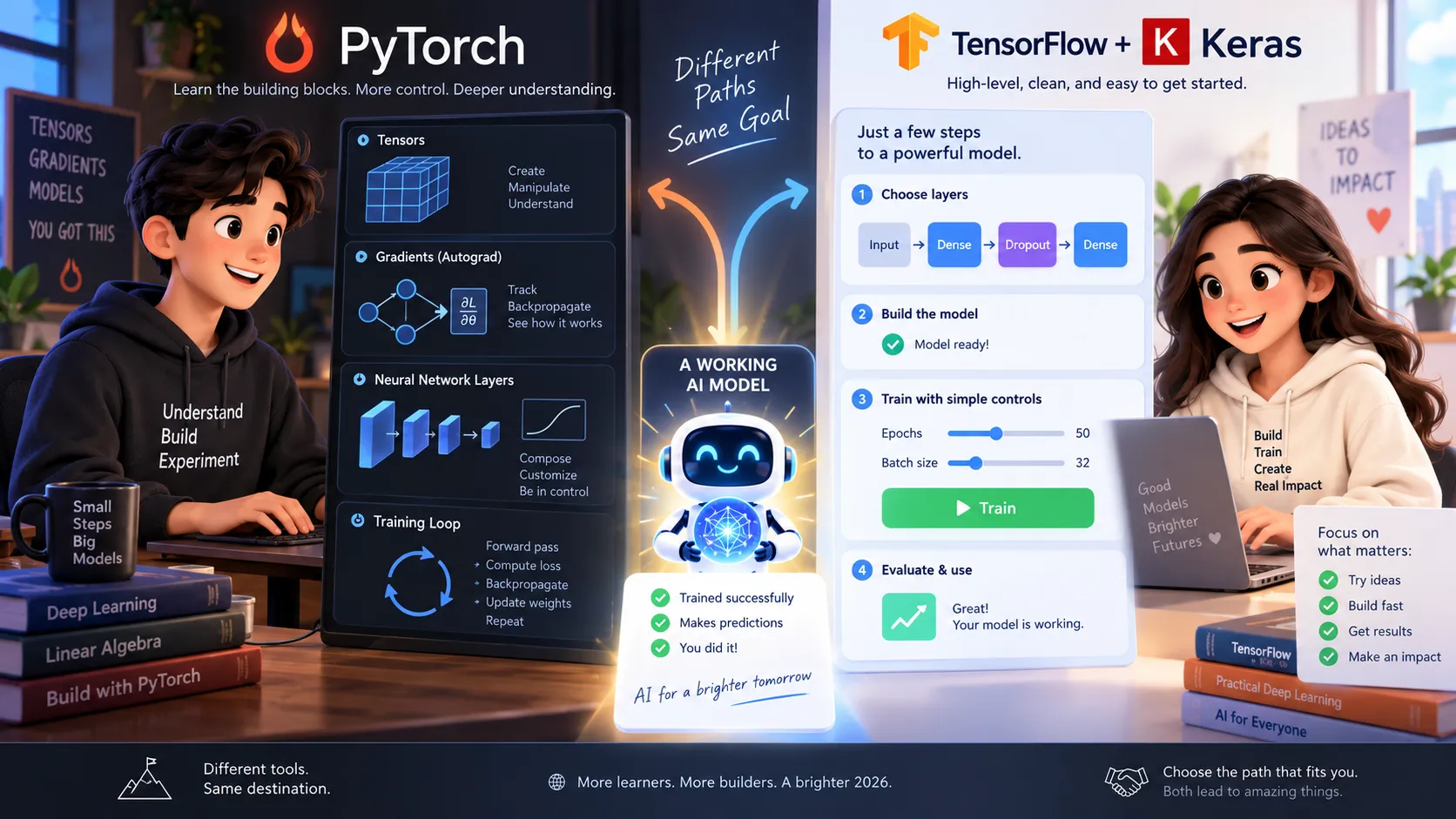
Coding Experience: PyTorch vs TensorFlow
Suppose you are teaching a child how to cook.
One approach is to let them see every step: cutting vegetables, adding spices, controlling the flame, and checking the food.
Another approach is to give them a machine where they select the recipe and press a button.
Both can produce food.
But the learning experience is different.
PyTorch traditionally gives developers more of that “see the process” feeling.
Its eager execution style lets operations happen immediately, which makes experimentation and debugging natural.
TensorFlow 2 also supports eager execution, so the gap is much smaller than it used to be. TensorFlow can additionally convert suitable Python functions into graph-based execution using tf.function, which can help optimize workloads.
This means the old statement that “TensorFlow uses graphs while PyTorch is completely dynamic” is too outdated for a serious PyTorch vs TensorFlow 2026 comparison.
Both frameworks now mix flexibility with compilation and optimization.
PyTorch provides torch.compile, while TensorFlow provides tools such as tf.function and its compiler ecosystem.
The important question is no longer simply whether a framework supports compiled execution.
It is:
How comfortably can your team build, debug, optimize, and maintain the model?
Debugging: Why PyTorch Often Feels Natural
Imagine training an image classifier and suddenly your loss becomes NaN.
Something is wrong.
Maybe your learning rate is too high.
Maybe the data contains bad values.
Maybe one operation is producing unstable numbers.
When debugging this kind of issue, a flexible Python-style workflow can be extremely helpful.
This has been one of PyTorch's strongest attractions.
You can inspect tensors, print intermediate results, test individual model layers, and experiment without mentally switching between completely different programming styles.
TensorFlow's eager execution has improved its debugging experience greatly as well.
For a beginner, however, PyTorch still often feels closer to regular Python when writing custom training logic.
That is one reason I would usually recommend PyTorch for someone who wants to deeply understand how neural networks work, rather than only learning how to call a high-level training API.
But there is an important exception.
If your goal is:
“I want to build a basic deep learning model quickly without writing a lot of training code,”
then Keras remains an excellent starting point.
Keras describes itself as a multi-framework deep learning API and can now work with TensorFlow, PyTorch, or JAX backends.
That makes the beginner decision much less restrictive than it once was.
Vanishing & Exploding Gradients Deep Dive
PyTorch vs TensorFlow Performance
This is where many comparisons become misleading.
You may see claims such as:
“PyTorch is faster.”
or:
“TensorFlow gives better performance.”
Do not choose your framework based on a sentence like that.
Real performance depends on many things:
your model architecture,
GPU or accelerator,
batch size,
data pipeline,
precision settings,
compiler configuration,
distributed training setup,
and the operations your model actually performs.
A framework that wins one benchmark can lose another.
Even Keras publishes backend benchmarks across TensorFlow, PyTorch, and JAX, but clearly notes that these tests represent particular workflows rather than the maximum possible performance of every framework.
In other words:
There is no trustworthy universal winner for every model.
If you are building a small CNN for classifying product images, the framework difference may matter far less than your model design and data pipeline.
If you are training a huge language model across hundreds of GPUs, compiler quality, communication overhead, memory usage, and distributed training become much more important.
Convolutional Neural Networks (CNNs) Explained
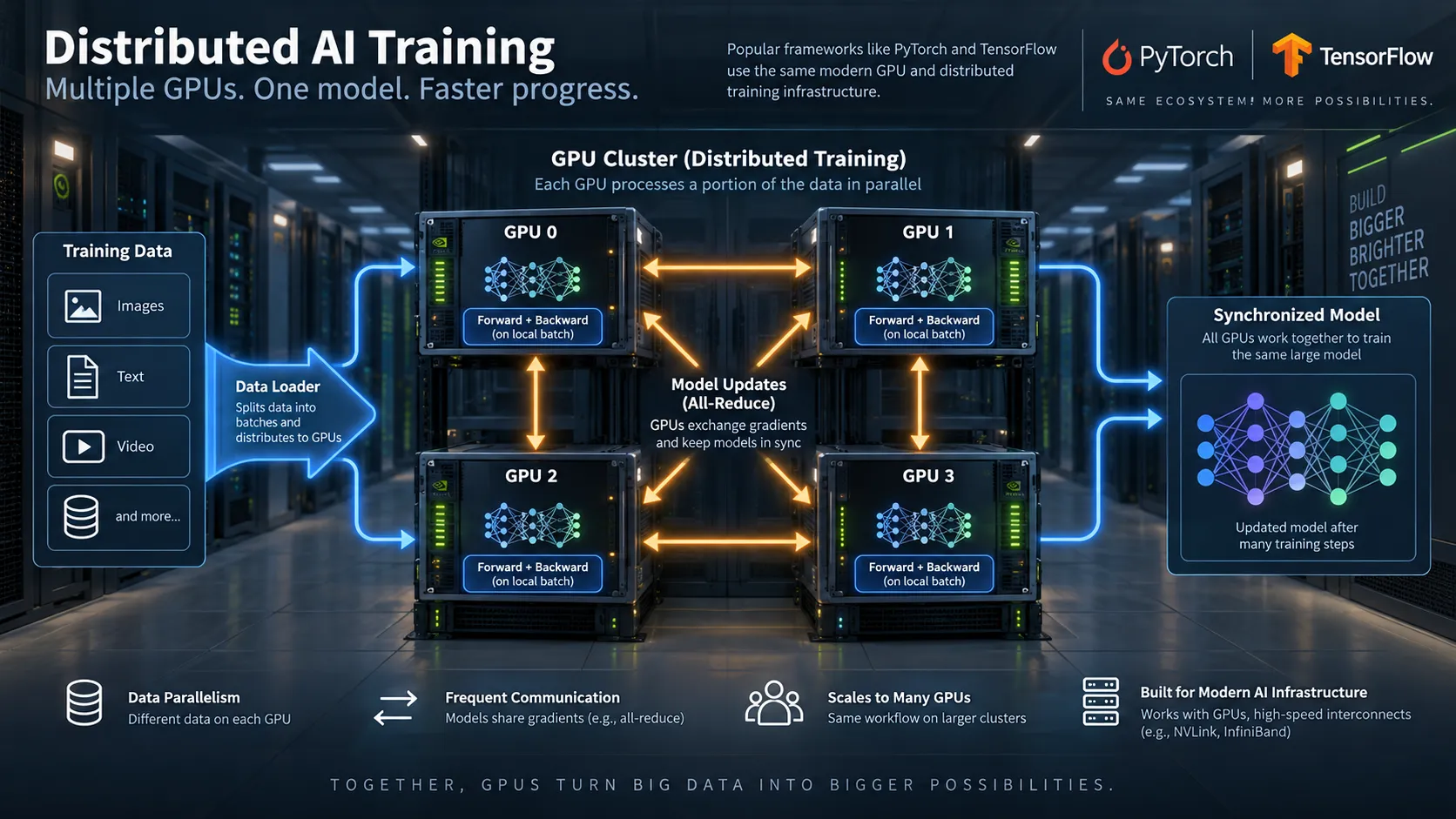
GPU and Large-Scale Training
Both frameworks support GPU acceleration.
TensorFlow models can use supported GPUs, and TensorFlow provides tf.distribute.Strategy for training across multiple GPUs, machines, and TPUs.
PyTorch also has a mature distributed ecosystem.
PyTorch 2.13 pushed this area further with updates including torchcomms and improvements to FSDP2 for large distributed workloads.
This is important because modern AI training is no longer only about making one GPU faster.
Imagine your model requires 64 GPUs.
Now those GPUs need to continuously exchange information.
If communication becomes slow, expensive GPUs can spend valuable time waiting instead of training.
That is why technologies around distributed training, memory efficiency, and communication are so important for modern AI systems.
PyTorch for AI Research
This is still one of PyTorch's strongest areas.
Research work often involves changing things.
A researcher might say:
“What happens if I modify this attention mechanism?”
“What if this model has two unusual branches?”
“What if I create my own loss function?”
“What if I need to inspect a tensor halfway through the network?”
Research code changes constantly.
PyTorch's flexible programming model fits this kind of experimentation extremely well.
This is especially useful in areas such as:
computer vision,
natural language processing,
generative AI,
large language models,
reinforcement learning,
and experimental neural network architectures.
But this does not mean TensorFlow cannot be used for research.
It can.
The real point is that PyTorch's workflow has made it especially comfortable for people who constantly modify model internals.
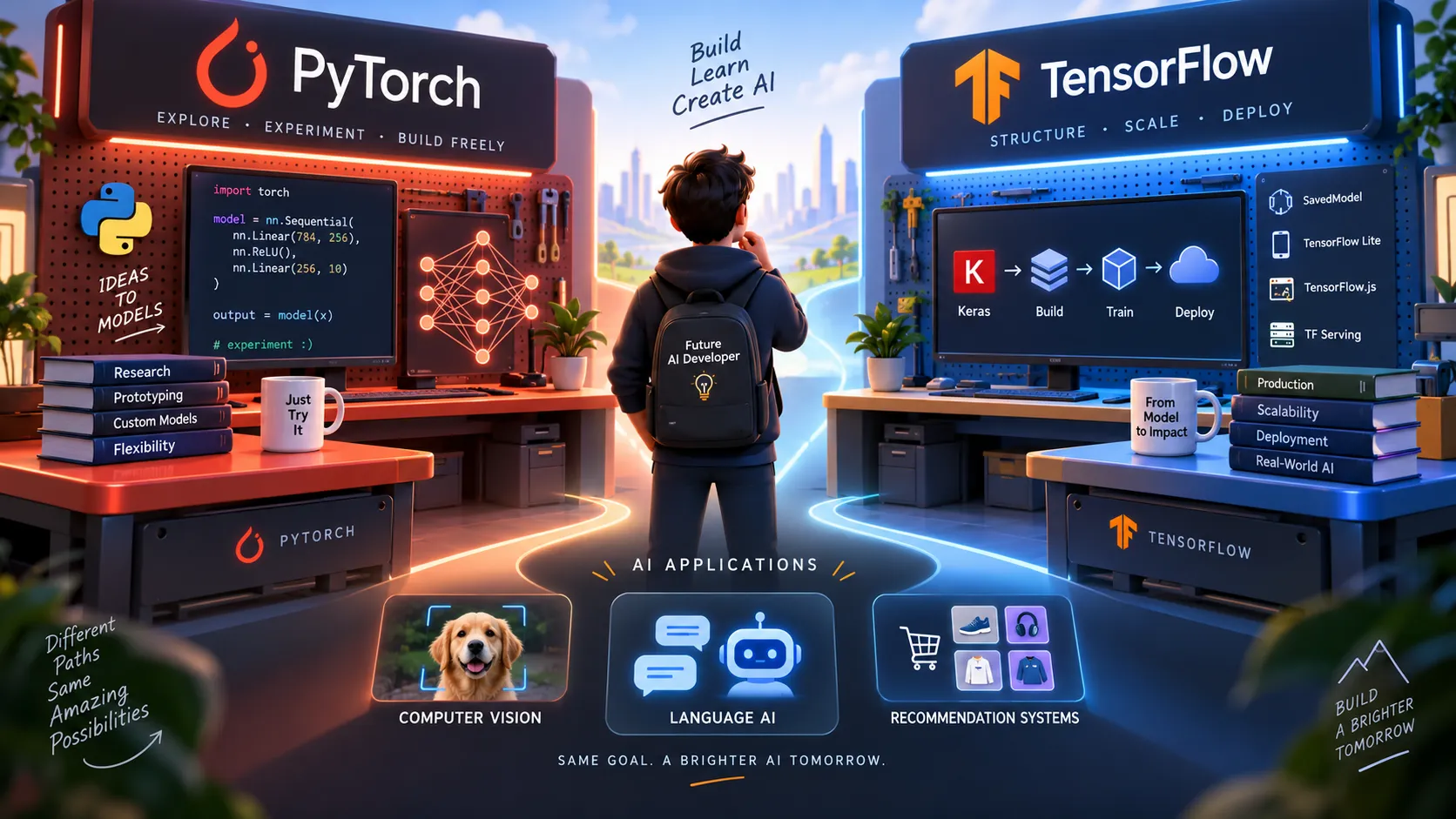
Is TensorFlow Still Better for Production?
This question needs a much more careful answer in 2026.
TensorFlow still provides mature tools for training and deployment, and its ecosystem has years of production use behind it.
However, saying:
“TensorFlow is for production and PyTorch is for research”
is now misleading.
PyTorch has spent years improving compilation, distributed training, export, and on-device inference.
PyTorch 2.13 continues that direction, with the PyTorch Foundation describing the 2.x series as moving from a research-first framework toward a broader platform for production training and inference.
TensorFlow is changing too.
TensorFlow 2.21 is the current stable release as of 2026, and its ecosystem continues evolving, including changes around lightweight and edge deployment.
So if you are choosing a framework for a company, the decision should not be based on an old reputation.
You should look at the complete system:
How will the model be trained?
Where will it run?
How many users will use it?
Will it run in the cloud, browser, mobile phone, or edge device?
Does your team already know one framework?
Which pretrained models and libraries do you need?
And how expensive will it be to maintain the system for the next three years?
That last question is often more important than a benchmark.
Because the best deep learning framework is not necessarily the one that trains your demo five seconds faster.
It is the one your team can confidently build, deploy, debug, update, and maintain after the demo becomes a real product.
And that brings us to the areas where the choice becomes even more practical: deployment, mobile AI, ecosystem support, jobs, career learning, and which framework you should personally choose in 2026.
Deployment: Where Will Your AI Model Actually Run?
Training a model is only half the journey.
Imagine you have built a model that can detect damaged products in a factory.
During testing, everything works perfectly on your laptop.
But the real model needs to run inside a factory system, process thousands of images, respond quickly, and keep working every day.
Now deployment becomes important.
This is where choosing between PyTorch and TensorFlow for production becomes less about popularity and more about your final environment.
If your company already has a TensorFlow-based system, moving everything to PyTorch simply because it is popular may create more work than value.
The opposite is also true.
If your AI team already builds models with PyTorch, forcing them into a completely different workflow just for deployment may create unnecessary complexity.
A good production decision should consider the full path:
training → testing → optimization → deployment → monitoring → future updates.
The easier that path is for your team, the better the framework choice.
PyTorch for Production and Edge AI
PyTorch's deployment story has changed significantly.
One important part of that change is ExecuTorch.
ExecuTorch is designed for running PyTorch models directly on edge devices such as smartphones, laptops, embedded devices, and other hardware with limited resources.
In April 2026, ExecuTorch became part of PyTorch Core, strengthening its position inside the main PyTorch ecosystem.
Think about a security camera that needs to detect a person.
If every camera frame has to travel to a cloud server before the AI model can make a prediction, you may face network delay, cloud cost, and privacy concerns.
With on-device AI, some or all of that processing can happen directly on the device.
That can mean faster responses and less dependence on an internet connection.
So if you hear someone say:
“PyTorch cannot be used for mobile or edge AI,”
that advice is outdated.

What Happened to TensorFlow Lite?
This is another area where old tutorials can confuse beginners.
For years, TensorFlow Lite, often called TFLite, was one of TensorFlow's major advantages for mobile and embedded machine learning.
But TensorFlow Lite has evolved into LiteRT.
More importantly, LiteRT is no longer being positioned as something that only belongs to TensorFlow models.
Google says LiteRT has expanded beyond its TensorFlow roots and can work with models coming from frameworks including PyTorch, JAX, and Keras.
That changes the comparison.
In 2026, you should not automatically think:
TensorFlow = mobile
PyTorch = no mobile
The edge AI world is becoming more framework-independent.
Google's TensorFlow 2.21 announcement also states that the old TF Lite project is now LiteRT and is being actively developed separately.
This is exactly why choosing a deep learning framework based only on old articles can lead to the wrong decision.
What About Browser-Based AI?
TensorFlow still has another interesting tool: TensorFlow.js.
TensorFlow.js allows machine learning models to work with JavaScript in the browser and Node.js.
Imagine a website where a user opens their webcam and an AI model recognizes hand gestures directly inside the browser.
For certain projects like this, TensorFlow.js may be worth exploring.
But again, deployment architecture should be decided from the actual product requirement rather than the framework's name.
PyTorch vs TensorFlow for Generative AI and LLMs
If your main goal in 2026 is Generative AI, large language models, or modern open-source AI research, PyTorch has a particularly strong advantage.
One major signal comes from Hugging Face.
With Transformers v5, Hugging Face announced that it was sunsetting its TensorFlow and Flax backend support and focusing Transformers on PyTorch as its sole backend.
That matters because the Transformers ecosystem is heavily used for modern language, vision, audio, and multimodal models.
The TensorFlow team itself also gives an interesting signal.
In its TensorFlow 2.21 announcement, Google said TensorFlow would continue providing production stability while recommending that developers explore Keras 3, JAX, and PyTorch for new Generative AI work.
So for someone asking:
“Should I learn PyTorch or TensorFlow for LLMs in 2026?”
I would start with PyTorch.
That does not make TensorFlow useless.
It simply means the center of gravity for many modern open-source Generative AI workflows currently leans strongly toward PyTorch.
But Keras 3 Changes the Whole Conversation
There is one final twist.
You do not always need to lock yourself completely into one framework.
Keras 3 can run with TensorFlow, PyTorch, or JAX as its backend.
A developer can write a Keras model and, when the model stays within compatible multi-backend APIs, move between these backends much more easily than before.
Imagine having one steering wheel that can work with several different engines.
That is not a perfect technical analogy, but it captures the idea.
Framework boundaries are becoming softer.
This is useful for companies that want more flexibility instead of building their entire AI system around a single ecosystem forever.
Should You Learn PyTorch or TensorFlow First?
If you are a beginner starting deep learning from zero in 2026, my recommendation is:
Learn PyTorch first.
Not because TensorFlow is bad.
And not because PyTorch will win every benchmark.
Learn it because its Python-friendly workflow makes it easier to understand what your neural network is actually doing, while its modern ecosystem gives you a strong path toward research, Generative AI, computer vision, LLMs, distributed training, and production systems.
Once you understand neural networks properly, learning TensorFlow or Keras becomes much easier.
Choose PyTorch First If You Want To:
learn deep learning from the ground up,
understand custom training loops,
experiment with neural networks,
work with modern Generative AI,
explore LLMs and multimodal models,
do AI research,
or build highly customized model architectures.
Choose TensorFlow or Keras If You:
already work inside a TensorFlow-based company,
need to maintain an existing TensorFlow production system,
prefer a high-level Keras workflow,
have a project closely connected to TensorFlow-specific tools,
or simply have an existing team that is already highly productive with TensorFlow.
Consider Keras 3 If You Want:
a simpler high-level API,
the ability to experiment across multiple backends,
and less dependence on one framework ecosystem.
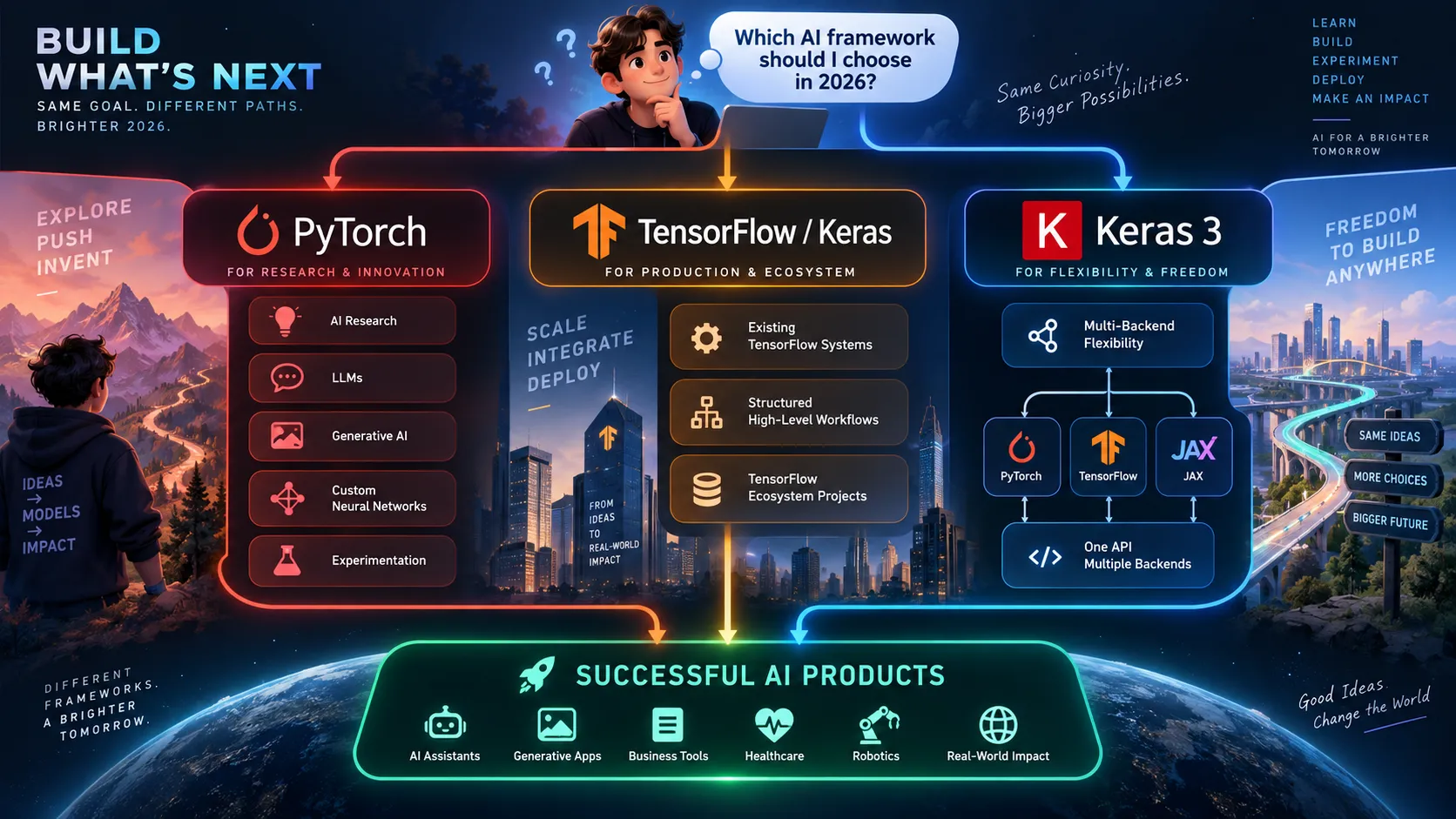
PyTorch vs TensorFlow: Final Verdict for 2026
So, is PyTorch better than TensorFlow in 2026?
For every project?
No.
For a beginner choosing one framework to learn first?
PyTorch is my first recommendation.
For modern AI research and many Generative AI workflows, the case for PyTorch is especially strong.
But TensorFlow still matters.
There are real production systems built around it, TensorFlow continues receiving updates, Keras remains an important high-level deep learning API, and tools such as TensorFlow.js still solve useful problems.
The biggest mistake would be spending three months debating which framework to learn and building nothing.
Choose one.
Build a small image classifier.
Break it.
Fix it.
Train another model.
Deploy something.
Once you understand how tensors, gradients, optimizers, neural networks, and training actually work, switching frameworks becomes much easier.
Because frameworks will continue changing.
Deep learning fundamentals will stay with you.
And that is the real skill worth learning.
Frequently Asked Questions About PyTorch vs TensorFlow
Which is better, PyTorch or TensorFlow in 2026?
There is no single winner for every project. However, PyTorch is a strong first choice in 2026 for beginners, AI research, Generative AI, LLM development, and highly customized deep learning projects.
TensorFlow still makes sense for teams that already use the TensorFlow ecosystem, maintain existing TensorFlow applications, or need specific TensorFlow tools.
The best framework depends on what you want to build, where the model will run, and which ecosystem your team already understands.
Is PyTorch easier than TensorFlow for beginners?
For many beginners, PyTorch feels easier because its code works naturally with Python and makes the training process easier to inspect.
You can see tensors, gradients, losses, and model outputs directly while learning.
TensorFlow with Keras can also be very beginner-friendly, especially when your goal is to build a basic neural network with less code.
A useful way to think about it is this:
PyTorch is often easier for understanding how deep learning works, while Keras can be easier for getting a simple model running quickly.
Should I learn PyTorch or TensorFlow first in 2026?
If you are starting from zero, PyTorch is a strong framework to learn first.
It gives you experience with tensors, neural networks, custom training loops, GPU training, computer vision, Generative AI, and modern deep learning workflows.
After learning the fundamentals with PyTorch, understanding TensorFlow or Keras becomes much easier because concepts such as loss functions, optimizers, layers, epochs, and backpropagation remain similar.
Is TensorFlow still relevant in 2026?
Yes. TensorFlow is still an actively maintained deep learning framework and TensorFlow 2.21 was released in 2026.
It continues to be useful for existing production systems, TensorFlow-based workflows, JavaScript machine learning through TensorFlow.js, and projects that already depend on its ecosystem.
However, developers starting completely new projects should choose based on their actual requirements rather than assuming TensorFlow is automatically the production choice.
Is PyTorch good for production?
Yes.
Modern PyTorch is no longer only a research framework. It includes tools for compilation, distributed training, model optimization, export, and on-device inference.
PyTorch 2.13 continues this direction, including improvements for large-scale training and integration of ExecuTorch into PyTorch Core.
A company can therefore use PyTorch for both experimentation and real production AI systems.
Which is better for AI research: PyTorch or TensorFlow?
PyTorch is generally the stronger first choice for modern AI research.
Its flexible Python-style workflow makes it convenient to modify model architectures, create custom loss functions, inspect intermediate tensors, and experiment with new ideas.
This does not mean research cannot be done with TensorFlow. It means PyTorch currently fits many experimental workflows particularly well.
Which is better for Generative AI and LLMs?
For most developers entering Generative AI and large language model development in 2026, PyTorch is the stronger starting choice.
A major reason is ecosystem support. Hugging Face Transformers v5 moved toward PyTorch as its sole framework backend while sunsetting its TensorFlow and Flax backend support.
Many modern LLM training, fine-tuning, inference, and research tools are also closely connected to the PyTorch ecosystem.
Can TensorFlow be used for LLMs?
Yes.
TensorFlow can technically be used to build and train language models.
However, if you are starting a new LLM or Generative AI learning journey in 2026, you will often find a larger modern open-source ecosystem around PyTorch.
Your decision should still depend on the libraries and infrastructure required by your project.
Is PyTorch faster than TensorFlow?
Not always.
There is no universal performance winner.
Speed depends on your neural network, GPU or accelerator, batch size, data pipeline, compiler settings, precision, memory usage, and distributed training configuration.
One framework may perform better for one model while another may perform better for a different workload.
You should benchmark your actual project instead of selecting a framework from a single online performance test.
Can Keras work with PyTorch?
Yes.
Keras 3 is a multi-backend deep learning API and can run with PyTorch, TensorFlow, or JAX.
This means developers can use the simpler Keras API while selecting a backend that fits their project.
However, fully portable code should use backend-independent Keras APIs rather than depending heavily on framework-specific operations.
What is the difference between PyTorch and Keras?
PyTorch is a complete deep learning framework.
Keras is a high-level deep learning API that can run on top of different backends, including PyTorch, TensorFlow, and JAX.
So comparing Keras and PyTorch is no longer exactly the same as comparing two completely separate frameworks.
A developer can actually use Keras with PyTorch as the backend.
Is TensorFlow better than PyTorch for production?
Not automatically.
TensorFlow has a long history in production machine learning, but modern PyTorch also supports serious production workflows.
Instead of choosing based on reputation, companies should compare deployment requirements, existing infrastructure, team knowledge, hardware, model ecosystem, maintenance cost, and long-term support.
For an existing TensorFlow company, staying with TensorFlow may be the smartest option.
For a PyTorch-focused AI team, keeping the training and production stack around PyTorch may be simpler.
Which framework is better for mobile and edge AI?
Both ecosystems now provide options for on-device AI.
PyTorch provides ExecuTorch for running models on edge devices.
Google's LiteRT, which evolved from TensorFlow Lite, is designed for on-device inference and is becoming less dependent on models originating only from TensorFlow.
The right choice depends on your target hardware, required operators, model architecture, performance requirements, and application platform.
Do I need to learn both PyTorch and TensorFlow?
Not when you are starting.
Learning two frameworks at the same time can create unnecessary confusion.
Choose one framework, understand deep learning properly, and build real projects.
Once you understand tensors, gradients, optimizers, loss functions, training loops, and neural network architectures, learning another framework becomes much easier.
For most beginners in 2026, starting with PyTorch is a practical choice.
Will PyTorch replace TensorFlow?
Nobody can reliably predict that.
AI frameworks continue to change quickly, and both ecosystems contain technologies used in real applications.
Rather than trying to predict which framework will exist ten years from now, learn the deep learning concepts underneath them.
Framework syntax can change.
The fundamentals of model training, data preparation, optimization, evaluation, and deployment are much more transferable.


