


Convolutional Neural Networks (CNNs) Explained
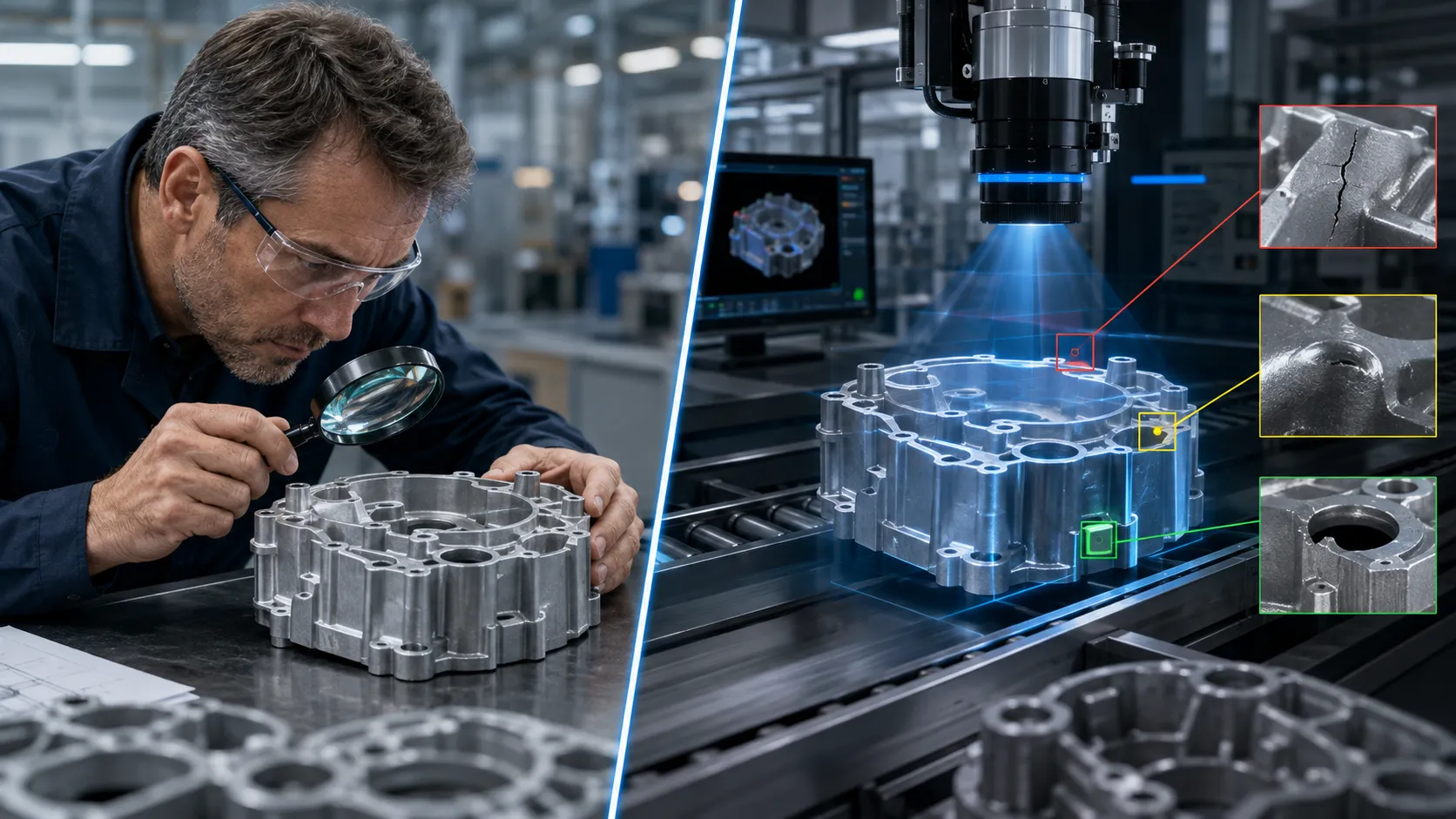
Imagine a factory where thousands of metal parts move along an assembly line every hour. Most look perfect. But one part has a tiny crack, another has a small dent, and one finished component is missing a screw.
A human inspector may catch these problems, but checking every product again and again is slow and difficult to keep consistent.
This is where Convolutional Neural Networks, or CNNs, become useful.
A CNN is a deep learning model that is especially good at understanding images. It does not look at an image as one big block. It learns small visual patterns such as edges, lines, curves, textures, shapes, and eventually complete objects or defects.
For a factory, this means a CNN can learn what a normal product looks like and help identify products that contain visible problems.
What Is a Convolutional Neural Network?
A Convolutional Neural Network is a neural network designed to work especially well with images.
A digital image is made of pixels. Each pixel stores information about color and brightness. To a computer, a photo of a metal gear is not really a “gear” at first. It is simply a large collection of numbers.
The job of a CNN is to turn those raw pixel values into useful visual features.
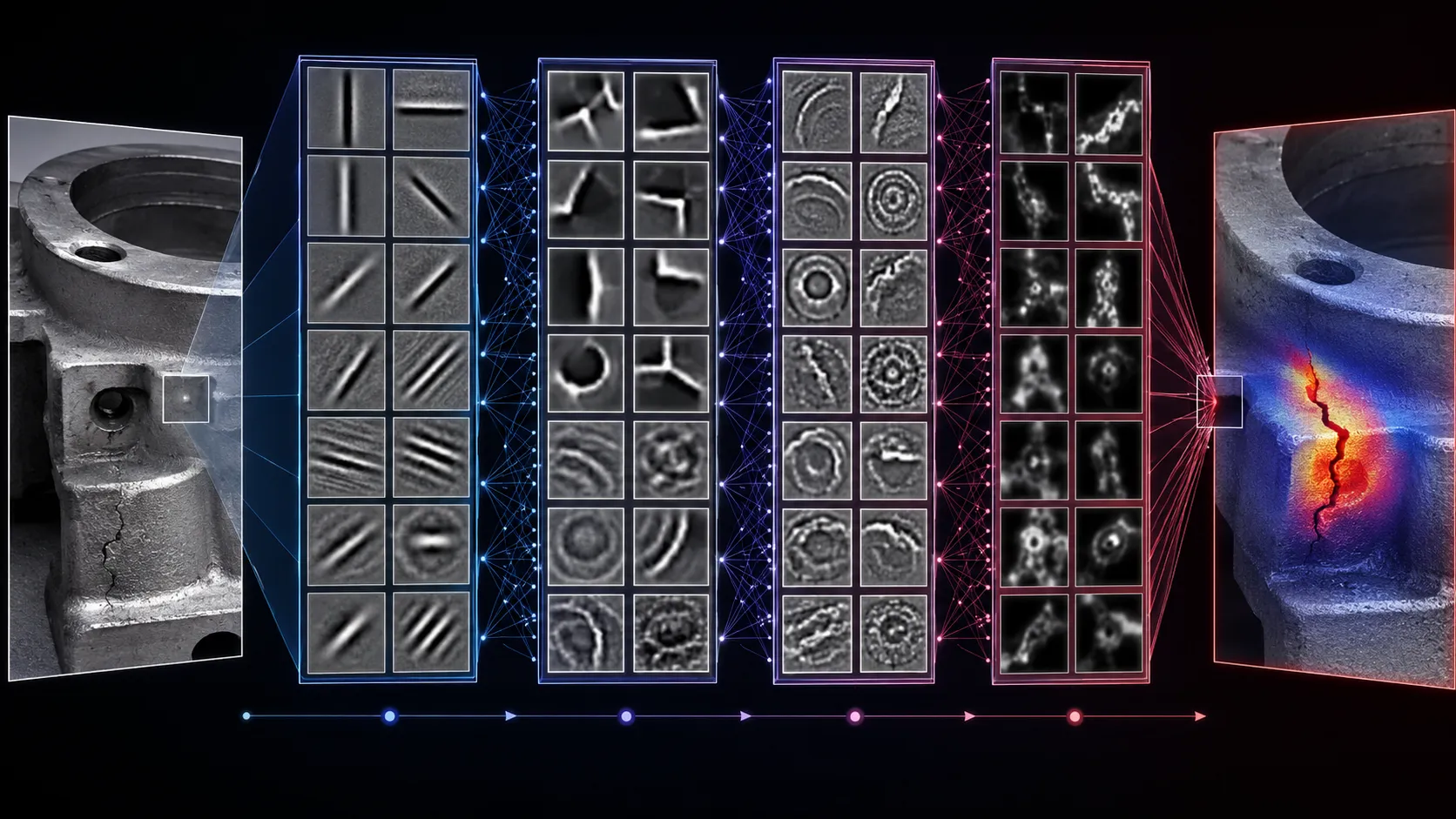
In early layers, the network may learn simple patterns such as edges, corners, or changes in color. Deeper layers combine those patterns and can learn more meaningful features, such as the teeth of a gear, the shape of a bolt, a scratch on a surface, or an unusual gap between two parts.
Think about how you notice a cracked phone screen. You do not calculate every pixel. You notice visual clues: a thin broken line, an unusual pattern, or a crack spreading from one corner.
A CNN follows a similar idea, but it learns those visual clues from training examples.
Why Are CNNs Used for Defect Detection?
Manufacturing quality inspection is a natural use case for computer vision because many defects can be seen.
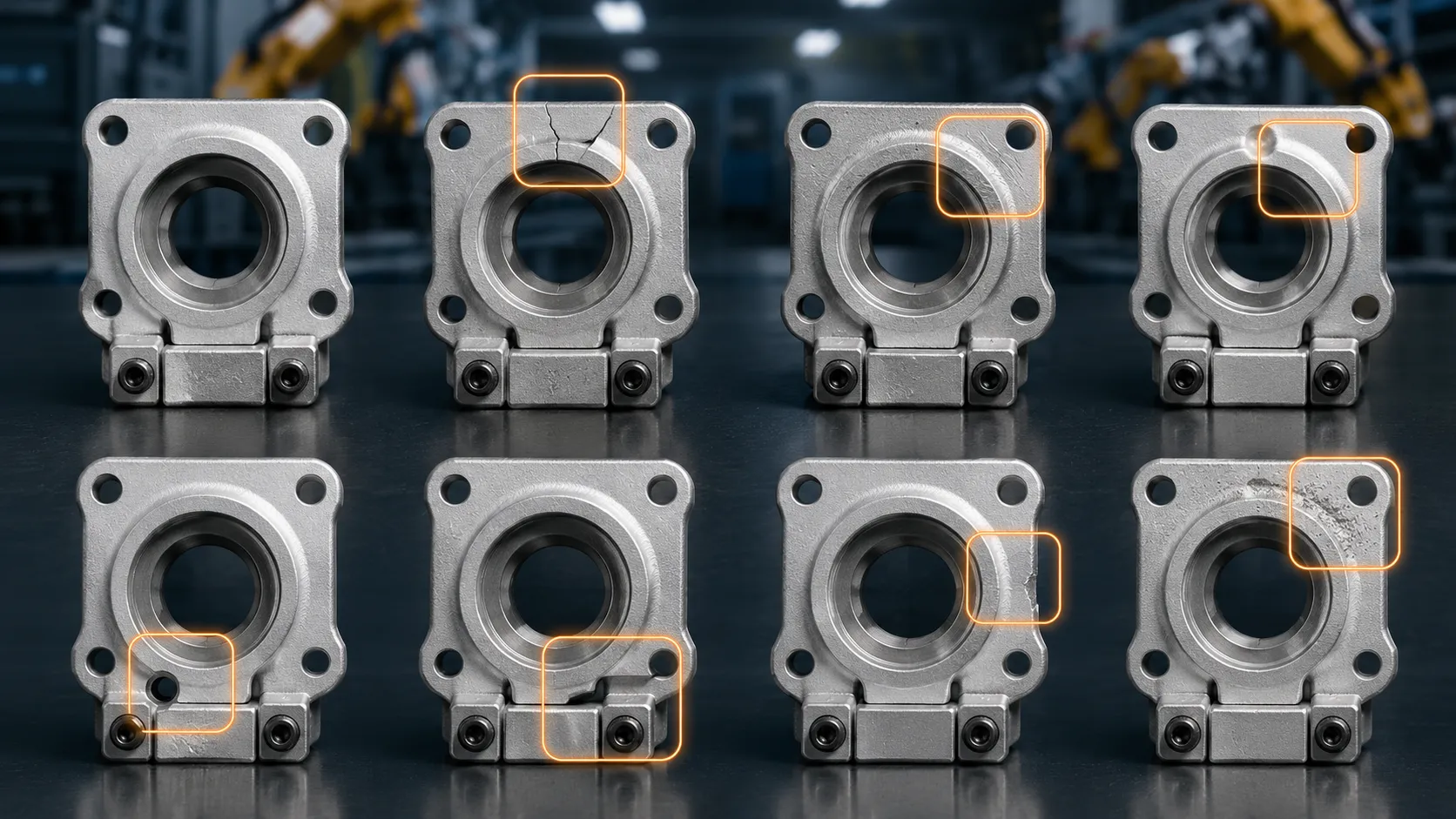
A product may have a scratch, crack, dent, missing component, damaged edge, wrong alignment, unusual texture, or a surface mark that should not be there.
Traditional image-processing systems often depend on fixed rules. An engineer may tell the software to flag any dark line longer than a certain number of pixels.
That can work in controlled conditions, but real factories are not always perfect.
Lighting changes. Metal reflects light. Products may rotate slightly. Dust may appear in the camera view. The same defect can also look different from one item to another.
A CNN for defect detection can learn useful visual patterns directly from examples instead of depending only on manually written rules.
The MVTec AD benchmark, created for industrial anomaly detection research, contains more than 5,000 high-resolution images across 15 industrial object and texture categories. It includes defect-free samples as well as different kinds of defects, making it a useful example of the visual variation an inspection model may need to handle.
How Does a CNN See an Image?
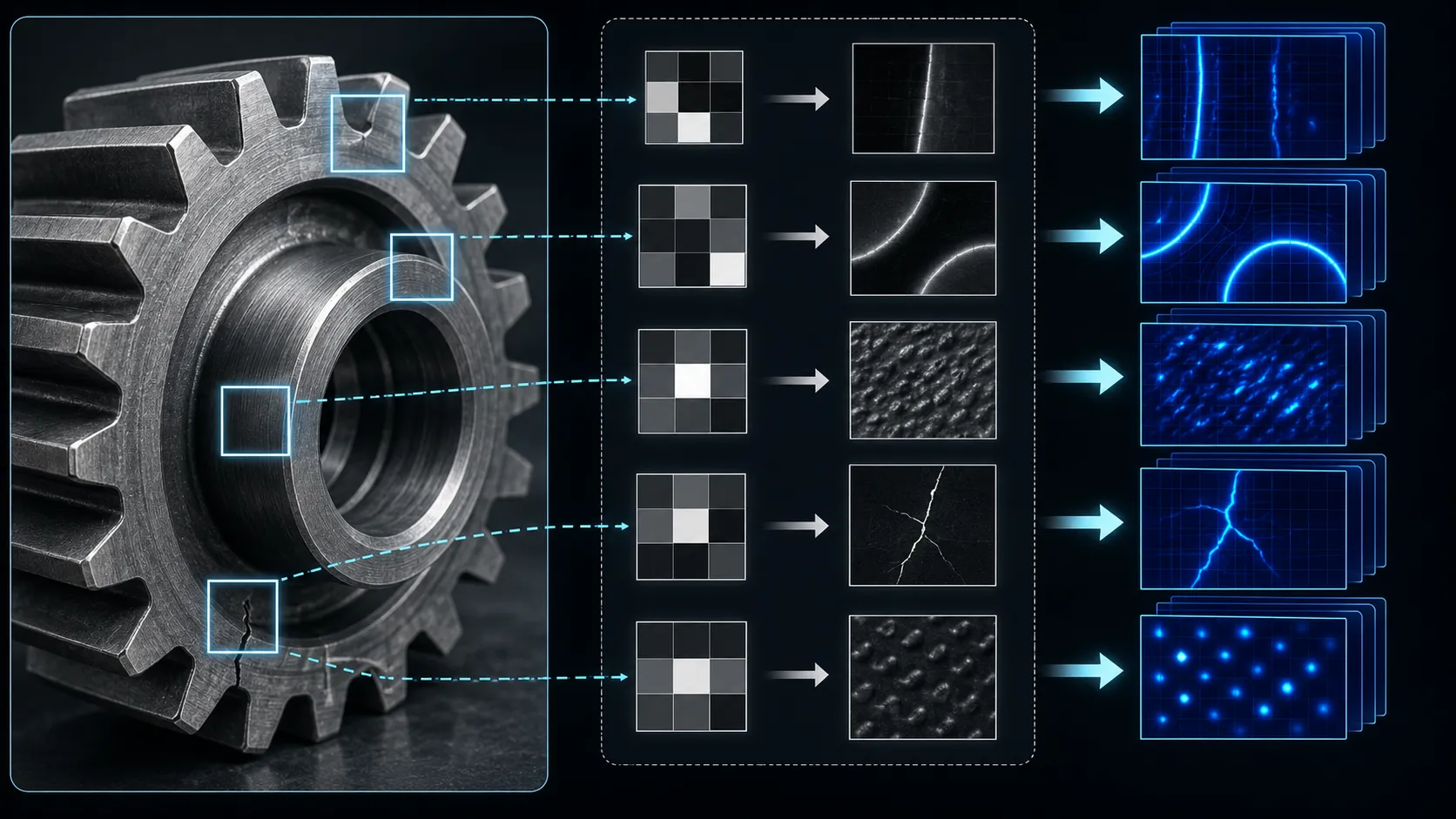
The easiest way to understand a CNN is to imagine a small magnifying glass moving across an image.
The network uses small filters, also called kernels, that move across local areas of the image.
A filter may learn to react strongly when it sees a certain pattern. One may respond to vertical edges, another to curves, and another to a rough texture.
As a filter moves across the image, it creates a feature map. The feature map shows where that learned pattern appears strongly.
This process is called convolution, and it gives the Convolutional Neural Network its name.
In a factory inspection image, one feature map may highlight the border of a product while another reacts to scratches or unusual surface areas.
During training, the model learns which filters help it make better predictions.
The Main Layers of a CNN
You do not need to memorize dozens of architecture names to understand how a CNN works. The basic flow is much simpler than it first appears.
1. Convolution Layer
The convolution layer scans small regions of an image and looks for useful patterns.
Early layers usually find simple features. Deeper layers combine them into more complex ones.
For example, when checking a metal part, one layer may notice edges while a deeper layer learns patterns related to cracks or damaged surfaces.
2. ReLU Activation
After convolution, CNNs commonly use an activation function such as ReLU.
ReLU helps the network learn more complex patterns rather than acting like a simple linear system.
Want to learn about What is ReLU in Deep Learing
3. Pooling Layer
A pooling layer reduces the size of feature maps while keeping useful information.
Think of it as creating a smaller summary of what the network has already found. This also reduces the amount of computation needed in later layers.
4. Final Prediction Layer
After several rounds of feature extraction, the network uses what it has learned to make a decision.
For a basic factory inspection system, the result could be:
Normal product or Defective product.
A more advanced system may also identify the type of defect or show exactly where the damaged area appears in the image.
This general progression from convolution and activation through feature reduction and final prediction is a core pattern used to understand CNN architectures.
A Simple Factory Example
Suppose a company produces metal washers.
A camera is placed above the conveyor belt. Every washer is photographed before packaging.
The training data contains many images of correct washers and examples showing cracks, dents, incomplete circles, and surface damage.
During training, the CNN gradually learns which visual patterns separate a good washer from a damaged one.
Later, a new washer reaches the camera.
The early CNN layers detect edges and shapes. Deeper layers examine surface patterns. The final layer estimates whether the washer matches the normal pattern or contains a defect.
This is the basic idea behind automated defect detection using CNNs: turn an image into learned visual features, then use those features to make a quality decision.
But one important question is still unanswered.
How does a CNN actually learn which filters are useful, and what happens when its prediction is wrong?
That is where training data, loss, backpropagation, and feature learning become important.
How Does a CNN Learn to Detect Defects?
A CNN does not begin training already knowing what a crack, scratch, dent, or missing component looks like. At the start, its filters are mostly just numbers with no useful meaning.
The learning happens by showing the network many examples and allowing it to make mistakes.
Suppose a factory makes metal brackets. The training images include normal brackets and defective ones with scratches, bent corners, cracks, and missing holes. Each image gives the model another chance to learn which visual patterns matter.
Step 1: The CNN Receives a Training Image
The image enters the network as pixel values.
The convolution layers scan small areas of it. At the beginning, the filters are not very useful, so the first prediction may be poor.
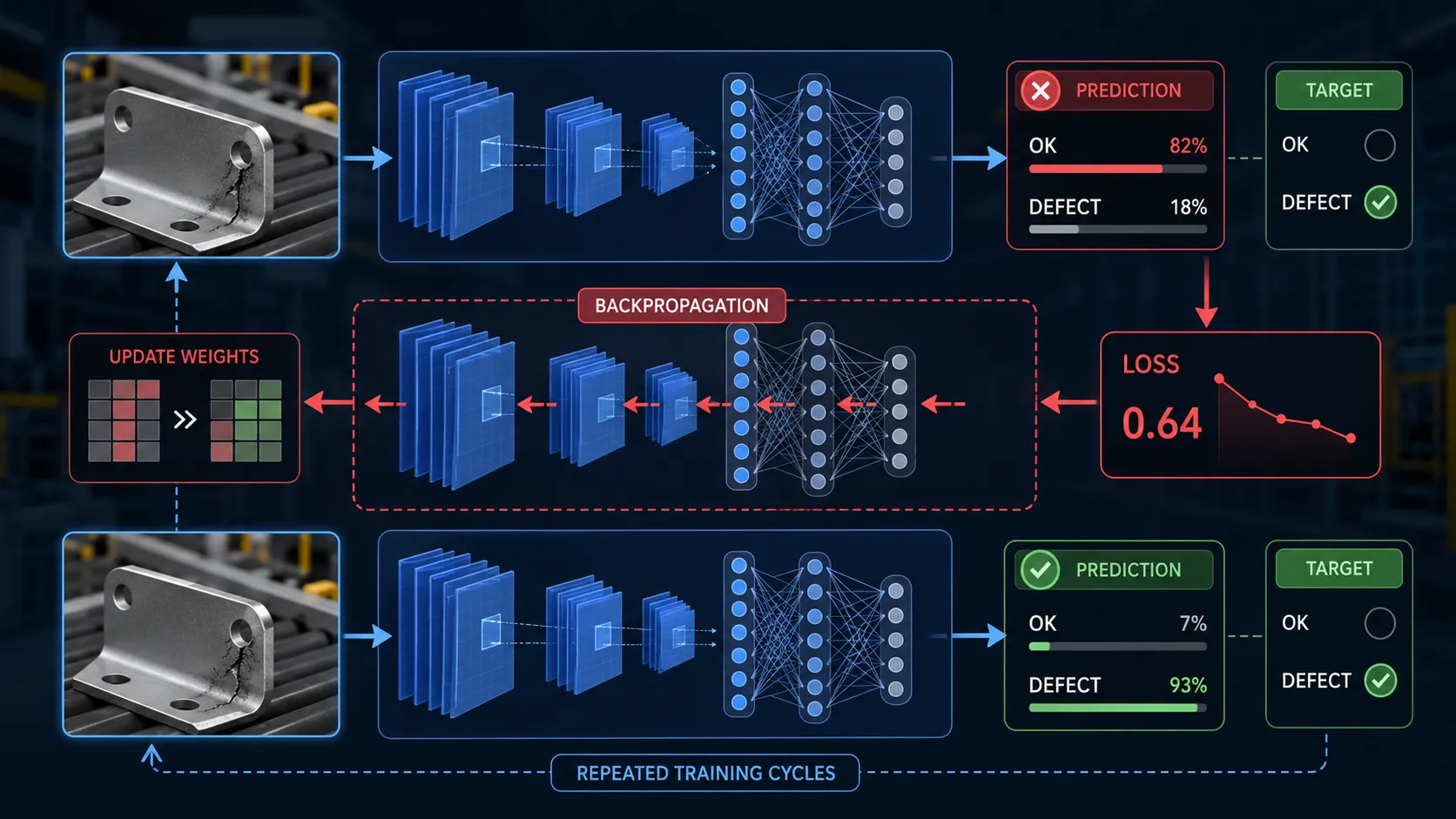
For example, the model may see a bracket with a clear crack and still predict:
Normal: 72%
Defective: 28%
The prediction is wrong, but that mistake is useful. It tells the model that something needs to change.
Step 2: The Loss Function Measures the Mistake
The model needs a way to measure how far its prediction is from the correct answer. That job is handled by a loss function.
Think of loss as a mistake score.
If the model makes a confident wrong prediction, the loss is higher. As the prediction moves closer to the correct answer, the loss becomes lower.
Training tries to reduce this loss over many examples.
Step 3: Backpropagation Improves the Model
After the loss is calculated, backpropagation works backward through the network.
It checks how the model's weights and filters contributed to the error. An optimizer then adjusts those values so future predictions can improve.
The model is not simply told, “This line is a crack.” Instead, it gradually discovers which visual patterns help it make better decisions.
This cycle—prediction, loss, backpropagation, and adjustment—is repeated many times.
What Does a CNN Learn in Different Layers?
Different CNN layers can learn different levels of visual detail.
Imagine the model is inspecting a steel plate.
Early layers may react to edges, brightness changes, and simple lines.
Middle layers may notice textures, corners, repeated shapes, or unusual surface patterns.
Deeper layers combine smaller features into more meaningful patterns related to the final task.
For example, a thin dark line does not always mean a crack. It could be a shadow or reflection. Deeper layers can use the surrounding visual information to decide whether that pattern is actually useful for detecting a defect.
Why Training Data Matters So Much
A strong CNN cannot fully compensate for poor training data.
Imagine training a defect detection model only with images taken under bright white lights. Later, the system is installed where the lighting is slightly darker.
The products are the same, but the images look different.
Good training data should represent the conditions the model will face in the factory. This can include changes in lighting, product position, camera angle, reflections, backgrounds, and different types of real defects.
The data is also usually separated into training, validation, and test sets.
The training set is used to learn.
The validation set helps measure performance during model development.
The test set checks the finished model on unseen examples.
This separation helps reveal whether the CNN learned a useful pattern or simply became too familiar with its training images.
How Data Augmentation Can Help
Factories may not have a large collection of every possible defect. Some defects are naturally rare.
One technique that can help is data augmentation.
It creates changed versions of training images. Depending on the real inspection setup, images may be slightly rotated, shifted, cropped, zoomed, or adjusted in brightness.
The goal is not to invent unrealistic defects. It is to help the model handle harmless changes that may occur during normal production.
For example, if a component can appear slightly rotated on a conveyor belt, small rotation changes during training can make the model more prepared for that situation.
Augmentation should still match reality. Adding changes that can never happen on the production line may make the training data less useful.
Classification, Localization, and Segmentation
Not every CNN defect detection system needs the same type of output.
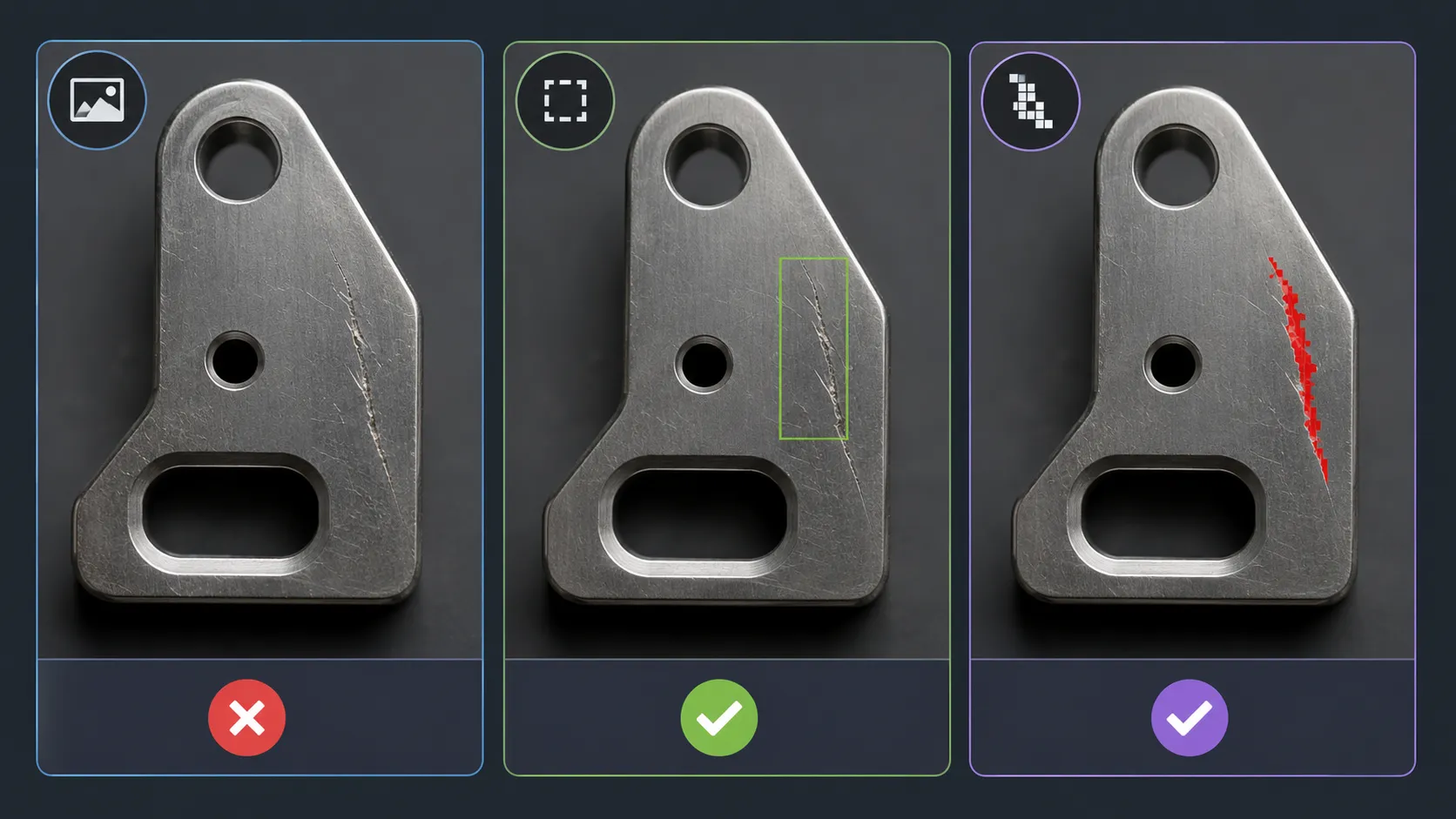
A basic image classification model may only answer:
Normal or defective?
This can work when the factory simply needs to separate suspicious products.
Sometimes, however, the operator also needs to know where the problem is.
A detection or localization system can point to the area containing the defect. A segmentation system can go further and mark the damaged region at pixel level.
Imagine a large metal sheet with one tiny scratch. A “defective” result is useful, but showing the location of that scratch gives the quality team much more information.
What Happens on a Real Assembly Line?
Now connect the training process to a real production line.
A product reaches the inspection point and a camera captures an image. The image is prepared in the format expected by the trained model.
The CNN processes the image and produces a prediction.
If the product appears normal, it can continue. If the model finds a likely defect, the item can be flagged for human review or moved to another inspection path.
The CNN is not “looking” at the product exactly like a person. It is using visual patterns learned from training data to judge the new image.
That sounds powerful, but building a production-ready system raises bigger questions.
How accurate should it be? What happens when defective products are very rare? Can a pre-trained CNN reduce the amount of data needed? And when should a factory use classification, object detection, or anomaly detection instead?
Those questions are where a basic CNN model becomes a real industrial inspection system.
Can You Train a CNN With a Small Dataset?
One of the biggest problems in factory inspection is simple: companies usually have many images of good products, but far fewer images of real defects.
That makes sense.
If a factory produces 50,000 correct parts and only 150 defective parts, collecting a balanced dataset becomes difficult.
This does not always mean you need to build a CNN from zero.
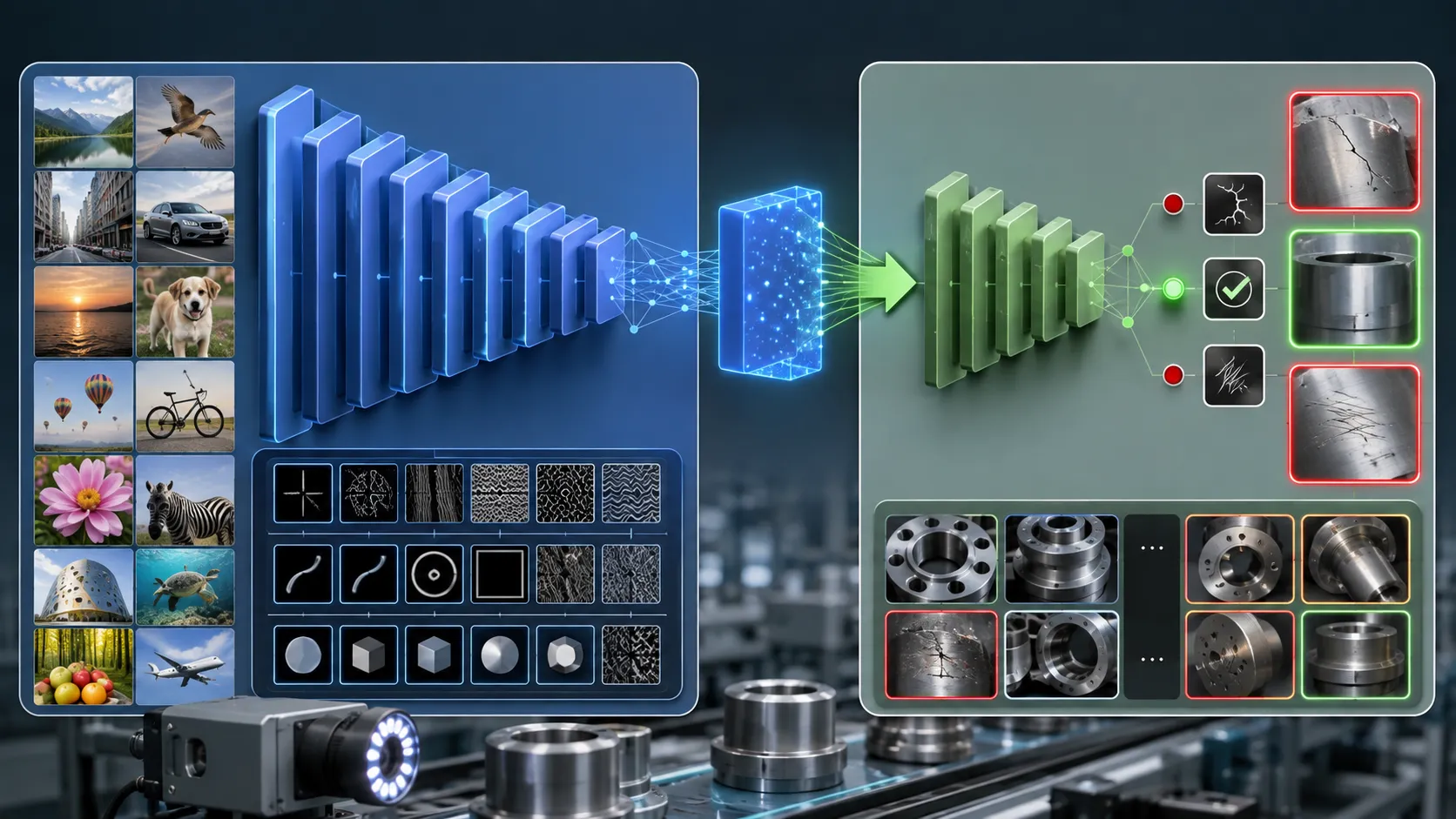
A common approach is transfer learning.
What Is Transfer Learning in CNN?
Transfer learning means starting with a model that has already learned useful visual features from a large image dataset.
Instead of teaching the CNN everything from the beginning, you reuse its existing visual knowledge and adapt it to your own problem.
Think of it like hiring an experienced quality inspector.
A new inspector who has never seen an industrial product needs to learn basic visual skills first. An experienced inspector already understands shapes, edges, textures, and unusual patterns. You only need to teach that person what defects matter on your specific production line.
Transfer learning follows a similar idea.
A pre-trained CNN may already recognize useful low-level features such as:
edges
curves
shapes
textures
color changes
repeated visual patterns
You can then train the model further using your own factory images.
This can be especially useful when you have a limited amount of labeled defect data.
The Problem of Class Imbalance in Defect Detection
Imagine a factory tests 10,000 products.
Out of those products:
9,900 are normal.
Only 100 are defective.
A careless model could classify almost everything as normal and still show very high overall accuracy.
That is why accuracy alone is not enough for defect detection.
The factory does not only care about how many total predictions were correct. It cares about the mistakes the model makes.
Two mistakes are especially important.
False Positive
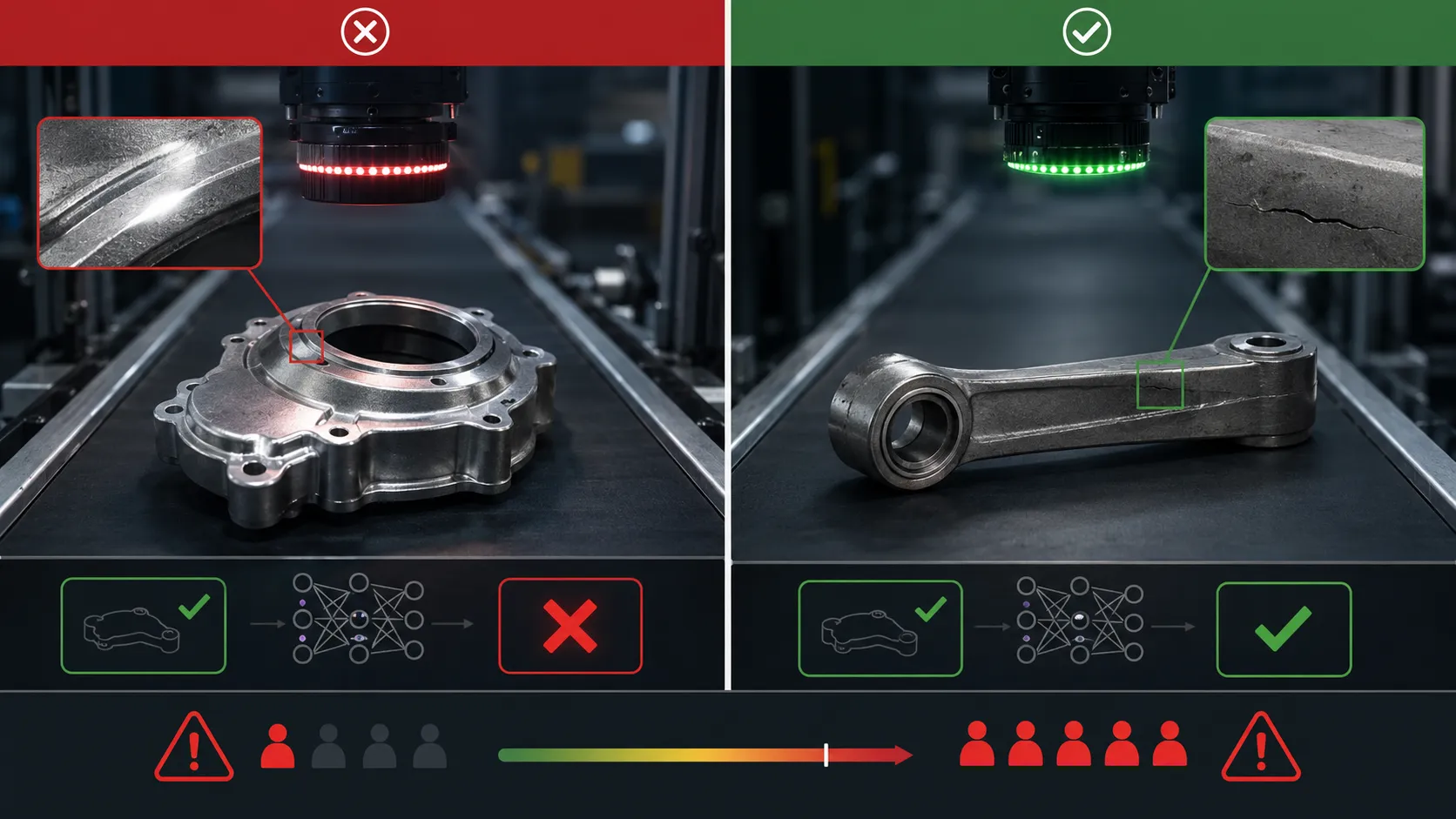
A false positive happens when the CNN says a good product is defective.
For example, a harmless reflection on a metal surface may look like a scratch, causing the system to reject a perfectly good component.
Too many false positives can increase manual inspections, slow production, and waste good products.
False Negative
A false negative is usually more dangerous.
It happens when a defective product is classified as normal.
Imagine a component has a small crack that could become larger after installation, but the CNN allows the product to continue through the assembly line.
That missed defect could become a quality, warranty, or safety problem.
For this reason, factories often need to think beyond simple accuracy.
Precision and Recall for CNN Defect Detection
Two useful measurements are precision and recall.
You do not need to remember complicated formulas to understand why they matter.
Precision asks:
When the CNN says a product is defective, how often is it actually defective?
High precision means the system is not creating too many false alarms.
Recall asks:
Out of all truly defective products, how many did the CNN successfully detect?
High recall means fewer defects are being missed.
In many quality-control situations, recall can be extremely important because missing a serious defect may cost much more than checking an extra good product.
The correct balance still depends on the factory.
A company inspecting decorative packaging may accept different trade-offs than a company inspecting components used in aircraft, medical equipment, or heavy machinery.
Why the Prediction Threshold Matters
A CNN may produce a probability instead of a simple yes-or-no answer.
For example:
Defect probability: 67%
The system then needs a threshold.
If the threshold is 50%, the product may be marked as defective.
If the threshold is 80%, the same product may pass automatically.
Changing this threshold changes the balance between missed defects and false alarms.
That is why a production system should not choose a threshold randomly.
The team needs to test different thresholds using real validation data and understand the business cost of each type of mistake.
Which CNN Model Should You Use?
There is no single CNN architecture that is best for every defect detection problem.
The right approach depends on what you need the system to do.
Use Image Classification When...
Use classification when you mainly need to know whether the complete image is normal or defective.
For example:
Good bottle cap vs damaged bottle cap
This is usually the simplest starting point.
Use Object Detection When...
Use object detection when you need to find a defect and roughly show where it appears.
For example, a model may place a box around a damaged area on a machine component.
This gives operators more information than a simple defective label.
Use Segmentation When...
Use segmentation when the exact shape or area of the defect matters.
For example, if a metal sheet contains an irregular crack, segmentation can mark the pixels belonging to that crack.
Consider Anomaly Detection When...
Sometimes a factory has thousands of normal examples but very few examples of defects.
In that situation, industrial anomaly detection may be worth considering.
Instead of learning every possible defect category, the system learns what normal products look like and tries to identify unusual visual patterns.
This can be useful because factories cannot always predict every defect that may appear in the future.
Where CNN Defect Detection Can Fail
CNNs are powerful, but they are not magic.
A model trained in one environment may struggle when the environment changes.
Common problems include poor lighting, blurry camera images, reflections, new product versions, dirt on the camera lens, unexpected product positions, and defects that were not represented well during training.
There is another risk called overfitting.
Overfitting happens when a CNN performs very well on familiar training images but struggles with new images.
A model should therefore be tested on images it did not see during training.
Real production testing matters even more.
A 98% result in a controlled dataset does not automatically mean the system will perform the same way on a moving factory line.
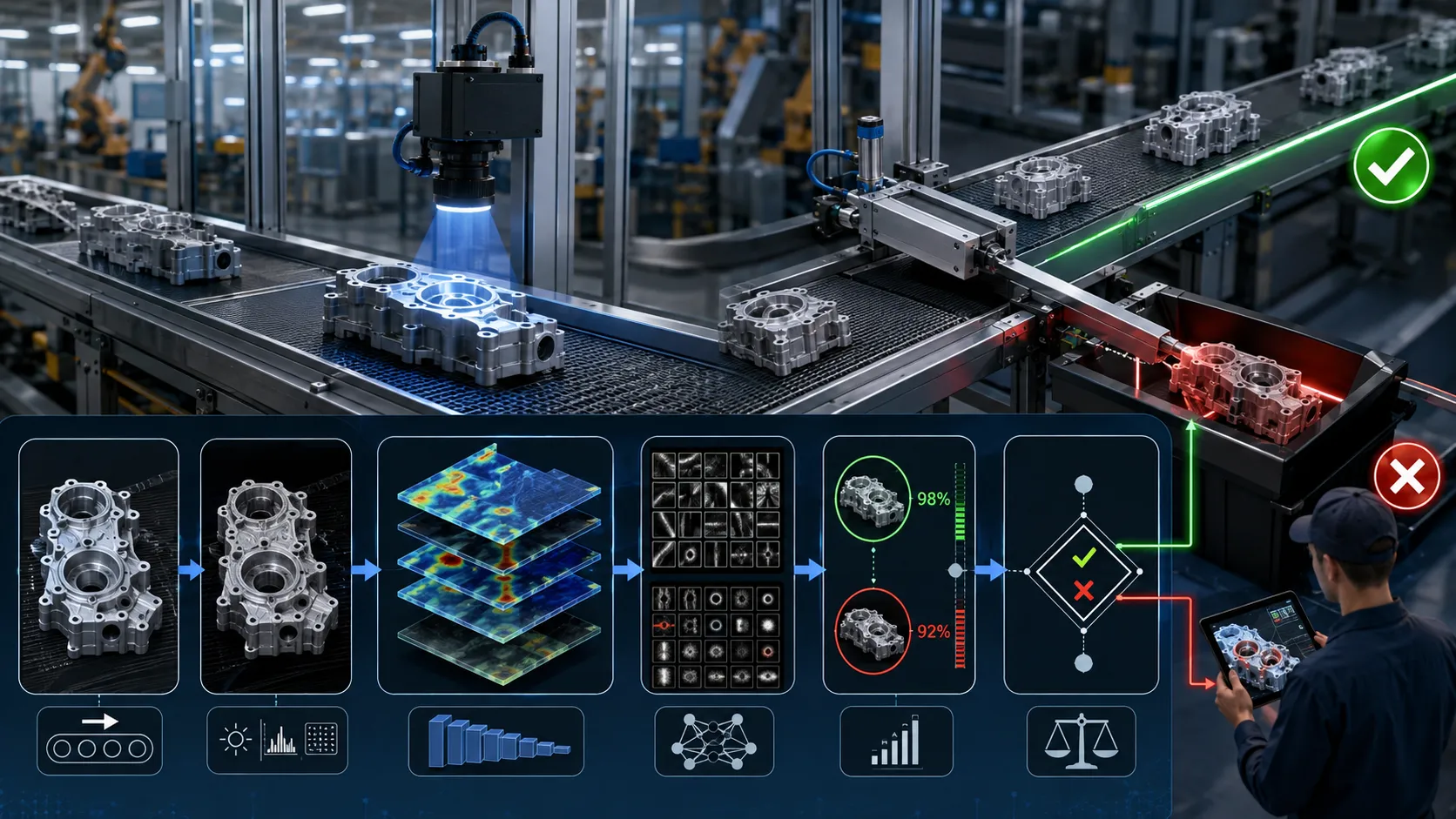
From Camera to Automated Quality Inspection
Now we can connect everything.
A camera captures an image of a product.
The image enters the CNN.
Convolution layers find useful visual features.
Deeper layers combine those features into more meaningful patterns.
The trained model produces a prediction.
A threshold decides how that prediction should be treated.
The product may continue, be rejected, or be sent to a human inspector for review.
That is the real value of a CNN in manufacturing.
It can turn visual inspection into a repeatable, scalable process.
But the strongest systems do not simply replace people with AI.
They combine reliable cameras, good training data, carefully selected metrics, sensible thresholds, human review, and regular performance checks.
Final Thoughts
A Convolutional Neural Network becomes much easier to understand when you stop thinking about it as a complicated mathematical machine.
At its core, a CNN learns visual patterns.
It starts with simple features such as edges and textures. It combines them into more useful patterns, learns from its mistakes, and eventually uses those patterns to classify or locate objects and defects.
In our factory example, that means turning camera images into useful quality decisions.
A scratch, crack, dent, missing component, or unusual surface may look obvious to a human inspector. A CNN must learn those patterns from data.
And that is the most important lesson:
The CNN architecture matters, but the quality of the images, labels, evaluation process, and real-world testing matters just as much.
When all of these pieces work together, automated visual inspection can become one of the most practical applications of deep learning in modern manufacturing.
Frequently Asked Questions About CNNs
What Is a Convolutional Neural Network?
A Convolutional Neural Network, or CNN, is a type of deep learning model mainly used to understand images. It learns visual patterns such as edges, shapes, textures, and objects directly from image data.
For example, in a factory, a CNN can learn the difference between a normal metal part and one that contains a crack, scratch, dent, or missing component.
How Does a CNN Work?
A CNN works by scanning small areas of an image using filters.
The first layers usually detect simple features such as edges and lines. Deeper layers combine those features to understand more complex patterns.
After learning enough useful features, the CNN uses them to make a final prediction, such as whether a product is normal or defective.
Why Are CNNs Used for Images?
CNNs are well suited for images because they can understand local visual patterns without treating every pixel independently.
They can learn where edges, textures, curves, and shapes appear in an image.
This makes CNNs useful for tasks such as image classification, object detection, face recognition, medical imaging, and automated factory inspection.
How Does CNN Detect Defects in Manufacturing?
A CNN detects manufacturing defects by learning from images of normal and defective products.
During training, the model sees examples containing scratches, cracks, dents, missing parts, or unusual surface patterns.
After training, a camera captures a new product image and the CNN compares its learned visual features with what it sees. It then predicts whether the product appears normal or defective.
What Is Convolution in CNN?
Convolution is the process where a small filter moves across an image and looks for useful visual patterns.
A filter may respond strongly to an edge, curve, texture, or unusual surface area.
The result is called a feature map, which helps the network understand where important visual information appears inside the image.
What Are Filters in a CNN?
Filters, also called kernels, are small groups of values that scan different parts of an image.
During training, the CNN learns which filters are useful.
One filter may become useful for detecting edges, while another may react to textures or certain shapes. Deeper CNN layers combine these simple patterns to recognize more complex features such as damaged surfaces or cracks.
What Is Pooling in CNN?
Pooling reduces the size of feature maps while keeping important information.
This helps the CNN process images more efficiently and reduces unnecessary detail.
For example, if a feature map already shows that an important edge exists in a small area, pooling can keep that useful signal while reducing the amount of data passed to the next layer.
Can CNNs Be Used for Automated Quality Inspection?
Yes. CNNs are widely suitable for automated visual quality inspection where defects can be identified from images.
A camera can capture products moving along an assembly line, and the trained CNN can inspect each image for problems such as scratches, cracks, incorrect shapes, missing components, or surface damage.
Suspicious products can then be flagged for additional inspection.
What Is the Difference Between CNN Classification and Defect Detection?
CNN classification gives a general result for the entire image.
For example:
Normal product or Defective product.
Defect detection goes further by helping identify where the defect appears in the image.
For tasks where the exact damaged region matters, object detection or segmentation methods can be used to show the location or shape of the defect.


