


Imagine you are teaching a friend to decide whether a photo shows a cat, a dog, or neither. Your friend may notice ears, eyes, shape, fur, and size. But a real decision does not come from adding those clues blindly. Some clues matter more, while others may be ignored.
A neural network works in a similar way. It receives numbers, combines them using weights and bias, and then decides what information should move forward. That small decision is handled by an activation function.
This is why activation functions in neural networks are such an important idea in deep learning. They help a neural network learn useful patterns instead of behaving like a simple calculator.
What Is an Activation Function in a Neural Network?
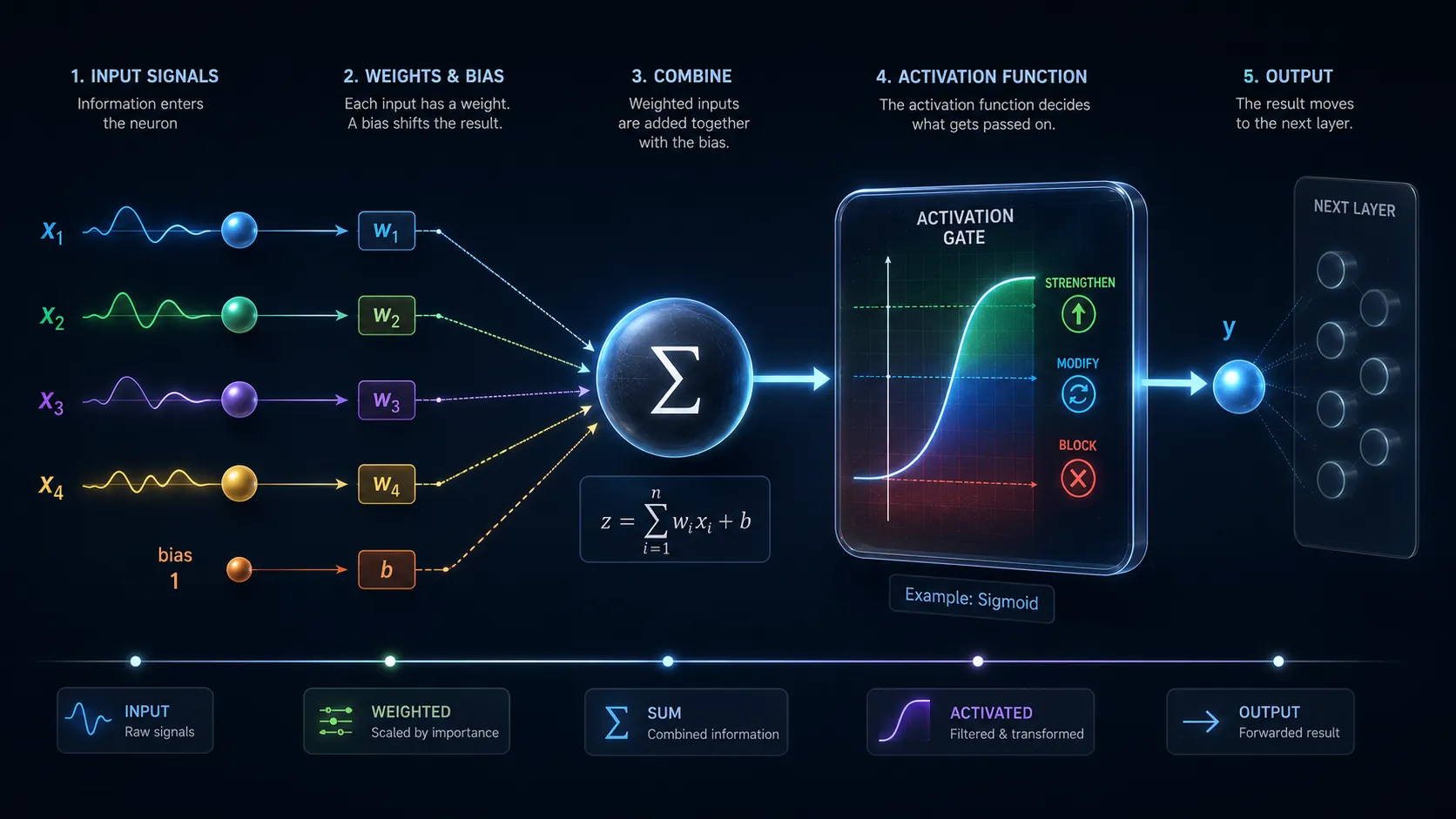
An activation function is a mathematical rule applied to the output of a neuron. In simple words, it decides how strongly that neuron should respond before passing information to the next layer.
A neuron receives inputs. Each input is multiplied by a weight. The neuron adds those values together, adds a bias, and sends the result through an activation function.
Think of it like a small decision gate.
Suppose a food delivery app is trying to predict whether an order will arrive late. The model may look at distance, traffic, weather, restaurant preparation time, and available delivery partners. A neuron may combine these signals and produce a number such as 3.7 or -1.2.
The activation function turns that raw number into a more useful signal for the network.
Why Do Neural Networks Need Activation Functions?
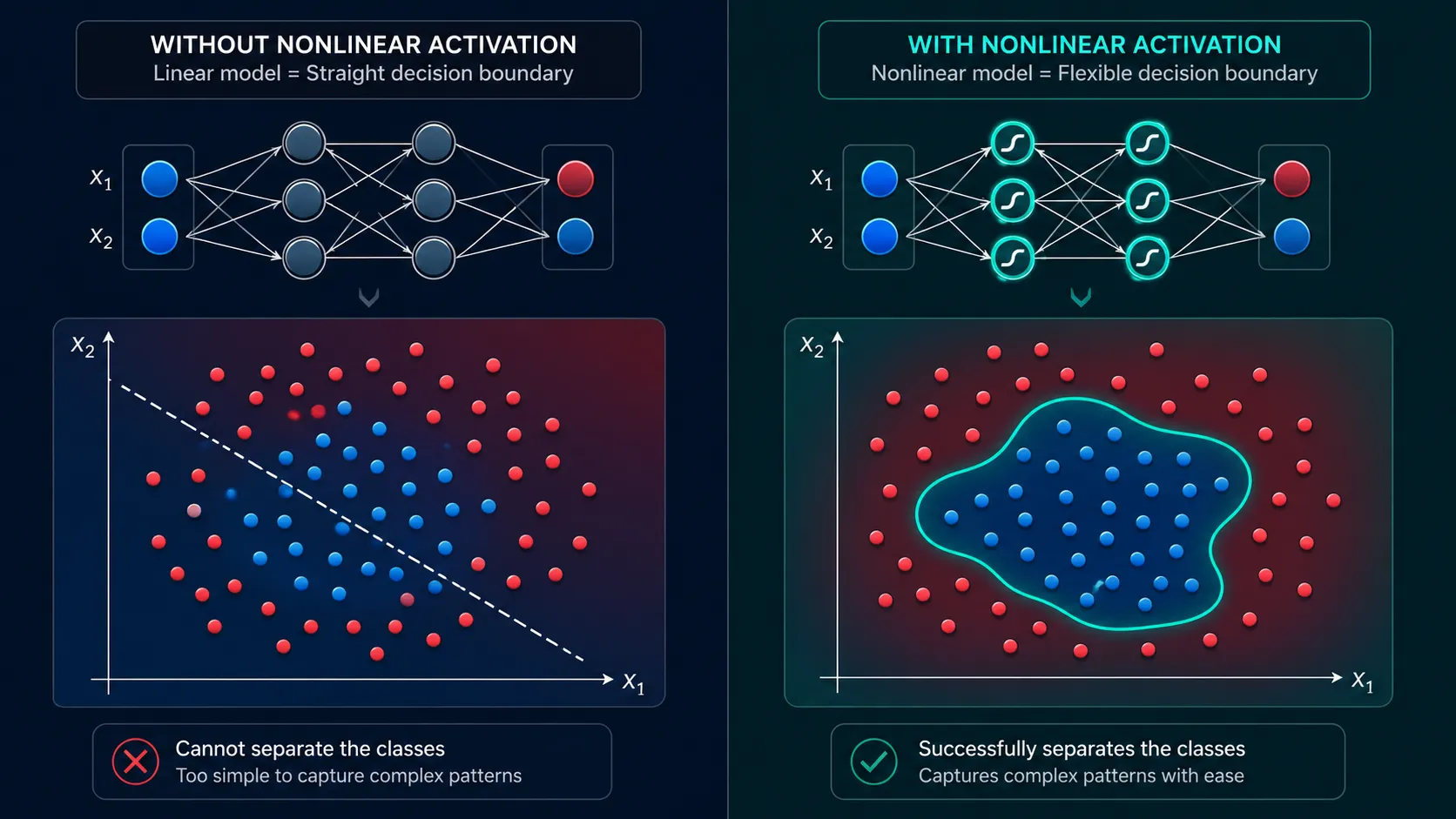
Without activation functions, even a neural network with many layers would behave mostly like one large linear calculation. Extra layers would not give it the flexibility needed to learn complicated patterns.
Real life is rarely linear.
If you study for two hours instead of one, your exam score does not always double. If an online store gives a bigger discount, sales do not increase in a perfectly straight line forever. Real-world relationships change with the situation.
Activation functions introduce non-linearity in neural networks. That allows neural networks to learn curves, boundaries, interactions, and complex patterns.
This is one reason deep learning can work with images, speech, text, recommendations, fraud detection, and many other problems.
A Simple Real-Life Way to Understand Non-Linearity
Imagine a security guard at the entrance of an event.
If a person's ticket is not valid, the guard does not allow entry. Once the ticket meets the requirement, the person can enter.
That decision is not simply “add everything and keep going.” There is a condition.
Activation functions create a similar kind of behavior inside neural networks. Different activation functions create different responses, which is why choosing the right activation function matters.
What Is ReLU Activation Function?
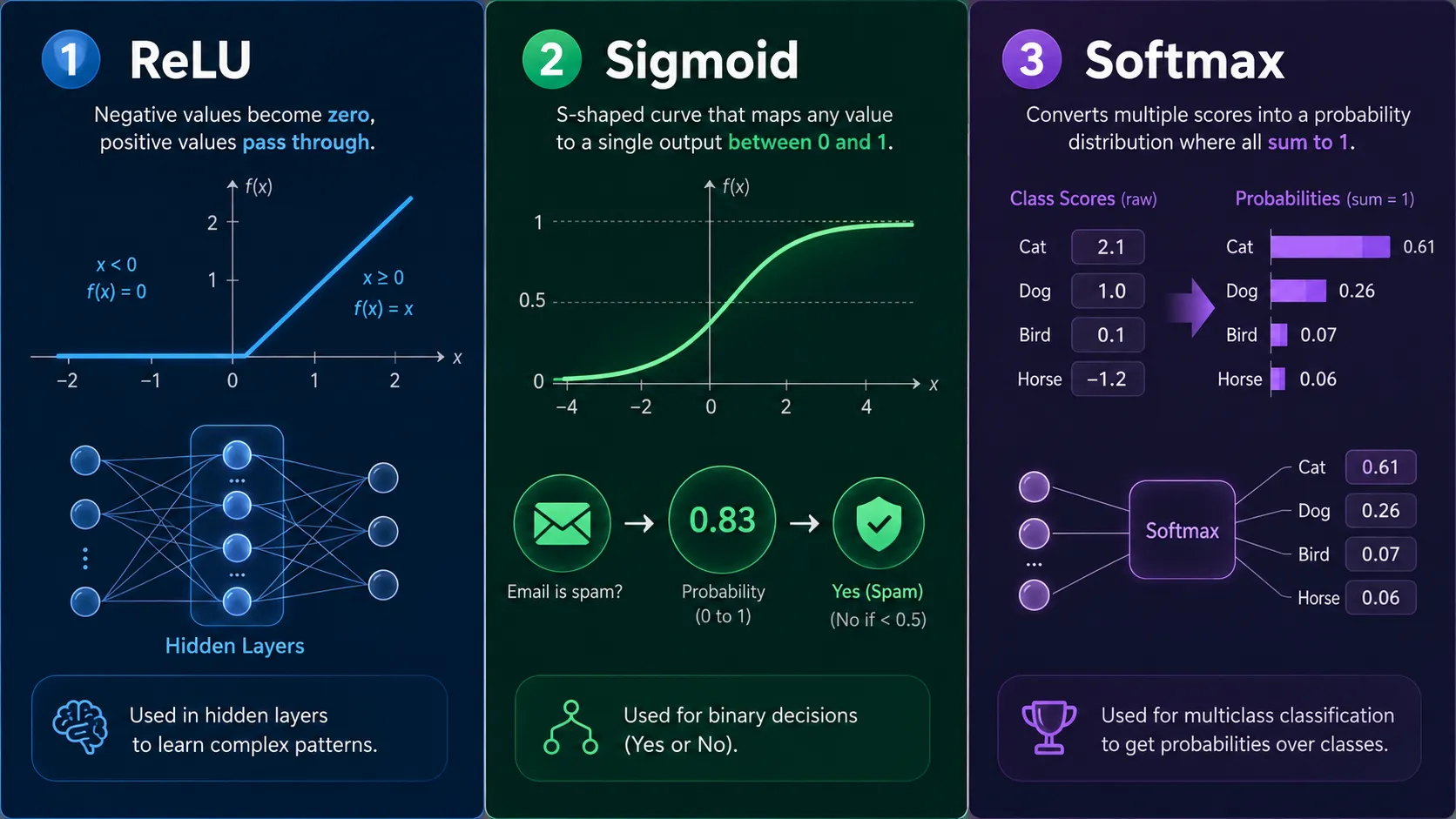
ReLU stands for Rectified Linear Unit. It is one of the most widely used activation functions in neural networks, especially inside hidden layers.
Its basic rule is simple:
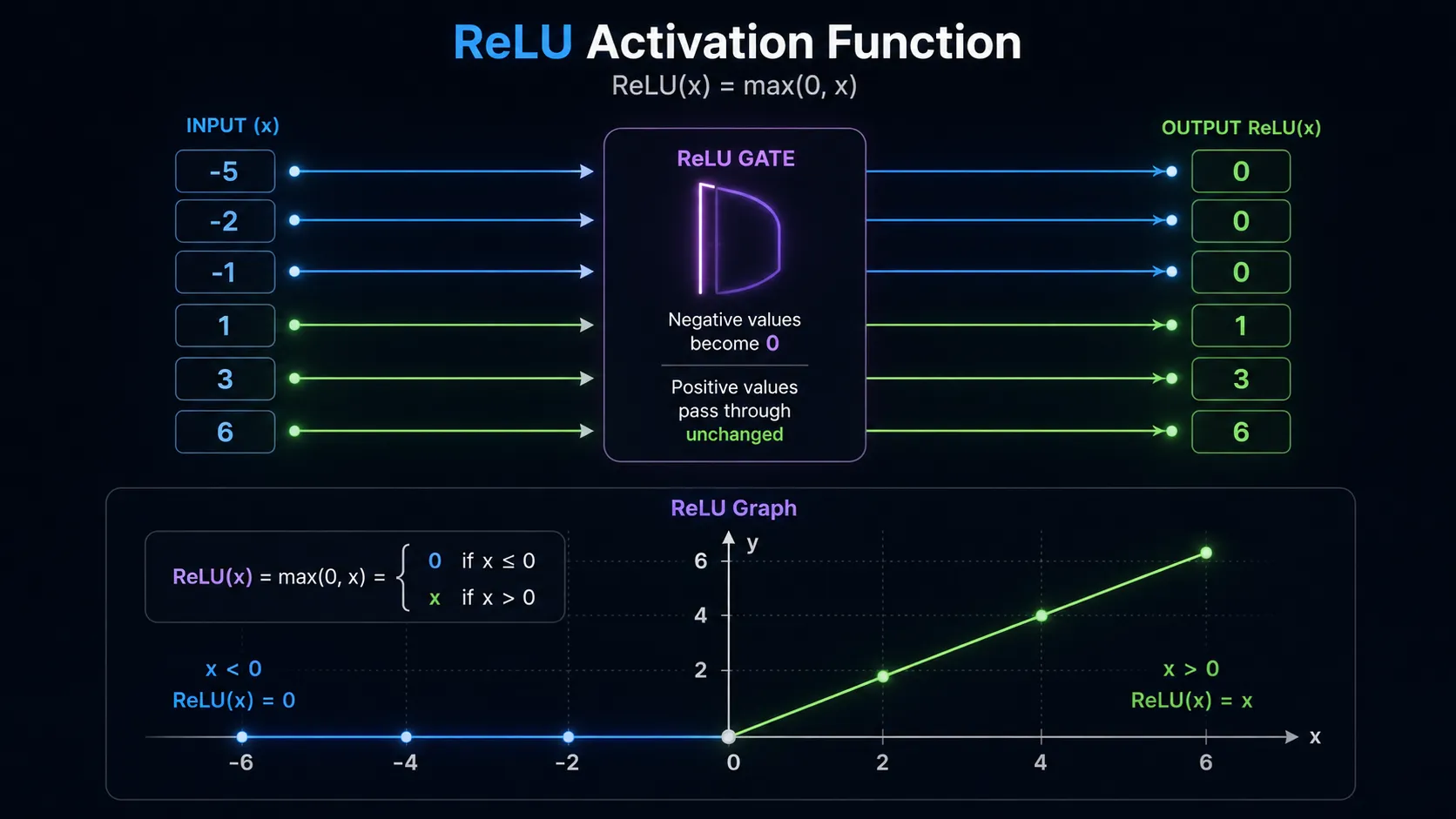
If the input is positive, keep it. If the input is negative, return 0.
Mathematically:
ReLU(x) = max(0, x)
So:
Input 5 becomes 5.
Input 1.4 becomes 1.4.
Input 0 stays 0.
Input -3 becomes 0.
This simple behavior makes the ReLU activation function easy to understand and efficient to calculate.
ReLU Example From Daily Life
Think about a smart home light that turns on only when the room becomes dark enough.
The sensor keeps receiving information, but not every signal needs a response. Signals below a useful level may produce no action, while useful signals are allowed to continue.
ReLU behaves in a similar way. Negative values are blocked by turning them into zero, while positive values pass forward.
This does not mean ReLU “knows” which information is good or bad. It only applies its mathematical rule. During training, the network adjusts its weights so useful patterns produce helpful activations.
Why Is ReLU So Popular?
ReLU is popular because it combines simplicity with strong practical performance.
First, it is computationally cheap. The network mainly checks whether a value is above zero.
Second, ReLU often helps deep networks train effectively in hidden layers.
Third, positive values are not compressed into a tiny range. If a neuron produces 2, 8, or 20, ReLU can keep those values instead of squeezing them between 0 and 1.
For example, imagine an image recognition model learning to detect faces. Early layers may learn edges. Deeper layers may respond to eyes, noses, shapes, or larger face patterns. ReLU lets strong positive signals continue while setting negative responses to zero.
Does ReLU Have Any Problems?
Yes. Its best-known issue is the dying ReLU problem.
If a neuron keeps receiving negative inputs, ReLU keeps returning zero. When this continues during training, that neuron may stop contributing useful information.
Imagine an employee who receives tasks but is told “do nothing” every time. That employee adds no useful output to the workflow. A ReLU neuron can face a similar situation when its input stays negative.
Modified versions such as Leaky ReLU allow a small negative output instead of always returning zero. We will compare those choices later.
For now, remember one practical rule: ReLU is usually a strong default for hidden layers, while the output layer often needs a different activation function depending on the prediction task.
What Is the Sigmoid Activation Function?
ReLU is useful when we want signals to move through hidden layers, but sometimes a neural network needs to answer a much simpler question:
Yes or no?
Will this customer buy the product?
Is this email spam?
Does this image contain a dog?
Will this user click the button?
For problems like these, the Sigmoid activation function can be very useful.
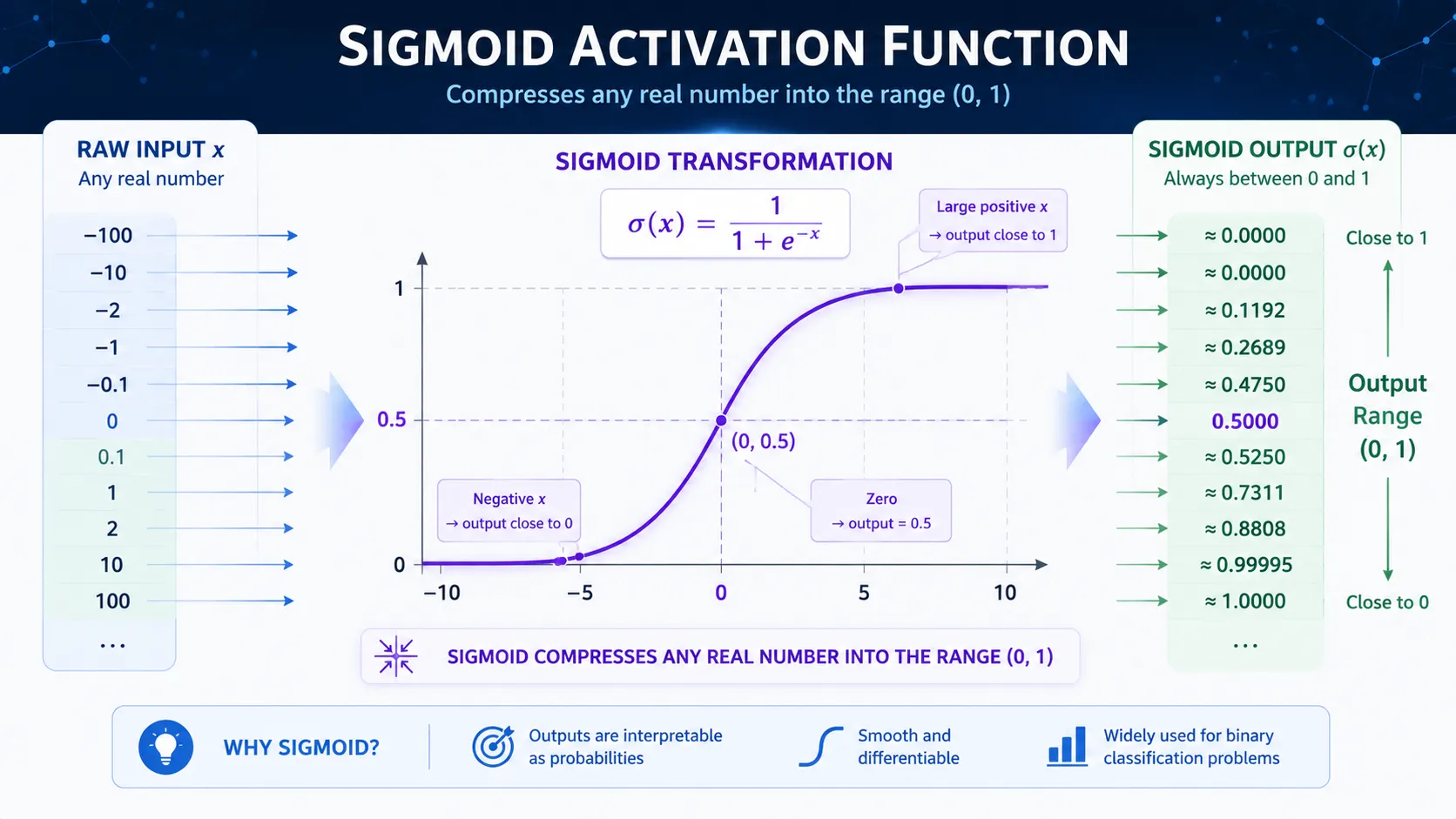
Sigmoid takes almost any real number and converts it into a value between 0 and 1.
Its formula is:
Sigmoid(x) = 1 / (1 + e⁻ˣ)
The formula may look uncomfortable if you are new to machine learning, but the idea behind it is much easier.
A very large positive input produces an output close to 1.
A very large negative input produces an output close to 0.
An input of 0 produces an output of 0.5.
So instead of returning a raw value such as -6, 2.8, or 10, Sigmoid gives us a value that is easier to interpret.
Sigmoid Example From Real Life
Imagine you are building an email spam detector.
The neural network looks at things such as:
words used in the email
suspicious links
sender information
repeated promotional phrases
unusual formatting
After processing all this information, the final neuron may produce a raw score.
Sigmoid can convert that score into something like:
0.92
We may interpret that as the model giving a high probability to the email belonging to the spam class.
If the output is:
0.08
the model is leaning strongly toward the other class.
This is why Sigmoid for binary classification is such a common idea.
The model has two possible outcomes, and Sigmoid gives one output between 0 and 1.
When Should You Use Sigmoid?
A common use of Sigmoid is the output layer of a binary classification model.
Binary classification simply means that the model is choosing between two classes.
For example:
Fraud or not fraud.
Disease detected or not detected.
Customer leaves or stays.
Loan defaults or does not default.
Product purchased or not purchased.
The important point is not the exact example. The important point is that there are two possible outcomes.
Sigmoid can also be useful in multi-label classification, where more than one answer can be true at the same time.
Imagine an AI system looking at a photo.
The same image might contain:
person + car + tree
These labels are not competing with each other. All three can be true.
In that situation, separate Sigmoid outputs can estimate each label independently.
Why Is Sigmoid Not Usually the First Choice for Hidden Layers?
Sigmoid sounds perfect so far, but it has an important weakness.
When its input becomes very large or very negative, the output gets extremely close to either 1 or 0.
The curve becomes almost flat in those areas.
During neural network training, gradients help tell the network how much its weights should change. When gradients become extremely small, learning can slow down.
This is connected to the famous vanishing gradient problem.
Imagine trying to pass a message through ten people.
The first person speaks clearly.
The second repeats it more quietly.
The third makes it even quieter.
By the time the message reaches the tenth person, almost nothing can be heard.
Something similar can happen to the learning signal in deep networks.
That is one reason ReLU and related functions are commonly preferred over Sigmoid inside many hidden layers.

What Is the Softmax Activation Function?
Now imagine the problem is no longer yes or no.
Suppose your model receives an image and must decide whether it contains:
a cat, a dog, or a horse.
There are three possible classes, but we want the model to choose between them.
This is where the Softmax activation function becomes extremely useful.
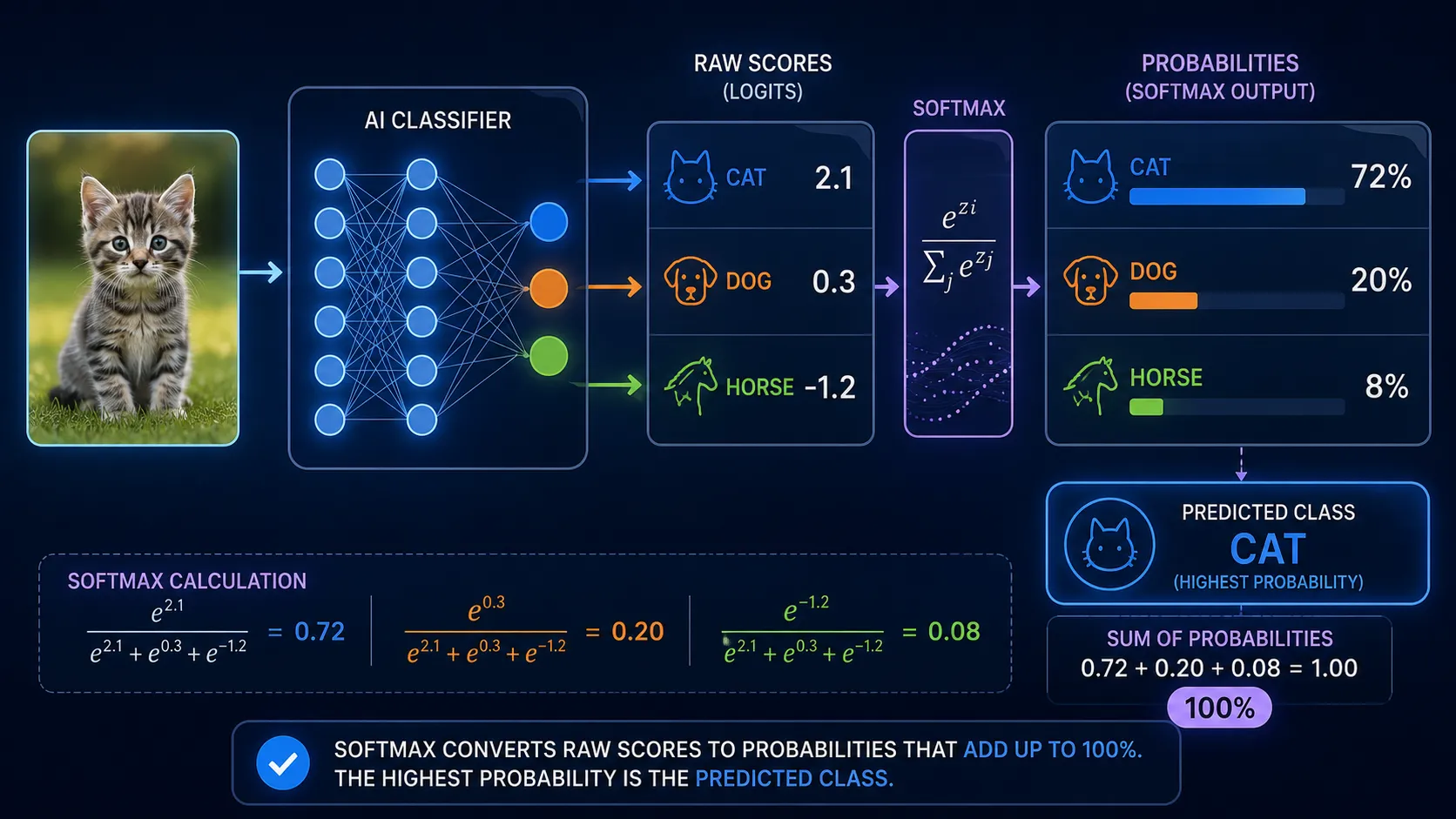
Softmax takes several raw scores from the output layer and converts them into values between 0 and 1.
More importantly, those values add up to 1.
For example, a model might produce:
Cat: 0.72
Dog: 0.20
Horse: 0.08
Together:
0.72 + 0.20 + 0.08 = 1
The cat has the highest value, so the model would normally choose cat as its prediction.
This is why Softmax for multiclass classification is widely used when the classes are mutually exclusive.
In simple words, only one class should be the correct answer.
Softmax Example From Everyday Life
Imagine a food delivery app trying to predict which meal category a customer is most likely to order next.
The possible classes are:
Pizza
Burger
Indian food
Suppose the model first produces raw scores based on the user's previous orders, time of day, location, and browsing behavior.
Those scores are difficult for a normal user to understand.
Softmax converts them into something easier:
Pizza: 60%
Burger: 25%
Indian food: 15%
Now the prediction has a clear meaning.
The system considers pizza the strongest option, while the other possibilities still receive some probability.
Sigmoid vs Softmax: What Is the Difference?
This is one of the most common questions beginners ask when learning activation functions in deep learning.
The easiest way to remember the difference is this:
Sigmoid asks independent yes-or-no questions.
Softmax makes classes compete with each other.
Imagine a photograph containing a dog standing beside a car.
If the task is to identify everything visible in the image, both dog and car can be true.
That is a multi-label problem, so independent Sigmoid outputs can make sense.
But suppose the task is:
“What type of animal is shown?”
And the options are:
Dog
Cat
Horse
Only one answer should win.
That is a multiclass classification problem, where Softmax is often the natural choice.
This small difference is extremely important.
A Simple Rule to Remember
If you have two classes, Sigmoid is commonly used at the output.
If you have multiple mutually exclusive classes, Softmax is commonly used.
If several labels can be true at the same time, multiple Sigmoid outputs may be more suitable.
So by now we have three different jobs:
ReLU helps hidden layers learn useful non-linear patterns.
Sigmoid is useful when outputs behave like independent yes-or-no decisions.
Softmax is useful when several classes compete and one should usually win.
But knowing these definitions is only half the story. The real question is: how do you choose the right activation function for an actual neural network?
That is where things become much more practical.
ReLU vs Sigmoid vs Softmax: Which One Should You Use?
At this point, the three activation functions may sound simple on their own. The confusion usually starts when you actually build a neural network and ask:
Which activation function should go in which layer?
The answer becomes much easier when you focus on the job of that layer.
In most neural networks, hidden layers need to learn patterns, while the output layer needs to produce the final type of prediction.
That is why ReLU, Sigmoid, and Softmax are not really competitors in every situation. They often solve different problems inside the same model.
Use ReLU for Hidden Layers
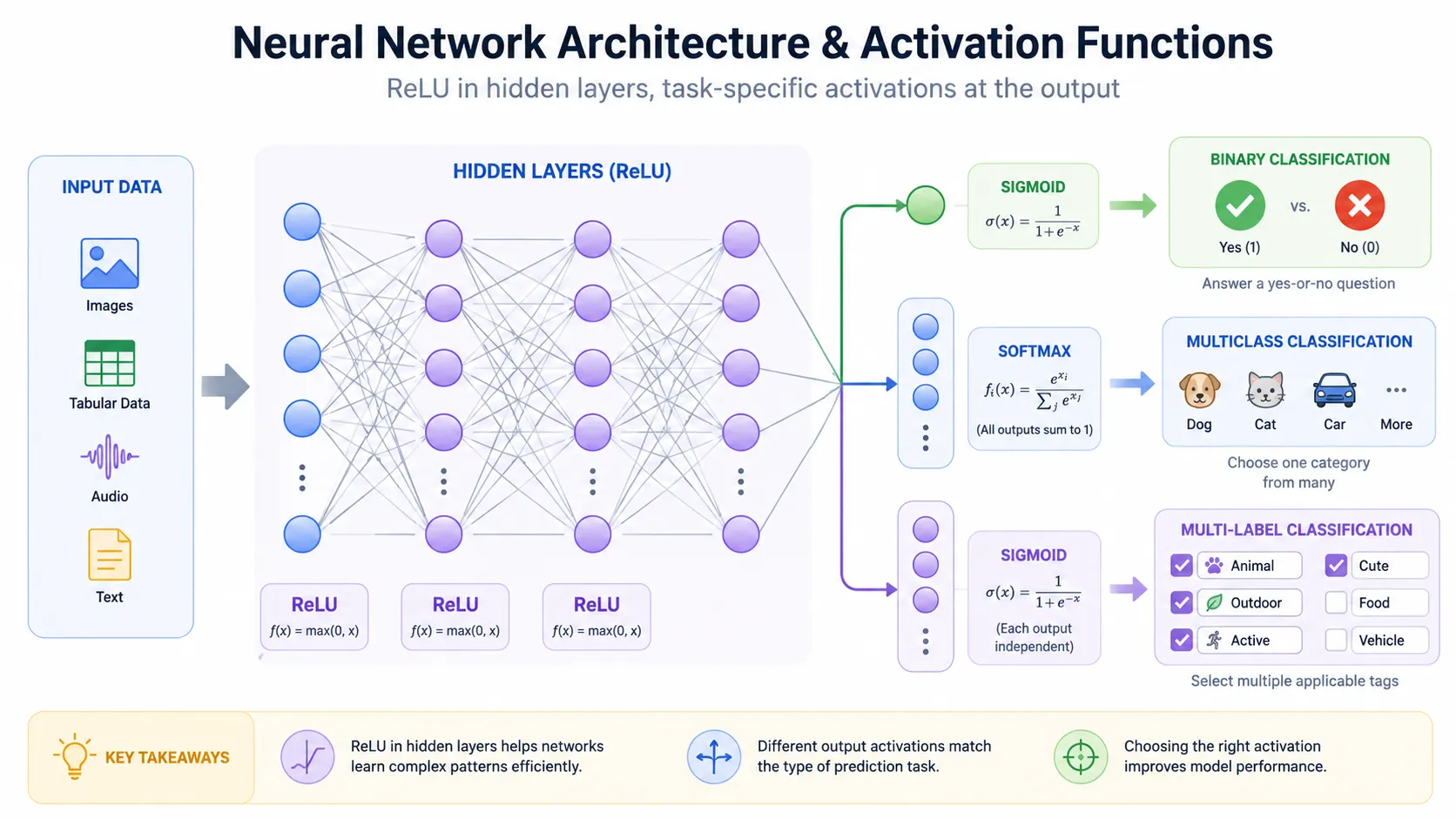
For many deep learning models, ReLU is a strong default choice for hidden layers.
Suppose you are building a model that predicts whether a customer will cancel a hotel booking.
The network may receive information such as booking time, trip length, room price, cancellation history, location, and number of guests.
The hidden layers need to discover relationships between all these signals.
ReLU works well here because it introduces non-linearity without making the calculation unnecessarily complex.
A simple beginner rule is:
If you are unsure what activation function to try first in hidden layers, ReLU is often a sensible starting point.
This does not mean ReLU is perfect for every neural network. Different architectures may use different functions. But for learning the basics, this rule will save you from a lot of confusion.
Use Sigmoid for Binary Classification
Now imagine the same hotel model needs to answer only one final question:
Will the customer cancel the booking?
There are two possible outcomes:
Cancel
Not cancel
This is a binary classification problem.
A Sigmoid activation at the output layer can convert the final score into a value between 0 and 1.
For example:
0.87
The model may treat this as strong support for the positive class.
A prediction closer to 0 would support the other class.
This is why you will often see the combination:
ReLU in hidden layers + Sigmoid in the output layer
when learning simple binary classification networks.
Use Softmax for Multiclass Classification
Now change the task.
Instead of predicting whether a hotel booking will be cancelled, imagine a travel app trying to classify a user's next trip as:
Beach holiday
Adventure trip
City break
Wildlife trip
Only one category should be selected as the main prediction.
This is a multiclass classification problem.
Softmax can turn the output scores into a probability-like distribution across all the available classes.
For example:
Beach holiday: 0.55
Adventure trip: 0.25
City break: 0.15
Wildlife trip: 0.05
The values add up to 1, and the class with the highest score becomes the strongest prediction.
So another useful pattern to remember is:
ReLU in hidden layers + Softmax in the output layer
for many multiclass classification tasks.
What About Multi-Label Classification?
This is where many beginners accidentally use Softmax when they actually need Sigmoid.
Imagine an AI model looking at a travel photo.
The image may contain:
a mountain
a person
snow
a backpack
All these labels can be correct at the same time.
The classes are not fighting for one winning position.
This is called multi-label classification.
In this situation, separate Sigmoid outputs are often used because every label can receive its own score.
The model might predict:
Mountain: 0.97
Person: 0.91
Snow: 0.88
Backpack: 0.76
There is no need for these values to add up to 1 because several labels may be true together.
That gives us a very useful distinction:
One winner among many classes → Softmax
Several labels can be true together → Sigmoid
Common Activation Function Mistakes Beginners Make
Learning the formulas is useful, but avoiding basic mistakes is even more important.
Using Sigmoid Everywhere
A beginner may think:
“If Sigmoid gives a clean output between 0 and 1, why not use it in every layer?”
The problem is that deep networks can struggle when Sigmoid repeatedly pushes values toward its flat regions. Gradients can become very small, which may slow learning.
This is one reason ReLU became so common in hidden layers.
Using Softmax for Independent Labels
Softmax makes outputs compete.
If one class gets more probability, the others must receive less because the total is forced toward 1.
That behavior makes sense when only one class should win.
It does not make sense when several labels can be correct together.
Thinking ReLU Produces Probabilities
ReLU does not convert values into probabilities.
An output of 8 from ReLU does not mean an 800% probability.
ReLU simply returns positive inputs and converts negative inputs to zero.
It is usually helping the network learn features rather than presenting the final probability-style output.
How to Choose an Activation Function Step by Step
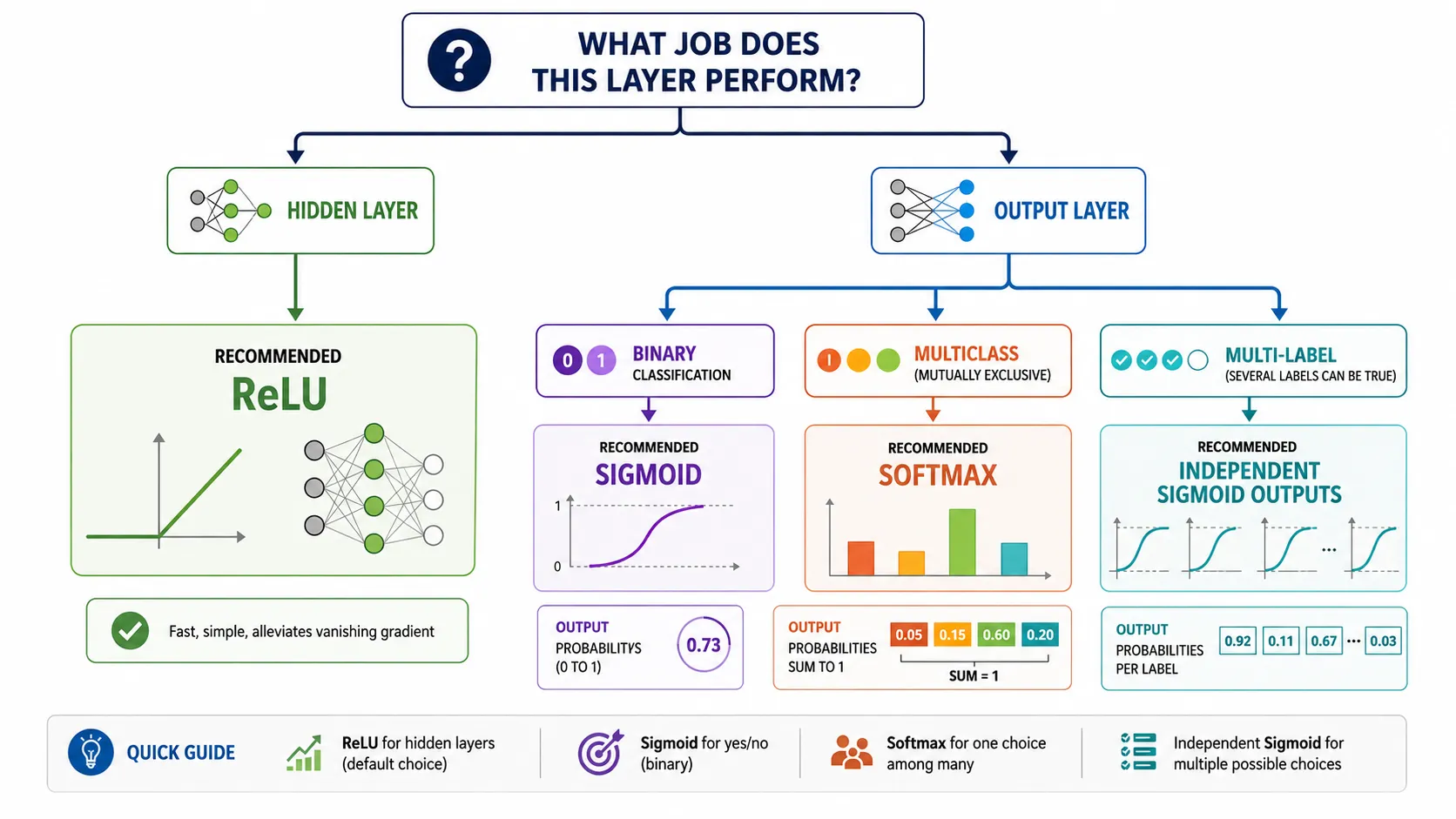
When choosing an activation function, start by asking what the model is trying to predict.
If you are choosing an activation for a hidden layer, ReLU is often one of the first functions worth testing.
If the output is a single binary decision, Sigmoid is commonly used.
If the output must choose one class from several classes, Softmax is commonly used.
If the output may contain multiple independent labels, separate Sigmoid outputs are usually more suitable.
This simple decision process is more useful for beginners than trying to memorize dozens of activation functions at once.
Later, as you move into advanced deep learning, you may come across functions such as Leaky ReLU, ELU, GELU, Swish, and others.
They are important, but you do not need all of them to understand the foundation.
First understand why activation functions exist.
Then understand what ReLU does.
Then learn when Sigmoid makes sense.
Then learn why Softmax is useful for competing classes.
Once these ideas are clear, the advanced functions become much easier to understand.
Frequently Asked Questions About Activation Functions
What is the main purpose of an activation function?
An activation function helps a neural network learn complex and non-linear relationships. It transforms the output of a neuron before information moves forward.
Is ReLU better than Sigmoid?
There is no single winner for every task.
ReLU is commonly used in hidden layers, while Sigmoid is often useful in the output layer for binary classification. Their jobs can be different.
What is the difference between Sigmoid and Softmax?
Sigmoid can treat outputs independently, while Softmax makes multiple classes compete as part of one distribution.
Can Softmax be used for binary classification?
It can be used with two output classes, but a single Sigmoid output is often simpler for standard binary classification.
Which activation function is best for deep learning?
There is no universal best activation function. ReLU and related functions are widely used in hidden layers, but the right choice depends on the model, data, architecture, and prediction task.
Final Thoughts
Activation functions may look like small mathematical formulas, but they play a major role in how neural networks learn.
The easiest way to remember the three functions is:
ReLU helps hidden layers learn useful patterns.
Sigmoid works well for independent yes-or-no style outputs.
Softmax helps choose between multiple competing classes.
You do not need to memorize every formula on your first day.
Instead, remember what problem each function is solving.
Once you understand that, ReLU vs Sigmoid vs Softmax stops feeling like a confusing deep learning topic and starts becoming a practical decision you can make while building a neural network.
Frequently Asked Questions About Activation Functions
What Is an Activation Function?
An activation function is a mathematical rule used inside a neural network. It takes the value produced by a neuron and decides what output should move forward to the next layer.
Activation functions are important because they help neural networks learn more than simple straight-line relationships. They allow the model to understand complex patterns in images, text, speech, customer behavior, and many other types of data.
In simple words, an activation function helps a neuron decide how strongly it should respond to the information it receives.
Why Do Neural Networks Need Activation Functions?
Neural networks need activation functions because real-world problems are rarely simple.
Imagine trying to predict whether a customer will buy a product. The answer may depend on price, previous purchases, age, location, offers, product reviews, and many other factors. These relationships are not always linear.
Activation functions add non-linearity to a neural network. This allows the network to learn complex patterns instead of behaving like one large linear calculation.
Without activation functions, adding many layers would not give the network the same ability to learn complicated relationships.
How Does ReLU Work?
ReLU, or Rectified Linear Unit, follows a very simple rule:
If the input is positive, ReLU keeps it.
If the input is negative, ReLU changes it to zero.
For example:
If the input is 5, the output is 5.
If the input is -3, the output is 0.
This simple behavior makes ReLU fast and practical, which is why it is commonly used in the hidden layers of neural networks.
ReLU helps useful positive signals move forward while blocking negative values.
When to Use Sigmoid Activation?
The Sigmoid activation function is commonly used when the model needs to make a binary or yes-or-no style prediction.
For example:
Is this email spam?
Will the customer cancel the booking?
Is this transaction fraudulent?
Does this image contain a particular object?
Sigmoid converts the model's raw output into a value between 0 and 1, which makes it useful for probability-style outputs.
It is commonly used in the output layer for binary classification.
Sigmoid is also useful in multi-label classification when several labels can be true at the same time.
When to Use Softmax?
Use the Softmax activation function when the model needs to choose one class from several possible classes.
For example, imagine an image classifier with three possible answers:
Cat
Dog
Horse
Softmax converts the model's raw scores into values between 0 and 1. These values add up to 1.
The result might look like this:
Cat: 0.70
Dog: 0.20
Horse: 0.10
The cat has the highest value, so the model would normally choose cat as its final prediction.
Softmax is commonly used in the output layer for multiclass classification, where one class should normally win.
What Is the Sigmoid vs Softmax Difference?
The main Sigmoid vs Softmax difference is how they treat different output classes.
Sigmoid treats each output independently.
Softmax makes all output classes compete with each other.
For example, imagine an image contains a person, a car, and a tree.
If the model needs to identify everything in the image, several answers can be correct at the same time. Separate Sigmoid outputs can work well here.
Now imagine the model must answer:
Which animal is shown: cat, dog, or horse?
Only one answer should normally be correct. Softmax is a better fit because the classes compete with each other.
A simple way to remember the difference is:
Several labels can be true → Sigmoid
Only one class should win → Softmax
Which Activation Function Should I Use?
The right activation function depends on what the neural network layer is trying to do.
For hidden layers, ReLU is often a strong starting point because it is simple, fast, and works well in many neural networks.
For binary classification, Sigmoid is commonly used in the output layer.
For multiclass classification, where one class must be selected from several choices, Softmax is commonly used.
For multi-label classification, where several labels can be correct at the same time, separate Sigmoid outputs are often used.
The easiest rule to remember is:
Hidden layers → ReLU
Binary output → Sigmoid
One class from many → Softmax
Several independent labels → Sigmoid
Once you understand the job of the layer, choosing between ReLU, Sigmoid, and Softmax becomes much easier.
If you want you learn What is deep learing How It Works click this


