


Positional Encoding in Transformers: How Word Order Works
Imagine receiving a message from your friend that says:
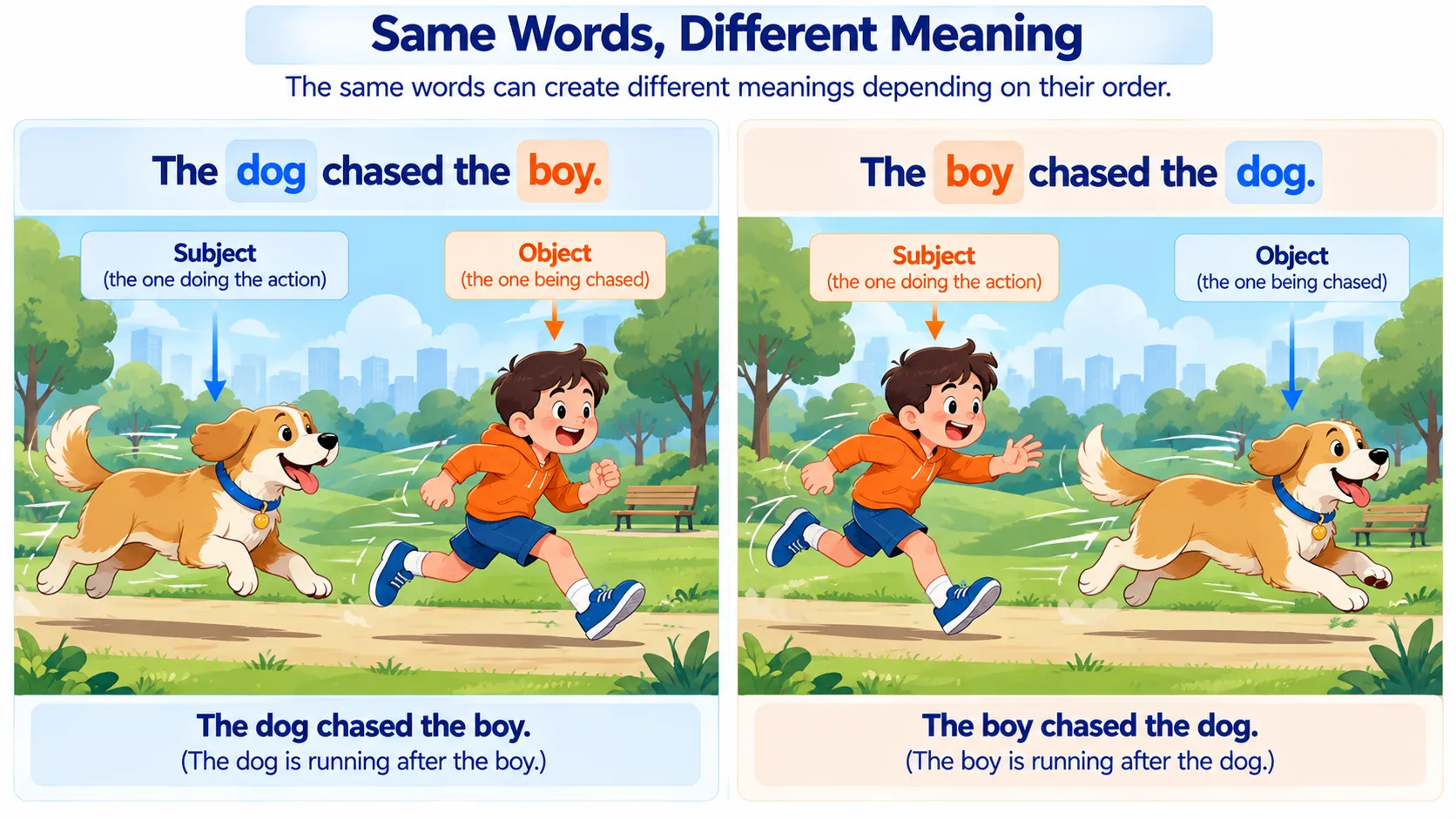
"The dog chased the boy."
Now imagine receiving another message:
"The boy chased the dog."
Both sentences contain exactly the same words. Yet they describe two completely different situations.
In the first sentence, the dog is chasing the boy. In the second, the boy is chasing the dog.
You understand the difference instantly because your brain pays attention to the order of words.
But what happens when an artificial intelligence system reads these sentences?
How does it know which word comes first, which comes next, and how they fit together?
This question becomes especially interesting when we look at Transformers, the neural network architecture behind many modern language models.
Unlike older recurrent neural networks, Transformers can process multiple tokens in parallel. That makes them powerful, but it also creates an important challenge.
How can a Transformer understand word order without reading every word one after another?
The answer involves a technique called positional encoding.
Let's explore how it works using simple examples, everyday situations, and a little mathematics.
What Is Positional Encoding in Transformers?
Positional encoding in Transformers is a technique that provides information about the position of tokens in a sequence, helping the model understand word order and relationships between words.
Think of it as giving every word a position label.
Consider this sentence:
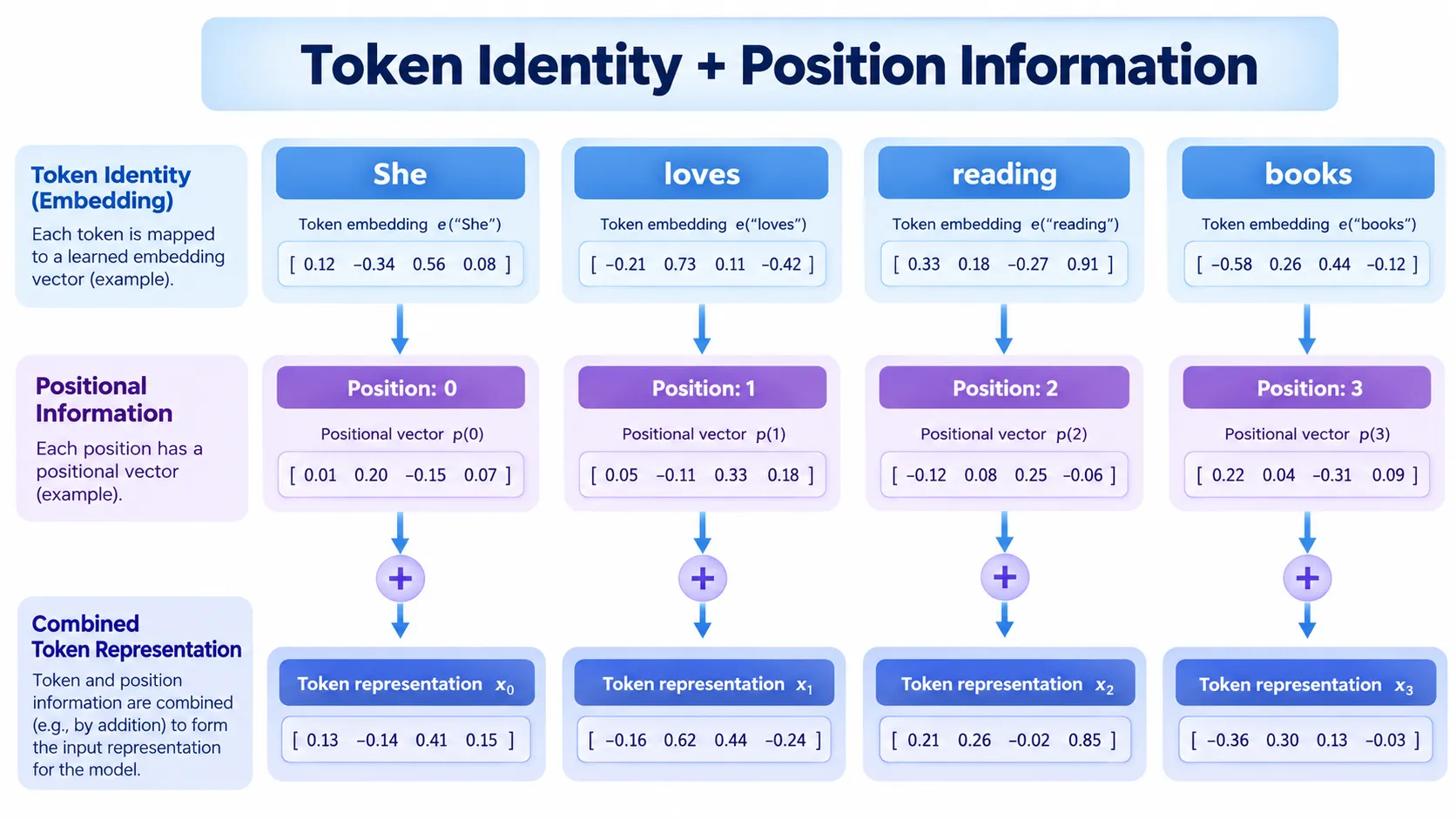
"She loves reading books."
Each word appears at a particular position:
Position 0: She
Position 1: loves
Position 2: reading
Position 3: books
These positions help describe how the sentence is arranged.
However, Transformers do not necessarily receive simple position numbers as additional words or labels.
Instead, positional information is represented mathematically and introduced into the model.
In the original Transformer architecture, positional encoding vectors were added to token embeddings. Other Transformer designs use different methods to introduce position information.
The purpose remains similar: help the model distinguish between tokens appearing at different places in a sequence.
A Simple Everyday Example
Imagine a classroom where a teacher gives every student a numbered seat.
Without seat numbers, the teacher can recognize the students but may not know where each student is supposed to sit.
With seat numbers, the teacher understands both the student's identity and their location.
A similar idea applies to Transformers.
Token embeddings represent information about tokens, while positional information helps indicate where those tokens appear.
Together, these signals help the model learn relationships that depend on sequence order.
Simple takeaway: Positional encoding helps Transformers understand not just which tokens appear, but also where they appear.
Why Do Transformers Need Positional Encoding?
To understand why positional encoding matters, we first need to understand a small limitation of the basic self-attention mechanism.
Self-attention allows tokens to interact with one another based on their representations.
For example, consider the sentence:
"The little girl opened the door."
The word "opened" is related to "girl" because the girl performs the action.
The word "door" is related to "opened" because the door receives the action.
Self-attention helps the model learn these relationships.
But there is a catch.
Self-Attention Does Not Automatically Understand Word Order
Imagine placing the following words on separate cards:
"Cat — chased — mouse"
Now rearrange them:
"Mouse — chased — cat"
The words remain the same, but their positions change.
Basic self-attention, without positional information or another source of ordering, does not inherently distinguish the two arrangements in the way language understanding requires.
More precisely, ordinary self-attention is permutation-equivariant: rearranging the input token representations rearranges the corresponding outputs.
It does not independently attach a fixed meaning to the original sequence positions.
This is why positional information is so important.
It provides the model with a way to learn patterns involving the order and distance between tokens.
For example, a model may learn that nearby words often form phrases, while more distant words can still share important grammatical relationships.
Of course, word order is not the only part of language understanding. Context, grammar, and learned language patterns also matter.
Positional encoding supplies an important piece of that information.
What Happens Without Positional Encoding?
Let's imagine building a Transformer that receives token embeddings but has no positional information.
You give it two sentences:
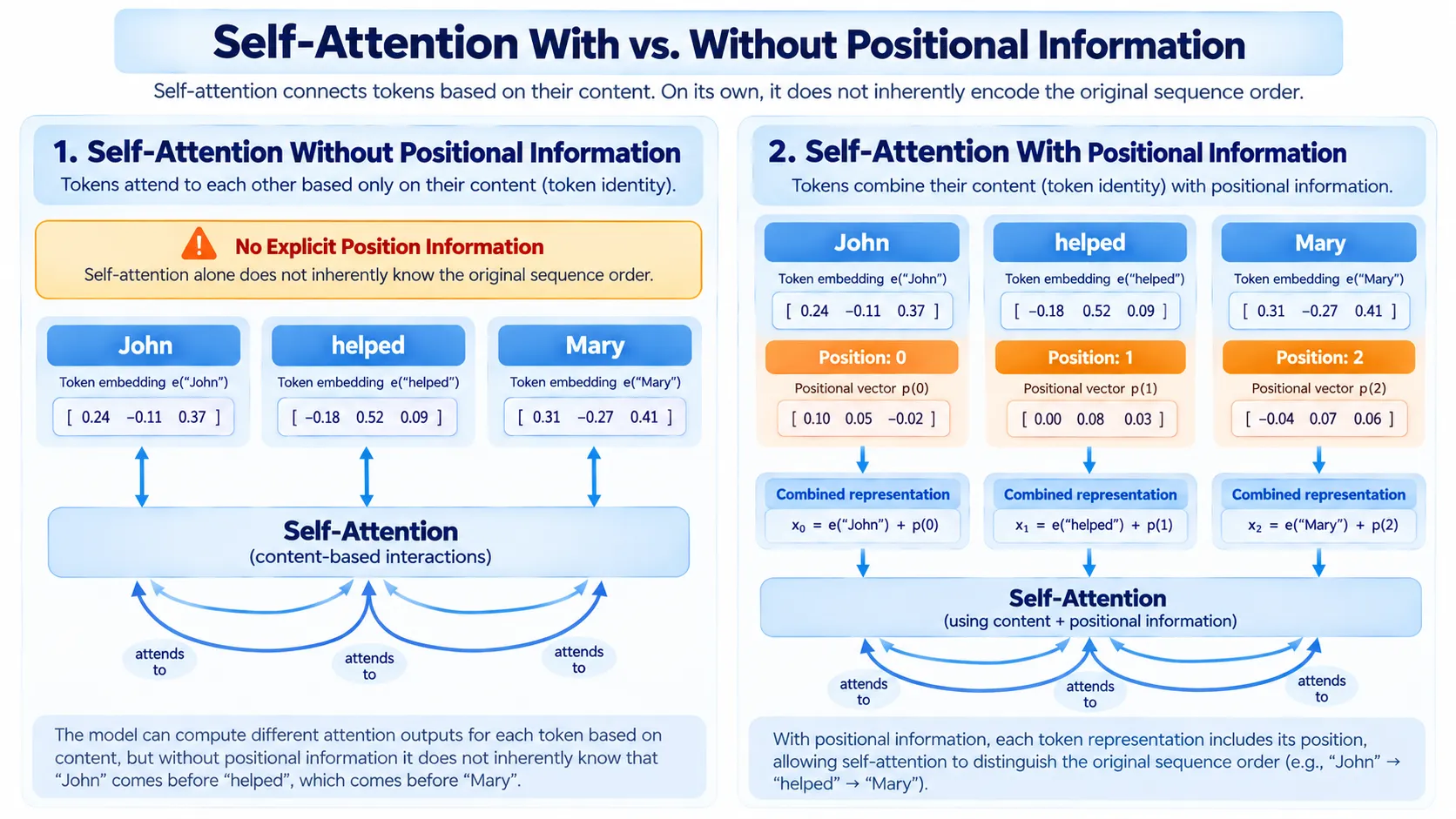
"John helped Mary."
"Mary helped John."
Both contain the same three words.
Without positional signals, an otherwise standard Transformer encoder using unrestricted self-attention cannot reliably distinguish the original ordering of those tokens.
Its representations can reflect the token identities and their interactions, but the architecture has no built-in way to assign meaning to their original positions.
This becomes a problem when understanding who performed an action and who received it.
Adding positional information helps solve this problem.
It allows the model to learn that changing the arrangement of words can also change the meaning of a sentence.
Important: Positional encoding does not teach grammar by itself. It gives the model position-related information that can be used while learning grammar and meaning.
How Did Transformers Change the Way AI Processes Sequences?
Before Transformers became popular, many language-processing systems relied on recurrent neural networks, or RNNs.
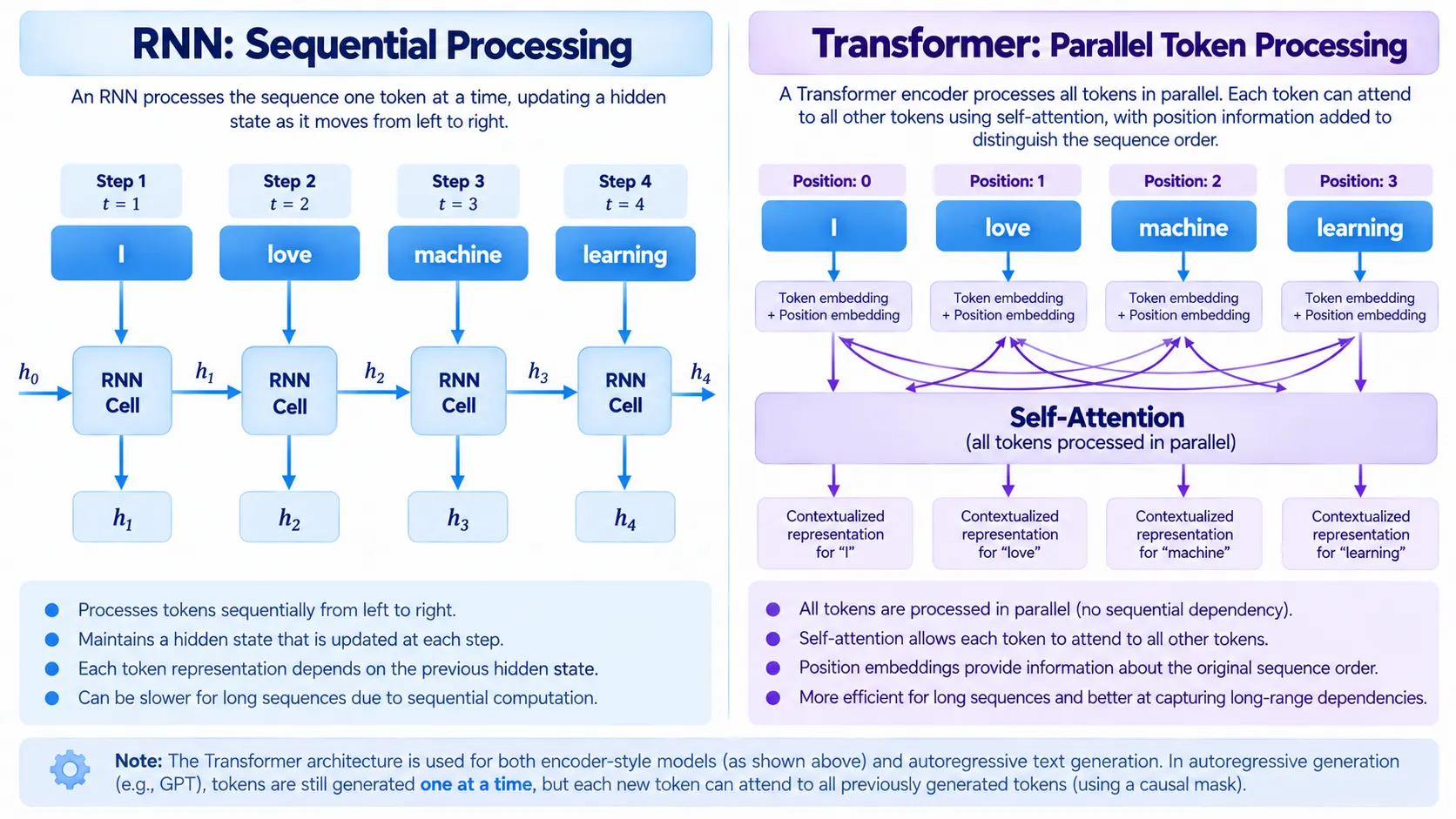
RNNs process sequences through repeated steps, passing information from earlier positions to later ones.
Consider the sentence:
"I am learning artificial intelligence."
A traditional RNN processes the sequence step by step.
It reads "I," updates its internal state, then processes "am," followed by "learning," and continues through the sentence.
This sequential structure naturally provides information about the order in which tokens are processed.
However, it also creates dependencies between processing steps that can make parallel training more difficult.
Transformers introduced a different approach.
Instead of relying on recurrence, the original Transformer architecture used attention mechanisms to connect tokens across a sequence.
This allowed substantially more parallel processing during training.
But removing recurrence also meant the model needed another way to represent sequence order.
That is where positional encoding entered the architecture.
Positional Encoding vs RNNs: The Key Difference
Think about two people reading a story.
The first person reads one word at a time, moving from the beginning of the sentence to the end.
The second person can examine all the words together but receives additional information about their positions.
The first approach resembles the sequential processing used by RNNs.
The second resembles how a Transformer can use attention alongside positional information.
This comparison is simplified, but it highlights an important difference.
RNNs obtain ordering information through sequential computation, while Transformers typically use explicit or built-in positional mechanisms.
There is one more detail worth remembering.
Although Transformers can process multiple input tokens in parallel, autoregressive language models generally generate new tokens one at a time.
So parallel attention processing does not mean every Transformer operation happens simultaneously.
The major advantage is that Transformers can learn relationships between tokens without depending on the same recurrent processing structure used by traditional RNNs.
This explains why positional encoding became such an important part of Transformer design.
As we look more closely at the architecture, the next question is how a simple mathematical representation can communicate a token's position to a neural network.
How Does Positional Encoding Work in Transformers?
Imagine attending a concert where thousands of people are sitting in different rows.
Every person has a name, but knowing their name alone does not tell you where they are sitting.
To find someone, you also need their row and seat number.
A similar challenge appears when Transformers process language.
Each token has an embedding that represents learned information about that token. However, the embedding alone does not tell the model where the token appears in a sentence.
Positional encoding solves this problem by introducing position-related information into token representations.
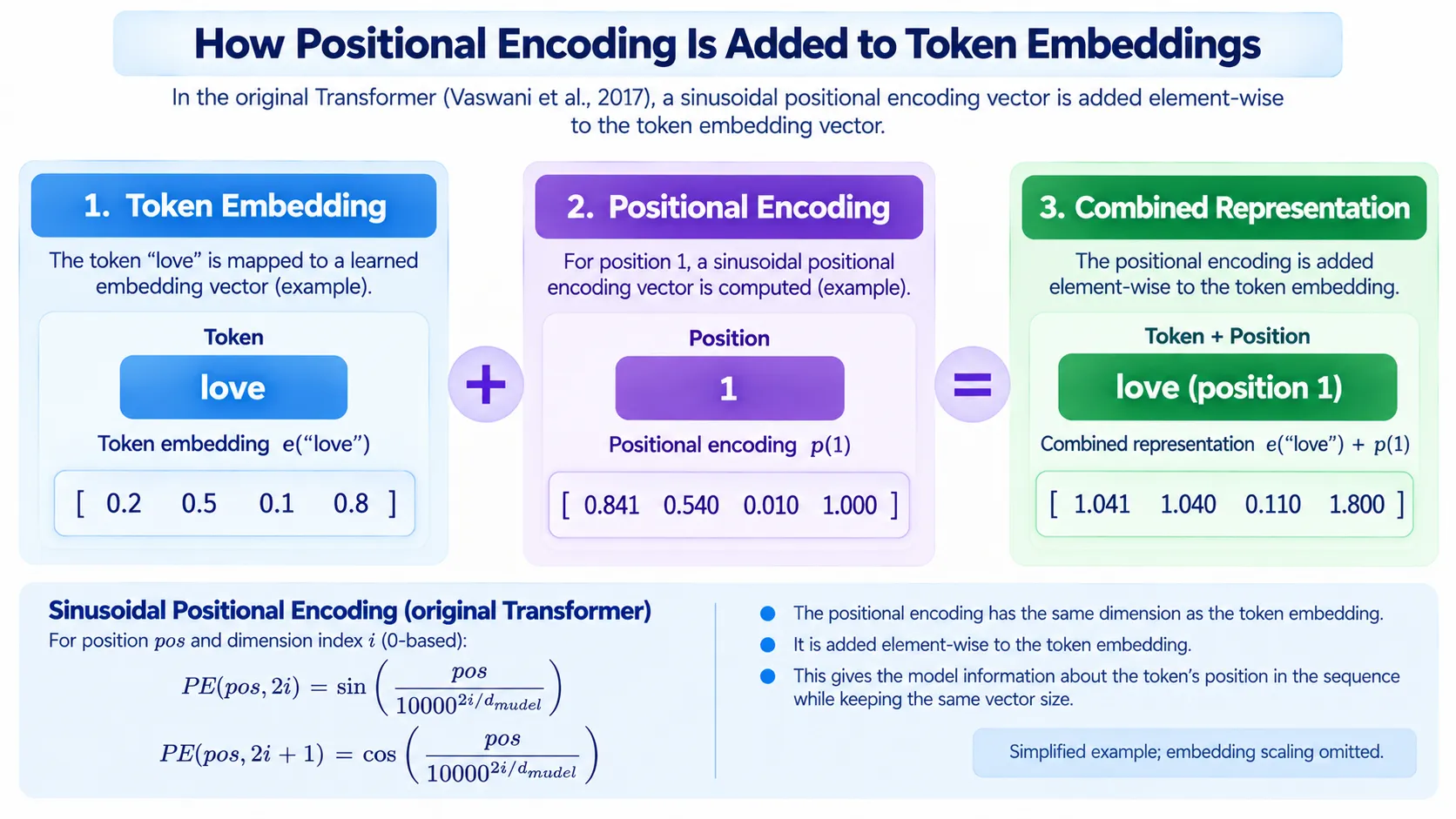
Let's understand the process step by step.
Step 1: Convert Words Into Token Embeddings
Consider the sentence:
"I love machine learning."
Before a Transformer processes this sentence, a tokenizer converts it into tokens.
For simplicity, imagine the tokenizer produces four tokens:
I
love
machine
learning
Each token is converted into a numerical representation called a token embedding.
For example, a simplified embedding for "love" might look like:
[0.2, 0.5, 0.1, 0.8]
These numbers are illustrative, not actual values from a trained model.
In real Transformers, embeddings can contain hundreds or thousands of dimensions.
The important point is that token embeddings represent learned features, but they do not automatically communicate the token's position.
Step 2: Generate Positional Encoding Vectors
Now the Transformer needs to represent where each token appears.
For our example:
I → Position 0
love → Position 1
machine → Position 2
learning → Position 3
In the original Transformer, mathematical functions generate a positional encoding vector for each position.
These vectors have the same number of dimensions as the token embeddings.
For example, a simplified positional vector for position 1 could be:
[0.841, 0.540, 0.010, 1.000]
This is approximately what sinusoidal positional encoding produces for position 1 when the embedding dimension is four.
Different positions receive different vectors.
As a result, the model can distinguish between the same token appearing at different positions.
Step 3: Add Positional Encoding to Token Embeddings
Once both vectors are available, the original Transformer combines them through element-wise addition.
The basic equation is:
Input Representation = Token Embedding + Positional Encoding
Suppose the token "love" has this embedding:
[0.2, 0.5, 0.1, 0.8]
Its positional encoding at position 1 is approximately:
[0.841, 0.540, 0.010, 1.000]
Adding the corresponding values gives:
[1.041, 1.040, 0.110, 1.800]
This combined vector now contains information derived from both the token and its position.
The self-attention layers can use that information while learning relationships between tokens.
In the original architecture, token embeddings are also scaled before adding positional encodings. Our simplified example leaves out that scaling to make the main idea easier to understand.
Key takeaway: Positional encoding does not replace token embeddings. It adds information that helps the model interpret sequence order.
What Is Sinusoidal Positional Encoding?
Now let's explore one of the most important techniques introduced in the original Transformer research.
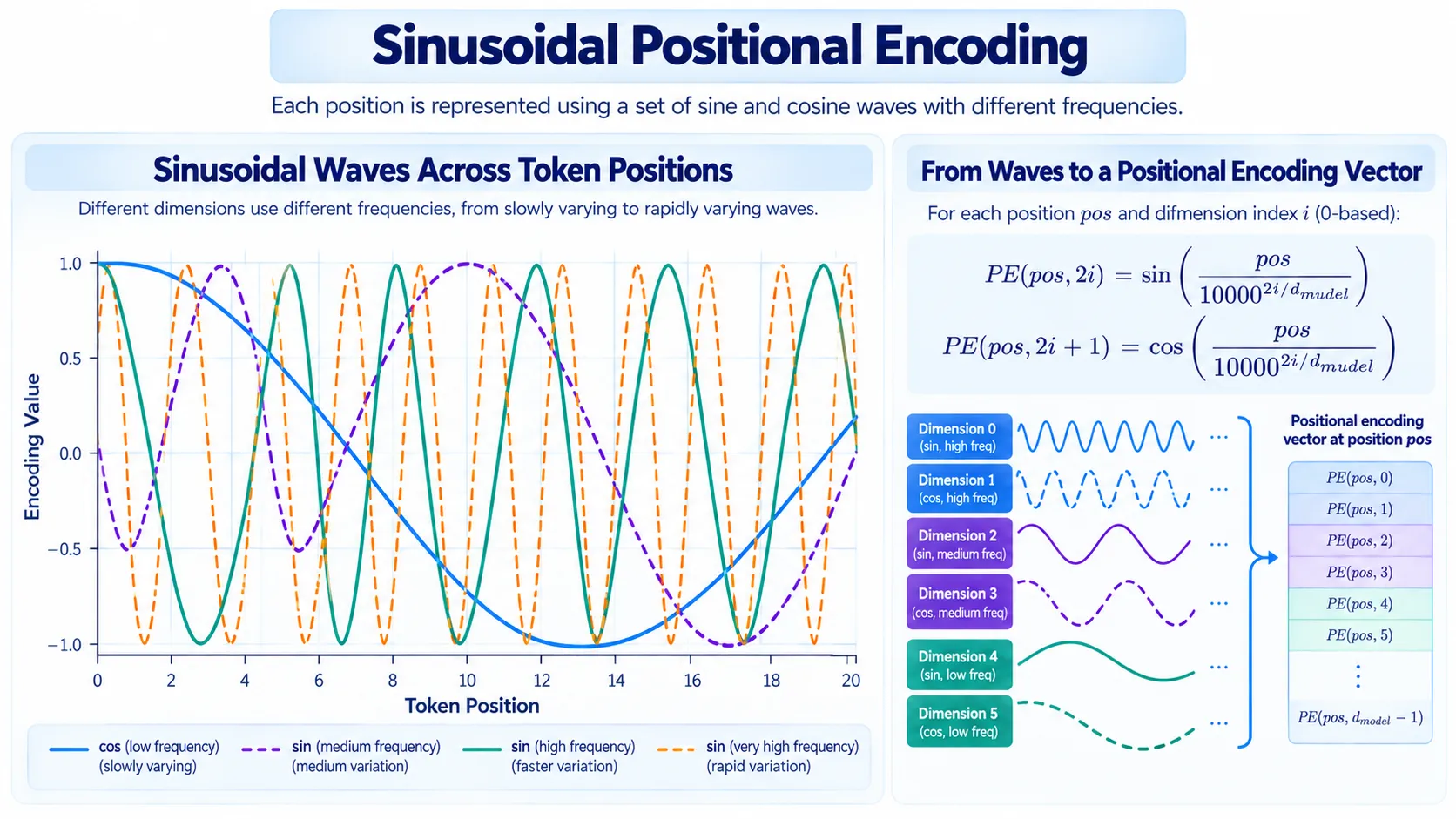
Sinusoidal positional encoding uses sine and cosine mathematical functions to create position-dependent vectors.
Instead of learning a separate positional vector for every position, the original Transformer could calculate these vectors using fixed mathematical formulas.
This approach is called sinusoidal positional encoding.
But why use sine and cosine?
Imagine watching two ocean waves.
One wave moves quickly, producing many small waves.
Another moves slowly, producing longer waves.
Although both follow repeating patterns, they change at different speeds.
Now imagine combining several waves with different frequencies.
Their combined values can describe positions in a much richer way than one wave alone.
That is the basic idea behind sinusoidal positional encoding.
The Sinusoidal Positional Encoding Formula
The original Transformer uses two equations:
PE(pos, 2i) = sin(pos / 10000^(2i / d_model))
PE(pos, 2i + 1) = cos(pos / 10000^(2i / d_model))
These formulas may look complicated, but their components are straightforward.
Here is what each term means:
PE: Positional encoding value.
pos: Position of the token in the sequence.
i: Index of a sine-cosine dimension pair.
d_model: Total number of dimensions in the representation.
sin: Sine mathematical function.
cos: Cosine mathematical function.
Even-numbered dimensions use sine, while odd-numbered dimensions use cosine.
Each pair operates at a particular frequency.
Different dimension pairs use different frequencies, allowing the representation to capture positional patterns at multiple scales.
The number 10,000 controls how the frequencies are distributed.
It is a design choice from the original paper, not a universal constant required by every Transformer.
A Simple Mathematical Example
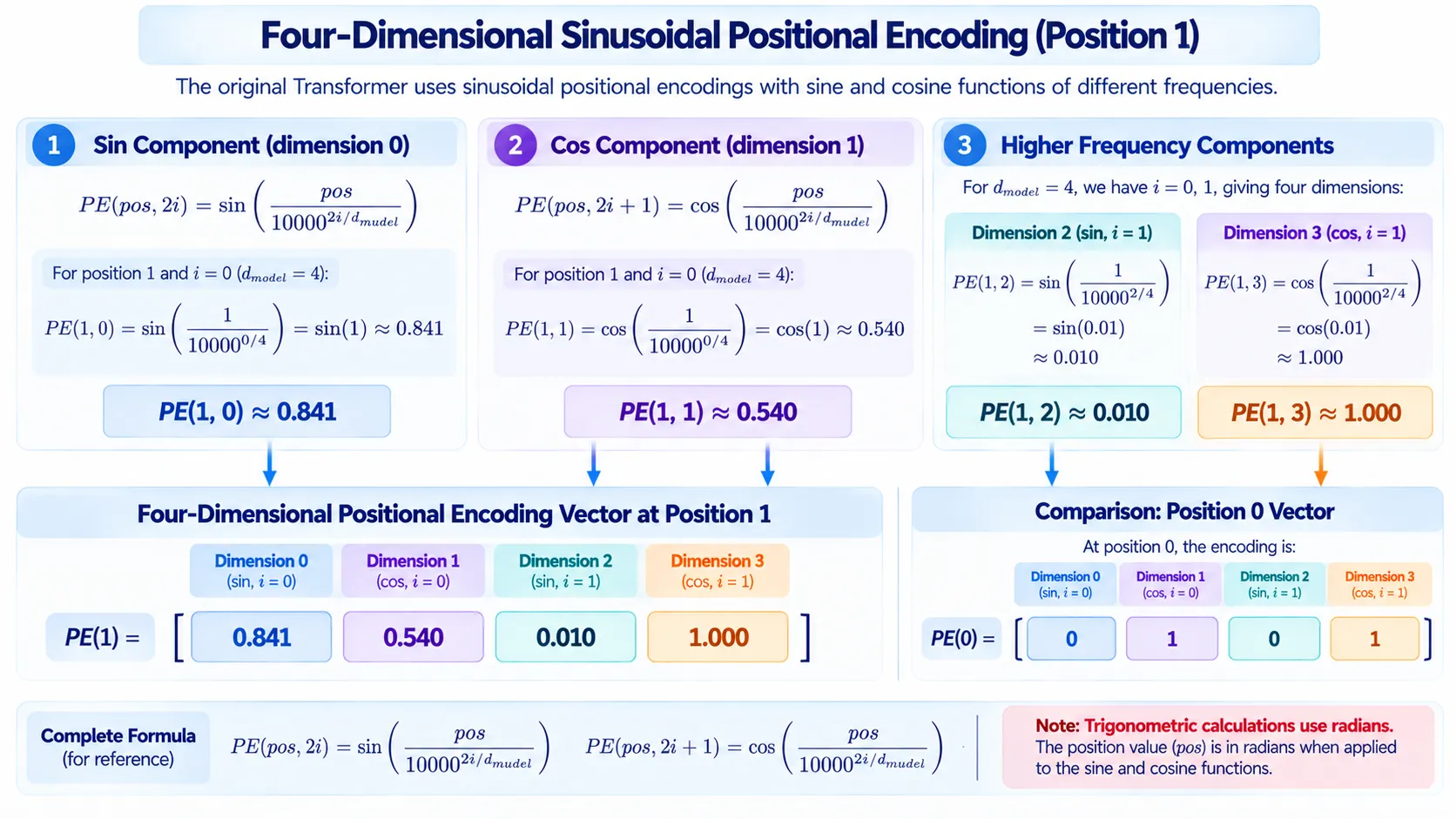
Let's calculate the first two values for a token at position 1.
Assume:
pos = 1
i = 0
For the first dimension:
PE(1, 0) = sin(1 / 10000⁰)
Since 10000⁰ = 1:
PE(1, 0) = sin(1) ≈ 0.841
For the second dimension:
PE(1, 1) = cos(1 / 10000⁰)
Therefore:
PE(1, 1) = cos(1) ≈ 0.540
These calculations use radians, which is the standard angle unit for these mathematical functions.
For a four-dimensional positional encoding, the remaining two values are approximately 0.010 and 1.000.
The resulting vector is:
[0.841, 0.540, 0.010, 1.000]
For position 0, the corresponding vector is:
[0, 1, 0, 1]
This shows how different positions receive different numerical representations without requiring a separately trained vector for each position.
Why Are Sine and Cosine Functions Used?
You might wonder why researchers chose these particular mathematical functions instead of simply assigning position numbers such as 1, 2, 3, and 4.
There are several useful reasons.
1. They Produce Smooth Positional Patterns
Sine and cosine functions change continuously.
As token positions increase, their positional encoding values follow predictable mathematical patterns.
This gives the model structured information about changing positions rather than unrelated numerical labels.
2. They Represent Multiple Positional Scales
Different sine and cosine frequencies change at different speeds.
Some dimensions change rapidly across nearby positions.
Others change slowly across much longer distances.
Together, they provide information at different sequence scales.
3. They Support Learning Relative Positions
One useful mathematical property is that a position shifted by a fixed amount can be represented through a linear transformation of the original sinusoidal encoding.
For example, the relationship between positions 2 and 5 has the same three-position offset as the relationship between positions 10 and 13.
This structure can help attention layers learn patterns involving relative distances.
It does not mean the model automatically understands every relationship. Those patterns still need to be learned.
4. They Can Be Calculated for New Positions
Sinusoidal encodings are generated from formulas rather than a fixed table of learned position vectors.
Therefore, positional vectors can be calculated for positions beyond those encountered during training.
However, being able to calculate a vector does not guarantee that the model will perform well on longer sequences.
Learned Positional Embeddings vs Sinusoidal Positional Encoding
Sinusoidal encoding is not the only way Transformers can represent positions.
Another important approach uses learned positional embeddings.
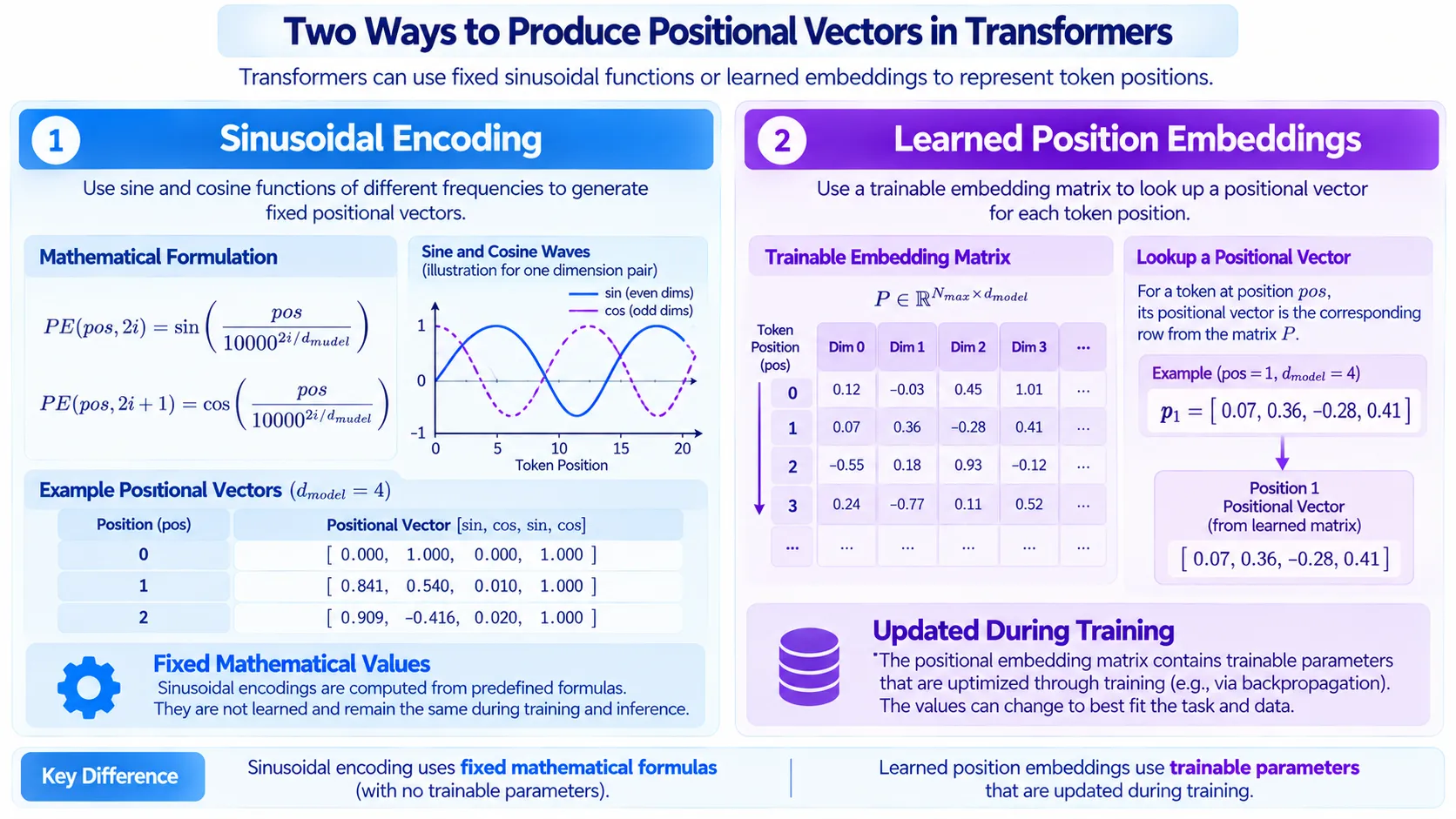
With sinusoidal encoding, positional values come from fixed mathematical formulas.
With learned positional embeddings, the model starts with trainable position vectors and updates them during training.
Imagine two students learning a route through a city.
The first student follows a fixed coordinate system.
The second learns important location patterns through repeated experience.
Both approaches provide location information, but they obtain that information differently.
Similarly, sinusoidal encoding provides a predetermined mathematical structure, while learned positional embeddings adapt to patterns in training data.
Learned absolute position embeddings are commonly associated with earlier Transformer-based architectures, including BERT.
However, they can face difficulties when processing positions beyond their configured embedding range.
Neither approach is automatically better for every application.
Their effectiveness depends on the model architecture, training setup, sequence length, and intended task.
Modern Transformers also use other positional techniques, including relative positional representations and rotary position embeddings.
These approaches become especially important when models need to understand relationships across long sequences.
Absolute vs Relative Positional Encoding
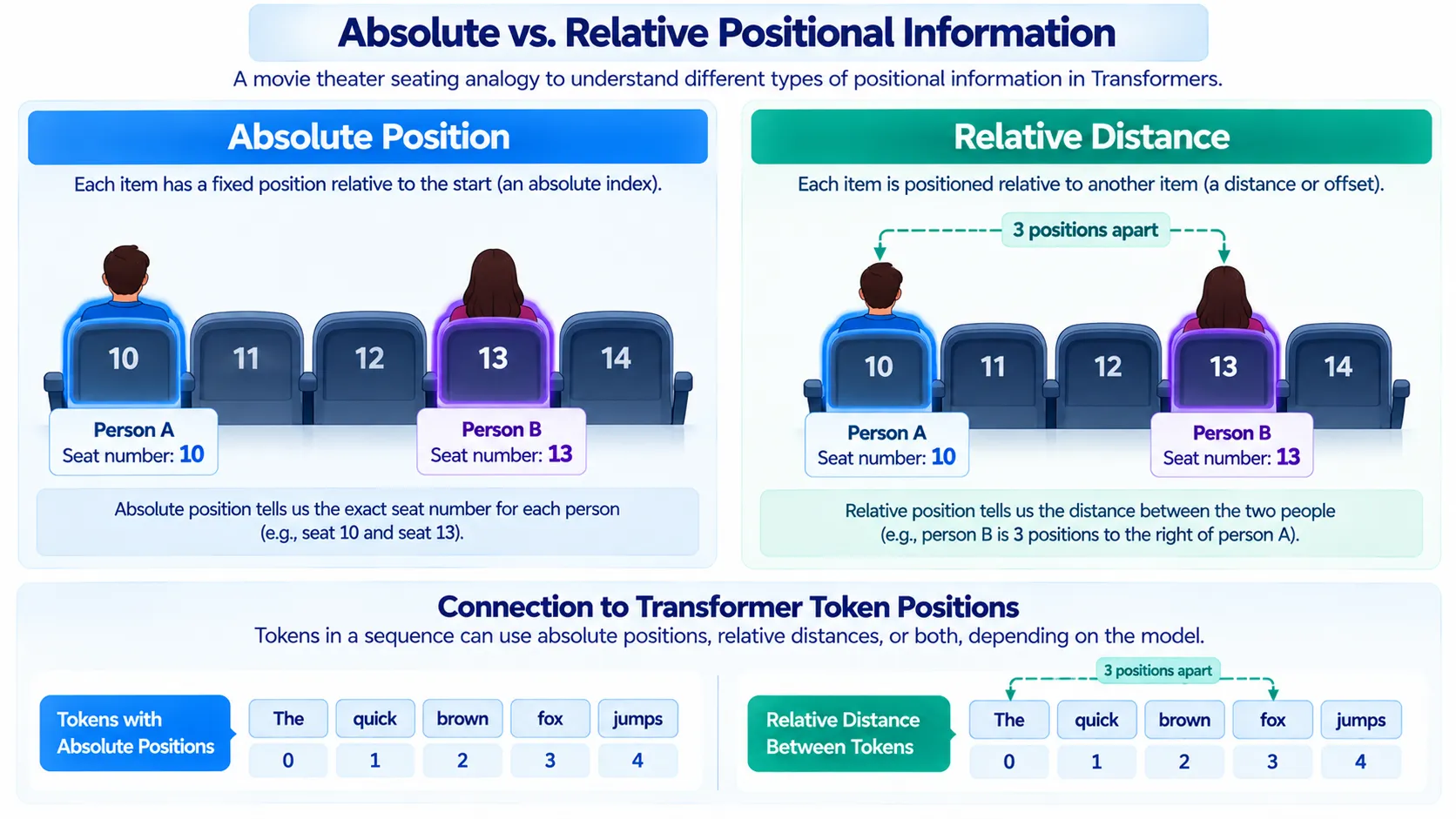
Imagine two friends sitting in a movie theater.
One friend is sitting in seat 12, while the other is sitting in seat 15.
There are two ways to describe their locations.
You could say that the first friend is in seat 12 and the second is in seat 15.
Or you could simply say that they are three seats apart.
The first approach describes absolute positions. The second describes relative distance.
Transformers can use similar ideas to understand token positions.
What Is Absolute Positional Encoding?
Absolute positional encoding represents where a token appears within a sequence.
For example, consider:
"The student opened the book."
Each token has a particular position, starting from the beginning of the sentence.
An absolute position representation helps the model distinguish the first token from the second, third, or fourth.
Fixed sinusoidal encodings and learned absolute positional embeddings are examples of approaches that provide absolute position information.
What Is Relative Positional Encoding?
Relative positional encoding represents relationships between token positions, such as how far apart two tokens are.
Consider these sentences:
"The boy quickly opened the door."
"The girl carefully opened the window."
The words are different, but both sentences contain useful patterns involving the distance between actions and surrounding words.
Relative positional information helps attention mechanisms use such distance relationships.
This can be useful when processing longer sentences because the distance between two tokens may matter more than their exact position from the beginning.
However, relative methods are not automatically superior in every situation. Their benefits depend on the architecture and task.
What Is Rotary Position Embedding (RoPE)?
As Transformer models developed, researchers introduced new ways to represent positional information.
One important technique is Rotary Position Embedding, commonly called RoPE.
RoPE was introduced in research on RoFormer and has influenced the design of many modern language models.
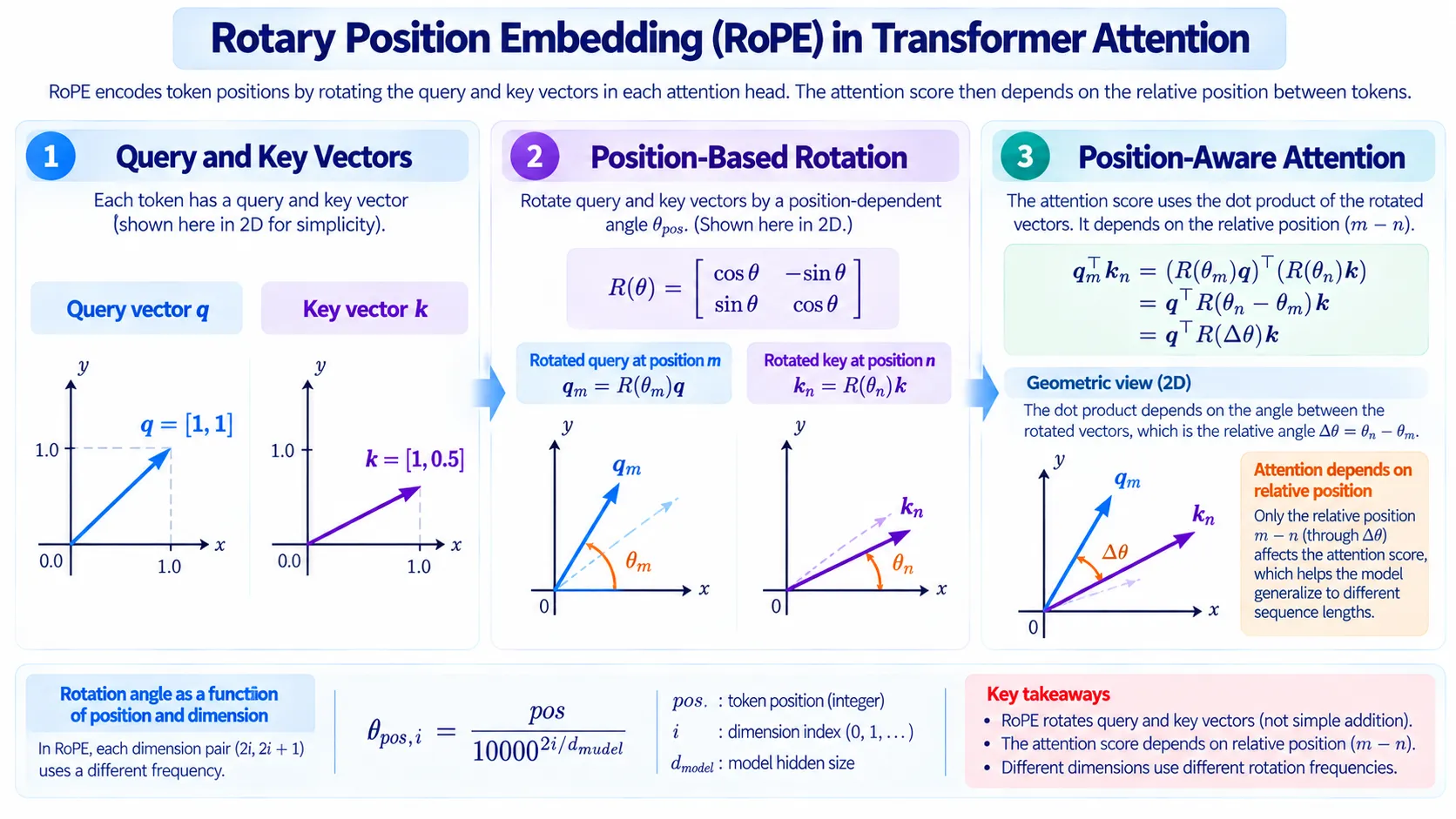
Unlike the original approach of adding positional vectors to token embeddings, RoPE applies position-dependent rotations to the query and key representations used by attention.
That may sound complicated, but imagine the hands of a clock.
As time passes, the hands rotate to different angles.
Their angles indicate their positions, and the difference between two angles tells us something about the distance between them.
RoPE applies a related mathematical idea to token representations.
How Does RoPE Work?
Imagine a Transformer processing:
"The cat is sleeping peacefully."
RoPE assigns position-dependent rotations to parts of the query and key vectors.
These rotations change according to each token's position.
When the Transformer calculates attention scores, the interaction between rotated queries and keys contains information about their relative positions.
This allows the model to use both token relationships and positional differences during attention.
RoPE is especially interesting because its attention calculations naturally incorporate relative position information.
It can also be adapted for longer contexts, although reliable performance beyond the training length is not guaranteed.
What Is ALiBi in Transformers?
Another positional technique is called Attention with Linear Biases, or ALiBi.
Its main idea is surprisingly simple.
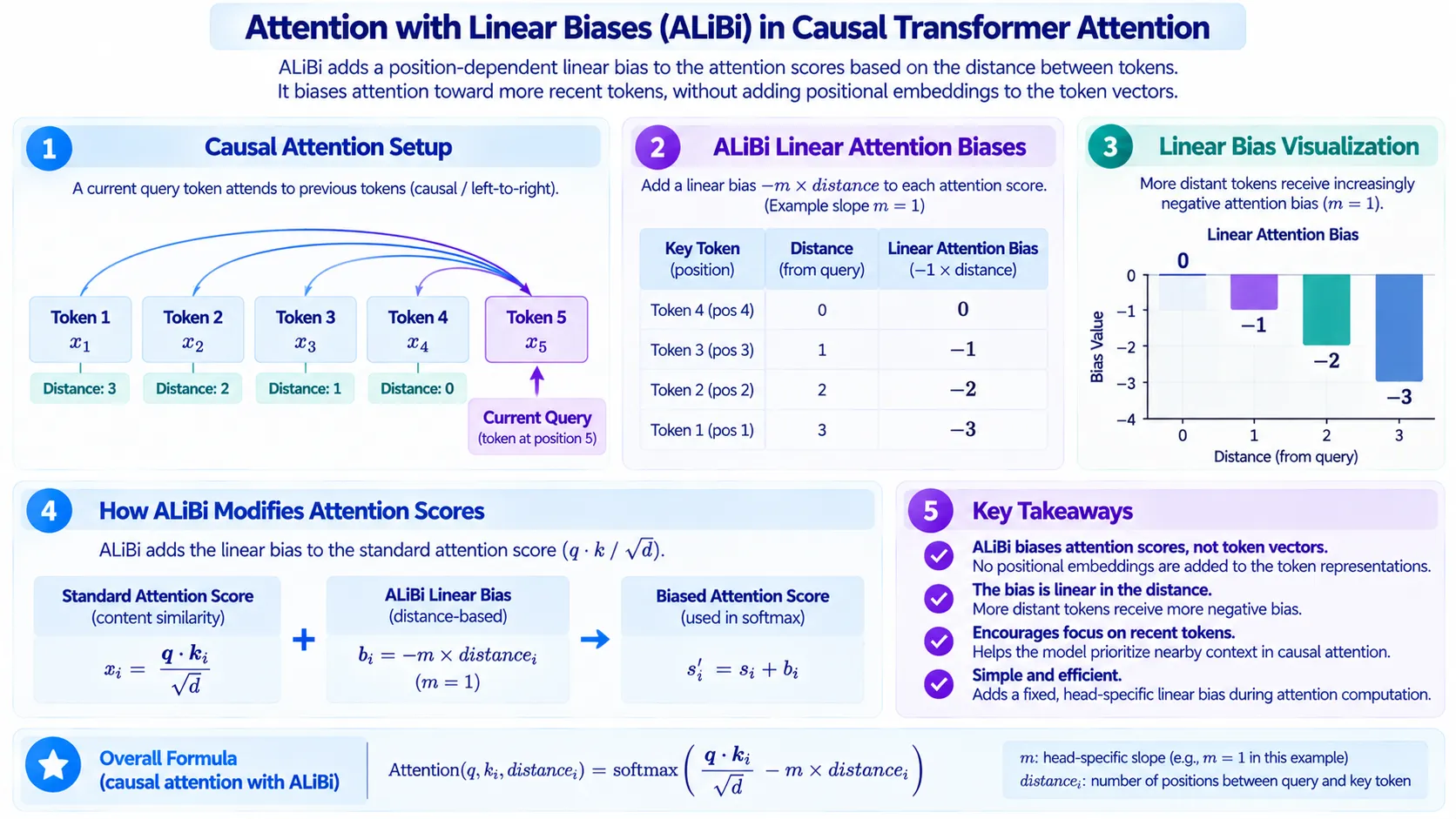
Instead of adding positional vectors to token embeddings, ALiBi modifies attention scores using a penalty based on the distance between tokens.
Imagine reading a conversation.
You may give particular attention to something someone said recently, while still remembering important information from earlier.
ALiBi introduces a distance-based preference into attention calculations.
How Does ALiBi Work?
Suppose a token attends to another token located one position away.
Now imagine another token located ten positions away.
In causal attention, ALiBi applies a distance-dependent penalty to attention scores, generally making distant tokens less favored before the attention weights are calculated.
Different attention heads use different penalty slopes.
This does not prevent the model from attending to distant tokens. A distant token can still receive substantial attention when its content is important.
Researchers developed ALiBi partly to improve the ability of Transformer models to process longer sequences than those encountered during training.
However, its performance depends on the model and evaluation conditions.
Real-World Applications of Positional Encoding
Positional information is not limited to understanding simple sentences.
It plays an important role in systems that process ordered information.
Let's explore three everyday examples.
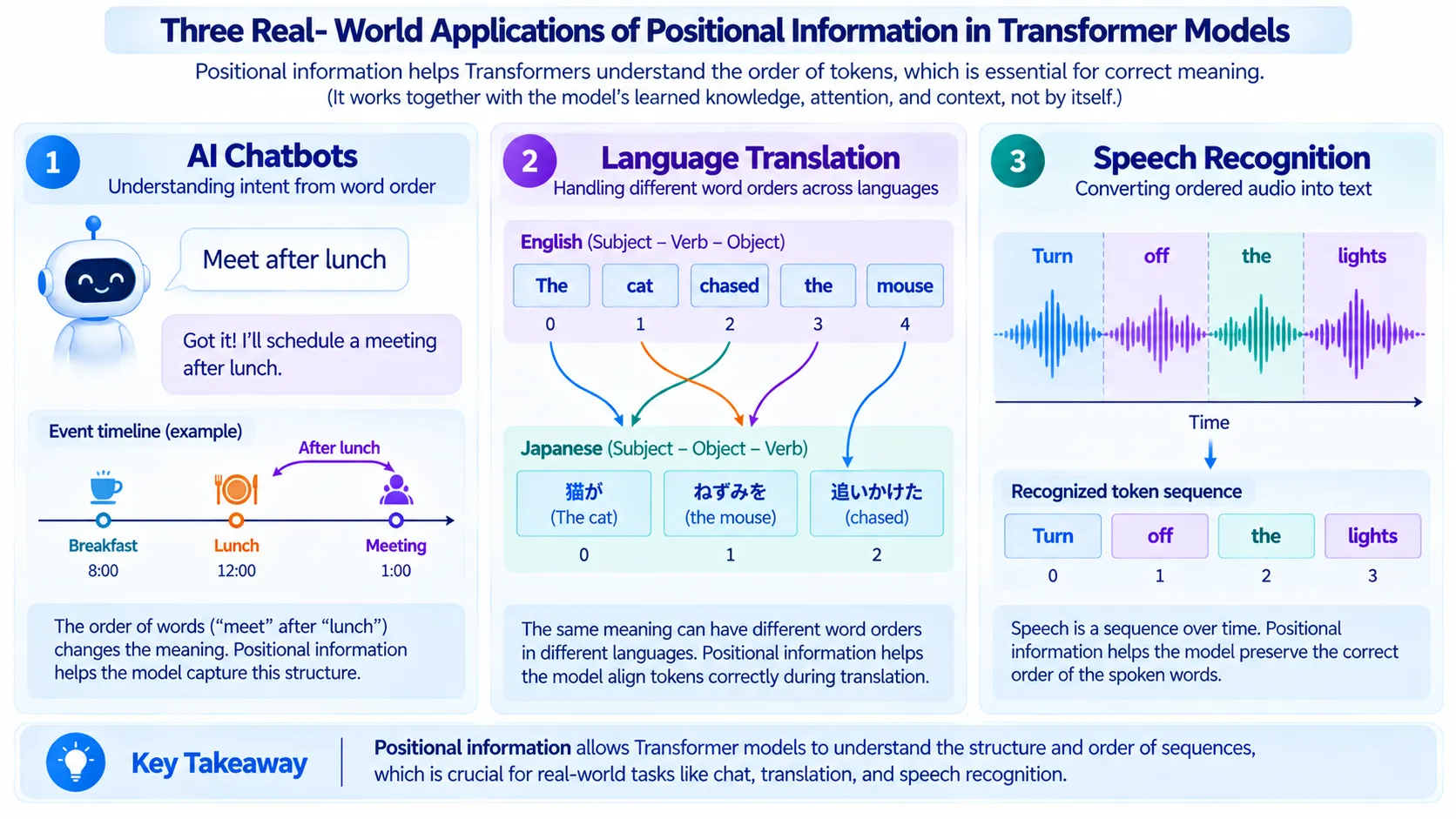
1. AI Chatbots and Virtual Assistants
Imagine asking an AI assistant:
"Book a meeting after lunch but before my evening class."
The order of the events matters.
Booking the meeting before lunch would not satisfy your request.
Language models must learn relationships between words such as "after," "before," "lunch," and "evening."
Positional information helps support that understanding by allowing attention layers to distinguish token arrangements.
However, the correct interpretation also depends on learned language patterns and context.
2. Language Translation
Consider translating:
"She gave her brother a gift."
Different languages may arrange the subject, object, and verb differently.
A translation model needs to understand which words belong together, even when their positions change between languages.
Positional information helps the model represent ordering relationships within the source and target sequences.
This works alongside attention and the language patterns learned during training.
3. Speech Recognition
Imagine saying:
"Turn off the bedroom lights."
A speech recognition system processes acoustic information that unfolds over time.
The order of sounds matters because changing their arrangement can change the recognized words.
Transformer-based speech systems may use positional representations to help model these time-dependent relationships.
The same general principle applies to other sequence-based tasks, including music processing and some time-series applications.
Common Limitations of Positional Encoding
Positional encoding is valuable, but it does not solve every sequence-processing problem.
Understanding its limitations is important.
1. Longer Contexts Can Be Difficult
Some positional methods work well within a particular training length but struggle when sequences become much longer.
A model trained on short documents may not automatically understand extremely long documents.
The problem involves more than positional encoding. Attention behavior, training data, memory requirements, and model design also matter.
2. Position Does Not Equal Meaning
Knowing that a token appears at position 5 does not explain what the token means.
The model must combine positional information with token representations and learned contextual relationships.
Positional encoding is one component of language understanding, not a complete solution.
3. Different Tasks Need Different Approaches
Absolute embeddings, relative representations, RoPE, and ALiBi introduce positional information differently.
A technique that works well for one model may not produce the same results in another.
Researchers therefore evaluate positional methods according to model quality, context length, computational requirements, and task performance.
Which Positional Encoding Method Is Best?
There is no single positional encoding method that is best for every Transformer.
Sinusoidal positional encoding is useful for understanding the original Transformer architecture and provides a clear mathematical foundation.
Learned positional embeddings allow position representations to adapt during training.
Relative positional methods explicitly model relationships between positions.
RoPE incorporates positional rotations into attention and is widely used in modern language-model architectures.
ALiBi provides a relatively simple way to introduce distance-based attention preferences.
When designing a Transformer, the right choice depends on what the model needs to accomplish.
For beginners, understanding sinusoidal encoding first makes learning the other techniques much easier.
Conclusion: Why Positional Encoding Matters
Let's return to our original example:
"The dog chased the boy."
"The boy chased the dog."
The words are identical, but their order changes the meaning.
This simple example reveals an essential challenge in language processing.
Transformers need information about token positions because basic self-attention does not inherently represent sequence order.
Positional encoding provides that missing information.
The original Transformer demonstrated how fixed sine and cosine functions could help represent positions without relying on recurrent processing.
Later approaches introduced learned positions, relative relationships, rotary embeddings, and attention biases.
Each method offers a different way to help attention mechanisms work with ordered sequences.
The most important lesson is simple: understanding which words appear is not enough. A language model also needs ways to learn how their positions and relationships affect meaning.
That is why positional information remains a fundamental part of Transformer architecture.
Frequently Asked Questions About Positional Encoding
1. What Is Positional Encoding in Transformers?
Positional encoding is a technique that helps Transformers understand the order of tokens in a sequence. Since basic self-attention does not automatically identify where each token appears, positional information is introduced into the model. This allows Transformers to learn how word positions affect sentence meaning and how different tokens relate to one another.
2. Why Do Transformers Need Positional Encoding?
Transformers need positional information because word order can change the meaning of a sentence. For example, "The dog chased the cat" and "The cat chased the dog" contain the same words but describe different events. Positional encoding helps the model distinguish these arrangements and learn important relationships between tokens.
3. How Does Positional Encoding Work in Transformers?
In the original Transformer architecture, each token receives a numerical embedding. A positional encoding vector is then generated for that token's position and added to its embedding. The combined representation contains information about both the token and its location. Modern Transformers may use other methods, including rotary embeddings or relative attention biases.
4. What Is Sinusoidal Positional Encoding?
Sinusoidal positional encoding uses sine and cosine functions to create mathematical representations of token positions. Different dimensions use different frequencies, producing structured patterns across the sequence. This approach was introduced in the original Transformer paper and does not require learning a separate positional vector for every position.
5. What Is the Difference Between Positional Encoding and Positional Embedding?
Positional encoding is a broad term for techniques that introduce positional information into a model. Positional embeddings usually refer to vector representations associated with token positions, often learned during training. Sinusoidal encoding uses fixed mathematical formulas, while learned positional embeddings update their values through training.
6. Can Transformers Work Without Positional Encoding?
Some Transformer architectures can work without traditional positional embeddings because they obtain ordering information through other architectural features, such as certain attention masks or alternative position-aware mechanisms. However, ordinary unrestricted self-attention does not inherently represent token order. For many language-processing tasks, an appropriate source of positional information is essential.
7. What Is the Difference Between Absolute and Relative Positional Encoding?
Absolute positional encoding represents a token's position within a sequence, such as position 3 or position 10. Relative positional encoding represents relationships between positions, such as two tokens being three positions apart. Both approaches help Transformers learn sequence patterns, but they introduce positional information differently.
8. What Is RoPE in Transformers?
Rotary Position Embedding, or RoPE, is a positional technique that applies position-dependent rotations to attention query and key vectors. These rotations allow attention calculations to incorporate relative positional relationships. RoPE is used in several modern language-model architectures because it offers a useful way to combine attention with positional information.
9. Which Positional Encoding Is Best for Transformers?
There is no single positional encoding method that performs best for every Transformer. Sinusoidal encoding provides a simple mathematical foundation, while learned embeddings adapt through training. RoPE and ALiBi introduce positional information through attention-related operations. The most suitable method depends on the architecture, training data, context length, and intended application.
10. Does Positional Encoding Help Transformers Understand Long Sentences?
Yes. Positional information helps Transformers learn relationships between tokens across a sequence, including tokens that are far apart. However, longer-context performance also depends on attention mechanisms, training methods, model capacity, and other architectural choices. Positional encoding alone does not guarantee accurate understanding of very long documents.


