


Imagine opening a weather app before leaving home. It says there is a high chance of rain this evening.
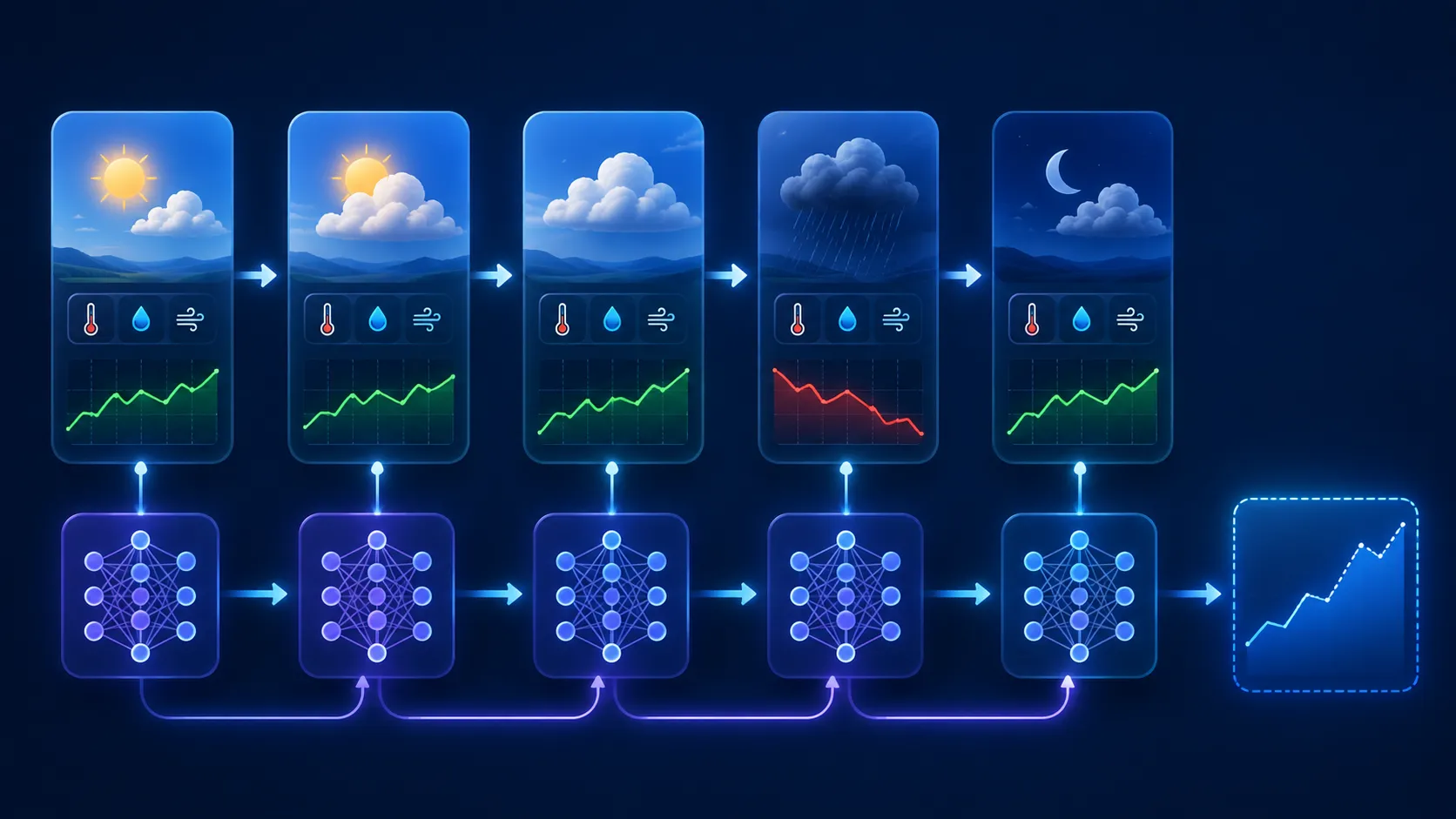
That prediction is not based only on the temperature right now. A forecasting system may look at what happened during the last few hours or days — temperature changes, humidity, air pressure, wind speed, rainfall, and many other signals.
Now think about the stock market.
Suppose a stock closed at $100 yesterday. Knowing only that number tells us very little. We may also want to know how the price moved during the previous week, whether trading volume increased, whether the market was rising or falling, and how quickly the price was changing.
Both examples have something important in common:
The order of the data matters.
This type of information is called sequential data, and understanding sequential data is exactly where Recurrent Neural Networks (RNNs) became important in deep learning.
What Is a Recurrent Neural Network?
A Recurrent Neural Network, usually called an RNN, is a neural network designed to work with data where previous information can help us understand the current information.
A normal neural network usually treats each input like a separate case.
An RNN works differently.
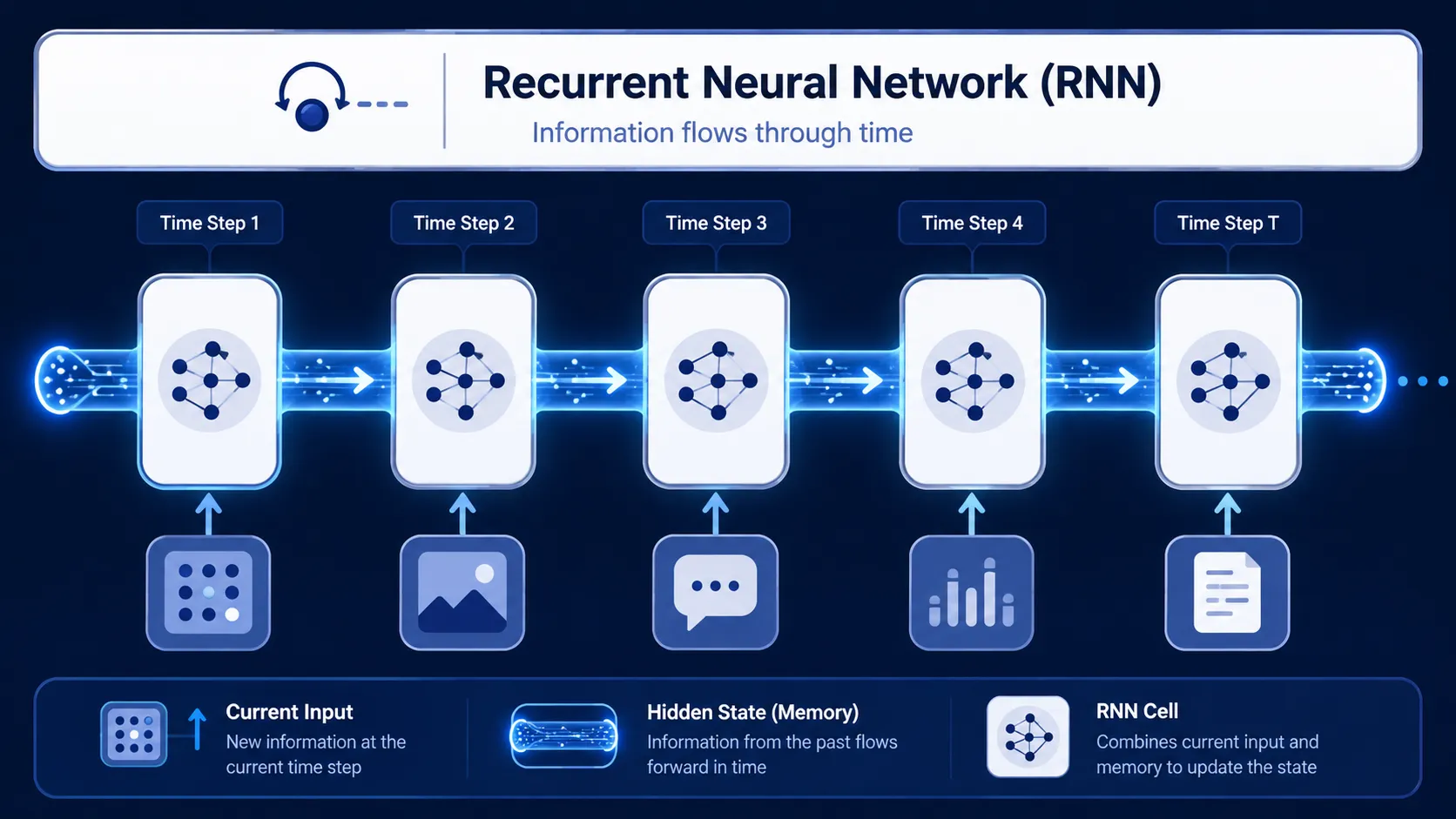
It processes information step by step and carries a small amount of information from one step to the next. You can think of this information as the network's temporary memory.
Consider a simple weather sequence:
Monday: 27°C
Tuesday: 29°C
Wednesday: 31°C
Thursday: ?
If a model wants to predict Thursday's temperature, the earlier temperatures provide useful context.
Instead of looking only at Wednesday's 31°C value, an RNN can process Monday, then Tuesday, then Wednesday while carrying information forward.
In simple terms:
Previous information → Current input → Updated memory → Prediction
This ability makes a recurrent neural network useful for sequence data.
Why Does an RNN Need Memory?
Think about reading this sentence:
“The movie started slowly, but the ending was amazing.”
If you looked only at the word “amazing,” you would miss part of the story.
To understand the sentence properly, you remember the words that came before it.
An RNN tries to do something similar.
Every time it receives a new input, it combines that input with information saved from the previous step.
That saved information is called the hidden state.
What Is the Hidden State in an RNN?
The hidden state is basically the RNN's working memory.
Suppose we give an RNN five days of stock prices:
Day 1 → $102
Day 2 → $104
Day 3 → $103
Day 4 → $107
Day 5 → $110
The model does not simply throw away Day 1 when it reaches Day 2.
Instead, information from Day 1 affects its hidden state.
When Day 2 arrives, the model combines the new price with its previous hidden state and creates a new hidden state.
The same process continues through the sequence.
You can picture it like this:
Day 1 → Memory → Day 2 → Updated Memory → Day 3 → Updated Memory → Prediction
The actual calculations involve weights and activation functions, but this mental model is enough to understand the main idea.
The RNN is continuously asking:
“What have I seen so far, and how should that affect what I am seeing now?”
How Does an RNN Work Step by Step?
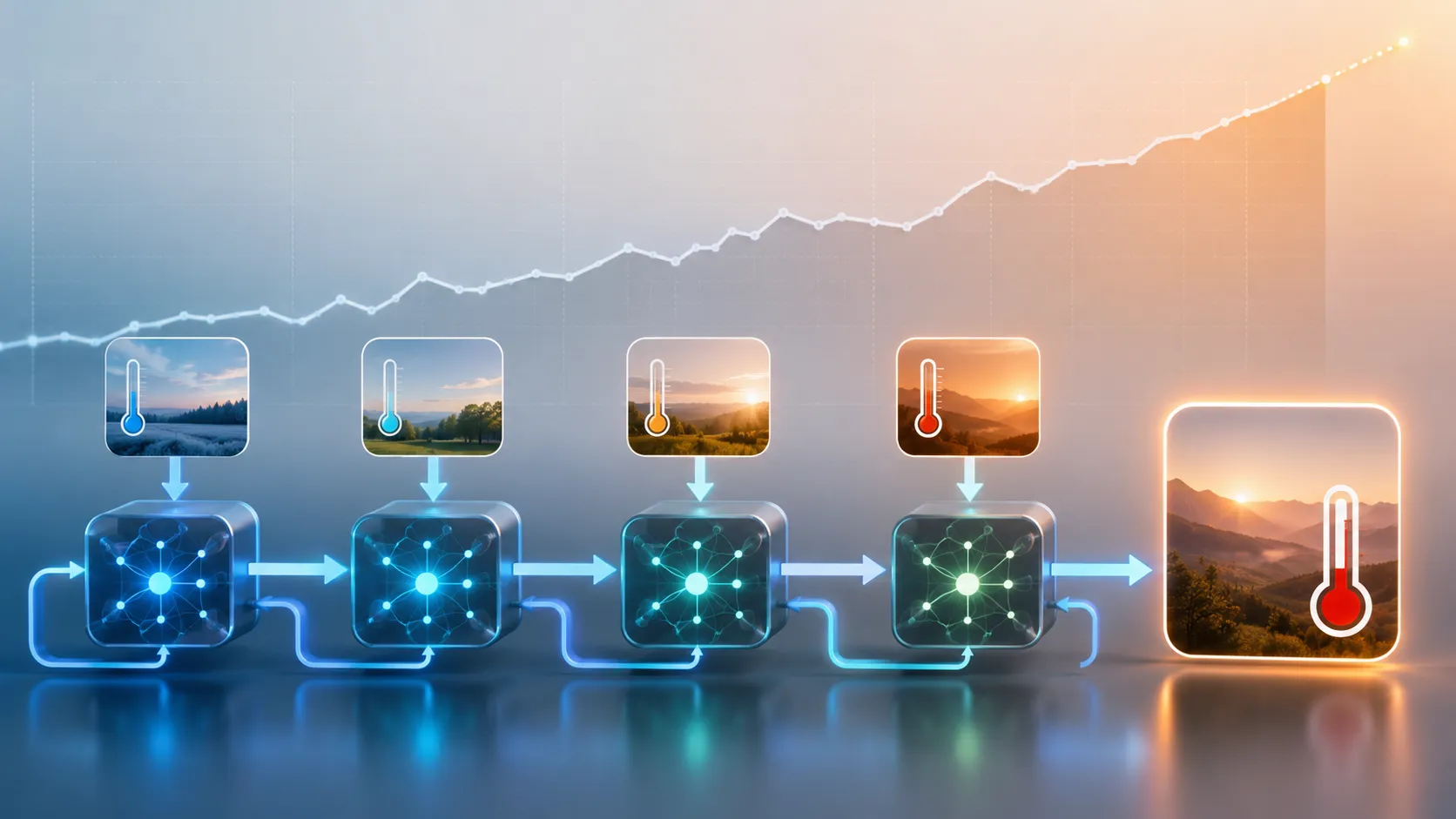
Suppose we are building a simple system that predicts tomorrow's temperature.
We give it previous temperature readings:
24°C → 25°C → 27°C → 28°C
At the first step, the RNN receives 24°C and creates an internal state.
At the second step, it receives 25°C along with information carried from the first step.
At the third step, it processes 27°C while using information from the previous state.
The process repeats until the network has passed through the complete sequence.
Finally, it can use its learned representation of the recent pattern to make a prediction.
For example:
Predicted next temperature → 29°C
Of course, a real weather forecasting system would normally use much more than temperature. It might also include humidity, pressure, wind, rainfall, cloud information, and time-related features.
But the principle remains the same:
past observations can provide context for future predictions.
Why Normal Neural Networks Struggle With Sequential Data
Imagine shuffling the words in a sentence.
Instead of:
“I booked a flight to London yesterday.”
we get:
“Yesterday London flight I a booked to.”
The same words are present, but their order has changed.
Sequence is important.
The same problem appears in time-series data.
Consider these two price movements:
$100 → $105 → $110 → $115
and
$115 → $110 → $105 → $100
The values are almost the same, but the pattern is completely different.
The first sequence shows an upward movement.
The second shows a downward movement.
A model that ignores sequence may miss this difference.
An RNN for time series data can process observations in order and carry information from earlier steps, allowing the network to learn patterns that develop through time.
Where Are RNNs Used?
RNNs can be useful whenever information arrives as a sequence.
Common examples include:
time-series forecasting
weather data
sensor readings
speech signals
text and language sequences
financial data
activity recognition
machine monitoring
For example, a factory may record machine vibration every second.
One vibration reading may look completely normal.
But a pattern such as:
normal → slightly unusual → stronger vibration → sudden spike
could indicate that something is changing.
Because the order matters, sequence-aware models can be useful for detecting such patterns.
The Big Problem With Basic RNNs
RNNs sound perfect so far, but they have an important weakness.
Their memory is not unlimited.
Imagine someone tells you a 200-word story and then asks you about a tiny detail from the very beginning.
Remembering something from five seconds ago may be easy.
Remembering something from much earlier becomes harder.
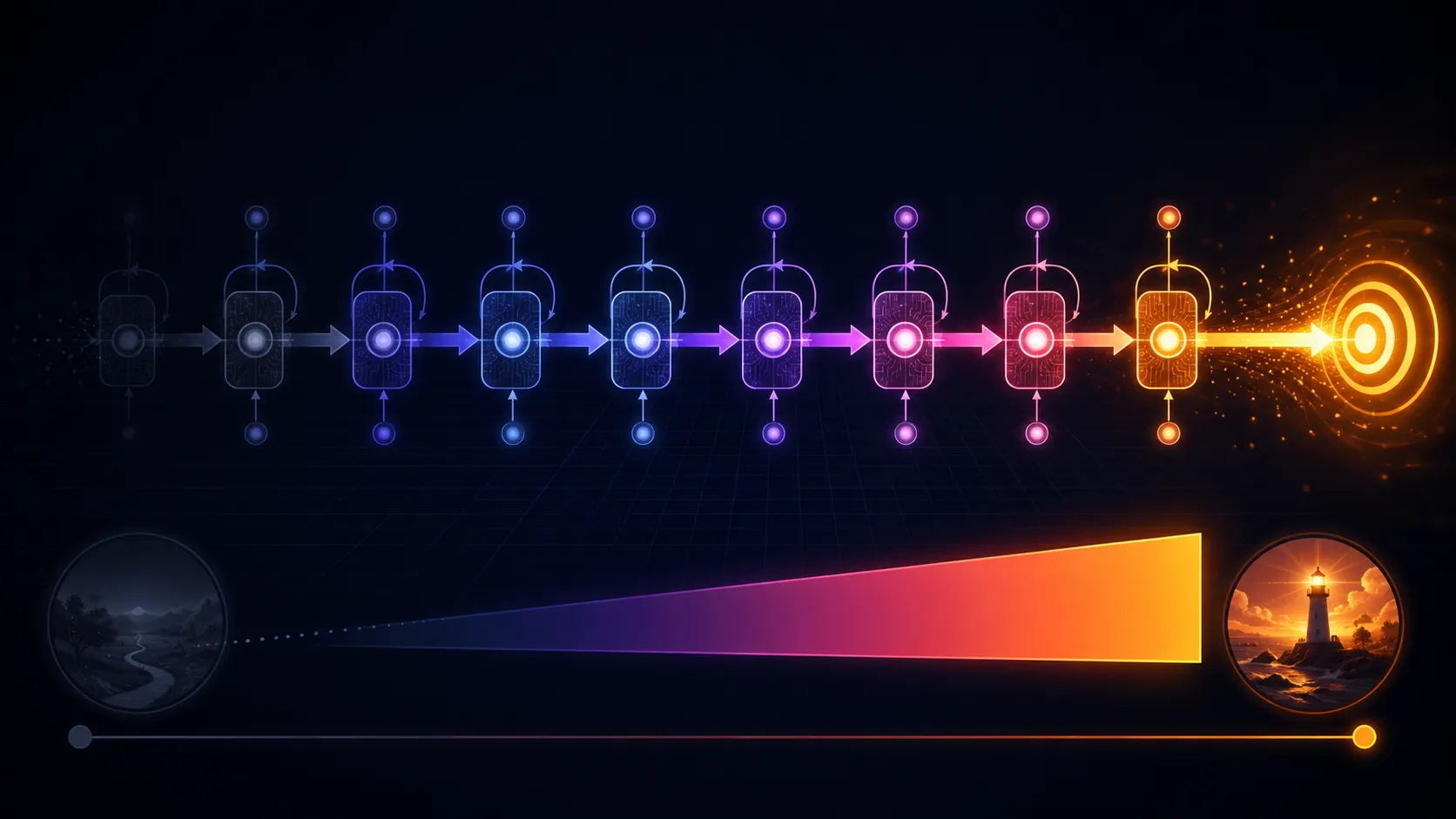
A basic RNN can face a similar problem when sequences become long.
During training, information has to travel backward through many time steps so the network can learn which earlier events were important.
As sequences become longer, the learning signal can become extremely small.
This is known as the vanishing gradient problem.
Why the Vanishing Gradient Problem Matters
Suppose a stock model is analyzing 60 days of market data.
Something that happened 40 days earlier might still matter to the current pattern.
But if the learning signal connected to that earlier information becomes too weak, a basic RNN may struggle to learn the relationship properly.
In other words:
RNNs can remember the past, but basic RNNs may struggle with long-term dependencies.
This limitation led researchers to develop a smarter type of recurrent network with a much better system for controlling memory.
That network is called Long Short-Term Memory, or LSTM.
And this is where recurrent neural networks become much more interesting.
What Is LSTM in Deep Learning?
LSTM stands for Long Short-Term Memory.
It is a special type of Recurrent Neural Network designed to remember useful information for a longer time and reduce the memory problems found in a basic RNN.
The easiest way to understand LSTM is to think about your own memory.
During a normal day, you see and hear thousands of things. You do not remember every car that passed you, every word someone said, or every number you saw.
Your brain keeps information that seems important and lets less useful information fade away.
An LSTM network tries to do something similar.
Instead of carrying everything from the past, it learns:
what information should be remembered
what information can be forgotten
what new information should be added
what information should influence the current output
This controlled memory is what makes LSTM useful for time series forecasting and other sequence problems.
Why Was LSTM Created?
Basic RNNs can work well when the important information is close to the current input.
The problem appears when the useful information happened much earlier.
Imagine predicting electricity demand.
The electricity usage at 8 PM may depend on what happened:
one hour ago
earlier that morning
on the same day last week
during a similar weather condition
during a holiday
Some relationships can stretch across many time steps.
A normal RNN may struggle to preserve these long connections because of the vanishing gradient problem discussed earlier.
LSTM was designed to handle these long-term dependencies more effectively.
That does not mean an LSTM remembers everything forever.
It means the network has a better mechanism for deciding which information should continue through the sequence.
How Does LSTM Memory Work?
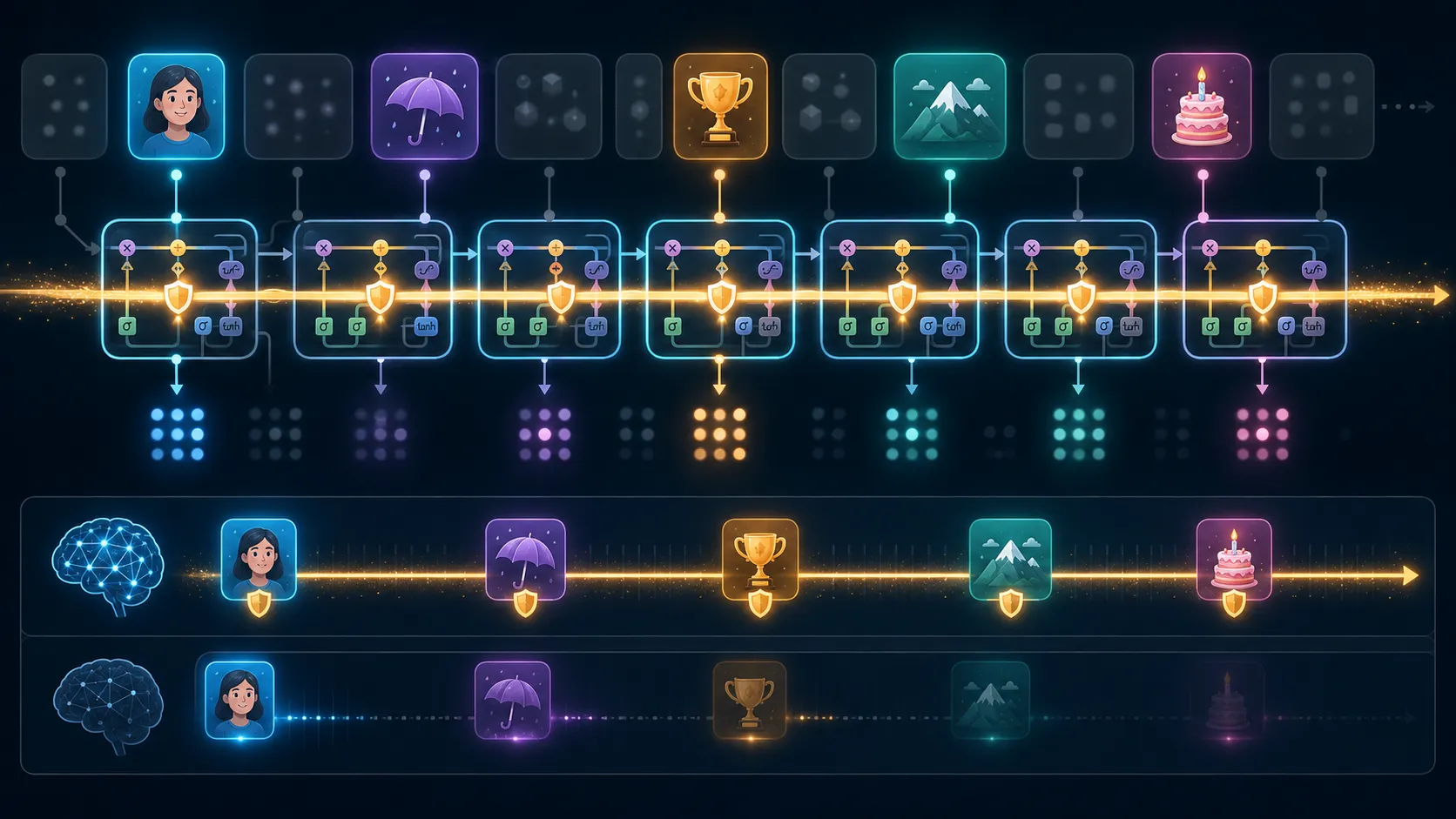
The heart of an LSTM is something called the cell state.
Think of the cell state as a memory highway running through the sequence.
Important information can travel along this highway while the network continuously decides whether to keep, remove, or update parts of it.
A standard LSTM mainly uses three control systems called gates:
Forget gate
Input gate
Output gate
The word “gate” sounds technical, but the idea is simple.
A gate behaves like a filter.
It controls how much information is allowed to pass.

Forget Gate: What Should We Remove?
Suppose we are forecasting tomorrow's weather.
The model has been processing several days of data.
Three days ago, the temperature suddenly dropped because of a short storm.
But now the storm has passed and temperatures are rising again.
That old storm information may no longer deserve the same importance.
The forget gate helps the LSTM decide:
“Which information from my previous memory is no longer useful?”
It does not simply delete everything.
The model learns how much of each piece of information should remain.
This ability to forget is surprisingly important.
If a model stored every previous event with equal importance, its memory would quickly become full of noise.
Good prediction often depends not only on remembering the right things, but also on forgetting the wrong things.
Input Gate: What New Information Should We Remember?
Now imagine that a new weather reading shows:
humidity rising quickly
pressure falling
dark cloud activity increasing
The model may recognize that these new signals could be important.
The input gate decides which parts of the new information should be added to the cell state.
In simple words, it asks:
“What new information is worth remembering?”
The LSTM then updates its memory using both its existing knowledge and the useful information from the current time step.
This happens again and again as new data enters the network.
Output Gate: What Information Matters Right Now?
An LSTM may store several pieces of information internally, but not all of them need to affect every prediction.
The output gate decides which part of the current memory should influence the output.
Suppose an LSTM is predicting tomorrow's temperature.
Information about a recent temperature trend may be highly important.
A less relevant older signal may stay inside the memory but have very little influence on the current prediction.
The output gate essentially asks:
“What part of my memory should I use right now?”
RNN vs LSTM: What Is the Real Difference?
A basic RNN and an LSTM are both designed for sequential data.
Both process information step by step.
Both can use previous information while handling the current input.
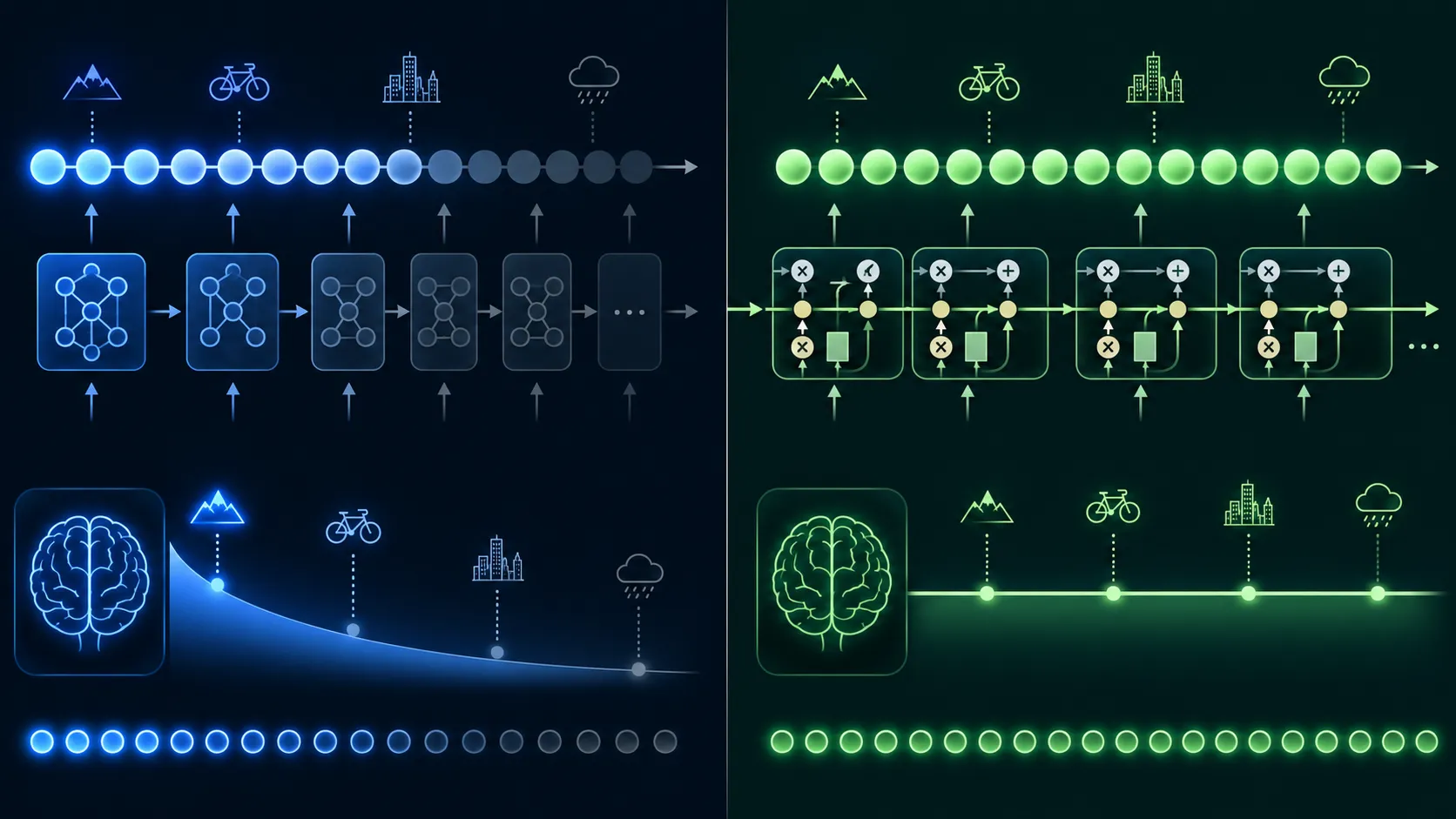
The main difference is how they manage memory.
A basic RNN has a relatively simple hidden-state mechanism.
It can learn short sequence patterns, but maintaining important information across long sequences can become difficult.
An LSTM adds a more controlled memory system.
Its cell state and gates help it decide what to keep, what to forget, and what to use.
So a simple way to remember the RNN vs LSTM difference is:
RNN has memory. LSTM has better control over memory.
That is why LSTMs became popular for problems where older information may still affect what happens later.
A Simple LSTM Time-Series Example
Imagine that you run a small café.
You want to predict how many cold drinks you may sell tomorrow.
You have previous daily data such as:
Monday: 62 drinks
Tuesday: 67 drinks
Wednesday: 74 drinks
Thursday: 85 drinks
Friday: 96 drinks
But sales are also affected by temperature.
Monday: 24°C
Tuesday: 26°C
Wednesday: 29°C
Thursday: 32°C
Friday: 34°C
An LSTM can process these observations as a sequence.
It may begin learning that drink sales tend to rise when temperatures remain high for several days.
Now imagine Saturday is expected to reach 35°C.
The LSTM can use the previous sequence to help estimate Saturday's demand.
The important point is that the network is not looking at each day as an isolated record.
It is learning how the pattern develops through time.
That is the basic idea behind LSTM time series forecasting.
Can LSTM Be Used for Stock Price Prediction?
Yes, LSTM models can be trained on historical financial time-series data.
For example, a model might receive a sequence containing:
previous closing prices
opening prices
daily highs and lows
trading volume
returns
technical indicators
other relevant time-based features
Suppose a stock moved like this:
$120 → $121 → $124 → $123 → $127 → $130
An LSTM can process that ordered sequence and try to learn relationships between earlier movements and a future value.

But there is an important warning.
Stock markets are not simple predictable machines.
Prices can suddenly change because of earnings reports, economic announcements, interest-rate decisions, company news, political events, market sentiment, or unexpected global events.
So an LSTM should not be presented as a machine that can magically predict tomorrow's stock price.
A better way to understand it is:
LSTM can learn patterns from historical sequential data, but historical patterns do not guarantee future market movements.
This distinction is extremely important when using LSTM for stock market prediction.
How Stock Price Prediction With LSTM Works
Imagine we want the model to predict the next closing price.
We could give it the previous 30 days of data.
The model processes Day 1, Day 2, Day 3, and continues until Day 30.
While moving through the sequence, its memory system tries to preserve useful patterns.
After processing those 30 days, the model produces a prediction for the next time step.
Then the predicted value can be compared with the real value during training.
If the prediction is wrong, the network adjusts its internal weights.
This process is repeated across many historical sequences.
Over time, the model tries to learn which patterns are useful for making better predictions.
But stock data is only one example.
The same idea can be used for another problem where sequence matters enormously:
weather forecasting.
How LSTM Can Be Used for Weather Forecasting
Weather is one of the easiest real-life examples for understanding time-series forecasting.
Tomorrow's weather is connected to what has been happening during the previous hours and days.
For example, a forecasting model may receive information such as:
temperature
humidity
air pressure
wind speed
rainfall
cloud cover
previous weather conditions
Suppose the temperature during the last five days was:
26°C → 27°C → 29°C → 31°C → 32°C
At the same time, humidity has also been increasing.
An LSTM weather forecasting model can process these observations in the correct order and try to learn how the pattern is changing over time.
It may notice that certain combinations of temperature, humidity, pressure, and wind have appeared before particular weather conditions.
The model can then use those learned patterns to help predict a future value.
A Simple Weather Forecasting Scenario
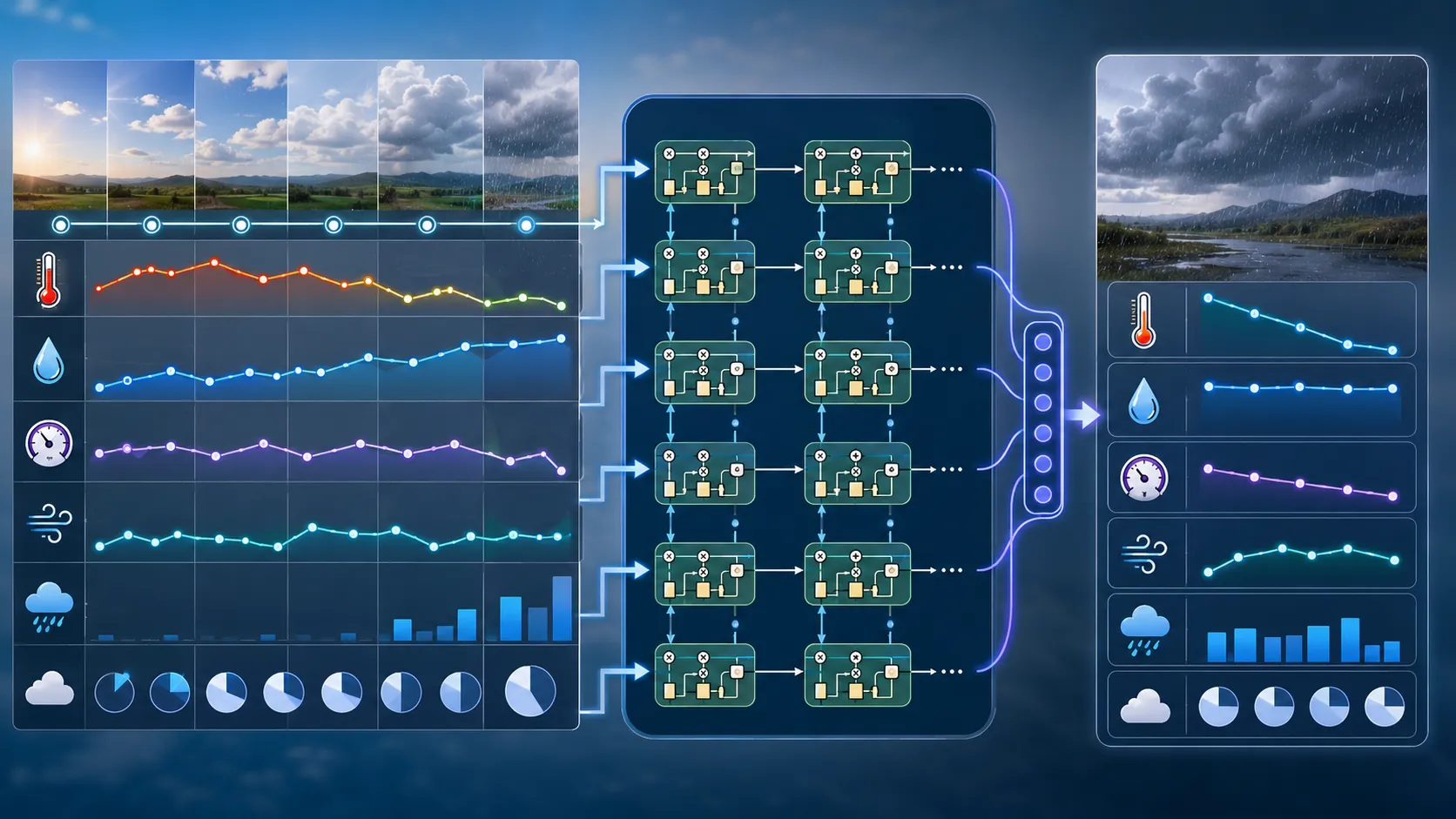
Imagine a weather station collects data every hour.
During the afternoon, it records:
2 PM: high temperature, normal pressure
3 PM: humidity rising
4 PM: pressure falling
5 PM: wind becoming stronger
6 PM: clouds increasing
Looking at only the 6 PM reading does not tell the complete story.
The sequence matters.
An LSTM can process how these conditions developed over several hours.
That is why LSTM for weather forecasting can be useful when past observations contain information about what may happen next.
However, just like stock prediction, weather forecasting is much more complex in the real world.
Professional weather systems use large amounts of atmospheric data, physics-based models, satellite observations, radar, and many other sources.
LSTM is one possible machine learning approach, not a replacement for every forecasting method.
When Should You Use RNN Instead of LSTM?
A basic RNN can still be useful.
If your sequence is short and the important information does not need to travel across many time steps, an RNN may be enough.
For example, imagine a small sensor sequence containing only the last few readings.
If the model mainly needs information from the recent past, a simple RNN may solve the problem without adding unnecessary complexity.
You might consider an RNN when:
sequences are relatively short
long-term memory is not very important
the problem is simple
you want a lightweight starting model
The main idea is not that LSTM is automatically better in every situation.
The right model depends on the data and the problem.
When Should You Use LSTM Instead of RNN?
LSTM becomes more useful when older information may still affect the current prediction.
Consider electricity usage.
Demand at 8 PM today may be related not only to 7 PM, but also to patterns from previous evenings or similar days.
In that situation, the model may need to learn relationships across a longer sequence.
You might choose LSTM instead of RNN when:
the sequence is long
long-term dependencies matter
a basic RNN forgets important older information
your time-series pattern develops across many steps
A simple rule for beginners is:
Short and simple sequence → try RNN.
Longer sequence with important past information → consider LSTM.
Does More Historical Data Always Improve LSTM Predictions?
No.
This is an important mistake beginners often make.
Suppose you want to predict tomorrow's sales.
You may think that giving the model 500 previous days must be better than giving it 30 days.
But older information may not always be useful.
Some of it may simply add noise.
For example, customer behavior from two years ago may be less helpful if prices, products, seasons, or market conditions have changed.
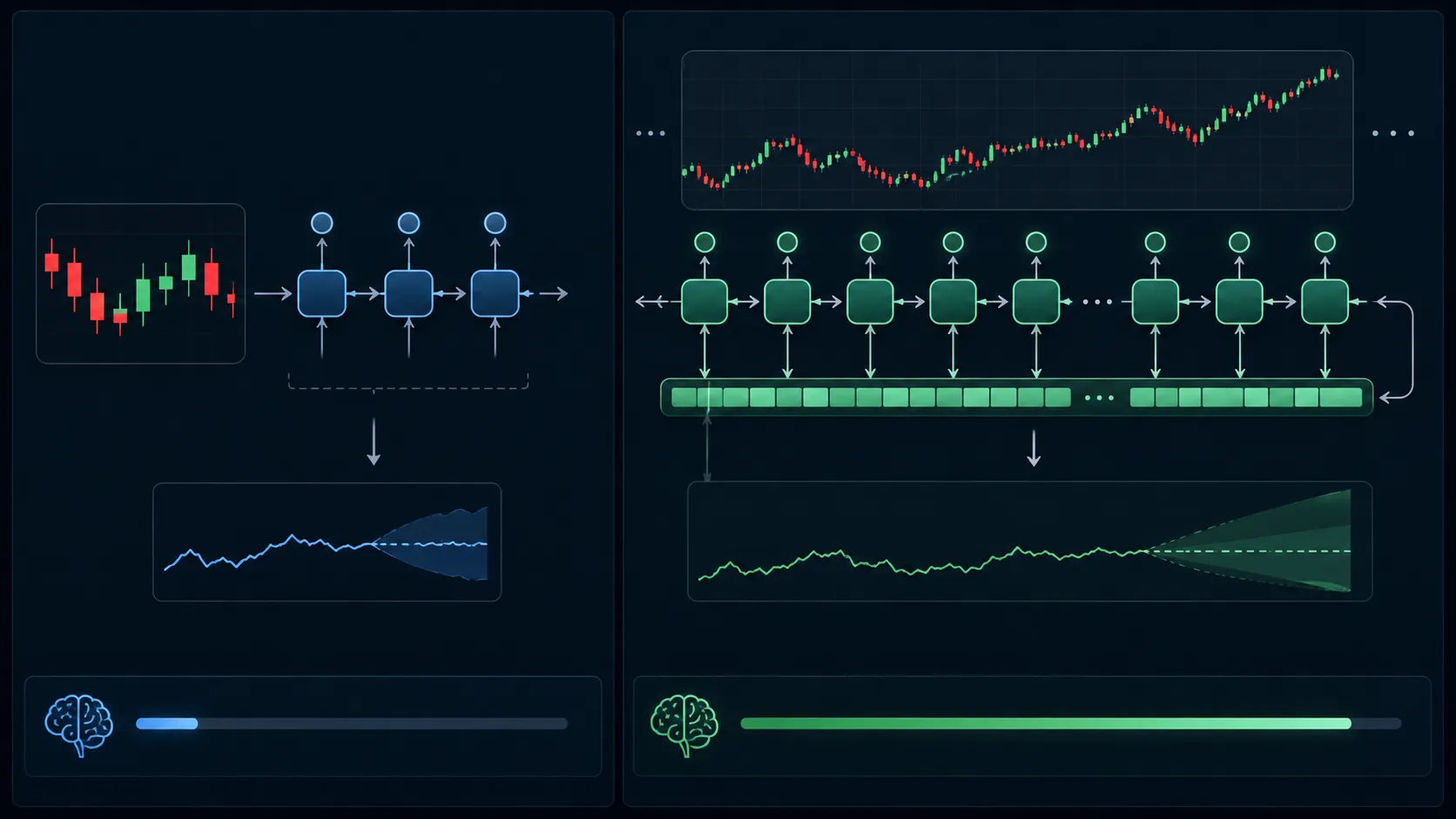
Choosing how much historical data the model should see is often called selecting the sequence length or lookback window.
There is no single perfect number for every problem.
It usually needs to be tested.
Common Problems When Building RNN and LSTM Models
Understanding the architecture is only one part of building a useful model.
Real-world time-series projects can fail because of poor data.
Poor Data Quality
Missing values, incorrect timestamps, unusual spikes, or bad sensor readings can affect the model.
The network cannot magically repair unreliable data.
Overfitting
An LSTM may perform extremely well on the data it saw during training but perform poorly on new data.
This is called overfitting.
The real goal is not to memorize historical data.
The goal is to learn patterns that can still be useful on unseen data.
Wrong Sequence Length
A very short sequence may not contain enough context.
A very long sequence may add unnecessary information.
The best lookback period depends on the problem.
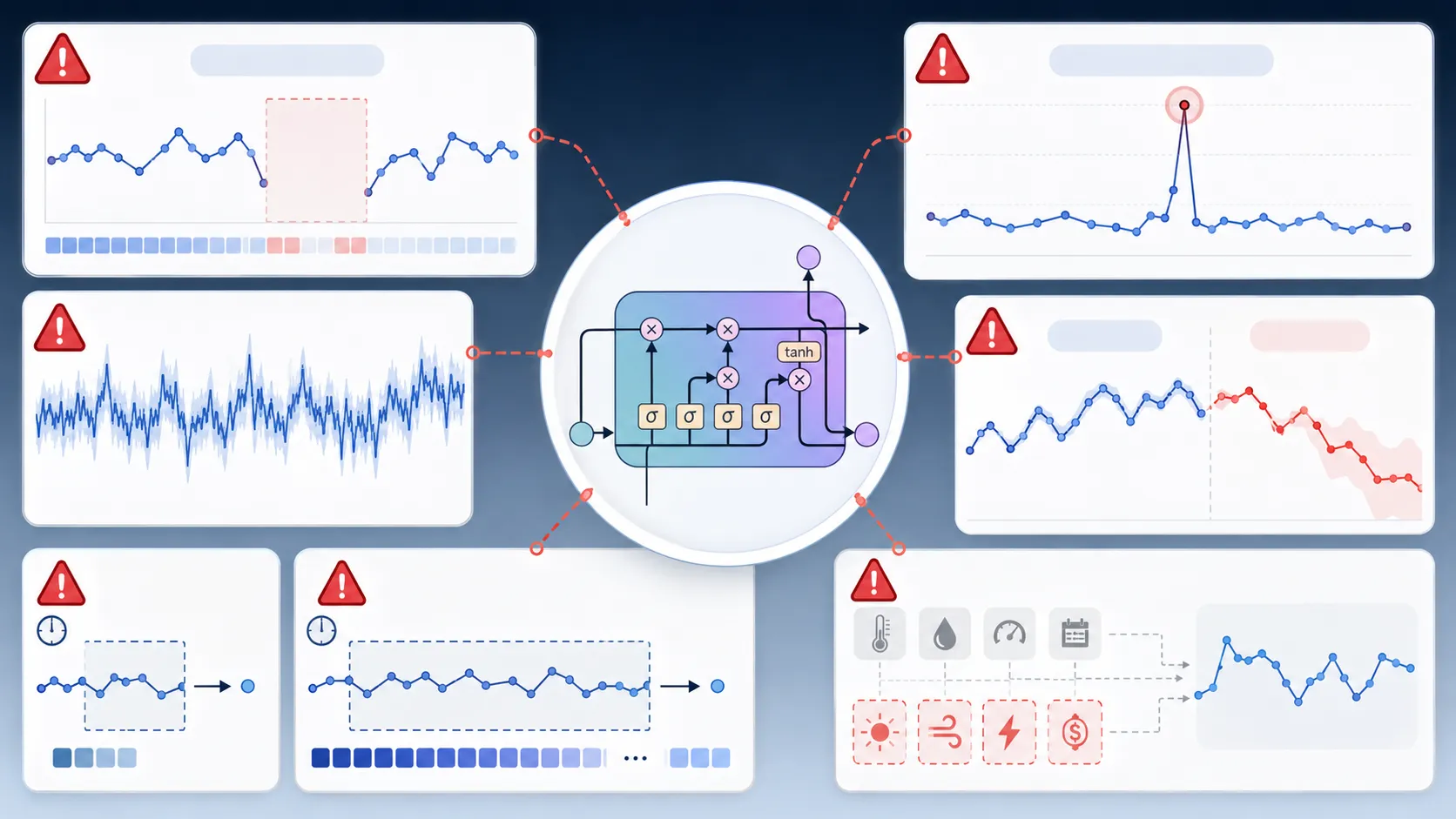
Ignoring Other Important Features
Stock prices are not influenced only by previous prices.
Weather is not determined only by yesterday's temperature.
A useful model often needs several relevant features.
RNN vs LSTM: Which One Should a Beginner Learn First?
Learn RNN first.
Not because it is always the best model, but because it makes LSTM much easier to understand.
Start with this idea:
RNN = a neural network with memory.
Then move to:
LSTM = an RNN with a smarter memory-control system.
Once you understand hidden states, sequential processing, and the long-term memory problem, LSTM gates become much easier to understand.
You do not need to memorize every mathematical equation on your first day.
First understand what problem each architecture is trying to solve.
The mathematics will make more sense afterward.
What Is the Difference Between RNN and LSTM?
An RNN carries information from previous steps through its hidden state.
An LSTM also carries information through a sequence, but it adds a cell state and gates that control what should be remembered, updated, forgotten, and used.
Because of this design, LSTM generally handles long-term dependencies better than a basic RNN.
Why Do RNNs Have a Vanishing Gradient Problem?
RNNs are trained by sending learning signals backward through many time steps.
When a sequence becomes long, those signals can become smaller and smaller.
Eventually, information from distant time steps may have very little effect on learning.
This makes it difficult for a basic RNN to learn long-range relationships.
LSTM was designed partly to reduce this problem.
Can LSTM Predict Stock Prices Accurately?
LSTM can learn patterns from historical stock-market time-series data, but it cannot guarantee accurate future prices.
Financial markets react to many unpredictable factors.
For that reason, a strong evaluation should compare predictions on data the model never saw during training.
An LSTM stock model should be treated as a forecasting experiment, not as a guaranteed trading system.
Can LSTM Be Used for Weather Forecasting?
Yes.
LSTM can be trained on ordered weather observations such as temperature, humidity, pressure, wind, and rainfall.
Because these values change through time, an LSTM can learn sequential patterns that may help with forecasting.
But real weather forecasting is a much larger scientific problem, so LSTM is only one possible tool.

Final Thoughts
RNNs introduced a powerful idea into neural networks:
the past can help us understand the present.
Instead of treating every input separately, an RNN carries information forward through a sequence.
That makes it useful for data such as text, sensor readings, financial data, and weather observations.
But basic RNNs struggle when important information comes from far back in a long sequence.
LSTM improves this process by adding a controlled memory system.
Its forget gate decides what can be removed.
Its input gate decides what new information deserves attention.
Its output gate decides which part of the stored information should affect the current result.
That is the core idea behind RNN vs LSTM.
You do not need to think of them as mysterious deep-learning machines.
Think of them as systems learning from a story told in order.
A basic RNN tries to remember the story.
An LSTM tries to remember the parts of the story that matter most.
And whether we are studying changing stock prices, predicting café demand, reading sensor signals, or analyzing weather patterns, that ability to understand what happened before is what makes sequence models so useful.
Frequently Asked Questions About RNN and LSTM
What is a Recurrent Neural Network?
A Recurrent Neural Network, or RNN, is a type of neural network designed for sequential data. It processes information step by step and uses previous information to understand the current input. RNNs are commonly used for time-series data, text, speech, sensor readings, and other sequence-based problems.
What is LSTM in deep learning?
LSTM stands for Long Short-Term Memory. It is a special type of RNN that can keep useful information for longer periods. LSTM uses memory cells and gates to decide what information should be remembered, updated, forgotten, or used for the current prediction.
What is the difference between RNN and LSTM?
The main difference between RNN and LSTM is how they handle memory. A basic RNN can remember previous information, but it may struggle with long sequences. LSTM uses a more controlled memory system, which makes it better at learning long-term dependencies.
Why is LSTM better than RNN for long sequences?
LSTM is often better for long sequences because it is designed to reduce the vanishing gradient problem. Its memory cell and gates allow important information to remain useful across many time steps instead of quickly fading away.
Can RNN and LSTM be used for time-series forecasting?
Yes. Both RNN and LSTM can be used for time-series forecasting because they process data in sequence. They can learn patterns from historical observations and use those patterns to estimate future values. LSTM is often preferred when older information may still affect future predictions.
Can LSTM predict stock prices?
LSTM can be trained on historical stock-market data to learn time-based patterns. However, it cannot guarantee future stock prices. Markets are affected by news, economic events, company performance, investor behavior, and many unpredictable factors.
Can LSTM be used for weather forecasting?
Yes. LSTM can work with historical weather data such as temperature, humidity, pressure, wind speed, rainfall, and other time-based features. It can learn how these values change over time and use those patterns to support forecasting.
What is the hidden state in an RNN?
The hidden state is the RNN's temporary memory. It carries information from previous time steps into the current step. As new inputs arrive, the hidden state is updated so the network can use earlier information while processing the sequence.
What is the vanishing gradient problem in RNN?
The vanishing gradient problem happens when the learning signal becomes very small as it moves backward through many time steps during training. This can make it difficult for a basic RNN to learn relationships between events that are far apart in a sequence.
When should I use RNN instead of LSTM?
A basic RNN can be a good choice when the sequence is short and long-term memory is not very important. It may also be useful as a simple starting model before testing more advanced architectures.
When should I use LSTM instead of RNN?
LSTM is usually a better choice when your data contains longer sequences and information from earlier time steps may still affect the current result. Examples include longer time-series patterns, sensor data, demand forecasting, and some financial or weather forecasting tasks.
Does LSTM always perform better than RNN?
No. LSTM is not automatically better for every problem. Performance depends on the dataset, sequence length, features, training setup, and forecasting task. A simpler RNN may perform well when long-term dependencies are not important.


