


Think about the last time you typed a half-finished sentence into an AI chatbot and it somehow understood what you were trying to say.
Or imagine asking an AI:
“Rahul gave his phone to Amit because he was leaving.”
Who does “he” refer to?
A computer cannot understand that sentence by simply reading one word at a time. It needs context. It needs to understand how different words in the sentence are connected.
That ability to connect information across a sequence is one of the biggest reasons Transformer architecture became so important in modern artificial intelligence.
Transformers are now at the heart of many systems used for text generation, translation, search, summarization, coding, image understanding, and large language models.
But the architecture can look intimidating when you first see terms such as self-attention, multi-head attention, embeddings, positional encoding, encoder, and decoder.
The good news is that the basic idea is much simpler than it looks.
Let’s build it from the ground up.
What Is Transformer Architecture?
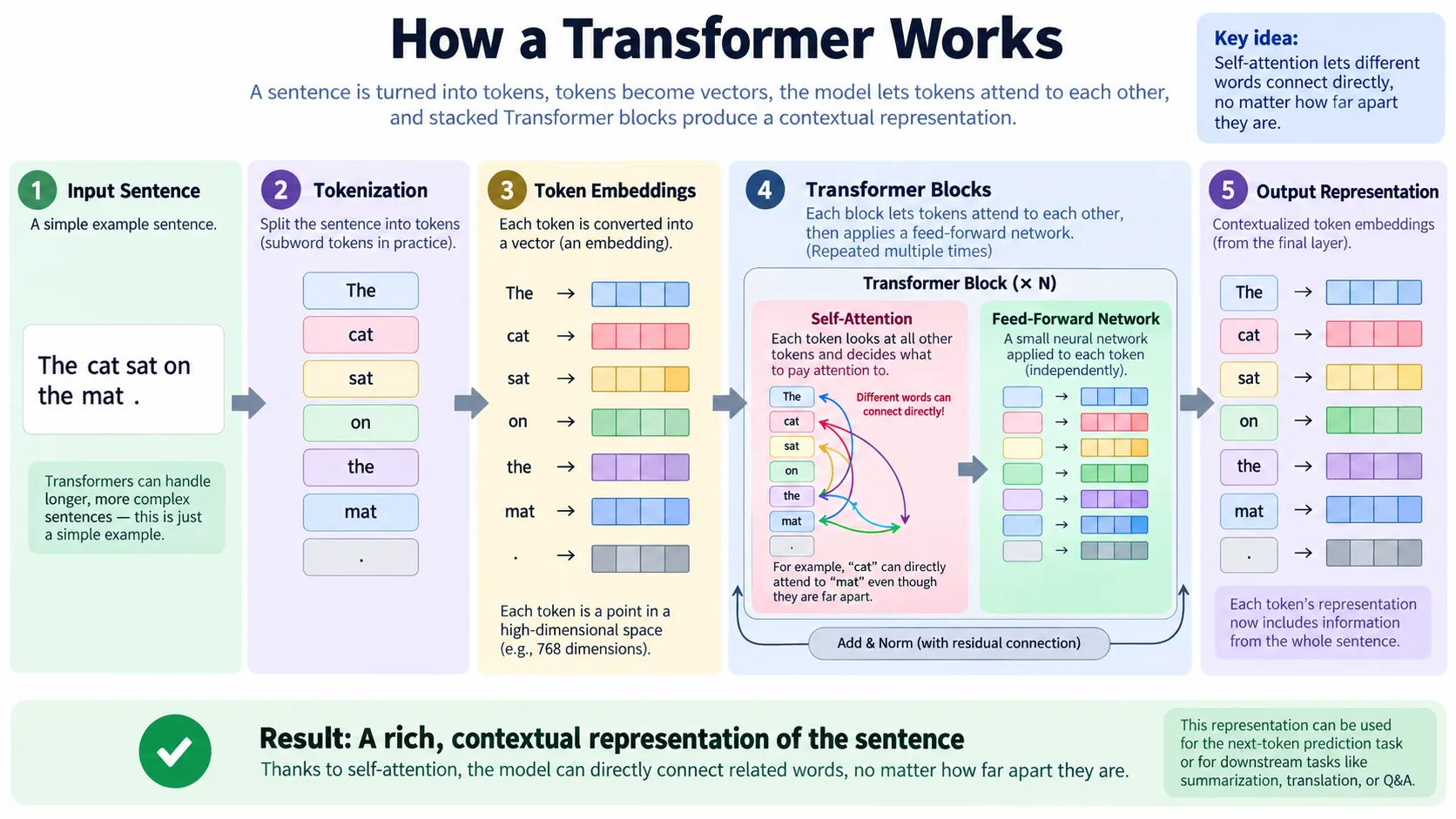
A Transformer is a neural network architecture designed to understand relationships between pieces of information in a sequence.
The original Transformer architecture was introduced in the 2017 research paper Attention Is All You Need. Unlike many earlier sequence models, it did not depend on recurrence to process a sentence one word after another.
Instead, the Transformer was built around an attention mechanism.
The easiest way to understand attention is to imagine a group conversation.
Suppose five people are talking, but one person suddenly mentions your name. Even though you can hear everyone, your brain automatically gives more importance to the sentence related to you.
A Transformer does something similar.
For every word or token, it tries to determine:
Which other tokens are important for understanding this token?
This process allows the model to create a much richer understanding of context.
For example:
“The dog did not cross the road because it was tired.”
To understand the word “it,” the model should pay strong attention to “dog.”
Now consider:
“The dog did not cross the road because it was flooded.”
Here, “it” is much more likely to refer to the “road.”
The individual words are similar in both sentences, but their relationships are different.
That is exactly the type of relationship a Transformer learns to model.
Before going deeper into Transformers, it helps to understand how neural networks learn patterns, because Transformers are also built from layers that learn useful representations from data.
Why Were Transformers Needed?
Before Transformers became popular, sequence problems were commonly handled using architectures such as Recurrent Neural Networks (RNNs) and Long Short-Term Memory networks (LSTMs).
These models were powerful, but they had an important limitation.
They normally processed sequence information step by step.
Imagine reading this sentence:
“The laptop that I bought from a small store near my university last summer still works perfectly.”
A sequential model processes information in an ordered chain. When sentences become long, keeping track of relationships between words that are far apart can become difficult.
LSTMs were specifically designed to improve the handling of longer dependencies, but sequential computation still made large-scale training harder to parallelize.
Transformers changed the approach.
Instead of forcing the model to rely mainly on a long chain of previous hidden states, self-attention directly connects tokens with other relevant tokens in the sequence.
The original Transformer research showed that an attention-based architecture could perform sequence-transduction tasks without recurrent or convolutional layers and could be trained with much more parallelism.
Think of the difference like this.
An RNN is similar to passing a message through a line of people:
Person 1 → Person 2 → Person 3 → Person 4 → Person 5.
Information has to travel through the chain.
Self-attention is closer to putting everyone in the same meeting room where each person can directly decide whose information matters to them.
That change turned out to be extremely powerful.
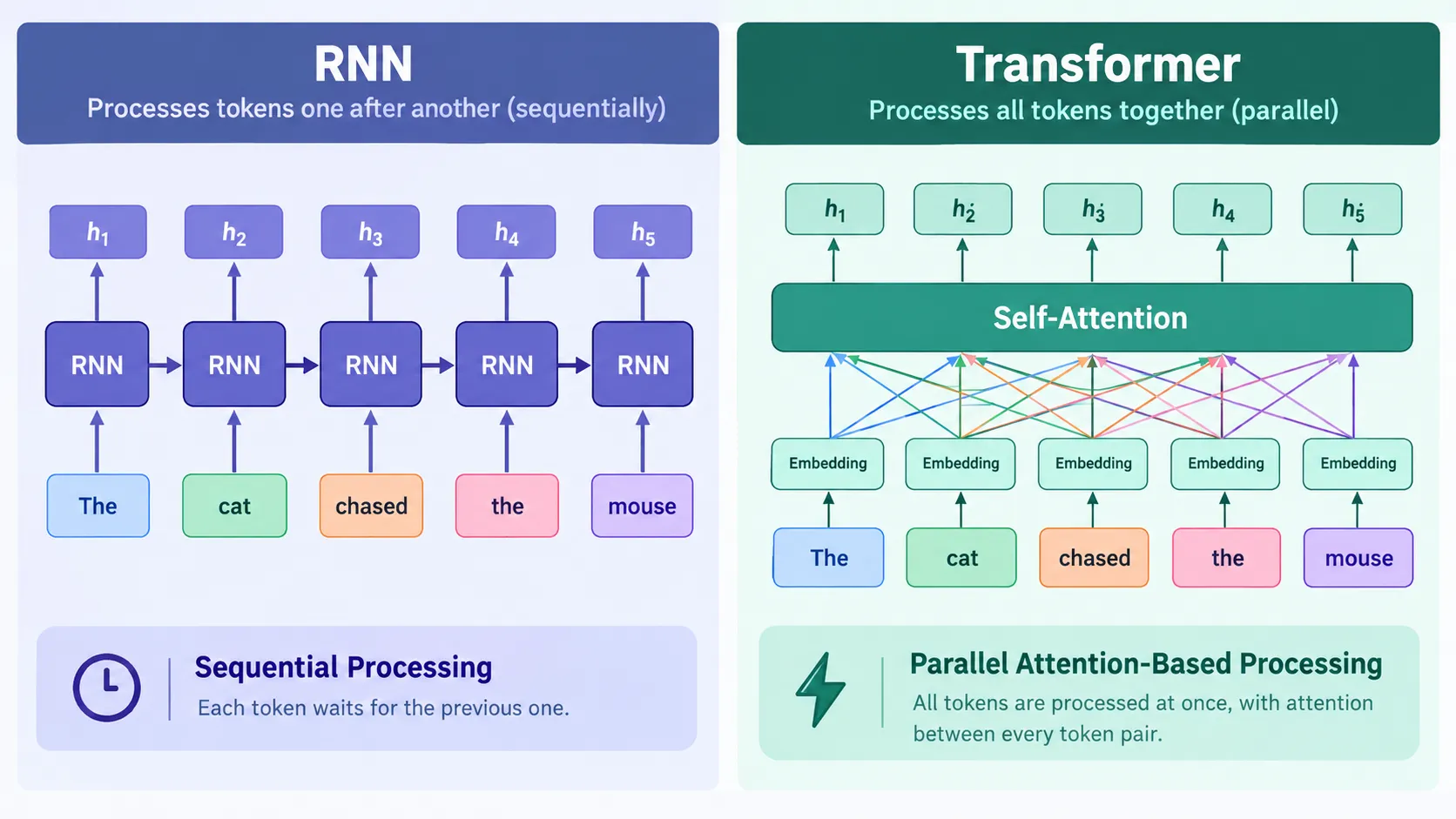
Before Transformers became dominant, RNNs and LSTMs were among the most important architectures for processing sequential information such as text and time-series data
The Main Idea Behind a Transformer
At a high level, information moves through a Transformer in several stages.
First, the input is broken into tokens.
A sentence such as:
“Transformers understand context.”
may be split into words, parts of words, or other token units depending on the tokenizer.
Those tokens are then converted into numerical representations called embeddings.
Why numbers?
Because a neural network cannot directly calculate with normal written words. It needs numerical vectors that can be processed mathematically.
But there is another problem.
If we simply give the model token embeddings, how will it know which token came first, second, or third?
That is where positional information becomes important.
The model combines information about the token itself with information about its position in the sequence.
After that, the representations move through Transformer blocks containing attention and other neural-network layers.
In simplified form, you can think of the journey as:
Text → Tokens → Embeddings → Position Information → Attention → Neural Network Layers → Output
We will break each of these steps down shortly.
What Is Self-Attention?
Self-attention is the mechanism that allows tokens inside the same sequence to evaluate their relationships with one another.
Google describes the basic idea in a useful way: for each input token, self-attention effectively determines how much the other input tokens should influence its interpretation.
Consider this sentence:
“Sara dropped the glass on the floor, and it broke.”
When processing “it,” the model should strongly connect that token with “glass.”
Words such as “Sara,” “floor,” and “dropped” may still provide context, but they do not necessarily receive the same importance.
Self-attention learns these relationships.
Internally, this becomes more mathematical. Each token produces representations commonly called:
Query (Q)
Key (K)
Value (V)
The Query asks, in a simplified sense:
“What information am I looking for?”
The Key represents:
“What information do I contain?”
And the Value represents:
“What information should I contribute if I am relevant?”
The Transformer compares Queries and Keys to calculate attention scores. Those scores decide how much of each Value should influence the new representation of a token.
This Query-Key-Value system is one of the most important ideas in the entire Transformer model architecture.
But a Transformer does not perform this process only once.
It can examine different relationships through several attention heads at the same time.
That leads us to multi-head attention, where the architecture starts becoming far more interesting.
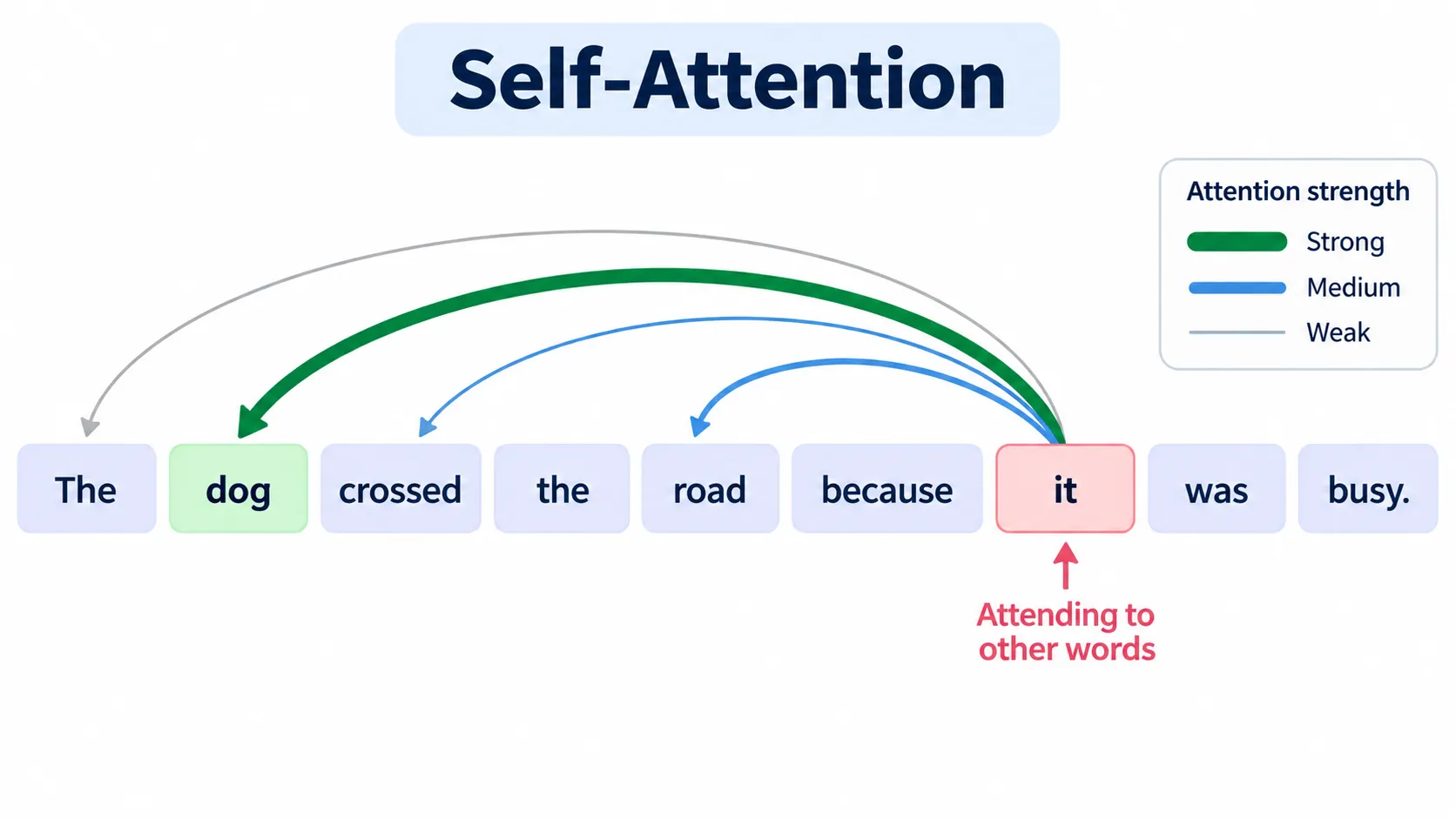
If you want to explore this concept separately, our guide to the attention mechanism in deep learning explains why attention became such an important idea in modern AI.
Encoder, Decoder, or Both?
The original Transformer contains two major sides:
Encoder and Decoder.
The encoder focuses mainly on building a useful representation of the input.
The decoder focuses on generating an output.
However, modern Transformer models do not always use both.
Some models use an encoder-only architecture, some use a decoder-only architecture, while others use the complete encoder-decoder architecture. Hugging Face currently groups Transformer models around these three major architecture families.
A simple way to remember them is:
Encoder → Understand
Decoder → Generate
Encoder + Decoder → Understand an input and generate a related output
For example, text classification often benefits from an encoder-style model, while text generation commonly uses decoder-based models. Translation and similar sequence-to-sequence tasks can use encoder-decoder models.
The architecture behind modern AI becomes much easier to understand once these three variations are clear.
Next, we need to open the Transformer block itself and see exactly what happens inside — including Query, Key, Value calculations, scaled dot-product attention, multi-head attention, positional encoding, feed-forward networks, residual connections, layer normalization, masking, and the full encoder-decoder flow.
How Query, Key, and Value Actually Work
The terms Query, Key, and Value, or Q, K, and V, often make Transformer architecture sound much harder than it really is.
Let’s understand them with a simple real-life example.
Imagine you walk into a library and say:
“I need a beginner-friendly book about artificial intelligence.”
Your request is the Query.
Every book has information describing what it contains. That works like a Key.
The actual knowledge inside the book is the Value.
The library system compares your Query with the Keys of different books. The books whose Keys match your request more closely receive more attention.
A Transformer does something similar, but instead of searching books, it compares tokens.
Suppose the sentence is:
“The cat sat near the window because it was warm.”
When the model processes the word “it,” it needs to decide which other words are most useful for understanding it.
Each token is transformed into three different vectors:
Query (Q) represents what the current token is looking for.
Key (K) represents what each token can offer.
Value (V) contains the actual information that can be passed forward.
These vectors are created using learned weight matrices. During training, the model gradually learns how those transformations should work.
The original Transformer architecture uses these Query, Key, and Value representations as the foundation of its scaled dot-product attention mechanism.
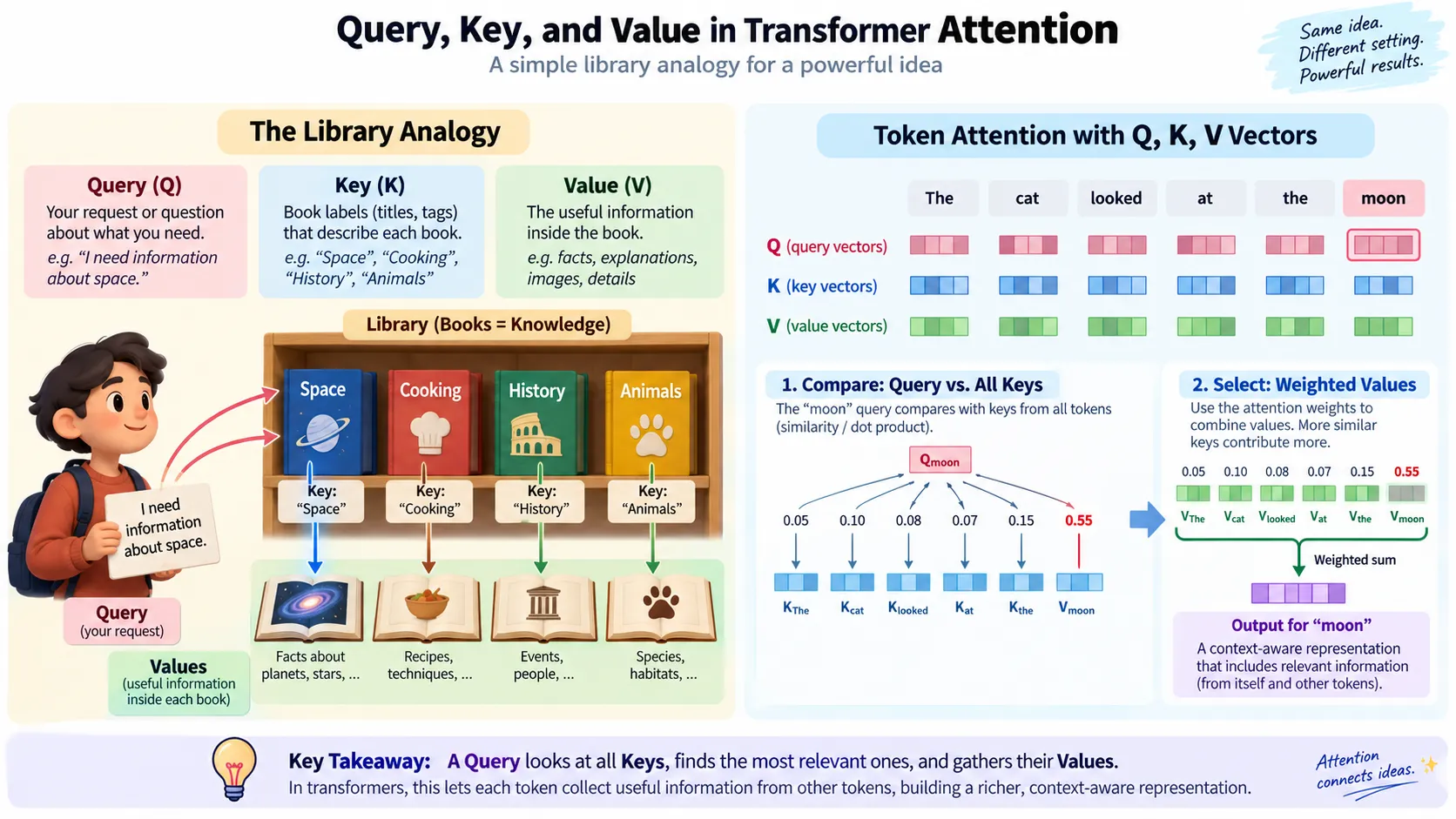
How Attention Scores Are Calculated
Once the model has Queries and Keys, it needs to calculate how strongly different tokens are related.
The basic comparison is performed using a dot product between a Query and the Keys.
You do not need advanced mathematics to understand the idea.
Think of the result as a relevance score.
A stronger match means:
“This token may contain useful information for me.”
A weaker match means:
“This token probably matters less for my current understanding.”
For example, take:
“Riya went to the bank because she needed money.”
When processing “she,” the token “Riya” may receive a strong attention score.
When processing “money,” words such as “bank” and “needed” may become highly relevant.
Different tokens therefore build different views of the same sentence.
This is an important point.
Self-attention does not create one attention pattern for an entire sentence. Each token can pay different amounts of attention to other tokens.
Google’s explanation of self-attention describes essentially the same process: for each token, the Transformer determines how strongly the other tokens should affect its interpretation.
Scaled Dot-Product Attention
The original Transformer expresses this operation as:
Attention(Q, K, V) = softmax(QKᵀ / √dₖ)V
It looks complicated at first, but the logic is simple.
First, Q and K are compared.
Then the scores are divided by √dₖ.
After that, softmax converts the scores into useful attention weights.
Finally, those weights are applied to the Values.
The division by √dₖ helps prevent very large dot-product values from making the softmax distribution too extreme, especially when the key/query dimension becomes large. This scaling step was part of the original Transformer design.
The Softmax step converts raw attention scores into useful weights. You can understand the function in more detail in our guide to ReLU, Sigmoid, and Softmax activation functions.
So instead of memorizing the equation, remember this:
Compare → Scale → Normalize → Collect useful information
That is the heart of scaled dot-product attention.
Why Do Transformers Use Multi-Head Attention?
One attention calculation is useful.
But language rarely contains only one type of relationship.
Look at this sentence:
“Aman, who joined the company last year, told Ravi that he would lead the project.”
To understand it properly, the model may need to track several things at once.
One relationship could involve people.
Another could involve grammar.
Another could connect “he” with the person it refers to.
Another may capture the relationship between “lead” and “project.”
This is why Transformers use multi-head attention.
Instead of performing only one attention operation, the model performs multiple attention operations in parallel using different learned projections.
Each one is called an attention head.
Different heads can potentially learn different patterns or relationships in the data.
Their outputs are then combined and projected into another representation.
The original Transformer specifically introduced multiple attention heads so that the model could attend to information from different representation subspaces and positions in parallel.
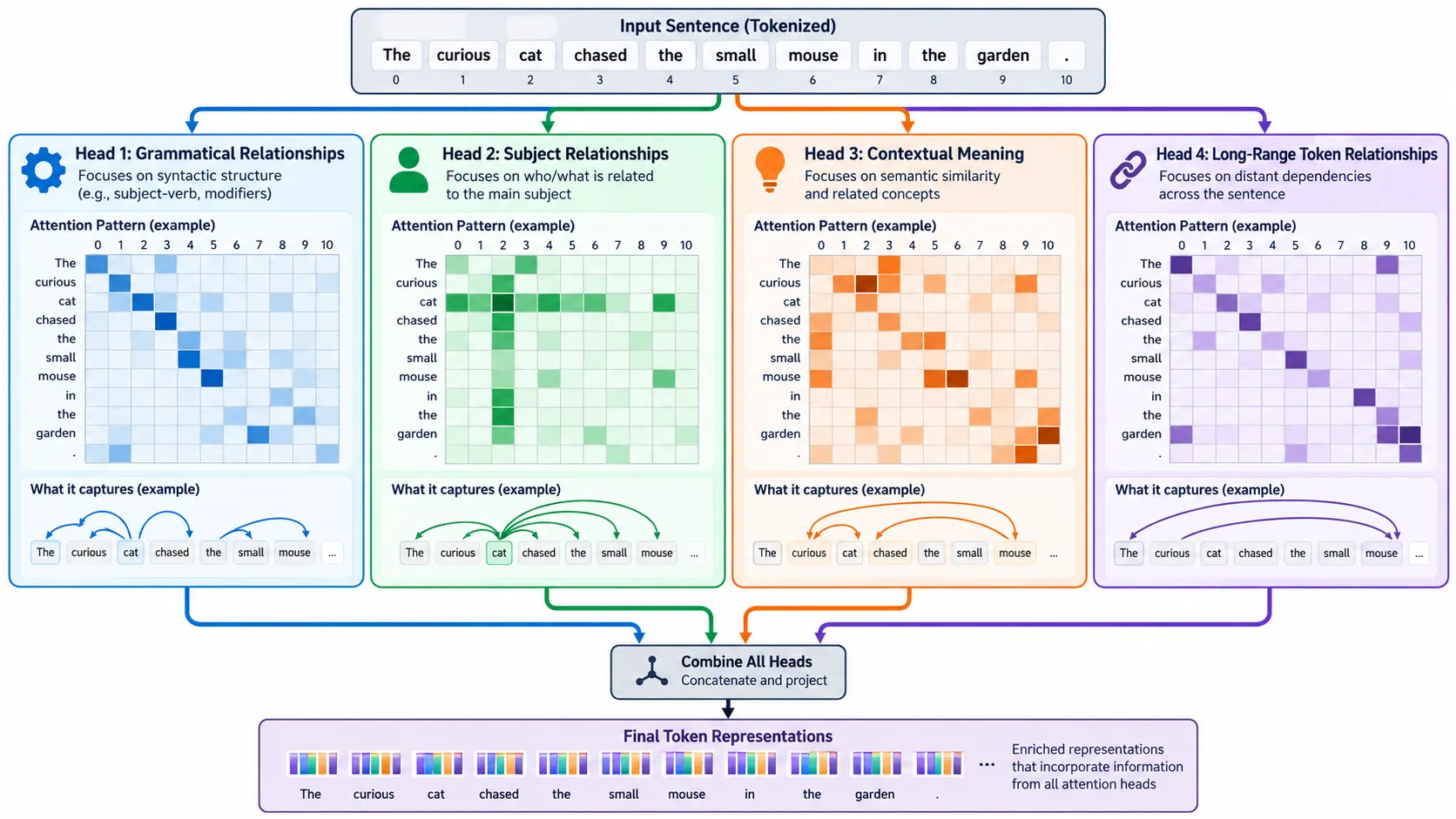
Think of it like watching a football match using several cameras.
One camera follows the ball.
Another focuses on the goalkeeper.
Another captures player formations.
Another gives a wide view of the field.
No single camera tells the whole story.
Combine them, and you get a much better understanding of what is happening.
Multi-head attention gives a Transformer multiple views of the same information.
Why Transformers Need Positional Information
Self-attention creates another interesting problem.
Suppose we have:
“Dog bites man.”
and:
“Man bites dog.”
The words are almost identical.
But the meaning is clearly not.
Word order matters.
Because self-attention does not inherently process tokens in the same sequential way as an RNN, the model needs information about where tokens appear in the sequence.
This is where positional encoding comes in.
The original Transformer added positional encodings to token embeddings so the architecture could use information about token order.
You can think of each token as receiving two pieces of information:
What am I?
and
Where am I?
For example:
“Transformer” + position 1
“models” + position 2
“understand” + position 3
“context” + position 4
That positional information helps the architecture distinguish between sentences where the same tokens appear in different orders.
[INTERLINK: Link here to your RNNs & LSTMs article using anchor text how sequential neural networks process information.]
What Happens After Attention?
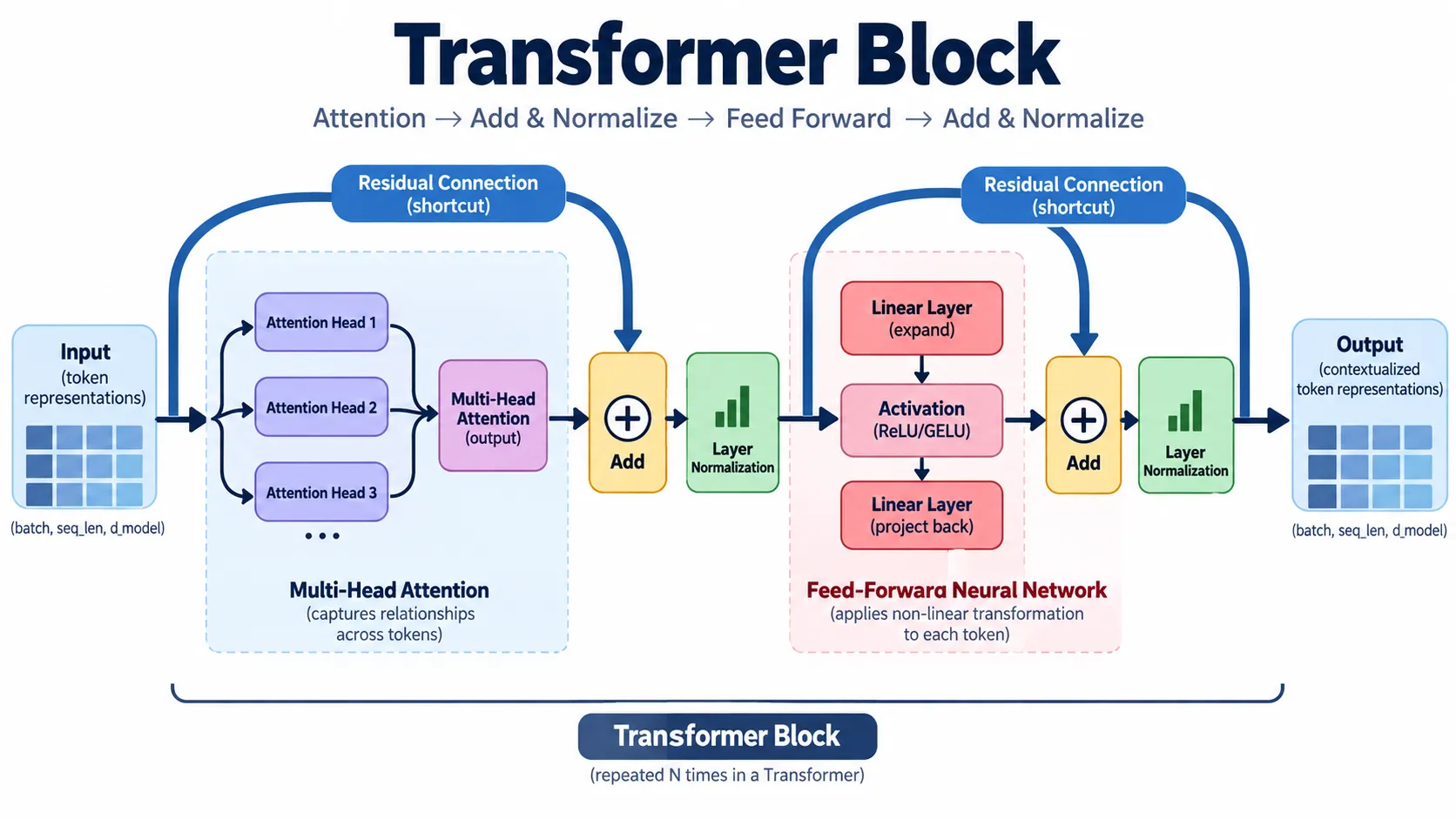
Attention is extremely important, but a Transformer block is not made of attention alone.
After the attention operation, information also passes through a feed-forward neural network.
A feed-forward network processes the representation produced for each position and transforms it further.
You can think of attention as asking:
“Which information from other tokens matters to me?”
The feed-forward network then asks:
“Now that I have this information, how should I transform it?”
This combination allows a Transformer to first collect contextual information and then process it through learned nonlinear transformations.
The feed-forward network inside a Transformer follows the same broader idea of how neural network layers transform information through learned weights and nonlinear operations.
Residual Connections and Layer Normalization
Deep neural networks contain many transformations.
If every layer completely replaced the information from the previous layer, useful signals could become harder to preserve as they pass through a deep network.
Transformers therefore use residual connections.
Instead of only using the newly transformed representation, the architecture also keeps a path for information from an earlier representation to continue forward.
Think of editing a document.
Rather than throwing away the original document every time you make an improvement, you keep the original information available while adding useful changes.
The original Transformer architecture combines these residual connections with layer normalization around its sublayers.
Layer normalization helps keep internal representations at a manageable scale during processing.
Why Masking Matters in Transformer Decoders
There is one more concept we need before understanding modern language generation: masked self-attention, also called causal attention in many decoder-based models.
Imagine the model is learning:
“Artificial intelligence is changing the world.”
When predicting the word “changing,” it should not secretly look ahead and use “the world” as information that has not been generated yet.
That would be like seeing the answer before taking an exam.
A decoder therefore uses a mask that prevents a token from attending to future tokens during autoregressive generation.
It can use information from previous positions, but not positions that come later.
Hugging Face’s Transformer documentation explains that the decoder restricts attention to earlier positions during generation, while encoder attention can normally access the full input sequence.
This seemingly small rule is crucial.
It is what allows decoder-based Transformers to generate text step by step:
Existing tokens → Predict next token → Add it to the sequence → Predict again
And this brings us directly to the architecture behind modern Large Language Models.
Once we connect attention, masking, embeddings, Transformer blocks, and repeated next-token prediction, we can finally understand how a Transformer goes from simple mathematical operations to generating paragraphs, answering questions, writing code, and powering modern AI systems.
How the Full Transformer Encoder Works
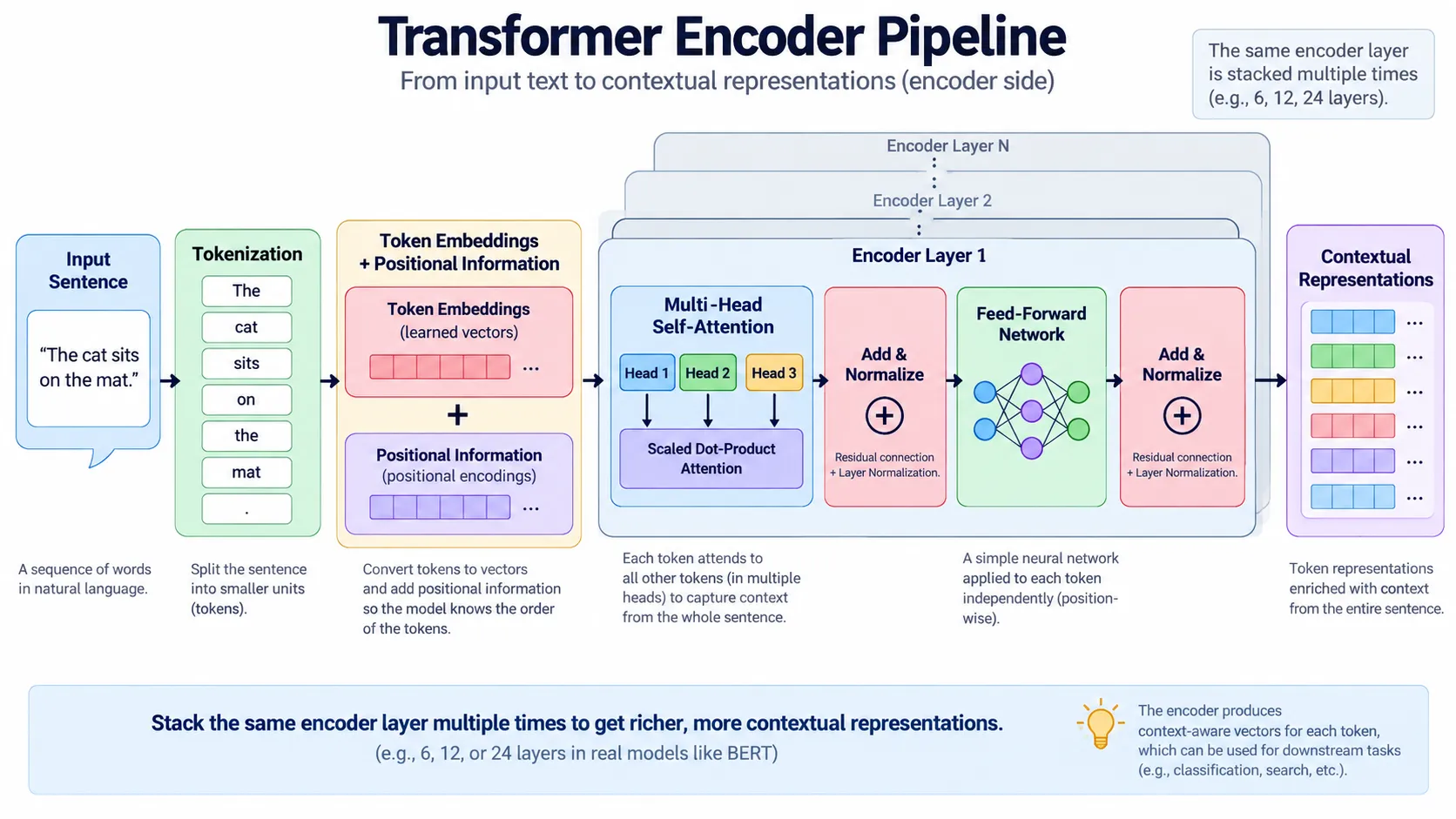
Now that we understand attention, positional information, and feed-forward layers, we can connect everything inside the Transformer encoder.
The encoder receives the input sequence and turns it into rich contextual representations.
A simplified flow looks like this:
Input text → Tokenization → Embeddings → Positional information → Multi-head self-attention → Feed-forward network → Contextual representation
Suppose the input is:
“The doctor checked the patient because she was feeling weak.”
The encoder does not simply store each word separately.
Through self-attention, every token can use information from other relevant tokens.
The representation of “she,” for example, can be influenced by the words around it. As information passes through multiple encoder layers, these representations become increasingly contextual.
This is why Transformer encoders are useful for tasks where understanding the full input matters.
Examples include:
text classification
sentiment analysis
document understanding
information extraction
semantic search
Models built mainly around the encoder side are especially useful when the goal is to understand information rather than generate long sequences of new text.
Transformers are one of several important Deep learning architectures that learn increasingly useful representations through multiple processing layers.
How the Transformer Decoder Works
The decoder has a different job.
Instead of only understanding an existing sequence, it is designed to help generate an output sequence.
Imagine asking a model:
“Complete this sentence: Machine learning can…”
The decoder looks at the tokens already available and predicts what token could come next.
Suppose it predicts:
“help”
Now the sequence becomes:
“Machine learning can help…”
The model repeats the process.
It may predict:
“businesses”
Then another token.
Then another.
This continues until the response is complete.
This process is known as autoregressive generation.
The important rule is that while predicting the next token, the model cannot use future tokens that have not yet been generated.
That is why masked, or causal, self-attention is so important.
What Is Cross-Attention?
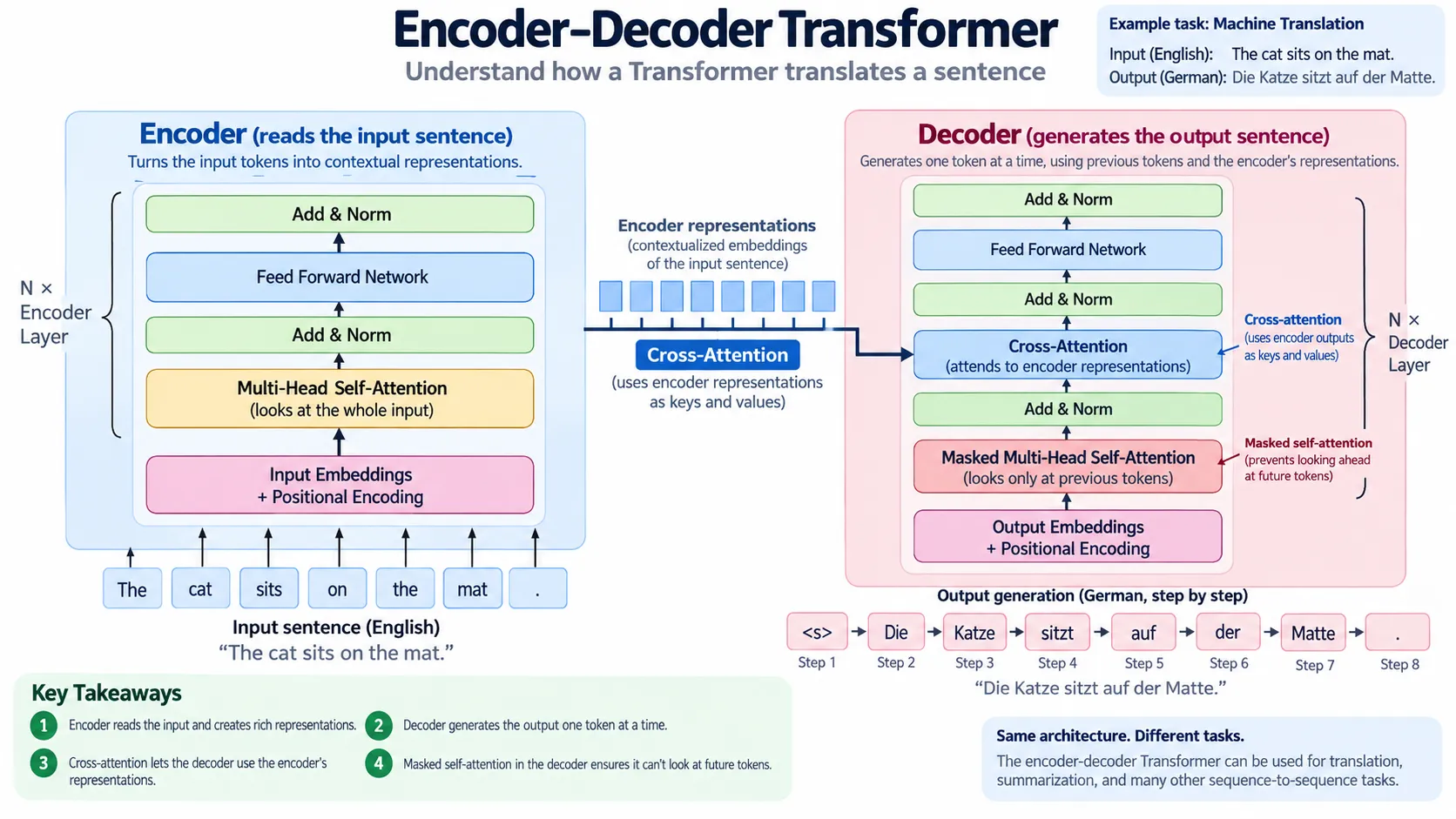
In the original encoder-decoder Transformer, the decoder does not work alone.
It can also attend to information produced by the encoder.
This is called cross-attention.
Suppose we are translating:
“I love learning AI.”
into another language.
The encoder first creates contextual representations of the original sentence.
The decoder then generates the translated sentence while using those encoder representations.
In simple terms:
Self-attention: Look at information inside my own sequence.
Cross-attention: Look at useful information from another sequence.
Cross-attention is extremely useful in tasks where one input needs to be converted into another output, such as translation or some multimodal systems.
Encoder-Only vs Decoder-Only vs Encoder-Decoder Transformers
Not every modern Transformer uses the exact original architecture.
Today, Transformer systems are commonly grouped into three broad families.
Encoder-Only Transformers
Encoder-only models mainly focus on understanding input.
They are well suited for tasks such as classification, extracting information, and producing contextual representations.
A simple way to remember them is:
Encoder = Understand
Decoder-Only Transformers
Decoder-only architectures are especially important for text generation.
They repeatedly predict the next token based on tokens already available.
Many modern Large Language Models (LLMs) use decoder-style Transformer architectures.
A simple memory trick is:
Decoder = Generate
Encoder-Decoder Transformers
These architectures use both sides.
The encoder understands the input, while the decoder generates an output based on that representation.
They are commonly associated with sequence-to-sequence problems.
Remember:
Encoder → Understand
Decoder → Generate
Encoder + Decoder → Understand and Transform
[INTERLINK: Add your future or existing Large Language Models article here using anchor text how large language models work.]
How Transformers Power Modern LLMs
This is where everything we have learned starts connecting to modern AI.
A Large Language Model does not store language like a dictionary containing every possible response.
Instead, it learns statistical patterns from enormous amounts of training data.
When a prompt is given, the text is tokenized.
Those tokens are converted into numerical representations and passed through many Transformer layers.
Inside those layers, attention mechanisms continuously build relationships between tokens.
The model eventually produces probabilities for possible next tokens.
For example:
“The capital of France is…”
The model may assign a very high probability to:
“Paris”
After selecting a token, it repeats the process.
This simple-looking cycle:
Read context → Calculate representations → Predict next token → Repeat
can produce surprisingly sophisticated results when the model contains many layers, parameters, and learned patterns.
That is how Transformer-based systems can generate explanations, summaries, code, conversations, and many other forms of content.
But there is an important distinction.
A language model does not understand the world exactly like a human.
It generates outputs from learned patterns and context.
This is also why LLMs can sometimes produce confident but incorrect information.
Transformers Are Not Only for Text
Transformers eventually moved far beyond natural language processing.
One major example is the Vision Transformer, commonly called ViT.
Instead of processing words, a Vision Transformer can divide an image into smaller patches.
Those patches are converted into representations that can be processed similarly to tokens.
Think of an image of a dog.
Instead of feeding the complete image into the Transformer as one giant object, the system can divide it into smaller blocks:
Patch 1 → Patch 2 → Patch 3 → Patch 4 → ...
The Transformer can then learn relationships between these image patches.
This allows attention mechanisms to capture information across different parts of an image.
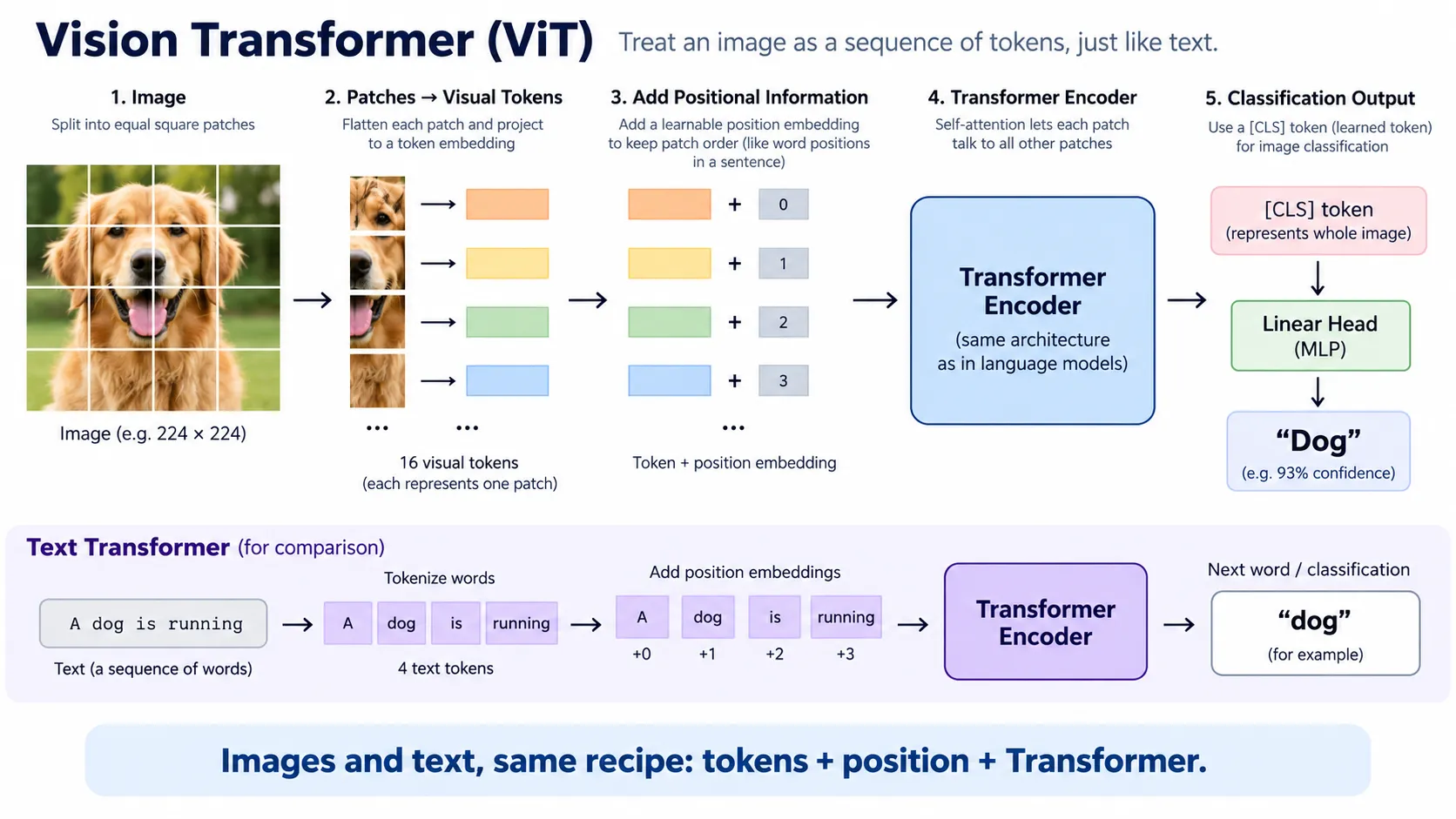
Vision Transformers approach images differently from traditional convolutional neural networks, which rely heavily on convolutional filters for extracting visual features.
Transformers vs RNNs and LSTMs
Transformers became dominant partly because they solve several problems that affected earlier sequence architectures.
RNNs process sequence information recurrently.
LSTMs improve the ability to maintain information over longer sequences.
Transformers take a different route by relying heavily on attention.
This offers major advantages.
Transformers can model long-range relationships more directly.
Their training computations can also be parallelized more effectively than traditional recurrent processing.
However, that does not mean Transformers are perfect.
Attention can become computationally expensive as sequence length grows.
Large Transformer models can also require enormous amounts of memory, compute, training data, and energy.
For a deeper understanding of recurrent sequence models, read our guide to RNNs and LSTMs for sequence modeling before comparing their architecture with Transformers.
Limitations of Transformer Architecture
Transformers are powerful, but understanding their limitations is equally important.
High Computational Cost
Training a large Transformer can require expensive hardware and significant computing resources.
Attention Cost
Standard self-attention compares many tokens with many other tokens.
As the context grows, this can become expensive in both computation and memory.
Training Data Quality Matters
A model learns from its training data.
If that data contains errors, bias, or poor-quality information, the model can learn undesirable patterns.
Hallucinations
Language models can generate information that sounds convincing even when it is incorrect.
A fluent answer should therefore not automatically be treated as a factual answer.
Context Is Limited
Transformer systems can only process a certain amount of information within their supported context window.
Modern architectures continue to improve this limit, but it remains an important engineering consideration.
During training, Transformer parameters are updated through optimization methods based on gradient descent and modern optimizers.
Why Transformer Architecture Changed AI
The biggest contribution of Transformers was not simply creating another neural network.
They changed how machines process relationships within information.
Self-attention allows a model to decide which parts of its input matter most.
Multi-head attention allows it to examine those relationships from several perspectives.
Positional information preserves sequence structure.
Feed-forward layers transform what attention discovers.
Residual connections and normalization help deep networks process information effectively.
Stack those components across many layers, train them on large datasets, and you get the foundation behind some of the most capable AI systems available today.
From translation and search to coding assistants, chatbots, image understanding, and multimodal AI, Transformer architecture has become one of the central building blocks of modern artificial intelligence.
And if you remember only one idea from this entire guide, remember this:
A Transformer becomes powerful because it learns what information deserves attention, how different pieces of information relate to one another, and how those relationships should influence the next representation or prediction.
Once that idea is clear, terms such as self-attention, Query-Key-Value, multi-head attention, encoder, decoder, masking, and LLMs stop looking like separate concepts.
They become pieces of one connected system.
Frequently Asked Questions About Transformer Architecture
What is Transformer architecture in simple words?
A Transformer is a neural network architecture that uses attention to understand how different pieces of information are related. Instead of processing every word only one by one, it can compare tokens with other relevant tokens and build a contextual representation of the sequence.
How does self-attention work in Transformers?
Self-attention allows each token to examine other tokens in the same sequence and decide which ones are most important for understanding its meaning. Attention scores determine how strongly information from different tokens should influence the new representation.
What are Query, Key, and Value in a Transformer?
Query, Key, and Value are learned representations used by the attention mechanism. A Query represents what a token is looking for, a Key represents what another token can offer, and a Value contains the information that can be passed forward when that token is considered relevant.
What is multi-head attention?
Multi-head attention performs several attention operations in parallel. This allows different attention heads to learn different types of relationships, such as grammatical structure, contextual meaning, or connections between distant tokens.
Why do Transformers need positional encoding?
Self-attention alone does not naturally represent token order. Positional information helps the model understand where each token appears in a sequence, allowing it to distinguish between sentences containing similar words in different orders.
What is the difference between a Transformer encoder and decoder?
The encoder mainly builds contextual representations of an input, while the decoder is designed to generate an output sequence. Encoder-decoder models combine both, allowing one sequence to be understood and transformed into another.
Why are Transformers better than RNNs for many language tasks?
Traditional RNNs process sequences recurrently, which makes training harder to parallelize. Transformers use attention to model relationships more directly and support much more parallel computation during training. However, Transformers can also require significant memory and computing power.
How do Transformers power large language models?
Transformer-based language models process tokens through many layers of attention and neural-network operations. They use the resulting contextual representations to estimate probabilities for possible next tokens and repeatedly generate new tokens to produce a response.
What is causal masking in a Transformer?
Causal masking prevents a decoder from looking at future tokens while predicting the next token. During text generation, the model can use previous tokens but cannot access words that have not been generated yet.
What is a Vision Transformer?
A Vision Transformer, or ViT, applies Transformer ideas to images. An image is divided into smaller patches, those patches are represented like tokens, and attention is used to learn relationships between different parts of the image.


