


Imagine you are trying to teach someone a long set of instructions.
You tell the first person something important. They pass it to another person, who passes it to another, and the message keeps moving through 20 or 30 people.
By the time it reaches the last person, one of two things may happen.
The message becomes so weak that important details almost disappear.
Or every person adds a little extra until the final message becomes completely out of control.
Something surprisingly similar can happen inside a deep neural network.
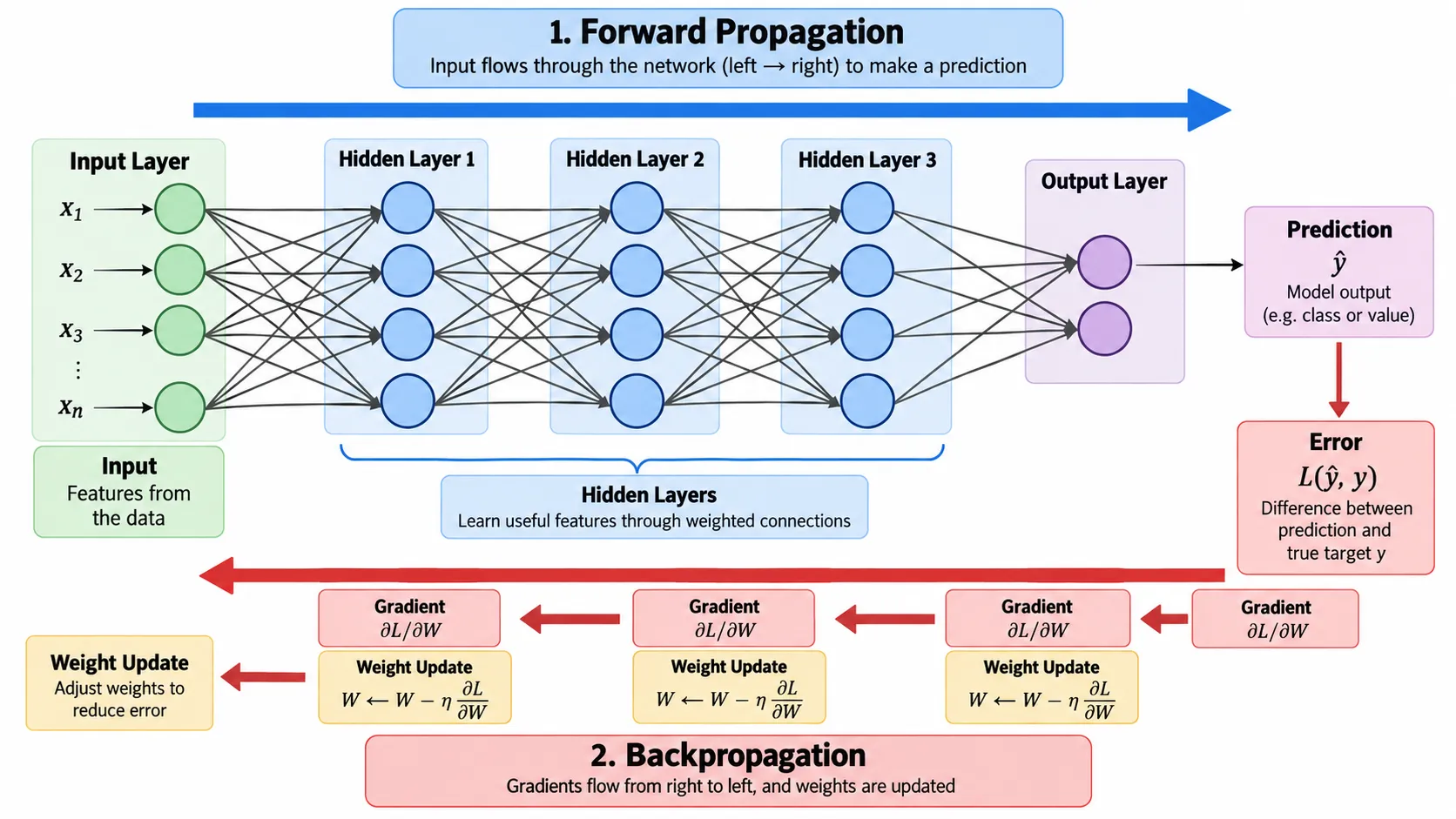
During training, a neural network sends information forward to make a prediction. Then it sends an error signal backward through the network so that its weights can improve.
That backward signal is called a gradient.
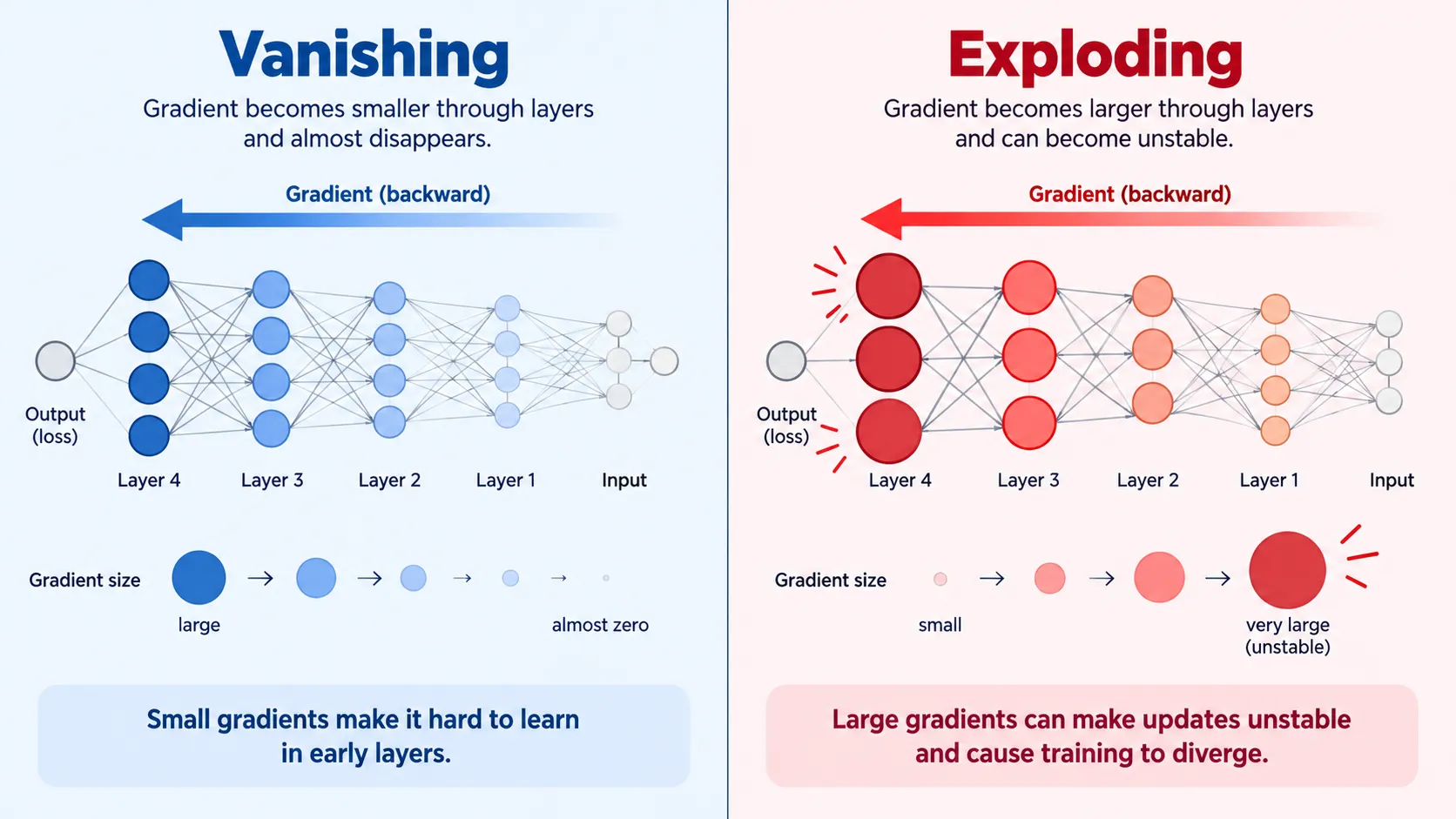
When this gradient becomes extremely small, we get the vanishing gradient problem.
When it becomes extremely large, we get the exploding gradient problem.
Both problems can make a powerful deep learning model surprisingly difficult to train.
Why Gradients Matter in a Neural Network
Before understanding vanishing and exploding gradients, we need to understand what a gradient actually does.
Suppose you are training a neural network to identify whether an image contains a dog.
The model sees an image and predicts:
“Dog: 35%”
But the correct answer is dog.
The network therefore has an error.
Training tries to answer a simple question:
Which weights inside the neural network caused this error, and how should we change them?
This is where backpropagation comes in.
Backpropagation moves from the output layer toward the earlier layers and calculates gradients for the network's parameters.
You can think of a gradient as a small instruction saying:
“Move this weight a little in this direction.”
The optimizer then uses those gradients to update the weights.
If useful gradients reach every important layer, the model can gradually learn better features.
But deep networks may contain dozens or even hundreds of layers.
The gradient has to travel through all of them.
That journey is where trouble can begin.
What Is the Vanishing Gradient Problem?
A vanishing gradient happens when gradients become smaller and smaller while moving backward through a deep network.
Eventually, the gradient reaching the early layers may become so tiny that those layers barely update.
Imagine a company where feedback must pass through 30 managers before reaching the employee who needs it.
Every manager keeps only half of the original message.
After enough steps, almost nothing useful remains.
A neural network can behave in a similar way.
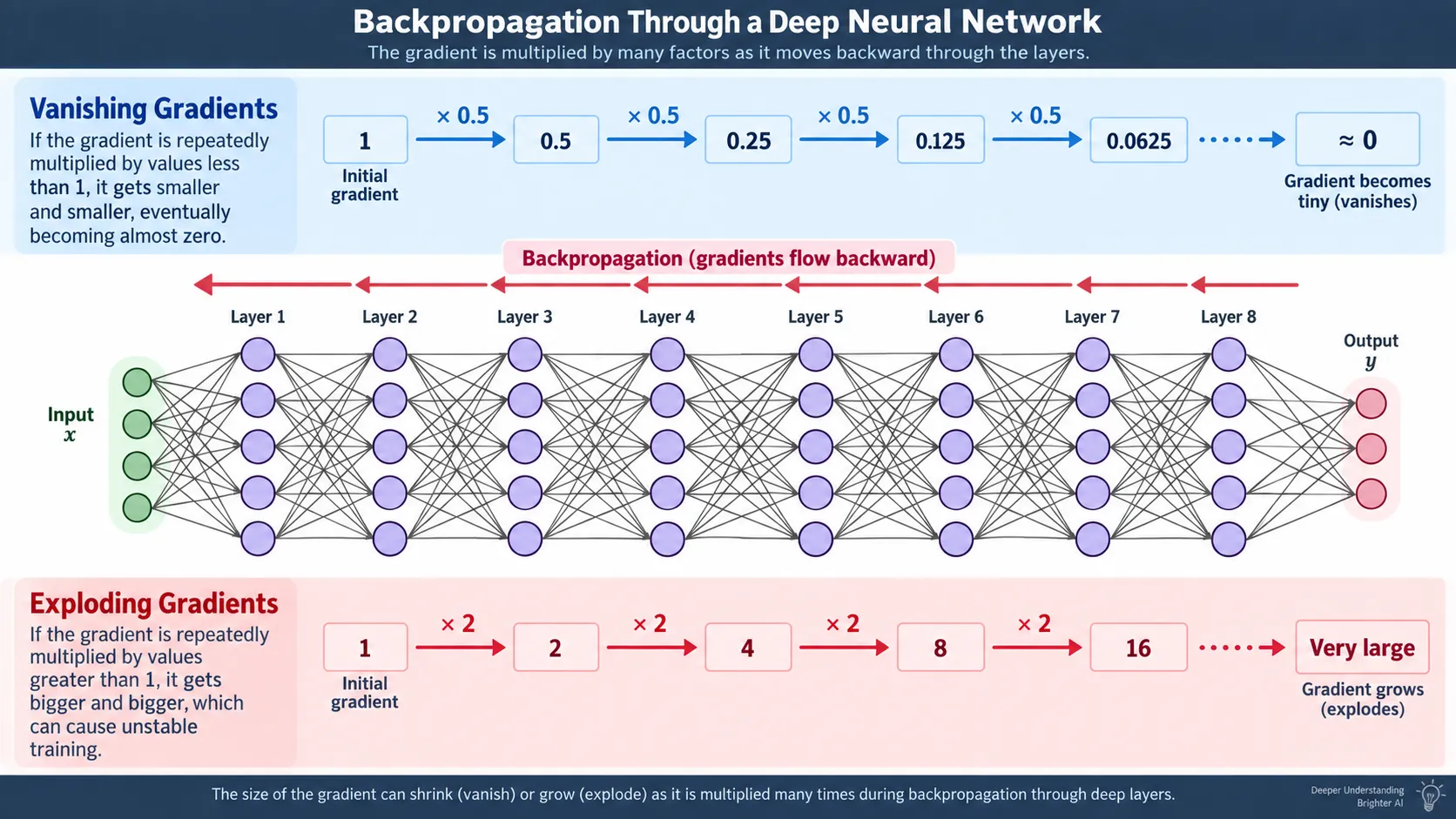
During backpropagation, several derivatives are multiplied together.
If many of those values are smaller than 1, repeatedly multiplying them can produce an extremely small number.
For example:
0.5 × 0.5 = 0.25
Keep multiplying 0.5 again and again, and the result quickly moves toward zero.
In a very deep network, that means earlier layers may receive almost no useful learning signal.
What Happens When Gradients Vanish?
The model may still appear to be training, which makes this problem frustrating.
The loss might decrease slowly.
Later layers might continue learning.
But the early layers barely change.
This can cause:
slow training,
poor feature learning,
very long training plateaus,
weak performance,
and difficulty learning relationships that depend on information from much earlier stages of the network.
For a deep image model, for example, early layers often learn simple patterns such as edges and textures.
If those layers receive almost no useful gradient, the whole network can struggle to build stronger features on top of them.
Why Sigmoid Can Make Vanishing Gradients Worse
Activation functions play an important role in gradient flow.
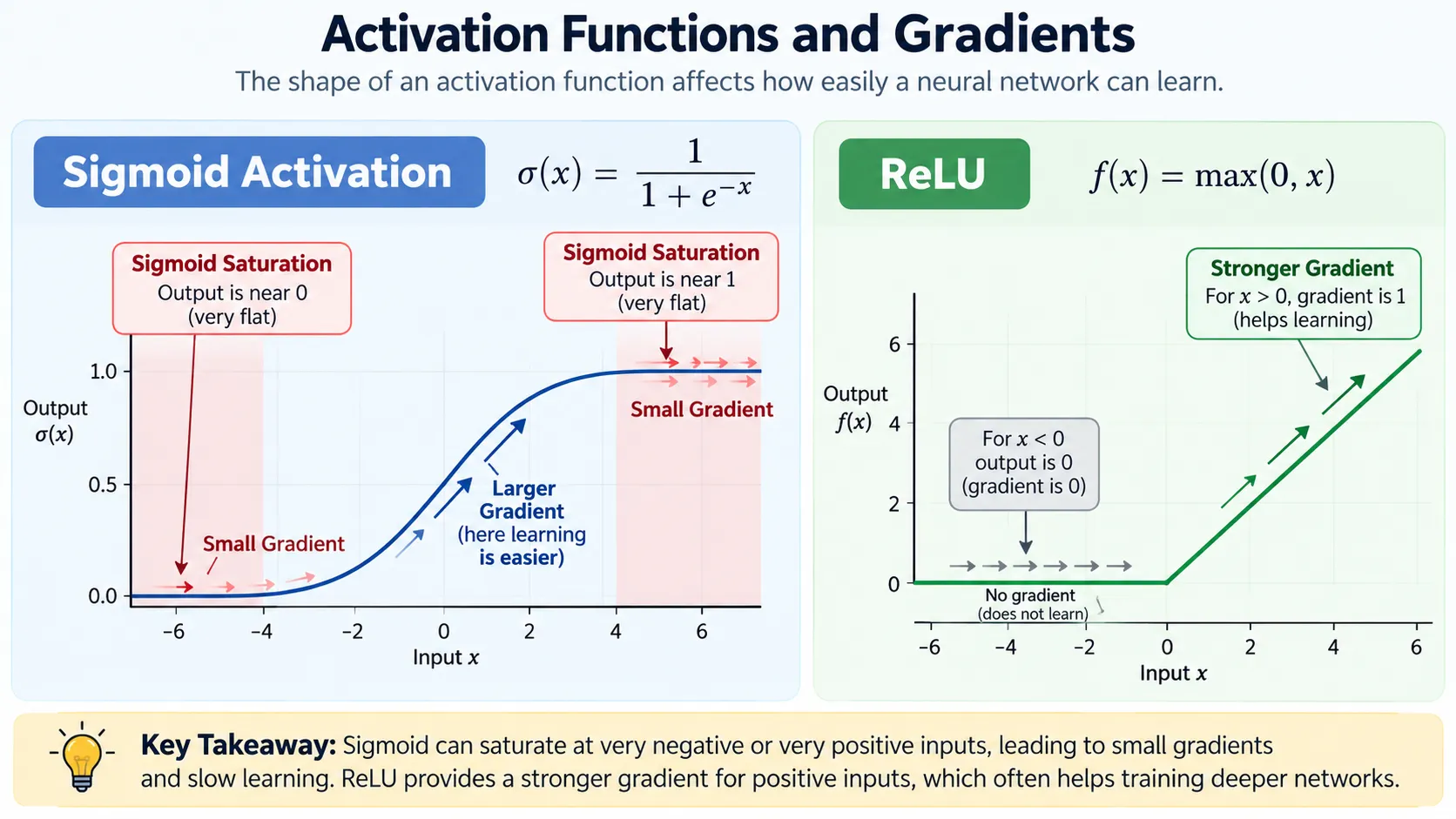
One famous example is the sigmoid activation function.
Sigmoid converts values into a range between 0 and 1.
That sounds useful, but sigmoid has regions where its curve becomes almost flat.
When an activation enters one of these flat regions, its derivative becomes very small.
A small derivative may not create a serious problem in a shallow network.
But imagine multiplying several small derivatives across many layers.
The gradient can shrink very quickly.
This is one reason modern deep neural networks often use activation functions such as ReLU and its variants instead of putting sigmoid activations throughout many hidden layers.
What Is the Exploding Gradient Problem?
Exploding gradients are the opposite problem.
Instead of becoming smaller, gradients grow too large as they move backward through the network.
Imagine pushing a shopping cart gently down a hill.
At first, everything looks normal.
But the hill becomes steeper.
The cart keeps gaining speed until you can no longer control it.
An exploding gradient can create the same feeling during training.
The optimizer receives extremely large updates and changes the model's weights too aggressively.
Instead of moving toward a good solution, training may start jumping around.
Common Signs of Exploding Gradients
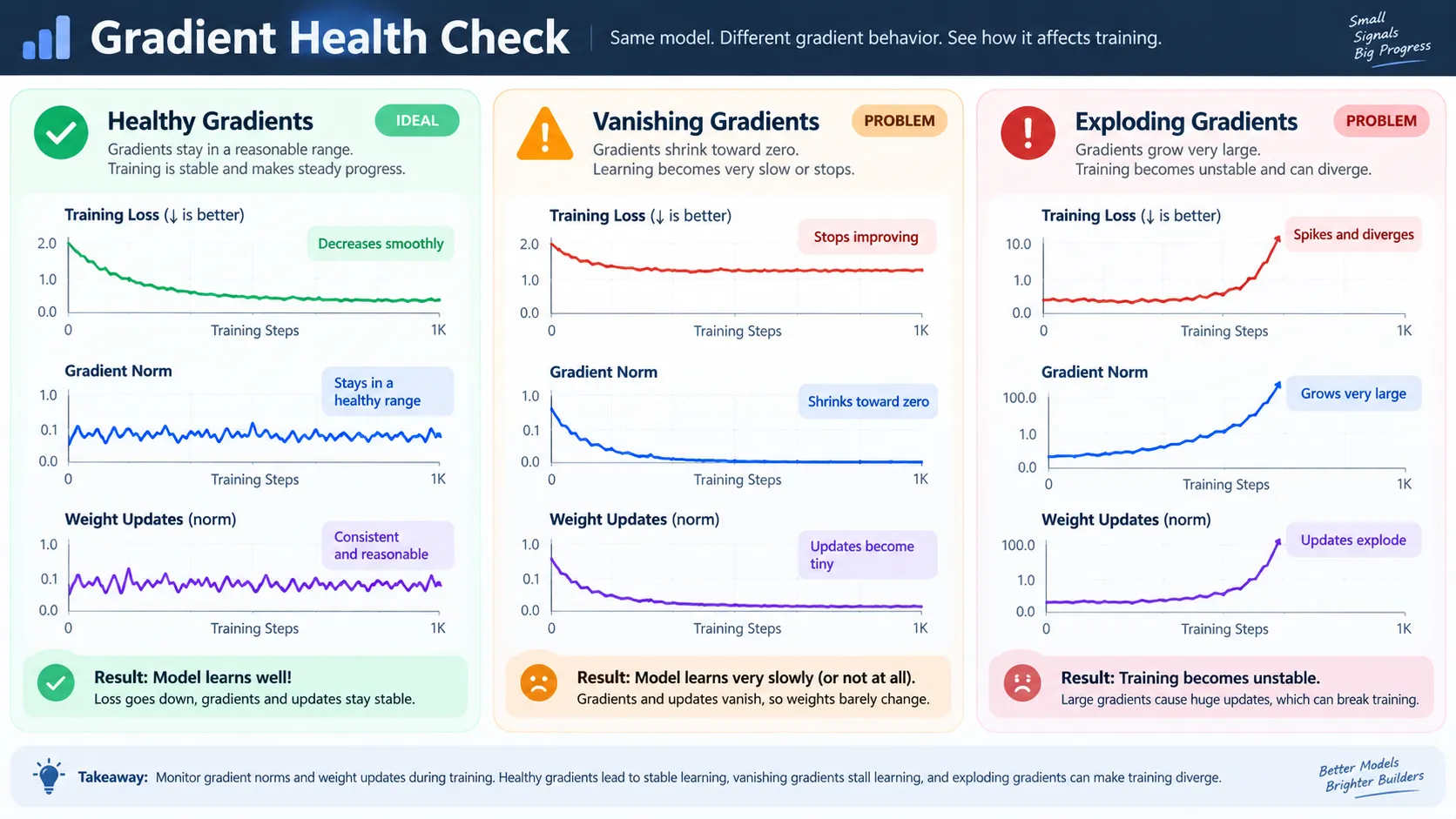
One obvious warning sign is a loss value that suddenly becomes extremely large.
You may also see:
training that changes wildly between steps,
weights becoming extremely large,
gradient norms increasing sharply,
loss turning into NaN or infinity,
or a model that trains normally for some time and suddenly becomes unstable.
This can be confusing because people often blame the dataset or optimizer first.
But sometimes the real issue is simply that the gradients have become too large.
A Simple Real-Life Training Scenario
Suppose you build a deep neural network to predict delivery time for an online shopping platform.
The model uses information such as location, traffic, weather, order size, delivery distance and previous delivery patterns.
At first, the model trains normally.
Then you increase its depth because you want it to learn more complex patterns.
Suddenly, training becomes strange.
The loss barely improves in one experiment.
In another experiment, the loss shoots upward and eventually becomes NaN.
The architecture may not necessarily be useless.
You may simply be seeing two different gradient problems.
If gradients are becoming too small, early layers stop learning effectively.
If gradients are growing too large, weight updates become unstable.
Understanding which problem is happening is important because their fixes are not always identical.
Vanishing vs Exploding Gradients: The Core Difference
The easiest way to remember them is this:
Vanishing gradient = the learning signal becomes too weak.
Exploding gradient = the learning signal becomes too strong.
One causes parts of the network to learn painfully slowly.
The other can make training unstable or completely break it.
And network depth alone is not the full story.
Activation functions, weight initialization, architecture, recurrent connections, learning rate and normalization can all influence how smoothly gradients move through a model.
That is why fixing gradient problems is not about applying one magic setting.
The first job is learning how to recognize what is happening inside the network.
Why Do Vanishing and Exploding Gradients Happen?
Knowing that gradients become too small or too large is only the first step.
The more useful question is:
Why does this happen in the first place?
There is rarely one single reason. In most deep neural networks, gradient problems come from a combination of network depth, activation functions, weight initialization and repeated mathematical operations during backpropagation.
Once you understand these causes, fixing unstable neural network training becomes much easier.
1. Very Deep Networks Create a Long Gradient Path
Every additional layer gives a neural network more ability to learn complex patterns.
But it also makes the path for backpropagation longer.
Imagine passing a signal backward through 50 layers.
At every layer, that signal is multiplied by another value.
If those values are mostly smaller than 1, the gradient can slowly shrink toward zero.
If they are repeatedly larger than 1, the gradient can grow very quickly.
This is why gradient flow in deep networks matters so much.
The goal is not simply to build the deepest model possible. We want useful learning signals to reach the important layers without disappearing or becoming uncontrollably large.
2. Poor Weight Initialization Can Hurt Training From the Beginning
Before train
ing starts, neural network weights need initial values.
These initial values may look like a small detail, but they can affect the entire training process.
Suppose the starting weights are too small.
As the gradient passes backward and repeatedly interacts with these small values, it may become smaller and smaller.
Now imagine starting with weights that are too large.
Activations and gradients may grow aggressively as they pass through the network, increasing the chance of unstable updates.
This is why simply setting weights randomly without considering the architecture is not always enough.
Two widely used approaches are Xavier initialization and He initialization.
Xavier Initialization
Xavier, also called Glorot initialization, tries to keep the scale of signals more balanced as they move through different layers.
It is commonly associated with activation functions such as tanh.
The main idea is simple:
Do not let values become dramatically larger or smaller every time they pass through another layer.
He Initialization
For neural networks using ReLU-style activation functions, He initialization is often a better choice.
It considers the behavior of rectifier-based activations when setting initial weights.
In practical terms, good initialization gives training a healthier starting point.
It does not magically solve every gradient problem, but it can greatly reduce unnecessary instability.
How Activation Functions Affect Gradient Flow
Activation functions decide how signals are transformed inside a neural network.
They also affect what happens during backpropagation.
Sigmoid and the Vanishing Gradient Problem
As discussed earlier, sigmoid can move into saturated regions where its gradient becomes extremely small.
If this happens across several layers, earlier layers may receive almost no useful learning signal.
This is one reason sigmoid is usually not the first choice for hidden layers in a very deep feedforward network.
What About Tanh?
tanh is often better centered than sigmoid because its output ranges roughly from -1 to 1.
But it can still saturate.
When input values become very positive or very negative, the slope of tanh becomes small.
So vanishing gradients can still occur.
Why ReLU Helps
ReLU uses a very simple rule.
Positive values are allowed to pass through, while negative values become zero.
For positive inputs, ReLU does not have the same saturating behavior as sigmoid.
This can make gradient flow easier through deep networks.
However, ReLU is not perfect.
A neuron that keeps receiving negative values may output zero repeatedly and stop updating effectively.
This is sometimes called the dying ReLU problem.
Alternatives such as Leaky ReLU, PReLU and other modern activation functions can help in situations where this becomes a serious issue.
Why RNNs Are Especially Vulnerable
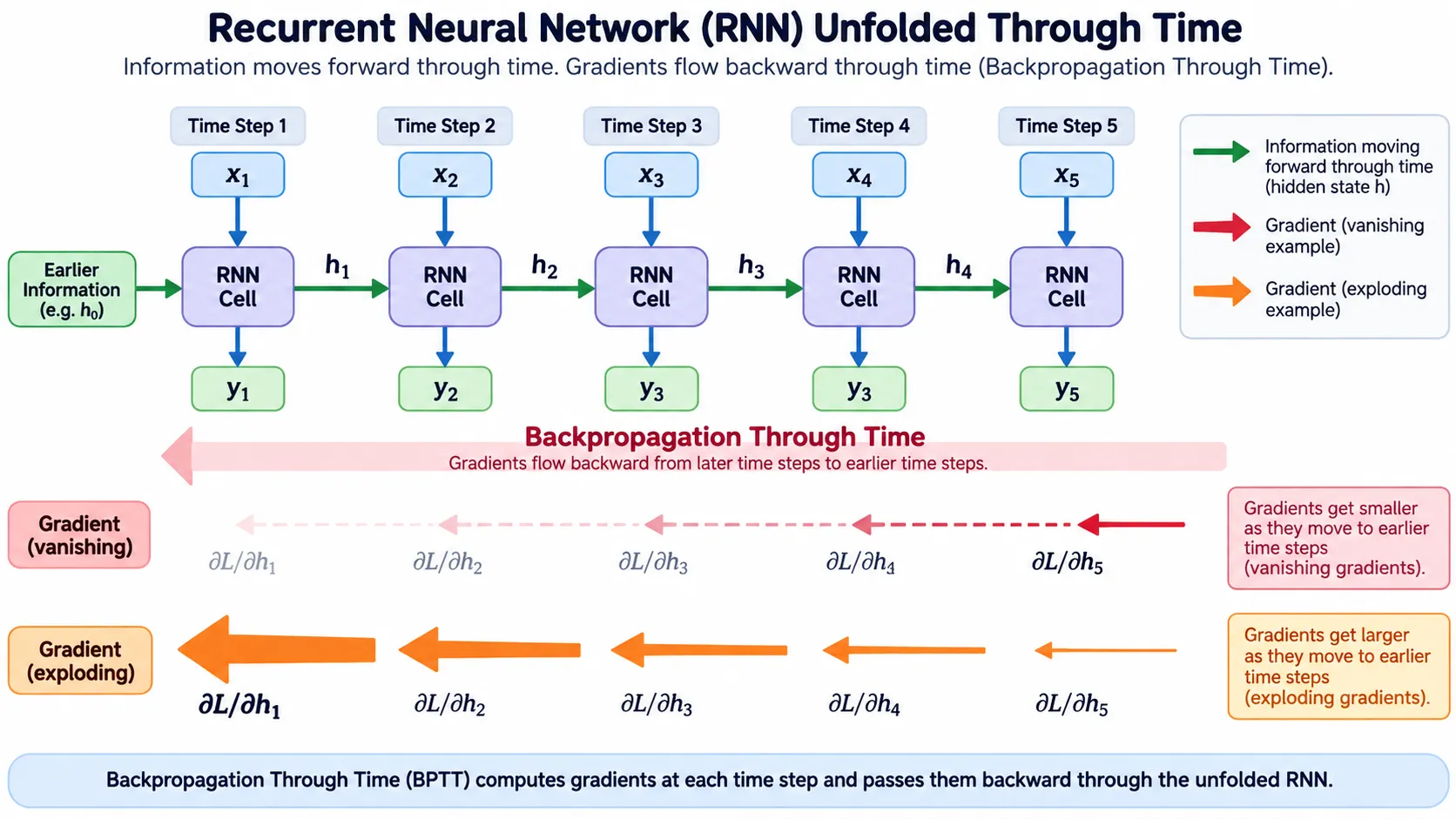
Vanishing and exploding gradients became particularly famous because of recurrent neural networks, or RNNs.
An RNN processes sequential information by carrying information from one step to another.
Think about predicting the next word in a sentence:
“The package I ordered three weeks ago finally arrived at my...”
To predict the next word correctly, the model may need information from much earlier in the sentence.
During training, an RNN effectively performs backpropagation through many time steps.
This is known as Backpropagation Through Time, or BPTT.
The longer the sequence becomes, the more repeated multiplications are involved.
And that creates the perfect environment for gradients to either shrink or grow.
A Simple Long-Term Memory Example
Imagine an AI system analyzing customer reviews.
A review begins with:
“I thought this phone would be terrible...”
Several sentences later, it ends with:
“...but after two months of use, I absolutely love it.”
A basic RNN may need to carry information across many steps to understand the full meaning.
If gradients vanish while training, learning these long-term relationships becomes difficult.
This problem helped motivate architectures such as LSTM and GRU, which were designed to handle information across longer sequences more effectively.
How to Detect Vanishing Gradients
One dangerous thing about vanishing gradients is that your model may not completely fail.
It may simply learn very slowly.
Look for signs such as:
training loss decreasing extremely slowly
early layers changing very little
gradients becoming extremely close to zero
deeper layers learning while earlier layers appear almost frozen
performance stopping far earlier than expected
A useful debugging method is to inspect the gradient norm of different layers.
If gradients become smaller and smaller as you move toward earlier layers, you may have a gradient flow problem.
How to Detect Exploding Gradients
Exploding gradients are usually easier to notice because training can become visibly unstable.
Common warning signs include:
sudden jumps in training loss
extremely large weight values
very large gradient norms
unstable predictions
loss becoming NaN
loss becoming infinity
training working normally and then suddenly collapsing
Gradient Clipping: A Practical Fix for Exploding Gradients
One of the best-known techniques for controlling exploding gradients is gradient clipping.
Imagine the gradient norm suddenly becomes extremely large.
Instead of allowing the optimizer to use that huge value directly, gradient clipping places a limit on how large the update is allowed to become.
Think of it like a speed limiter on a car.
The engine can generate more power, but once the car reaches a chosen limit, it is prevented from accelerating uncontrollably.
The same basic idea can make neural network training more stable.
Gradient clipping is especially common when training recurrent networks and other models where very large gradients may appear.
But remember:
Gradient clipping mainly controls exploding gradients. It does not directly solve the root cause of vanishing gradients.
For vanishing gradients, we usually need to think about activation functions, initialization, normalization and network architecture.
Better Gradient Flow Needs More Than One Fix
There is no single setting called “fix gradients.”
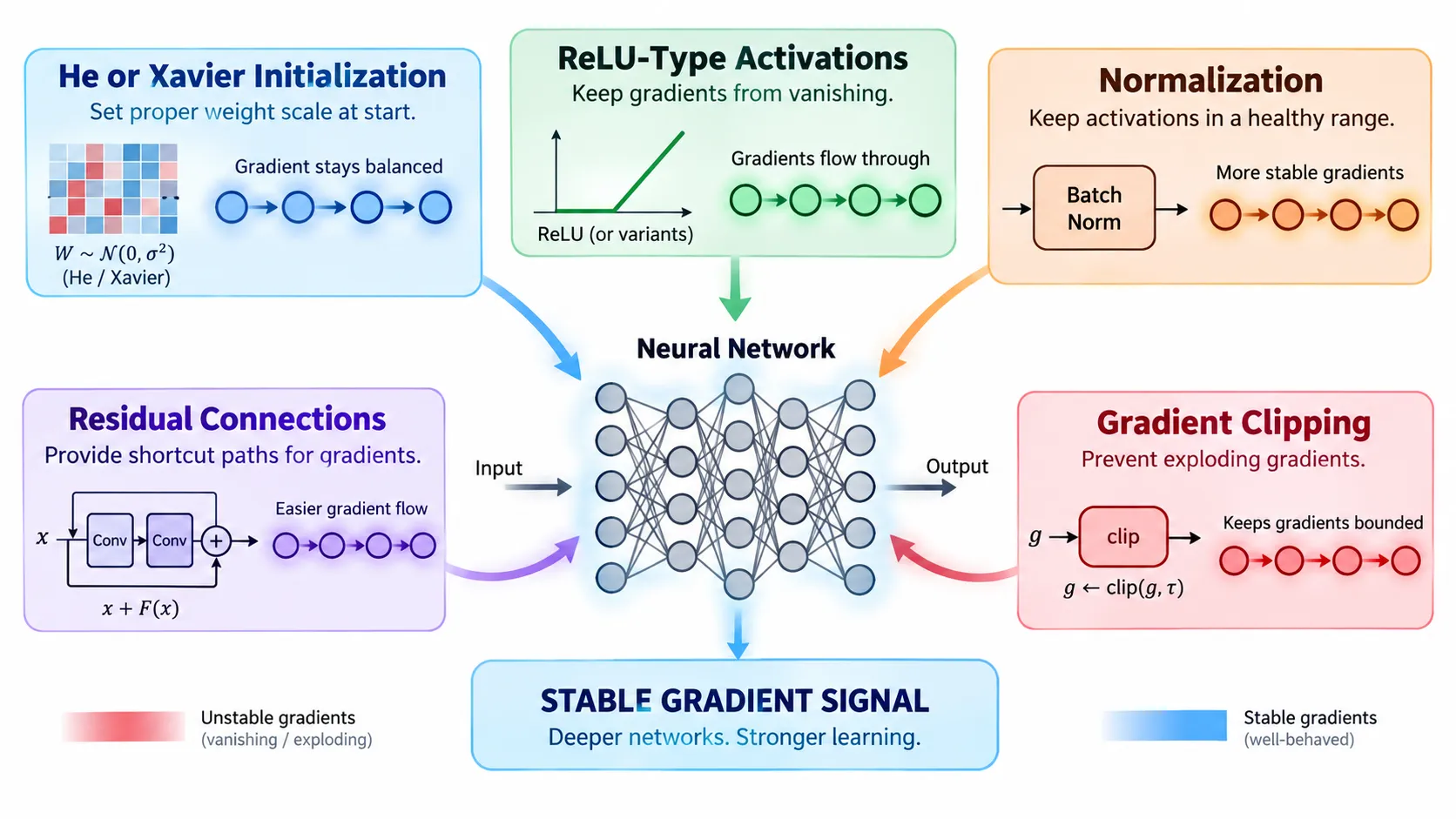
A stable deep network usually comes from several good choices working together:
proper weight initialization,
suitable activation functions,
a reasonable learning rate,
normalization when appropriate,
careful architecture design,
and gradient clipping when exploding gradients are a risk.
The most important habit is to stop treating training instability as a mystery.
Watch the gradients.
Watch the loss.
Watch how different layers are learning.
Once you can see where the learning signal becomes too weak or too strong, fixing the model becomes far more systematic.
How to Fix Vanishing and Exploding Gradients
Once you know that gradients are causing trouble, the next step is not to randomly change settings.
A better approach is to fix the parts of the network that control gradient flow.
In most cases, stable training comes from using the right combination of activation functions, weight initialization, normalization, architecture and optimizer settings.
Let us go through the most useful fixes one by one.
Use the Right Weight Initialization
Good weight initialization gives the network a balanced starting point.
If you are using ReLU or similar activation functions, He initialization is usually a strong choice.
If your network uses tanh or similar activations, Xavier initialization can often work well.
The goal is simple:
Keep activations and gradients from becoming extremely small or extremely large as they move through the network.
This one decision can make a noticeable difference before training even begins.
Prefer ReLU-Type Activations in Deep Hidden Layers
For many deep feedforward networks, ReLU and its variants are easier to train than sigmoid.
Sigmoid can saturate and produce very small gradients.
ReLU avoids this problem for positive inputs, which often helps gradients travel through deeper networks.
If dying ReLU becomes a problem, you can consider alternatives such as Leaky ReLU.
The important point is not that one activation is always best.
The activation should match the architecture and the problem you are solving.
Use Batch Normalization to Stabilize Training
Batch Normalization can also help make deep network training more stable.
It normalizes intermediate activations during training so that values do not constantly move into extreme ranges.
In practical terms, this can make optimization easier and allow the model to train more smoothly.
Imagine trying to learn while the difficulty level of every lesson changes wildly.
That would make learning harder.
Batch Normalization helps keep internal values in a more manageable range.
It is not a direct replacement for good initialization or architecture design, but it can support healthier training.
Residual Connections Help Gradients Travel Through Deep Networks
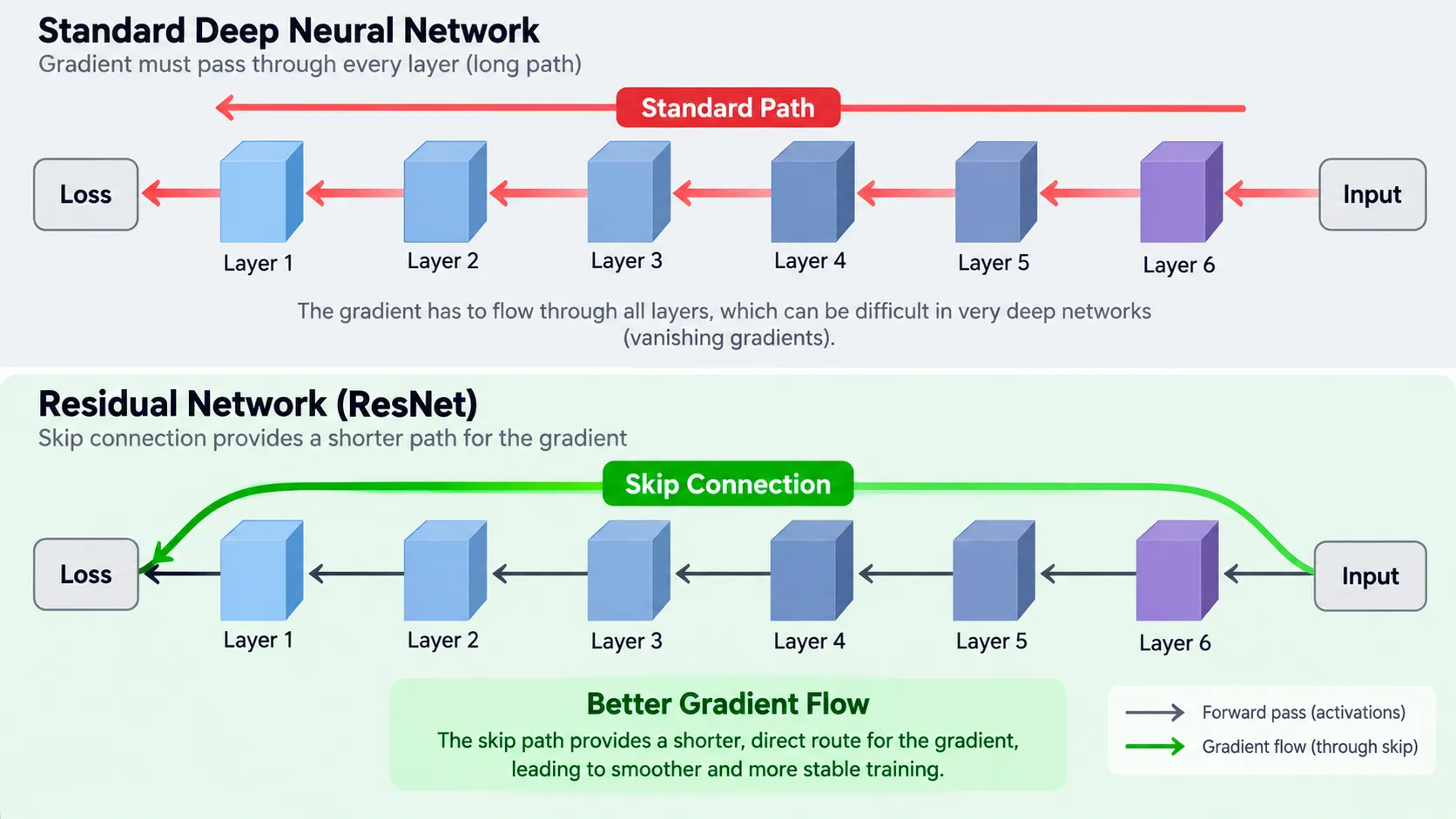
One of the biggest breakthroughs in very deep neural networks was the use of residual connections, also called skip connections.
Instead of forcing information to move through every transformation in sequence, a residual connection creates a shorter path.
Think of a large office building.
Normally, you may need to pass through ten rooms to reach the other side.
A skip connection is like adding a direct hallway.
Information and gradients now have an easier route.
This idea is a major reason very deep architectures such as ResNet can be trained more effectively.
Residual connections help reduce the difficulty of passing useful signals through many layers.
LSTM and GRU Help With Long-Term Dependencies
For sequence problems, standard RNNs can struggle badly with vanishing gradients.
Architectures such as LSTM and GRU were designed to make long-term information easier to preserve.
They use special gates that control what information should be remembered, updated or forgotten.
Imagine reading this sentence:
“The restaurant looked ordinary from outside, but after trying the food and seeing the service, I would definitely visit again.”
To understand the final opinion, the model needs to connect information across multiple words and phrases.
LSTMs and GRUs are better designed for this type of long-term relationship than a basic RNN.
They do not remove every training problem, but they greatly improve gradient flow across long sequences.
Reduce an Overly Aggressive Learning Rate
Sometimes what looks like an exploding gradient problem becomes much worse because the learning rate is too high.
The learning rate decides how large each optimization step should be.
Imagine walking down a mountain toward the lowest point.
Small, controlled steps help you move toward your goal.
But if every step is ten meters long, you may repeatedly jump past the target.
A very high learning rate can make neural network updates unstable.
If loss jumps wildly or training suddenly collapses, lowering the learning rate is one of the first things worth testing.
Use Gradient Clipping When Gradients Become Too Large
As we discussed earlier, gradient clipping places a limit on extremely large gradients.
Instead of allowing a huge gradient to create a massive update, the gradient is scaled or limited.
This is especially useful in sequence models.
However, clipping should not become an excuse to ignore deeper problems.
If gradients explode constantly, also inspect:
the learning rate,
weight initialization,
network depth,
activation functions,
and the overall architecture.
Gradient clipping is a safety mechanism, not a magic cure.
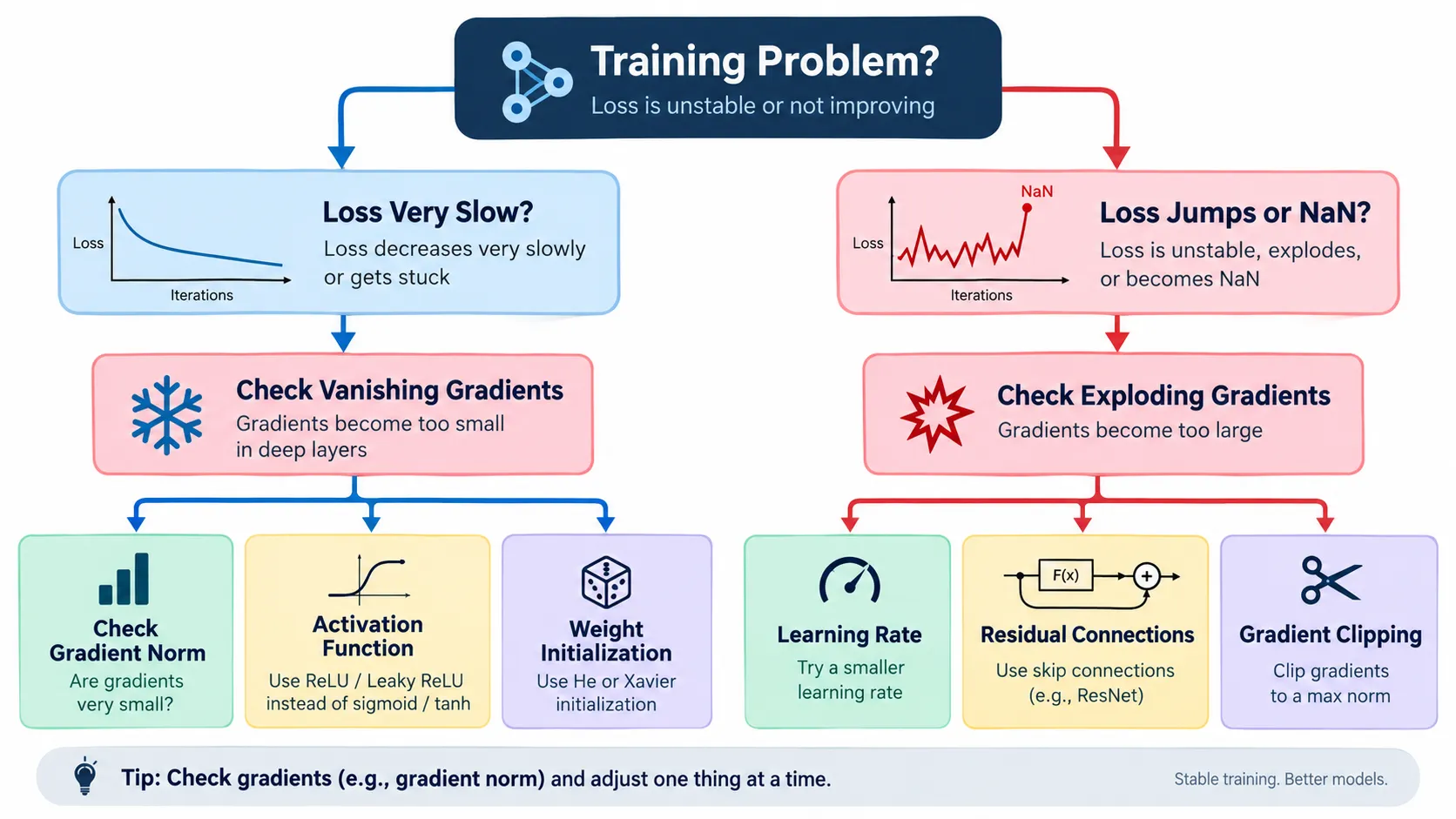
A Practical Debugging Workflow
Suppose your deep learning model suddenly stops training properly.
Do not change ten things at once.
Start by looking at the training loss.
If the loss becomes extremely large or turns into NaN, check for exploding gradients.
Next, inspect gradient norms.
If gradient values are huge, test a lower learning rate and gradient clipping.
If gradients in early layers are almost zero, investigate vanishing gradients.
Then check your activation functions and initialization.
For a deep ReLU network, make sure initialization is suitable for ReLU.
If the network is extremely deep, consider whether residual connections would improve gradient flow.
For a sequence model, ask whether a basic RNN should be replaced with an LSTM or GRU.
This step-by-step approach is far more useful than randomly changing hyperparameters.
Real-World Example: Fixing an Unstable Prediction Model
Imagine a team building a neural network to predict electricity demand.
The model uses weather, time of day, previous electricity usage, holidays and seasonal patterns.
The first version has only a few layers and trains well.
The team then creates a much deeper version because they expect better accuracy.
But training becomes unstable.
Sometimes the loss barely improves.
Other times, the loss suddenly explodes.
Instead of immediately deleting the architecture, the team investigates the gradient flow.
They discover that early layers receive extremely small gradients, while some later training steps produce unusually large gradient norms.
They replace poor initialization with a better method, use ReLU-based activations, reduce the learning rate and add residual connections.
They also apply gradient clipping where large gradients appear.
Training becomes much more stable.
The important lesson is that the model did not necessarily need more data or more layers.
It needed healthier gradient flow.
Final Thoughts
Vanishing and exploding gradients sound like advanced deep learning problems, but the core idea is simple.
A neural network learns by sending error information backward.
If that learning signal becomes too weak, earlier layers stop learning properly.
If it becomes too strong, training becomes unstable.
That is the difference between the vanishing gradient problem and the exploding gradient problem.
Modern deep learning gives us several ways to control these issues.
Good weight initialization can create a healthier starting point.
ReLU-style activations can improve gradient flow in deep hidden layers.
Batch Normalization can make training more stable.
Residual connections create easier paths through very deep networks.
LSTM and GRU architectures help sequence models preserve information over longer periods.
Gradient clipping can protect training when gradients become dangerously large.
And a reasonable learning rate keeps weight updates under control.
The main lesson is not to memorize a list of fixes.
Learn to observe what your network is doing.
When loss behaves strangely, inspect the gradients.
When early layers stop learning, check whether the signal is disappearing.
When updates become unstable, check whether gradients are growing too large.
Once you understand the flow of gradients, deep neural network training becomes much less mysterious.
Frequently Asked Questions About Vanishing and Exploding Gradients
What is a vanishing gradient in deep learning?
A vanishing gradient happens when the gradients used during backpropagation become extremely small as they move toward the earlier layers of a neural network.
When this happens, those early layers receive almost no useful learning signal. Their weights change very slowly, and the model may struggle to learn important patterns.
This problem is more common in very deep networks and in models that use saturating activation functions such as sigmoid.
What causes exploding gradients?
Exploding gradients happen when gradient values become extremely large during backpropagation.
This can happen because of poor weight initialization, repeated multiplication across many layers or time steps, an unsuitable network architecture, or an aggressive learning rate.
Common warning signs include unstable loss, very large gradient norms, huge weight values, and loss values that suddenly become NaN or infinity.
How can I tell if my model has vanishing gradients?
A common sign is that the model trains very slowly even though the training process is still running.
You may notice that gradients in the earlier layers are extremely close to zero while later layers continue changing.
Checking gradient norms across different layers is one of the most useful ways to detect this problem.
How do you prevent vanishing gradients?
There is no single fix, but several techniques can improve gradient flow.
Using suitable weight initialization, ReLU-style activation functions, residual or skip connections, normalization, and architectures designed for long-term information can all help.
For sequence problems, LSTM and GRU networks are often better choices than a basic RNN when long-term dependencies are important.
What is the best way to fix exploding gradients?
Gradient clipping is one of the most common ways to control exploding gradients.
It prevents extremely large gradients from creating dangerously large weight updates.
You should also check the learning rate, weight initialization, activation functions, and network architecture because gradient clipping controls the symptom but may not remove the deeper cause.
What is the difference between vanishing and exploding gradients?
The difference is the size of the learning signal.
With a vanishing gradient, the signal becomes too small, so earlier layers learn very slowly.
With an exploding gradient, the signal becomes too large, making training unstable.
A simple way to remember it is:
Vanishing gradient = too little learning signal.
Exploding gradient = too much learning signal.
Does ReLU solve the vanishing gradient problem?
ReLU can greatly reduce the vanishing gradient problem compared with sigmoid in many deep networks because it does not saturate in the same way for positive inputs.
However, ReLU is not a complete solution.
Neurons can sometimes become inactive when they continuously receive negative inputs. This is known as the dying ReLU problem.
That is why activation choice should be combined with good initialization and architecture design.
Why are vanishing gradients common in RNNs?
RNNs pass information through many time steps.
During Backpropagation Through Time, gradients are repeatedly multiplied as they travel backward through those steps.
If the values involved are consistently small, the gradient may gradually disappear.
This makes it difficult for a basic RNN to learn relationships between information that appears far apart in a sequence.
LSTM and GRU architectures were designed to handle these long-term relationships more effectively.
🚀 Want to master Machine Learning?
👉 Click here to explore our complete Machine Learning guide!


