


How Transformers Focus on Multiple Things at Once
Imagine you're sitting in a busy classroom. Your teacher is explaining something important, your friend whispers a question, and someone at the back of the room drops a book.
Even though several things happen together, your brain can pick up different pieces of information. You understand what your teacher is saying, recognize your friend's voice, and notice the sudden noise.
Now imagine an artificial intelligence system trying to do something similar while reading a sentence.
Consider this example:
"The boy gave his dog some water because it was thirsty."
When you read this sentence, you naturally understand that "it" refers to the dog.
But how does a machine figure that out?
More importantly, how does it identify relationships between different words while also understanding grammar, meaning, and context?
This is where multi-head attention becomes important.
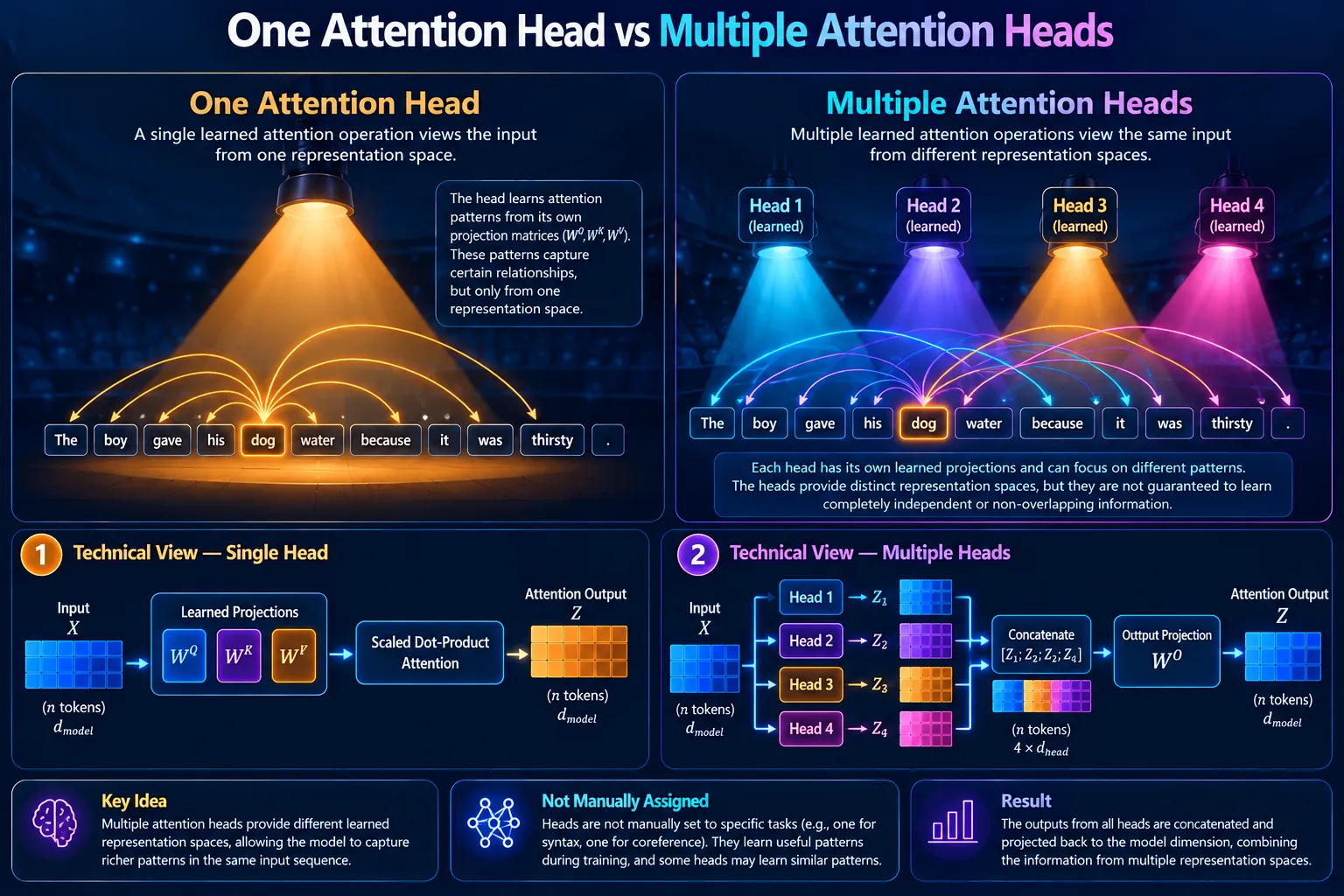
Instead of examining a sentence through just one set of learned relationships, a Transformer can analyze information through several attention mechanisms working in parallel.
This approach helps AI models build richer representations of language.
And once you understand how it works, one of the most important ideas behind modern AI becomes much easier to follow.
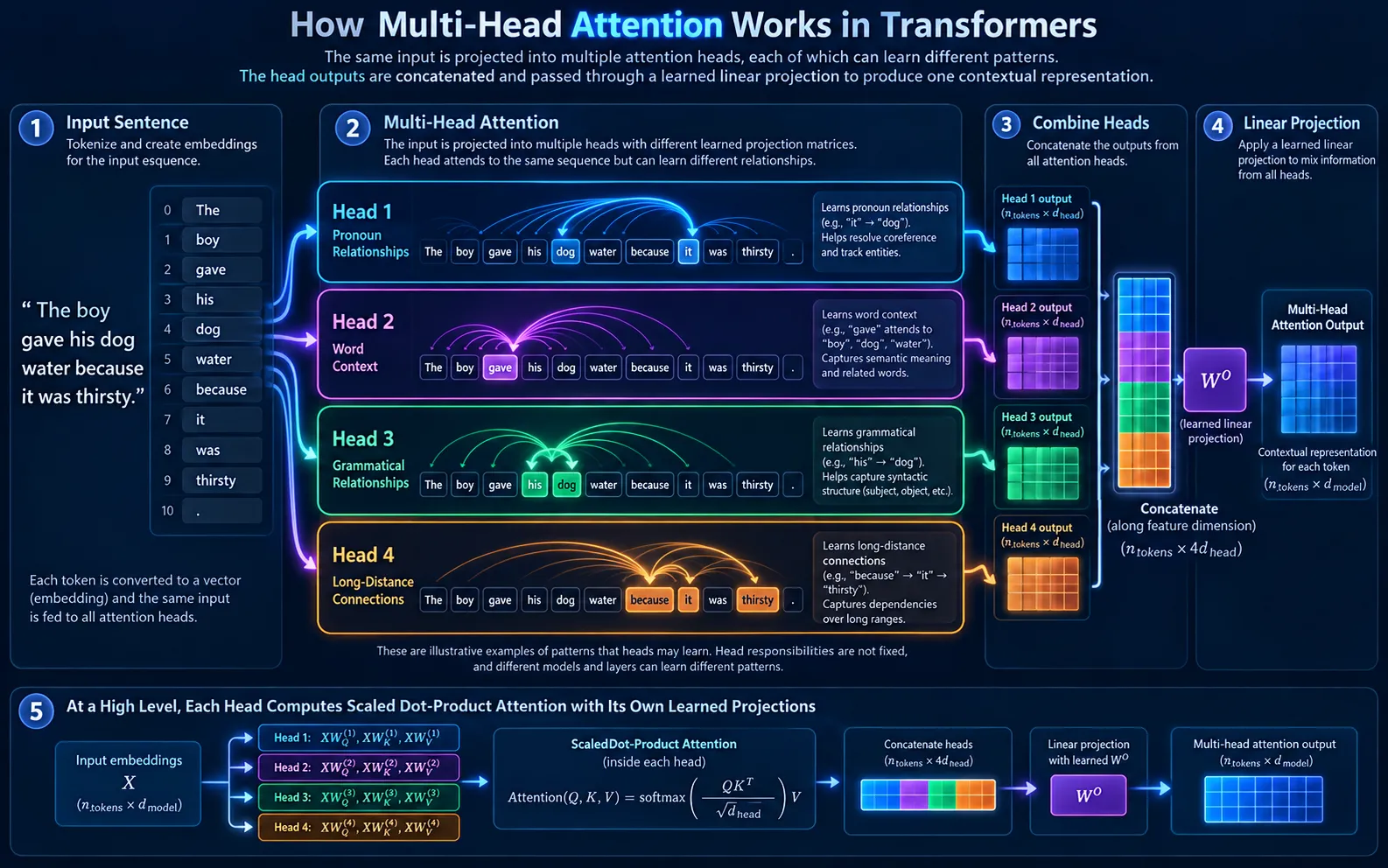
What Is Multi-Head Attention?
Multi-head attention is a mechanism used in Transformer neural networks that allows a model to examine different relationships within information simultaneously.
Think of it as having several readers examine the same sentence, each looking for something useful.
One reader might notice which words are connected.
Another might focus on nearby words.
A third might identify relationships between words that appear far apart.
These are examples of patterns that different attention heads might learn, not fixed responsibilities assigned to each head.
After examining the information, their findings are combined into a single representation.
That's the basic idea behind multi-head attention.
In technical terms, the mechanism uses multiple attention heads. Each head has its own learned projections that allow it to process information in a different representation space.
The outputs are then combined and transformed so the next layer can use them.
This design was introduced as a central component of the Transformer architecture in the 2017 research paper Attention Is All You Need.
Transformers Explained — Complete Beginner's Guide
A Simple Everyday Example
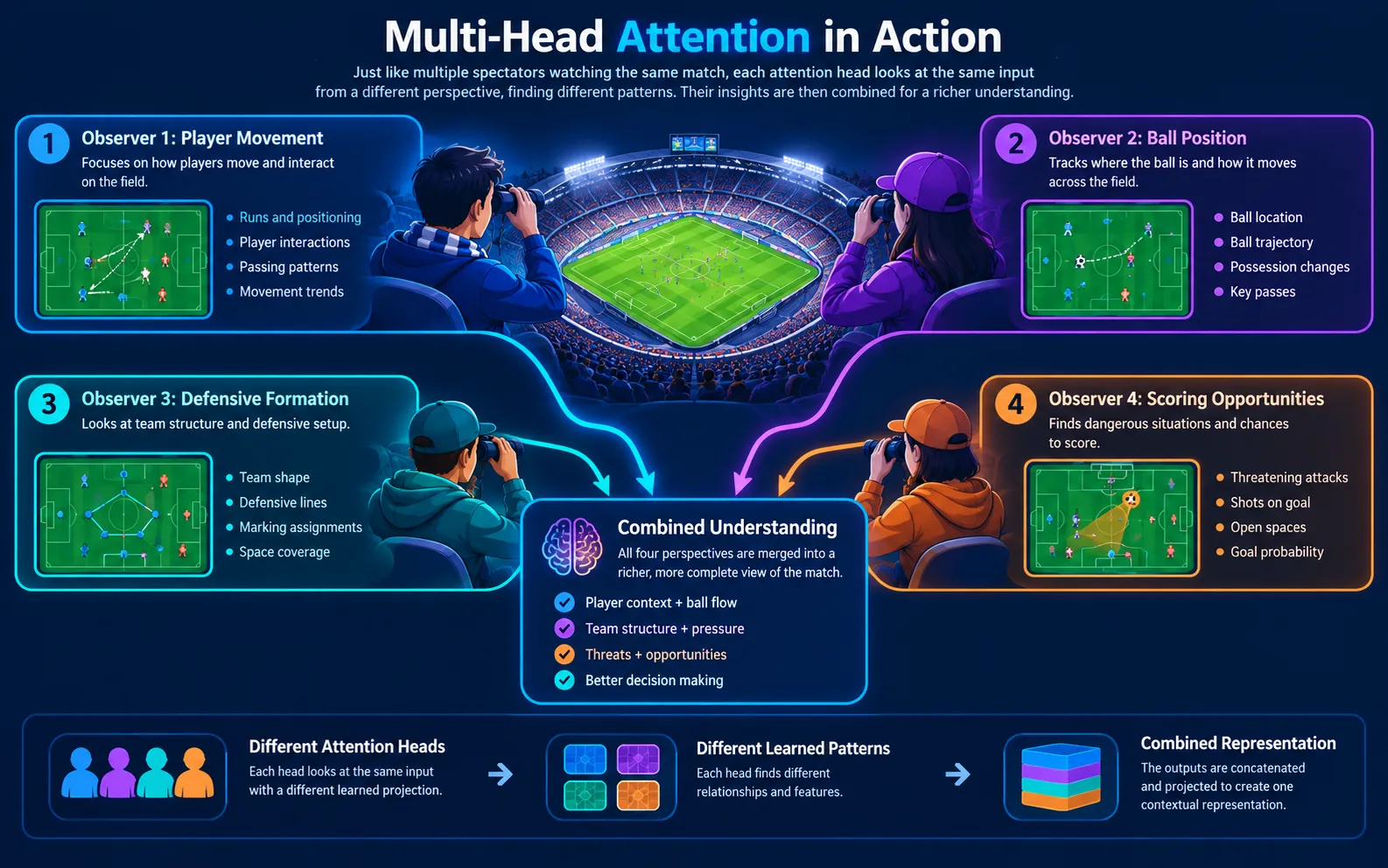
Imagine four friends watching the same football match.
One watches how the players move.
Another follows the ball.
The third studies the defensive positions.
The fourth notices opportunities to score.
Everyone watches the same match, but each person pays attention to different details.
When they share their observations, they can develop a more complete understanding of the game.
Multi-head attention follows a similar principle.
Each attention head learns its own way of examining the input, and the Transformer combines information from those different perspectives.
However, unlike the football fans, attention heads are not explicitly instructed what to look for. They learn useful patterns during training.
Why Do Transformers Need Multi-Head Attention?
To understand why multiple attention heads are useful, we first need to understand a problem with reading words individually.
Take this sentence:
"The bank near the river was flooded."
The word "bank" can have different meanings.
It might describe a financial institution or the land beside a river.
If an AI model considers only the word "bank," it may struggle to identify the intended meaning.
But when it examines the surrounding words, the answer becomes clearer.
The words "river" and "flooded" provide important context.
This is one of the reasons attention mechanisms matter.
They allow a model to use information from other relevant positions when representing a particular word.
The Limitation of Looking Through One Attention Head
A single attention head can learn useful relationships between words.
But it produces one attention-based combination of information for each position.
That can limit the variety of relationships represented within that particular attention operation.
Consider another sentence:
"The little girl who was holding a red umbrella ran toward her mother."
To understand this sentence, a language model may benefit from recognizing several relationships.
For example, "girl" connects with "ran," even though other words appear between them.
The word "red" describes "umbrella."
And "her" refers to someone mentioned earlier in the sentence.
A single attention head can represent several relationships, but multiple heads provide separate learned ways to examine them.
This allows the model to gather information from different positions and different representation spaces.
How Multiple Heads Help
With multi-head attention, the model doesn't rely on one attention calculation alone.
Instead, it performs several attention calculations using different learned transformations of the input.
Each head produces its own output.
Those outputs are then combined to create a richer representation.
The important distinction is that different heads can learn complementary patterns, although they may sometimes learn similar or overlapping patterns.
Having more attention heads does not automatically make a model smarter. Their usefulness depends on the architecture, training, and task.
Understanding Self-Attention Before Multi-Head Attention
Before exploring the complete mechanism, let's understand self-attention.
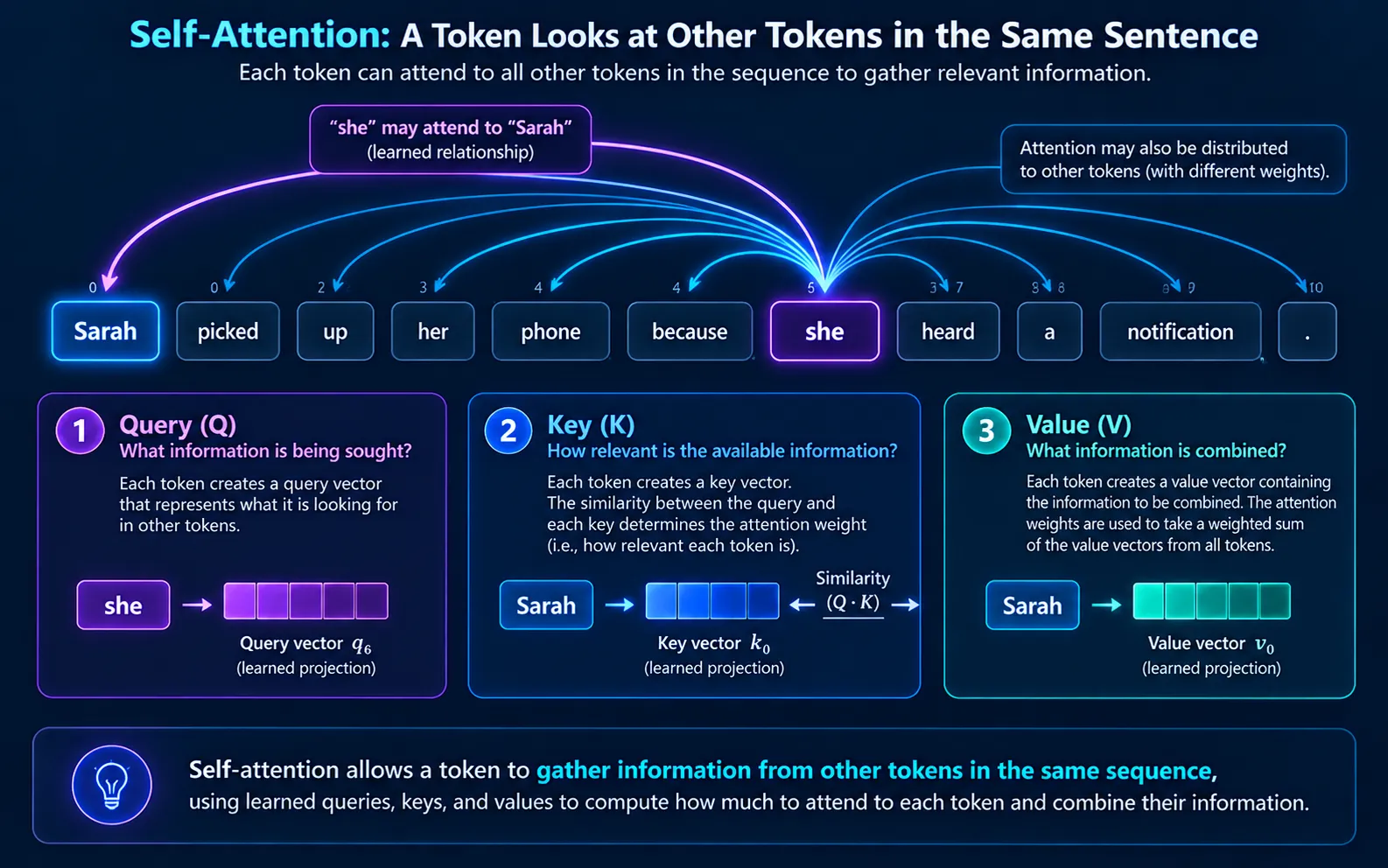
Self-attention allows words or tokens in a sequence to use information from other relevant tokens in that same sequence.
A token is a piece of text processed by a language model. Depending on the tokenizer, it might be a word, part of a word, or punctuation.
Consider this sentence:
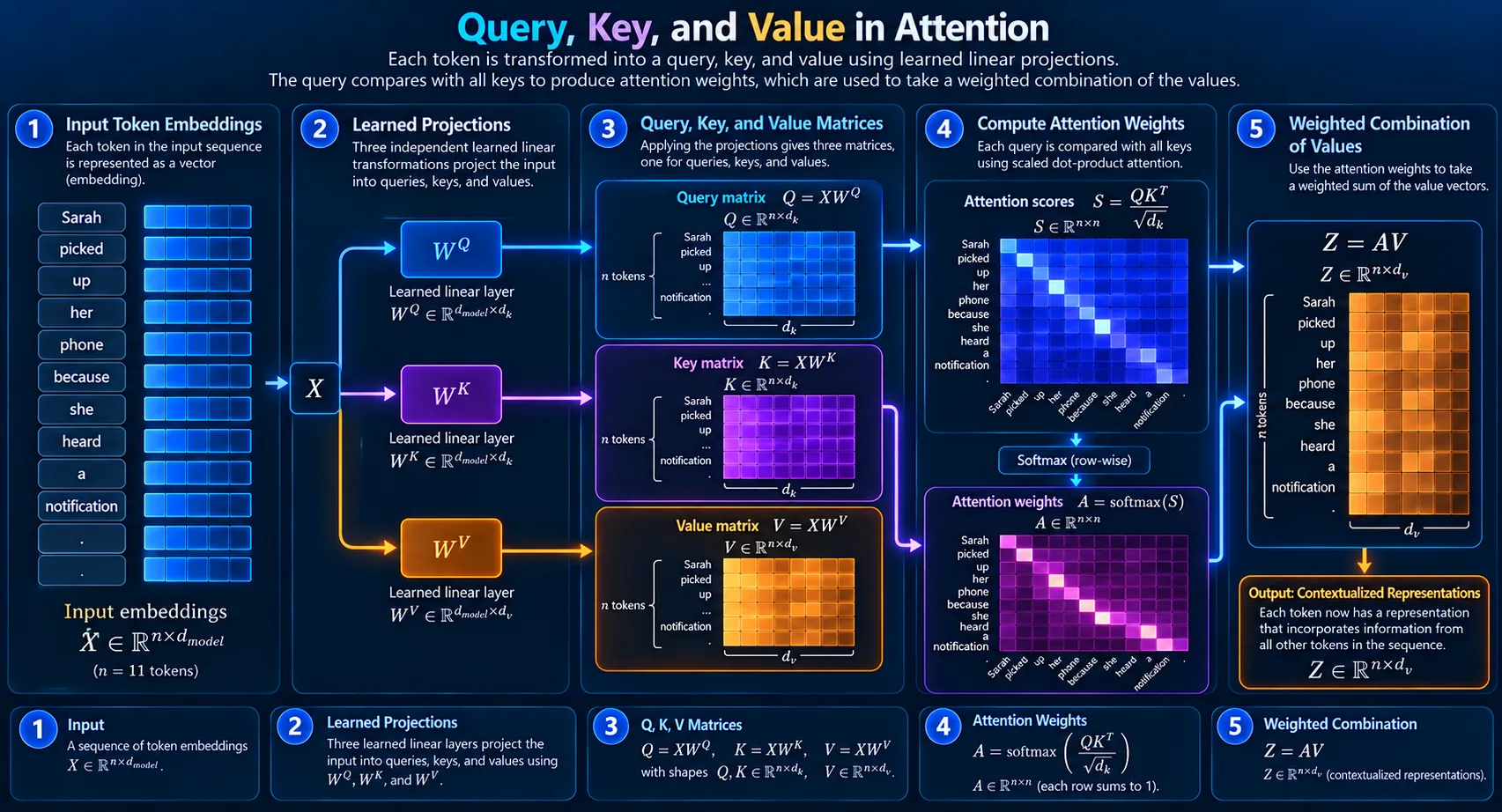
"Sarah picked up her phone because she heard a notification."
When the model processes "she," the earlier word "Sarah" provides useful information.
Self-attention gives the model a way to connect these positions.
It calculates how much information each position should receive from other available positions.
The model then creates a new representation that includes relevant context.
This happens through three important components:
Query (Q): Represents the information a token is looking for.
Key (K): Represents information used to determine how relevant another token is.
Value (V): Represents the information that can be passed into the resulting representation.
You can imagine Query as a question, Key as a way of identifying relevant information, and Value as the information retrieved.
These are learned numerical vectors, not actual written questions or labels.
In multi-head self-attention, several sets of Query, Key, and Value projections are used in parallel.
This is what allows different heads to learn different relationships.
Self-Attention Mechanism Explained with Examples
Query, Key, and Value in Transformers Explained
How Does Multi-Head Attention Work Step by Step?
Now that you understand Query, Key, and Value, let's see how they work together inside a Transformer.
Imagine you're reading a message from your friend:
"Emma bought a new laptop because her old computer stopped working."
You immediately understand that "her" refers to Emma. You also recognize the connection between the new laptop and the broken computer.
A Transformer needs to learn how to identify these relationships using mathematical operations.
The multi-head attention mechanism makes this possible through a sequence of steps.
Step 1: Convert Words Into Numerical Representations
Computers cannot directly understand words the way humans do.
Before processing a sentence, a Transformer converts its tokens into numerical vectors.
These vectors are called embeddings.
An embedding represents information about a token using numbers that the neural network can process.
For example, the sentence:
"Emma bought a laptop"
might be divided into tokens representing "Emma," "bought," "a," and "laptop."
Each token receives a vector containing numerical values.
These vectors provide the starting information for the attention mechanism.
The model also needs information about token positions because attention calculations alone do not tell it which word comes first.
Transformers handle this using positional information.
Positional Encoding in Transformers Explained
Step 2: Create Query, Key, and Value Vectors
The next step involves transforming the token representations into three sets of vectors.
These are Query (Q), Key (K), and Value (V).
Remember our example:
"Emma bought a new laptop because her old computer stopped working."
When processing "her," the model needs information that may help connect the pronoun with Emma.
The Query vector represents what information the current token is seeking.
The Key vectors help determine which token representations are relevant to that Query.
The Value vectors contain the information that can contribute to the final output.
All three are created using learned mathematical transformations.
One important detail is that the model does not manually assign meanings to these vectors.
It learns how to create useful Query, Key, and Value representations during training.
Step 3: Calculate Attention Scores
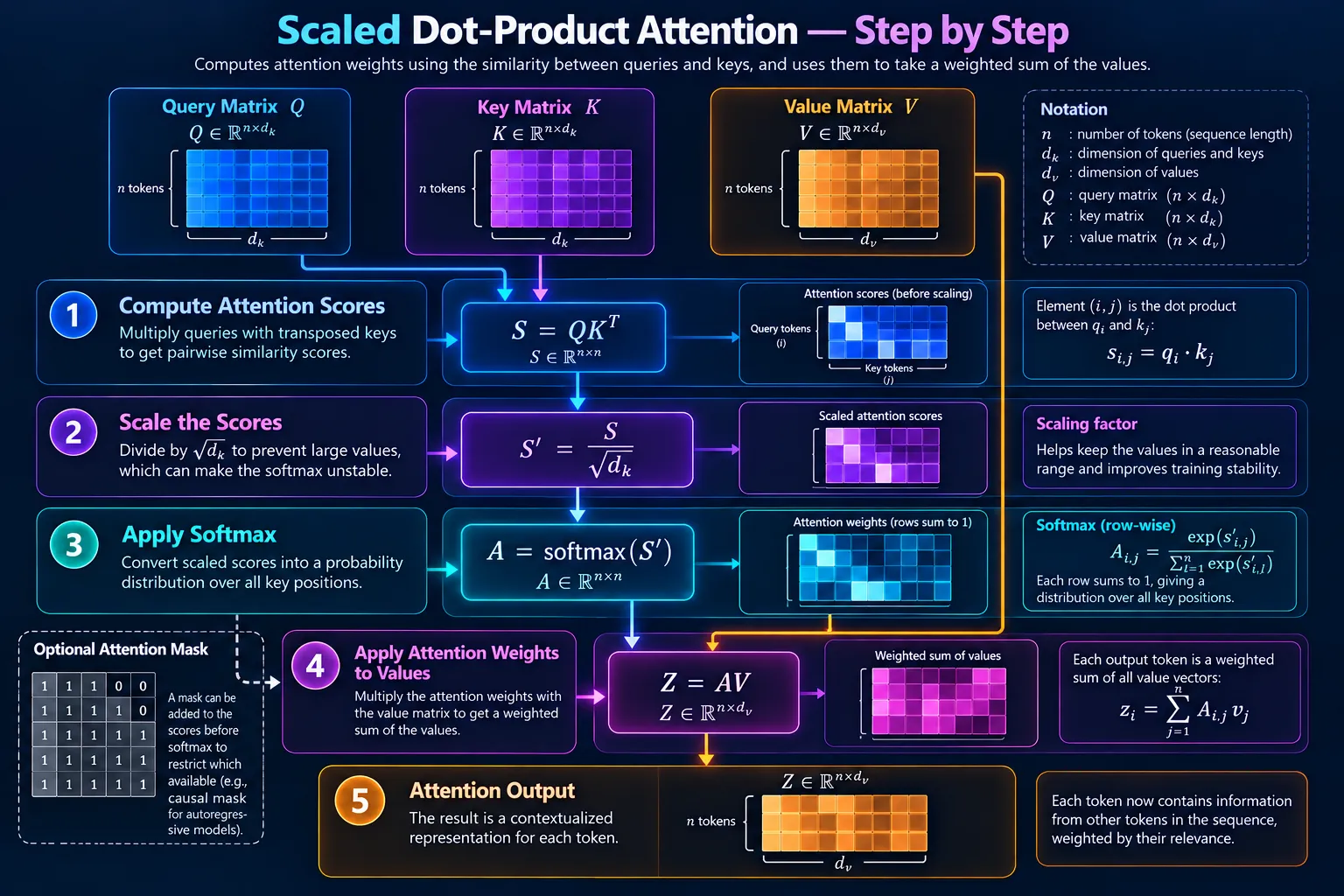
Once the Query and Key vectors are ready, the model compares them.
This comparison produces an attention score.
An attention score helps determine how strongly one token should use information from another token.
The calculation uses an operation called the dot product.
You can think of the dot product as a mathematical way of measuring how well two vectors match.
A higher score generally means that the Key is more compatible with the Query.
However, a high attention score does not necessarily mean that two words have the same meaning.
It simply indicates a stronger learned relationship within that attention calculation.
For example, when processing "her," one attention head might assign a relatively high score to "Emma."
Another head might distribute attention across several words.
These scores are calculated separately for every attention head.
Step 4: Apply Scaling and Softmax
Raw attention scores cannot be used directly as normalized attention weights.
First, the model divides the scores by the square root of the Key vector dimension.
This step is called scaling.
Why is scaling necessary?
When vectors contain many dimensions, their dot products can become large.
Large scores may cause the next mathematical operation to produce extremely uneven results, which can make training more difficult.
Scaling helps control this problem.
After scaling, the model applies a function called softmax.
Softmax converts the scores into non-negative attention weights that add up to 1 across the available Key positions.
Imagine a simplified example where one Query produces these weights:
Emma: 0.60
Bought: 0.10
Laptop: 0.20
Computer: 0.10
These are illustrative values, not actual measurements from a trained model.
They show how one position might receive more attention than others.
The model then uses these weights to combine the corresponding Value vectors.
Softmax Function in Machine Learning Explained
Understanding the Multi-Head Attention Formula
The mathematics may look complicated initially, but the idea behind it is straightforward.
The formula for scaled dot-product attention is:
Attention(Q, K, V) = softmax(QKᵀ / √dₖ) V
Let's understand each component.
Q represents the Query matrix.
Kᵀ represents the transposed Key matrix, allowing Queries to be compared with Keys.
√dₖ is the square root of the Key vector dimension.
Softmax converts the resulting scores into normalized attention weights.
V represents the Value matrix used to calculate the final attention output.
Together, these operations allow the model to create new representations using information from relevant tokens.
A Small Mathematical Example
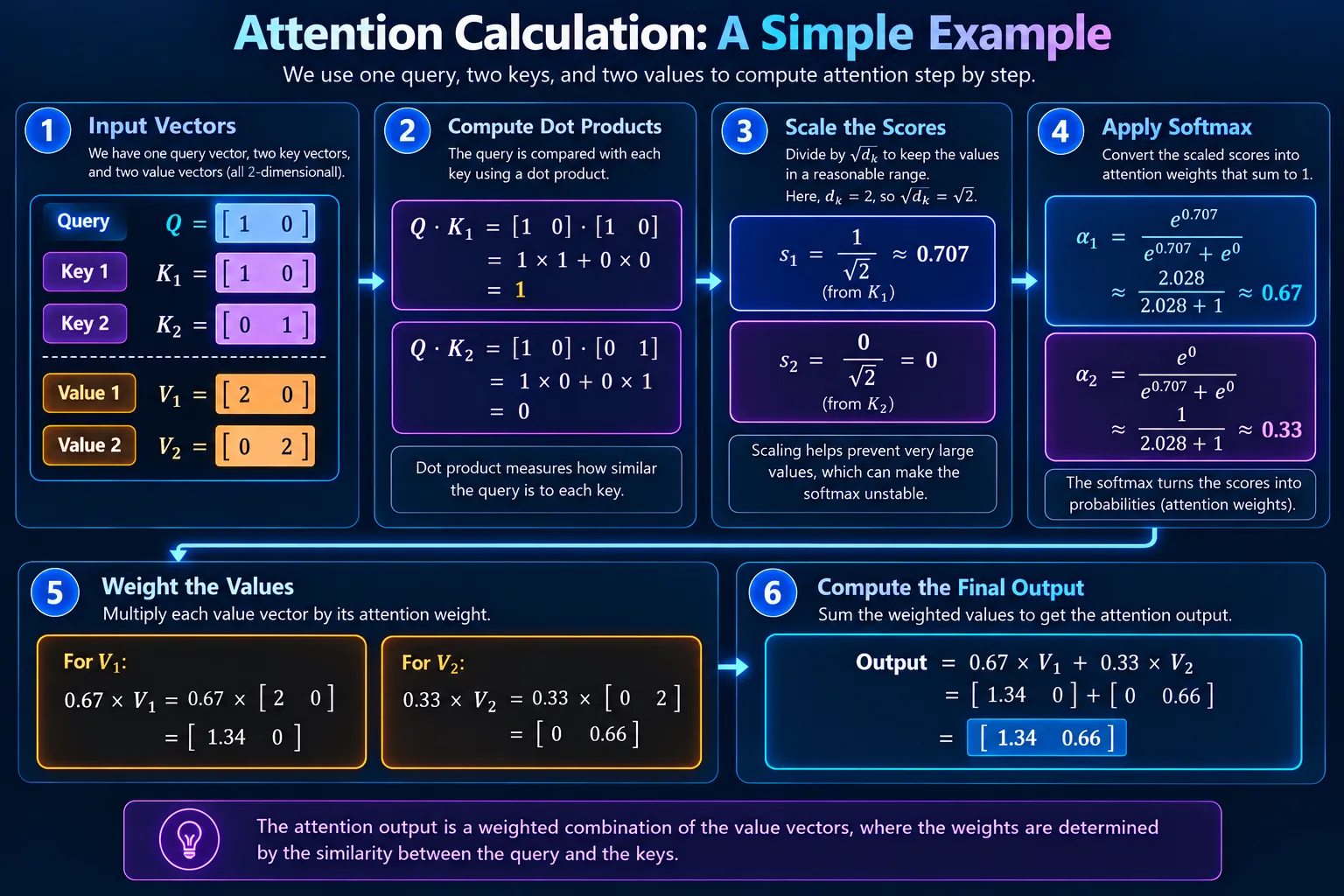
Suppose a Query vector is:
Q = [1, 0]
And two Key vectors are:
K₁ = [1, 0]
K₂ = [0, 1]
Their dot-product scores are:
Q · K₁ = 1
Q · K₂ = 0
Because the Key dimension is 2, both scores are divided by √2.
This gives approximately:
0.707 and 0
Applying softmax produces attention weights of approximately:
0.67 and 0.33
The first Key receives more attention because it matches the Query more strongly.
If the two corresponding Value vectors are [2, 0] and [0, 2], their weighted combination is approximately [1.34, 0.66].
This shows how attention scores determine the information included in the output.
How Multiple Attention Heads Work in Parallel
So far, we've explored how one attention calculation works.
Now imagine performing several attention calculations simultaneously.
That's exactly what happens in multi-head self-attention.
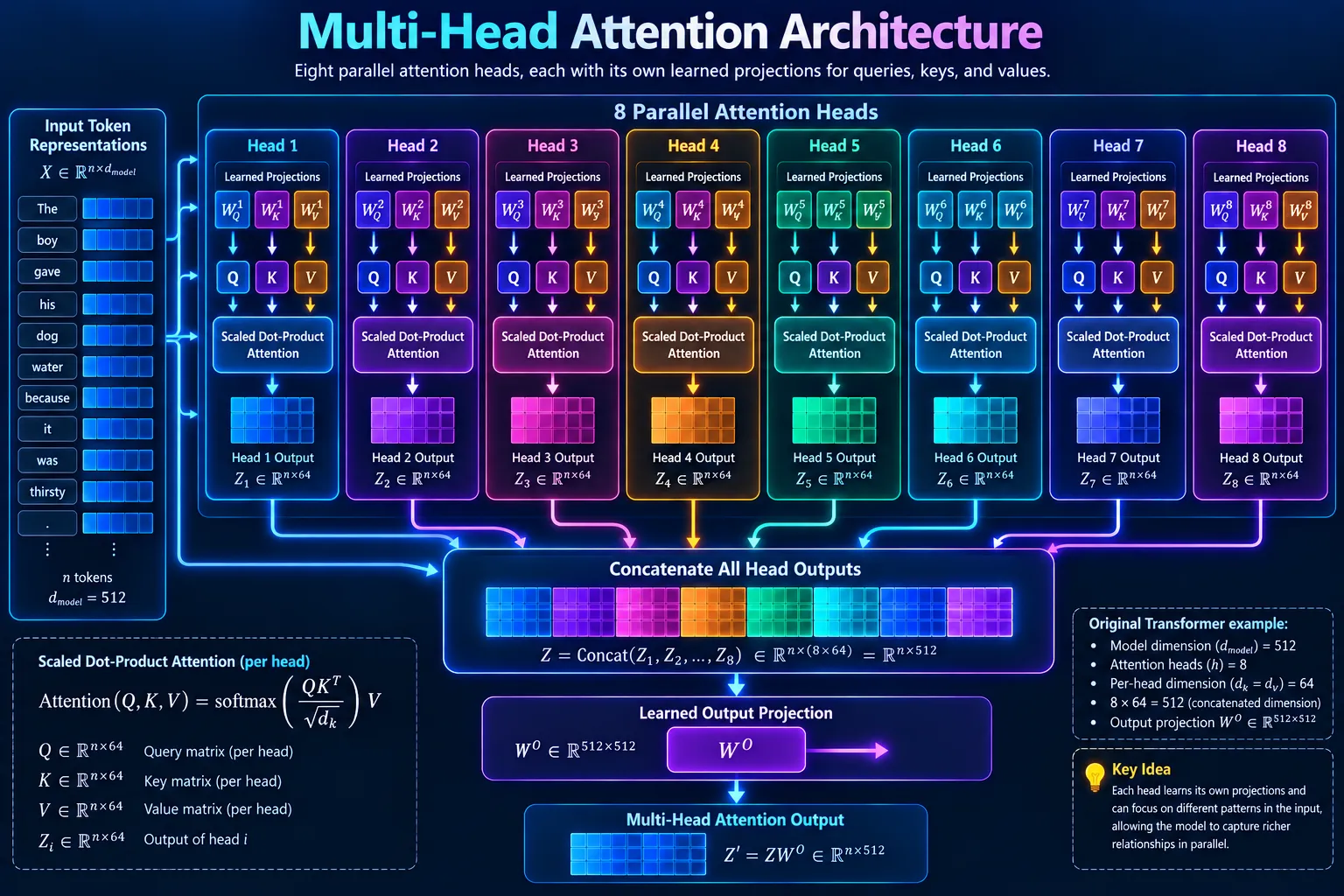
Each attention head uses its own learned Query, Key, and Value projections.
Because these projections differ, the heads can learn different patterns.
Consider this sentence:
"The student opened the book because she wanted to study."
One head might learn to connect "she" with "student."
Another might examine the relationship between "opened" and "book."
A third might focus on information related to "study."
These are possible learned behaviors, not guaranteed roles.
The Transformer combines the outputs from all heads to produce a representation containing information gathered through multiple attention patterns.
How Are the Attention Heads Combined?
Each head produces its own output vector.
The model joins these outputs through a process called concatenation.
Concatenation simply means placing vectors together to create a larger vector.
The combined vector then passes through another learned linear transformation.
This produces the final multi-head attention output.
The complete formula is:
MultiHead(Q, K, V) = Concat(head₁, head₂, ..., headₕ)Wᴼ
Here, each head represents an independent attention calculation using learned projections.
Wᴼ is the output projection matrix that combines information from the heads.
In the original Transformer, the authors used eight attention heads with a model dimension of 512.
Each head used 64-dimensional Query, Key, and Value representations.
With eight heads operating on smaller dimensions, the model could examine multiple patterns without increasing the total attention computation in direct proportion to the number of heads.
This is the central idea behind parallel attention heads in Transformers.
Transformer Architecture Explained Step by Step
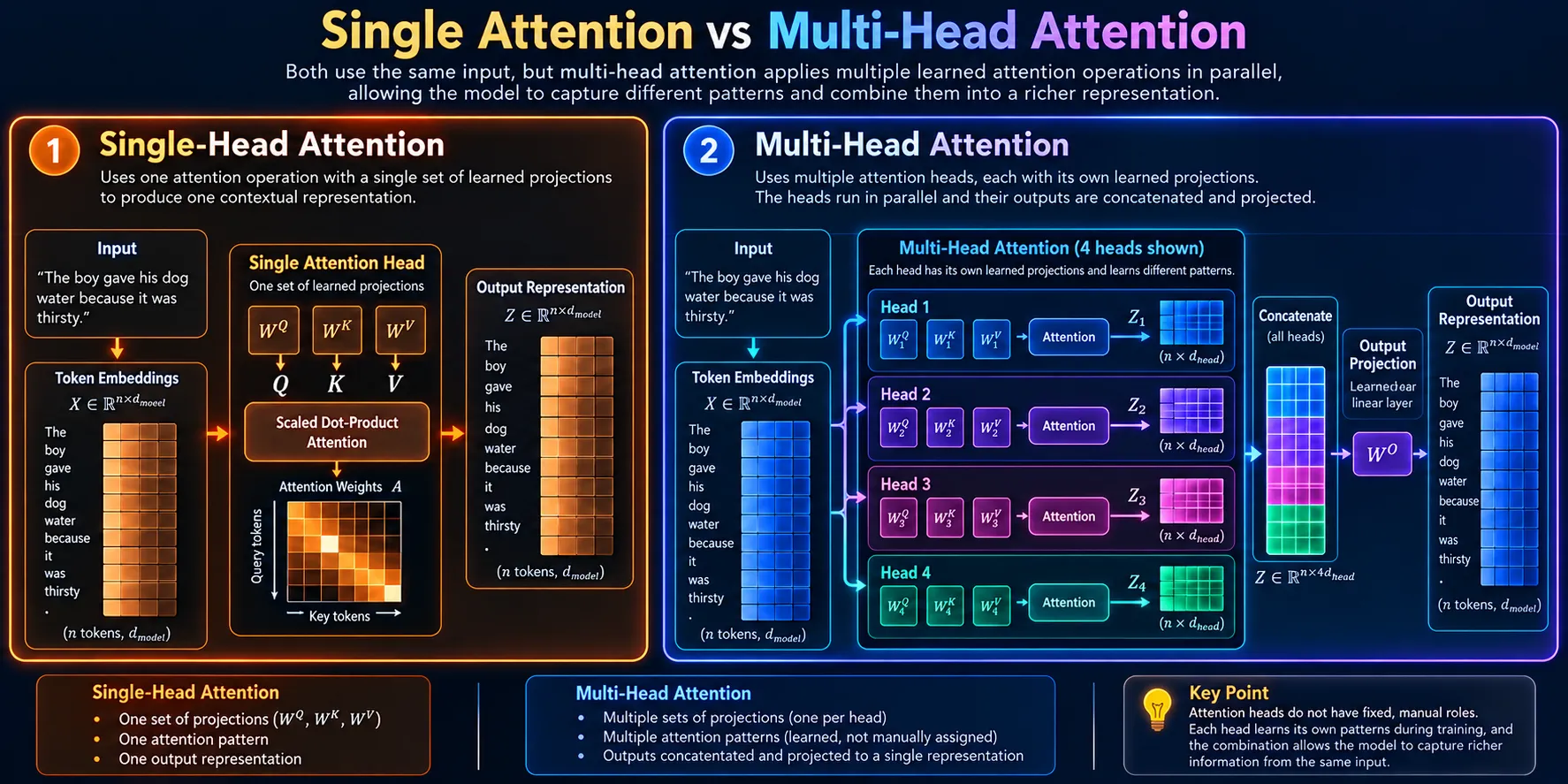
Single-Head Attention vs Multi-Head Attention: What's the Difference?
Imagine you're trying to understand a complicated movie.
If you watch it once, you might concentrate on the main character and follow the overall story.
But what if several people watch the same movie and each notices different details?
One follows the characters' emotions. Another notices clues hidden in conversations. Someone else recognizes connections between events.
When they discuss what they noticed, they may develop a deeper understanding of the story.
This is a helpful way to understand the difference between single-head and multi-head attention.
Single-Head Attention
Single-head attention uses one set of learned Query, Key, and Value projections to calculate attention.
It identifies useful relationships between tokens and produces one attention-based representation.
This can work well for many tasks, but it offers only one learned attention representation within that operation.
Multi-Head Attention
Multi-head attention performs several attention calculations in parallel.
Each head uses different learned projections, allowing it to examine information in a different representation space.
The outputs are combined to create the final representation.
The key difference is that single-head attention uses one attention operation, while multi-head attention combines several independently learned attention operations.
However, more heads do not always guarantee better results. Some heads may learn similar patterns, and their effectiveness depends on the model's design and training.
Multi-Head Self-Attention vs Cross-Attention
Another important concept is the difference between self-attention and cross-attention.
These terms are closely related, but they describe where the information comes from.
Multi-Head Self-Attention
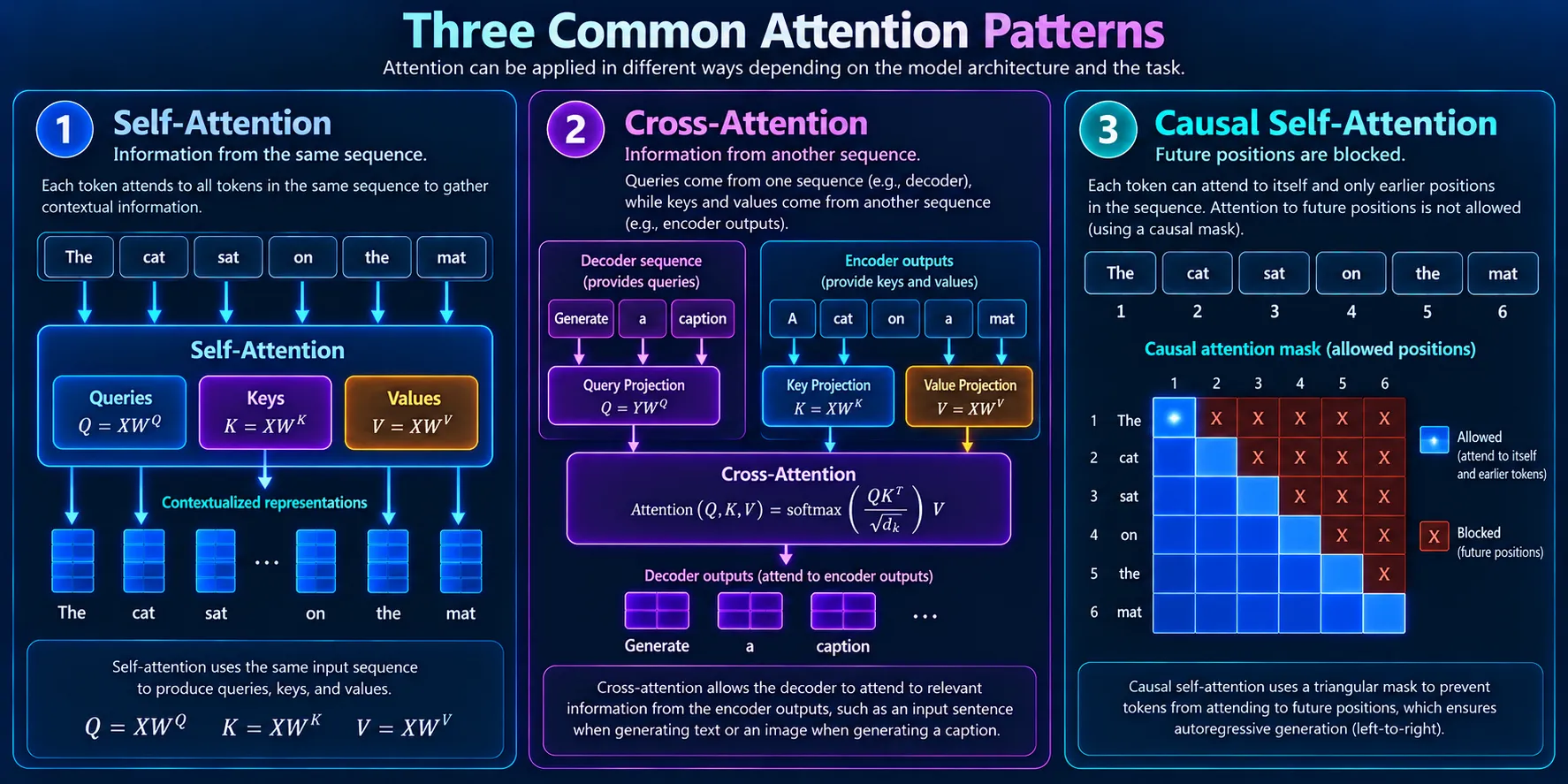
In self-attention, Query, Key, and Value representations come from the same sequence.
For example:
"The cat slept beside the window because it was warm."
When processing this sentence, the model can examine relationships among its tokens.
Multiple attention heads allow it to learn different relationships within that same sequence.
Multi-Head Cross-Attention
Cross-attention works differently.
Its Queries come from one sequence or representation, while its Keys and Values come from another.
Imagine an AI translation system converting an English sentence into French.
As it generates French words, it can use cross-attention to retrieve relevant information from the encoded English sentence.
This helps connect the generated translation with the original meaning.
In the original encoder-decoder Transformer, the decoder used cross-attention to access information produced by the encoder.
Encoder vs Decoder in Transformers Explained
What Is Masked Multi-Head Attention?
Some Transformers generate text one token at a time.
When predicting the next token, the model must not access future tokens that have not yet been generated.
A technique called causal masking prevents this.
For example, when generating:
"I love learning"
the model must predict the next token using only the information available up to that position.
Masked self-attention enforces this restriction.
This is an important feature of autoregressive language models.
Real-World Applications of Multi-Head Attention
Multi-head attention isn't just a mathematical idea used in research papers.
It plays an important role in many AI systems people interact with.
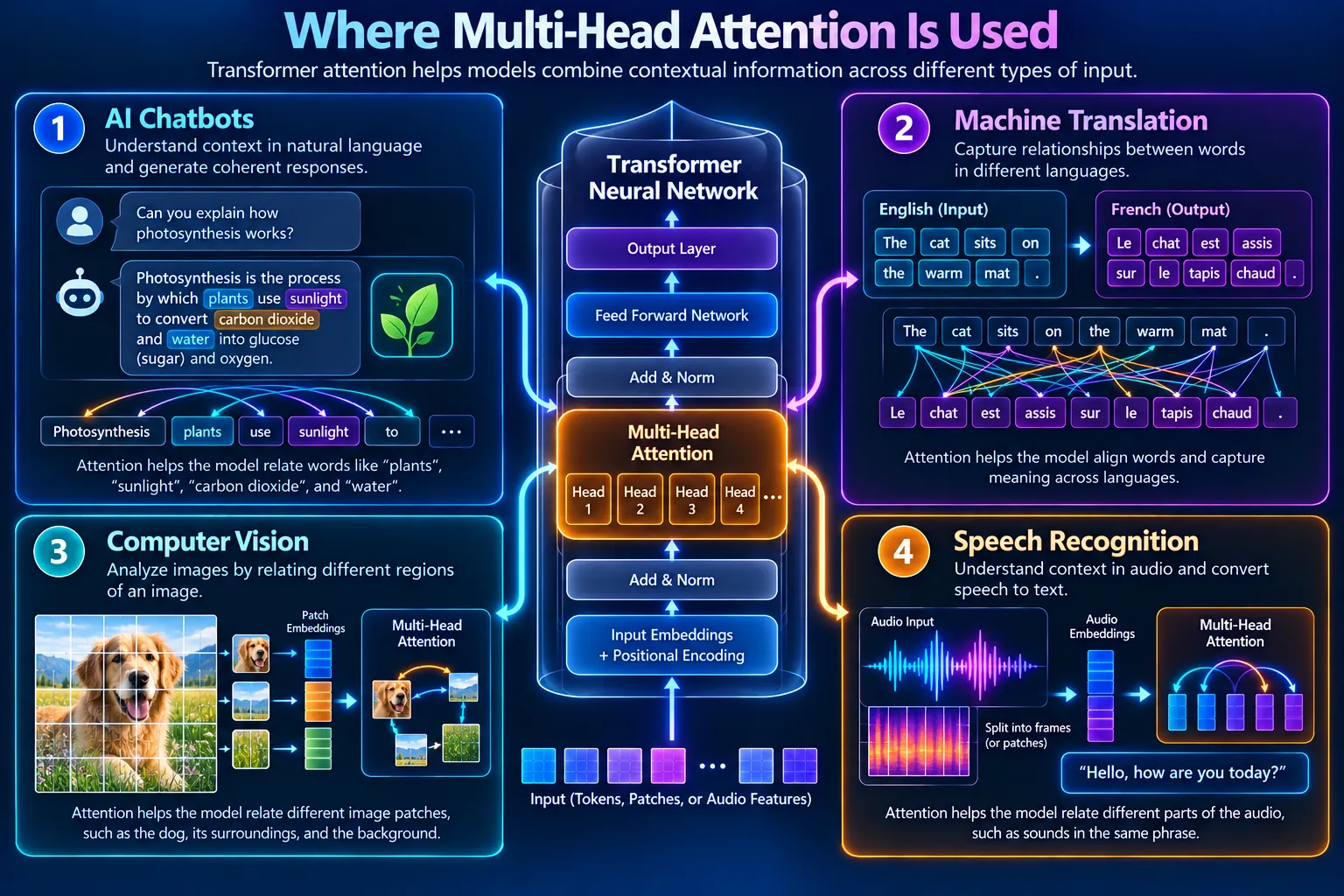
1. AI Chatbots and Language Models
When you ask an AI assistant a question, it needs to process the relationships between words, instructions, and earlier conversation context.
Multi-head attention helps Transformer-based language models create contextual representations of that information.
For example, consider:
"Explain gravity to a seven-year-old using a football example."
The model needs to process the topic, requested explanation level, and example preference.
Attention contributes to representing these relationships, while other components of the model help produce the response.
2. Language Translation
Imagine translating:
"She put the glass on the table because it was wet."
A translation system needs to consider how words relate to one another and how those relationships affect meaning.
Multi-head attention can help capture relevant contextual information.
However, attention alone does not guarantee correct interpretation when a sentence is ambiguous.
3. Image Recognition
Transformer architectures can also process images.
In a Vision Transformer, an image is divided into smaller patches that are converted into numerical representations.
Attention allows the model to combine information from different image patches.
For example, while examining a photograph of a bicycle, attention layers can help connect information from different parts of the image.
4. Speech Recognition
Speech contains relationships that stretch across time.
Understanding a spoken sentence may require connecting sounds and words that occur at different moments.
Transformer-based speech systems can use attention to model these relationships.
This supports tasks such as converting speech into text.
Real-World Applications of Transformers in AI
Advantages of Multi-Head Attention
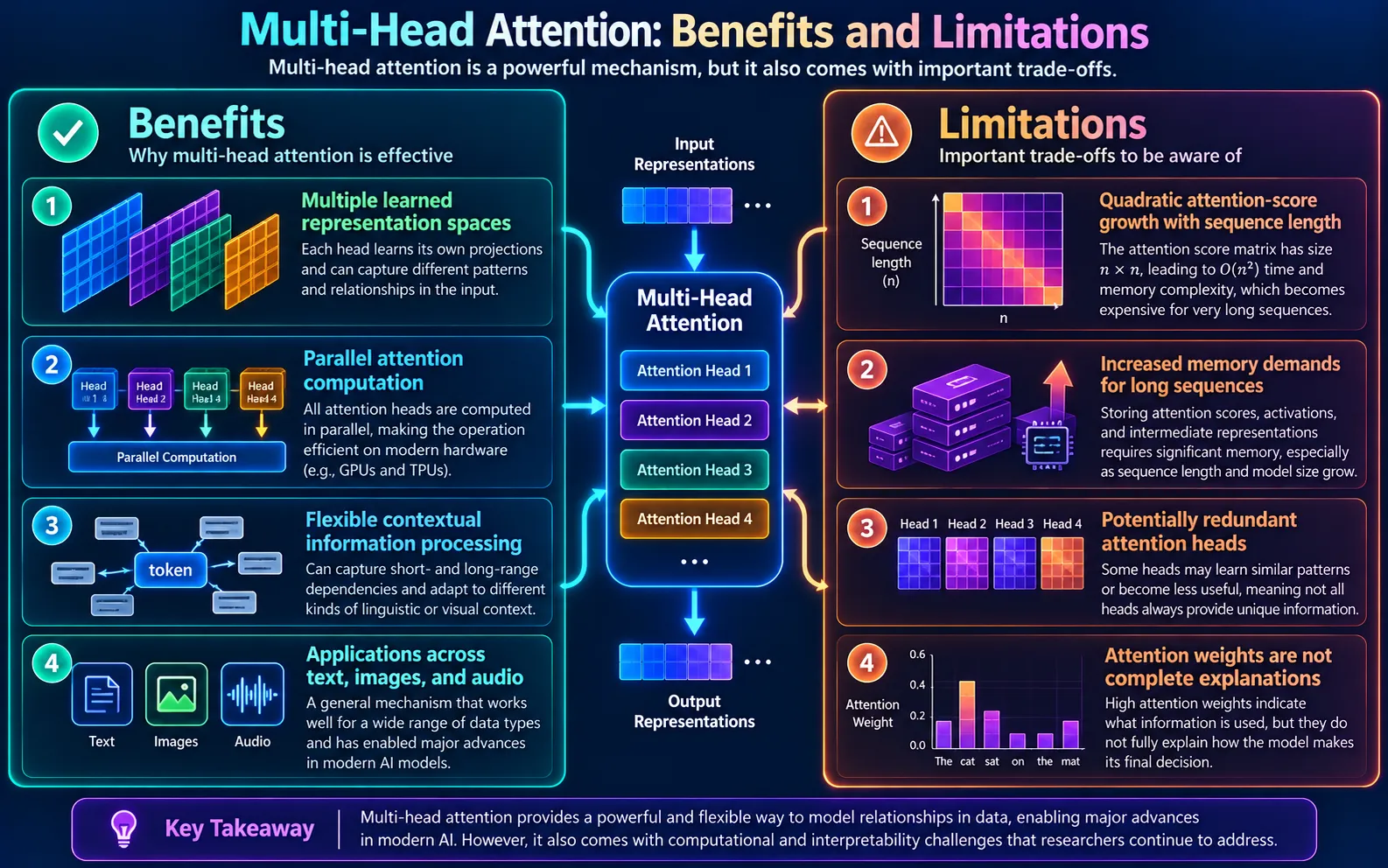
One major advantage of multi-head attention is its ability to examine information through multiple learned projections.
Rather than producing just one attention-based representation, the model combines outputs from several heads.
This can help it capture different relationships between tokens.
Another benefit is parallel computation.
Unlike older recurrent architectures that process sequence positions through a chain of recurrent steps, standard Transformer self-attention can calculate relationships across available sequence positions in parallel during training.
This parallel structure helped make Transformers highly effective for large-scale machine learning.
Multi-head attention is also flexible.
The same basic mechanism can be adapted for text, images, audio, and other types of sequential or structured information.
Limitations of Multi-Head Attention
Despite its advantages, multi-head attention has important limitations.
1. High Computational Cost
Standard full self-attention compares each token with every other available token.
As sequence length increases, the attention-score matrix grows rapidly.
For a sequence containing n tokens, this matrix contains approximately n² scores per head.
Long sequences can therefore require significant computation and memory.
2. Not Every Attention Head Is Equally Useful
Some attention heads learn distinctive patterns.
Others may produce overlapping or less useful representations.
This means increasing the number of heads does not automatically improve model quality.
3. Attention Does Not Guarantee Understanding
A model can assign attention weights to different tokens without understanding information in the human sense.
Attention weights also should not automatically be treated as explanations of why a model made a particular prediction.
They show how information is combined within an attention operation, not necessarily the complete reasoning behind the result.
4. Long-Context Processing Remains Challenging
Processing long documents, extended conversations, or large amounts of information can be expensive.
Researchers and engineers address these challenges through techniques such as optimized attention implementations, sparse attention, and alternative attention architectures.
For example, FlashAttention uses a more memory-efficient approach to calculating exact attention.
Flash Attention Explained for Beginners
Is Multi-Head Attention Better Than Single-Head Attention?
Multi-head attention often provides greater representational flexibility because different heads can learn complementary attention patterns.
But whether it performs better depends on several factors, including the task, training data, model size, and number of attention heads.
A carefully designed single-head model may outperform a poorly configured multi-head model on a particular task.
The real advantage of multi-head attention is not simply having more heads.
It is the ability to learn and combine information from multiple representation spaces.
Final Thoughts: Why Multi-Head Attention Matters
Think back to the football match we discussed earlier.
One person follows the ball, another watches the players, and someone else studies the defensive strategy.
Each perspective provides useful information.
Together, those perspectives can reveal details that might be missed when looking at only one aspect of the game.
Multi-head attention follows a similar idea.
It gives Transformers several learned ways to examine relationships between tokens and combine the resulting information.
Through Query, Key, and Value projections, attention scores, softmax, and parallel attention heads, the model creates representations that incorporate relevant context.
This mechanism became one of the central building blocks of the Transformer architecture and continues to influence modern language, vision, and speech models.
The most important thing to remember is simple: multi-head attention allows a Transformer to examine information through multiple learned perspectives instead of relying on a single attention calculation.
Once you understand that idea, the mathematics and architecture behind Transformers become much easier to explore.
Frequently Asked Questions About Multi-Head Attention
1. What is multi-head attention in simple words?
Multi-head attention is a technique that allows a Transformer model to examine information through several attention mechanisms at the same time.
Each attention head uses its own learned projections to identify useful relationships between tokens.
The model combines these outputs to create a richer representation of the input.
2. Why is multi-head attention used in Transformers?
Transformers use multi-head attention to learn relationships between tokens from different representation spaces.
Instead of relying on one attention calculation, the model combines the results of several attention heads.
This can help it represent different patterns within a sentence or another type of input.
3. What is the difference between self-attention and multi-head attention?
Self-attention describes an attention operation in which Queries, Keys, and Values come from the same sequence.
Multi-head attention describes an architecture that performs multiple attention operations in parallel.
A Transformer can therefore use multi-head self-attention, combining both ideas.
4. What are attention heads in a Transformer?
Attention heads are separate attention operations within a multi-head attention layer.
Each head uses its own learned Query, Key, and Value projections.
These projections allow different heads to process information in different representation spaces.
Their outputs are combined to produce the layer's final attention result.
5. What are Query, Key, and Value in multi-head attention?
Query, Key, and Value are numerical representations used during attention calculations.
The Query is compared with Keys to calculate attention scores.
These scores are converted into attention weights, which determine how the Value vectors are combined.
The resulting output incorporates information from relevant positions.
6. How many attention heads does a Transformer have?
The number of attention heads depends on the model architecture.
The original Transformer described in Attention Is All You Need used eight heads in its base configuration.
Other Transformer models may use different numbers of heads.
The appropriate number depends on architectural choices, computational constraints, and model performance.
7. Is multi-head attention better than single-head attention?
Multi-head attention provides more opportunities to learn complementary representations because it uses several independently learned attention operations.
However, it does not always outperform single-head attention.
Performance depends on factors such as the task, architecture, training data, and model configuration.
8. What is the formula for multi-head attention?
The formula is:
MultiHead(Q, K, V) = Concat(head₁, head₂, ..., headₕ)Wᴼ
Each attention head calculates scaled dot-product attention using its own learned projections.
The outputs are concatenated and transformed using the output projection matrix Wᴼ.
9. Does ChatGPT use multi-head attention?
GPT-style language models are based on Transformer architectures that use attention mechanisms.
Multi-head self-attention is a foundational component of these architectures.
However, exact attention implementations can differ between model generations, and the detailed architecture of every proprietary model is not publicly available.
10. What is the biggest limitation of multi-head attention?
One major limitation of standard full self-attention is its computational cost when processing long sequences.
For a sequence of n tokens, each attention head calculates an attention-score matrix containing n² elements.
This can create substantial memory and computational requirements as sequence length increases.
Modern optimized attention techniques help address some of these challenges.
11. Can multi-head attention be used for images?
Yes.
Vision Transformers use attention mechanisms to process representations of image patches.
Multi-head attention allows these models to combine information from different image regions.
This supports computer vision tasks such as image classification and other visual understanding applications.
12. What is the main advantage of parallel attention heads?
Parallel attention heads allow a Transformer to learn several attention patterns using different learned projections.
Their outputs are then combined into one representation.
This gives the model greater representational flexibility than relying on a single attention operation alone.


