


Supervised Learning Explained: How Machines Learn From Labelled Data
Think about the last time you opened your email inbox.
You probably saw your important emails in the main inbox, while promotional messages, fake prize notifications and suspicious links were automatically moved to the spam folder.
You did not personally tell your email service where every new message should go. The system made that decision by looking at patterns it had learned from older emails.
That is one of the simplest real-world examples of supervised learning.
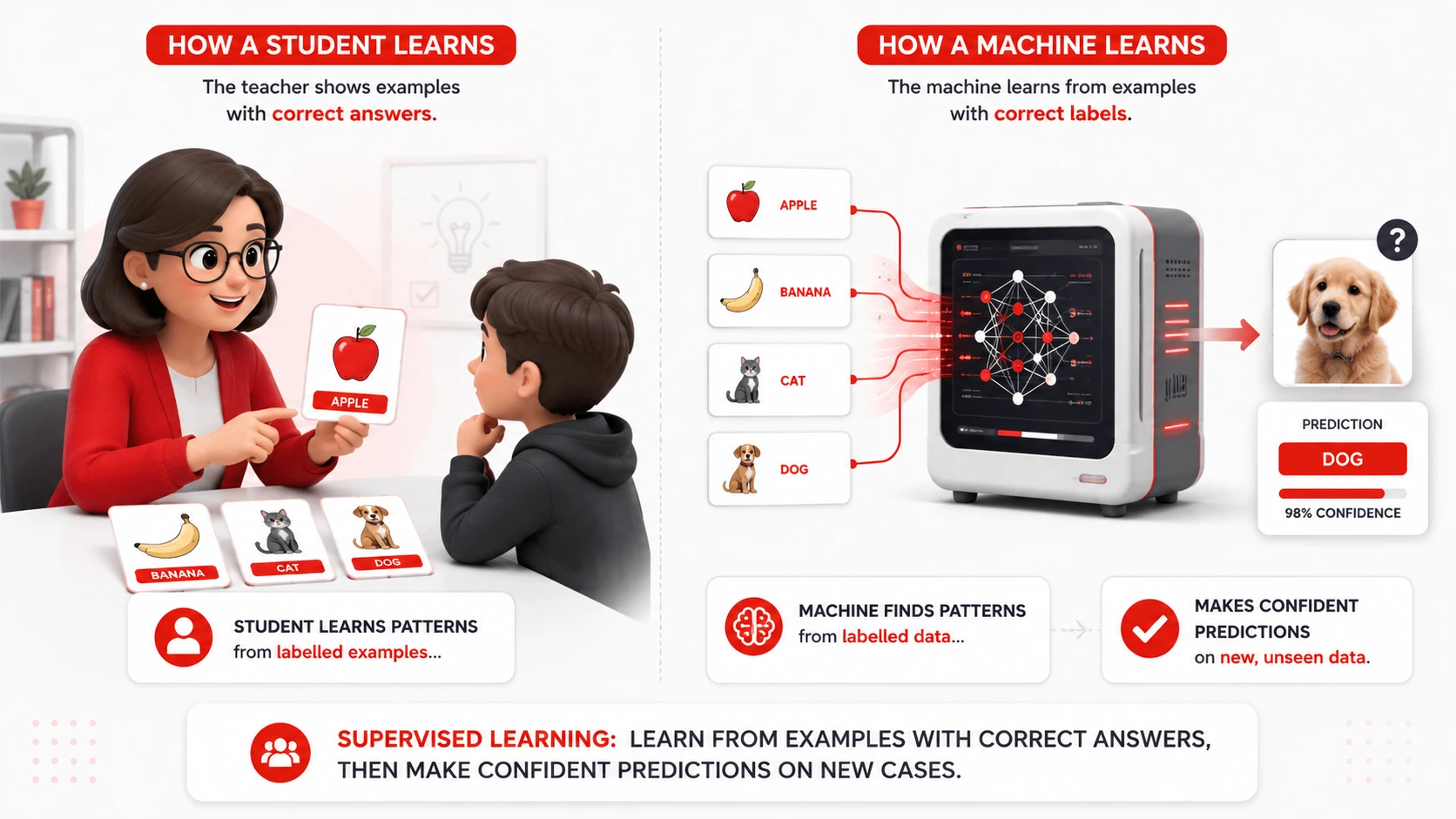
Supervised learning may sound like a difficult technical concept, but its basic idea is actually very familiar. It works in almost the same way a student learns from solved examples.
A teacher shows the student a question, explains the correct answer and then gives similar questions for practice. After seeing enough examples, the student begins to understand the pattern and can answer a new question without help.
A supervised machine learning model learns in a similar way.
It receives examples along with their correct answers. It studies the relationship between the information in each example and the expected result. Once the learning process is complete, the model uses those patterns to predict the answer for new data.
What Is Supervised Learning in Simple Words?
Supervised learning is a type of machine learning in which a computer model is trained using labelled data.
Labelled data simply means that every training example already contains the correct answer.
Suppose we want to teach a computer to recognise whether an email is spam.
We may provide examples such as:
“Claim your free holiday now” — Spam
“Your order has been delivered” — Not spam
“You have won a cash reward” — Spam
“The team meeting starts at 4 PM” — Not spam
The email message is the input. “Spam” or “not spam” is the correct answer, also called the label.
The model studies thousands or even millions of similar examples. Over time, it may learn that spam emails often contain suspicious links, unusual sender addresses, urgent language or phrases connected with fake prizes.
When a completely new email arrives, the trained model checks it against the patterns it has learned and predicts whether it is likely to be spam.
The model does not remember every email word for word. A well-trained model learns broader patterns that can also work on messages it has never seen before.
That ability to work on new examples is called generalisation.
Why Is It Called Supervised Learning?
The word “supervised” can be slightly confusing.
It does not mean that a human sits beside the computer and watches every calculation.
The supervision comes from the correct answers included in the training data.
Imagine a student solving twenty mathematics questions with an answer sheet placed nearby.
The student tries the first question, checks the correct answer and notices the mistake. On the next question, the student applies what was learned from the previous error.
The answer sheet acts as the supervisor.
In supervised learning:
The algorithm is the student.
The training examples are the practice questions.
The labels are the answer sheet.
The training process is the practice session.
The trained model is the student after learning.
The prediction is the answer to a new question.
This is why supervised learning is often considered one of the easiest forms of machine learning to understand. The model always has a known target during training.
The Four Basic Parts of Supervised Learning
Before learning how supervised learning works, you need to understand four simple terms: data, features, labels and models.
1. Training Data
Training data is the collection of examples used to teach the model.
Suppose a bank wants to predict whether a borrower may fail to repay a loan.
The bank may use historical records containing information such as:
Monthly income
Existing debt
Payment history
Loan amount
Employment duration
Number of missed payments
Whether the customer repaid the loan
Each previous customer record becomes one training example.
The model studies these past cases to identify patterns connected with repayment and default.
The quality of this training data matters a lot.
If the data is incomplete, outdated or filled with incorrect information, the model may learn unreliable patterns.
A complex algorithm cannot automatically repair poor-quality data.
It is similar to teaching a student from a textbook containing wrong answers. Even a hardworking student may learn the wrong lesson.
2. Features
Features are the pieces of information provided to the model.
In the loan example, features may include income, existing debt, employment history and repayment behaviour.
For a house-price prediction model, features may include:
Size of the house
Number of rooms
Location
Property age
Distance from the city centre
Nearby schools
Recent selling prices
Features are the clues the model uses to make a prediction.
Think of a doctor examining a patient.
The doctor may look at temperature, blood pressure, symptoms and test reports before reaching a decision. These observations act like features.
The better and more relevant the features are, the easier it becomes for the model to find useful patterns.
3. Labels
A label is the correct answer attached to a training example.
In a spam filter, the label is “spam” or “not spam.”
In a house-price model, the label is the actual selling price.
In a credit-risk model, the label may be “loan repaid” or “loan defaulted.”
The label tells the model what it is supposed to learn.
Without reliable labels, traditional supervised learning cannot properly compare its predictions with the correct results.
This is also why creating labelled datasets can be expensive.
A simple product image may be labelled by an ordinary user. A medical scan may need to be reviewed by an experienced radiologist. A legal document may require a trained lawyer.
The cost of labelling depends on the complexity of the problem.
4. The Model
A model is the trained system that produces predictions.
People often use the words algorithm and model as if they mean the same thing, but there is a small difference.
An algorithm is the method used to learn.
A model is the result created after that algorithm has learned from data.
Think about cooking.
The recipe describes the method. The prepared dish is the final result.
In the same way, the algorithm describes how learning happens, while the trained model is what we finally use to make predictions.
How Does Supervised Learning Work?
The complete process starts with historical examples.
First, we define what we want to predict. Then we collect examples containing both input information and correct answers.
The model makes an initial prediction using its current understanding.
That prediction may be wrong.
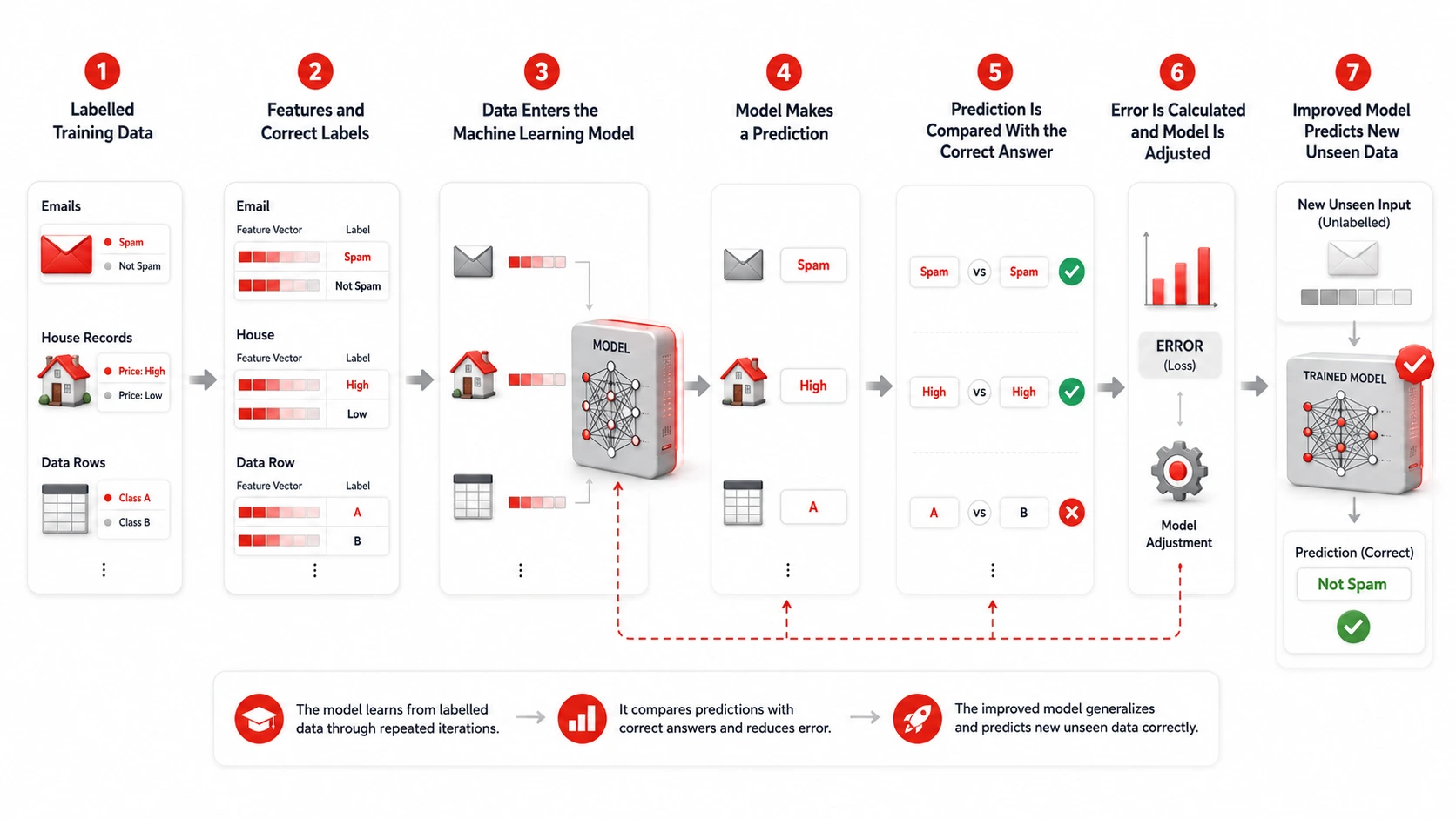
The system compares the prediction with the correct label and calculates the size of the error. It then adjusts its internal settings so that the next prediction can be slightly better.
This process repeats across many examples.
A simple way to understand it is:
Input data → Model prediction → Comparison with correct answer → Error calculation → Model adjustment
Suppose a house actually sold for £300,000, but the model predicted £250,000.
The prediction is £50,000 away from the correct answer.
The model uses this error to adjust the importance it gives to features such as property size, location and number of bedrooms.
After seeing many houses, it becomes better at estimating prices.
The same learning idea can be used for emails, loans, medical scans, customer behaviour and thousands of other problems.
However, supervised learning problems do not all produce the same type of answer.
Sometimes the model needs to predict a category, such as spam or not spam.
In other situations, it needs to predict a numerical value, such as a house price or delivery time.
These two tasks are known as classification and regression, and understanding their difference is the next major step in learning supervised machine learning.
The Two Main Types of Supervised Learning
Supervised learning problems are usually divided into two main categories:
Classification
Regression
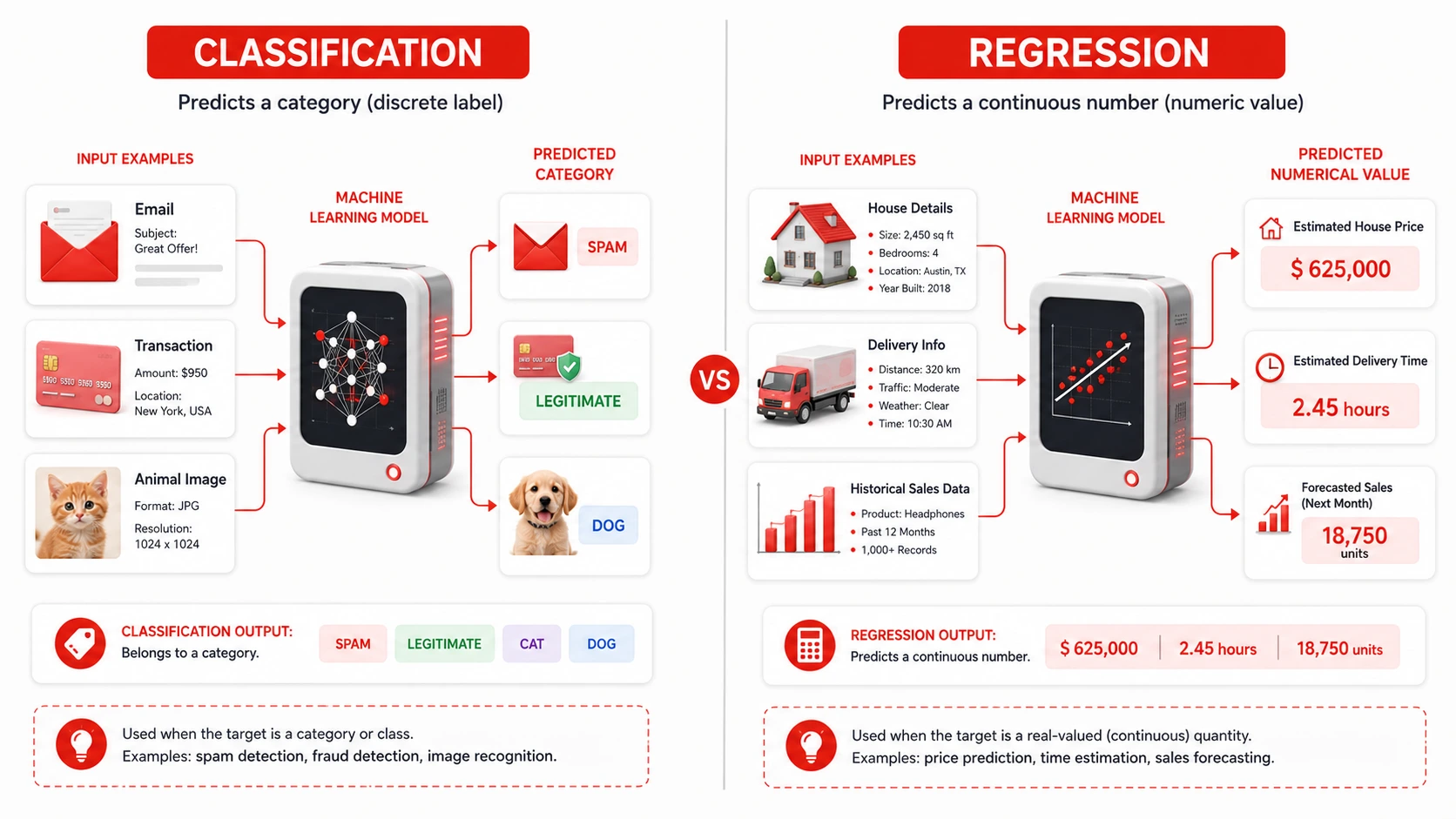
The easiest way to understand the difference is to look at the type of answer the model gives.
If the answer is a category, the problem is classification.
If the answer is a number, the problem is regression.
For example, predicting whether an email is spam or not spam is classification because the output belongs to a category.
Predicting the price of a house is regression because the output is a numerical value.
What Is Classification in Supervised Learning?
Classification is a type of supervised learning in which a model predicts a class or category.
You can think of classification as placing something into the correct box.
Imagine a teacher gives you a collection of animal pictures and asks you to place each one into a box labelled dog, cat, bird or horse.
You study the features of each animal and decide which category it belongs to.
A classification model does something similar.
It looks at the features in the input data and predicts the most likely category.
Common classification examples include:
Spam or not spam
Fraudulent or legitimate transaction
Customer will leave or stay
Loan will default or be repaid
Image contains a dog, cat or bird
Review is positive, negative or neutral
Medical scan is normal or suspicious
Binary Classification
Binary classification is used when there are only two possible output categories.
Examples include:
Yes or no
Pass or fail
Fraud or legitimate
Spam or not spam
Default or no default
Suppose a bank wants to predict whether a customer may default on a loan.
The model might analyse:
Monthly income
Existing debt
Previous missed payments
Credit history
Loan amount
Employment duration
After examining these features, the model may produce a probability such as:
Probability of default: 0.78
This does not mean the customer will definitely default.
It means the model believes there is a 78% chance of default based on the patterns it learned from previous cases.
The bank may then apply a decision threshold.
For example:
If probability is above 0.70 → Send for manual review
If probability is below 0.70 → Continue normal process
The threshold depends on the business goal and the cost of making a wrong decision.
Multiclass Classification
Multiclass classification is used when there are more than two possible categories.
Examples include:
Identifying a handwritten number from 0 to 9
Classifying a news article as sports, business, technology or entertainment
Recognising whether an image contains a cat, dog, horse or bird
Sending a customer-support message to billing, cancellation, refund or technical support
Each input is normally assigned to one class.
Suppose a travel company receives thousands of customer messages every day.
A classification model can read each message and place it into the correct category:
Flight issue
Hotel issue
Cancellation
Refund
Visa query
Payment issue
The model does not truly understand the customer’s emotions in the same way a human does. It identifies language patterns that were associated with particular categories in the training data.
What Is Regression in Supervised Learning?
Regression is used when the model needs to predict a numerical value.
Instead of choosing a category, the model estimates a quantity.
Common regression examples include:
House-price prediction
Sales forecasting
Delivery-time prediction
Temperature forecasting
Electricity-demand estimation
Insurance claim estimation
Hotel price prediction
Monthly revenue forecasting
Suppose a food-delivery company wants to predict how long an order will take.
The model may use features such as:
Distance between restaurant and customer
Traffic conditions
Weather
Restaurant preparation time
Number of available drivers
Time of day
Day of the week
The output might be:
Predicted delivery time: 34 minutes
The model is not choosing between “fast” and “slow.” It is predicting a specific numerical value.
That is why this task is regression.
Classification vs Regression
The difference can be understood through one simple example.
Imagine we are analysing houses.
If the model predicts whether a house is cheap, average or expensive, it is classification.
If the model predicts that the house will sell for £275,000, it is regression.
The same data can sometimes be used for both tasks. What changes is the target we ask the model to predict.
Popular Supervised Learning Algorithms
An algorithm is the method used to learn patterns from data.
There are many supervised learning algorithms, but beginners should first understand a few widely used ones.
1. Linear Regression
Linear regression is one of the simplest supervised learning algorithms.
It is mainly used for predicting numerical values.
Imagine a graph showing house size on one side and house price on the other.
Generally, larger houses cost more.
Linear regression tries to draw the best possible line through the existing examples.
That line can then be used to estimate the price of a new house.
A simple relationship may look like:
Predicted house price = Base price + Effect of house size
Real models may include many features, such as location, number of rooms and property age.
Linear regression is useful when the relationship between inputs and output is reasonably simple.
2. Logistic Regression
Logistic regression is commonly used for classification.
Despite the word “regression” in its name, it usually predicts the probability of a category.
For example, it might calculate:
Probability that email is spam: 0.91
If the probability is above a selected threshold, the email is classified as spam.
Logistic regression is popular because it is fast, easy to train and easier to explain than many complex models.
3. Decision Tree
A decision tree makes predictions by asking a series of questions.
Imagine a bank reviewing a loan application.
A simplified decision tree may work like this:
Has the customer missed payments before?
├── Yes → Higher default risk
└── No
├── Is existing debt high?
│ ├── Yes → Medium default risk
│ └── No → Lower default risk
A decision tree is easy to understand because its decisions can often be followed step by step.
However, a very large tree may memorise the training data and perform poorly on new examples.
4. Random Forest
A random forest combines many decision trees.
Instead of trusting one tree, it asks multiple trees to make predictions.
For classification, the trees vote for the most likely category.
For regression, their numerical predictions are averaged.
Think of it like asking ten experienced people for advice instead of depending on one person.
One individual may make a poor decision, but the combined opinion can be more reliable.
5. K-Nearest Neighbours
K-nearest neighbours, also called KNN, predicts an answer by looking at the most similar training examples.
Imagine finding an unknown fruit.
You compare its colour, size and weight with fruits you already know.
If most nearby examples are oranges, you may classify the unknown fruit as an orange.
The letter K represents the number of neighbours the model checks.
If K equals five, the model looks at the five closest examples before making its decision.
6. Support Vector Machine
A support vector machine tries to find the best boundary between different classes.
Imagine red and blue balls placed on a table.
You want to draw a line between them while keeping the largest possible gap on both sides.
That gap is called the margin.
The wider the margin, the more confidently the model may separate the two classes.
Support vector machines can work well when the number of features is large, although they may become slower on very large datasets.
Building a Spam Filter With Supervised Learning
Now let us connect everything with a complete real-world example.
Suppose we want to build a spam filter.
First, we collect thousands of emails that have already been labelled:
Spam
Not spam
Each email becomes one training example.
The model may study features such as:
Words used in the subject line
Number of links
Sender address
Use of capital letters
Suspicious phrases
Number of attachments
Message length
Previous user reports
For example, phrases such as “claim now,” “limited offer,” or “you have won” may appear frequently in spam messages.
However, the model cannot depend on one phrase alone.
A legitimate marketing email may also contain the words “limited offer.”
The model must learn combinations of patterns.
It may notice that an unknown sender, several suspicious links and urgent language together create a higher chance of spam.
During training, the model predicts whether each email is spam.
It then compares the prediction with the correct label.
If the model marks a legitimate email as spam, it has made a false positive.
If it allows a spam email into the inbox, it has made a false negative.
Both mistakes matter.
Too many false positives may hide important emails.
Too many false negatives may fill the inbox with unwanted messages.
The development team must decide how to balance these errors.
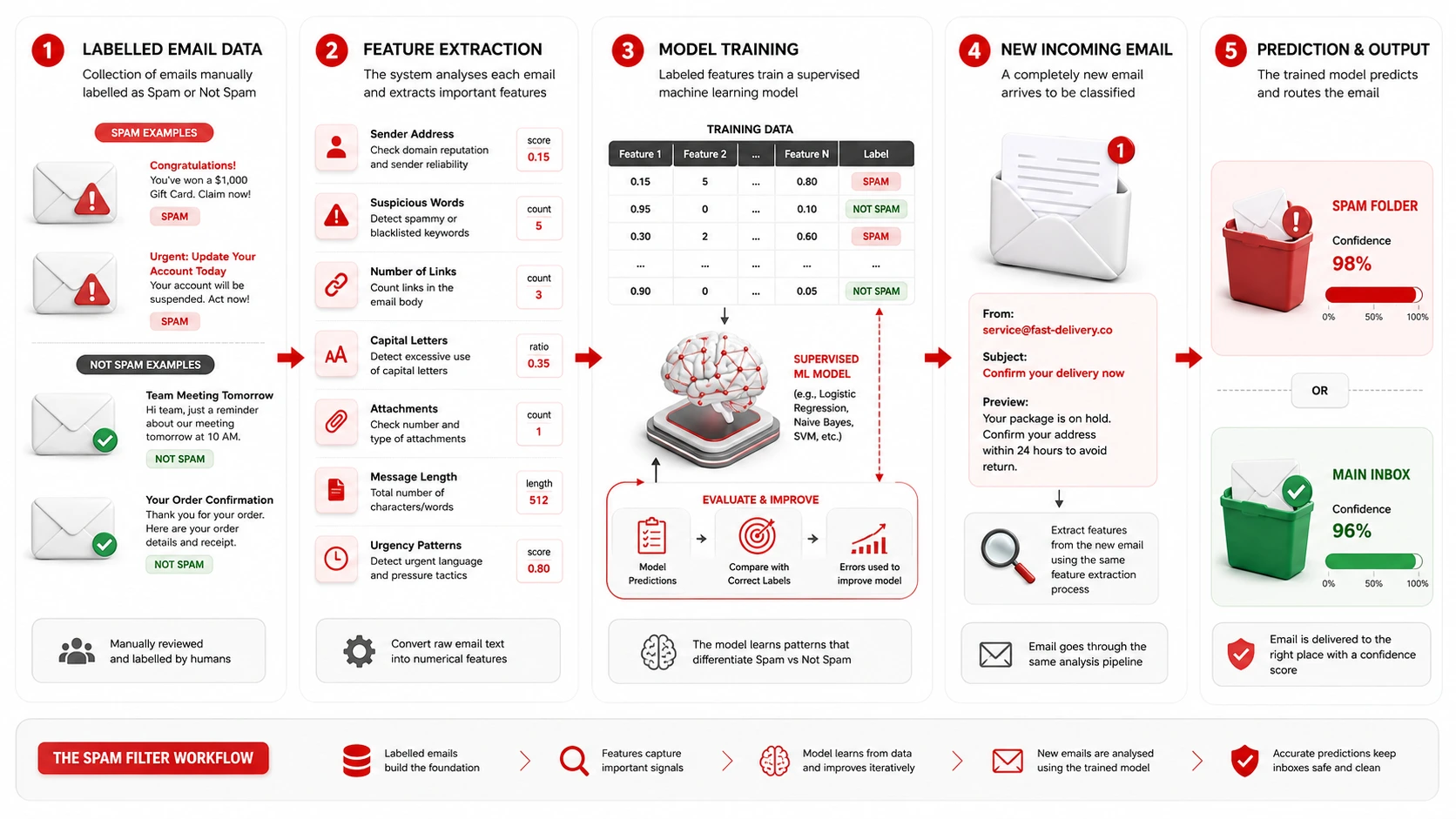
Once trained, the model is tested on emails it has never seen before.
If performance is acceptable, it can be deployed.
Even then, the system needs regular updates because spam messages change over time.
Spammers change words, links, formats and sending methods to avoid detection.
This changing behaviour is one reason machine learning models require monitoring and retraining.
A spam filter is therefore not just a model.
It is a complete system involving data collection, labelling, training, testing, deployment and continuous improvement.
In the next part, we will use another important example—predicting credit default risk—to understand model evaluation, accuracy, precision, recall, overfitting, limitations and the responsible use of supervised learning.
Predicting Credit Default Risk With Supervised Learning
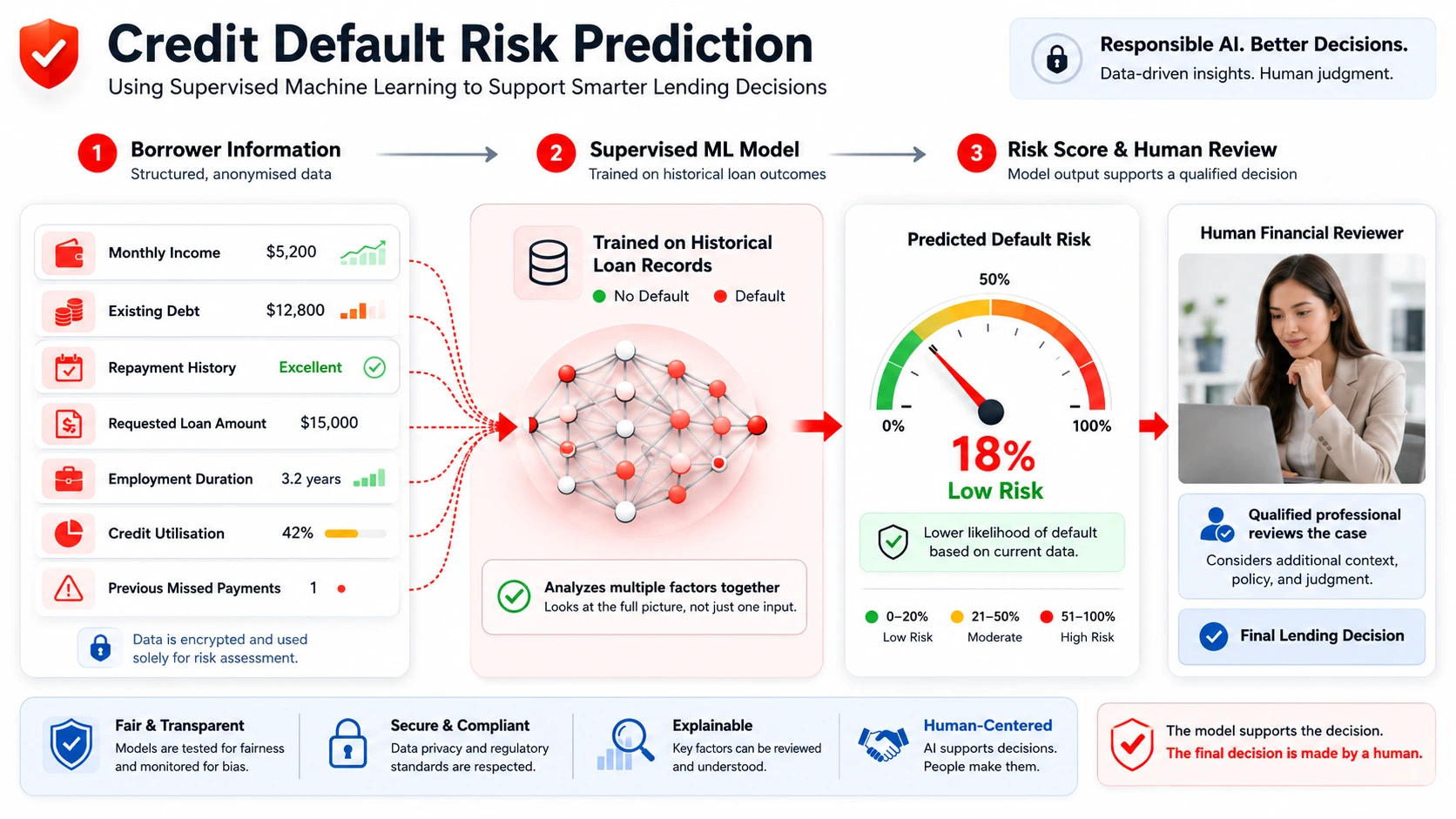
Let us now take a more sensitive example: predicting whether a borrower may fail to repay a loan.
This is known as credit default risk prediction.
Banks and financial institutions have historical records of customers who borrowed money. Some customers repaid their loans on time, while others missed payments or defaulted.
These previous outcomes can be used as labelled training data.
The input features may include:
Monthly income
Employment history
Existing loans
Previous repayment behaviour
Number of missed payments
Credit utilisation
Requested loan amount
Length of credit history
Current financial obligations
The label may be:
Default
No default
This makes credit-default prediction a binary classification problem.
The model studies historical cases and tries to identify combinations of features associated with repayment problems.
For example, a high loan amount alone may not mean that a customer is risky.
A person with a high income and a strong repayment history may comfortably manage a large loan. A smaller loan may still be risky for someone with unstable income, heavy existing debt and several missed payments.
The model therefore examines the relationship between multiple features rather than judging the customer using one number.
After training, it may produce a result such as:
Estimated probability of default: 0.64
This does not mean the customer will definitely default.
It means that, based on patterns found in the training data, the model estimates a 64% probability of default.
The institution must then decide how that prediction should be used.
It may:
Send the application for manual review
Request additional financial documents
Adjust the offered loan amount
Ask a qualified employee to examine unusual circumstances
Continue the normal approval process
A model’s output should support a decision rather than automatically become the final decision in every case.
Why Accuracy Alone Is Not Enough
Imagine a lender has data from 10,000 previous borrowers.
Out of these customers:
9,500 repaid their loans
500 defaulted
Now imagine a useless model that predicts “no default” for every customer.
It would still be correct for 9,500 people.
That gives it an accuracy of 95%.
At first glance, 95% accuracy sounds excellent. In reality, the model failed to identify every customer who defaulted.
This is why machine learning models cannot always be judged using accuracy alone.
The correct evaluation metric depends on the problem and the consequences of different mistakes.
Understanding the Confusion Matrix
A confusion matrix divides classification predictions into four categories.
True Positive
The model predicts default, and the customer actually defaults.
The prediction was correct.
True Negative
The model predicts no default, and the customer successfully repays the loan.
This prediction was also correct.
False Positive
The model predicts default, but the customer would have repaid the loan.
This may cause a reliable customer to face unnecessary checks, worse terms or rejection.
False Negative
The model predicts no default, but the customer eventually defaults.
This can create financial loss for the lender.
A perfect model would produce only true positives and true negatives.
Real-world models always make some mistakes. The goal is to understand those mistakes and manage them responsibly.
Precision Explained Simply
Precision answers this question:
Out of all the customers predicted to default, how many actually defaulted?
Suppose a model flags 100 customers as high risk, but only 70 of them actually default.
Its precision is 70%.
High precision means the model produces fewer false alarms.
In credit-risk prediction, poor precision may cause too many responsible borrowers to be incorrectly treated as high risk.
Recall Explained Simply
Recall answers another question:
Out of all the customers who actually defaulted, how many did the model successfully identify?
Suppose 100 customers defaulted, but the model detected only 80 of them.
Its recall is 80%.
High recall means the model misses fewer genuine default cases.
A lender may want strong recall to reduce financial losses. However, increasing recall can sometimes increase false positives.
That is why precision and recall often need to be balanced.
F1 Score
The F1 score combines precision and recall into one measurement.
It is useful when both false positives and false negatives matter.
A model with very high recall but extremely poor precision may flag almost everyone as risky. A model with high precision but poor recall may identify only the most obvious default cases and miss many others.
The F1 score helps measure whether the model maintains a reasonable balance.
Classification Thresholds
Many classification models do not directly produce “default” or “no default.”
They first produce a probability.
For example:
Customer A: 0.22 default probability
Customer B: 0.58 default probability
Customer C: 0.87 default probability
A threshold converts those probabilities into categories.
If the threshold is 0.50:
Customer A is classified as no default.
Customer B is classified as default.
Customer C is classified as default.
Changing the threshold changes the model’s behaviour.
A lower threshold identifies more possible defaults but may create more false positives.
A higher threshold reduces false positives but may miss customers who later default.
There is no perfect threshold for every situation. It must be selected according to the financial, legal and human consequences of each type of mistake.
Overfitting in Supervised Learning
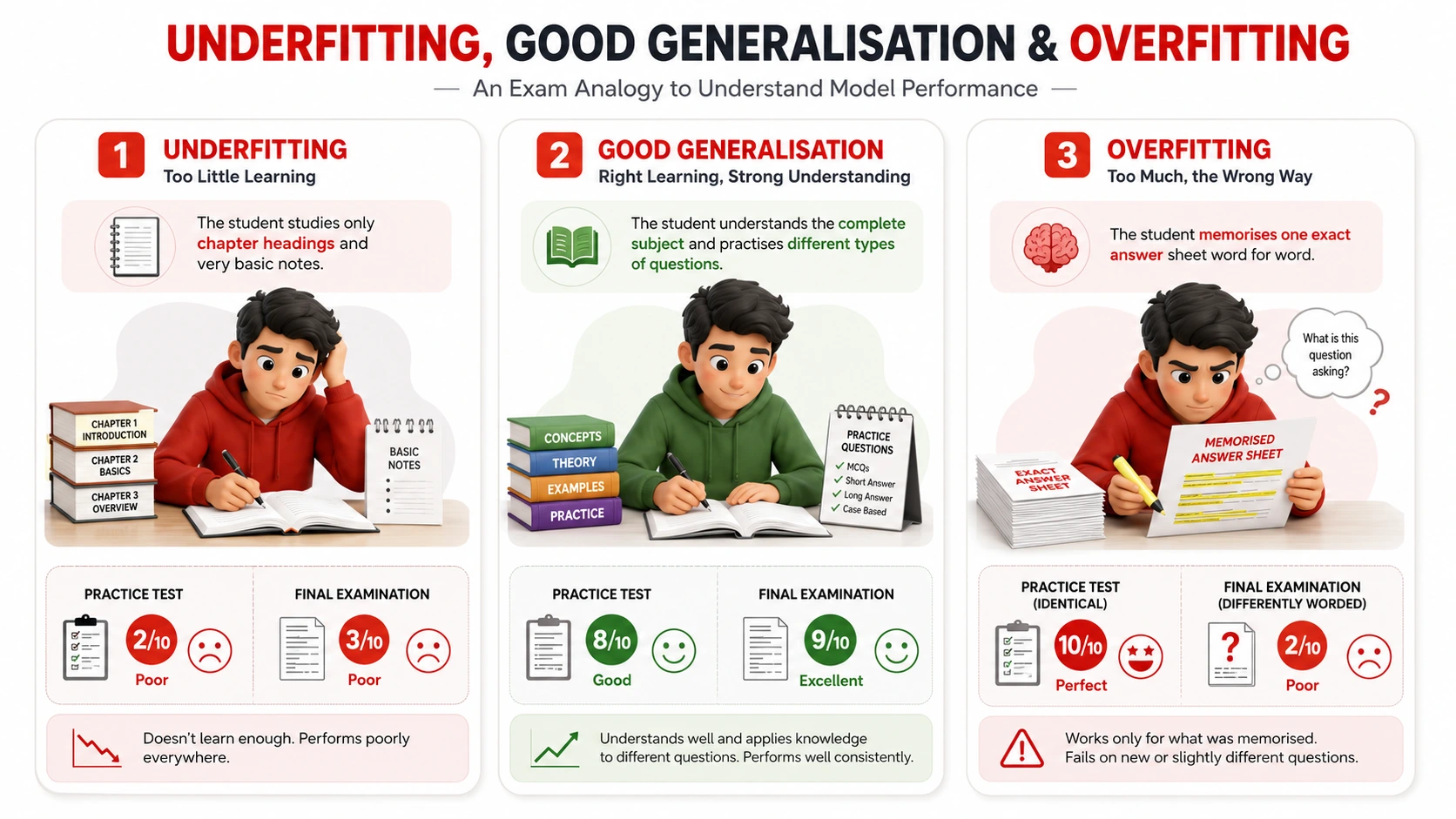
A model should learn general patterns rather than memorising its training data.
Overfitting happens when a model becomes too closely matched to the examples it studied.
Imagine a student who memorises every answer from one practice paper.
During the practice test, the student performs perfectly.
During the real exam, the questions are worded differently, and the student struggles because the underlying concepts were never understood.
An overfitted machine learning model behaves in the same way.
It may show excellent performance on training data but fail when it receives new customer records.
Overfitting can happen when:
The model is unnecessarily complex
The dataset is too small
The data contains noise
Too many irrelevant features are included
Training continues for too long
Information from the test set leaks into training
Ways to reduce overfitting include:
Collecting more representative data
Using a simpler model
Removing irrelevant features
Applying regularisation
Limiting the depth of decision trees
Using cross-validation
Stopping training at the right time
Underfitting in Supervised Learning
Underfitting happens when a model is too simple to learn important patterns.
Imagine another student who studies only the chapter headings and ignores all the explanations.
That student may perform poorly on both practice questions and the real exam.
An underfitted model performs poorly on both training and test data.
Underfitting may be improved by:
Adding useful features
Choosing a more flexible algorithm
Training the model properly
Reducing excessive restrictions
Improving data preparation
The goal is not to memorise the training data or ignore its patterns.
The goal is to learn enough to perform well on new examples.
Advantages of Supervised Learning
Supervised learning is widely used because it offers several practical benefits.
Clear Learning Objective
The model knows what it is expected to predict because correct labels are available during training.
Easy Performance Measurement
Predictions can be compared directly with known answers.
This makes it possible to calculate accuracy, precision, recall and other metrics.
Useful for Real Business Problems
Supervised learning can support:
Spam detection
Fraud detection
Demand forecasting
Customer churn prediction
Medical-image analysis
Credit-risk assessment
Product-quality inspection
Delivery-time prediction
Can Process Large Volumes of Data
Once deployed, a model can evaluate thousands or millions of examples faster than a human team.
This does not remove the need for people. It allows human experts to focus on complex, uncertain or high-risk cases.
Supports Consistent Predictions
A properly designed system can apply the same evaluation process across similar cases.
However, consistency is only valuable when the underlying process is fair and accurate.
Limitations of Supervised Learning
Supervised learning also has important limitations.
Labelled Data Can Be Expensive
Preparing labels may require time and specialist knowledge.
A medical dataset may need doctors. Legal documents may need lawyers. Financial records may need experienced analysts.
Historical Data May Contain Bias
A model learns from what happened in the past.
If previous decisions were unfair, incomplete or influenced by discrimination, the model may learn those patterns.
In a credit system, postcode, employment history or other variables may indirectly act as proxies for sensitive personal characteristics.
Removing one sensitive feature does not automatically remove unfairness.
Predictions Can Become Outdated
Customer behaviour, market conditions and fraud methods change.
A model trained on old data may stop representing current reality.
Complex Models Can Be Difficult to Explain
Some models can produce accurate predictions without giving a clear human-readable reason.
This becomes a serious issue when a prediction affects someone’s access to credit, employment, healthcare or another essential service.
Correlation Does Not Prove Cause
A model may discover that two factors appear together without proving that one causes the other.
For example, customers who contact support repeatedly may have a higher cancellation rate.
That does not necessarily mean contacting support causes cancellation. They may be contacting support because they are already unhappy.
Responsible Use of Supervised Learning
Supervised learning should not be treated as an automatic source of truth.
A prediction is an estimate based on:
Historical data
Chosen features
Labels
Model assumptions
Training methods
Decision thresholds
Each of these choices can affect the result.
For high-impact systems, organisations should include:
Human review
Clear documentation
Data-quality checks
Bias testing
Privacy protection
Security controls
Performance monitoring
A process for appeals and corrections
A person reviewing the model’s decision should have enough information and authority to question it.
Simply placing a human after the model is not meaningful oversight if that person is expected to approve every prediction without review.
Supervised Learning Frequently Asked Questions
What is supervised learning in one sentence?
Supervised learning is a machine learning method in which a model learns from input examples paired with correct answers.
What are the two main types of supervised learning?
The two main types are classification and regression. Classification predicts categories, while regression predicts numerical values.
Is spam detection supervised learning?
Yes. Spam detection can be trained using emails labelled as spam or not spam.
Is credit-default prediction classification or regression?
It is normally treated as binary classification when the output is default or no default. It may also estimate a numerical probability of default.
What is labelled data?
Labelled data contains input information along with the correct result the model should learn to predict.
Why is supervised learning accurate?
Supervised learning can perform well because the model receives direct feedback from correct answers. Its actual performance still depends on data quality, feature selection, evaluation and changing real-world conditions.
Can supervised learning work without labelled data?
Traditional supervised learning requires labelled examples. When only some data is labelled, semi-supervised learning may be used.
What is the biggest limitation of supervised learning?
One of its biggest limitations is the need for reliable labelled data. Poor labels, historical bias or unrepresentative examples can produce unreliable predictions.
Key Takeaways
Supervised Learning Summary
Supervised learning teaches a model using examples with known answers.
Classification predicts categories such as spam or not spam.
Regression predicts numerical values such as house prices.
Spam filters learn from emails labelled as spam or legitimate.
Credit-risk models learn from borrowers labelled as default or no default.
Accuracy alone may be misleading when classes are unbalanced.
Precision measures the reliability of positive predictions.
Recall measures how many genuine positive cases were detected.
Overfitting means memorising training examples.
Underfitting means failing to learn enough.
Models need human oversight, monitoring and regular evaluation.
Final Thoughts
Supervised learning is easiest to understand when you think of it as learning from solved examples.
The model is shown previous cases, given the correct answers and allowed to practise. With enough reliable and varied examples, it may learn patterns that help it make useful predictions about new data.
But the model does not understand a spam email, a borrower or a medical image in the same way a person does.
It finds statistical relationships.
Those relationships can be valuable, but they can also be incomplete, outdated or unfair.
That is why a successful supervised learning system needs more than a powerful algorithm.
It needs a clearly defined problem, trustworthy labels, honest evaluation, suitable error metrics, responsible human oversight and continuous monitoring.
The best model is not the one with the most impressive accuracy number.
It is the one that performs reliably in the real world, makes manageable mistakes and is used in a way that people can understand, question and improve.


