


Imagine you are trying to predict how long a food delivery will take.
Your dataset contains the restaurant name, customer location, order time, distance, weather, and delivery partner details. You train a machine learning model, but the results are only average.
Then you create a few smarter features.
You add whether the order was placed during rush hour, whether it was raining, the restaurant’s usual preparation time, and how busy that area normally is at that hour.
Suddenly, the model has a much clearer picture of what is actually happening.
That is the real idea behind feature engineering.
Feature engineering in machine learning is not about adding random columns because more data feels better. It is about turning raw information into useful signals that help a model understand a problem.
For beginners:- this is one of the most useful
skills to learn. Even a powerful algorithm can struggle when the input features do not represent the real situation properly.
What Is Feature Engineering in Machine Learning?
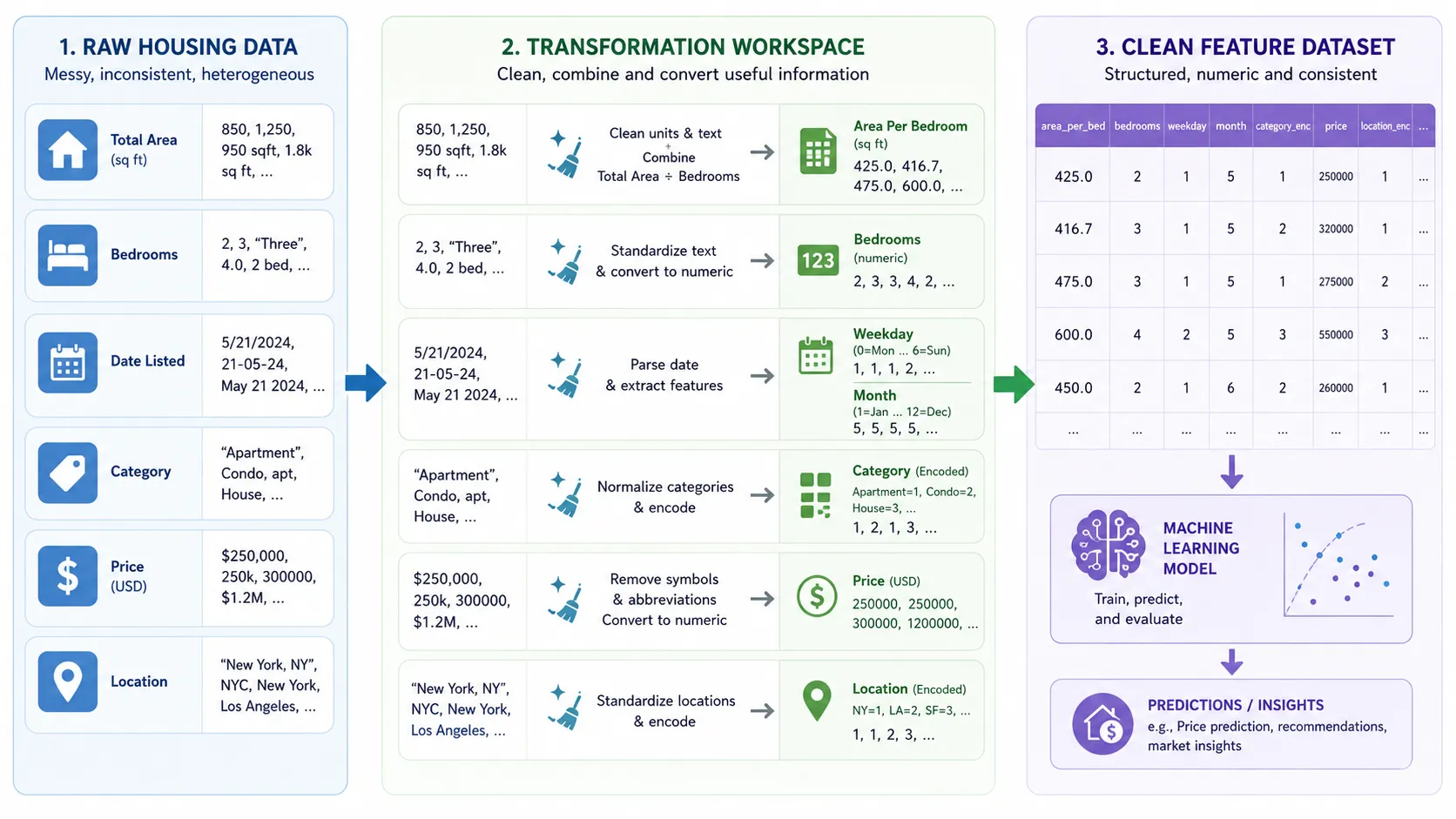
Feature engineering is the process of creating, changing, selecting, or combining input variables so they become more useful for a machine learning model.
A feature is simply a piece of information given to the model.
For example, if you are building a model to predict house prices, your features may include:
area, number of bedrooms, location, property age, distance from the city center, and floor number.
But raw features do not always tell the complete story.
Suppose two houses both have an area of 1,500 square feet. One house has three bedrooms while the other has six very small bedrooms.
Looking only at total area or bedroom count may miss some useful information.
You could create a new feature called area per bedroom.
That new feature may help the model understand how spacious each bedroom is instead of treating both houses as almost the same.
This is where feature engineering techniques become useful.
They can include changing numerical values, encoding categories, handling missing values, extracting information from dates, combining related columns, and creating interaction features.
Machine learning systems work with numerical feature representations, so non-numerical information often needs to be converted into a useful numerical form. Feature crosses can also help represent relationships between multiple features.
Why Feature Engineering Matters
A machine learning model does not understand the world the way you do.
It sees values and patterns.
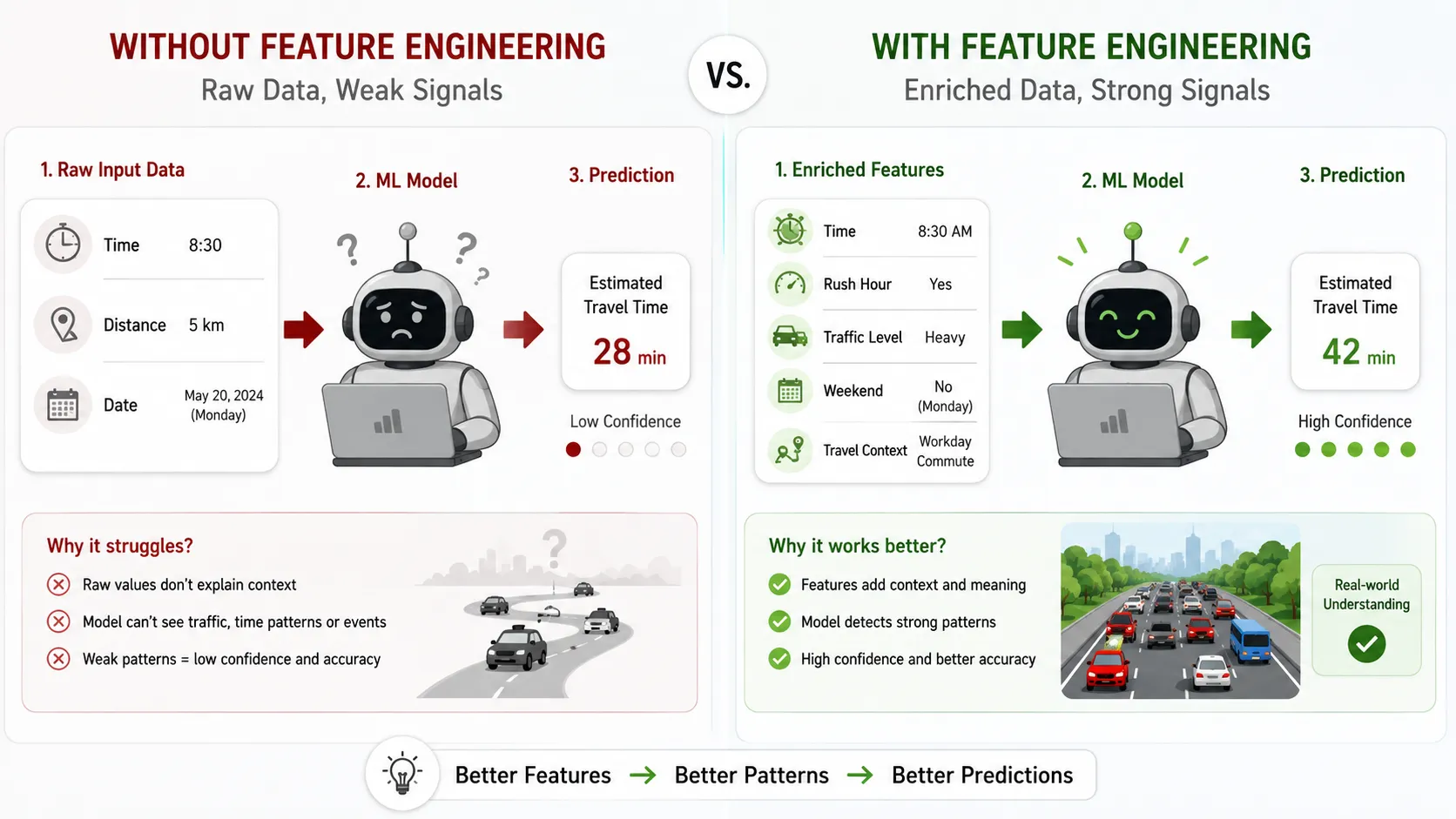
You may instantly understand that 8:30 AM means office rush hour.
A model may simply see 8:30.
You may know that Saturday night behaves differently from Tuesday afternoon.
You may also know that travelling five kilometres through heavy city traffic can take longer than travelling ten kilometres on an open highway.
The raw numbers alone may not explain these situations clearly.
Feature engineering helps bring that real-world meaning into the dataset.
This is why improving your machine learning features can sometimes produce better results than repeatedly changing algorithms.
A more advanced model cannot magically understand information that your data never represented properly.
A Simple Real-Life Feature Engineering Example
Imagine an online travel website wants to predict whether a visitor is likely to book a hotel.
The raw data may contain the search date, check-in date, check-out date, destination, number of travellers, hotel price, device type, and previous visits.
All of these columns are useful.
But we can make them much more meaningful.
From the search and check-in dates, we can create days before check-in.
From check-in and check-out dates, we can create length of stay.
From the time of search, we may create features such as weekend search or late-night search.
From previous user activity, we could create something like hotel views in the last seven days.
And by combining hotel price with length of stay, we may calculate an estimated total stay cost.
Notice what happened.
We did not magically collect a completely new dataset.
We simply turned existing information into features that explain user behaviour more clearly.
That is the mindset behind good feature engineering strategies.
Think about what information a human expert would consider before making the same decision, then find a safe and logical way to represent that information in your dataset.
Feature Engineering vs Data Preprocessing
Data preprocessing and feature engineering are closely connected, but they are not exactly the same.
Data preprocessing mainly focuses on making data clean and usable.
It may include handling missing values, scaling numerical columns, encoding categorical values, fixing incorrect formats, or cleaning obvious errors.
Common machine learning preprocessing workflows include standardization, categorical encoding, transformations, and missing-value imputation.
Feature engineering takes the next step.
Instead of only asking:
“Is this data clean?”
you also ask:
“Can this information be represented in a better way?”
For example, filling a missing age value is preprocessing.
Creating an age group such as child, adult, or senior from that age can be feature engineering.
Converting a date stored as text into a valid date format is preprocessing.
Extracting weekday, month, weekend status, season, or days since the previous purchase from that date is feature engineering.
In real machine learning projects, preprocessing and feature engineering usually work together.
The First Rule: Understand the Problem Before Creating Features
One common beginner mistake is opening a dataset and immediately starting scaling, encoding, or combining columns.
Do not begin with the technique.
Begin with the problem.
Ask yourself what you are predicting, when that prediction needs to happen, and what information will actually be available at that moment.
Suppose you are building a model to predict whether a flight booking will be cancelled.
Your dataset contains a field called refund processed.
That field may have a very strong relationship with cancellation.
It sounds like a great feature.
But there is a problem.
The refund is normally processed after the cancellation has already happened.
If you use that information to predict cancellation, your model is effectively seeing information from the future.
This problem is called data leakage.
It can make your model look extremely accurate during development while performing poorly when real users start using it.
Before using a feature, ask three simple questions:
What does this information actually mean?
When does this information become available?
Would I genuinely know this information before making the prediction?
These questions can save you from many feature engineering mistakes.
What Should You Look for in Raw Data?
Before applying any feature engineering method, study the dataset carefully.
Look for numerical features with very different ranges, text categories, missing values, dates, timestamps, unusual values, repeated information, IDs with little useful meaning, and columns that could accidentally reveal the answer.
Numerical scaling can matter for many machine learning algorithms when features operate on very different ranges. Categorical information may also need a suitable numerical representation such as one-hot encoding.
But remember one important rule:
Do not apply every feature engineering technique to every column.
A transformation that helps one dataset may hurt another.
The right approach depends on the feature, the model you are using, and most importantly, the real problem you are trying to solve.
Once you understand your raw data properly, you are ready for the practical side of feature engineering.
Practical Feature Engineering Strategies That Improve Machine Learning Models
Once you understand your dataset and the problem you are trying to solve, the next step is to improve the raw features.
This does not mean changing every column.
Good feature engineering is about finding the places where the data can explain the real-world situation more clearly.
Let us go through the most useful feature engineering strategies one by one.
1. Handle Missing Values Carefully
Real-world datasets are rarely perfect.
You may find missing ages, empty product categories, unknown locations, missing income values, or incomplete customer information.
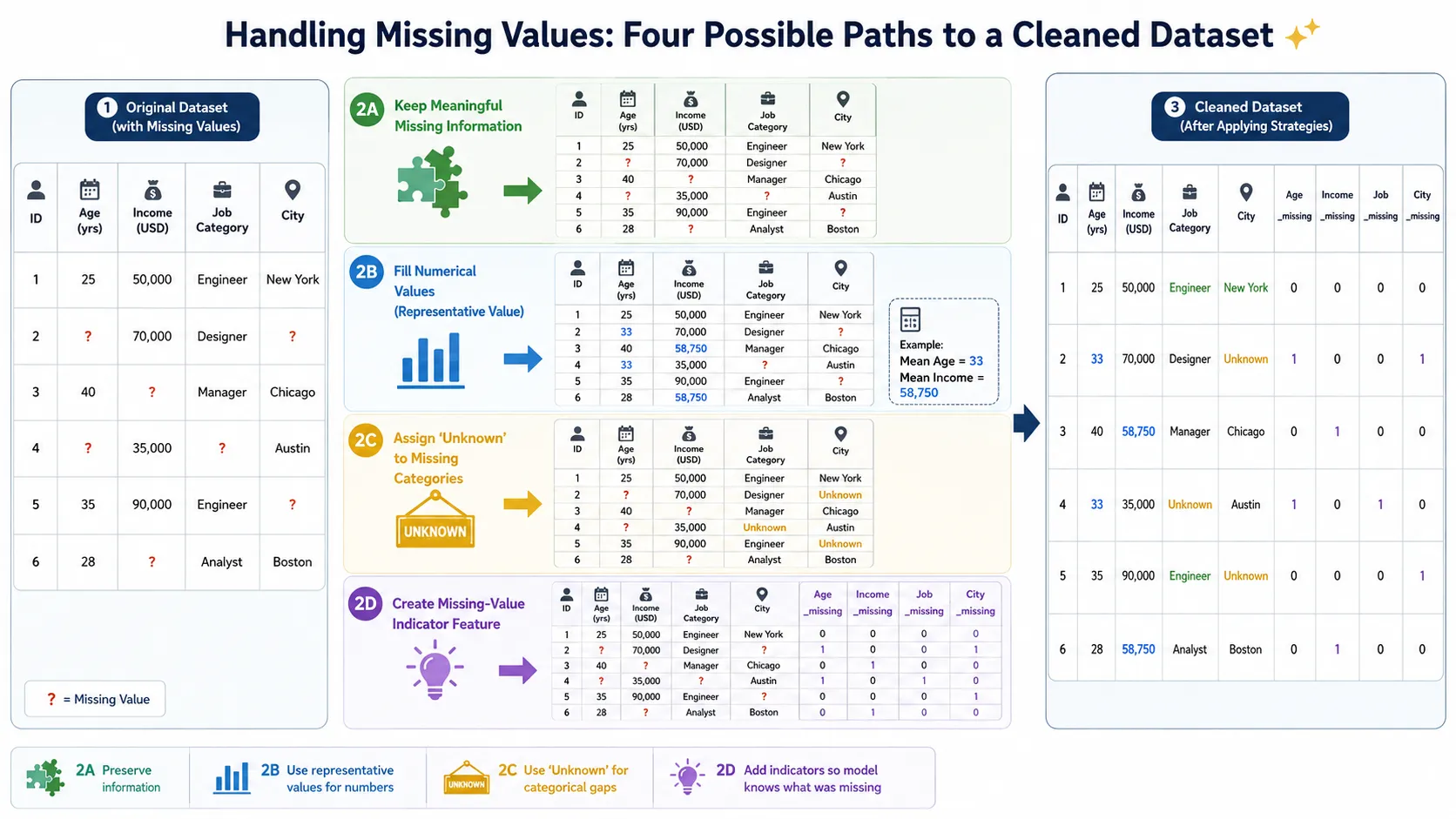
A beginner may think the easiest solution is to delete every row that contains a missing value.
Sometimes that works.
But sometimes you may lose a large amount of useful data.
Suppose an online shopping dataset contains 100,000 customers and around 15% of them have no age information.
Deleting all those customers could remove thousands of useful purchase records.
Instead, you could fill missing numerical values with a reasonable value such as the median.
For categorical features, you may create a separate category such as:
Unknown
This can sometimes be useful because the fact that information is missing may itself carry meaning.
For example, customers who do not provide certain profile details may behave differently from customers who complete every field.
You can even create an additional feature such as:
age_missing = yes/no
Now the model can learn whether missing age information has any connection with the final result.
The important lesson is simple:
Do not fill missing values blindly.
First understand why the value might be missing.
2. Scale Numerical Features When Needed
Imagine your dataset contains:
Age between 18 and 70.
Annual income between 200,000 and 5,000,000.
Number of previous purchases between 0 and 50.
These features operate on very different scales.
Some machine learning algorithms are sensitive to these differences.
In such cases, feature scaling can help.
Two popular approaches are standardization and normalization.
Standardization usually transforms values around a common scale based on their average and spread.
Normalization may bring values into a smaller fixed range.
You do not need to memorize formulas when you are starting.
The important point is to understand why scaling exists.
Think about measuring height in centimetres and salary in rupees.
The larger number does not automatically mean that feature should become more important.
Scaling helps certain models compare numerical features more fairly.
However, scaling is not equally important for every algorithm.
Tree-based models such as Decision Trees and Random Forests usually do not depend on feature scaling in the same way that algorithms based on distance or gradients often do.
you want to learning about Decision Trees and Random Forests so click this section .
So again:
Use a technique because the model needs it, not because every tutorial uses it.
3. Convert Categorical Data into Useful Features
Machine learning datasets often contain categories such as:
City
Payment method
Device type
Membership level
Product category
Hotel type
These values cannot always be passed directly to a model as plain text.
They usually need categorical encoding.
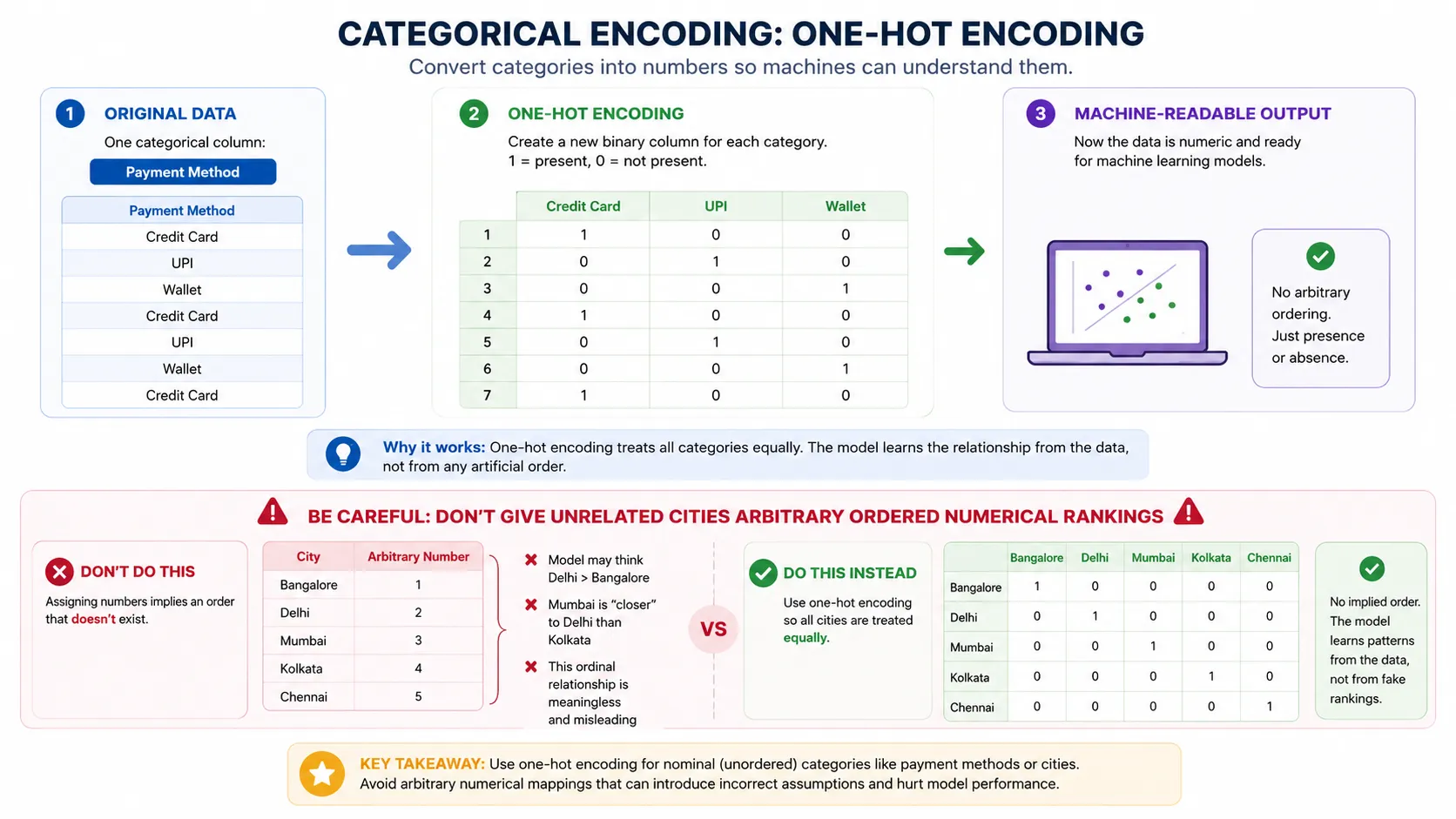
One of the most common techniques is one-hot encoding.
Suppose a travel dataset contains:
Payment Method = Credit Card, UPI, Wallet
Instead of treating these as ordinary words, one-hot encoding creates separate indicators for each category.
The model can then understand which payment method was used without assuming that one category is mathematically larger than another.
Another simple method is label encoding, where categories receive numerical labels.
However, you need to be careful.
If:
Economy = 1
Premium Economy = 2
Business = 3
that ordering may make sense because there is a natural progression.
But assigning:
Delhi = 1
Mumbai = 2
Goa = 3
does not mean Goa is somehow three times Delhi.
That is why the encoding technique should match the meaning of the feature.
4. Extract Powerful Features from Dates and Time
Dates are one of the best places to find hidden information.
A raw value such as:
2026-08-11 20:30
contains much more information than just a date.
From it, you may extract:
day of the week,
month,
hour,
weekend status,
morning or evening,
holiday period,
season,
or even time since a previous event.
Let us take a hotel booking example.
Suppose a user searches for a room on 1 December and plans to check in on 24 December.
Instead of giving the model only two dates, create:
days_before_check_in = 23
That may be much more meaningful.
You could also create:
check_in_on_weekend
holiday_season_booking
length_of_stay
booking_month
These features give the model additional context about customer behaviour.
A person booking two months in advance may behave very differently from someone booking a hotel for tonight.
That difference can be valuable.
5. Create Interaction Features
Sometimes two features become more useful when they are considered together.
These are often called interaction features or feature crosses.
Suppose an e-commerce dataset contains:
Product price
Customer income
Each feature is useful separately.
But you might create something like:
price_to_income_ratio
This may help explain whether a product is expensive relative to that particular customer.
Another example comes from food delivery.
Distance alone affects delivery time.
Traffic level also affects delivery time.
But combining them may reveal an even stronger pattern.
A five-kilometre delivery during light traffic and a five-kilometre delivery during rush hour are completely different situations.
A useful interaction might represent:
distance × traffic intensity
The goal is not to create hundreds of random combinations.
Create interactions when there is a logical real-world reason for two features to influence each other.
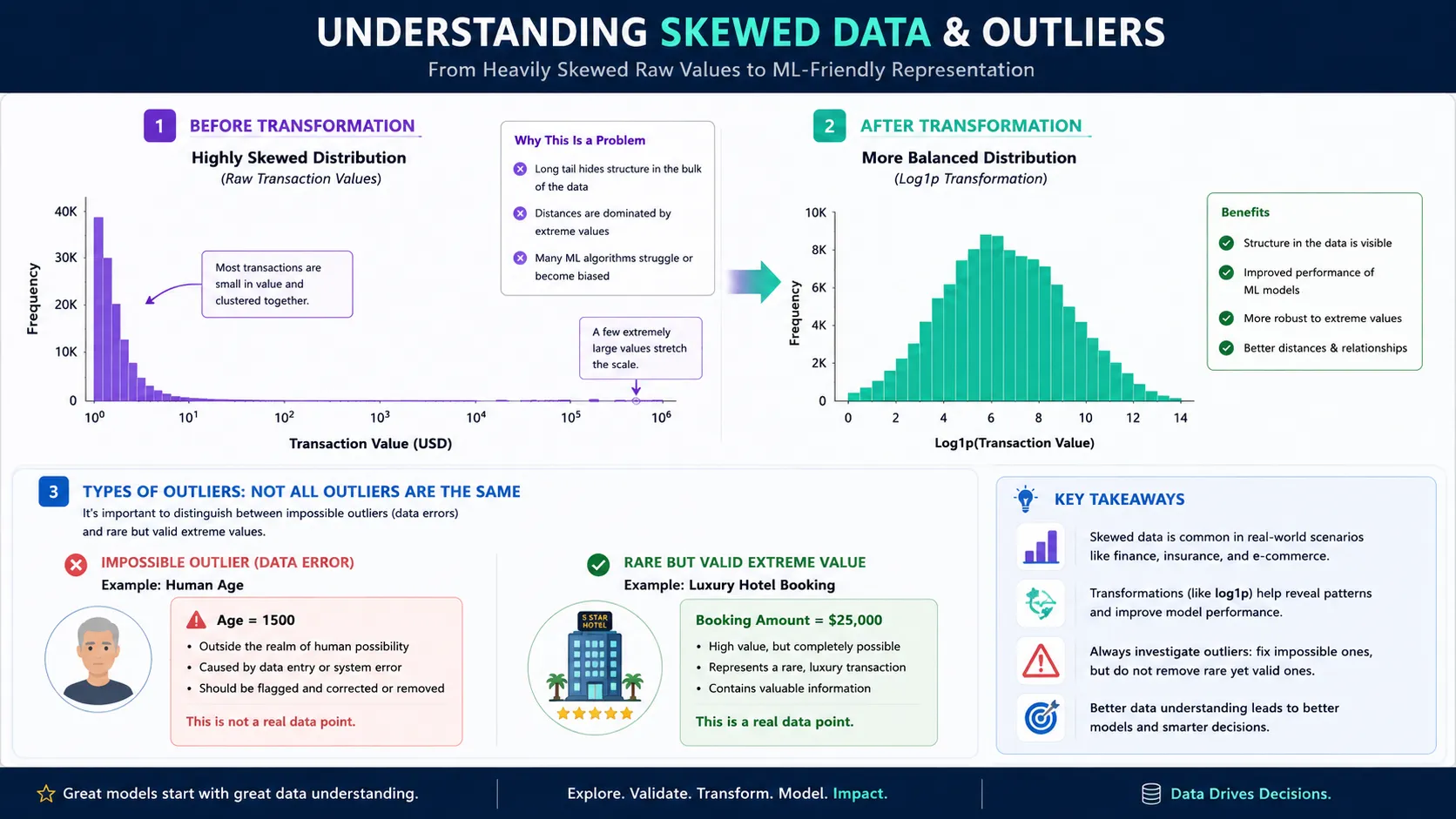
6. Transform Highly Skewed Numerical Data
Some numerical features are heavily unbalanced.
Income is a common example.
Most people may fall within a moderate range, while a small number have extremely high values.
The same thing can happen with:
transaction amount,
website visits,
property prices,
company revenue,
or product sales.
In some machine learning problems, applying a transformation such as a log transformation can make these values easier for the model to work with.
For example, imagine most orders are worth ₹500 to ₹5,000, but a few orders are worth ₹200,000.
Those extreme values may strongly affect certain models.
A transformation can reduce the gap between normal and extremely large values.
But transformations should always have a reason.
Do not transform a feature simply because it looks unusual.
Check its distribution and understand its meaning first.
7. Deal with Outliers Instead of Automatically Removing Them
An outlier is a value that looks very different from most other observations.
Suppose most hotel bookings cost between ₹3,000 and ₹15,000 per night.
Then you see one booking costing ₹180,000.
Is it an error?
Maybe.
But it could also be a luxury villa or presidential suite.
Deleting every unusual value can remove important real-world cases.
Before removing an outlier, ask:
Is the value impossible?
Could it be a data-entry error?
Or is it simply a rare but valid case?
For example, an age of 250 years is almost certainly incorrect.
A hotel price of ₹150,000 per night may be completely valid.
You may remove incorrect values, cap extreme values in certain situations, transform them, or simply keep them if they represent legitimate cases.
Outlier handling in machine learning requires context, not just a mathematical rule.
8. Turn Domain Knowledge into Features
This is where strong feature engineering becomes much more interesting.
Domain knowledge means understanding how the real problem works.
Imagine you are predicting flight booking conversions.
A normal dataset may contain:
departure airport,
arrival airport,
fare,
departure date,
booking date,
airline,
and number of passengers.
But someone who understands travel may create stronger features such as:
days until departure
weekend departure
international vs domestic trip
price per passenger
round-trip duration
peak travel season
These features come from understanding how travellers actually make decisions.
This is why feature engineering is not just a technical task.
It is also a thinking task.
A data scientist who understands the business problem can often create better features than someone who only knows more algorithms.
The best question to keep asking is:
“What would matter to a human making this decision?”
Then try to represent that information in a clean, measurable feature.
Good Feature Engineering Is About Meaning, Not Quantity
Creating 500 new columns does not automatically make your model better.
In fact, too many weak or irrelevant features can increase noise, slow training, and sometimes make the model harder to understand.
The aim is not to create the largest dataset.
The aim is to create the most useful representation of the problem.
Once useful features are created, the next challenge is deciding which ones should actually stay in the model.
That is where feature selection, dimensionality reduction, leakage prevention, validation, and feature engineering pipelines become important.
Feature Selection: Keep Only the Features That Actually Help
After creating new features, the next question is simple:
Do we really need all of them?
The answer is usually no.
A dataset may contain hundreds of features, but some of them may provide very little useful information. Others may repeat the same information in a different form.
This is where feature selection in machine learning becomes important.
Feature selection means choosing the most useful features and removing the ones that add noise, confusion, or unnecessary complexity.
Imagine you are predicting house prices.
Your dataset contains:
property area,
area in square feet,
area in square metres,
number of bedrooms,
location,
property age,
and price category.
If two or three columns are simply different versions of the same information, keeping all of them may not help.
The goal is not to keep every possible feature.
The goal is to keep features that help the model learn meaningful patterns.
A simpler feature set can also make a model easier to train, test, explain, and maintain.

How Can You Select the Best Features?
There are several feature selection techniques, but beginners do not need to start with complicated methods.
Begin with basic checks.
Ask whether the feature has a logical connection with the target.
Check whether it contains useful variation.
Look for duplicate or almost duplicate information.
Study how strongly features relate to each other.
Then test whether removing a feature changes model performance.
Some machine learning models can also show feature importance, which helps estimate how much individual features contribute to predictions.
But feature importance should not be treated as absolute truth.
A feature may look important because it is connected with another feature, or because the model happens to use it frequently.
Always combine statistical results with business understanding.
Avoid Data Leakage at Every Stage
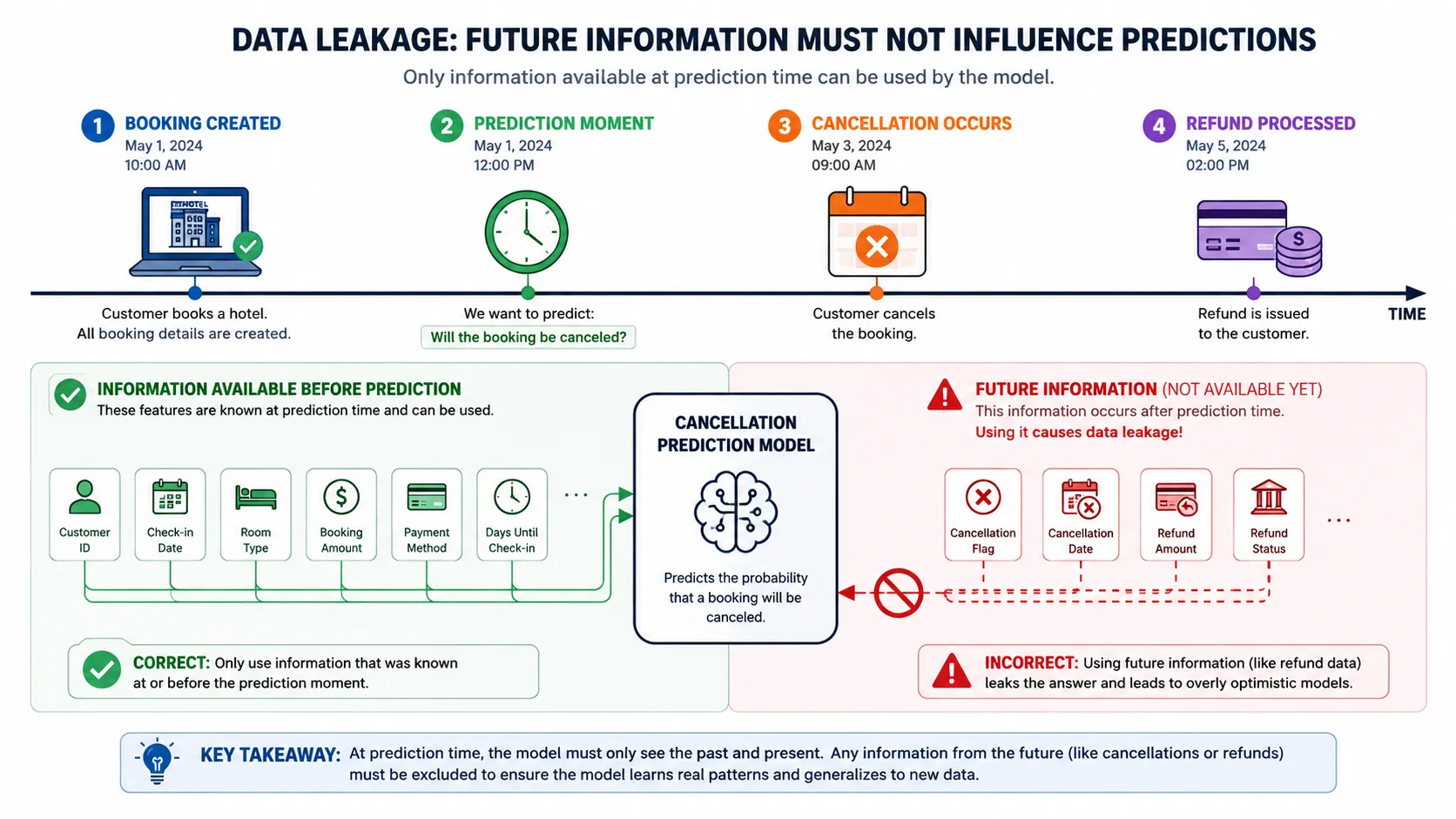
One of the biggest mistakes in feature engineering is data leakage.
Data leakage happens when your model receives information during training that would not actually be available when making a real prediction.
This can create amazing accuracy during testing and terrible results in production.
Imagine you want to predict whether a customer will cancel a hotel booking.
Your dataset contains:
booking date,
hotel name,
price,
check-in date,
payment status,
and cancellation refund amount.
The refund amount may strongly indicate whether the booking was cancelled.
But this information normally exists only after cancellation.
Using it would make the model cheat.
Another example is predicting whether a loan will default while using a field that is created only after the customer has missed several payments.
The model may look intelligent, but it is simply reading information from the future.
A useful rule is:
Only use information that would genuinely exist at the exact moment when the prediction is made.
Apply Feature Engineering After the Train-Test Split
There is another type of leakage that beginners often miss.
Suppose you calculate the average and standard deviation of the entire dataset and then use those values to scale the data before separating training and test sets.
The test data has now indirectly influenced the training process.
This may produce slightly unrealistic evaluation results.
A safer approach is to first divide your data into training and test sets.
Then learn transformations from the training data.
After that, apply the same learned transformation to the test data.
The same idea applies to:
scaling,
missing value imputation,
category handling,
feature selection,
and several other preprocessing steps.
Your test set should behave like completely unseen future data.
That is what makes machine learning model validation reliable.
Build a Feature Engineering Pipeline
When a project becomes larger, manually applying every transformation becomes difficult.
You may forget which columns were scaled.
You may apply one transformation differently during testing.
Or you may create features in a slightly different order when the model reaches production.
This is where a feature engineering pipeline helps.
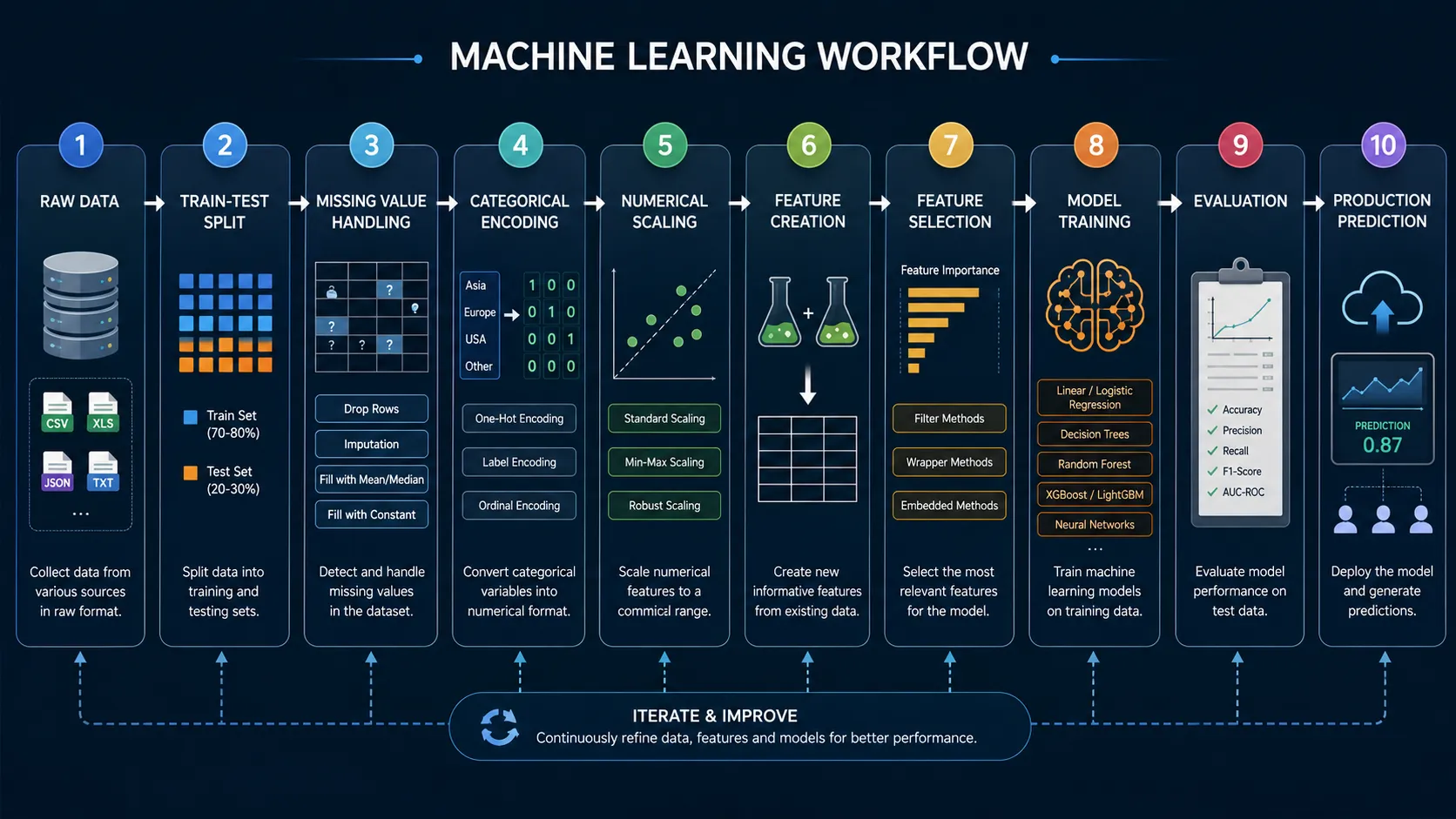
A pipeline keeps preprocessing and model steps organized in one repeatable workflow.
For example, your workflow may look like this:
raw data → missing value handling → categorical encoding → numerical scaling → feature creation → feature selection → model training
The exact order can change depending on the project.
The important thing is consistency.
If your training data goes through one process and production data goes through another, your predictions may become unreliable.
A well-designed machine learning pipeline reduces this risk.
Test Whether a New Feature Actually Works
Every new feature should be treated like an experiment.
Do not assume that a clever idea will automatically improve your model.
Create a baseline model first.
Measure its performance.
Then add your new feature or feature group.
Train the model again using the same evaluation method.
Compare the results.
Suppose your original model accuracy is 82%.
You create five new behavioural features and accuracy becomes 86%.
That is a useful improvement.
But if accuracy remains 82% or drops to 80%, those features may not be helping.
The same idea applies to other evaluation metrics such as precision, recall, F1-score, MAE, RMSE, or ROC-AUC.
Which metric you use depends on the problem.
The key point is:
Feature engineering should be measured, not guessed.
Do Not Ignore Features That Work Differently Over Time
Real-world behaviour changes.
A feature that works extremely well today may become less useful later.
Customer behaviour changes.
Prices change.
Markets change.
Products change.
Even search patterns and travel behaviour can change across seasons.
Imagine a hotel demand model.
Features created from Christmas bookings may behave very differently during normal weekdays in February.
This is why production machine learning systems should regularly check whether their features are still useful.
This problem is often connected with data drift and feature drift.
You do not need to become an expert in monitoring on day one.
Just remember that machine learning is not always a one-time project.
A model needs fresh data, monitoring, and sometimes new features.
Common Feature Engineering Mistakes Beginners Should Avoid
The first mistake is creating features without understanding the business problem.
The second is keeping every feature simply because more data feels safer.
Another common mistake is using future information and creating data leakage.
Beginners may also scale every feature even when the chosen model does not need it.
Another mistake is applying one-hot encoding to a column containing thousands of unique values without considering what that will do to the dataset.
Some people also remove every outlier automatically.
Others create dozens of interaction features without any logical reason.
And one of the biggest mistakes is testing many transformations on the test set until the model looks good.
The test set should not become part of your trial-and-error process.
A Simple Feature Engineering Workflow for Beginners
When working on your next machine learning project, follow a simple process.
Start by understanding the prediction problem.
Then study the raw dataset.
Identify missing values, numerical features, categorical features, dates, possible errors, and unusual values.
After that, split your training and test data correctly.
Clean the training data.
Encode categories where needed.
Scale numerical features when the model requires it.
Create useful date, interaction, ratio, behavioural, or domain-based features.
Remove weak or unnecessary features.
Train a baseline model.
Add or remove features in small groups and compare the results.
Finally, create a repeatable pipeline so the same transformations can be used when new data arrives.
This process is much safer than randomly trying dozens of techniques.
Final Thoughts
Good feature engineering starts with one question:
What information would help someone understand this problem better?
If a human travel expert knows that last-minute bookings behave differently, create a feature for booking lead time.
If a retailer knows that repeated purchases matter, create a feature representing purchase frequency.
If a delivery company knows that traffic and distance work together, represent that relationship.
That is the real power of feature engineering in machine learning.
You are not simply changing columns.
You are helping the model see the problem more clearly.
And in many real projects, a carefully designed set of features can make a bigger difference than moving from one advanced algorithm to another.
Learn the data.
Understand the real-world problem.
Create features with a reason.
Test every important change.
Keep only what works.
That mindset will take you much further than memorizing a long list of feature engineering techniques.
Want to Learn about what is Overfitting vs underfitting click this link


