


Imagine you are preparing for a driving test.
Your instructor gives you one road to practice on every day. After a few weeks, you can drive on that road almost perfectly. You know every turn, every traffic light, and even where people usually cross the street.
But then your actual driving test happens on a completely different road.
Suddenly, things are not so easy.
This is very close to a problem we face in machine learning. A model may perform extremely well on the data it has already seen, but that does not automatically mean it will perform well when new data arrives.
That is where cross-validation in machine learning becomes useful.
Instead of judging a model from one lucky train-test split, cross-validation gives the model several chances to prove itself.
What Is Cross-Validation in Machine Learning?
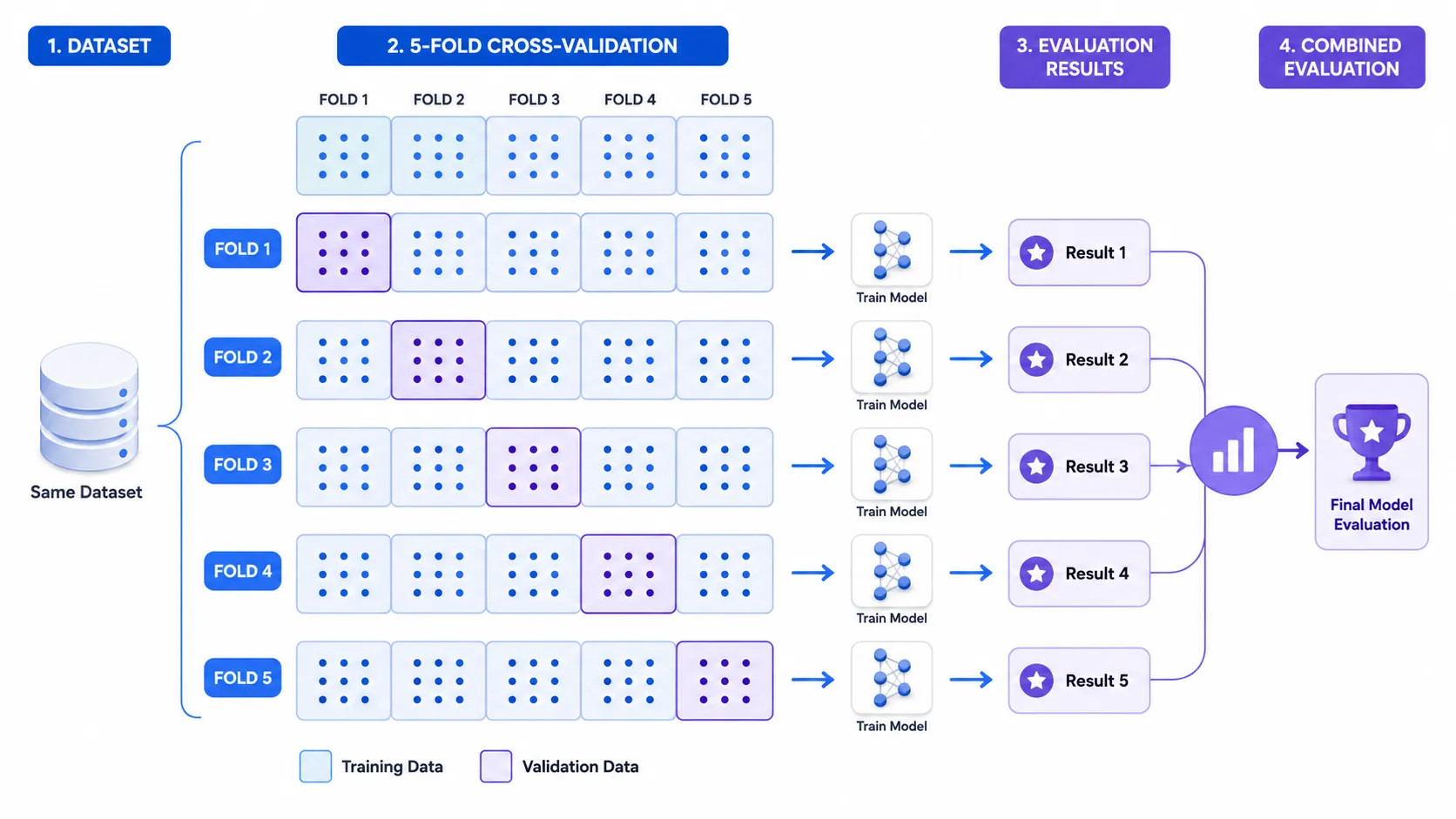
Cross-validation is a model evaluation method used to estimate how well a machine learning model may perform on unseen data.
The basic idea is simple.
Instead of dividing your dataset only once, you divide it into several smaller sections. These sections are usually called folds.
The model trains on some folds and validates its performance on the remaining fold. The process is repeated so that different sections of the dataset get a chance to act as validation data.
For example, suppose you have data from 1,000 customers and want to build a model that predicts whether a customer will buy a product.
If you use 5-Fold cross-validation, the dataset is divided into five sections.
The model might:
Train on sections 2, 3, 4, and 5 and validate on section 1.
Train on sections 1, 3, 4, and 5 and validate on section 2.
Continue the same process until every fold has been used for validation once.
This matches the standard K-Fold process described in scikit-learn: each fold is used once for validation while the remaining folds are used for training.
After all rounds are complete, we look at the model's scores across the different folds instead of trusting only one result.
That gives us a much better picture of how stable the model really is.
Why Can a Single Train-Test Split Be Misleading?
Suppose you have 500 house records.
You randomly use 400 houses for training and 100 for testing.
Your model gets an accuracy or evaluation score that looks excellent.
Great.
But what if those 100 test houses happened to be unusually easy examples?
Maybe most were located in similar areas. Maybe their prices followed very predictable patterns. Your model could look stronger than it actually is simply because it received a convenient test set.
Now imagine splitting the same dataset differently.
The score drops.
Split it again.
The score changes again.
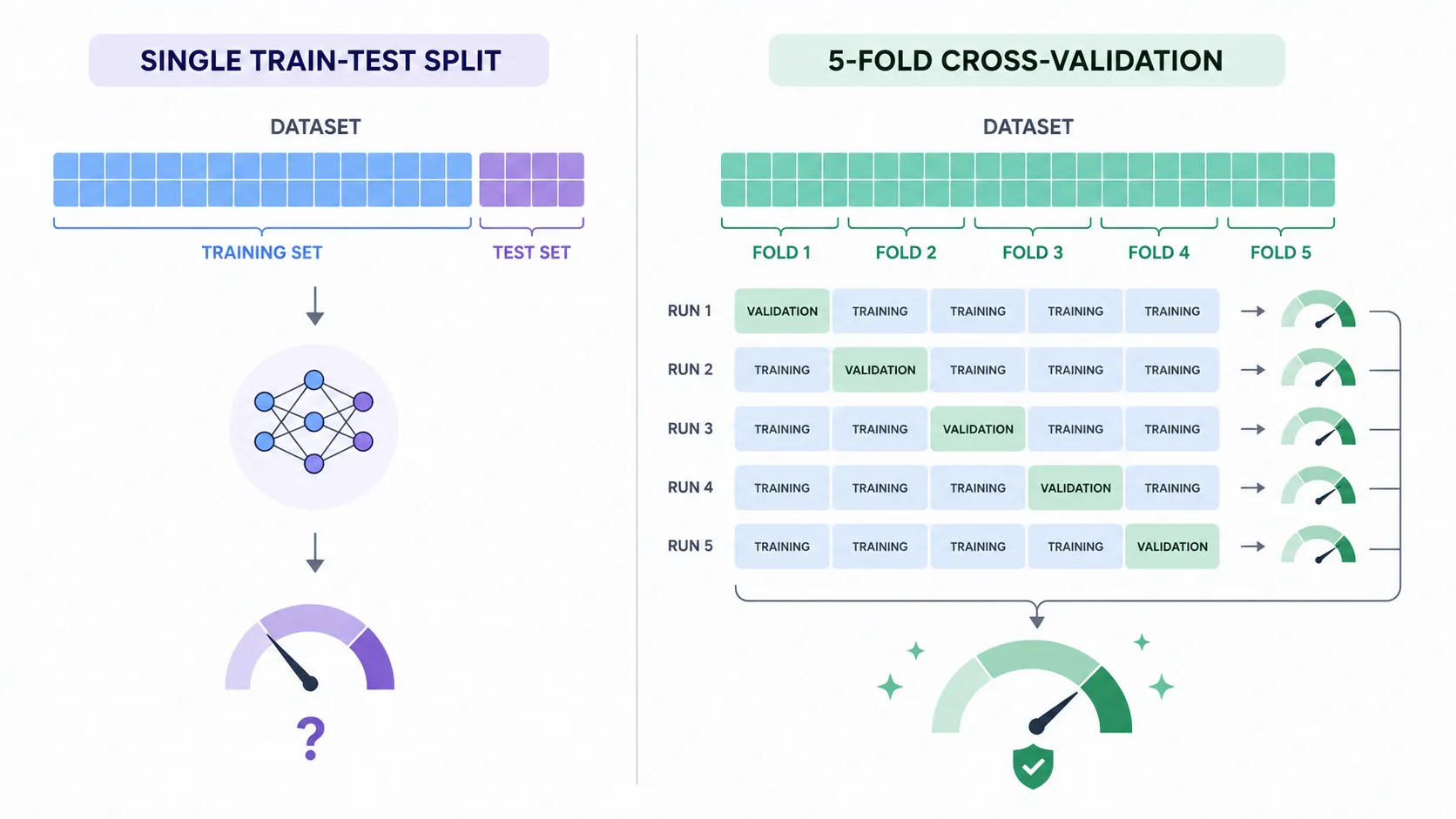
This is one reason machine learning model validation should not always depend on a single random split.
Cross-validation asks a more useful question:
“Does this model perform well across different portions of my data, or did it simply get lucky once?”
That difference matters when a model moves from an experiment to the real world.
Google's machine-learning guidance also emphasizes that the real test of a model is how it handles new examples rather than examples that overlap with its training data.
How Does Cross-Validation Work Step by Step?
Let us use another simple example.
Imagine a teacher has 100 questions and wants to know whether a student truly understands mathematics.
Giving the student only one 20-question test may not tell the whole story. That particular test might contain the topics the student knows best.
Instead, the teacher creates five different sets of questions and checks performance several times.
Machine learning cross-validation follows a similar idea.
Step 1: Start With the Dataset
Suppose we have 1,000 records.
These could represent customers, houses, transactions, patients, products, or almost any type of machine-learning data.
Step 2: Divide the Data Into Folds
If we choose five folds, we create five groups of data.
This method is known as 5-Fold cross-validation, which is one form of K-Fold cross-validation.
Here, K simply represents the number of folds.
Step 3: Train the Model
During the first round, four folds are used to train the model.
The remaining fold stays separate and is used to check performance.
Step 4: Change the Validation Fold
For the next round, another fold becomes the validation data.
The model is trained again using the remaining folds.
This continues until every fold has served as validation data.
Step 5: Compare the Results
Suppose the model produces these scores:
91%, 89%, 92%, 90%, and 91%.
Seeing several similar results gives us more confidence than seeing a single 92% score.
But imagine the results were:
96%, 94%, 75%, 91%, and 69%.
That tells us something important.
The model's performance changes significantly depending on which data it sees. We would want to investigate why before trusting it in production.
This is why cross-validation for model evaluation gives us more information than a single score.
What Is Cross-Validation Really Trying to Tell Us?
The purpose is not simply to generate more accuracy numbers.
The bigger goal is generalization.
Generalization means the model has learned useful patterns that also work on data it has never seen before.
For example, an online store does not care only about how accurately its model predicts the customers already stored in its database.
It cares about tomorrow's customers.
A bank does not build a fraud model only to recognize historical transactions.
It needs the model to detect suspicious transactions arriving in the future.
A house-price model should not only explain houses from its training dataset. It should also give sensible predictions for new properties.
That is the real reason cross-validation techniques matter.
They help us check whether good model performance is reasonably consistent across different samples of the available data.
Cross-validation can also help expose signs of overfitting and support model or hyperparameter selection, although it does not magically remove overfitting by itself. Overfitting happens when a model learns the training data too closely and fails to generalize to new examples.
Training Data, Validation Data, and Test Data Are Not the Same Thing
This distinction confuses many beginners.
Training data teaches the model.
Validation data helps us evaluate choices while developing the model.
A separate test set can then provide a final check after important model decisions have been made.
Why keep that final test data separate?
Because repeatedly checking the same test set while changing the model can slowly influence our decisions. Eventually, we may begin optimizing our model for that particular test set without realizing it.
At that point, the test set is no longer giving us a truly independent final check.
This separation becomes especially important when we start comparing models, tuning hyperparameters, and choosing between different cross-validation methods.
And this is where things become more interesting—because ordinary K-Fold is only one option. Classification problems, imbalanced datasets, grouped records, and time-based data can require very different validation strategies.
Different Cross-Validation Techniques You Should Know
Now that we understand why cross-validation matters, the next question is obvious:
Which cross-validation technique should we actually use?
There is no single method that is perfect for every machine learning problem.
The right choice depends on your dataset, the type of problem you are solving, and how your data is connected.
For example, a normal house-price dataset may work well with K-Fold Cross-Validation, while a disease prediction dataset with very few positive cases may need Stratified K-Fold. A stock-price dataset needs a completely different approach because time order matters.
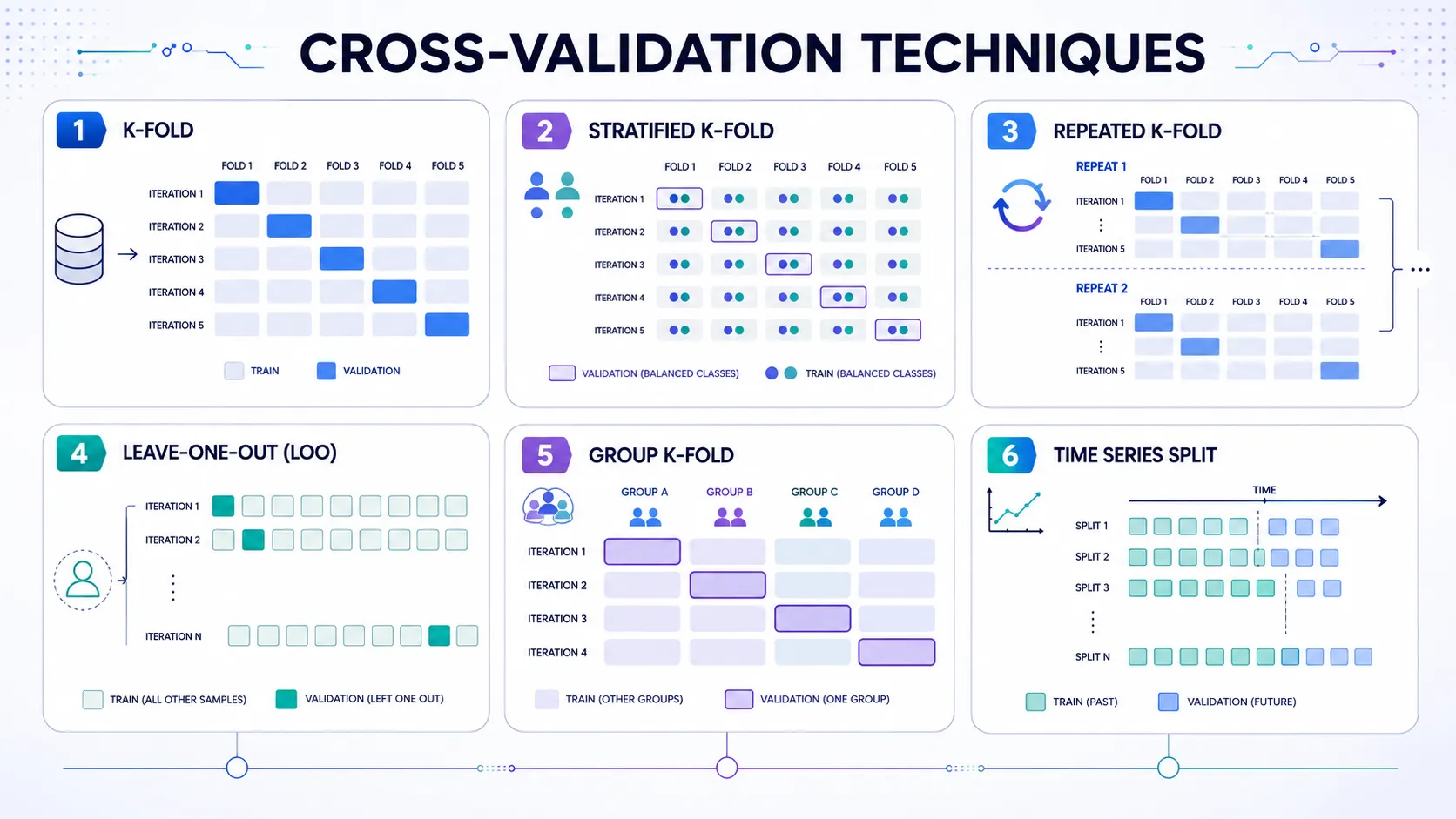
Let us understand the most useful cross-validation techniques in machine learning one by one.
1. K-Fold Cross-Validation
K-Fold Cross-Validation is one of the most commonly used model validation techniques.
The idea is simple.
We divide the dataset into K equal or nearly equal parts called folds.
Suppose we choose:
K = 5
Our dataset is divided into five folds.
During the first round, four folds are used for training and one fold is used for validation.
In the next round, another fold becomes the validation fold.
This continues until every fold has been used for validation once.
According to the current scikit-learn documentation, KFold divides samples into K consecutive folds, and each fold is used once as validation data while the remaining folds form the training data.
A Real-Life K-Fold Example
Imagine you run a food-delivery company.
You have data from 10,000 previous orders and want to predict whether a new order will arrive late.
Instead of training your model once and testing it on one random group of orders, you use 5-Fold Cross-Validation.
The model is trained and checked five times.
You may receive validation scores like:
88%, 87%, 89%, 86%, and 88%.
Because these results are fairly close to each other, you have a stronger reason to believe that the model behaves consistently across different parts of your data.
This is one of the main benefits of K-Fold Cross-Validation for model evaluation.
However, ordinary K-Fold is not always the right choice.
That becomes clear when our classes are unbalanced.
2. Stratified K-Fold Cross-Validation
Suppose you are building a model to detect fraudulent online payments.
Your dataset contains 100,000 transactions.
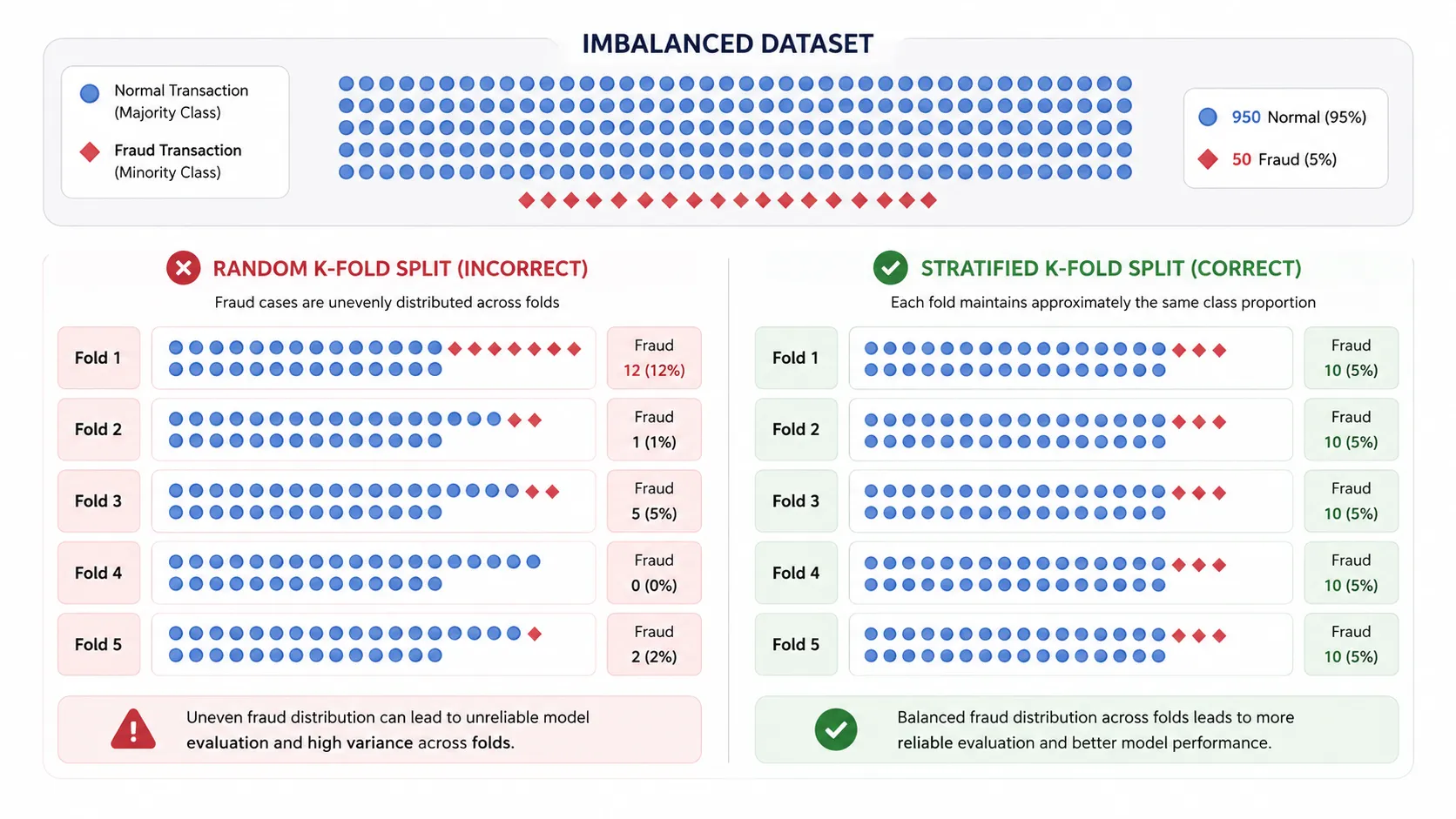
Maybe only 1,000 of them are fraud cases, while the remaining 99,000 are normal transactions.
Now imagine randomly creating folds.
One fold might receive many fraud examples, while another receives very few.
That can make model evaluation unreliable.
This is where Stratified K-Fold Cross-Validation becomes useful.
Stratified K-Fold tries to preserve the percentage of each class inside every fold. Scikit-learn describes it as a variation of K-Fold that keeps approximately the same class proportions across folds for classification problems.
So if around 1% of your overall dataset belongs to the fraud class, each fold should also contain roughly that same class proportion.
When Should You Use Stratified K-Fold?
It is especially useful for classification tasks where the target classes are not evenly distributed.
Examples include:
Fraud detection
Disease diagnosis
Spam detection
Customer churn prediction
Loan default prediction
If you are working with an imbalanced classification dataset, Stratified K-Fold is often a much safer starting point than ordinary K-Fold.
3. Repeated K-Fold Cross-Validation
Sometimes running K-Fold only once is not enough.
Imagine two machine learning models perform almost equally well.
Model A gets an average score of 91%.
Model B gets 91.3%.
Is Model B really better?
Maybe.
But perhaps that tiny difference happened because of the way the dataset was divided.
Repeated K-Fold Cross-Validation helps us investigate this problem.
Instead of performing K-Fold once, we repeat the process multiple times using different splits.
For example:
5-Fold Cross-Validation repeated 3 times creates multiple training and validation rounds.
This gives us a broader view of how the model behaves across different data splits.
The trade-off is simple:
More repeated training usually means more computation and more training time.
So we do not repeat cross-validation just for the sake of getting more numbers. It is useful when we want a more stable estimate and the dataset and model are manageable enough to train repeatedly. Scikit-learn includes repeated cross-validation iterators specifically for repeating K-Fold-style evaluation with different randomization.
4. Leave-One-Out Cross-Validation
Now imagine you have a very small dataset.
Suppose a rare medical study contains data from only 120 patients.
You do not want to waste a large part of that already-small dataset as validation data.
One option is Leave-One-Out Cross-Validation, often called LOOCV.
The concept is exactly what the name suggests.
You leave one data point out for validation and train the model using all the remaining data points.
If you have 120 samples:
The model trains on 119 samples and validates on 1 sample.
Then another sample is left out.
The process continues until all 120 samples have been used once for validation.
This allows almost all available observations to participate in training during every round.
But there is a cost.
If your dataset contains 50,000 samples, the model may need to be trained thousands of times.
That can become extremely expensive.
So Leave-One-Out Cross-Validation is usually more practical for small datasets than very large ones. Scikit-learn lists Leave-One-Out as one of its exhaustive cross-validation strategies.
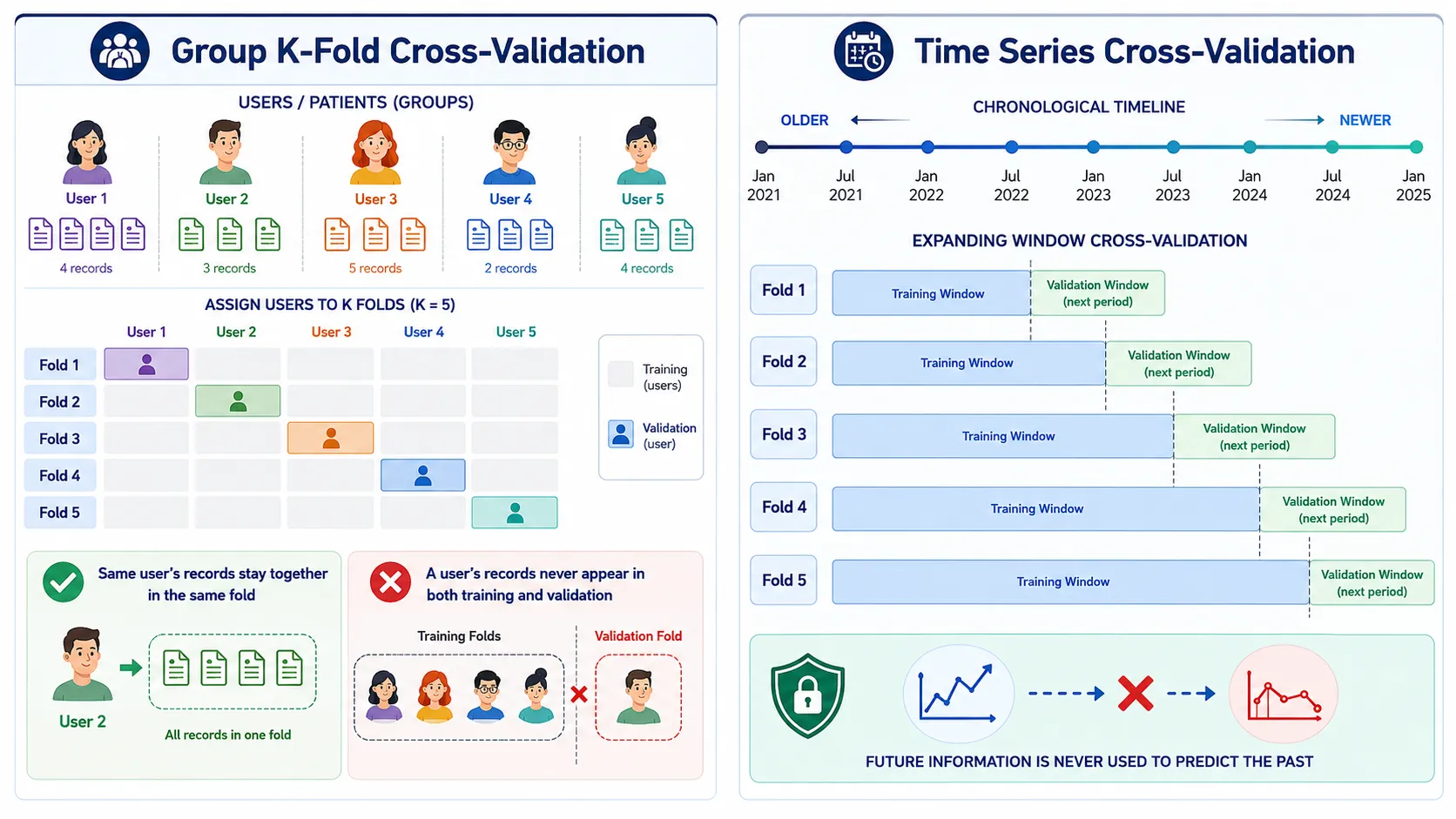
5. Group K-Fold Cross-Validation
Here is a situation that beginners often miss.
Suppose you are building a fitness model using data collected from 1,000 people.
Each person has 50 records.
That means you have 50,000 rows.
If records from the same person appear in both your training and validation sets, your model may indirectly recognize patterns belonging to that person.
The validation score may then look much better than the model's real ability to handle a completely new person.
This is where Group K-Fold Cross-Validation helps.
Group K-Fold keeps samples from the same group together so the same group does not appear in both training and validation folds.
Your groups might represent:
Individual patients
Customers
Students
Devices
Families
Stores
Companies
This technique is extremely useful when several rows belong to the same real-world entity.
6. Time Series Cross-Validation
Now imagine you are predicting tomorrow's sales.
You have sales data from:
2022, 2023, 2024, 2025, and 2026.
Would it make sense to train the model using 2026 data and then test it on 2023?
No.
That would mean using information from the future to predict the past.
For time series machine learning, the order of data matters.
This is why normal random cross-validation can be inappropriate for time-based problems.
A Time Series Split keeps the temporal order intact. Earlier observations are used to train the model, while later observations are used for validation. Scikit-learn explicitly notes that standard cross-validation methods can be inappropriate for time-ordered data because they may lead to training on future data and evaluating on past data.
Think about monthly sales.
You may train on:
January → March
and validate on:
April.
Then train on:
January → April
and validate on:
May.
Then train again using more historical data and test on the next future period.
This approach is much closer to what will happen when the model is used in real life.
Time Series Cross-Validation is commonly useful for problems such as:
Sales forecasting
Demand prediction
Website traffic forecasting
Energy consumption
Weather-related prediction
Financial time series
And this gives us one of the most important lessons in cross-validation:
The best cross-validation method is not the most complicated one. It is the method that matches how your model will face new data in the real world.
A random K-Fold split might be excellent for one project and completely misleading for another.
Before choosing a technique, ask yourself three simple questions:
Are my classes balanced?
Do several rows belong to the same person or group?
Does the order of time matter?
Those three questions alone can prevent many common model-validation mistakes.
But choosing the correct split is only half the job.
You can still get an impressive cross-validation score and build a weak model if you make mistakes such as data leakage, wrong preprocessing, poor evaluation metrics, or careless hyperparameter tuning.
That is exactly what we need to understand next.
Common Cross-Validation Mistakes and Best Practices
Choosing the right cross-validation technique is important, but that alone does not guarantee a reliable machine learning model.
You can use 5-Fold Cross-Validation, get a great score, and still build a model that fails badly in the real world.
Why?
Because the way you prepare the data, choose evaluation metrics, tune the model, and handle leakage matters just as much as the cross-validation method itself.
Let us understand the most common mistakes and how to avoid them.
1. Data Leakage Can Make a Weak Model Look Excellent
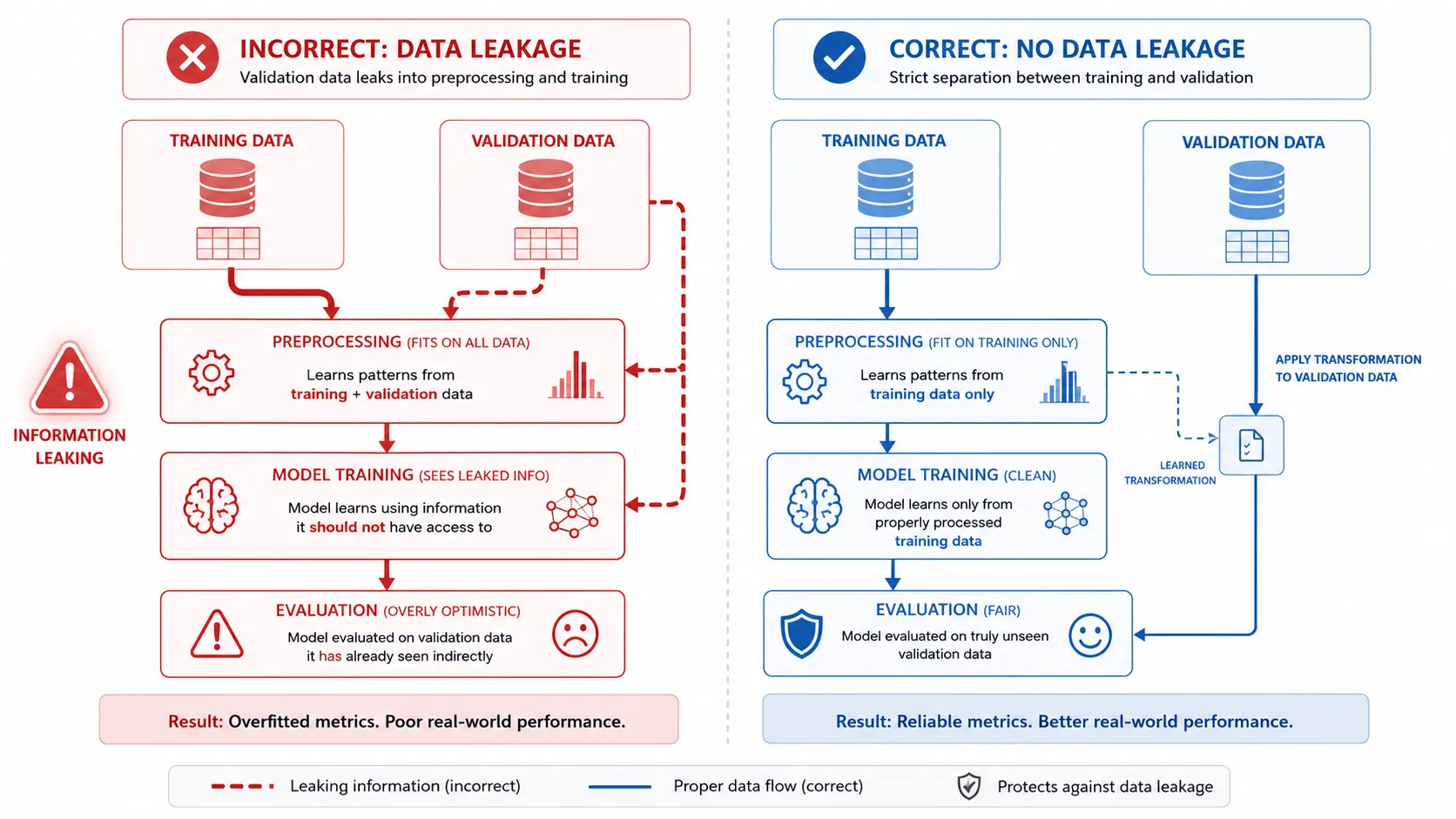
Data leakage happens when information from outside the training data secretly reaches the model during training.
This can create extremely high validation scores that look impressive but are not trustworthy.
Imagine you are creating a model to predict whether a customer will cancel a hotel booking.
Your dataset contains a field called:
Cancellation Fee Charged
But that information is available only after the customer cancels.
If you use this feature while training the model, the model is basically getting a clue about the answer.
Your validation accuracy may become very high.
But in a real booking system, you would not know whether a cancellation fee was charged before predicting the cancellation.
This is a classic example of data leakage in machine learning.
The same problem can happen during data preprocessing.
Suppose you want to scale numerical features.
If you calculate the mean and standard deviation using the entire dataset before cross-validation, information from the validation folds has already influenced the training process.
The safer approach is simple:
Perform preprocessing inside each training fold, not once on the complete dataset.
This is one reason machine learning pipelines are so useful.
2. Preprocessing Should Happen Inside Cross-Validation
Let us say you have a dataset containing customer income.
Before training the model, you want to replace missing values with the average income.
Imagine the complete dataset has an average income of ₹65,000.
If you calculate this number using all the records, your validation data has already helped create that value.
The leakage might look small, but it still affects the fairness of your model evaluation.
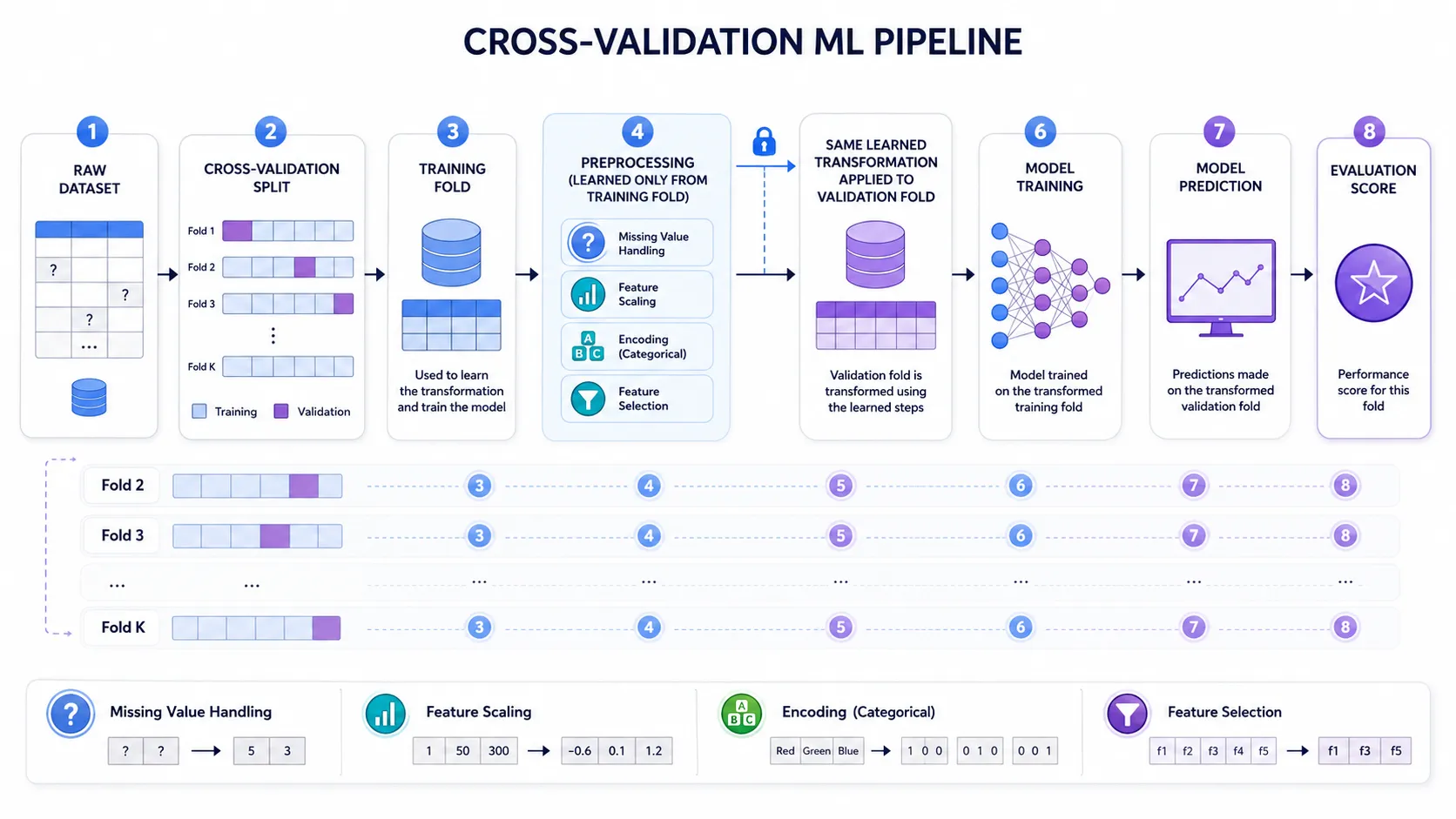
The proper process is:
First create the training fold.
Then calculate preprocessing values using only that training fold.
Apply those learned transformations to the validation fold.
Train the model.
Measure the result.
Repeat the process for every fold.
This applies to many preprocessing steps, including:
Missing value handling
Feature scaling
Standardization
Feature selection
Encoding
Dimensionality reduction
Whenever a preprocessing step learns something from the dataset, it should generally learn that information from the training portion only.
3. Do Not Trust Accuracy Alone
Suppose you are building a fraud detection model.
Out of 10,000 transactions:
9,900 are normal.
Only 100 are fraud.
Now imagine a useless model that predicts:
“Normal transaction”
for every single record.
Its accuracy would be:
99%.
That sounds amazing.
But the model failed to detect every fraud case.
This is why cross-validation metrics should match the actual business problem.
For classification problems, useful metrics may include:
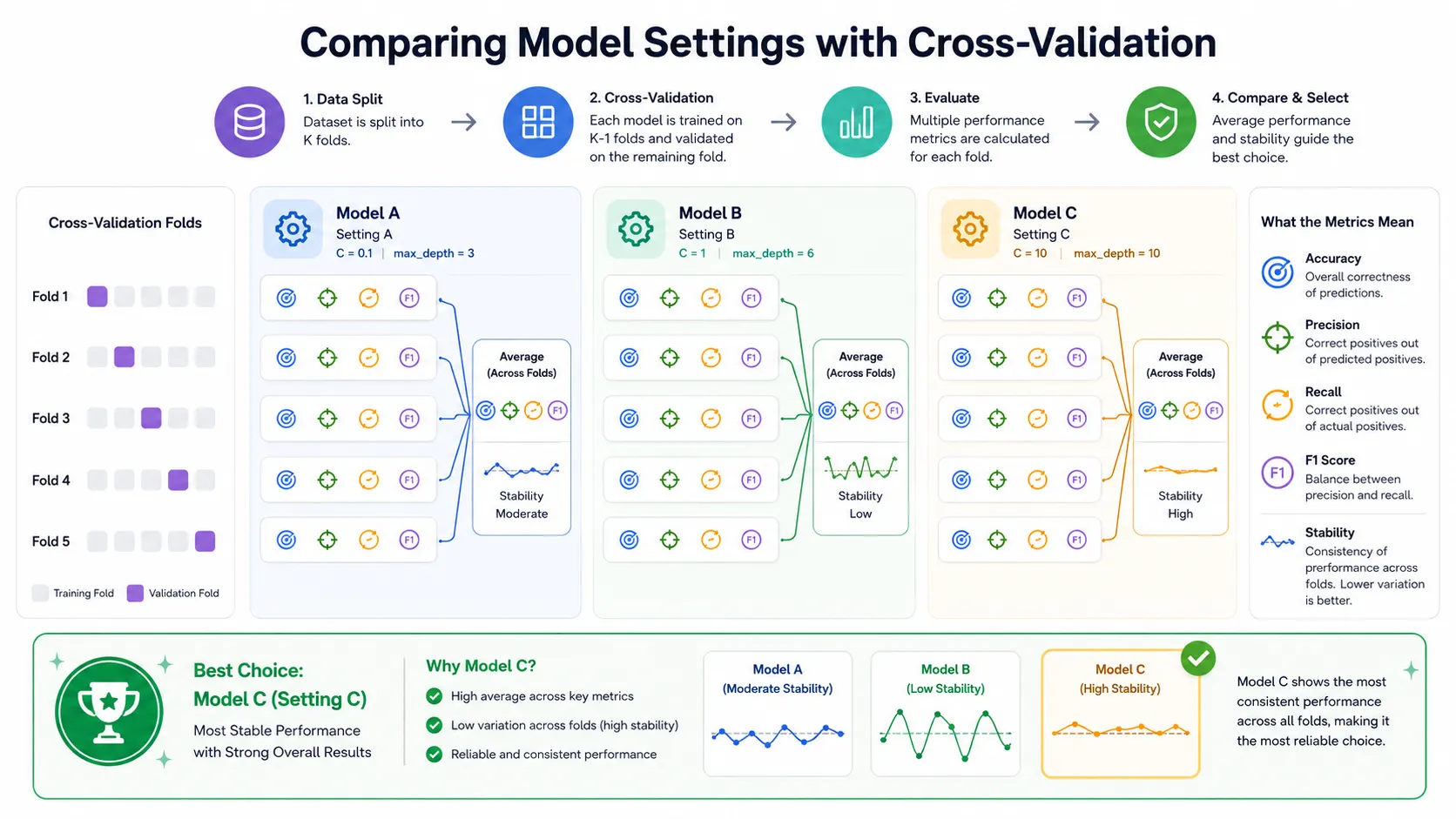
Precision – When the model predicts positive, how often is it correct?
Recall – Out of all actual positive cases, how many did the model find?
F1 Score – A balance between precision and recall.
ROC-AUC – Measures how well the model separates classes across different thresholds.
For regression problems, you may use metrics such as:
MAE, MSE, RMSE, or R², depending on what kind of prediction error matters most.
The important lesson is simple:
Do not choose a model because one number looks high. Choose the metric that matches the real problem you are solving.
4. Cross-Validation and Hyperparameter Tuning
Machine learning models often have settings that we choose before training.
These settings are called hyperparameters.
For example, a Random Forest may have:
Number of trees
Maximum tree depth
Minimum samples required for a split
A K-Nearest Neighbors model may have:
Number of neighbors
An SVM may have:
C value
Kernel type
Gamma
How do we know which values are best?
This is where cross-validation for hyperparameter tuning becomes extremely useful.
Suppose you are testing three Random Forest settings.
Instead of checking each setting using one train-test split, you can evaluate every configuration across several folds.
The configuration that performs consistently well across the folds becomes a stronger candidate.
Popular techniques such as Grid Search and Random Search often use cross-validation internally to compare multiple hyperparameter combinations.
But there is an important warning.
Do not keep looking at your final test data while tuning the model.
Use cross-validation for experimentation and tuning, then use the untouched test set for the final evaluation.
5. What Does a Good Cross-Validation Score Look Like?
Beginners often ask:
“Is 90% cross-validation accuracy good?”
There is no universal answer.
A good score depends on the problem.
For one task, 75% may be extremely useful.
For another task, even 98% may not be enough.
Instead of looking only at the average score, also look at how much the scores change across folds.
Imagine Model A gets:
91%, 92%, 90%, 91%, 92%.
Model B gets:
98%, 83%, 96%, 79%, 95%.
Model B has some very high scores, but its performance changes a lot.
Model A is much more stable.
This stability matters because your future data will not look exactly like your training data.
A good cross-validation result usually means the model performs reasonably well and remains fairly consistent across different validation folds.
6. How Many Folds Should You Use?
One of the most common questions is:
Should I use 5-Fold or 10-Fold Cross-Validation?
There is no fixed answer for every project.
But 5-Fold Cross-Validation and 10-Fold Cross-Validation are common choices.
More folds mean each training round uses a larger portion of the dataset.
But more folds also mean the model needs to be trained more times.
For example:
5-Fold means roughly five training rounds.
10-Fold means roughly ten training rounds.
If the model takes a long time to train, this difference matters.
For many regular machine learning projects, 5-Fold is a practical starting point because it provides useful evaluation without making training unnecessarily expensive.
7. Cross-Validation Does Not Replace a Final Test Set
This is one of the most important ideas in model validation techniques in machine learning.
Cross-validation is excellent for:
Comparing models
Selecting hyperparameters
Estimating model stability
Testing different approaches
Finding possible overfitting
But after you finish all major decisions, you should ideally evaluate your final model on data that was not used during those decisions.
Think of it like studying for an exam.
Cross-validation is similar to taking several practice tests.
You learn what works, find your weak areas, and improve your strategy.
The final test set is the real exam paper that you have never seen before.
If you keep opening the final exam paper during practice, it is no longer a fair exam.

A Simple Cross-Validation Workflow for Beginners
If you are starting your first machine learning project, you do not need to make cross-validation complicated.
Start by understanding your data.
If your samples are independent and your problem is simple, K-Fold Cross-Validation can be a good choice.
If you are working with an imbalanced classification problem, consider Stratified K-Fold.
If multiple records belong to the same person, customer, device, company, or another group, use a group-aware validation method.
If your dataset follows time order, use Time Series Cross-Validation.
Keep preprocessing inside the validation process.
Choose an evaluation metric based on the real business goal.
Use cross-validation to compare models and tune hyperparameters.
Then keep a final test set untouched until the end.
That is the real purpose of cross-validation.
It is not about making your model look better.
It is about finding out whether the model deserves to be trusted.
A machine learning model that performs well only on familiar data is not very useful. A strong model should continue giving reliable results when it faces new customers, new transactions, new images, new houses, or new situations.
And that is exactly what cross-validation techniques in machine learning help us measure.
Once you understand this idea, model evaluation becomes much easier.
You stop asking:
“How high is my accuracy?”
And start asking the better question:
“Will this model still work when the real world gives it data it has never seen before?”
That question is what separates a model that looks good in a notebook from a model that can actually be trusted in the real world.


