


Overfitting vs Underfitting in Machine Learning: How to Identify and Fix Both
Imagine you are preparing for an exam. You solve the same 50 questions again and again until you remember every answer. On the practice test, you score 100%. Then the real exam arrives with the same concepts but different questions, and suddenly your score drops badly.
Now imagine the opposite. You read only the chapter titles, skip the examples, and enter the exam knowing just the basic idea. You struggle with both the practice questions and the final exam.
These two situations explain one of the most important problems in machine learning.
The first student is like an overfitting machine learning model. It remembers the training data so closely that it struggles when new data appears. The second student is like an underfitting machine learning model. It has not learned enough to understand even the main pattern.
A useful model sits between these two extremes. It does not simply memorize. It does not learn too little. It learns the real pattern well enough to work on data it has never seen before. This ability is called model generalization, and it is one of the main goals of machine learning.
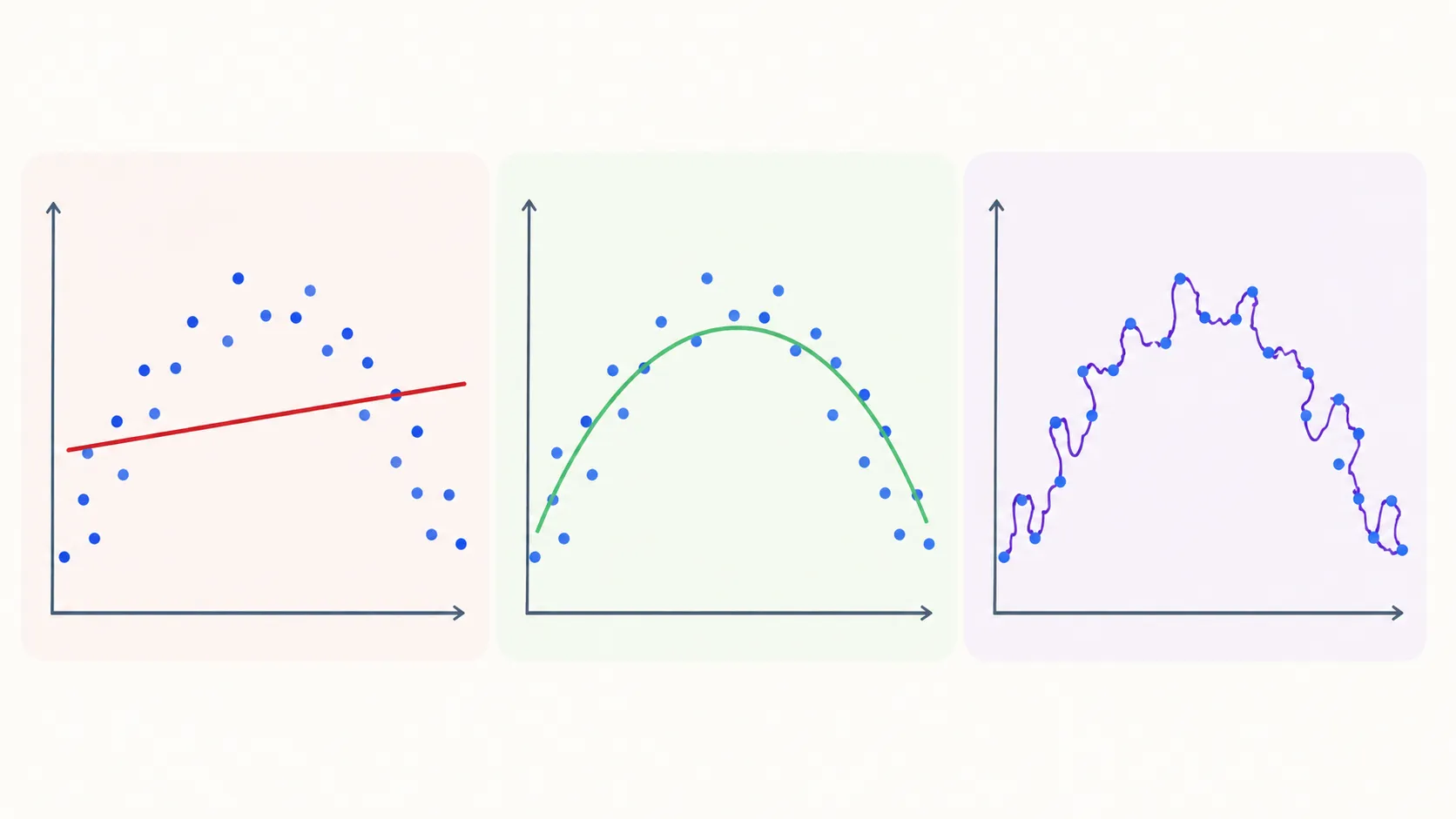
What Is Overfitting in Machine Learning?
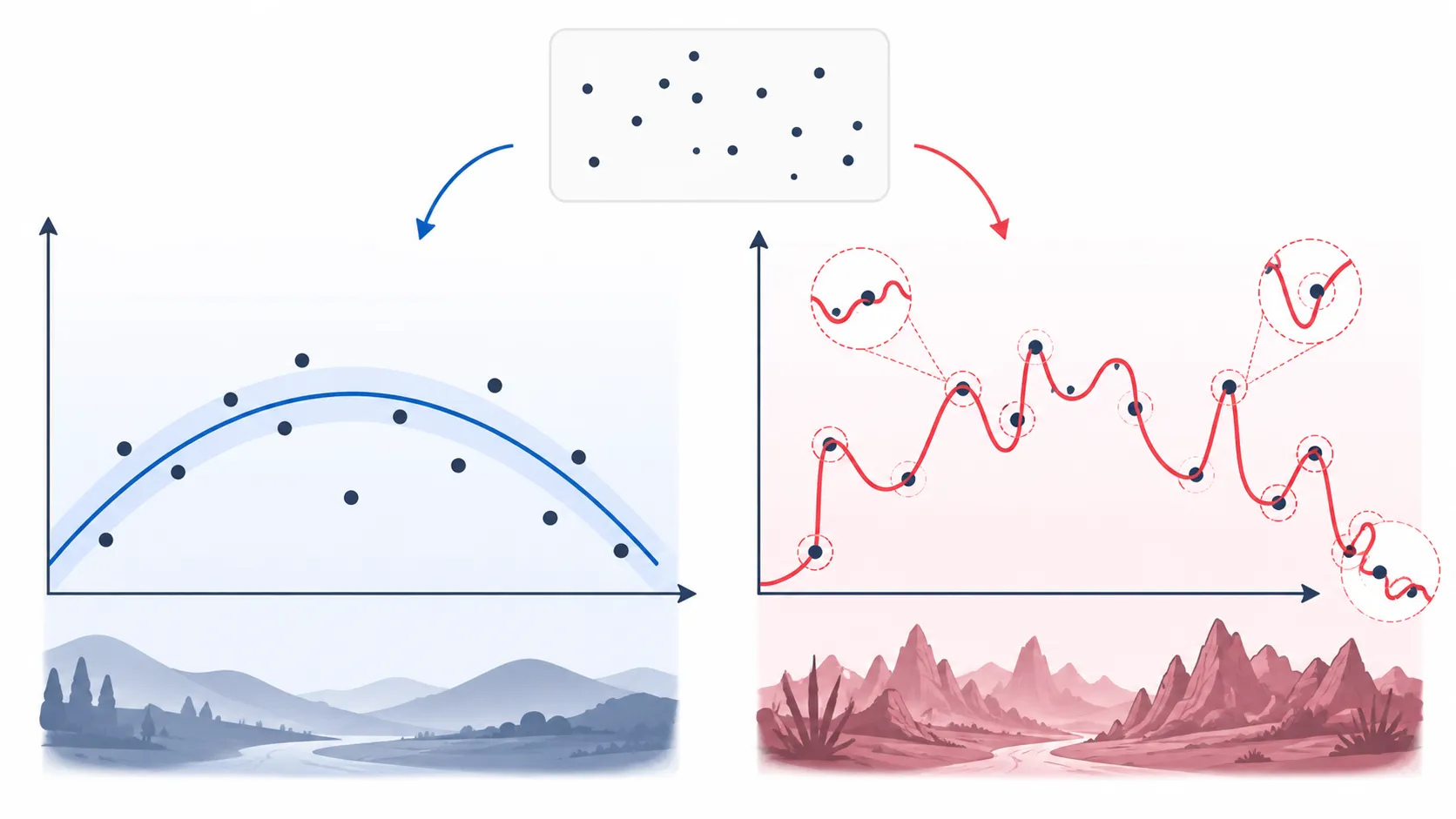
Overfitting happens when a model learns the training data too closely. Instead of learning only the useful relationship between inputs and outputs, it may also learn random noise, unusual examples, or tiny details that do not represent the real world.
Suppose you build a model to predict house prices. Your training data contains information such as location, area, number of rooms, age of the property, and selling price. During training, the model reaches very high accuracy.
But when you give it new houses from the same market, its predictions are much worse.
The problem is not that the model learned nothing. It learned too much from the particular training examples. It became very good at the data it had already seen but weak at handling new cases.
This is the key idea behind overfitting vs underfitting in machine learning: training performance alone does not tell you whether a model is actually useful.
A Simple Real-Life Example of Overfitting
Think about a food delivery app trying to predict how long an order will take.
The training data was collected mostly on normal weekdays. The model notices many small details and creates very specific rules around those examples. It performs extremely well on the old orders.
Then Sunday evening comes. It rains, traffic becomes heavy, restaurants are overloaded, and delivery times change.
If the model learned only the exact patterns inside the old dataset instead of the broader relationship between distance, traffic, restaurant load, weather, and delivery time, its predictions may fail.
What Is Underfitting in Machine Learning?
Underfitting is almost the opposite.
An underfit model is too simple, poorly trained, or missing important information, so it cannot capture the main pattern in the data. Because of this, it performs poorly not only on new data but often on the training data as well.
Return to the house-price example.
Imagine trying to predict every house price using only one rule:
“Bigger houses cost more.”
House size is useful, but price also depends on location, property condition, nearby facilities, floor, age, demand, and many other factors. A model that considers only size may miss too much information.
Underfitting can happen when the chosen model is too basic for the problem, useful features are missing, training stops too early, or regularization is so strong that the model is not allowed to learn enough.
How Can You Tell Whether a Model Is Overfitting or Underfitting?
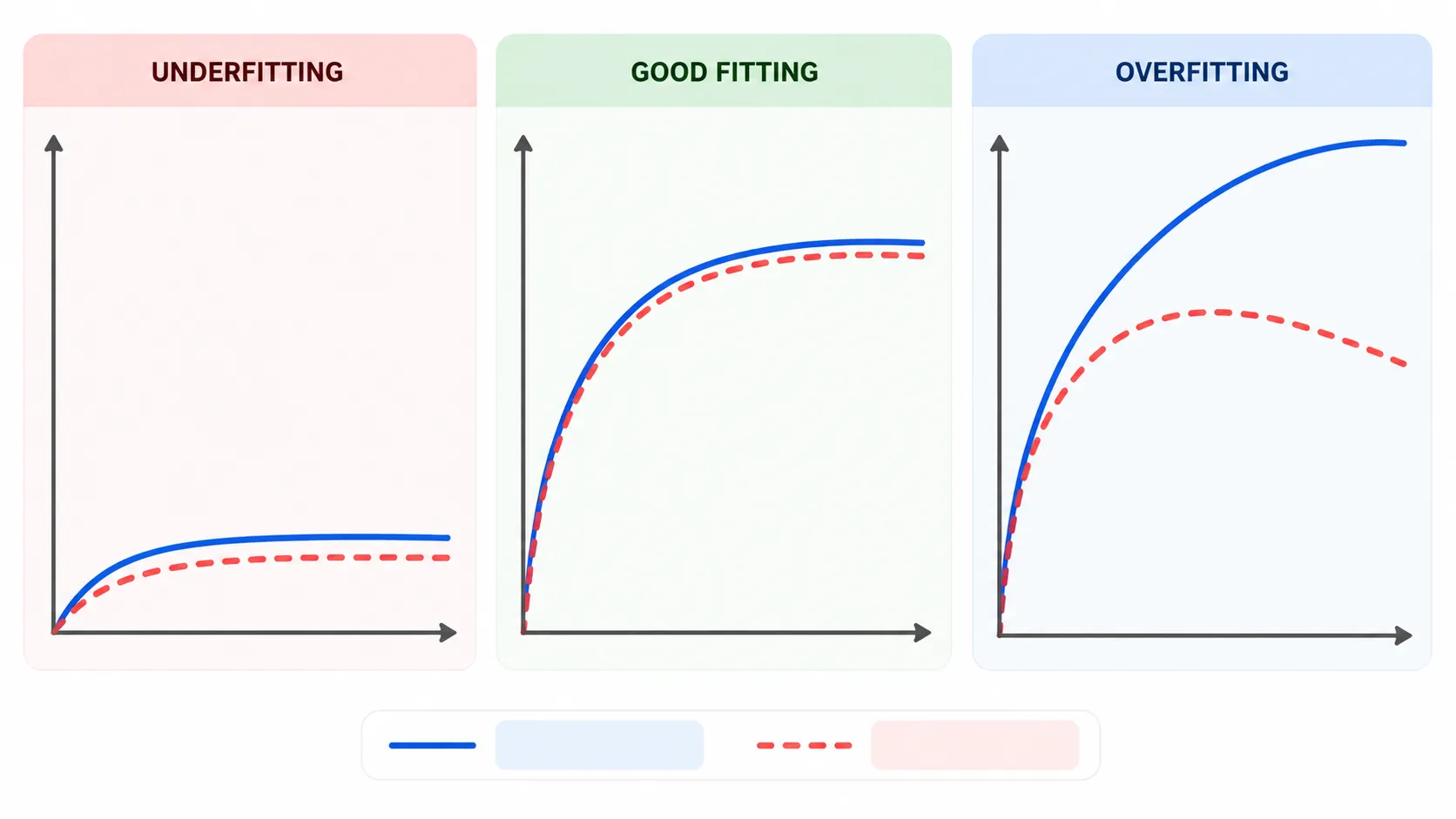
One of the easiest ways is to compare performance on training data with performance on validation data.
Training data is the data the model learns from. Validation data is separate data used to check how well the model handles examples it did not directly learn from.
If training performance is very strong but validation performance is much weaker, overfitting is a likely problem.
If performance is weak on both training and validation data, underfitting is more likely.
For example, imagine a classification model reaches 98% accuracy on training data but only 78% on validation data. The 20-point gap is a warning sign. It does not automatically prove that overfitting is the only problem, but it tells you to investigate.
Now imagine another model reaches 69% training accuracy and 67% validation accuracy. The gap is small, but the overall performance is still poor. That points more toward underfitting, weak features, poor data quality, or a model that cannot capture the task well enough.
This is why learning how to detect overfitting is more useful than simply chasing the highest training accuracy.
Training Loss and Validation Loss Tell an Important Story
You can also watch training and validation loss while the model learns.
Training loss tells you how much error the model makes on training examples. Validation loss tells you how much error it makes on unseen validation examples.
In a healthy training process, both usually improve for some time.
With overfitting, training loss may continue falling while validation loss stops improving or starts getting worse. The model is becoming better at the training set without becoming better at the real task.
With underfitting, both losses may remain relatively high because the model still has not learned the important structure.
Learning curves make this much easier to see.
Once you understand this pattern, overfitting and underfitting stop feeling like confusing textbook terms. They become problems you can actually spot while building a model.
And spotting the problem correctly matters, because the fix for overfitting can be very different from the fix for underfitting.
Why Does Overfitting Happen?
Overfitting usually does not happen because the model is “too intelligent.” It happens because the model gets too much freedom to learn details that are not useful outside the training data.
A model should learn the real pattern behind the data. But sometimes it starts learning random noise, unusual examples, and small details that appear only in the training set.
There are several common reasons behind this.
1. The Model Is Too Complex
A very complex model can learn complicated relationships. That sounds useful, but complexity can become a problem when the dataset is small or simple.
Imagine you have only 100 customer records and you use a model with the ability to create hundreds of very specific rules.
The model may create rules such as:
“Customers between age 27 and 29 who visited on Tuesday and clicked a certain page are likely to buy.”
That rule may work perfectly for the training data, but it may have happened only by chance.
A simpler and more meaningful pattern may be:
“Customers who visit pricing pages several times are more likely to buy.”
The second pattern has a better chance of working on new customers.
This is why choosing the right model complexity in machine learning is important.
2. The Training Dataset Is Too Small
A small dataset gives the model fewer examples of how the real world behaves.
Think about trying to understand the taste of an entire city by asking only ten people about their favorite food.
You may get an answer, but it may not represent everyone.
Machine learning models face the same problem.
If a model learns from only a small number of examples, it may treat unusual patterns as normal patterns. When new data appears, those patterns may no longer work.
More high-quality training data can often help the model understand what is common and what is only noise.
However, simply adding random data is not enough. The new data should represent the real problem properly.
Too Many Features Can Also Cause Overfitting
Features are the pieces of information given to the model.
In a house-price model, features may include:
location, property size, number of rooms, age of the building, parking availability, distance from schools, and many other details.
Useful features can improve predictions.
But adding every possible feature is not always better.
Some features may be unrelated to the target. Others may repeat the same information. A few may contain accidental patterns that exist only in the training dataset.
Suppose you are predicting whether a customer will cancel a hotel booking.
Useful information may include booking date, check-in date, cancellation history, booking type, and payment status.
But imagine adding a random internal database number assigned to each booking.
That number has no real relationship with cancellation behavior. Still, a powerful model may find patterns in it by accident.
This can increase overfitting.
Good feature selection helps the model focus on useful information instead of unnecessary noise.
Noise and Incorrect Data Can Make Things Worse
Real datasets are rarely perfect.
They may contain wrong labels, incorrect values, duplicate records, missing information, measurement errors, or unusual cases.
For example, suppose you are training a model to detect spam emails.
Most emails are labeled correctly, but several promotional emails are accidentally marked as normal emails.
A complex model may try to understand why those unusual examples are different instead of recognizing that the labels themselves are wrong.
That is why data cleaning in machine learning is not just preparation work. It directly affects how well the final model can generalize.
What Is the Bias-Variance Tradeoff?
You may often hear the terms bias and variance in machine learning when people discuss overfitting and underfitting.
The idea sounds technical, but it is quite simple.
Bias means the model makes assumptions that are too simple.
Variance means the model changes too much depending on the exact training data it receives.
Underfitting is usually connected with high bias.
Overfitting is usually connected with high variance.
Imagine teaching two students to identify different types of dogs.
The first student learns only one rule:
“If the animal has four legs, it is a dog.”
That rule is too simple. The student may call cats, horses, and cows dogs.
This is similar to high bias and underfitting.
The second student memorizes every dog photo from the training book, including background colors, camera angles, collars, and lighting.
When shown a new dog photo in a different environment, the student becomes confused.
This is similar to high variance and overfitting.
A good learner understands the important characteristics of a dog without memorizing every photo.
A good machine learning model does something similar.
It captures meaningful patterns without becoming dependent on tiny details.
How to Fix Overfitting in Machine Learning
Once you identify overfitting, the next step is to reduce the model's dependence on the training data.
There is no single fix that works for every problem, but several techniques are widely useful.
Use More Training Data
One of the most effective solutions is giving the model more representative examples.
When the dataset grows, random patterns become less important.
Imagine a model that has seen only ten images of bicycles. It may learn that bicycles usually appear on roads because all ten images contain roads.
If you train it on thousands of bicycle images from streets, parks, garages, mountains, and houses, it becomes easier for the model to understand what actually makes something a bicycle.
This can improve model generalization.
Reduce Model Complexity
Sometimes the model simply has more learning power than the problem requires.
In that case, reducing complexity can help.
For a decision tree, this may mean limiting how deep the tree can grow.
For some machine learning models, it may mean reducing the number of parameters or using fewer unnecessary features.
The goal is not to make the model weak.
The goal is to give it enough power to learn useful patterns without allowing it to memorize everything.
Use Regularization
Regularization is one of the most common techniques for controlling overfitting.
Instead of allowing the model to create extremely complicated solutions freely, regularization adds a penalty for unnecessary complexity.
You can think of it like this:
A teacher asks a student to explain an answer, but says:
“Use the simplest explanation that still solves the problem correctly.”
The student is discouraged from adding unnecessary rules.
In machine learning, techniques such as L1 regularization and L2 regularization can help control how strongly some models depend on individual features.
You do not need to memorize the mathematics immediately.
For a beginner, the important idea is simple:
Regularization helps prevent a model from becoming more complicated than necessary.
Use Cross-Validation
A model should not be judged from only one train-validation split.
Sometimes one validation set is easier or harder than another.
Cross-validation checks the model using several different splits of the available data.
For example, instead of training once and testing once, the dataset can be divided into several parts. The model trains on some parts and validates on another part, then the process is repeated.
This gives you a more reliable idea of whether the model performs consistently.
Cross-validation is especially useful when the dataset is not very large.
Use Early Stopping
In some models, especially neural networks and boosting methods, training for too long can cause overfitting.
At first, both training and validation performance may improve.
Later, training performance continues improving, but validation performance starts getting worse.
Early stopping watches this behavior and stops training when validation performance stops improving.
It is similar to studying for an exam efficiently instead of repeating the same answers until you start memorizing tiny details that do not matter.
The main lesson is simple:
A model does not become better just because it trains longer.
It becomes better when it learns patterns that continue to work on new data.
In the next stage of model improvement, we need to look at the opposite problem: what happens when the model is too simple, learns too little, and starts underfitting the data.
Why Does Underfitting Happen?
Underfitting happens when a model is not able to learn enough from the training data.
The model may be too simple, important features may be missing, training may stop too early, or the settings may prevent the model from learning the real pattern.
Think about a student preparing for a mathematics exam by reading only formulas without solving any questions.
The student has some knowledge, but not enough practice to understand how those formulas work in different situations.
An underfit machine learning model behaves in a similar way.
It knows something, but not enough to make good predictions.
The Model Is Too Simple
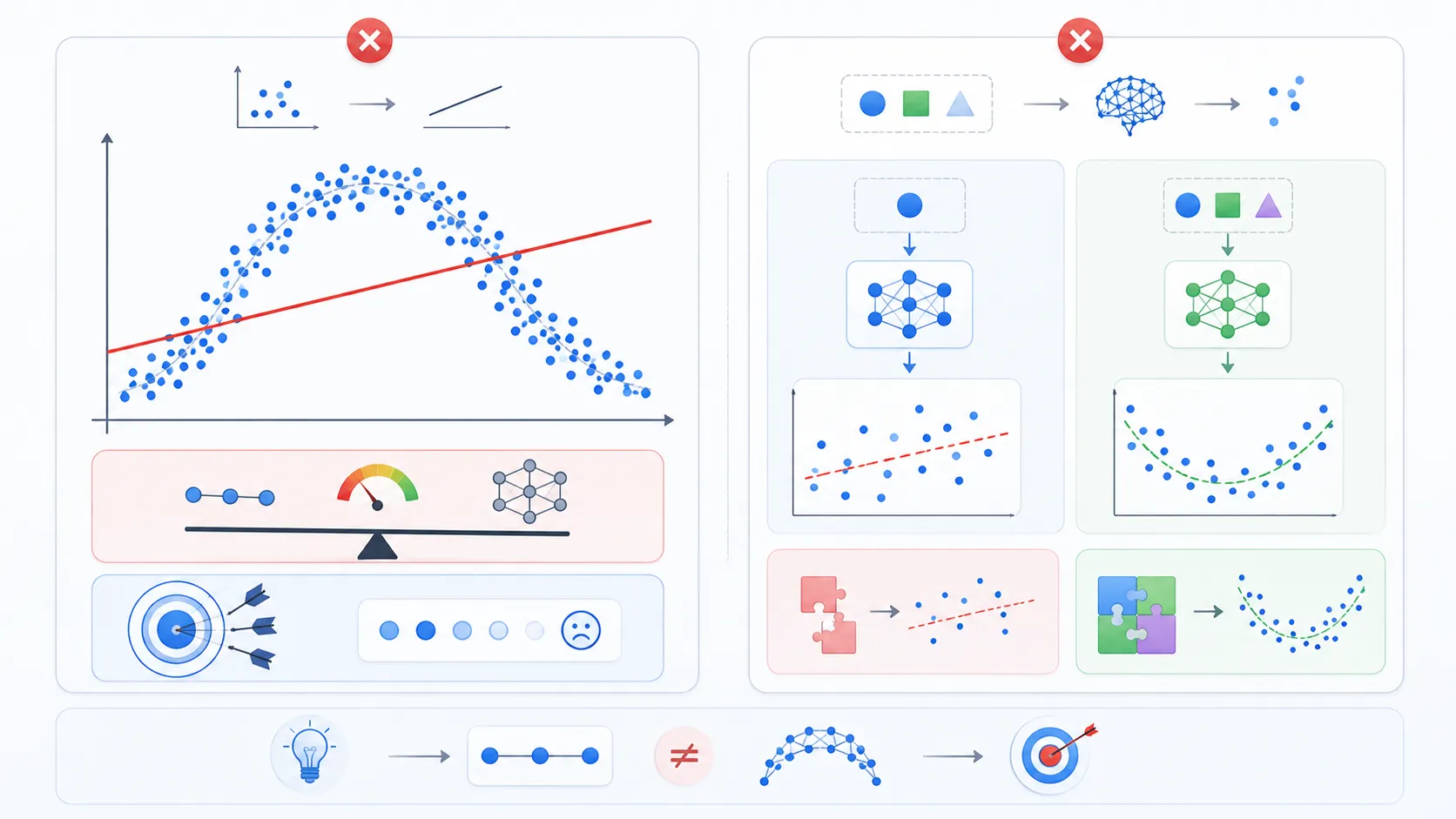
One of the most common causes of underfitting is choosing a model that is too simple for the problem.
Imagine that house prices in a city depend on location, size, age, nearby schools, floor, parking, and local demand.
If you try to explain every house price using only one very simple relationship, the model may miss most of the real pattern.
A simple model is not always bad. In fact, simpler models are often easier to understand and maintain.
The problem begins when the model is simpler than the problem itself.
Important Features Are Missing
A model can only learn from the information we give it.
Suppose an airline wants to predict whether a flight will be delayed.
The dataset contains flight number and departure time but does not include weather, airport traffic, previous aircraft delay, or season.
Even a good algorithm may struggle because some of the most useful information is missing.
This is why feature engineering in machine learning matters.
Sometimes improving the input data gives a much bigger improvement than changing the algorithm.
Training Stops Too Early
Some models need enough training time to discover useful patterns.
If training stops before the model has learned them, both training and validation performance may remain poor.
This can happen in neural networks when the number of training epochs is too low.
But there is an important balance here.
Training too little can create underfitting.
Training too long can sometimes create overfitting.
So the goal is not maximum training time. The goal is the right training time.
How to Fix Underfitting in Machine Learning
Once you know that your model is underfitting, you usually need to give it a better chance to learn the real pattern.
Increase Model Complexity
If the model is too simple, try a model that can capture more complex relationships.
For example, a very shallow decision tree may miss important patterns. Allowing a little more depth may improve performance.
Similarly, a simple linear relationship may not work when the real relationship is curved or highly complex.
The key word here is controlled complexity.
Do not jump directly from a very simple model to the most complicated model available.
Increase complexity gradually and keep checking validation performance.
Add Better Features
Better features can completely change model performance.
Imagine predicting whether a hotel customer will cancel a reservation.
Using only the customer's name and booking date may not tell you much.
But adding useful features such as number of days before check-in, booking source, payment status, previous cancellations, refundable status, and length of stay can give the model much more useful information.
The goal is not to add hundreds of features.
The goal is to add features that actually help explain the target.
Reduce Excessive Regularization
Regularization helps control overfitting, but too much regularization can create the opposite problem.
If you restrict the model too strongly, it may not be able to learn important relationships.
Think of regularization like rules given to a student.
A few rules can keep the answer focused.
Too many rules can make it impossible for the student to explain anything properly.
If both training and validation performance are poor, checking whether regularization is too strong can be useful.
Train the Model Properly
Sometimes the algorithm is fine and the data is fine, but the training setup is weak.
The model may need more training iterations, a better learning rate, improved feature scaling, or better hyperparameter settings.
This is why solving underfitting is not always about replacing the model.
Sometimes the existing model simply needs better training.
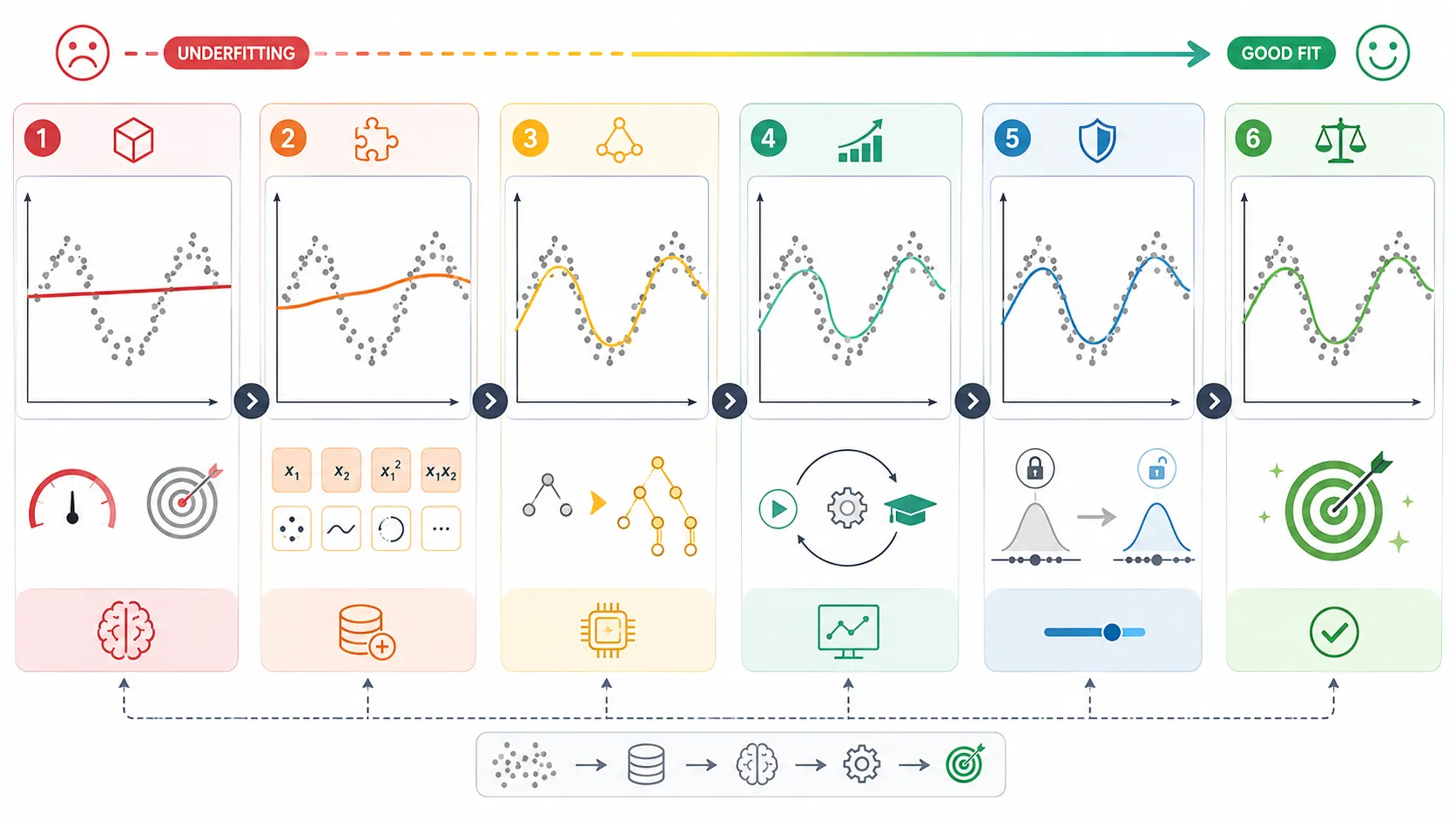
Overfitting vs Underfitting: The Difference You Should Remember
You do not need a complicated definition to remember the difference.
An underfit model has not learned enough.
An overfit model has learned the training data too closely.
A well-fitted model learns the useful pattern and can apply it to new data.
Here is a simple mental picture.
If training performance is poor and validation performance is also poor, think about underfitting.
If training performance is excellent but validation performance is much worse, think about overfitting.
If both training and validation performance are good and reasonably close, the model may be generalizing well.
But do not rely on one number alone.
The size of the dataset, class imbalance, evaluation metric, data quality, and the real business problem also matter.
A Practical Way to Diagnose Your Model
When a model performs badly, avoid changing ten things at once.
Follow a simple process.
First, check whether your training and validation data are separated correctly. Data leakage can make results look much better than they really are.
Next, compare training performance with validation performance.
If both are weak, investigate underfitting, missing features, poor data quality, or weak training.
If training performance is strong but validation performance is weak, investigate overfitting.
Then use learning curves or cross-validation to see whether the same pattern continues across different samples of the data.
After that, change one important thing at a time.
You might reduce model complexity, add regularization, improve features, collect better data, tune hyperparameters, or change the model.
Then evaluate again.
This approach makes it much easier to understand which change actually improved the model.
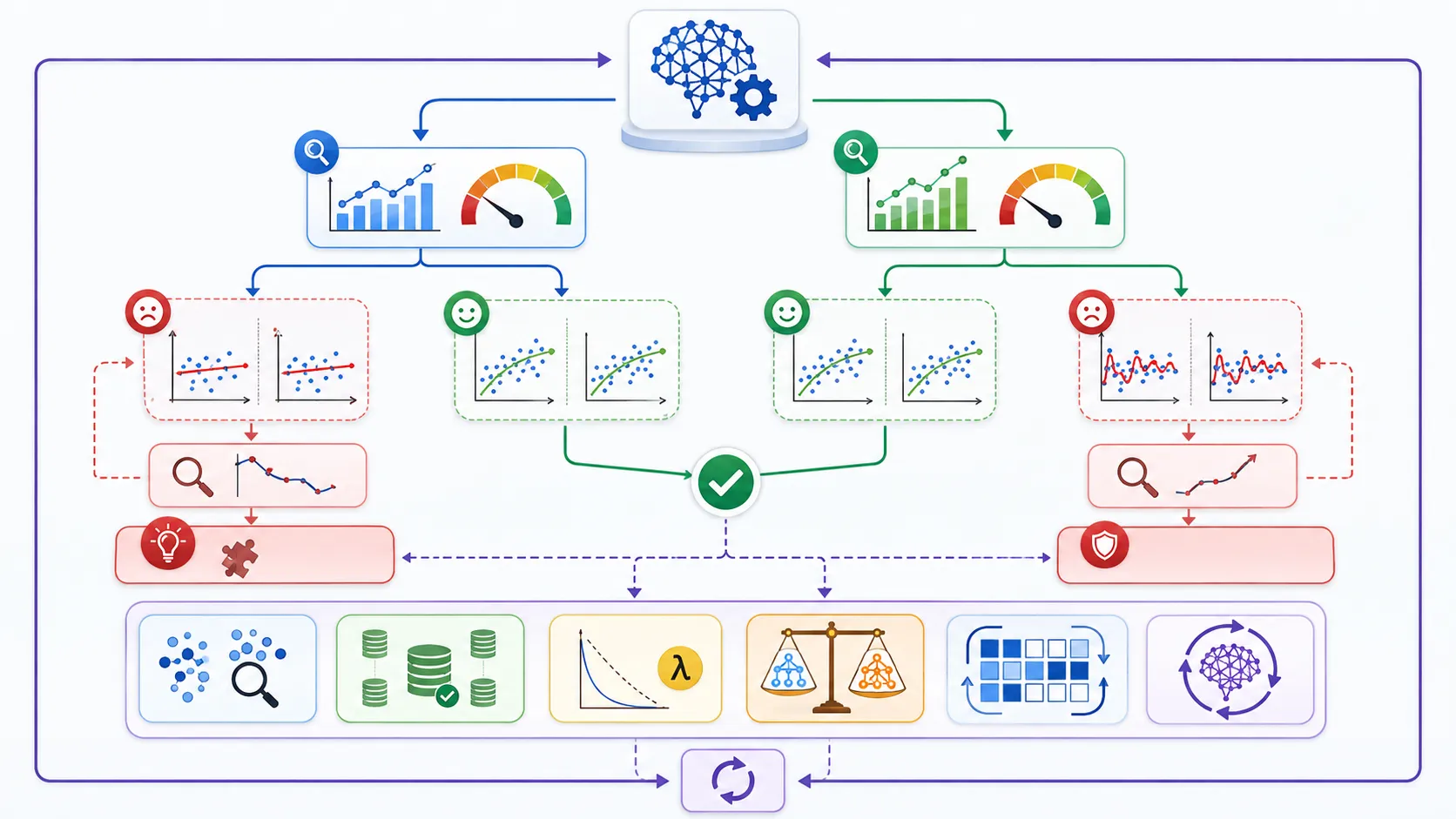
Common Mistakes Beginners Make
One common mistake is thinking that 100% training accuracy means the model is perfect.
It does not.
A model can score extremely well on data it has already seen and still fail badly in the real world.
Another mistake is choosing the most complex model because it looks more advanced.
A more complicated algorithm is not automatically a better algorithm.
The best model is the one that solves your problem reliably on unseen data.
Beginners also sometimes keep adding features because they believe more data columns always mean more intelligence.
Irrelevant features can add noise and sometimes make the problem harder.
Another mistake is testing the model repeatedly on the final test dataset while tuning it.
Your test set should stay separate until you are ready for the final evaluation. Otherwise, you may slowly start optimizing your decisions around the test data itself.
The Real Goal Is Generalization
Machine learning is not a competition to achieve the highest training score.
The real goal is to build a model that works when tomorrow's data looks a little different from yesterday's data.
That is why understanding overfitting vs underfitting matters so much.
If the model memorizes, simplify it, regularize it, validate it properly, or give it better and more representative data.
If the model has not learned enough, improve the features, increase useful complexity, train it properly, and make sure you are not restricting it too much.
Most real machine learning projects involve finding the balance between these two problems.
You may never create a model that is perfect on every possible example. That is not the target.
The target is a model that learns enough, ignores unnecessary noise, and performs reliably on data it has never seen before.
Once you understand that idea, overfitting and underfitting stop being definitions you need to memorize.
They become signals that tell you exactly where your model may be going wrong—and what you should try next.


