


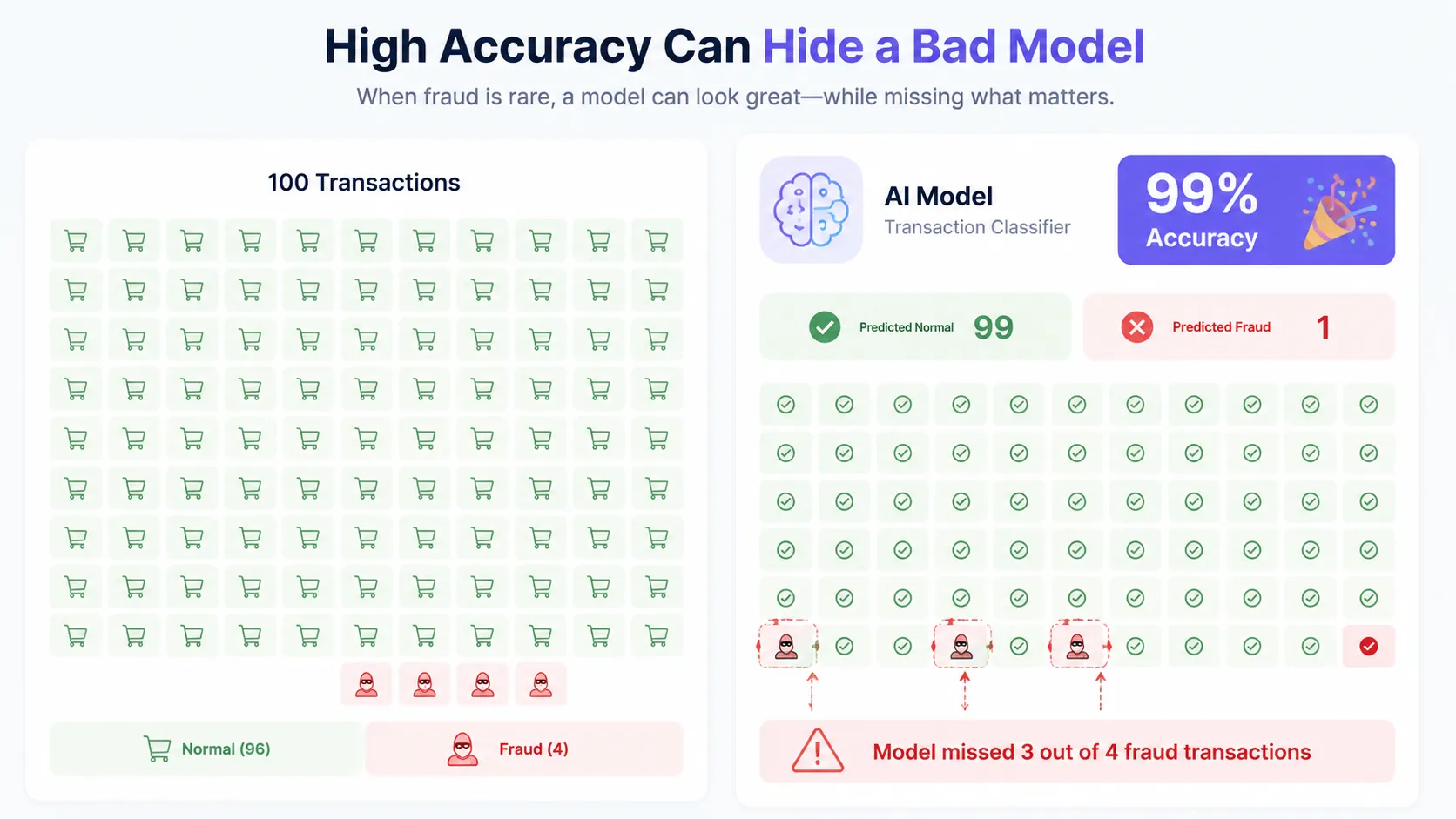
Imagine you build a fraud detection system for a bank. It checks 10,000 transactions and gives 99% accuracy. Sounds excellent, right?
But then you discover something uncomfortable: almost every transaction was normal, and the model simply learned to say “not fraud” most of the time. It looked accurate on paper while still missing some of the transactions that actually mattered.
This is where model evaluation becomes more useful than one attractive accuracy number.
In a classification problem, we do not only want to know, “How many predictions were correct?” We also want to know: When the model says something is positive, how often is it right? How many real positive cases does it successfully find? And what happens when we need a balance between both?
That is exactly what precision, recall, and F1 score help us understand.
What Are Model Evaluation Metrics?
A machine learning model learns from past data and then makes predictions on new data. After training, we need a way to check whether those predictions are useful. The measurements we use for this purpose are called model evaluation metrics.
Different machine learning problems need different metrics. For a classification model, common metrics include accuracy, precision, recall, F1 score, ROC-AUC, and others.
The important point is simple: there is no single metric that is automatically best for every problem.
Think about two systems:
A spam filter should avoid sending an important work email to the spam folder.
A disease screening system should avoid missing a person who may actually have the disease.
Both are classification problems, but the cost of a mistake is different. Because the mistakes are different, the metric we care about can also be different.
This is why understanding classification evaluation metrics is more important than memorizing formulas.
Why Accuracy Alone Can Be Misleading
Accuracy tells us the percentage of predictions that were correct.
If a model makes 100 predictions and 90 are correct, its accuracy is 90%.
That sounds useful, and it often is. The problem appears when the classes are highly unbalanced.
Suppose an online payment system receives 1,000 transactions. Only 10 are fraudulent and 990 are genuine.
Now imagine a lazy model that predicts every transaction as genuine.
It gets 990 predictions correct.
Its accuracy is 99%.
But it catches zero fraud cases.
Would you call that a good fraud detection model? Of course not.
This is a classic imbalanced classification problem. When one class is much more common than another, accuracy can hide the model’s most important failures. Google’s Machine Learning Crash Course specifically highlights precision, recall, and related metrics as tools for evaluating classification behavior beyond accuracy, especially when different mistakes matter differently.
To understand precision and recall properly, we first need four simple terms.
The Four Outcomes Behind Precision and Recall
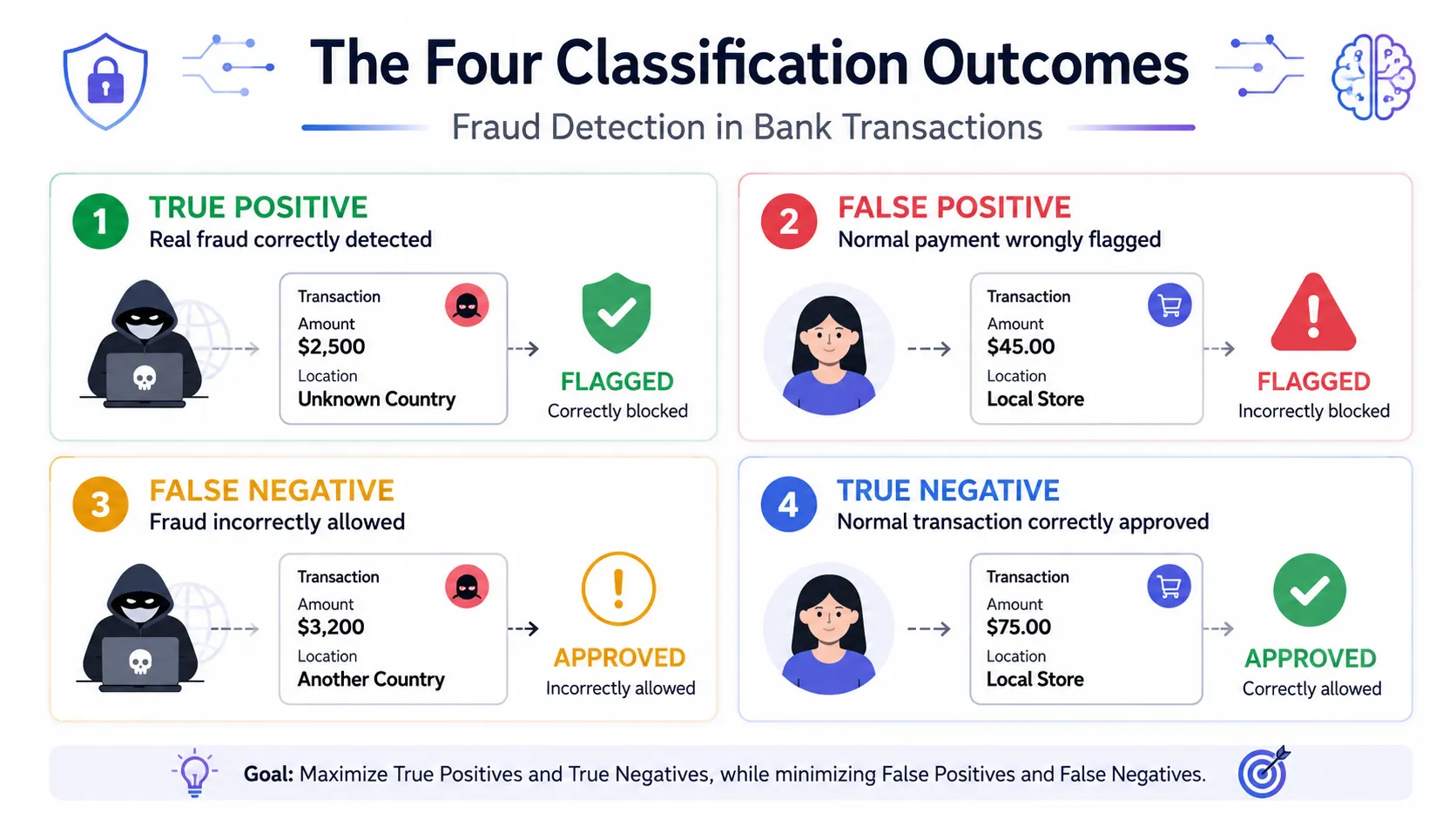
Imagine we are building a model that detects fraudulent card transactions. We will call “fraud” the positive class and “normal transaction” the negative class.
Every prediction falls into one of four cases.
True Positive
The transaction is actually fraud, and the model correctly predicts fraud.
This is a correct alert.
False Positive
The transaction is actually normal, but the model predicts fraud.
This is a false alarm. A customer may see a genuine payment blocked even though nothing suspicious happened.
False Negative
The transaction is actually fraud, but the model predicts it as normal.
This can be a costly mistake because the fraud passes through without an alert.
True Negative
The transaction is normal, and the model correctly predicts it as normal.
Once these four outcomes are clear, precision and recall become much easier. Both metrics use true positives, but they answer different questions.
What Is Precision in Machine Learning?
Precision asks:
“Out of everything the model predicted as positive, how many predictions were actually positive?”
The formula is:
Precision = True Positives / (True Positives + False Positives)
Scikit-learn defines precision as the ratio of true positives to all predicted positives.
Let us use a simple example.
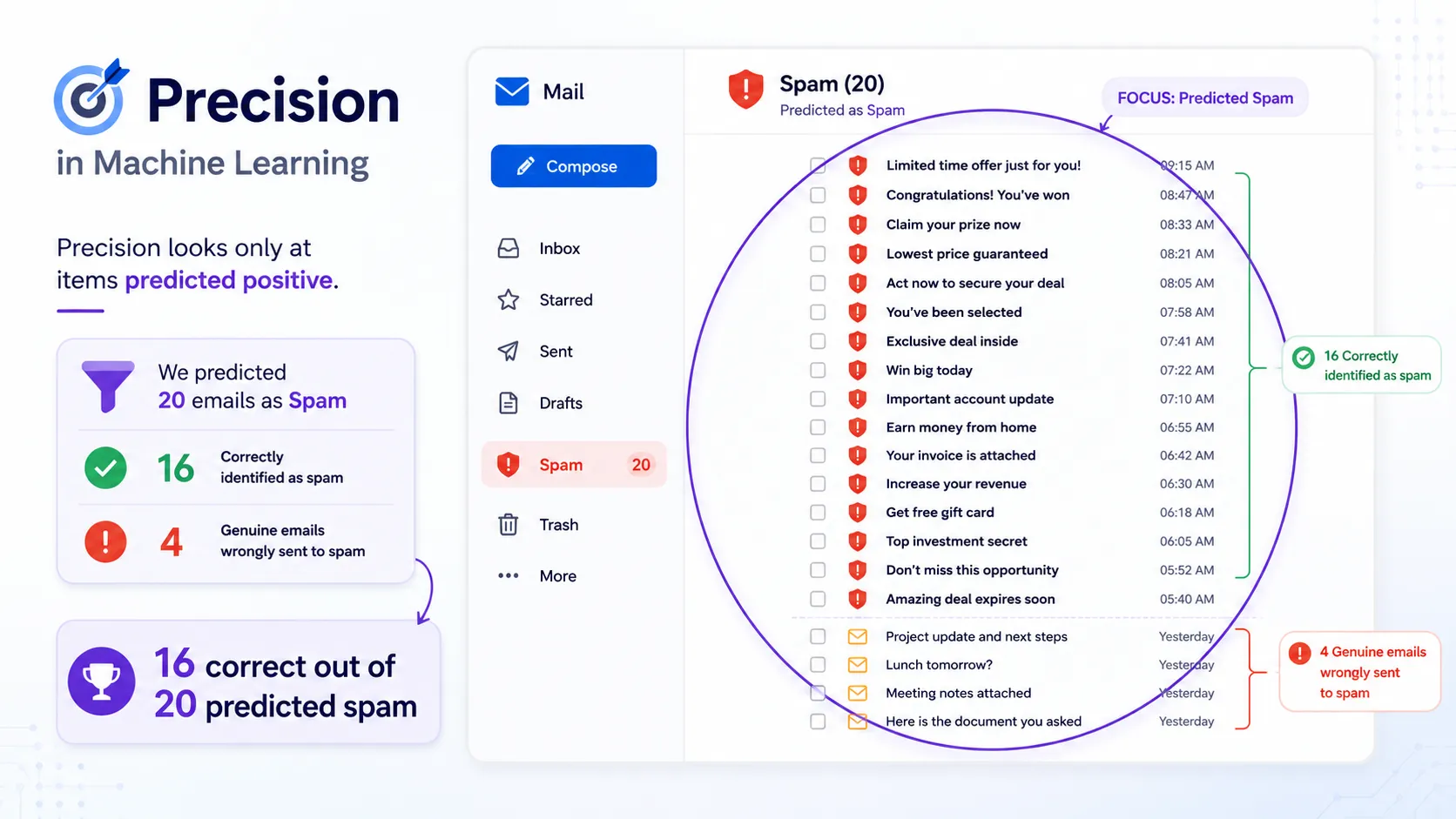
Suppose an email spam filter marks 20 emails as spam. After checking them, we discover that:
16 really were spam.
4 were genuine emails incorrectly marked as spam.
So:
Precision = 16 / (16 + 4) = 0.80
The precision is 80%.
In plain English, whenever the model said “spam,” it was correct 80% of the time.
When Is High Precision Important?
High precision matters when a false positive is expensive, annoying, risky, or difficult to undo.
A spam filter is a good example. If it has poor precision, useful emails may repeatedly disappear into the spam folder.
Another example is an automated system that blocks user accounts for suspicious activity. If the model wrongly blocks many genuine users, the business may create a terrible customer experience.
So a simple memory trick is:
Precision = How much can I trust a positive prediction?
What Is Recall in Machine Learning?
Now change the question.
Instead of asking how trustworthy positive predictions are, suppose we want to know whether the model is finding the positive cases that actually exist.
That is recall.
Recall asks:
“Out of all the real positive cases, how many did the model successfully find?”
The formula is:
Recall = True Positives / (True Positives + False Negatives)
Google describes recall as the share of actual positive cases that the model correctly identifies, while scikit-learn uses the same true-positive and false-negative relationship in its classification metrics.
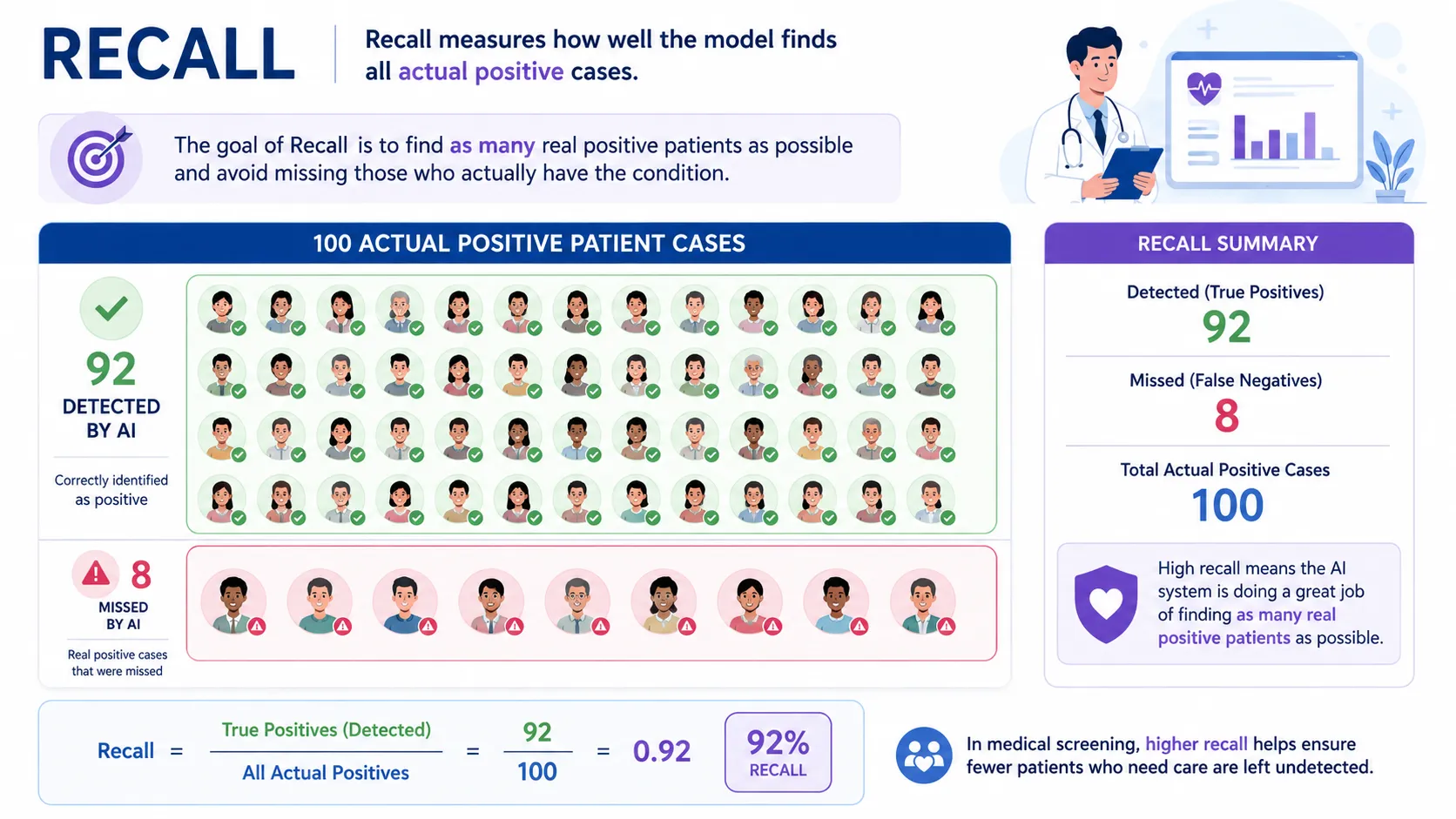
Imagine a security system reviewing 100 truly fraudulent transactions. It successfully detects 92 of them but misses 8.
Its recall is:
Recall = 92 / (92 + 8) = 0.92
So the model has 92% recall.
That means it catches 92 out of every 100 fraud cases in this example.
This leads to another easy memory trick:
Recall = How many of the real positive cases did I manage to catch?
When Is High Recall Important?
High recall becomes important when missing a positive case can create a serious problem.
Think about a medical screening system.
Suppose 100 patients actually have a disease, but the model identifies only 60 of them. The remaining 40 patients receive a negative prediction even though they are actually positive.
That is dangerous.
In this situation, we usually care a lot about reducing false negatives.
A model with high recall tries to catch as many real positive cases as possible.
The same idea appears in many real-world systems:
Fraud detection, where missing a fraudulent transaction can cause financial loss.
Cybersecurity, where missing an actual attack may be more dangerous than investigating a few false alerts.
Manufacturing defect detection, where allowing a faulty product to leave the factory can create bigger problems later.
Disease screening, where failing to identify a possible patient can delay further testing.
This does not mean precision becomes unimportant. It simply means that in some situations, recall deserves more attention because false negatives are more costly.
Precision vs Recall: What Is the Real Difference?
This is where many beginners get confused because both precision and recall involve true positives.
The easiest way to understand precision vs recall is to focus on the question each metric asks.
Precision asks:
“When my model predicts positive, how often is it correct?”
Recall asks:
“Out of all the positive cases that really exist, how many did my model find?”
Let us use a simple everyday example.
Imagine you are searching through a large box containing 100 photos. Ten photos contain your best friend.
You pick 8 photos and say, “I think my friend is in these.”
After checking them, you discover that 6 of those 8 photos actually contain your friend.
Your precision is:
6 / 8 = 75%
Now remember that there were actually 10 photos containing your friend, but you found only 6.
Your recall is:
6 / 10 = 60%
So your predictions were fairly accurate when you selected a photo, but you still missed several relevant photos.
That is the key difference.
Precision focuses on the quality of positive predictions.
Recall focuses on the coverage of actual positive cases.
Once you understand this difference, most confusion around these two metrics disappears.
The Precision-Recall Trade-Off
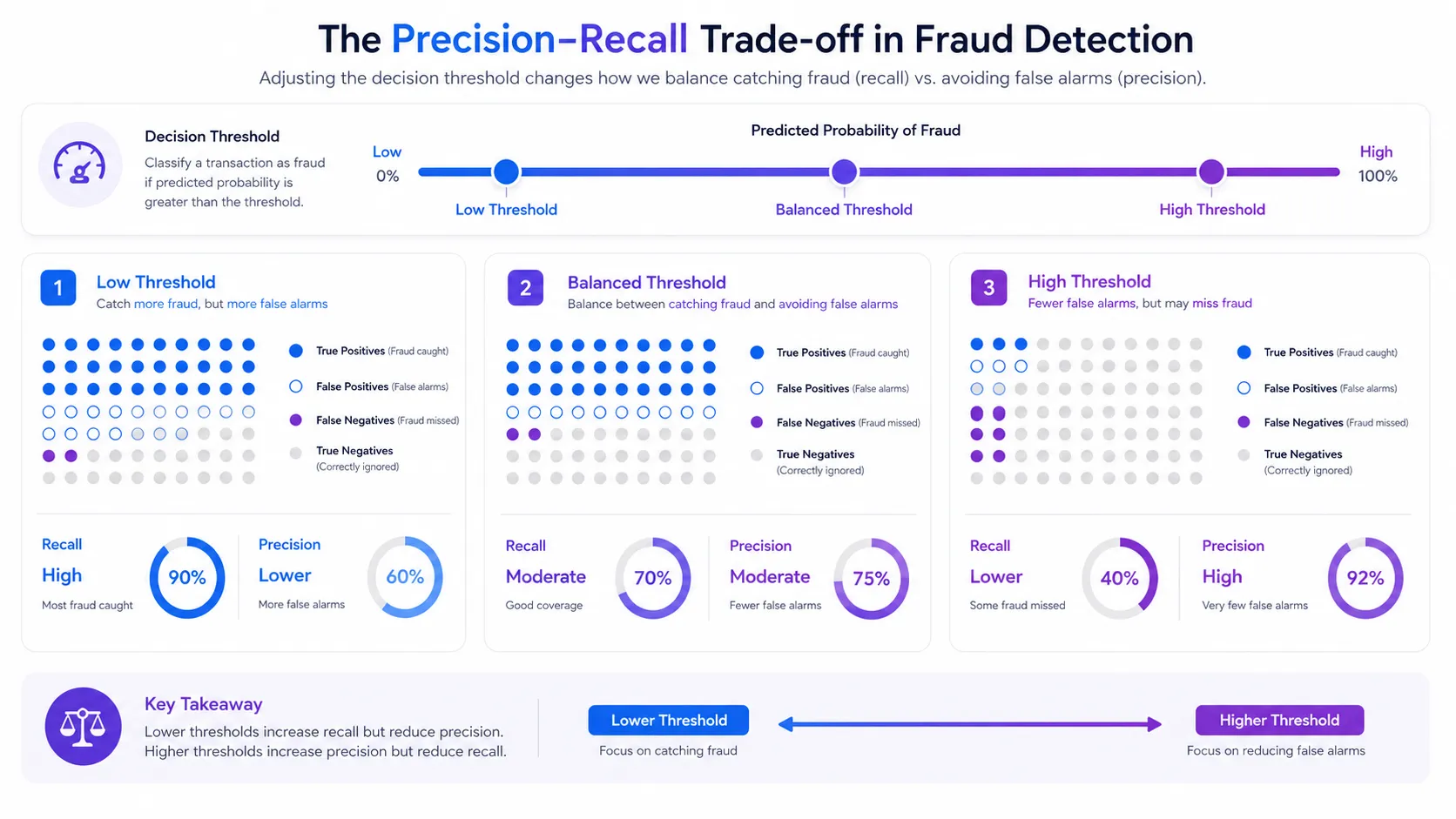
In many machine learning models, improving recall can reduce precision, and improving precision can reduce recall.
This is called the precision-recall trade-off.
Why does this happen?
Many classification models do not directly say “positive” or “negative.” They first produce a probability or score.
For example, a fraud model may say:
A transaction has a 0.82 probability of being fraudulent.
Another transaction may receive 0.61.
Another may receive 0.38.
We then choose a classification threshold.
Suppose the threshold is 0.50.
Anything above 0.50 is classified as fraud.
Now imagine we lower the threshold to 0.30.
The model starts marking more transactions as fraud.
This may help it catch fraud cases that were previously missed, so recall can increase.
But there is a downside.
More genuine transactions may also be incorrectly marked as fraud, increasing false positives and possibly reducing precision.
Now do the opposite.
Increase the threshold from 0.50 to 0.80.
The model becomes more careful before calling something fraud.
False positives may decrease, which can improve precision.
But some real fraud cases with scores like 0.70 may now be missed, which can reduce recall.
So the goal is not always to maximize one metric blindly.
The goal is to choose the right balance for the real-world problem.
What Is F1 Score?
What if both precision and recall matter?
That is where the F1 score becomes useful.
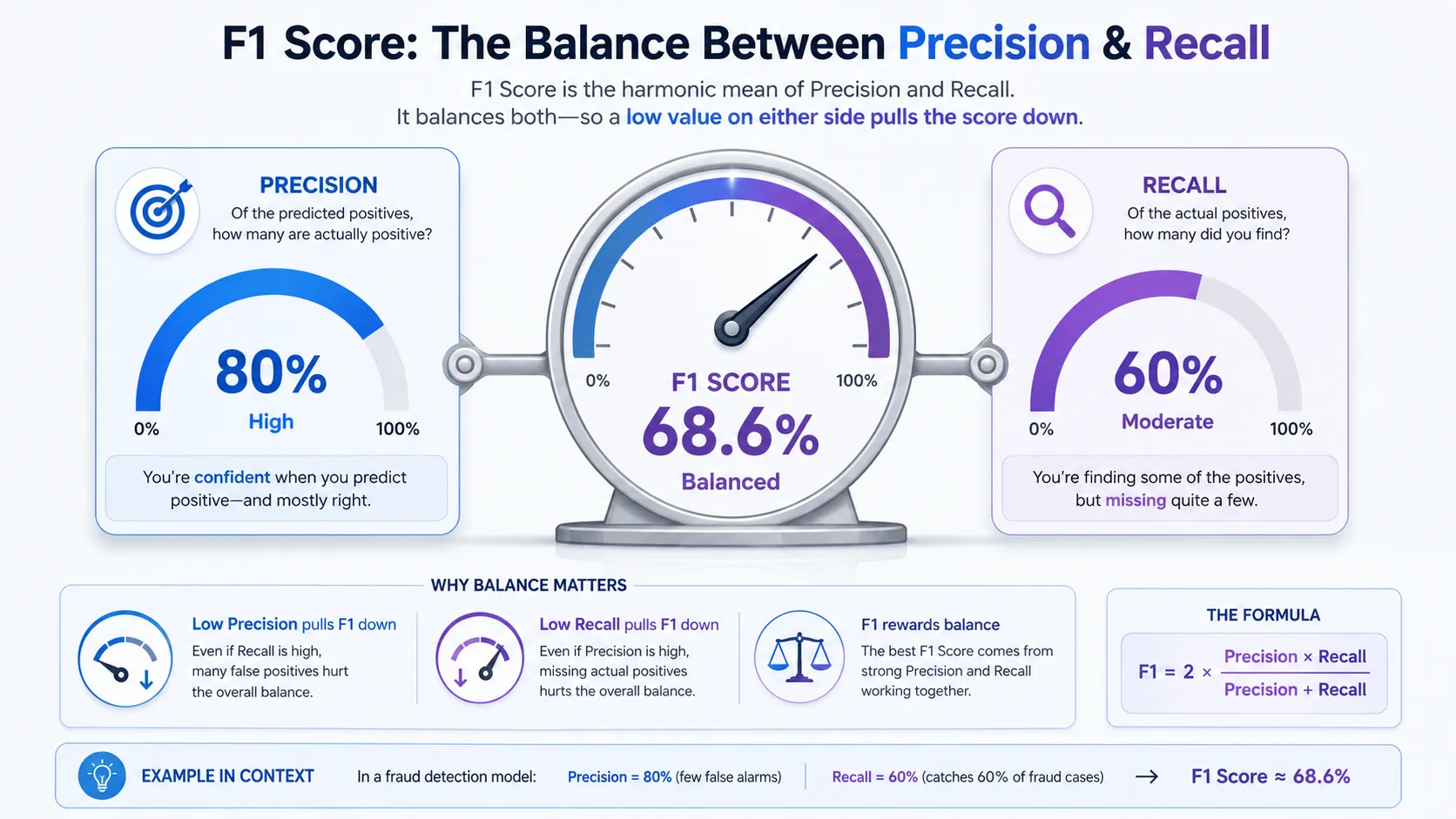
The F1 score combines precision and recall into a single metric.
Its formula is:
F1 Score = 2 × (Precision × Recall) / (Precision + Recall)
The value normally falls between 0 and 1.
A score closer to 1 generally means the model has a stronger balance between precision and recall.
A score closer to 0 means one or both of these metrics are poor.
But there is something interesting about the F1 score.
It does not simply calculate the normal average of precision and recall.
It uses something called the harmonic mean.
Do not worry about the mathematical name. The idea is actually easy.
The harmonic mean gives more importance to the lower value.
Imagine your model has:
Precision = 95%
but
Recall = 20%
A normal average might make the result look better than it deserves.
But the model clearly has a problem. It is very precise when it predicts positive, yet it misses most actual positive cases.
The F1 score reflects this imbalance more strongly.
That is why the F1 score in machine learning is often useful when you want one number that represents the balance between precision and recall.
A Simple F1 Score Example
Suppose a model has:
Precision = 0.80
Recall = 0.60
Using the formula:
F1 = 2 × (0.80 × 0.60) / (0.80 + 0.60)
First multiply precision and recall:
0.80 × 0.60 = 0.48
Multiply that by 2:
0.96
Now divide by:
0.80 + 0.60 = 1.40
So:
F1 ≈ 0.686
The F1 score is approximately 68.6%.
Notice that it does not simply sit comfortably near the higher precision value. The lower recall score pulls the F1 score down.
That is exactly what F1 is designed to do.
Why Not Always Use F1 Score?
At this point, F1 may sound like the perfect metric.
It is useful, but it is not automatically the best metric for every classification problem.
The F1 score treats precision and recall as equally important.
Real businesses do not always work that way.
Imagine a cancer screening model.
Missing a real patient may be far more serious than sending a healthy person for one additional test.
In that situation, you may care more about recall than an equal balance.
Now imagine a system automatically banning users for financial fraud.
If false accusations can block thousands of genuine customers, the business may place much more importance on precision.
F1 score is especially helpful when:
Both false positives and false negatives matter.
You want a balance between precision and recall.
Your dataset contains an imbalanced class distribution.
Accuracy does not tell the full story.
You need a simple metric for comparing similar classification models.
The bigger lesson is this:
Do not choose a model evaluation metric because it is popular. Choose it because it matches the cost of mistakes in your real problem.
That single habit can make your model evaluation much more meaningful.
Accuracy vs Precision vs Recall vs F1 Score
A beginner often asks:
“Which metric should I use?”
There is no universal winner.
Accuracy asks how many total predictions were correct.
Precision asks how reliable your positive predictions are.
Recall asks how many actual positive cases you successfully detected.
F1 score asks how well precision and recall are balanced.
The right choice depends on what kind of mistake matters most.
This is why professional classification model evaluation starts with the business problem, not with the formula.
Before choosing a metric, ask yourself:
What would hurt more in this system—a false positive or a false negative?
Your answer will often tell you whether precision, recall, F1 score, or another metric deserves the most attention.
How to Choose Between Precision, Recall, and F1 Score
Now we know what each metric means. The next question is more practical:
Which metric should you actually use for your machine learning model?
Instead of choosing a metric because it looks impressive, start by thinking about the mistake your model cannot afford to make.
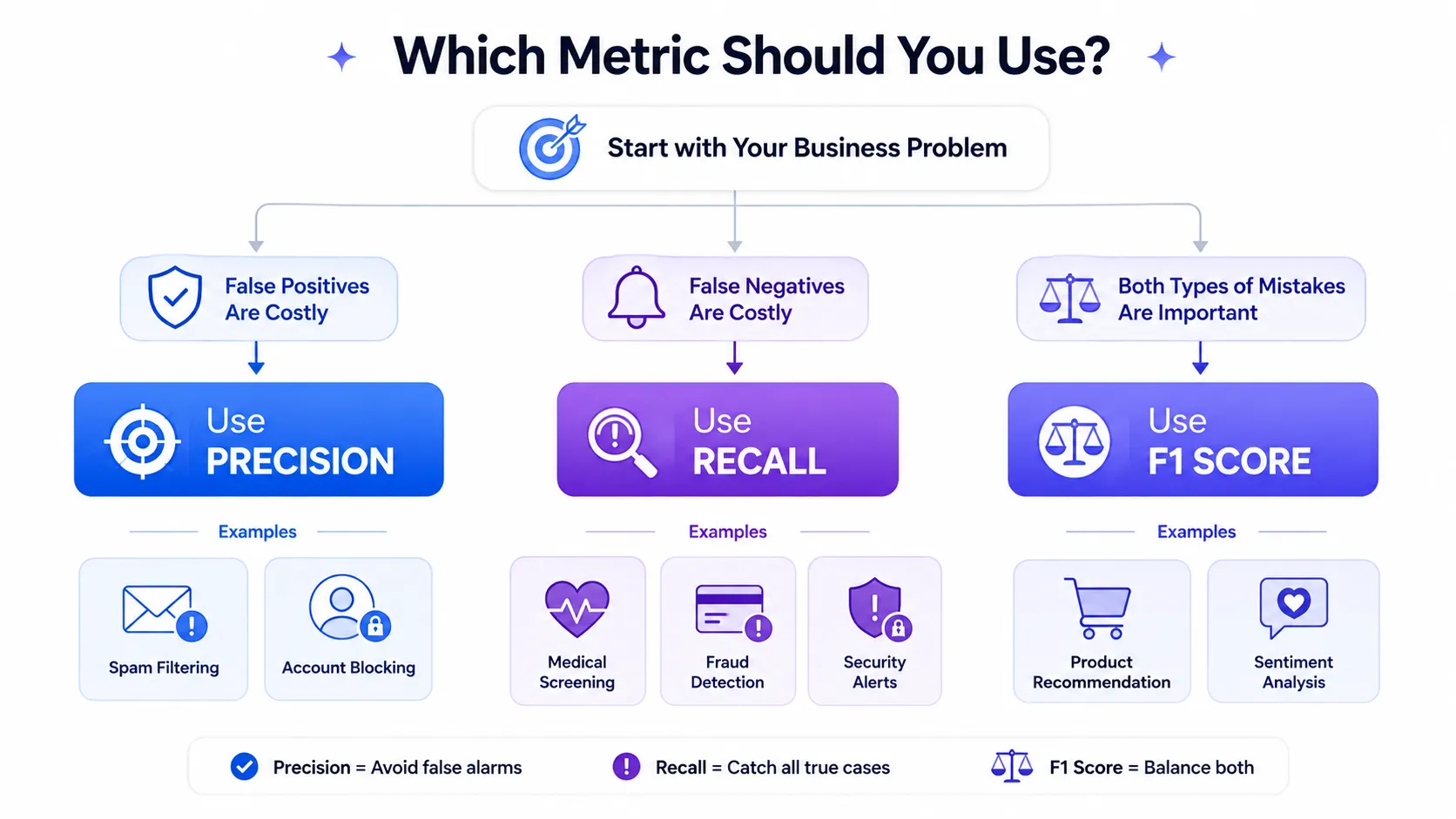
Choose Precision When False Positives Are Costly
Focus more on precision when a wrong positive prediction can create a serious problem.
Think about an email spam filter.
Suppose your model marks an important job interview email as spam. Technically, it is only one wrong prediction. But for the user, that mistake could be very costly.
Another example is an automated fraud system that freezes customer accounts.
If the system keeps blocking genuine customers, people may become frustrated and stop using the service.
In such cases, you want your positive predictions to be highly trustworthy.
That means high precision becomes important.
Choose Recall When False Negatives Are Costly
Focus more on recall when missing a real positive case is dangerous.
Consider medical screening.
If a patient actually has a serious condition but the model predicts that everything is fine, that false negative may delay further testing.
The same logic applies to:
Fraud detection
Cyberattack detection
Fire or smoke detection
Manufacturing defect detection
Safety monitoring systems
In these cases, finding as many actual positive cases as possible may be more important than avoiding every false alarm.
Choose F1 Score When You Need a Balance
Use the F1 score when both false positives and false negatives matter and you want one number that reflects both precision and recall.
This is especially useful in imbalanced datasets, where accuracy can look excellent even when the model performs badly on the smaller class.
Precision, Recall, and F1 Score in an Imbalanced Dataset
Let us return to fraud detection because it shows why these metrics matter so clearly.
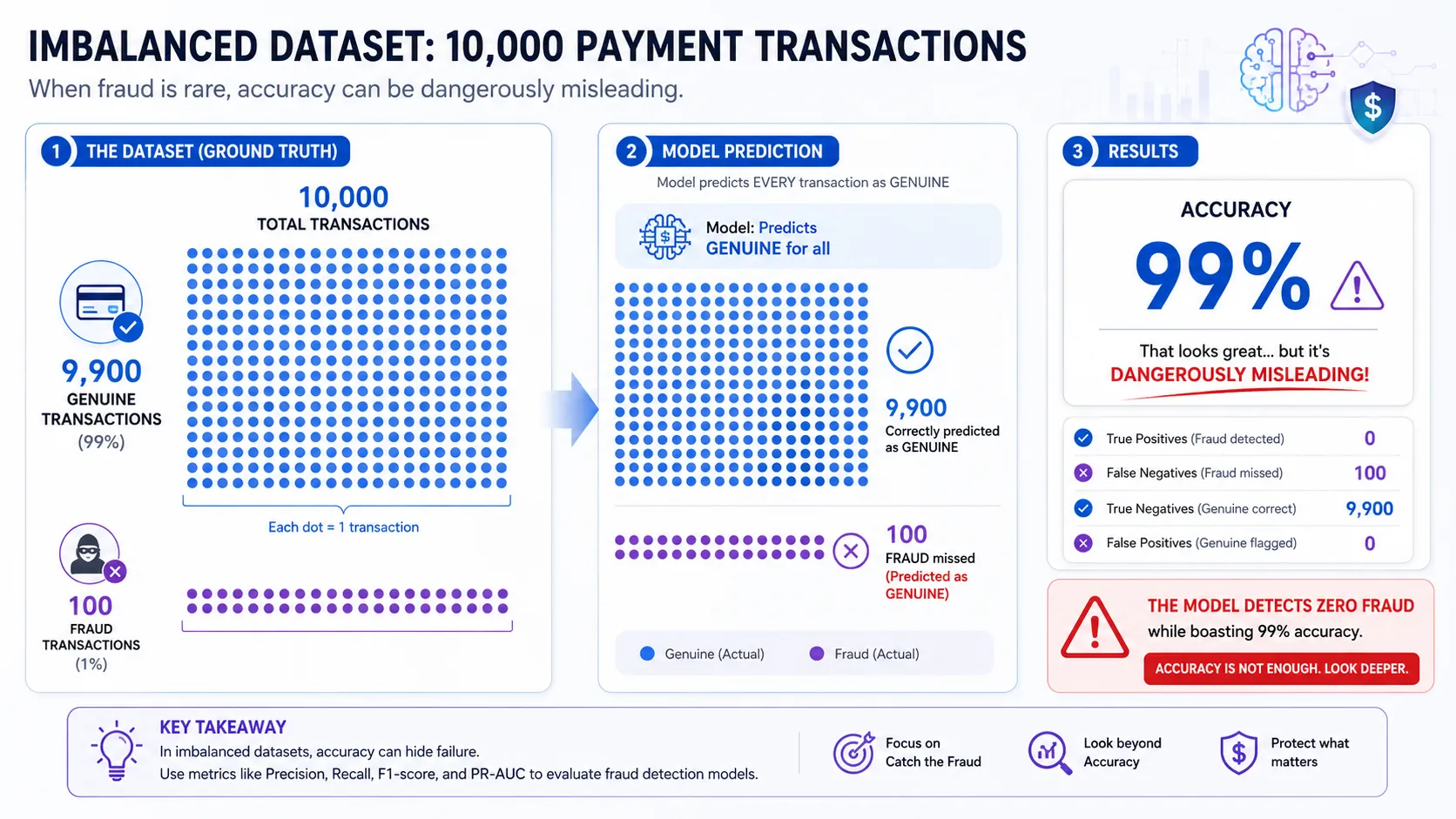
Imagine a payment platform processes 10,000 transactions.
Only 100 transactions are actually fraudulent.
The remaining 9,900 are genuine.
A model could predict every transaction as genuine and still achieve:
9,900 / 10,000 = 99% accuracy
At first glance, 99% sounds outstanding.
But the model catches zero fraud cases.
For the business, that model is almost useless.
This is why accuracy vs precision vs recall vs F1 score is not just an academic discussion.
When working with imbalanced classification data, always look beyond accuracy.
Check how the model performs on the class that matters most.
A Complete Real-World Example
Imagine an online store builds a system to detect fake orders.
During testing, there are 1,000 orders.
Out of those, 100 are actually fake.
The model correctly detects 80 fake orders.
It misses 20 fake orders.
It also incorrectly flags 40 genuine orders as fake.
Here:
True Positives = 80
False Negatives = 20
False Positives = 40
Now calculate precision:
Precision = 80 / (80 + 40)
Precision = 80 / 120 ≈ 66.7%
So when the model says an order is fake, it is correct around 66.7% of the time.
Now calculate recall:
Recall = 80 / (80 + 20)
Recall = 80 / 100 = 80%
That means the model catches 80% of all fake orders.
Now calculate F1 score:
F1 = 2 × (0.667 × 0.80) / (0.667 + 0.80)
The result is approximately:
F1 ≈ 72.7%
Now we understand the model much better than we would by looking at accuracy alone.
Common Mistakes Beginners Make
Understanding formulas is only one part of model evaluation in machine learning. You also need to avoid some common mistakes.
Looking Only at Accuracy
This is probably the most common mistake.
Accuracy can work well when classes are reasonably balanced and the cost of mistakes is similar.
But with highly imbalanced data, accuracy alone can hide poor performance.
Thinking a High F1 Score Means a Perfect Model
A strong F1 score is useful, but it does not automatically mean your model is ready for the real world.
You still need to understand:
What errors the model makes
Whether the dataset represents real users
Whether performance changes over time
Whether false positives or false negatives have different costs
Comparing Metrics Without Business Context
Imagine Model A has higher precision while Model B has higher recall.
Which one is better?
You cannot answer that until you understand the problem.
If you are detecting a life-threatening disease, Model B may be better because it catches more real cases.
If you are automatically banning users, Model A may be safer because its positive predictions are more reliable.
A metric has meaning only when connected to the real problem.
Classification Thresholds Can Change Your Metrics
One more concept beginners should know is the decision threshold.
Many binary classification models produce a probability.
For example:
Fraud probability = 0.72
You might decide that any probability above 0.50 will be classified as fraud.
But 0.50 is not a universal rule.
If you lower the threshold, the model usually predicts more positive cases. This may increase recall but can reduce precision.
If you increase the threshold, the model becomes more selective. This may improve precision but reduce recall.
This is why experienced machine learning practitioners often experiment with different thresholds instead of accepting the default value automatically.
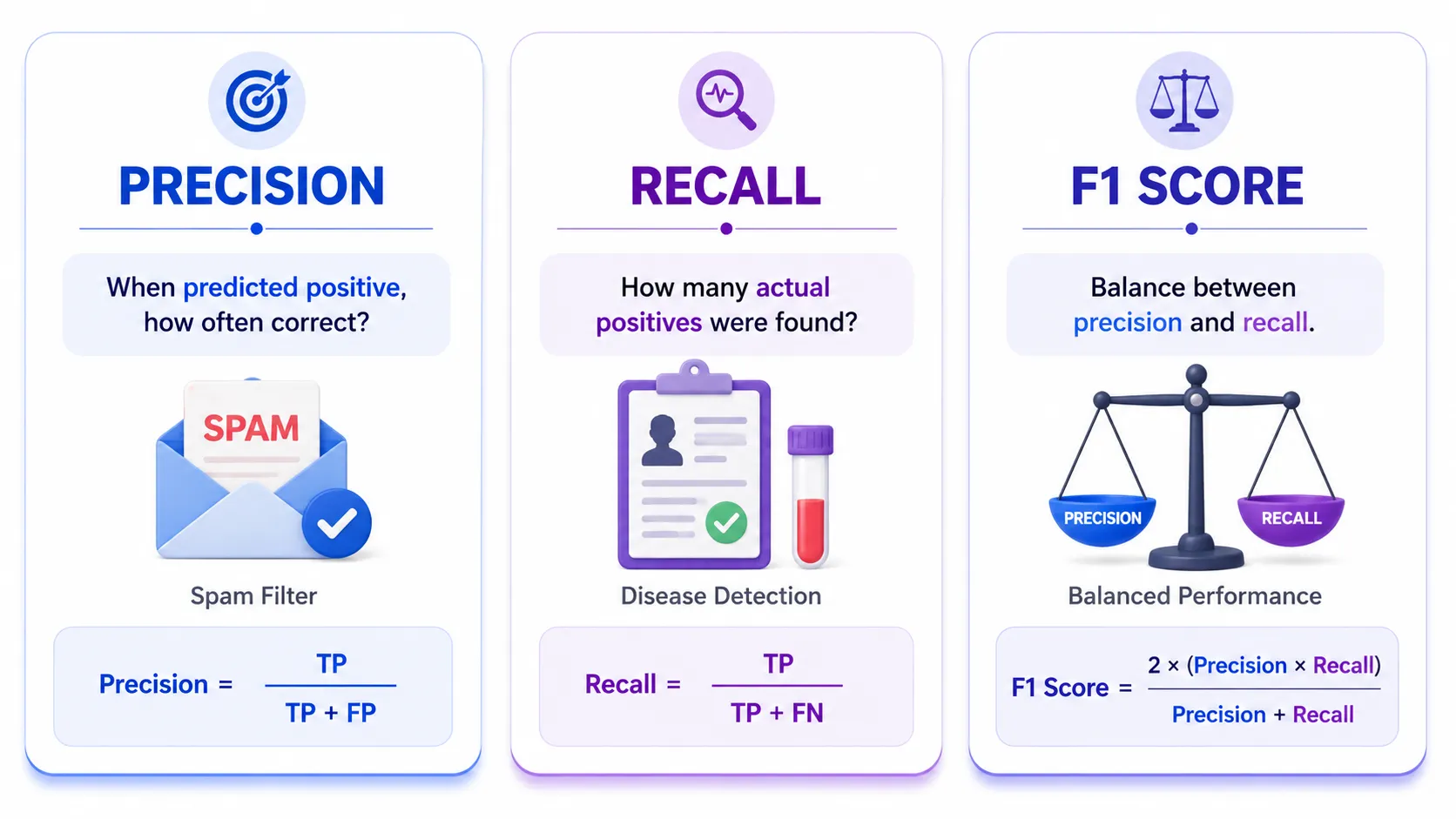
A Simple Way to Remember Everything
If the formulas ever feel confusing, remember these three questions:
Precision:
“When the model says YES, how often is it correct?”
Recall:
“Out of all the real YES cases, how many did the model find?”
F1 Score:
“How well is the model balancing precision and recall?”
That is the core idea.
You do not need to memorize every equation on your first day.
Understand the story behind the metric first. The formulas become much easier after that.
Final Thoughts
Precision, recall, and F1 score are not just numbers that appear after training a machine learning model.
They tell you what kind of mistakes your model is making.
Precision helps you understand the reliability of positive predictions.
Recall shows whether your model is successfully finding the positive cases that actually exist.
F1 score gives you a useful balance between the two.
And accuracy tells you how many total predictions were correct.
The best metric depends on the problem.
For spam filtering, false positives may matter more.
For disease screening, false negatives may matter more.
For an imbalanced classification task where both mistakes matter, F1 score may be a better starting point.
So the next time you evaluate a classification model, do not ask only:
“What mistakes is my model making, and which of those mistakes actually matter?”
Once you start thinking this way, model evaluation metrics stop feeling like formulas and start becoming tools for making better machine learning decisions.


