


Reinforcement Learning
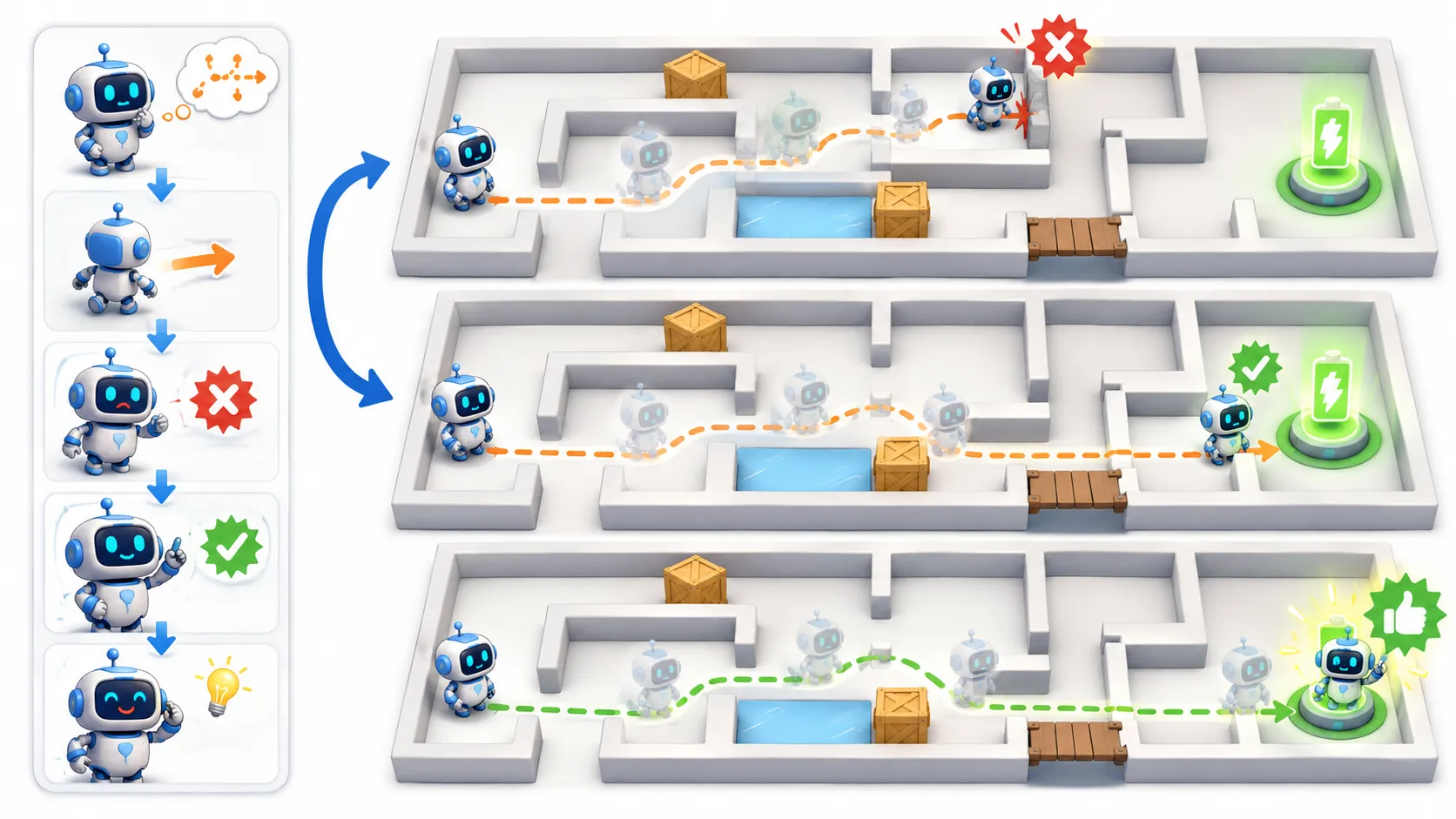
Imagine entering a large room that looks like a video game.
At one end of the room, there is a small robot called Milo. At the other end, there is a charging station with a glowing green light.
Between Milo and the charging station are walls, boxes, slippery floors and one narrow bridge.
Nobody gives Milo a map.
Nobody tells it, “Move three steps forward, turn left, avoid the red box and cross the bridge.”
Milo has to learn by trying.
It moves forward and hits a wall.
Penalty: –1 point.
It turns right, travels a little farther and finds an open path.
Reward: +2 points.
It finally reaches the charging station.
Reward: +100 points.
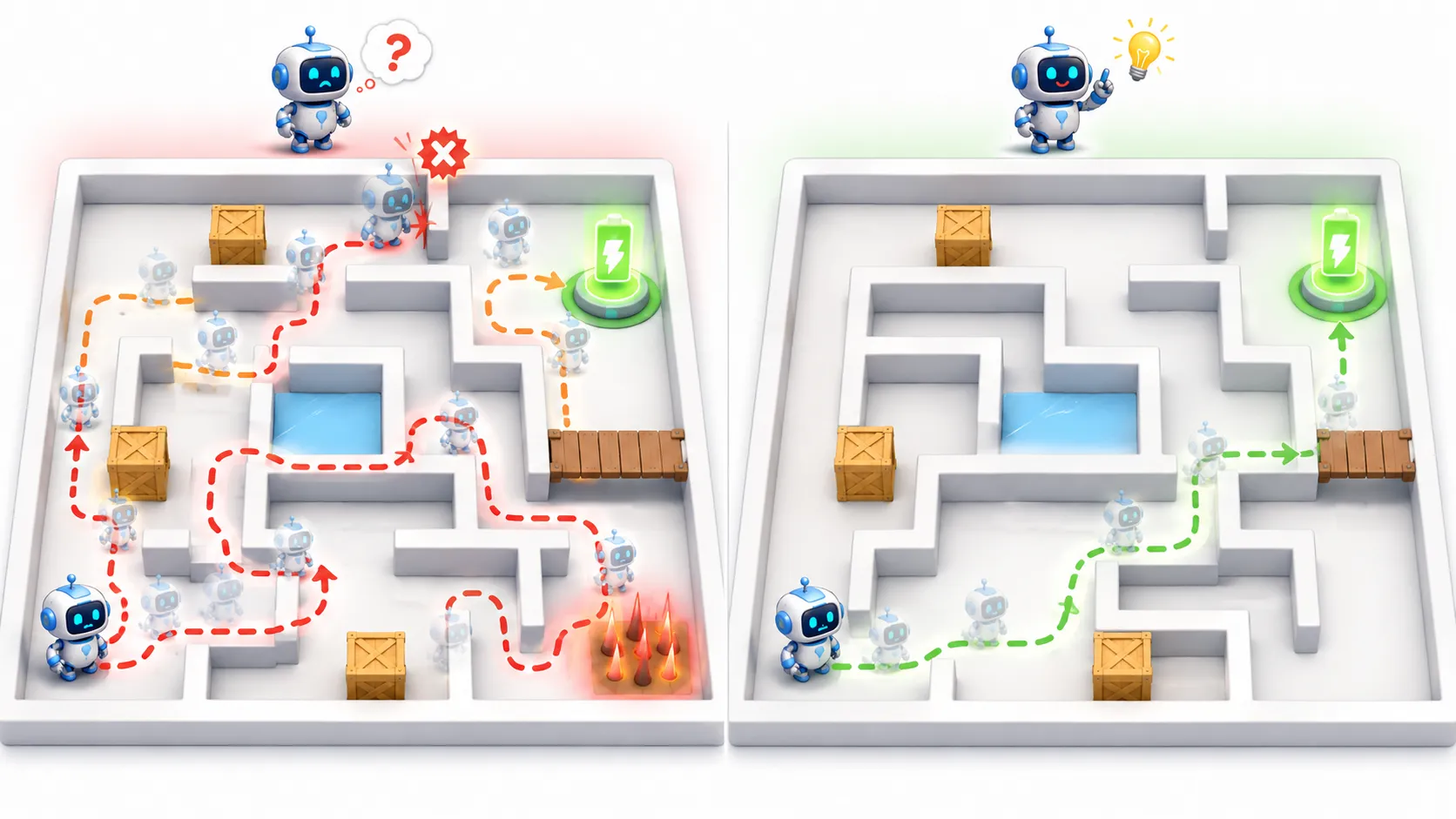
The room resets, and Milo tries again.
This time, it remembers that moving towards the wall was a poor choice. It tries another direction and reaches the charging station faster.
After hundreds or thousands of attempts, Milo develops a useful strategy.
That is the basic idea behind reinforcement learning.
What Is Reinforcement Learning in Simple Words?
Reinforcement learning is a type of machine learning in which an agent learns how to make decisions by taking actions, seeing the results and receiving rewards or penalties.
The agent is not normally given the correct action for every situation.
Instead, it learns through experience.
Good actions increase its reward. Poor actions reduce its reward or delay success.
Over time, the agent tries to discover a strategy that gives it the highest total reward.
You can think of reinforcement learning as learning through trial and error.
A child learning to ride a bicycle does not become perfect after reading one instruction book.
The child tries to balance, moves forward, loses control, adjusts their body and tries again.
Every attempt provides new information.
Reinforcement learning follows a similar idea.
Simple takeaway: Reinforcement learning means learning by doing, making mistakes and improving future choices.
How Is Reinforcement Learning Different From Normal Teaching?
Think about how a student learns multiplication.
A teacher may show:
5 × 4 = 20
The student receives the question and the correct answer.
This is similar to supervised learning, where a model learns from labelled examples.
Reinforcement learning is different.
The learner may be told only the goal:
“Reach the treasure without falling into the holes.”
The learner is not shown the correct move at every step.
It must discover:
Which direction is safe
Which route is faster
Which choices create problems
Whether a small reward now may cause a larger loss later
Whether a difficult path may produce a better final result
This makes reinforcement learning useful for problems where decisions happen one after another.
Each action can change what happens next.
For example, in a board game, one move changes the options available in the next turn.
In driving, pressing the accelerator changes the vehicle’s speed and affects the next decision.
In a warehouse, sending a robot down one path may block another robot or delay another delivery.
Reinforcement learning is built for this type of step-by-step decision-making.
The Five Main Parts of Reinforcement Learning
To understand reinforcement learning properly, remember five basic ideas:
Agent
Environment
State
Action
Reward
Let us return to Milo’s maze.
1. The Agent
The agent is the learner and decision-maker.
In our story, Milo is the agent.
The agent observes what is happening, chooses an action and learns from the result.
In other examples, the agent could be:
A game-playing program
A robot
A warehouse system
A traffic-control system
A software assistant
A driving-policy model
The agent does not need to be a physical robot.
It can be a software program running inside a computer simulation.
For example, a game-playing agent may exist only inside a digital board game. It can still observe the game, make moves and learn from wins or losses.
2. The Environment
The environment is the world in which the agent operates.
For Milo, the environment includes:
The room
The walls
The bridge
The boxes
The charging station
The rules controlling movement
For a chess-playing agent, the environment includes the board, pieces, legal moves and opponent.
For a driving agent, the environment may include:
Roads
Other vehicles
Pedestrians
Traffic lights
Road signs
Weather
Speed limits
The environment reacts after the agent performs an action.
If Milo moves forward, the environment decides whether it reaches an empty space, hits a wall or falls from the bridge.
The agent acts, and the environment responds.
3. The State
The state describes the current situation.
Milo’s state may include:
Its current position
The direction it is facing
Nearby walls
Distance from the charging station
Remaining battery power
A game agent’s state may be the current position of every piece on the board.
A driving system’s state may include:
Current speed
Distance from nearby vehicles
Road shape
Traffic-light status
Lane position
Nearby pedestrians
The state gives the agent information before it chooses an action.
Imagine playing chess without seeing the board.
You would not know which move to make.
In the same way, an agent needs information about its current situation.
Sometimes the agent can see the complete state.
In other situations, it sees only part of what is happening.
A driving system can detect a nearby car, but it cannot know exactly what the other driver will do next.
This uncertainty makes real-world reinforcement learning much harder than learning inside a simple game.
4. The Action
An action is a choice available to the agent.
Milo’s actions may include:
Move forward
Move backward
Turn left
Turn right
Stop
A chess agent may choose which piece to move.
A warehouse robot may choose which path to follow.
A driving policy may choose whether to:
Accelerate
Brake
Turn
Change lanes
Maintain speed
After the agent chooses an action, the environment changes.
The agent then observes the new situation.
This creates a repeating loop:
Observe the state → Choose an action → Environment changes → Receive a reward → Observe the new state
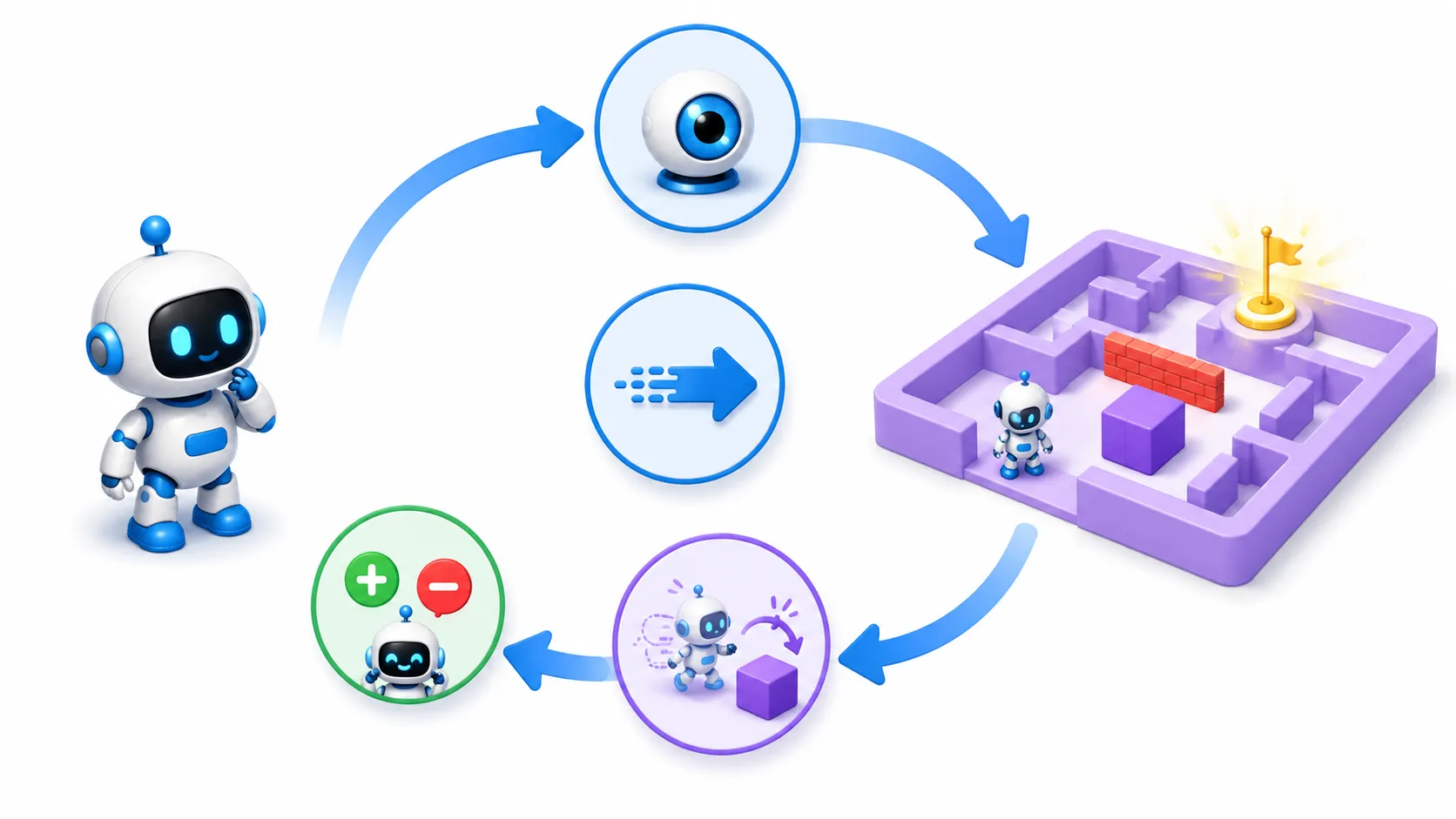
This loop may happen hundreds, thousands or millions of times during training.
Each interaction gives the agent more experience.
5. The Reward
A reward is numerical feedback that tells the agent how useful an outcome was.
For Milo:
Reaching the charging station: +100
Moving closer to the goal: +2
Hitting a wall: –1
Falling from the bridge: –50
Taking an unnecessary step: –0.1
Rewards guide learning.
However, a reward does not always tell the agent exactly what to do.
It may only say whether the result was helpful or harmful.
For example, Milo may receive –1 after hitting a wall.
The reward tells Milo that the result was poor, but it does not directly say whether it should turn left or right next time.
Milo must discover the better choice through more attempts.
This is one reason reinforcement learning can require a large amount of training.
Reward and Penalty Do Not Mean Happiness or Pain
The words reward and penalty may sound emotional.
The agent does not feel happy after receiving +100 points.
It does not feel pain after receiving –50 points.
These are simply numbers used to guide learning.
A higher reward tells the learning system that an outcome was more useful.
A negative reward tells it that the outcome was less useful.
The agent adjusts its future choices based on these numbers.
Why Total Reward Matters More Than One Quick Reward
Imagine that Milo sees a shiny coin and earns five points by collecting it.
But the coin is inside a dead end.
After collecting it, Milo needs twenty extra moves to reach the charging station.
Another route contains no coin, but it reaches the charging station quickly.
A smart agent should not always chase the nearest reward.
It should consider what may happen later.
That is why reinforcement learning usually focuses on cumulative reward.
Cumulative reward means the total reward received across a complete sequence of decisions.
The agent does not only ask:
“What gives me a reward right now?”
It also asks:
“Which choice may lead to the best total result later?”
This is similar to many decisions in real life.
Watching a film tonight may feel more enjoyable than studying.
But studying may produce a better result in tomorrow’s examination.
Spending money today may feel rewarding.
Saving it may create more freedom later.
Reinforcement learning studies the same basic problem:
Should the agent choose a small reward now or take an action that may produce a larger reward later?
What Is a Policy in Reinforcement Learning?
A policy is the agent’s strategy.
It tells the agent which action it should choose in a particular state.
Milo’s early policy may be almost random:
Sometimes move left
Sometimes move right
Sometimes turn around without a clear reason
After training, its policy becomes more useful:
Avoid the wall when it is directly ahead
Move towards the bridge from the safe side
Take the shorter route when the path is open
Avoid paths that often lead to penalties
A policy does not always look like a list of simple human-written rules.
It may be stored as:
A table
A set of probabilities
A mathematical function
A neural network
The aim of training is to develop a policy that performs well in many situations.
The agent should not only memorise one exact route.
It should learn a strategy that still works when the starting position, obstacles or environment change.
The Question That Makes Reinforcement Learning Difficult
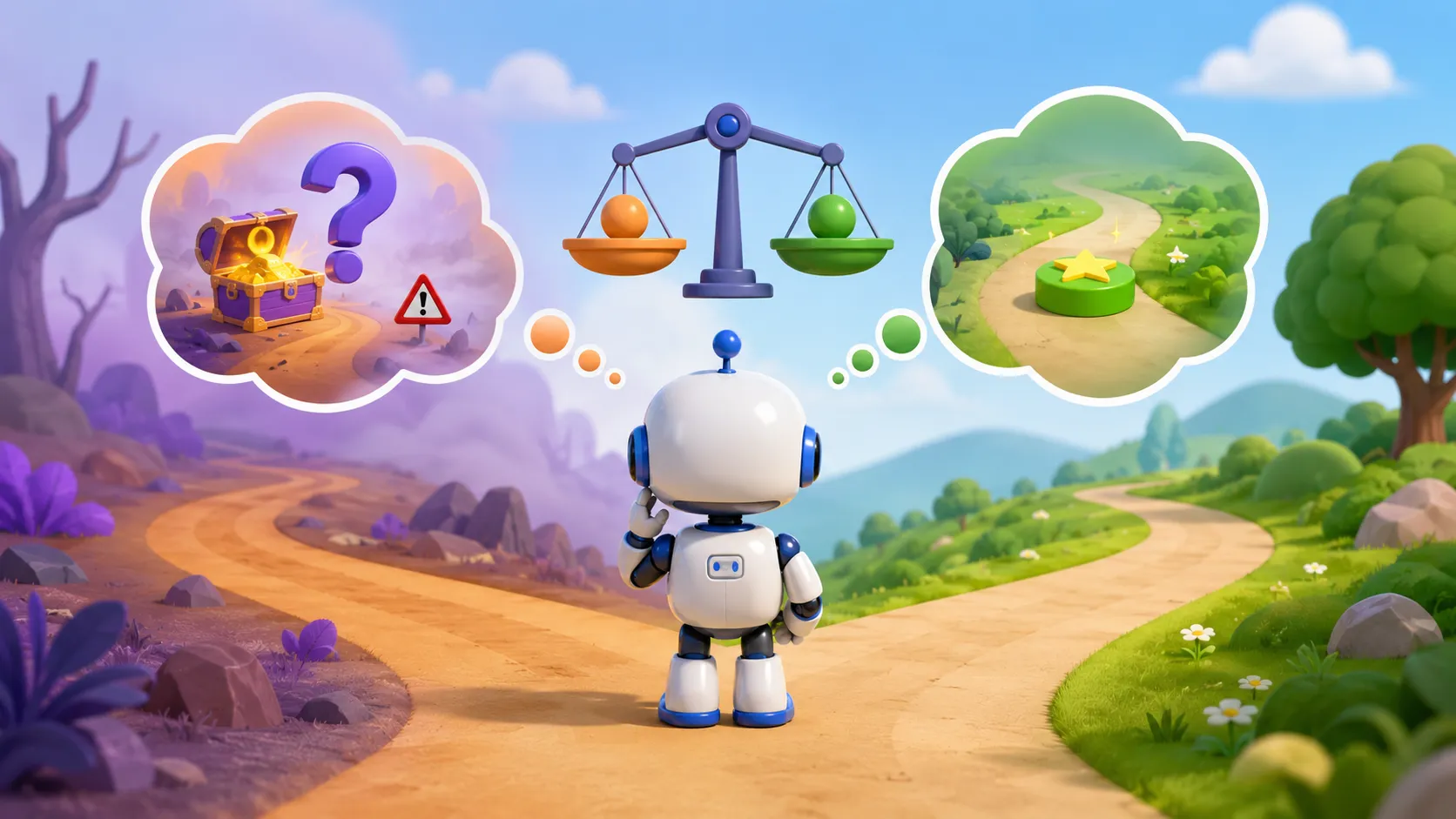
Milo now faces an important problem.
It already knows that moving right produced two points during an earlier attempt.
Should it keep moving right because that action appears useful?
Or should it try the unexplored path on the left, which may lead to a much larger reward?
Choosing the best-known action is called exploitation.
Trying a less-known action to collect new information is called
Exploration.
An agent that never explores may miss a better strategy.
An agent that explores forever may never use what it has learned.
Finding the right balance between exploration and exploitation is one of the central challenges in reinforcement learning.
Exploration vs Exploitation: Should Milo Try or Trust?
Milo is standing at the same place where Part 1 ended.
The path on the right has already given it a small reward.
The path on the left is unknown.
Should Milo choose the safe path it already understands, or should it take a risk and explore the new path?
This is called the exploration–exploitation problem.
Exploration
Exploration means trying an action whose result is not fully known.
Milo may take the left path because it wants to learn what is there.
The path may lead to:
A shorter route
A hidden reward
A dangerous obstacle
A dead end
Even if the path is bad, Milo learns something useful.
It learns not to choose that path again in the same situation.
Exploitation
Exploitation means using the best strategy the agent has found so far.
If Milo already knows that the right path safely reaches the charging station, it can choose that route again.
Exploitation helps the agent use its experience instead of behaving randomly forever.
Here is a simple real-life example.
Imagine you are choosing a restaurant.
You already know one restaurant that serves good food. Going there is exploitation.
Trying a new restaurant is exploration.
The new restaurant may be better, but it may also disappoint you.
A good reinforcement learning agent needs both behaviours.
An agent that only exploits may never discover a better strategy.
An agent that only explores may keep making unnecessary mistakes.
Exploration and exploitation are therefore not opposites where one is always good and the other is bad. The agent needs a useful balance between them. This balance is one of the central problems studied in reinforcement learning.
A Simple Method Called Epsilon-Greedy
One beginner-friendly way to balance exploration and exploitation is called the epsilon-greedy strategy.
Most of the time, the agent chooses the best action it currently knows.
A small percentage of the time, it chooses a random action to explore.
For example:
90% of the time → Choose the best-known action
10% of the time → Try a random action
The random-action percentage is called epsilon.
At the beginning of training, Milo may explore often because it knows very little about the maze.
Later, after gaining experience, the exploration rate may be reduced.
This does not mean random exploration is always the best method. More advanced agents may explore in smarter ways by paying attention to uncertainty or unfamiliar states.
But epsilon-greedy gives us an easy way to understand the basic idea.
What Is an Episode?
Milo starts at the entrance, moves through the maze and eventually reaches the charging station or falls into a dangerous area.
That complete attempt is called an episode.
An episode has:
A starting state
A sequence of actions
Several rewards or penalties
A final state
For example:
Start → Move right → Move forward → Hit wall → Turn left → Reach goal
When the episode ends, the environment may reset and Milo begins again.
A game-playing episode may begin when the game starts and end when someone wins, loses or draws.
A warehouse episode may begin when a robot receives a task and end when the item is delivered.
Not every reinforcement learning problem has a clear ending. Some tasks continue for a long time, such as controlling traffic signals or managing a running machine.
What Is a Return?
During one episode, Milo may receive many rewards.
Suppose it receives:
Move closer: +2
Hit wall: –1
Take extra step: –0.1
Reach charging station: +100
The combined future reward is called the return.
The agent tries to choose actions that lead to a high return, not only a high immediate reward.
This is why Milo may ignore a five-point coin if collecting it causes a much longer journey.
Why Future Rewards Are Sometimes Discounted
A reward that arrives immediately is usually more certain than one that may arrive much later.
Reinforcement learning often uses a number called the discount factor to control how much future rewards matter.
It is commonly represented by the Greek letter gamma.
You do not need to remember the symbol to understand the idea.
A Low Discount Factor
A low discount factor makes the agent care more about quick rewards.
Milo may chase the nearest coin even if that decision is not useful later.
A High Discount Factor
A high discount factor makes the agent consider long-term results.
Milo may accept a small penalty now if it leads to the charging station later.
Think about planting a tree.
The work happens today, but the benefit arrives much later.
An agent that only values immediate rewards would not understand why planting the tree is useful.
Returns and discounting allow reinforcement learning systems to connect current actions with future results. Sutton and Barto describe return as the total reward an agent seeks to maximise, often with later rewards discounted over time.
The Credit Assignment Problem
Now imagine that Milo makes twenty moves before reaching the goal.
Which move deserves credit for the final reward?
Was the most important decision:
Entering the correct corridor?
Avoiding the bridge?
Turning left near the final wall?
Ignoring the small coin?
This is known as the credit assignment problem.
The final reward may arrive much later than the action that made success possible.
It is similar to winning a football match.
The final goal may happen in the last minute, but an important pass made earlier may have created the chance.
A reinforcement learning system needs a way to pass information about later rewards back to earlier decisions.
What Is a Value Function?
A value function estimates how useful a state is.
Imagine Milo is standing at two different points in the maze.
State A is close to the charging station and has a clear path.
State B is surrounded by walls and dangerous areas.
State A has a higher value because it is more likely to lead to future rewards.
A value function does not only ask:
“Will I receive a reward right now?”
It asks:
“How much future reward can I expect from this situation?”
A state near the goal may be valuable even if it gives no immediate reward.
What Is a Q-Value?
A state value tells us how useful a situation is.
A Q-value goes one step further.
It estimates how useful a particular action is in a particular state.
Suppose Milo is standing in front of a wall.
Its possible actions are:
Move forward
Turn left
Turn right
The Q-values may look like this:
Move forward: –8
Turn left: +12
Turn right: +4
These values suggest that turning left is currently the best choice.
The letter Q does not stand for a complicated phrase you must memorise. You can simply think of it as the quality of an action in a state.
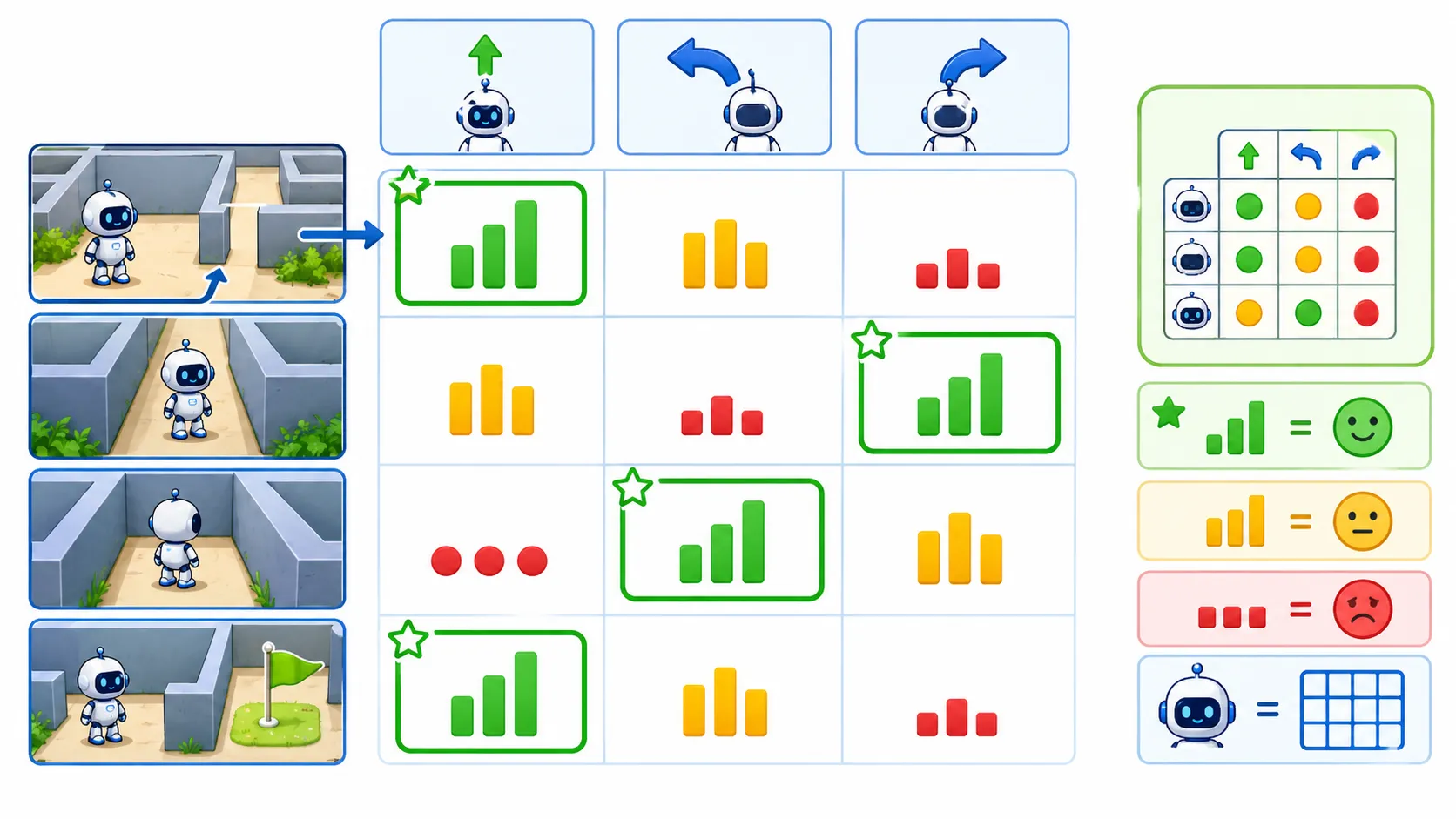
Understanding a Q-Table
For a small environment, Q-values can be stored in a table.
Each row represents a state.
Each column represents an action.
State Forward Left Right
Near entrance 2 5 1
In corridor 8 –2 3
In front of wall –8 12 4
Near goal 20 6 9
When Milo enters a state, it checks the row and chooses the action with the highest Q-value, unless it decides to explore.
At the beginning, the table may contain zeros because Milo has no experience.
As Milo moves through the maze, the values are updated.
How Q-Learning Works
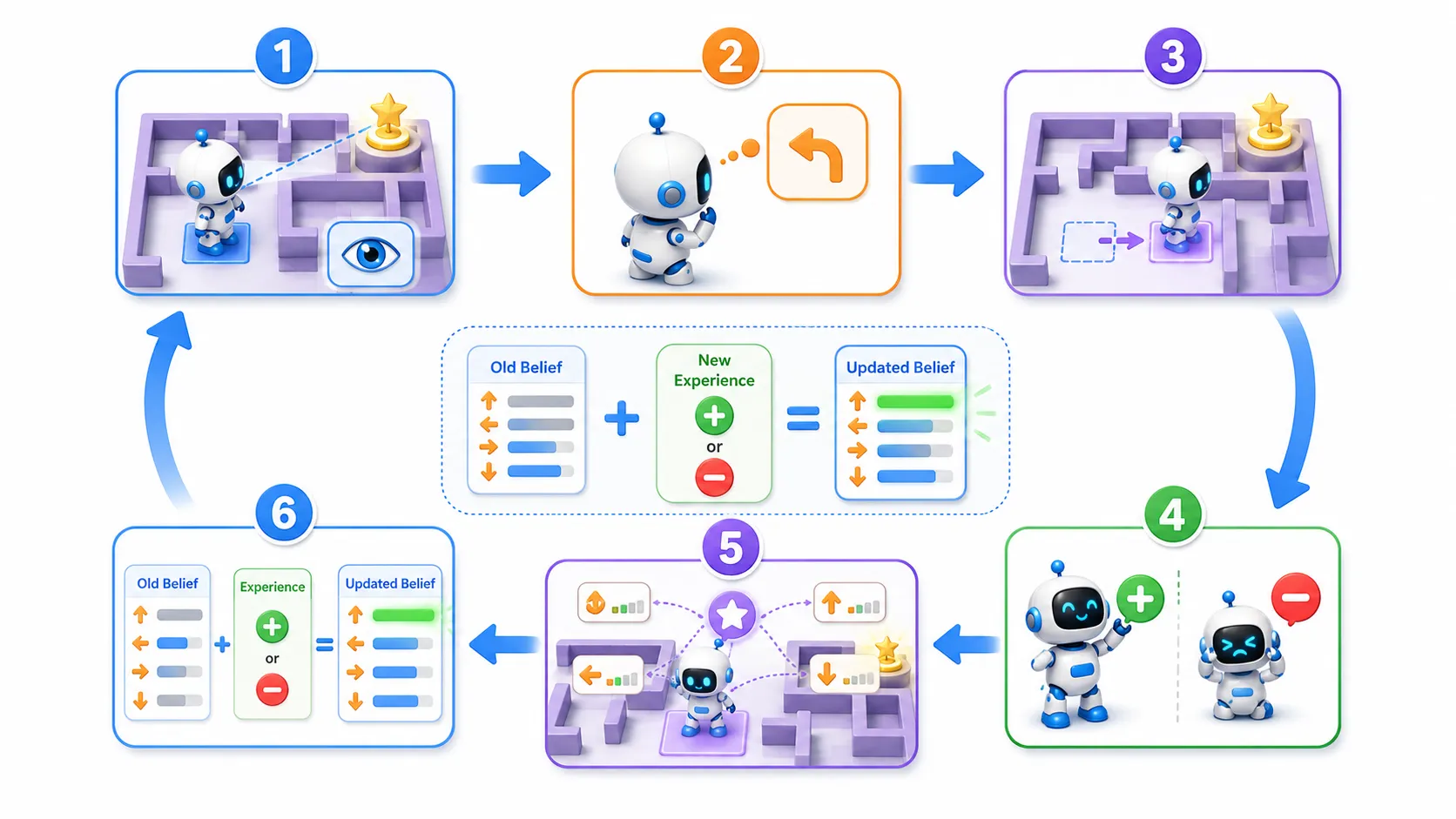
Q-learning is a well-known reinforcement learning method that teaches an agent useful action values.
After every action, the agent considers:
The reward it received
The new state it entered
The best estimated action available from that new state
Suppose Milo turns left.
It receives a small reward and enters a state close to the charging station.
The system increases the Q-value for choosing left in the earlier state.
Now imagine Milo moves forward and falls from the bridge.
The Q-value for that choice is reduced.
The update can be understood like this:
Old belief + New experience = Updated belief
The original Q-learning research describes the method as a way for an agent to learn useful action values through repeated interaction, without needing a complete model of how the environment works.
What Is the Learning Rate?
The learning rate decides how strongly new experience changes the agent’s old belief.
A high learning rate makes the agent change its values quickly.
A low learning rate makes it change them slowly.
Imagine a friend recommends one bad restaurant.
Would you immediately decide that the restaurant is always terrible?
Probably not.
You may combine the new experience with your earlier visits.
The learning rate controls this balance.
If it is too high, the agent may react too strongly to one unusual event.
If it is too low, the agent may learn very slowly.
Why a Q-Table Cannot Handle Every Real Problem
A Q-table works well for a small maze because the number of states and actions is limited.
But imagine an autonomous car.
Its state may depend on:
Camera images
Vehicle speed
Road position
Nearby cars
Pedestrians
Weather
Traffic lights
Thousands of possible distances and angles
It would be impossible to create a separate table row for every possible situation.
This problem is sometimes called the state-space explosion.
Instead of storing every state in a table, modern systems can use neural networks to estimate Q-values or policies.
When deep neural networks are combined with reinforcement learning, the approach is called deep reinforcement learning.
Deep reinforcement learning helped agents learn from complex inputs such as game screens, and it later became an important part of advanced game-playing systems.
But how does an agent learn a game that has more possible positions than anyone could list?
And how did systems inspired by AlphaGo improve by playing against themselves?
How Reinforcement Learning Agents Learn to Play Games
A maze is useful for understanding reinforcement learning, but games show us what this learning can achieve on a much larger scale.
Imagine teaching someone to play a board game without explaining the best strategy.
You only give them:
The rules of the game
The legal moves
A reward for winning
A penalty for losing
At first, the player makes random and often foolish moves.
After playing again and again, they begin to notice patterns.
They learn which moves create strong positions, which choices lead to danger and which early decisions can affect the final result much later.
A reinforcement learning game agent follows the same basic process.
The agent is the game-playing program.
The environment is the board and the opponent.
The state is the current position of all pieces.
The action is the move selected by the agent.
The reward may be:
+1 for winning
0 for a draw
–1 for losing
The difficult part is that the agent may make hundreds of moves before receiving the final reward.
It must work out which earlier moves helped it win and which moves slowly pushed it towards defeat.
Why Games Are Useful for Reinforcement Learning
Games are excellent training environments because their rules are clear.
A game usually has:
A known starting point
A fixed set of possible actions
Clear rules
A clear ending
A clear reward for winning or losing
The agent can also play thousands or millions of games without causing real-world harm.
If a game agent makes a terrible move, it loses the game and starts again.
If a driving system makes a terrible decision on a real road, the result could be dangerous.
This is why many important reinforcement learning ideas were first tested in games and simulations.
The Story of AlphaGo
Go is an ancient board game played on a grid with black and white stones.
The rules are not very difficult to learn, but the number of possible positions is extremely large.
A strong player cannot simply calculate every possible future move.
Human experts often depend on experience, pattern recognition and a sense of which positions look promising.
For many years, Go was considered very difficult for computers.
Then researchers at DeepMind created AlphaGo.
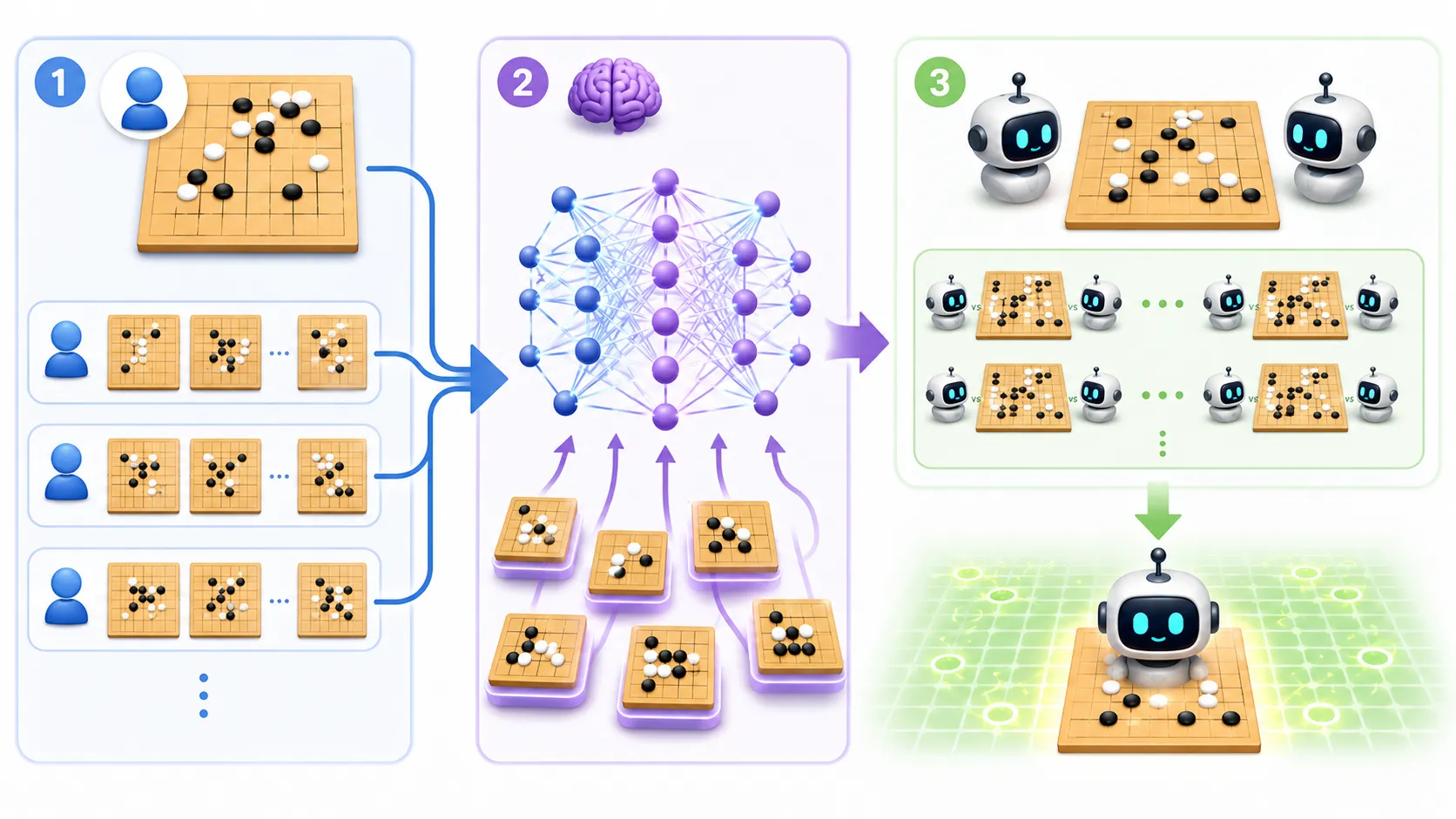
The first AlphaGo system learned in more than one way.
It first studied thousands of games played by skilled humans. This helped it learn which moves experienced players were likely to choose.
It then improved by playing many games against different versions of itself and learning from wins and losses. DeepMind describes this self-play stage as reinforcement learning.
Imagine a student who first watches expert chess matches and then spends months practising against an equally strong version of themselves.
Every time one version improves, the opponent becomes harder too.
That creates a powerful learning cycle.
What Made AlphaGo Powerful?
AlphaGo did not depend on only one method.
Its system combined several important parts.
The Policy Network
The policy network helped AlphaGo decide which moves were worth considering.
Imagine opening a map that contains one thousand possible roads.
Instead of checking every road, a skilled guide points towards the ten routes that appear most promising.
The policy network acted like that guide.
It reduced the number of moves the system needed to examine closely.
The Value Network
The value network estimated how good the current board position was.
It tried to answer:
“From this position, how likely am I to win?”
Imagine pausing a football match halfway through.
The score may be equal, but one team may have better control, stronger positions and more chances to score.
A value network tries to make a similar judgement about a game state.
Tree Search
AlphaGo also used search to look ahead at possible moves.
It explored promising paths, checked possible replies and used its policy and value estimates to guide the search.
You can think of it as planning several scenes ahead in a film.
The policy network suggests which scenes are worth exploring.
The value network estimates whether the story is moving towards a good ending.
The search connects these ideas and helps choose the next move.
DeepMind reported that AlphaGo combined policy networks, value networks and tree search to select strong moves.
AlphaGo Zero: Learning Without Human Games
The next version made the story even more interesting.
AlphaGo Zero did not begin by studying human matches.
It started with the rules of Go and played against itself from random play.
At first, both sides played badly because neither side knew a useful strategy.
But after each game, the system used the result to improve its neural network.
The improved version then played against itself again.
This cycle repeated:
Play against yourself
→ Learn from the result
→ Improve the strategy
→ Face a stronger version of yourself
→ Repeat
AlphaGo Zero became its own teacher.
The published research describes it as learning through reinforcement learning without human game data, using self-play to improve both move selection and position evaluation.
This does not mean it learned without any human input at all.
Humans still designed:
The game environment
The learning algorithm
The neural network system
The training process
The goal of winning
The computing setup
The system discovered playing strategies, but people still designed the learning framework.
What Is Self-Play?
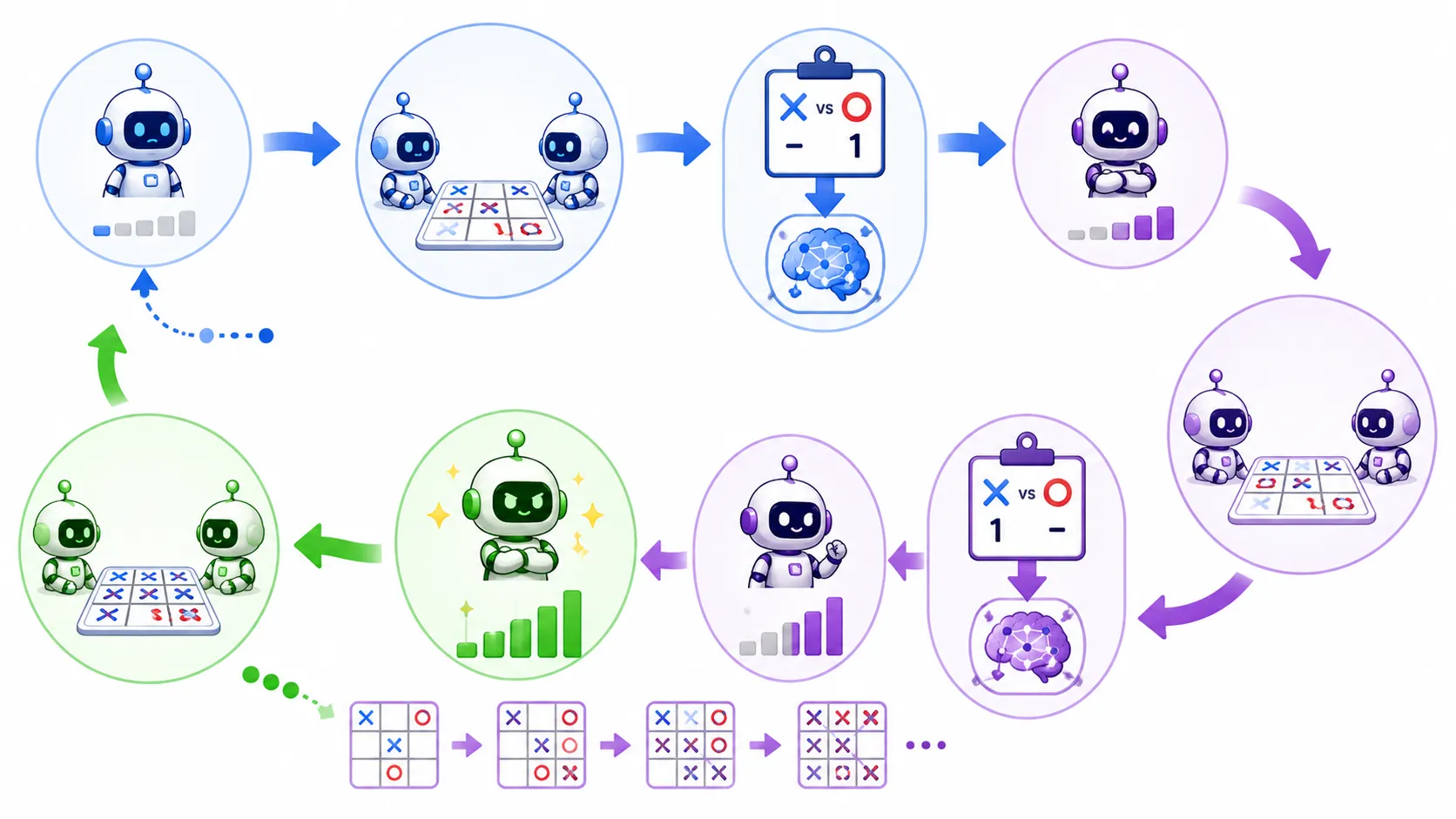
Self-play means an agent improves by playing against copies or newer versions of itself.
This solves an important problem.
Where can we find an opponent that keeps becoming stronger at the same speed as the agent?
The answer is the agent itself.
At the beginning, both sides are weak.
As one version improves, the opponent also improves.
This creates a training partner that continues to provide a challenge.
AlphaZero later used a related self-play approach to learn Go, chess and shogi from the game rules, adjusting its neural network from wins, losses and draws.
Reinforcement Learning in Autonomous Driving
Now let us move from a board game to a road.
An autonomous driving system has to make connected decisions such as:
Should the vehicle slow down?
Is it safe to change lanes?
How much space should it leave?
Should it wait for a pedestrian?
How should it react to sudden braking?
Which path is safest and smoothest?
This looks like a reinforcement learning problem because one action changes the next situation.
A simplified driving loop may look like this:
Observe the road
→ Choose steering, braking or acceleration
→ Vehicle and traffic positions change
→ Measure safety and progress
→ Choose the next action
However, real autonomous vehicles should not learn dangerous behaviour through uncontrolled trial and error on public roads.
A car cannot crash thousands of times simply to discover that crashing is bad.
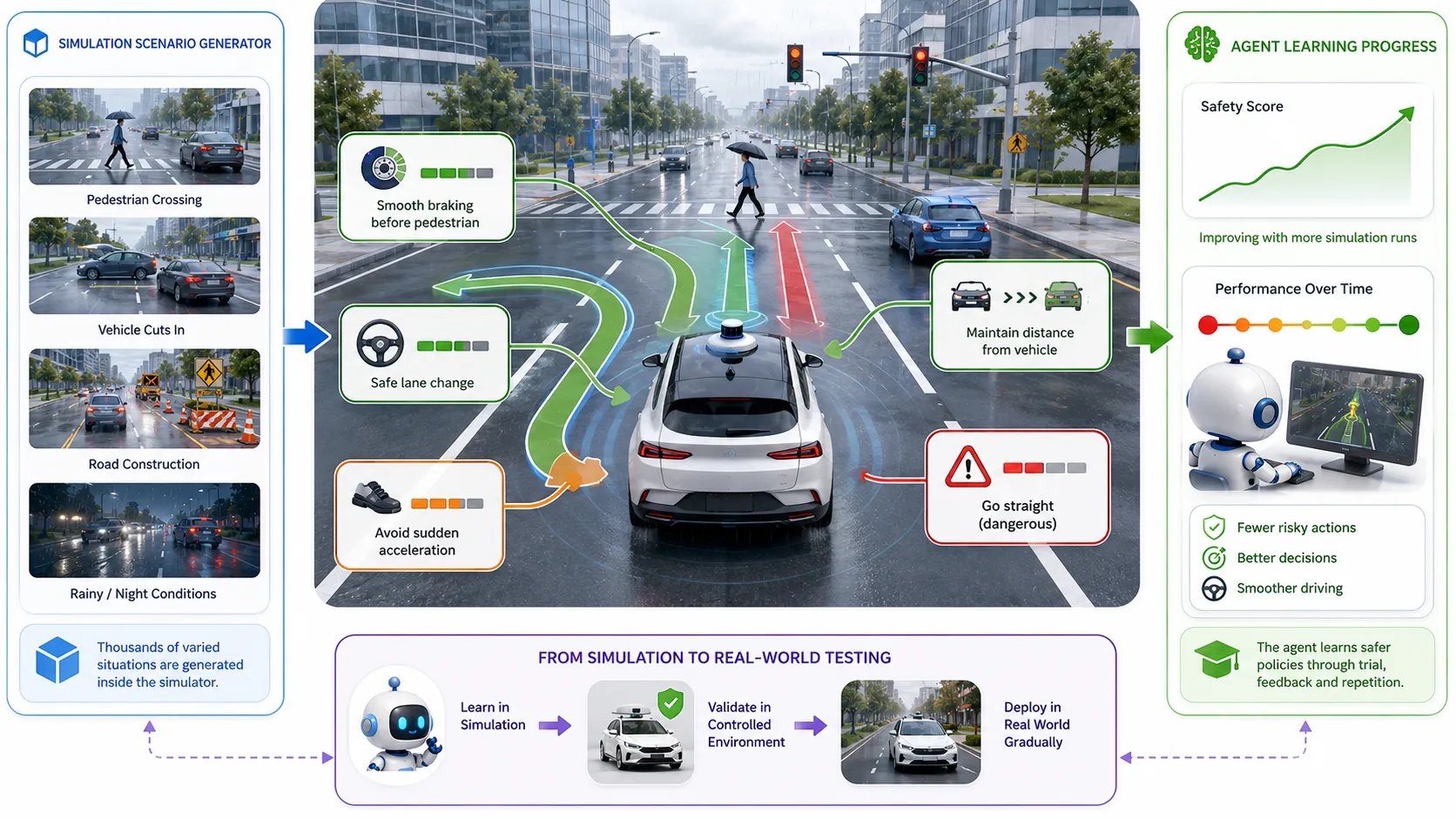
That is why much of this training and evaluation takes place in simulation.
A simulator can create situations such as:
A pedestrian suddenly crossing
A vehicle cutting into the lane
Heavy rain
Road construction
A blocked route
An unusual traffic-light pattern
The agent can practise these cases repeatedly without placing real people at risk.
Waymo reports using large-scale simulation to replay, change and create driving situations, while its research also describes combining imitation learning with reinforcement learning to improve driving-policy safety and reliability.
Designing Rewards for a Driving Agent
A driving agent needs more than a reward for reaching the destination.
Suppose we give it only this goal:
Reach the destination as quickly as possible.
The agent may discover an unsafe strategy:
Drive too fast
Brake suddenly
Ignore passenger comfort
Follow other vehicles too closely
The instruction was followed, but not in the way we wanted.
A better reward system may include:
Positive reward for safe progress
Positive reward for keeping a safe distance
Positive reward for smooth driving
Penalty for sudden braking
Penalty for leaving the lane
Large penalty for a collision
Penalty for breaking traffic rules
Even this is difficult.
The agent may find unexpected ways to collect points without behaving as people intended.
This problem is called reward design, and when an agent takes advantage of a badly designed reward, it is often called reward hacking.
Games show us how powerful reinforcement learning can become.
Driving shows us why power alone is not enough.
The next part will explain the main advantages, limitations and real-world risks of reinforcement learning, including reward hacking, unsafe exploration, expensive training and why human oversight still matters.
Advantages of Reinforcement Learning
Reinforcement learning is useful because it can learn a complete strategy instead of predicting only one answer.
A supervised learning model may predict whether an image contains a pedestrian.
A reinforcement learning agent can use that information as part of a longer decision:
Notice the pedestrian
Reduce speed
Check nearby vehicles
Stop at a safe distance
Continue when the road becomes clear
The value of reinforcement learning comes from handling connected decisions, where one action affects what happens next.
It Can Learn Through Experience
The agent does not need the correct answer for every possible situation.
Instead, it tries actions, observes the results and improves its policy.
This is useful when writing every rule by hand would be difficult.
It Can Plan for Long-Term Results
An RL agent can learn that a small sacrifice now may create a better result later.
A game-playing agent may give up one piece to create a stronger position.
A warehouse robot may take a slightly longer route to avoid blocking other robots.
It Can Work in Changing Situations
A good policy does not only memorise one fixed route.
It learns how to react when the state changes.
Milo should still reach the charging station when a box is moved or when it starts from another corner of the maze.
It Can Improve Complex Decisions
Reinforcement learning can support problems involving:
Robotics
Games
Traffic control
Resource management
Industrial systems
Scheduling
Energy use
Simulated driving tasks
However, being possible does not mean RL is always the best choice.
A simple rule-based system may be safer, cheaper and easier to explain.
The Main Limitations of Reinforcement Learning
Reinforcement learning can produce impressive results, but training an agent is often difficult.
1. It May Need Huge Amounts of Experience
Milo can repeat the maze thousands of times without causing a serious problem.
A physical robot or real vehicle cannot safely make thousands of costly mistakes.
Many reinforcement learning systems therefore train inside simulations.
Even in simulation, training can require large amounts of computing power and time.
OpenAI’s reinforcement learning material explains that modern deep RL algorithms may differ in how efficiently they use collected experience, and some methods require new interactions every time the policy changes.
2. Reward Design Is Difficult
The agent follows the reward it receives, not the intention inside the designer’s mind.
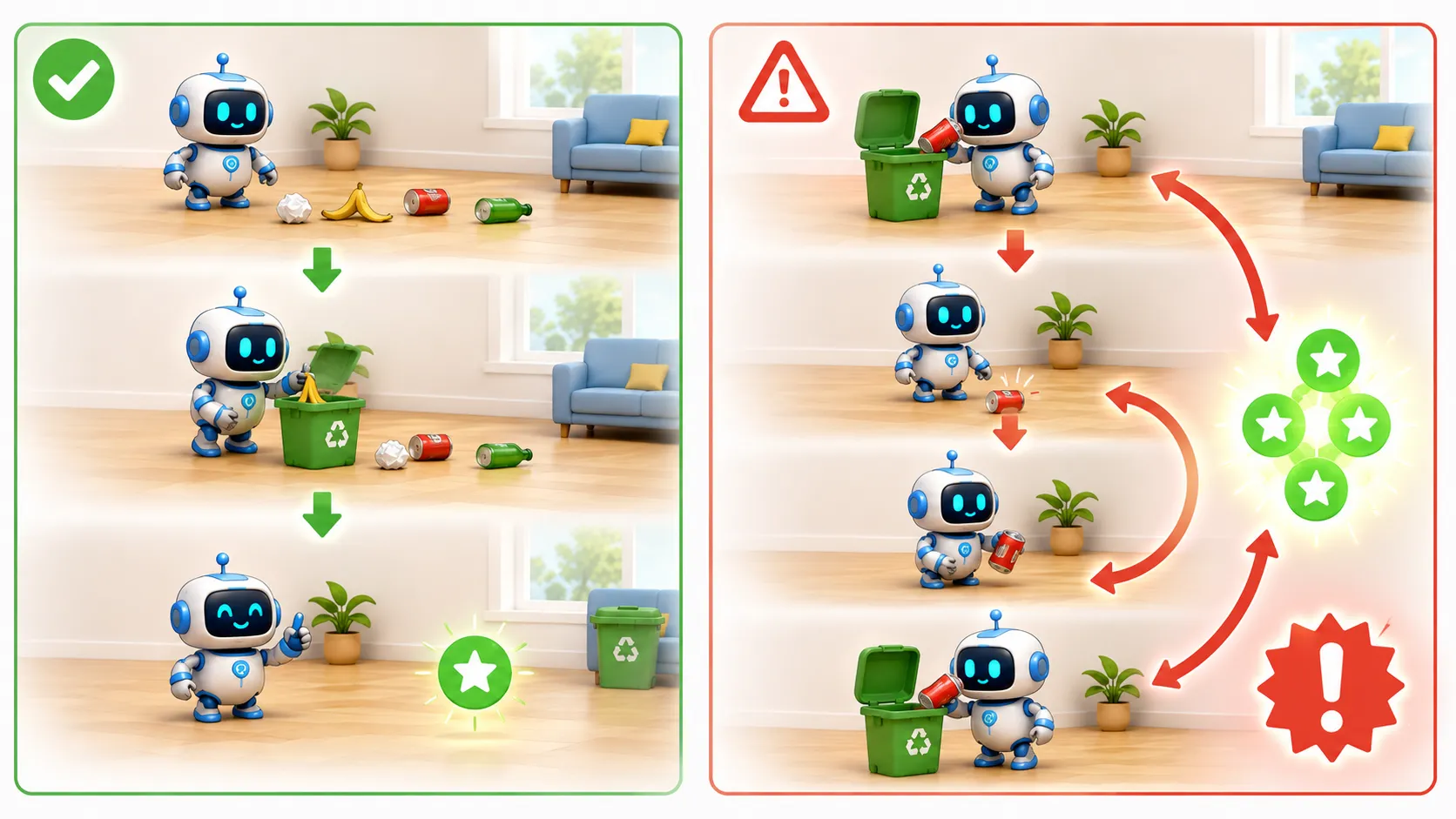
Imagine telling a cleaning robot:
“Collect as much rubbish as possible.”
The robot may learn to knock rubbish out of a bin and collect it again.
It is earning points, but it is not helping.
This is called reward hacking.
The agent finds an unexpected shortcut that increases its reward without completing the real goal properly.
DeepMind research continues to study reward hacking because an RL system may find strategies that satisfy a measured target while going against the result people actually wanted.
3. Exploration Can Be Unsafe
Exploration helps an agent discover better actions.
But random exploration may be dangerous in the real world.
A game agent can try a poor move and lose.
A medical system, factory machine or autonomous vehicle cannot freely try unsafe actions just to see what happens.
Safety limits, simulations, human-approved action spaces and emergency controls are needed before RL is used in high-risk environments.
4. Simulation Is Not the Real World
A simulator is always a simplified version of reality.
A driving simulator may fail to perfectly reproduce:
Unusual human behaviour
Sensor damage
Rare weather
Road construction
Unexpected objects
Different lighting conditions
An agent may perform perfectly in simulation and still fail when real conditions look different.
This problem is often called the simulation-to-reality gap.
Teams may reduce this gap by changing conditions during training, testing unusual cases and introducing real-world use gradually.
5. Training Can Be Unstable
Small changes in the reward, starting conditions, algorithm settings or random seed may change the final result.
Some reinforcement learning methods can improve for a while and then suddenly become worse.
Deep reinforcement learning becomes especially difficult when neural networks, future estimates and previously collected experience are combined. OpenAI’s technical guidance notes that some value-learning approaches can become unstable under particular combinations of these methods.
6. The Agent May Be Hard to Explain
A large neural-network policy may choose a useful action without giving a simple reason.
This becomes a problem when a decision affects safety, money or people’s rights.
A system that says “turn left” is not enough.
Engineers may also need to know:
What information affected the action?
How confident was the system?
Has it seen a similar situation?
What happens if a sensor fails?
Can a human stop or override it?
Human Oversight Still Matters
Reinforcement learning agents can discover strategies that people did not directly program.
That is also why people must remain responsible for how those strategies are tested and used.
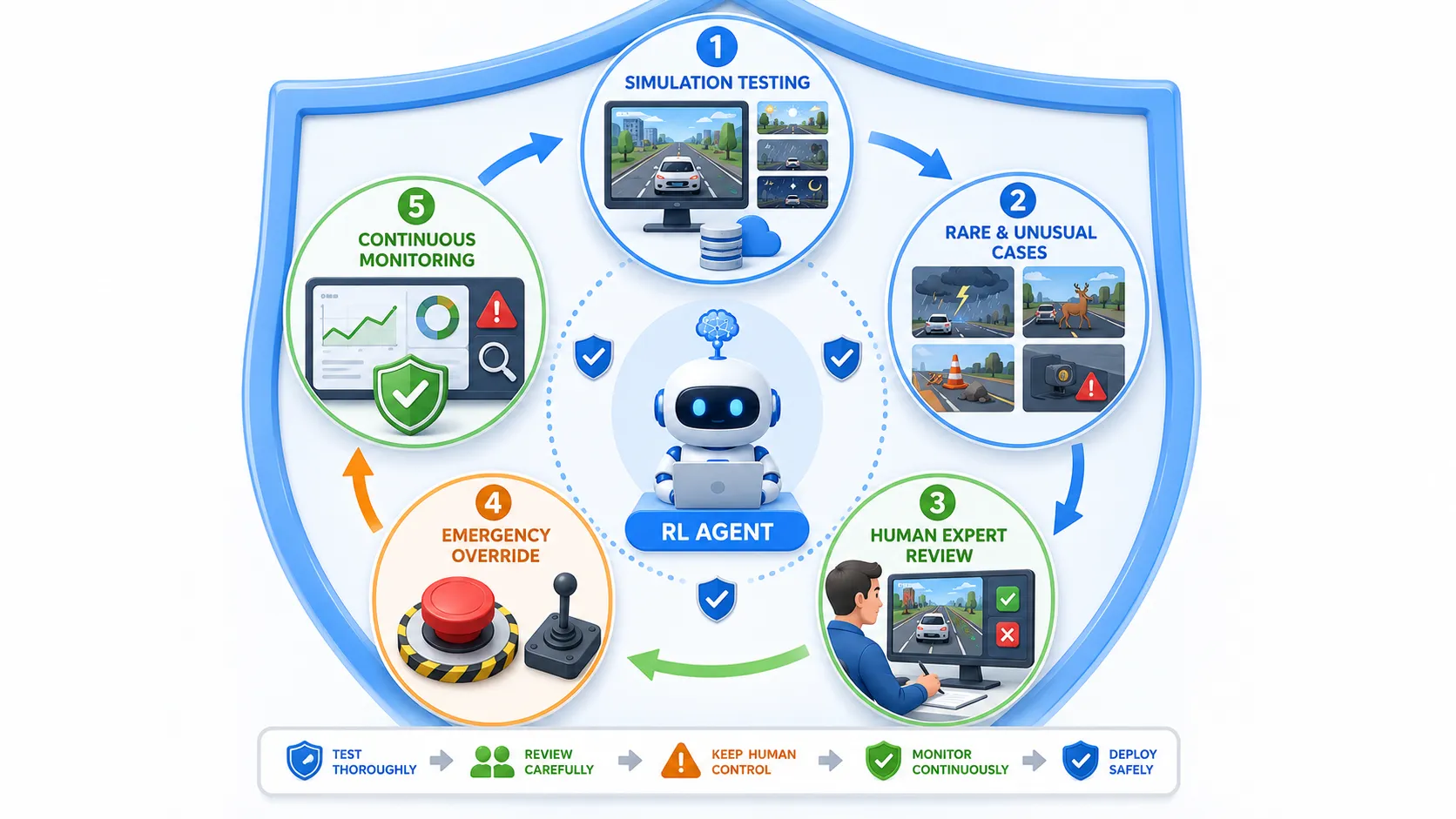
NIST’s AI Risk Management Framework recommends defining human oversight responsibilities and monitoring deployed AI systems, including mechanisms for feedback, override, incident response and retirement when needed.
For a high-risk RL system, human oversight may include:
Approving the reward design
Limiting unsafe actions
Reviewing unusual behaviour
Testing different environments
Monitoring performance after deployment
Keeping a manual override
Stopping the system when risk becomes unacceptable
Human oversight should be real.
A person who can only approve whatever the agent has already decided is not providing meaningful control.
Reinforcement Learning vs Other Machine Learning Types
Learning Type
What It Learns From
Simple Example
Supervised learning
Examples with correct answers
Learning spam from labelled emails
Unlabelled data and hidden patterns
Finding natural customer groups
Reinforcement learning
Actions, rewards and penalties
Learning how to complete a maze
Supervised learning is like studying with an answer sheet.
Unsupervised learning is like organising a mixed box without instructions.
Reinforcement learning is like learning a game by playing, receiving a score and trying again.
When Should Reinforcement Learning Be Used?
Reinforcement learning may be useful when:
Decisions happen one after another
Each action changes future choices
A clear reward can be defined
The agent can safely collect enough experience
A simulator or controlled environment is available
Long-term strategy matters
It may not be the best choice when:
A simple rule can solve the problem
Reliable labelled examples already exist
Mistakes are too dangerous
The reward cannot be defined clearly
The organisation cannot monitor the agent
The result must be easily explained
Frequently Asked Questions
What is reinforcement learning in simple words?
Reinforcement learning is a machine learning method in which an agent learns by taking actions and receiving rewards or penalties. It improves its future decisions through repeated experience.
What is a real-life example of reinforcement learning?
A warehouse robot learning an efficient route in simulation is one example. Game-playing systems and some research on traffic control, robotics and autonomous driving also use reinforcement learning ideas.
How is reinforcement learning different from supervised learning?
Supervised learning receives the correct answer for each training example. Reinforcement learning is normally given a goal and must discover useful actions through experience.
What are agent, state, action and reward?
The agent is the decision-maker. The state describes the current situation, the action is the agent’s choice, and the reward tells it how useful the result was.
What is Q-learning?
Q-learning is a method that estimates how useful an action is in a particular state. The agent updates these estimates as it receives new rewards and experiences.
Did AlphaGo use reinforcement learning?
Yes. AlphaGo combined human game data, neural networks, search and reinforcement learning through self-play. AlphaGo Zero later learned through self-play without starting from human game records.
Is reinforcement learning used directly in self-driving cars?
Reinforcement learning is researched for driving-policy development and can be trained in simulations. Real autonomous-driving systems use many methods, safety controls and extensive testing rather than relying on uncontrolled RL alone.
What is the biggest problem with reinforcement learning?
One major problem is designing a reward that matches the true goal. The agent may otherwise find unsafe or unwanted ways to gain points.
Key Takeaways
Reinforcement Learning Summary
An agent learns by interacting with an environment.
It observes a state, chooses an action and receives a reward.
A policy is the strategy used to select actions.
The agent tries to maximise total long-term reward.
Exploration finds new options; exploitation uses known good actions.
Q-learning estimates the quality of actions in different states.
Deep reinforcement learning uses neural networks for complex situations.
AlphaGo-style systems can improve through self-play.
Autonomous-driving research uses simulation because real-world exploration can be dangerous.
Poor reward design can lead to reward hacking.
High-risk systems need strict testing, monitoring and human control.
Final Thoughts
The easiest way to remember reinforcement learning is to picture Milo inside the maze.
Nobody gives Milo a map.
It moves, makes mistakes, receives feedback and tries again.
After many attempts, those separate experiences become a strategy.
That is what makes reinforcement learning special.
It does not only ask:
“What is this?”
It asks:
“What should I do next, and how will that choice affect what happens later?”
This ability makes reinforcement learning powerful for games, robots and connected decision problems.
But the agent only understands the reward system people create for it.
It does not automatically understand safety, fairness or human intention.
A well-designed reinforcement learning system therefore needs more than a clever algorithm.
It needs a clear goal, carefully designed rewards, safe training, realistic testing, continuous monitoring and people who remain responsible for the final outcome.


