


Introduction
You unlock your phone with your face, ask a chatbot to explain a difficult idea, receive a film recommendation, and avoid traffic because a navigation app predicts a faster route. These experiences look unrelated, yet all of them depend on artificial intelligence finding patterns in information and using those patterns to produce a useful result.
That is the simplest explanation of how AI works. An AI system receives an input, processes it through a mathematical model, and returns an output such as a prediction, classification, recommendation, generated response, or action.
The reality becomes more interesting when we look inside that process. Where does the model get its knowledge? What does it actually learn during training? Why can it recognise a dog, write computer code, detect suspicious payments, or generate an image? Why can the same system also misunderstand a basic question or confidently present false information?
AI is often described as a machine that “thinks”. That description is convenient, but it can also be misleading. Most current AI systems do not think, understand, remember, or experience the world as humans do. They convert information into numbers, calculate statistical relationships, and generate outputs based on patterns learned from data.
This guide explains the complete journey from raw information to a working AI product. You will learn how machine learning models are trained, how neural networks improve through feedback, how large language models generate text, how image generators turn noise into pictures, and why human oversight remains essential.

What Is Artificial Intelligence?
Artificial intelligence is the field of creating computer systems that perform tasks commonly associated with human intelligence. These tasks include recognising objects, understanding language, learning from examples, finding patterns, generating content, making predictions, and selecting actions.
A traditional program follows instructions written directly by a developer. An AI system may instead learn a useful relationship from examples, allowing it to handle situations that would be difficult to describe through thousands of fixed rules.
AI in simple language
Imagine teaching a child to recognise dogs. You show large dogs, small dogs, puppies, different breeds, and dogs viewed from several angles. The child gradually notices recurring features and can recognise a dog that was not included in the original examples.
Many modern AI systems learn in a broadly similar way. They study data, identify statistical patterns, and apply those patterns to new information. The system does not receive a human-style understanding of “dogness”; it learns numerical relationships useful for distinguishing dog images from other images.
AI in technical language
An AI model is a mathematical function that maps an input to an output. A spam filter maps an email to a spam probability. A vision system maps pixels to object labels. A recommendation engine maps user and product data to a ranked list.
The model contains adjustable numerical values called parameters. During training, an algorithm changes these parameters so the model performs better on examples. After training, the model uses them to process new inputs during inference
AI, machine learning, deep learning, and generative AI
Artificial intelligence
The broad field of intelligent computer systems
Example :- A route planner choosing a faster journey
Machine learning
AI that learns patterns from data
Example :- A model predicting demand
Deep learning
Machine learning using multi-layer neural networks
Example :- Object recognition in photographs
Generative AI
AI that creates text, images, audio, video, or code
Example :- A tool drafting an email
Large language model
A generative model designed for language
Example :- A conversational assista
A useful memory aid is: AI is the umbrella, machine learning is a major branch, deep learning is a branch of machine learning, and many generative systems use deep learning.
These differences matter because each approach has different strengths, costs, risks, and evaluation needs. A simple decision tree may suit an explainable business rule, while a deep network may be better for complex images.
AI literacy also changes how you use the technology. Understanding training data helps you ask whether examples were representative and lawful. Understanding inference helps you distinguish knowledge stored in a model from information retrieved from a live source. Understanding token prediction makes you less likely to confuse confident writing with verified truth.
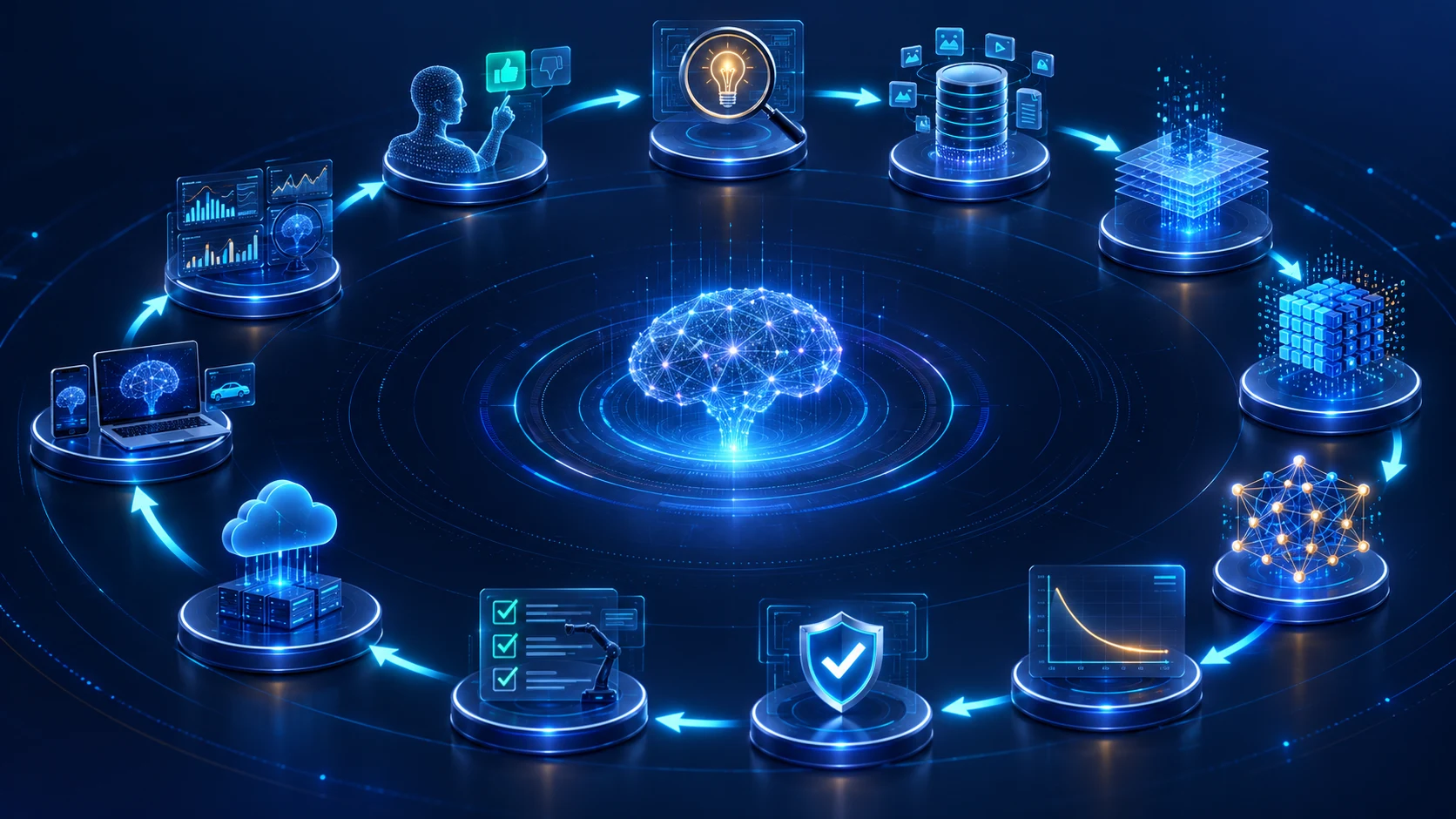
How AI Works: The Complete Step-by-Step Process
An AI product is rarely just a model. It is a system containing an objective, data pipeline, model, training process, evaluation framework, software interface, security controls, monitoring, and responsible people.
1.Define the problem
A useful project starts with a specific goal. “Use AI in customer service” is vague. “Identify support requests that require urgent human attention” is measurable
The team should define the input, expected output, intended user, success metric, cost of mistakes, and situations requiring escalation. The correct metric depends on consequences: missing a serious medical condition is not equivalent to recommending an uninteresting film.
2.Collect relevant data
Data is the experience from which most machine-learning systems learn. It may include text, images, audio, video, sensor readings, transactions, medical measurements, or customer interactions.
More data is not automatically better. Relevant, representative, legally obtained, and well-documented data is more valuable than a huge collection filled with errors, duplication, missing groups, or inappropriate personal information.
3. Clean, label, and organise the data
Real-world data may contain duplicates, missing values, inconsistent formats, incorrect labels, or outdated examples. Preparation commonly includes cleaning records, standardising formats, protecting sensitive information, labelling examples, checking representation, and separating data into training, validation, and test sets.
In supervised learning, a label is the expected answer. An email may be labelled “spam”, a review “positive”, or an image with the objects it contains. Poor or inconsistent labels teach unreliable lessons
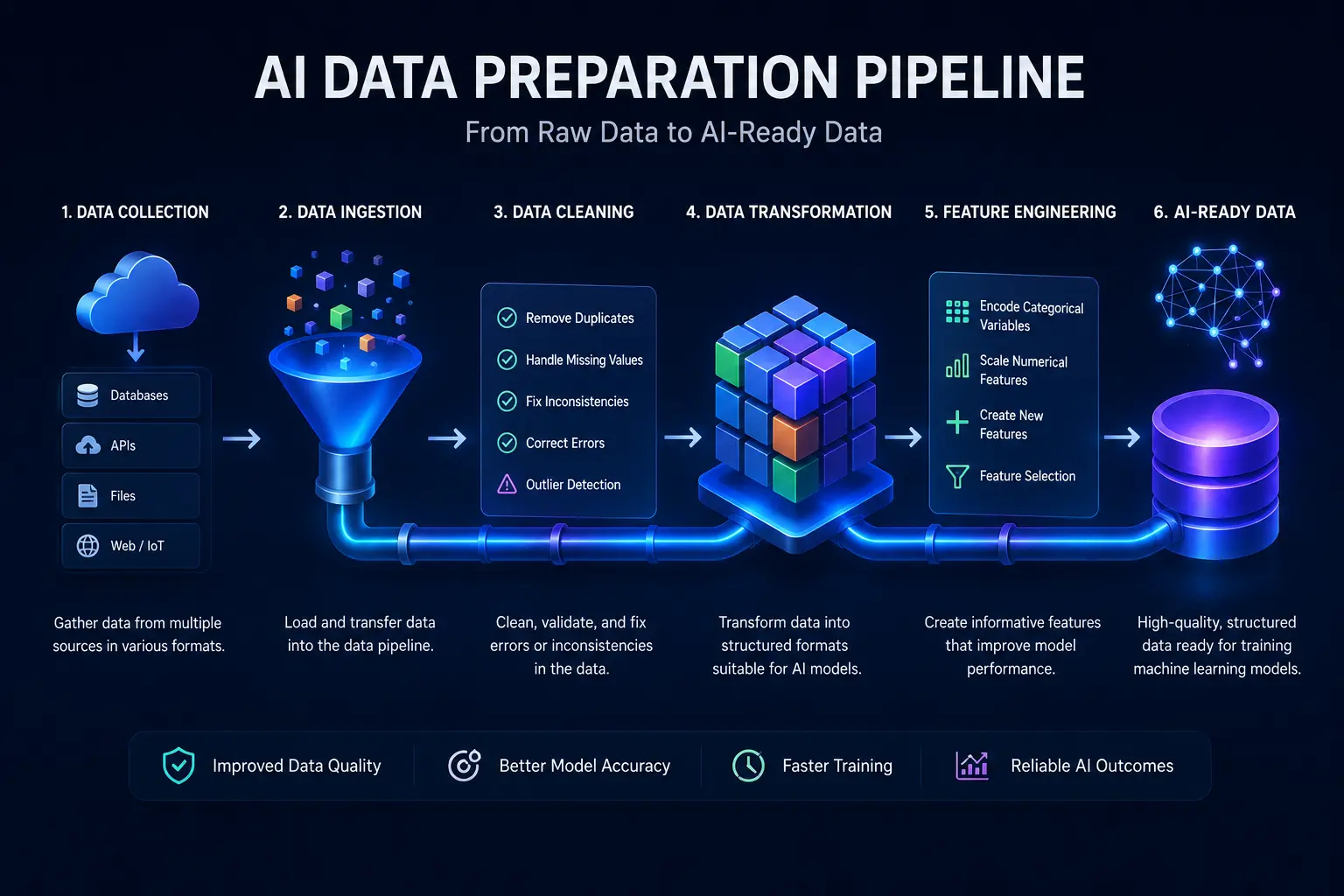
4.Convert information into numbers
Computers calculate with numbers, so AI systems must represent information numerically. Images become pixel values, audio becomes waveform or frequency measurements, and business records become numerical or categorical features.
Text is divided into tokens, which may be words, word fragments, punctuation, or symbols. Tokens can be mapped to embeddings—vectors that capture useful relationships between concepts.
5.Choose a model and learning method
The team selects an algorithm based on the problem, data, required accuracy, speed, budget, explainability, and failure risk. Options include regression, decision trees, clustering, neural networks, transformers, and reinforcement-learning systems.
The most complex model is not always best. A simpler model may be faster, cheaper, easier to audit, and sufficiently accurate.
6.Train the mode
Training adjusts the model’s parameters using examples
Send an input through the model
Produce a prediction
Compare it with the expected result
Calculate the error
Adjust parameters
Repeat across many examples
At first, predictions may be poor. Repeated updates strengthen patterns that reduce error. The learned behaviour is usually distributed across many interacting parameter values rather than stored as a readable list of rules.
7.Measure error and optimise
A loss function converts error into a numerical value. An optimiser changes parameters in a direction that tends to reduce that loss.
Many systems use gradient-based optimisation. A simple analogy is walking down a mountain in fog: measure the nearby slope, take a step downhill, and measure again.
8.Validate and test
A useful model must work on data it did not memorise.
Dataset Main purpose
Training set Adjusts model parameters
Validation set Helps tune development choices
Test set Provides an independent final check
Metrics may include accuracy, precision, recall, false-positive rate, error size, ranking quality, fairness, speed, robustness, and cost. The best metric is the one that reflects real-world consequences.
9.Deploy the model
Deployment connects the trained model to a product or workflow. It may run in the cloud, on a company server, inside a phone, camera, factory device, vehicle, or medical system.
The surrounding application collects input, prepares it, calls the model, receives the output, and decides how to present or use it. A strong model can still become a poor product if the interface hides uncertainty or grants excessive permissions.
10.Run inference
Inference is the stage in which a trained model processes new information. Asking a chatbot a question, uploading an image, or requesting a recommendation normally triggers inference.
11.Monitor and improve
Real-world conditions change. Language evolves, fraud tactics adapt, sensors age, and customer behaviour shifts. A model can lose quality when incoming data no longer resembles its training data.
Teams monitor errors, drift, bias, security events, response time, operating cost, and user complaints. They may retrain, restrict, replace, or retire the model. AI development is therefore a lifecycle, not a one-time launch.
The Main Ways AI Learns
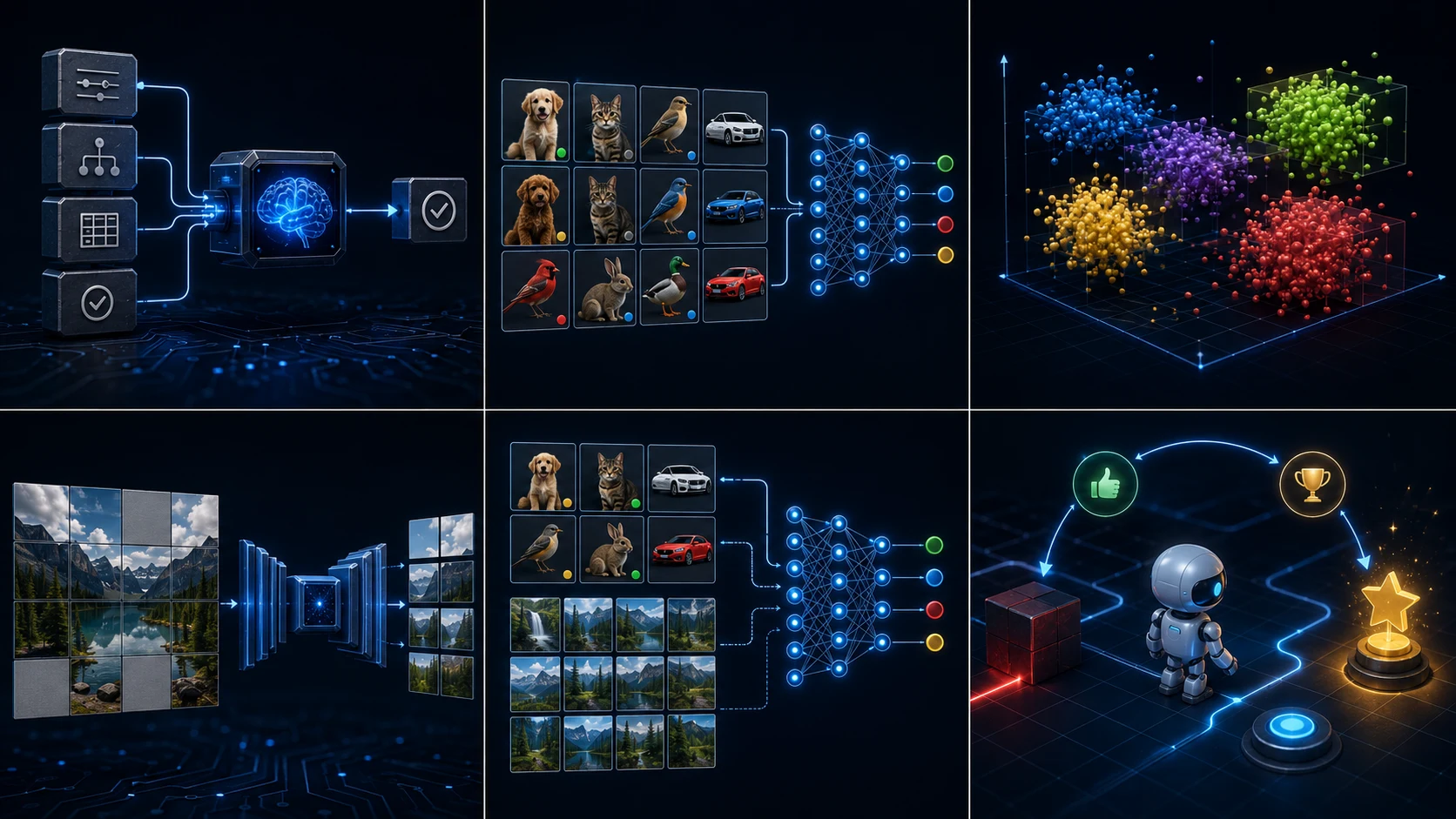
AI systems learn in different ways depending on whether correct answers are available, whether the goal is to discover structure, or whether the system must learn through actions and consequences.
Rule-based systems
Rule-based AI follows human-written instructions. It is predictable and easy to inspect when policies are clear, but difficult to maintain when a problem contains thousands of exceptions.
Supervised learning
Supervised learning uses labelled examples. The model receives an input and the correct output, then learns a relationship that can be applied to new cases. Typical uses include spam classification, price prediction, object recognition, sentiment analysis, and risk scoring.
Unsupervised learning
Unsupervised learning receives data without answer labels and searches for structure. It can group similar customers, organise documents, or identify unusual records. Humans must still decide whether the discovered patterns are meaningful.
Self-supervised and semi-supervised learning
Self-supervised learning creates targets from the data itself. A language model may predict hidden or next tokens, while an image model may reconstruct hidden regions.
Semi-supervised learning combines a smaller labelled dataset with a larger unlabelled one. It is useful when expert labels are expensive, as in medicine or industrial inspection.
Reinforcement learning
In reinforcement learning, an agent takes actions in an environment and receives rewards or penalties. It learns a policy intended to maximise long-term reward. Applications include games, robotics, control systems, and resource allocation.
How Neural Networks Work
Neural networks power image recognition, speech processing, recommendation engines, and large language models. They are loosely inspired by biological neurons, but they are mathematical systems rather than realistic copies of the brain.
Neurons, weights, and layers
An artificial neuron receives numerical inputs, multiplies them by adjustable weights, adds a bias, and applies an activation function. The result is passed to other neurons.
A network usually contains an input layer, one or more hidden layers, and an output layer. Deep learning uses multiple hidden layers to represent complex relationships.
In vision systems, early layers may respond to edges and textures. Later layers combine those signals into shapes and object-related patterns learned from data.
Forward pass and backpropagation
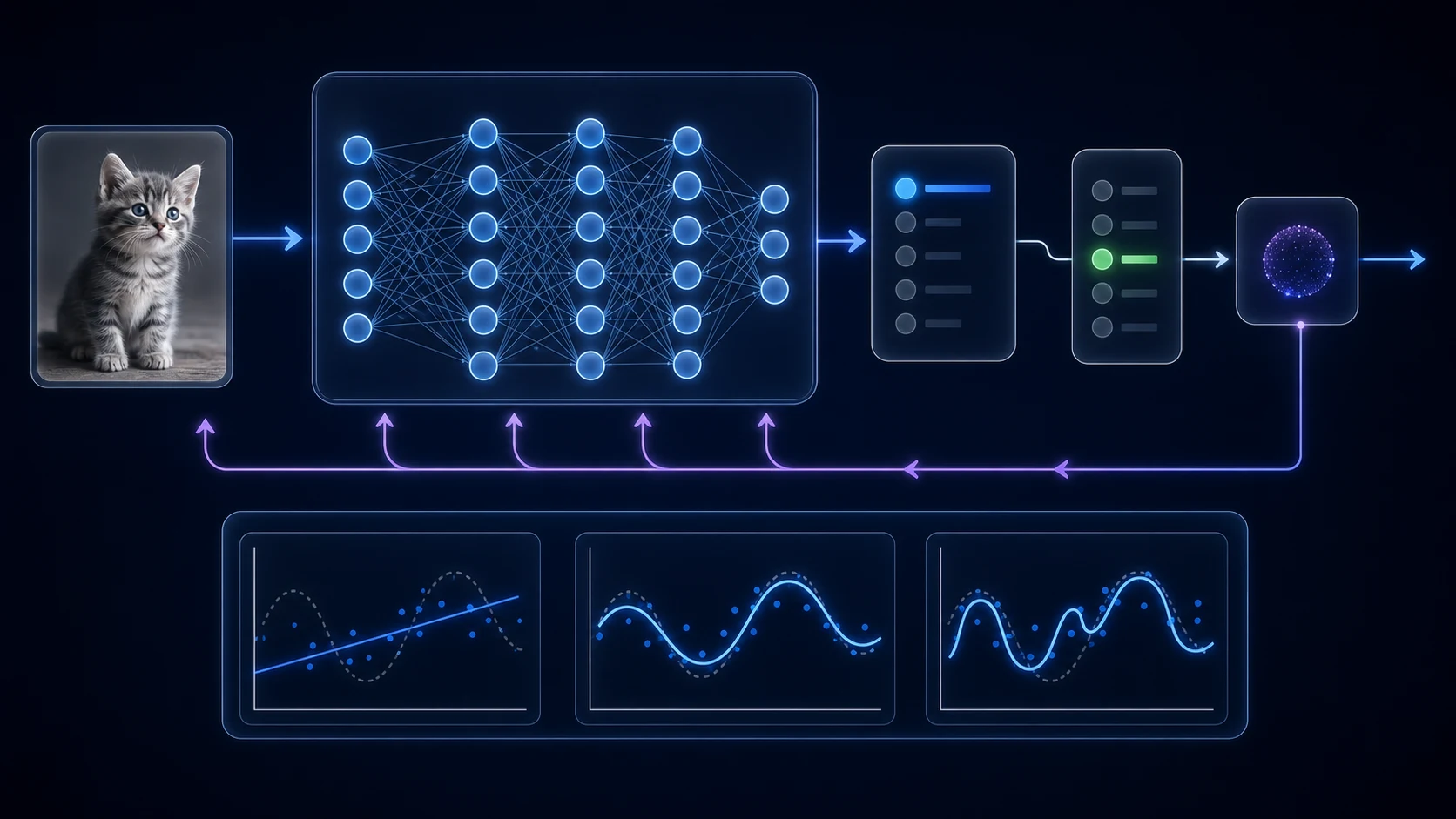
During a forward pass, information moves through the network to produce a prediction. A loss function measures the error.
Backpropagation calculates how parameters contributed to that error, and an optimiser updates the weights. Repeating this process across many examples improves performance.
Epoch: one complete pass through the training data
Batch: a smaller group processed together
Learning rate: the size of each update
Overfitting, underfitting, and generalisation
A model underfits when it fails to capture important patterns. It overfits when it matches training examples too closely and performs poorly on new data.
The goal is generalisation: reliable performance on unseen, real-world examples. Representative datasets, validation, regularisation, and early stopping help reduce overfitting.
How Generative AI Works
Predictive AI usually chooses a category, estimates a value, or ranks options. Generative AI creates content such as text, images, audio, video, code, or structured data.
The output comes from patterns learned during training, the current context, and the generation method. It may appear creative, but it is produced through mathematical operations rather than human imagination.
How large language models generate text
A large language model usually follows a repeating cycle:
Break the prompt into tokens
Convert tokens into numerical vectors
Process relationships across the context
Calculate probabilities for possible next tokens
Select one token
Add it to the context and repeat
At scale, next-token prediction can reproduce complex patterns involving grammar, style, formats, facts, code, translation, and explanations. Fluent language, however, does not guarantee human-like understanding or factual accuracy.
Transformers and attention
Many modern language models use the transformer architecture introduced in the 2017 paper Attention Is All You Need.
Transformers use self-attention to estimate how strongly tokens relate to one another. This helps the model process references, structure, topic relationships, and long-range dependencies. Multiple attention heads can learn different relationships at the same time.
Pretraining and fine-tuning
During pretraining, a foundation model learns broad patterns from a large dataset. Developers can later shape its behaviour through instruction tuning, supervised fine-tuning, preference feedback, reinforcement learning, safety training, domain adaptation, or distillation.
Fine-tuning can improve behaviour for a particular task, but it does not guarantee truthfulness. The system still needs evaluation and reliable sources.
Retrieval-augmented generation
A model’s parameters are not a live database. Retrieval-augmented generation, or RAG, connects a language model to external information.
A RAG system usually retrieves relevant passages from a document store or database, adds them to the model’s context, and generates an answer based on that material. This can improve recency and traceability, but failures still occur when retrieval finds the wrong source or the model misreads it.
Why AI hallucinates
A hallucination is a plausible-sounding but unsupported or false output. Language models generate likely continuations; they do not automatically verify every claim.
Errors are more likely with obscure facts, exact quotations, changing information, missing context, conflicting sources, or false assumptions. Important claims should be checked against authoritative evidence.
How AI image generators work
Many image generators use diffusion models. During training, the model learns how images change as noise is added and how to reverse that process.
During generation, it starts with random noise and repeatedly refines it while following a numerical representation of the prompt. Some systems work in a compressed latent space to reduce computing costs.
Generated images can look realistic while still containing errors in text, anatomy, object count, spatial relationships, or factual detail.
Multimodal AI, recommendations, and agents
Multimodal AI processes more than one data type, such as text, images, audio, video, and sensor readings.
Recommendation systems estimate what a user may value next from behaviour, item features, context, and business rules. Their result is a probability-based ranking, not proof of preference.
An AI agent combines a model with goals, tools, memory, and a control loop. It can plan steps, call software, observe results, and revise its approach. Greater autonomy requires tighter permissions, audit logs, spending limits, secure tool access, and human approval.

Real-World Applications and Advantages
Learning and career advantages
AI can explain difficult concepts, create practice questions, provide coding assistance, translate material, summarise documents, and help learners explore a topic from several angles.
For careers, the lasting advantage is not memorising one tool. It is understanding how to frame a problem, provide context, evaluate output, protect sensitive data, and redesign a workflow responsibly.
Developers and technical professionals can use AI to accelerate prototyping, testing, documentation, debugging, and code review. They still need to verify security, architecture, correctness, licensing, and maintainability.
Business and productivity advantages
Businesses use AI for forecasting, document extraction, customer support, personalisation, quality inspection, anomaly detection, research assistance, and routine analysis.
AI can process more information than a person can review manually and can apply the same procedure repeatedly at scale. It can also provide faster first drafts and help employees spend more time on judgement, relationships, and complex exceptions.
The benefit must be measured against the full cost. A tool that produces fast but unreliable work may create more review effort than it saves. Successful projects connect AI to a clear operational problem and track the result.
Long-term value
Specific model names and interfaces will change. The underlying concepts—data, training, validation, inference, grounding, monitoring, permissions, and human accountability—will remain valuable.
Someone who understands these foundations can adapt to new AI products more easily and recognise when impressive marketing does not match the actual system.
Limitations, Risks, and Common Mistakes
AI can be highly useful without being universally reliable. Understanding it honestly means examining how it can fail.
Bias and unfair outcomes
Models learn from data shaped by history, sampling choices, institutions, and human judgement. Missing groups, incorrect labels, proxy variables, and past discrimination can produce unequal outcomes.
Removing a sensitive field does not automatically remove bias because other features may reveal similar information. Fairness requires examining data, error rates across relevant groups, deployment context, and the consequences of mistakes.
Privacy, security, and accountability
AI systems may process personal, confidential, copyrighted, or commercially sensitive information. Risks include weak access controls, insecure integrations, prompt injection, data poisoning, malicious files, model theft, and unsafe tool calls.
Complex models can also be difficult to explain. This matters when AI influences healthcare, finance, employment, education, safety, or legal rights. Someone must remain responsible for approval, incident review, appeals, and correction.
Drift, cost, and changing conditions
A model can become less reliable when real-world data changes. Fraud tactics evolve, new products appear, sensors age, and policies are updated. Monitoring, retraining, rollback, and retirement plans are therefore essential.
Large models may also require substantial computing power, cloud spending, energy, and response time. A smaller model or conventional program may solve the problem more efficiently.
Common misconceptions and mistake
Treating AI as magic instead of examining data and objective
Assuming every chatbot searches the live internet
Confusing confident language with verified truth
Expecting a model to update its core knowledge during every conversation
Measuring only average accuracy while ignoring rare harmful failures
Automating a complete decision before testing decision support
Ignoring permissions, interfaces, workflow design, and human responsibility
Sharing private data without checking retention and access policies
Choosing AI because it is fashionable rather than useful
The practical question is not, “Does this look intelligent?” It is, “Has this system been shown to work reliably for this task, with these users, under these conditions?”
Best Practices for Using and Building AI
Responsible AI starts with clear decisions before deployment and continues throughout the system’s lifecycle. NIST’s AI Risk Management Framework treats trustworthiness as a lifecycle concern spanning design, development, use, and evaluation.
For people using AI tools
Give the system enough context to understand the task, but avoid sharing information you are not authorised to disclose. State the desired format, audience, constraints, and success criteria.
Treat the first output as a draft when accuracy matters. Check important facts, calculations, sources, dates, names, and technical instructions. Ask the model to state assumptions and identify uncertainty, but do not assume self-reported confidence is perfectly calibrated.
Use stronger verification for decisions involving health, money, safety, contracts, employment, or rights. AI can support qualified judgement; it should not silently replace responsibility.
For teams building AI systems
A practical development checklist includes:-
Define the user, task, output, success metric, and cost of failure
Document data sources, permissions, quality, and known gaps
Compare the model with a simple baseline or existing process
Test realistic, unusual, adversarial, and high-impact cases
Evaluate performance across relevant groups and environments
Limit access to data, tools, payments, publishing, and destructive actions
Add logging, monitoring, rollback, and incident-response procedures
Design the system to abstain, ask for clarification, or escalate
Keep a responsible human or team accountable for outcomes
Reassess the system when data, policies, or user behaviour change
Human-in-the-loop design
Human review works only when reviewers have the information, authority, training, and time needed to challenge a result. A person who approves every output automatically is not meaningful oversight.
The interface should show relevant evidence, uncertainty, source material, and alternative options. It should make correction and escalation easier than blindly accepting the model’s answer.
Choose the least risky useful level of automation
AI can assist a decision, recommend an action, perform an action after approval, or act autonomously within limits. These are different levels of risk.
A sensible approach is to begin with decision support, measure performance, and expand autonomy only when evidence justifies it. High-impact or irreversible actions should require stronger controls.
Expert Opinion
The general expert consensus is that AI should be evaluated as a complete sociotechnical system rather than judged by a single accuracy score or impressive demonstration.
Machine learning guidance emphasises training, validation, testing, and generalisation to unseen data. Risk-management frameworks add that trustworthy AI also depends on safety, reliability, security, privacy, transparency, explainability, fairness, and accountability.
This broader view matters because a model can perform well on a benchmark and still be unsuitable for a particular organisation, population, workflow, or environment. Real-world success depends on data quality, product design, human behaviour, operational controls, and continuing evaluation.
The 2026 Stanford AI Index describes a widening gap between rapidly advancing capabilities and the systems needed to govern, evaluate, and understand them. That does not mean AI should be rejected. It means deployment discipline must develop alongside capability
My Observation
The most useful way to understand AI is to replace the vague question “Does it really think?” with operational questions.
What data shaped it? What objective was optimised? How was it tested? What context is available during inference? Which errors matter most? Who reviews the output? What permissions does the system have? What happens when conditions change?
These questions apply to almost every system, from a small fraud classifier to a large multimodal assistant.
Modern AI products are also becoming combinations of components. The visible model may sit beside retrieval, databases, memory, software tools, safety filters, identity systems, workflow rules, and human approval. A modest model with reliable data and a strong workflow can outperform a more powerful model connected to weak sources and excessive permissions.
Where AI is heading next
Future systems are likely to become more multimodal, specialised, and integrated into everyday software. More models will run on phones, laptops, cameras, vehicles, and industrial equipment, reducing latency and creating new privacy options.
Smaller domain-specific models may handle routine work, while larger models are reserved for difficult requests. Agents will make permission design more important because a system that can send messages, change accounts, or make payments creates more risk than one that only drafts text.
Grounding will also improve as models consult current databases, verified documents, calculators, search tools, and specialised services. Evaluation will need to move beyond static benchmarks toward fresh data, realistic workflows, edge cases, and measurable business or social impact.
The long-term pattern is not simply “bigger models”. It is better combinations of models, data, tools, interfaces, and human responsibility. Systems will earn trust by making evidence, uncertainty, permissions, and limitations easier to understand.
Frequently Asked Questions
How does AI work in simple terms?
AI learns patterns from data and applies them to new inputs. Training adjusts the model; inference uses it to make a prediction, recommendation, generation, or action.
Does AI think like a human?
Most current AI does not think like a human. It performs mathematical operations on numerical representations and can imitate communication without human consciousness or lived experience.
What is an AI model?
An AI model is a learned mathematical system that transforms an input into an output. Its parameters contain numerical patterns acquired during training.
What is the difference between training and inference?
Training changes model parameters using examples. Inference uses the trained model to process new information.
How does AI learn from mistakes?
The system compares its output with a desired result, calculates loss, and adjusts parameters. Neural networks commonly use backpropagation and an optimiser.
Why does AI need so much data?
Diverse examples help a model generalise. Relevance, quality, permission, and representation often matter more than raw volume.
Where does generative AI get its information?
It may use training patterns, the current prompt, retrieved documents, connected databases, live search, or software tools. The sources depend on the product.
Why does AI make things up?
A language model predicts plausible sequences rather than verifying every statement. When reliable context is missing, it may generate a confident but false answer.
Can AI learn without labelled data?
Yes. Unsupervised and self-supervised methods use unlabelled data, although humans still choose objectives, data access, evaluation, and deployment rules.
Is AI always more accurate than humans?
No. Performance depends on the task, data, environment, and comparison group. AI can excel at narrow tasks and fail on situations that appear simple.
Will AI replace jobs?
AI will automate some tasks and change many workflows. The effect will vary because jobs combine technical, social, legal, physical, and judgement-based responsibilities.
Is AI dangerous?
AI can cause harm when it is inaccurate, biased, insecure, overly autonomous, poorly monitored, or deliberately misused. Risk depends on capability, permissions, context, and consequences.
How can beginners use AI responsibly?
Protect sensitive information, give clear instructions, verify important outputs, understand the tool’s sources, and keep human judgement for consequential decisions.
Key Take aways
AI works by converting information into numbers, learning patterns, and applying those patterns to new inputs
The full AI lifecycle includes problem definition, data preparation, training, validation, testing, deployment, inference, and monitoring.
Machine learning can be supervised, unsupervised, self-supervised, semi-supervised, or reinforcement-based.
Neural networks learn by adjusting weights and biases to reduce prediction error.
Large language models process tokens, use transformer-based attention, and generate likely token sequences.
Generative AI can create useful content but may hallucinate, reproduce bias, or mishandle sensitive information.
Retrieval, tools, and human review can improve reliability, but they do not guarantee correctness.
AI should be judged for a defined task and environment, not by fluency or impressive demonstrations alone.
Human accountability remains essential when AI affects health, money, safety, rights, or important decisions.
Conclusion
AI is not magic and it is not one universal machine mind. It is a family of technologies that turn data into predictions, classifications, recommendations, generated content, and actions.
The basic process is understandable: define a task, collect suitable data, convert it into numerical representations, train a model to recognise patterns, test whether those patterns generalise, deploy the system, and monitor its behaviour in the real world.
The difficult part lies in the details. Data can be incomplete. Objectives can be poorly chosen. Models can fail outside familiar conditions. Interfaces can hide uncertainty. Fluent answers can be false. Powerful tools can be given more access than they should have.
A mature approach holds two ideas at the same time: AI can be remarkably useful, and AI can be wrong. Use it with evidence, privacy controls, limited permissions, meaningful evaluation, monitoring, and accountable human judgement.
Once you understand these foundations, how AI works becomes far less mysterious. The same core ideas appear beneath chatbots, recommendation systems, image generators, fraud detection, medical tools, robotics, and AI agents.
Next Recommended Reading
What Is Artificial Intelligence?
Artificial Intelligence vs Machine Learning
What Is Machine Learning?
How Neural Networks Work
What Is Generative AI?
How Large Language Models Work
What Is Retrieval-Augmented Generation?
Why AI Hallucinates
Responsible AI for Beginners


