


Imagine you are preparing for an exam. On the first day, you solve ten practice questions and remember every answer. You score 100% when the same questions appear again.
But then the real exam gives you slightly different questions, and your score suddenly drops.
A neural network can make the same mistake.
It can become so good at its training data that it starts remembering small details, noise, and accidental patterns instead of learning the real idea behind the data. This problem is called overfitting.
The model looks smart during training, but its performance falls when it sees new data.
This is where Batch Normalization and Dropout become useful. They solve different problems, but both can help a deep neural network train more reliably and perform better when it faces data it has never seen before.
Why Do Deep Neural Networks Overfit?
Deep neural networks can contain thousands, millions, or even billions of adjustable parameters. That gives them enough power to learn very complex patterns.
But that power comes with a risk.
The network can also learn patterns that are not actually useful.
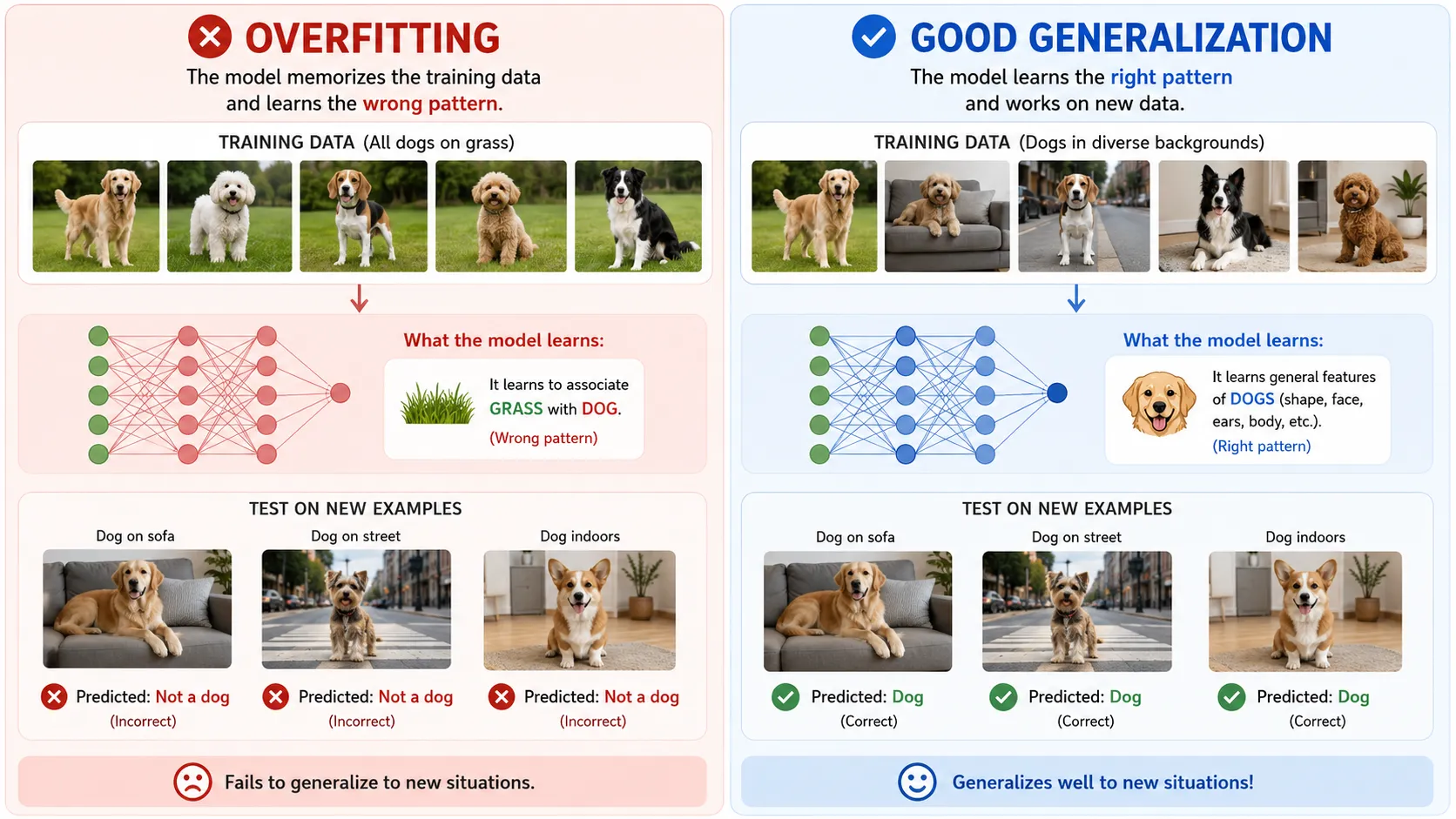
Suppose you are training an image recognition model to separate pictures of dogs and cats.
Most dog photos in your training data happen to have grass in the background. Many cat photos, on the other hand, were taken inside homes.
Instead of properly learning the face, ears, body shape, and other useful features of a dog, the model may start connecting green grass with dogs.
On the training images, the model may perform extremely well.
Now show it a dog sitting on a sofa.
Suddenly, it becomes confused.
The model did not really understand what a dog looks like. It learned a shortcut that happened to work on its training data.
This is exactly the kind of problem we want to avoid.
When training performance is very strong but performance on new or validation data becomes noticeably weaker, overfitting may be happening.
The real goal of machine learning is not to memorize the training dataset.
The goal is to generalize — to learn useful patterns that continue working when completely new examples arrive.
What Is Regularization in Deep Learning?
Regularization is a group of methods used to reduce the chance that a machine learning model becomes too dependent on its training data.
Think about our student example again.
One student memorizes the exact wording of 100 answers.
Another student understands the concepts behind those answers.
If the questions are rewritten, the first student may struggle. The second student can still answer because the idea has been understood.
Regularization tries to push a neural network toward that second type of learning.
Common regularization techniques for Neural Networks include Dropout, L1 and L2 regularization, data augmentation, and early stopping.
Dropout is specifically designed as a regularization technique. Batch Normalization is slightly different.
Batch Normalization is mainly a normalization and optimization technique that makes neural network training easier and more stable. Because mini-batch statistics introduce some noise during training, BatchNorm can sometimes produce a regularizing effect as well.
That difference is important.
You should not think:
“Batch Normalization and Dropout are two names for the same thing.”
They are not.
They can affect some similar problems, but they work in very different ways.
What Is Batch Normalization?
Batch Normalization, usually called BatchNorm or simply BN, is a technique that normalizes intermediate activations inside a neural network during training.
That definition may sound complicated.
The basic idea is much easier.
Imagine five people checking their weight using five badly calibrated weighing machines.
One machine consistently gives values that are too high.
Another gives values that are too low.
A third machine keeps changing its scale.
Comparing those readings becomes difficult because the numbers are not behaving consistently.
Something similar can happen inside a deep neural network.
As earlier layers learn and update their weights, the values being passed toward later layers can change.
The later layers are therefore trying to learn while the values coming into them are also moving around.
Batch Normalization helps keep those intermediate values on a more controlled scale.
How Does Batch Normalization Work?
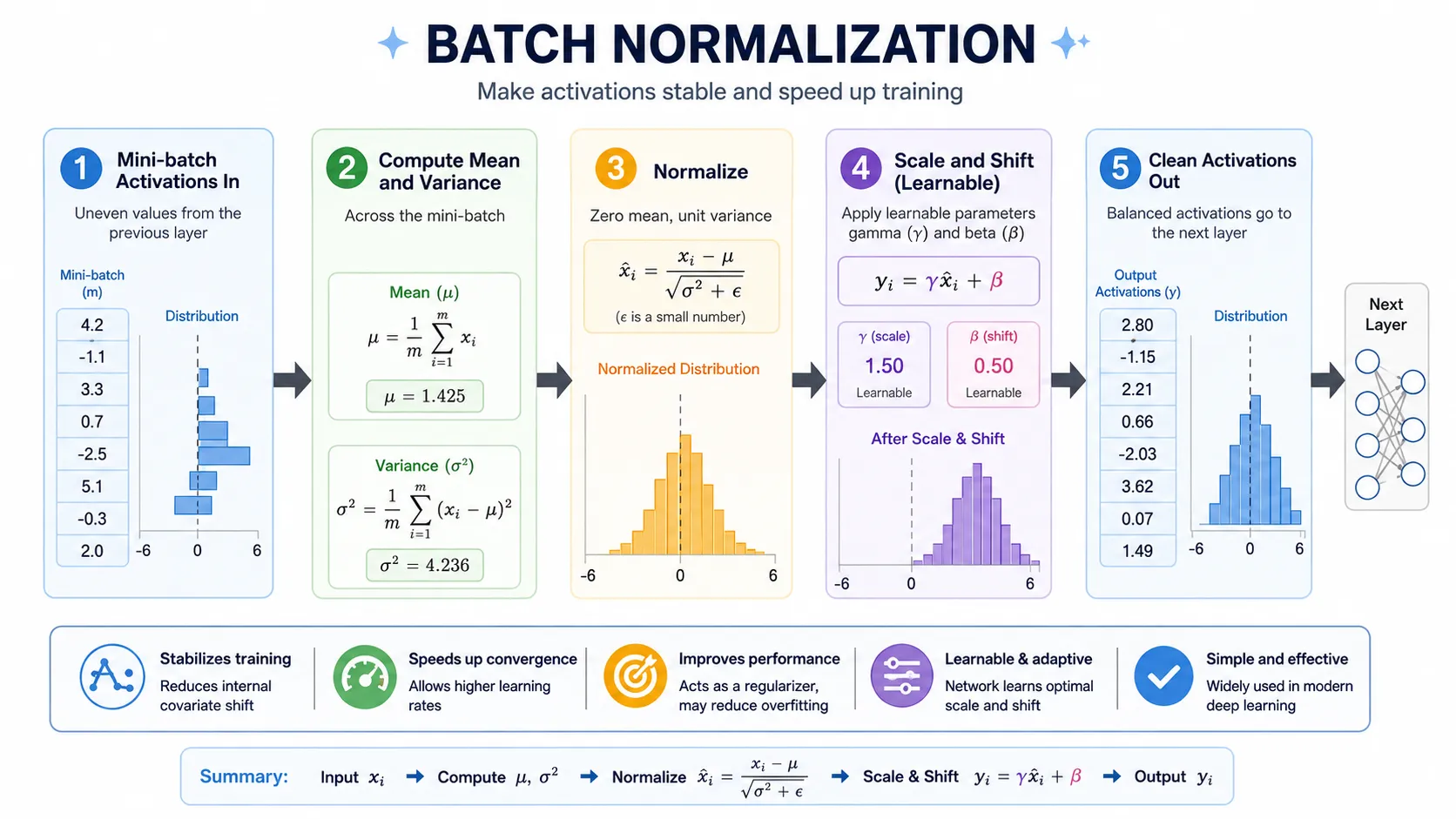
During training, Batch Normalization looks at the activations from a mini-batch and performs a few simple operations.
First, it calculates the mean of the values in the mini-batch.
Next, it calculates their variance, which tells us how spread out those values are.
The values are then normalized using that mean and variance.
But Batch Normalization does not stop there.
It also introduces two learnable parameters usually called gamma and beta.
Gamma allows the network to change the scale of the normalized values.
Beta allows it to shift those values.
So, in simple language, Batch Normalization does something like this:
Normalize the activations first, then allow the neural network to learn the most useful scale and position.
This final part is important.
BatchNorm is not forcing every layer to permanently produce exactly the same type of values. The model still keeps the flexibility needed to learn complicated patterns.
Why Does Batch Normalization Help Neural Network Training?
One major reason developers use Batch Normalization in deep learning is training stability.
Neural networks using BatchNorm can often train faster and can be less sensitive to the way their parameters were initialized. BatchNorm can also make larger learning rates practical in many training setups.
You may come across another explanation called internal covariate shift.
The original Batch Normalization research introduced BatchNorm partly as a way to address changing input distributions inside a network.
Later research showed that the story is more complicated.
One influential study found that Batch Normalization can make the optimization landscape smoother. In simple words, the path the neural network follows while learning becomes easier to handle, and its gradients can behave more predictably.
You do not need advanced mathematics to remember the practical lesson:
Batch Normalization gives a neural network a more stable environment in which to learn.
It should not be treated as a magic button that automatically removes overfitting.
A Real-Life Example: Product Image Classification
Suppose an online shopping company is building an AI model that classifies product images into shoes, watches, bags, and sunglasses.
During the early stages of training, one hidden layer might normally produce activation values mostly between -2 and 3.
After several weight updates, those values might suddenly become much larger or more spread out.
The next layer now has to learn while the scale of its incoming values is changing.
With Batch Normalization, the activations inside each mini-batch are normalized before the learned scaling and shifting are applied.
This can make optimization easier and reduce unstable changes during training.
But there is still another problem.
Even with stable activations, the network may begin relying too heavily on particular neurons or specific combinations of features.
That is where Dropout enters the story.
What Is Dropout in Deep Learning?
Imagine a football team where the same two star players are responsible for almost every goal.
The team may keep winning as long as those players are available. But if one of them cannot play, the whole system suddenly becomes weak.
A better team would train every player to contribute.
This is very close to the idea behind Dropout in neural networks.
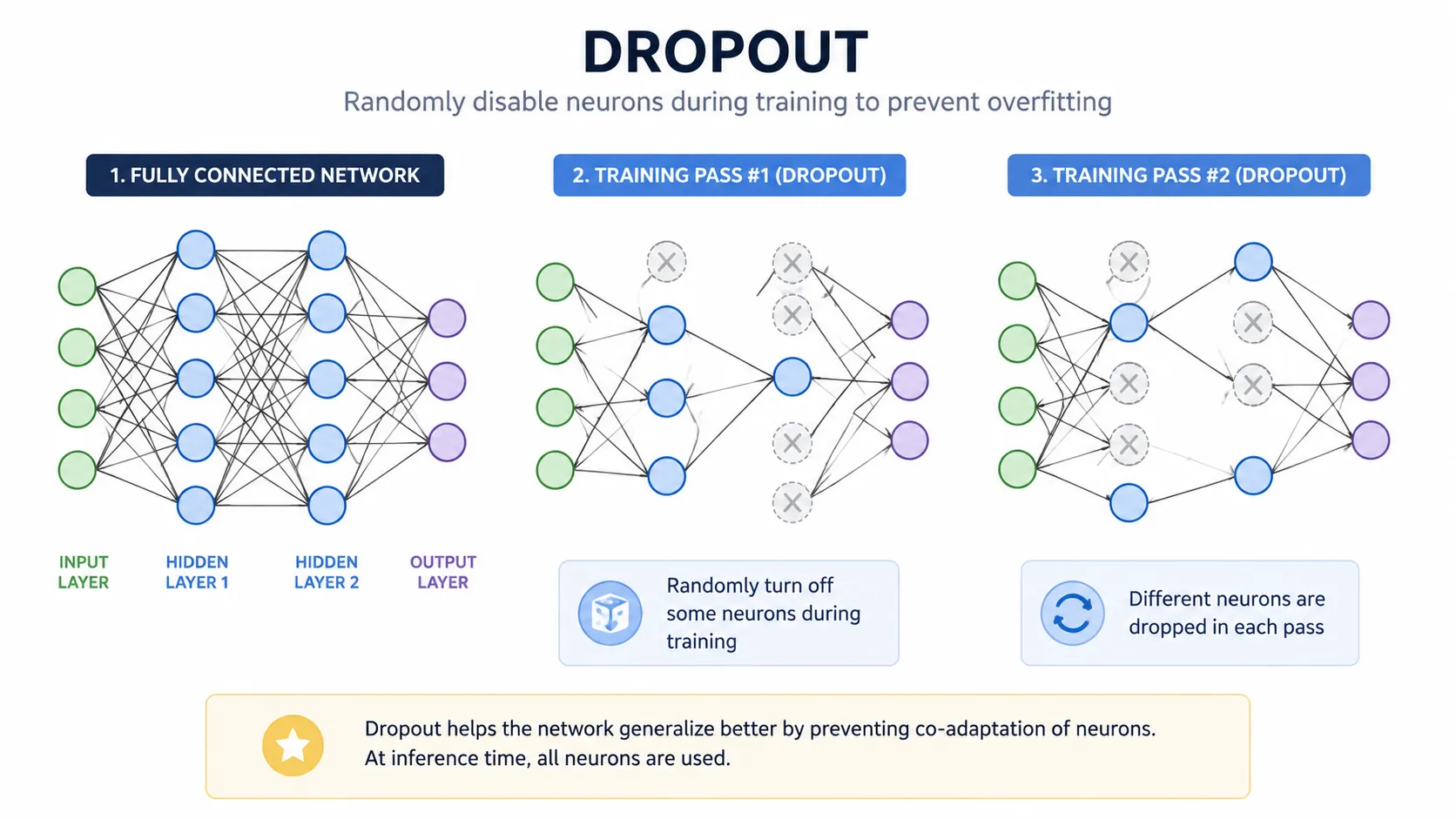
During training, Dropout randomly turns off some neurons for a short time. Those neurons do not take part in that particular forward pass.
On the next training step, a different group of neurons may be turned off.
Because the network cannot depend on exactly the same neurons every time, other neurons are forced to learn useful patterns too.
That is why Dropout regularization can help reduce overfitting.
How Does Dropout Work?
Suppose a hidden layer contains 100 neurons.
If we apply Dropout with a dropout rate of 0.5, roughly half of those neurons are randomly ignored during each training step.
This does not mean the same 50 neurons are permanently removed.
The selection changes again and again.
During one mini-batch, neurons 2, 7, 11, and many others may be dropped.
During another mini-batch, those neurons may return while a different group is dropped.
The network therefore keeps seeing slightly different internal structures while learning.
Think about it like studying with different classmates every day.
If you always depend on one friend to explain every difficult topic, you may never learn those topics yourself.
But if that friend is sometimes unavailable, you have to understand the subject independently.
Dropout creates a similar pressure inside a neural network.
It encourages neurons to become less dependent on one specific path through the model.
What Does Dropout Rate Mean?
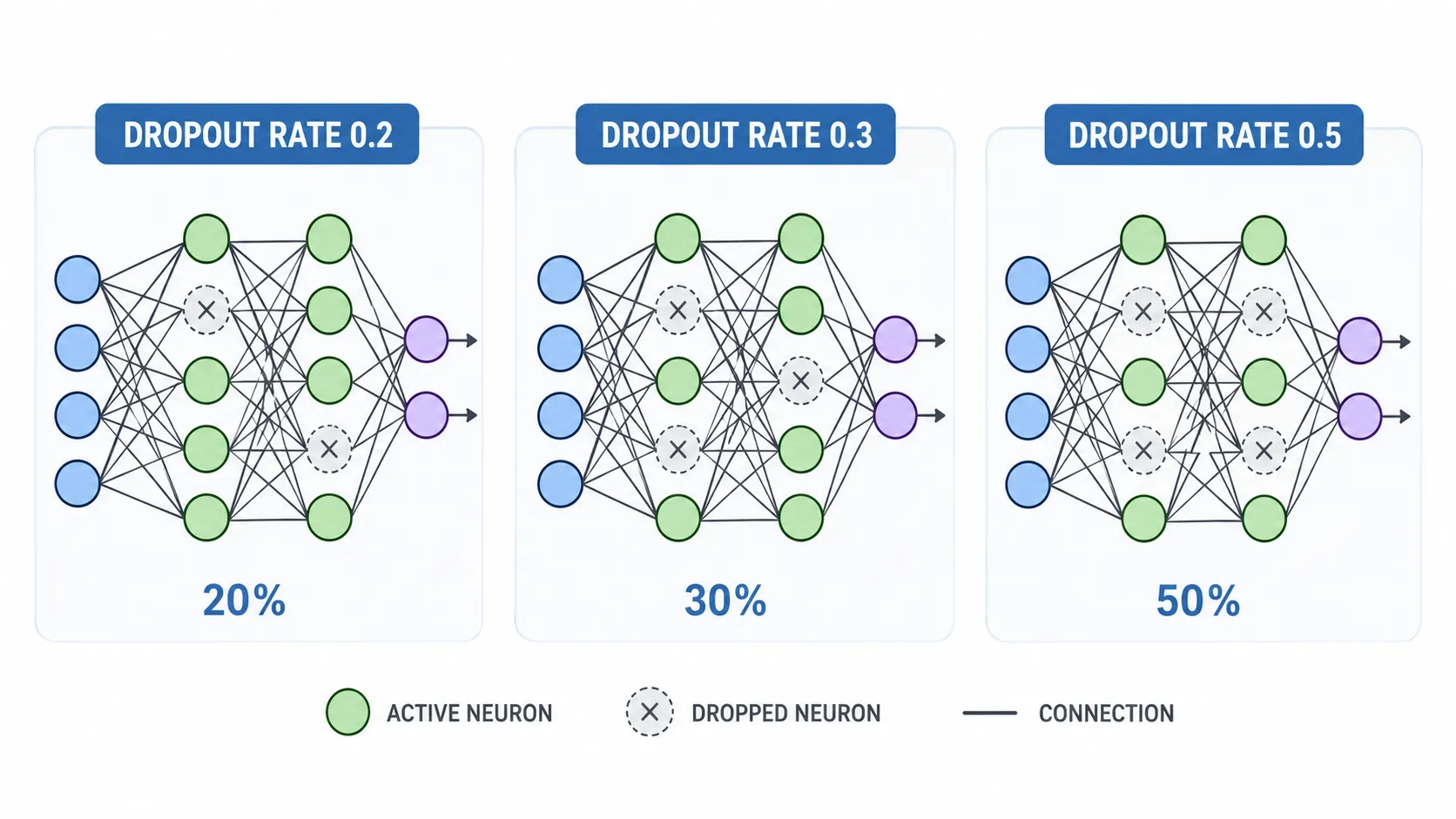
The dropout rate tells us what fraction of units should be randomly dropped during training.
For example:
A dropout rate of 0.2 means around 20% of units are dropped.
A dropout rate of 0.3 means around 30% are dropped.
A dropout rate of 0.5 means around half are dropped.
A larger dropout rate does not automatically mean better regularization.
If you remove too many units, the network may struggle to learn enough information.
If the rate is too small, it may not provide much regularization.
There is no single perfect dropout rate for every neural network.
The best value depends on the architecture, dataset size, model complexity, and how strongly the model is overfitting.
For many dense neural network layers, values somewhere around 0.2 to 0.5 are commonly explored as starting points.
But the correct value should be selected through validation rather than copied blindly.
Dropout During Training vs Prediction
One of the most important things beginners should understand is that Dropout behaves differently during training and inference.
During training, some units are randomly dropped.
During prediction, Dropout is turned off.
Why?
Because once the model has finished learning, we normally want the full network available when making predictions.
Imagine training a customer churn model.
During training, Dropout may repeatedly disable different hidden units so the model learns more robust patterns.
But when a real customer record enters the system, the model should use its complete learned network to estimate whether that customer may leave.
Modern deep learning libraries automatically handle the necessary scaling so that activation magnitudes remain consistent between training and inference.
This is why frameworks such as TensorFlow and PyTorch have separate training and evaluation behavior for layers like Dropout and Batch Normalization.
For developers, this distinction matters.
If a model accidentally remains in training mode during evaluation, Dropout may continue randomly removing units, which can make predictions unstable.
How Does Dropout Prevent Overfitting?
To understand how Dropout prevents overfitting, imagine a neural network learning to detect cars in images.
One neuron may become very good at detecting wheels.
Another may focus on headlights.
Another may recognize windows.
If the model becomes too dependent on one particular feature, such as wheels, it may struggle when that feature is hidden, blurry, or shown from an unusual angle.
Dropout randomly removes some internal signals during training.
As a result, the network cannot always depend on the wheel-detecting neuron.
It may also have to learn from the shape of the car, headlights, windows, body structure, and other features.
The model is encouraged to build several useful paths toward the correct prediction.
That can improve generalization, meaning the model has a better chance of performing well on data it has never seen before.
This is one reason Dropout became one of the most well-known regularization techniques for neural networks.
Batch Normalization vs Dropout: What Is the Difference?
At first glance, Batch Normalization and Dropout may seem similar because both can affect how well a deep neural network generalizes.
But their primary jobs are different.
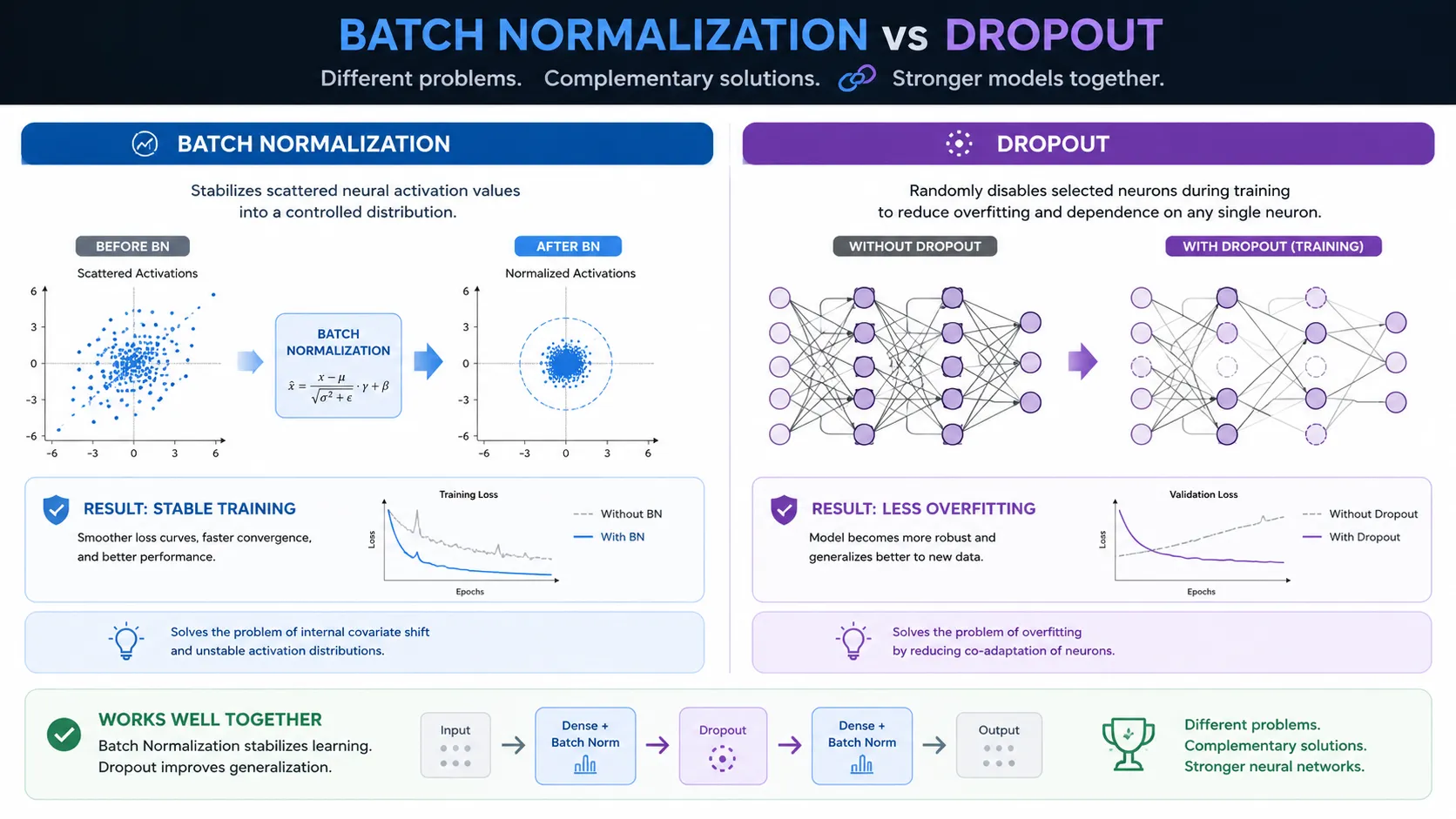
Batch Normalization mainly helps make optimization and training more stable by normalizing intermediate activations and then applying learned scale and shift parameters.
Dropout is mainly a regularization method designed to reduce overfitting by randomly dropping units during training.
A simple way to remember the difference is:
Batch Normalization helps control how information flows through training.
Dropout prevents the network from becoming too dependent on particular neurons.
They are not direct replacements for each other.
Can Batch Normalization and Dropout Be Used Together?
Yes, Batch Normalization and Dropout can be used together, but that does not mean every neural network needs both.
Imagine you are training a model with several dense layers.
BatchNorm may help the optimization process stay stable.
Dropout may then be added where overfitting is clearly visible.
This combination can work well in some architectures.
However, adding more regularization is not automatically better.
If Batch Normalization, Dropout, strong data augmentation, weight decay, and other techniques are all applied aggressively at the same time, the model may become too restricted and start underfitting.
That means it cannot learn the training data properly in the first place.
The best approach is to look at the actual problem your model is showing.
If training is unstable, examine optimization, learning rate, initialization, normalization, and related factors.
If training accuracy keeps increasing while validation performance gets worse, investigate overfitting and consider techniques such as Dropout, data augmentation, weight decay, or early stopping.
A Real-World Scenario: Detecting Fraudulent Transactions
Suppose a bank trains a deep learning model to identify suspicious transactions.
The model sees features such as transaction amount, purchase timing, device behavior, location patterns, and previous activity.
If the network memorizes unusual details from the training dataset, it may look extremely accurate during development but fail when new fraud patterns appear.
Dropout can make it harder for the model to depend on only a small set of hidden features.
At the same time, normalization can help the network train more consistently.
The goal is not simply to achieve the highest training accuracy.
The real goal is to build a model that continues making useful predictions when completely new transactions arrive.
And that leads to the most practical question:
Where should Batch Normalization and Dropout actually be placed inside a neural network, and how should you decide when to use them?
Where Should You Use Batch Normalization in a Neural Network?
Knowing what Batch Normalization does is useful, but the next question is more practical:
Where should Batch Normalization be placed?
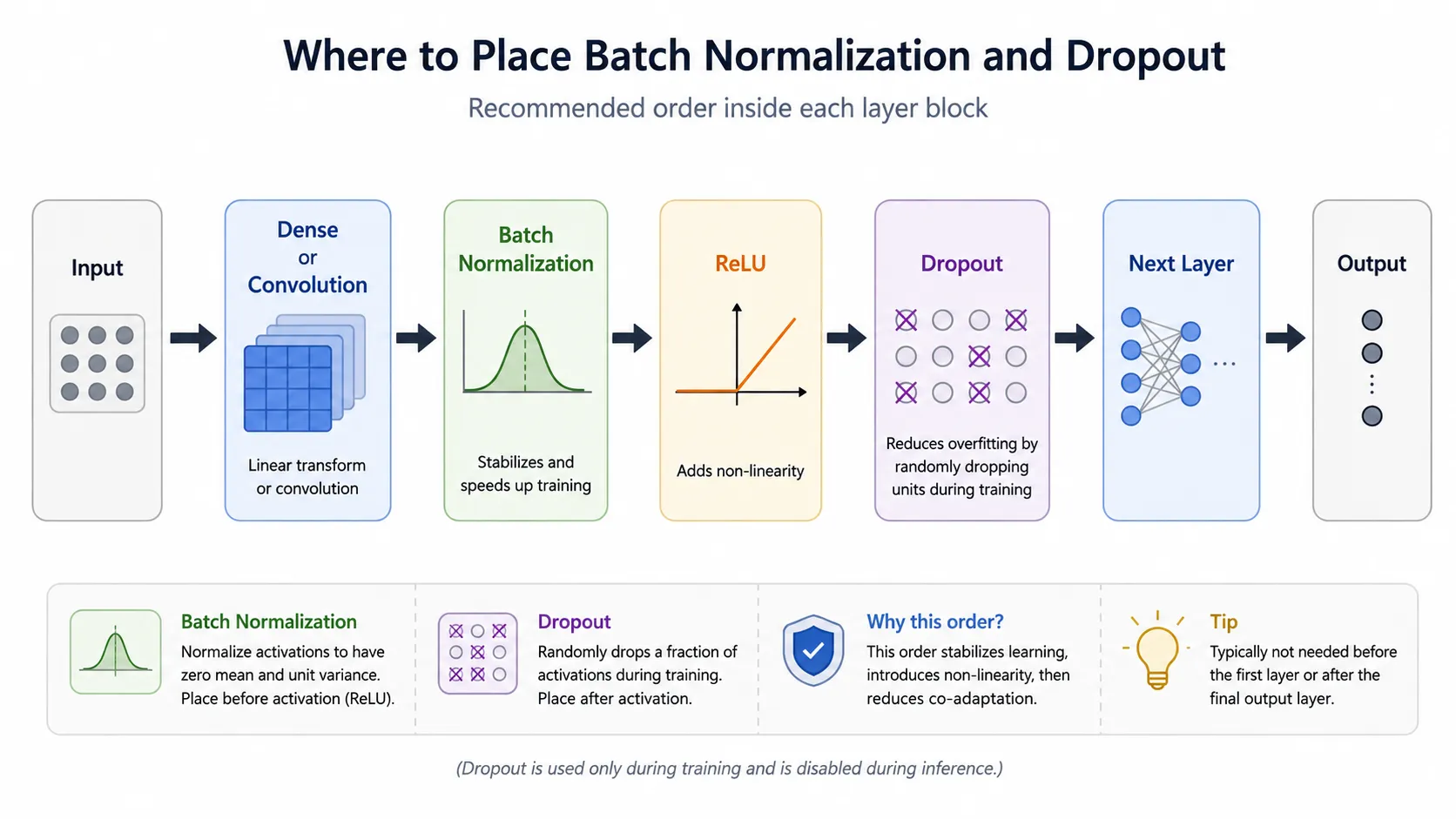
A common pattern in many neural networks is:
Layer → Batch Normalization → Activation
For example, a dense or convolution layer produces values, BatchNorm normalizes those values, and then an activation function such as ReLU is applied.
You may also see architectures that place Batch Normalization after the activation function. Both patterns exist, and the best choice can depend on the architecture.
For beginners, the important lesson is not to treat the placement as a fixed universal rule.
Follow the design used by the architecture you are implementing and validate its performance on your own data.
Batch Normalization is especially common in deep convolutional networks because it can help training remain stable across many layers.
Where Should You Add Dropout?
Dropout is usually added to parts of the network where overfitting is a real concern.
Suppose you have a simple network:
Input layer
Dense layer with 256 neurons
Dense layer with 128 neurons
Output layer
If training accuracy becomes very high while validation accuracy stays much lower, you might introduce Dropout after one or more hidden layers.
The structure could conceptually look like this:
Dense → ReLU → Dropout → Dense → ReLU → Dropout → Output
However, you should not automatically put Dropout after every layer.
More Dropout does not mean a better model.
Too much Dropout can remove so much information during training that the network struggles to learn useful patterns.
The real question should always be:
Is my model actually overfitting?
If the answer is no, adding aggressive Dropout may create a new problem instead of solving one.
How Do You Know If Your Neural Network Is Overfitting?
Imagine that you are monitoring training and validation performance.
Your training accuracy keeps improving:
90%.
94%.
97%.
99%.
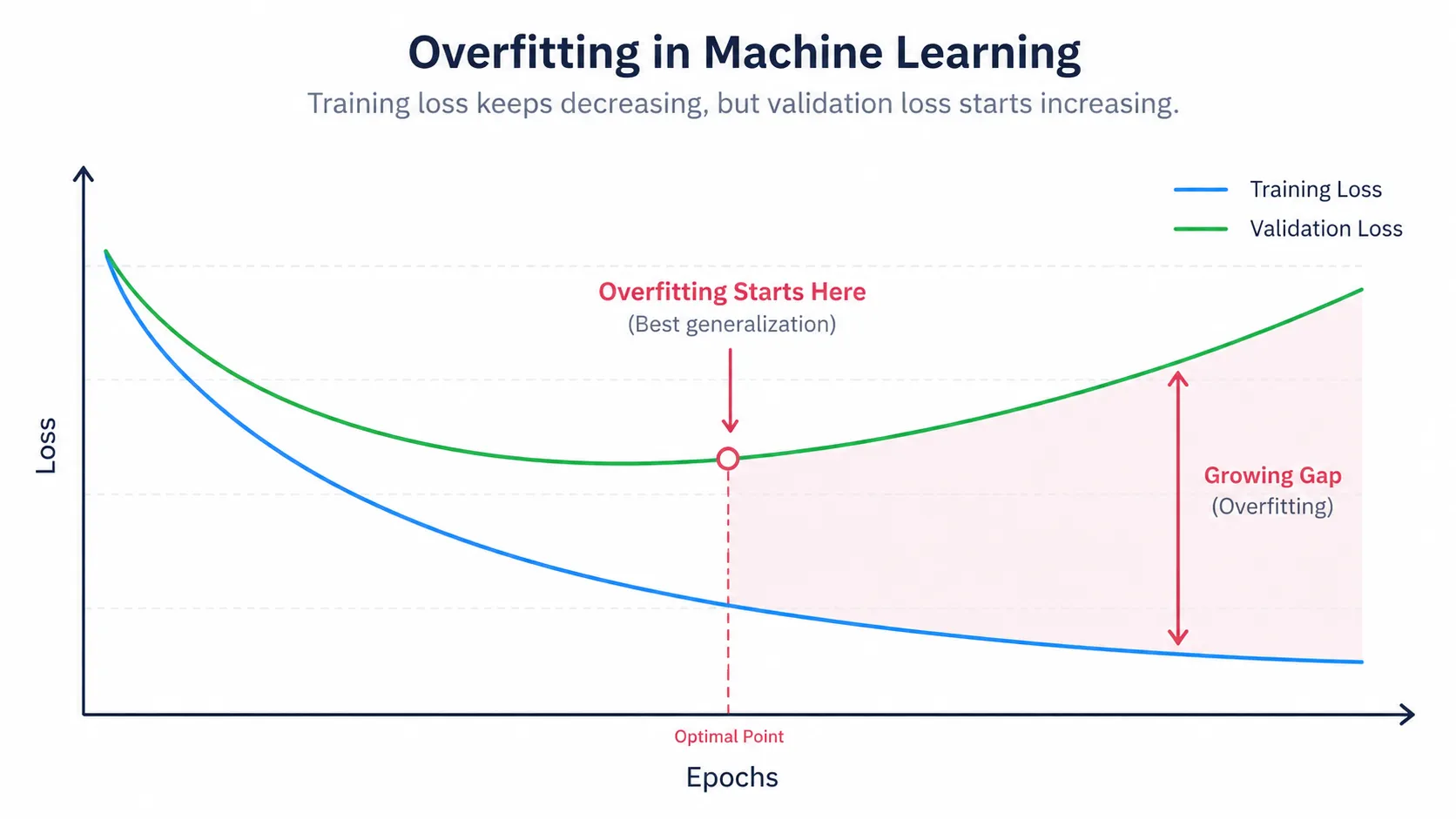
But validation accuracy reaches 88% and then starts falling.
At the same time, training loss keeps decreasing while validation loss begins increasing.
That gap is an important warning sign.
Your network may be learning the training examples too closely instead of learning patterns that generalize.
When this happens, do not immediately assume that Dropout is the only solution.
You should also check:
whether the training dataset is large enough,
whether your model is unnecessarily complex,
whether your train and validation data come from similar distributions,
whether data augmentation could help,
whether weight decay is appropriate,
and whether early stopping should be used.
Preventing overfitting in neural networks is normally a combination of good data, suitable model capacity, careful validation, and appropriate regularization.
Dropout is one tool inside that larger strategy.
Common Batch Normalization and Dropout Mistakes
Using Dropout Everywhere
One of the easiest beginner mistakes is adding Dropout to almost every layer because it is known to prevent overfitting.
That can make the network too difficult to train.
Start with a clear reason for adding it.
If your model generalizes well without Dropout, you may not need it.
Choosing a Very High Dropout Rate
Suppose you use a dropout rate of 0.8.
That means a very large fraction of units are being removed during each training pass.
In some special architectures this could make sense, but blindly using such a high value can destroy useful information.
Start conservatively and tune the value using validation performance.
Treating BatchNorm as an Overfitting Cure
Batch Normalization may sometimes have a regularizing effect, but that is not its primary purpose.
Its main practical value is connected to improving the behavior of neural network optimization and making training more stable.
If your model has serious overfitting, you should not simply add BatchNorm and assume the problem is solved.
Forgetting Training and Evaluation Modes
Batch Normalization and Dropout behave differently during training and inference.
Dropout randomly removes units during training but is disabled for normal inference.
BatchNorm uses batch statistics during training, while inference normally relies on statistics accumulated during training.
Most frameworks manage this correctly when you switch the model into evaluation or inference mode.
But if you forget that step, results can become inconsistent.
This is particularly important when working directly with frameworks such as PyTorch.
Batch Normalization and Dropout in a Real Project
Imagine you are building a neural network for detecting defective products in a factory.
Thousands of product images move through cameras every day.
Your first model achieves 99% training accuracy but only 89% validation accuracy.
You now know that simply celebrating the 99% score would be a mistake.
The model may be overfitting.
You first improve the dataset by adding more examples and using sensible image augmentation.
Then you test Dropout in suitable parts of the network.
You monitor validation loss instead of watching training accuracy alone.
Batch Normalization may already be present inside the convolutional architecture to support stable optimization.
After tuning the model, suppose training accuracy becomes 96% while validation accuracy increases to 94%.
The training number became slightly lower.
But the model actually became better.
Why?
Because a production model is judged by how it handles new products coming through the factory tomorrow, not by how perfectly it remembers yesterday's training images.
That is one of the most important lessons in deep learning.

When Should You Use Batch Normalization and Dropout?
Use Batch Normalization when normalization fits the architecture and you want more stable and manageable neural network training.
Consider Dropout when your network shows clear signs of overfitting and you want to reduce its dependence on particular hidden units.
You can use both in the same network, but each technique should have a reason for being there.
Never add layers or regularization methods simply because a popular architecture used them.
Machine learning is experimental.
Train.
Measure.
Compare validation results.
Change one important thing.
Train again.
That process gives you much more useful information than blindly copying a fixed recipe.
Batch Normalization vs Dropout: Which One Should You Choose?
If your main problem is unstable optimization, Batch Normalization may be more directly relevant.
If your main problem is overfitting, Dropout is specifically designed as a regularization method.
But the decision is not always either BatchNorm or Dropout.
A network can use both.
Another network may need BatchNorm but no Dropout.
A smaller model may need neither.
Modern architectures can also use other normalization methods and regularization strategies depending on their design.
So instead of asking:
“Which technique is always better?”
Ask:
“What problem is my model showing, and which technique directly addresses that problem?”
That question will lead you toward much better model design.
Final Takeaway
Batch Normalization and Dropout are two of the most important techniques beginners encounter while learning deep neural networks, but understanding their different jobs matters.
Batch Normalization helps normalize intermediate activations and often makes neural network optimization more stable.
Dropout randomly removes units during training to reduce dependence on specific neurons and help fight overfitting.
Neither technique is magic.
A strong model still needs good data, sensible architecture choices, proper validation, suitable hyperparameters, and careful evaluation.
Remember the simplest version:
Batch Normalization helps the network train more smoothly.
Dropout helps the network avoid relying too heavily on individual neurons.
And the real goal is not perfect training performance.
The goal is a neural network that works well when it finally meets data it has never seen before.
Frequently Asked Questions About Batch Normalization and Dropout
What Is Batch Normalization in Deep Learning?
Batch Normalization is a technique used to normalize intermediate activations inside a neural network during training. It calculates statistics such as mean and variance from a mini-batch and then applies learnable scaling and shifting parameters.
In simple words, it helps keep the values flowing through the network in a more manageable range, which can make training smoother and more stable.
What Is Dropout in a Neural Network?
Dropout is a regularization technique used to reduce overfitting.
During training, it randomly turns off some neurons for each training step. Because the network cannot depend on the same neurons all the time, different parts of the model are encouraged to learn useful patterns.
During normal prediction or inference, Dropout is turned off.
How Does Dropout Prevent Overfitting?
Dropout helps prevent overfitting by reducing the network's dependence on specific neurons.
For example, if a model always depends on one neuron to identify an important feature, it may perform poorly when that feature changes.
Dropout sometimes removes that neuron during training. The remaining neurons must then help solve the problem.
Over many training steps, this encourages the model to learn more distributed and robust patterns instead of memorizing narrow shortcuts in the training data.
Does Batch Normalization Prevent Overfitting?
Batch Normalization can sometimes have a regularizing effect, but preventing overfitting is not its main purpose.
Its main role is to normalize intermediate activations and improve the behavior of neural network training.
If a model has serious overfitting, techniques such as Dropout, data augmentation, weight decay, early stopping, more training data, or a simpler model may be more directly useful.
What Is the Difference Between Batch Normalization and Dropout?
The main difference between Batch Normalization and Dropout is what they are designed to do.
Batch Normalization mainly helps make training and optimization more stable by normalizing intermediate activations.
Dropout is primarily a regularization method that randomly removes units during training to reduce overfitting.
A simple way to remember it is:
Batch Normalization focuses more on stable training.
Dropout focuses more directly on reducing overfitting.
Can Batch Normalization and Dropout Be Used Together?
Yes. Batch Normalization and Dropout can be used together in the same neural network.
However, using both does not automatically make a model better.
You should first understand what problem your network is facing.
If the model trains poorly or optimization is unstable, normalization may help.
If training performance is excellent but validation performance is much worse, regularization such as Dropout may be worth testing.
Always compare validation results instead of adding both techniques automatically.
What Dropout Rate Should I Use?
There is no single dropout rate that works for every neural network.
Values such as 0.2, 0.3, or 0.5 are commonly tested, especially in dense layers, but the correct value depends on the architecture and dataset.
A very high dropout rate can make learning difficult because too much information is removed during training.
The best approach is to start with a reasonable value and tune it using validation performance.
Should Dropout Be Used During Prediction?
No.
Dropout is normally active only during training.
During prediction or inference, the complete network is used instead of randomly disabling units.
Deep learning frameworks such as PyTorch and TensorFlow handle this behavior when the model is correctly switched between training and evaluation modes.
Where Should Batch Normalization Be Added?
A common pattern is:
Layer → Batch Normalization → Activation
For example:
Dense → BatchNorm → ReLU
or
Convolution → BatchNorm → ReLU
However, architecture design can vary. Some models use normalization differently, so it is better to follow the architecture you are implementing rather than treating one placement rule as universal.
Where Should Dropout Be Added?
Dropout is commonly placed around hidden layers where overfitting is a concern.
For example:
Dense → ReLU → Dropout → Dense
You should not automatically add Dropout after every layer.
Too much Dropout can make a model underfit, meaning it becomes unable to learn the training patterns properly.
Use it where validation results show that regularization is actually needed.
Batch Normalization vs Dropout: Which Is Better?
Neither technique is universally better.
They solve different problems.
Use Batch Normalization when it fits the architecture and you want more stable optimization.
Consider Dropout when the network is overfitting and you want stronger regularization.
Some models benefit from both, while others may need only one—or neither.
The best choice should always come from experimentation and validation results.


