


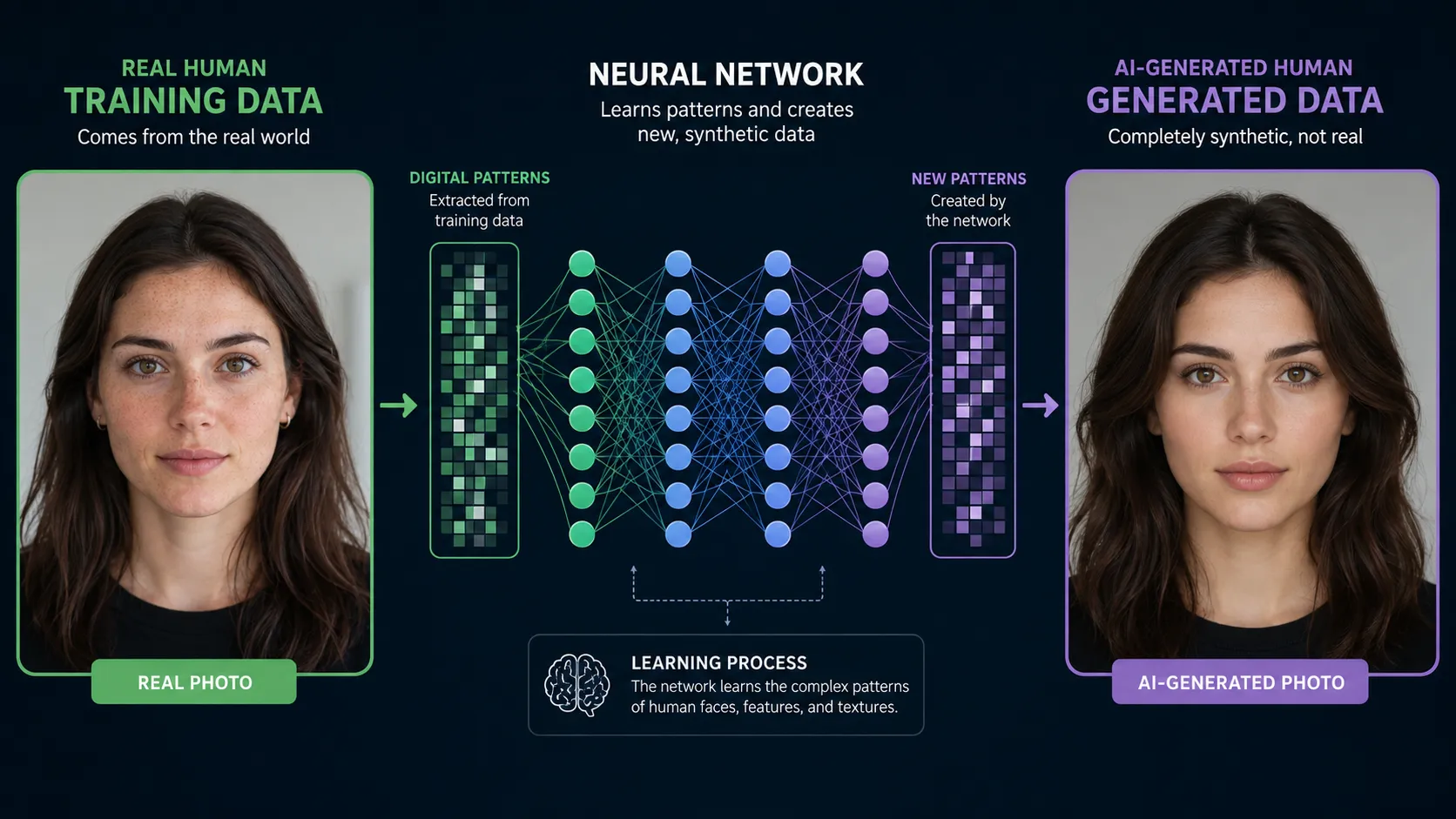
Imagine opening a website, seeing a clear photo of a smiling person, and then learning that the person was never born. No camera took the picture. No model stood in front of a lens. The face was created by a neural network from patterns it learned from real images.
That is the kind of problem Generative Adversarial Networks, or GANs, can solve.
GANs are deep learning models that learn patterns from training data and create new data that looks similar. They became famous for realistic image generation, especially synthetic human faces, but the same idea can also support artwork, data augmentation, image restoration, and other synthetic data tasks.
What Is a Generative Adversarial Network?
A Generative Adversarial Network is a machine learning system made from two neural networks that learn by competing with each other.
These networks are called the generator and the discriminator.
The generator tries to create something that looks real. The discriminator looks at real examples and generated examples and tries to decide which ones are genuine.
Think of it like a student learning to copy a painting and a strict art teacher checking every copy. At first, the student makes obvious mistakes. The teacher spots them. The student studies the feedback, improves, and tries again. As the student gets better, the teacher also has to become sharper.
That repeated competition is the heart of how GANs work.
Why Is It Called “Adversarial”?
The two networks have opposite goals.
The generator wants the discriminator to make a mistake by accepting fake output as real. The discriminator wants to correctly separate real data from generated data.
The original GAN framework introduced by Ian Goodfellow and his co-authors in 2014 described this as a two-player minimax game between a generative model and a discriminative model.
Generator vs Discriminator in GANs
To understand GANs for beginners, look at the two networks separately.
The Generator: The Creator
The generator starts with random input, often called a random noise vector or latent vector.
This input is simply a set of numbers. The generator passes those numbers through its neural network and turns them into an output, such as an image.
During early training, generated images may look like random blobs. After many training rounds, the generator begins to learn patterns such as where eyes usually appear, how shadows fall across a face, and how hair and skin textures look.
Its goal is not to reproduce one exact training photo. It tries to learn the broader data pattern well enough to create a believable new sample.
The Discriminator: The Judge
The discriminator works like a classifier.
It receives an image and asks: “Does this look like it came from the real training data?”
During training, it sees real images from the dataset and fake images produced by the generator. It learns clues that help separate them.
If generated faces have strange eyes, broken teeth, or unrealistic backgrounds, the discriminator can learn to notice those problems. The generator then receives a training signal that helps it improve.
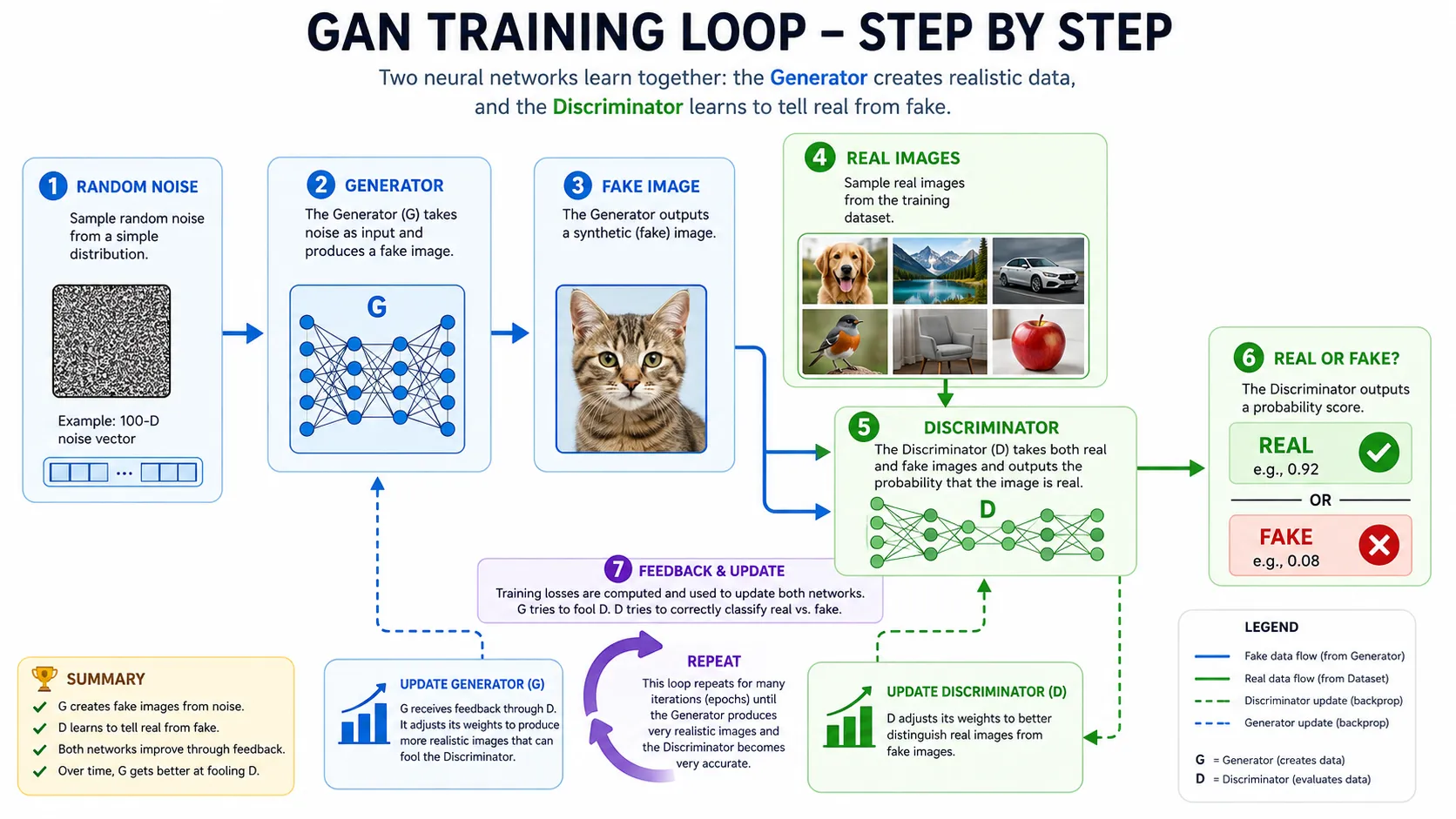
This creates a simple loop:
Generator creates → Discriminator checks → Generator improves.
TensorFlow’s GAN example describes the same basic setup: the generator learns to produce increasingly realistic images while the discriminator learns to separate generated images from real ones.
How Do GANs Learn Step by Step?
A GAN training cycle is easier to understand than it first sounds.
First, the system takes real examples from a dataset.
Second, the generator creates fake samples from random input.
Third, the discriminator sees both real and fake samples and tries to classify them correctly.
Fourth, the discriminator is updated so it becomes better at spotting generated data.
Fifth, the generator is updated using feedback from the discriminator so its next outputs become more convincing.
Then the cycle repeats.
This competition is important because neither network learns completely on its own. The discriminator constantly challenges the generator, while improvements in the generator force the discriminator to become better as well.
--- IMAGE 3 ---
Real-World Example: How GANs Create Synthetic Human Faces
One of the easiest ways to understand generative adversarial networks is through synthetic faces.
The well-known This Person Does Not Exist concept helped bring GAN-generated faces into public attention by showing realistic portraits created using NVIDIA’s StyleGAN technology. NVIDIA’s StyleGAN research showed improved control over larger visual properties such as pose as well as smaller details such as hair and freckles.
Imagine a face generator trained on a large collection of portraits. It learns common visual patterns across many faces rather than simply working with one person.
It starts learning relationships between facial features: where eyes normally appear, the distance between the nose and mouth, how hair surrounds a head, how lighting changes skin, and what makes a portrait look natural.
Now give the generator a new latent input.
From that numerical starting point, the network may produce a completely new-looking portrait: perhaps someone with dark hair, glasses, soft lighting, a slight smile, and realistic-looking skin texture.
The important idea is that the system creates a new visual sample using patterns learned during training rather than simply displaying one complete photo from its dataset.
That is why GAN-generated faces can look surprisingly real even when the displayed person does not correspond to a real individual.
Why GANs Matter in Deep Learning
Traditional machine learning is often used to recognize or predict things.
A model may detect spam, classify an image, recognize an object, or estimate the price of a house.
GANs pushed deep learning further toward creation.
Instead of only asking:
“What is inside this image?”
we can also ask:
“Can a machine create a new image that follows similar patterns?”
That idea helped expand work in synthetic data generation, image-to-image translation, super-resolution, creative tools, and realistic visual generation.
GANs also come with risks.
The same ability that can produce useful training data, design assets, or artificial examples can also be misused to create misleading media. Understanding how GANs generate images is therefore useful not only for machine learning developers but also for anyone trying to understand modern AI-generated content.
Once the basic generator-versus-discriminator idea is clear, the next important question is what actually happens during training.
How does the generator know that its image is bad? How does the discriminator calculate mistakes? What happens when one network becomes much stronger than the other? And why do some GANs keep generating very similar outputs?
Those questions take us deeper into the real mechanics behind GAN training.
How GAN Training Actually Works
Now that the basic idea of the generator and discriminator is clear, the next step is to understand what happens when a GAN starts learning.
A GAN does not become good at image generation instantly.
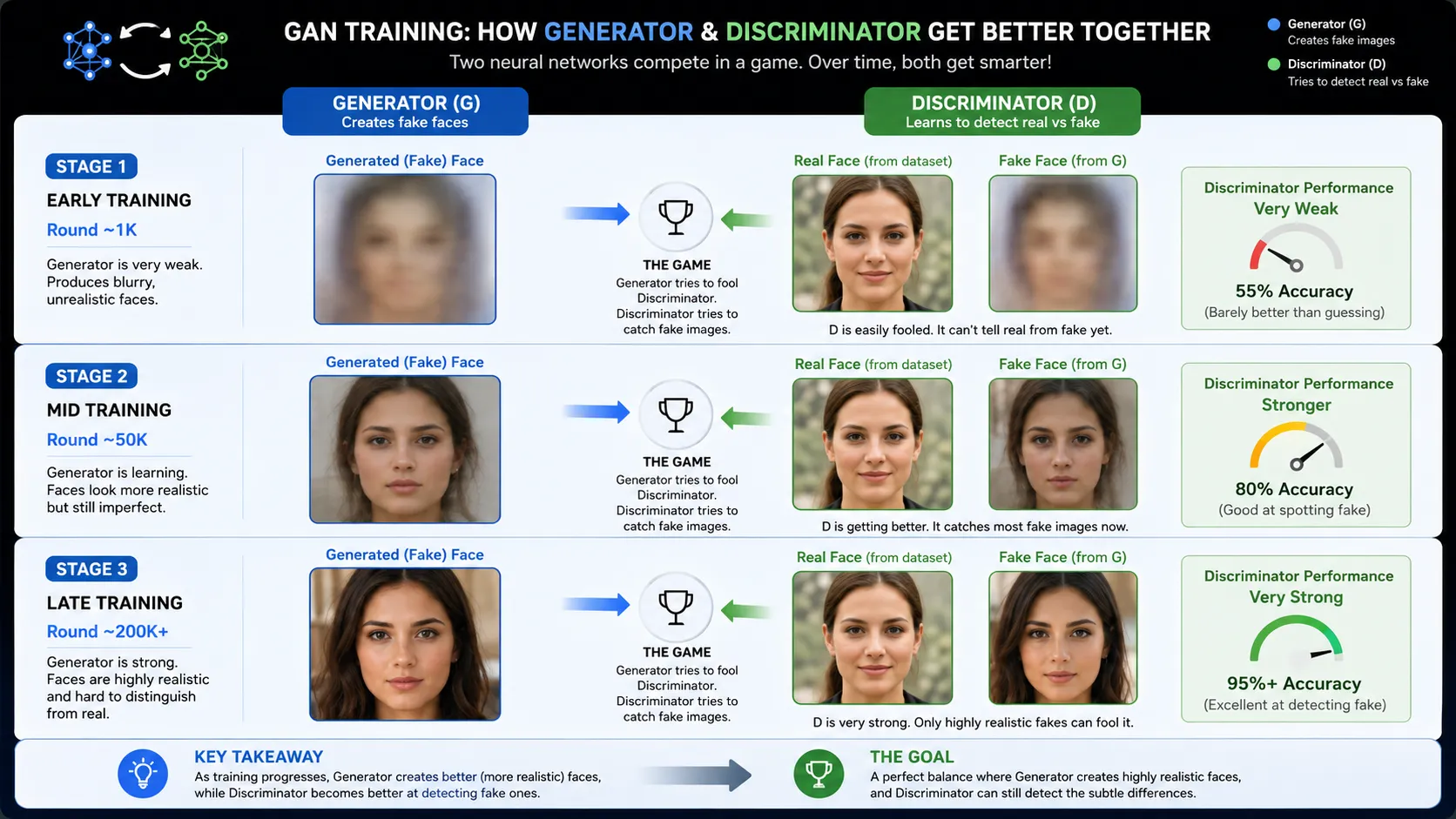
In the beginning, the generator usually creates meaningless output. If it is trying to create human faces, the first results may look like random colors, strange shapes, or broken facial features.
The discriminator has a much easier job at this stage because the fake images are easy to detect.
But as training continues, the generator slowly learns what makes real images look believable.
This repeated learning process is called adversarial training.
Step 1: Real Data Is Given to the Discriminator
The discriminator first receives real examples from the training dataset.
For example, if we want to build a GAN that generates human faces, the dataset may contain thousands of real face images.
The discriminator studies these images and learns patterns such as:
facial structure
skin texture
lighting
eye position
hair shape
background details
Its job is not to understand a person in the same way a human does.
Instead, it learns statistical patterns that often appear in real training images.
Step 2: The Generator Creates Fake Data
At the same time, the generator receives random numbers as input.
This random input is commonly called noise, a latent vector, or a point in latent space.
You can imagine latent space as a hidden map of possible outputs.
One position in that space may create a face with short hair. Another position may produce glasses. Another may create a different head angle or lighting style.
The generator converts the numbers into an image.
During early training, that image will probably look terrible.
But that is completely normal.
Step 3: The Discriminator Judges Real and Fake Images
The discriminator now sees two types of examples:
real images from the dataset and fake images produced by the generator.
Its goal is to correctly tell them apart.
Think of a security guard checking fake and real ID cards.
At first, the fake card may have a bad photo, strange text, and the wrong layout. The guard easily catches it.
But every time the fake card is rejected, its creator studies the mistakes and makes a better version.
Soon the security guard has to look more carefully.
The relationship between the generator and discriminator in GANs works in a similar way.
What Is a GAN Loss Function?
For a neural network to improve, it needs a way to measure how wrong its output is.
This measurement is handled using a loss function.
A simple way to understand GAN loss is to think of it as a score that tells both networks how well they are doing.
The discriminator wants a low error when identifying real and generated samples.
The generator wants to create samples that cause the discriminator to make mistakes.
If the discriminator easily identifies every fake image, the generator knows that its output needs major improvement.
If the discriminator starts confusing generated images with real ones, the generator is doing a better job.
Generator Loss
The generator loss measures how successful the generator is at fooling the discriminator.
Suppose the generator creates a fake face.
If the discriminator immediately says:
“This image is fake.”
the generator receives a poor result.
But if the discriminator believes that the fake face looks real, the generator receives a better training signal.
The generator then adjusts millions of internal parameters called weights.
These small changes help it produce better images during the next training cycle.
Discriminator Loss
The discriminator loss measures how accurately the discriminator identifies real and fake samples.
A strong discriminator should ideally say:
“This training image is real.”
and:
“This generator image is fake.”
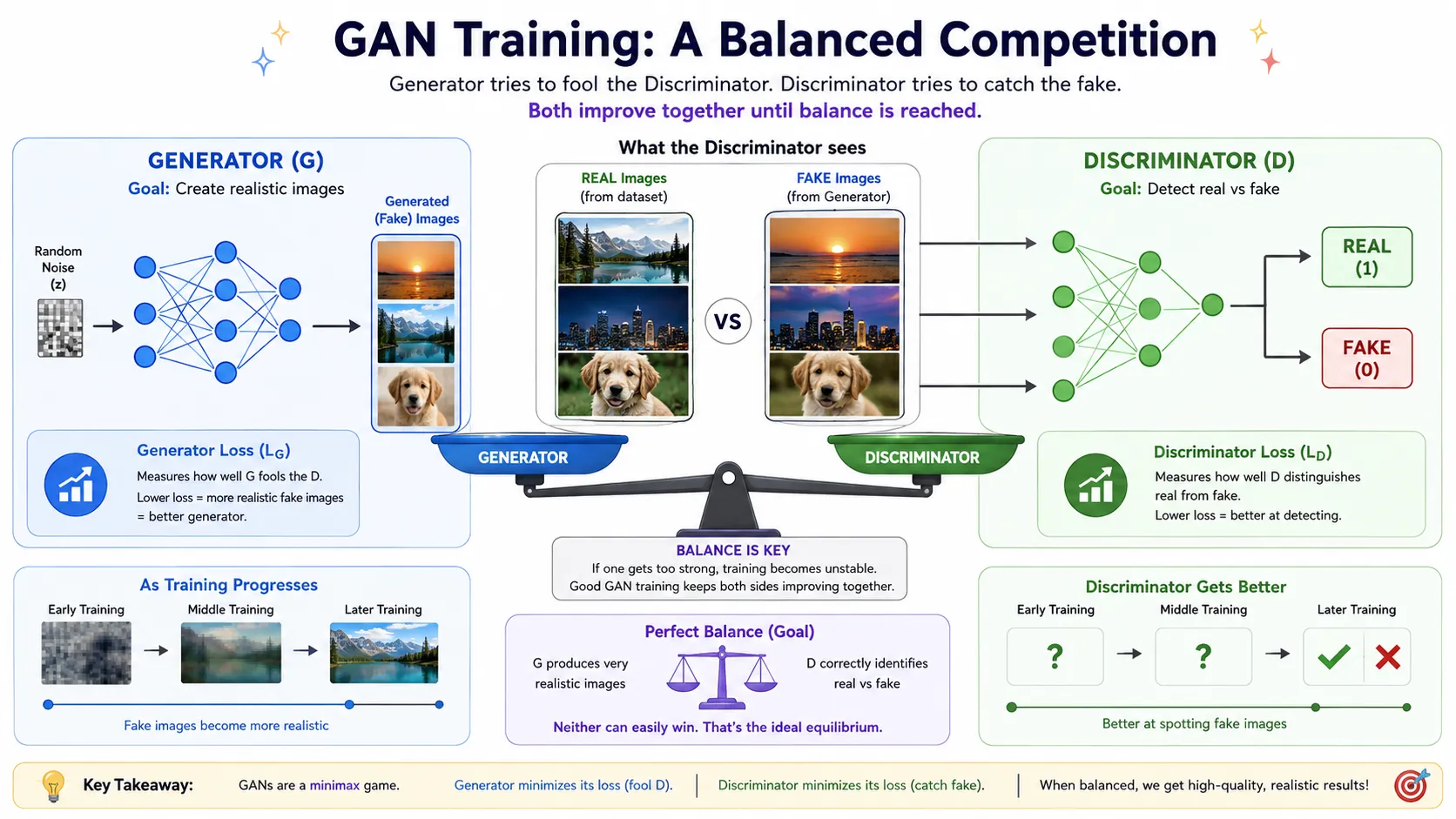
But GAN training is a competition.
If the discriminator becomes too powerful, the generator may struggle to learn.
If the generator becomes too strong too quickly, the discriminator may fail to provide useful feedback.
That balance is one reason why training GANs can be difficult.
What Is Latent Space in GANs?
The term latent space sounds complex, but the basic idea is simple.
Imagine a giant invisible control panel.
Instead of switches labeled “hair,” “smile,” “age,” or “lighting,” the panel contains numbers.
The generator learns how combinations of those numbers connect to visual features.
Changing the input numbers can change the generated result.
For example, one latent vector may generate a young-looking face with dark hair.
A slightly different vector may create a similar face with lighter hair or a different expression.
This is why latent space is one of the most interesting parts of GAN image generation.
Researchers can sometimes move through latent space and observe smooth changes in generated images.
A face may slowly change from looking left to looking right, from neutral to smiling, or from one hairstyle to another.
The model is not necessarily storing these features as simple named controls. Instead, they emerge from patterns learned during training.
Why Does a GAN Sometimes Fail?
GANs can create impressive results, but training them is not always stable.
One common problem is called mode collapse.
What Is Mode Collapse?
Imagine asking an artist to create 100 different faces.
Instead of creating 100 unique people, the artist discovers one face that always gets a good score and starts drawing almost the same face again and again.
That is similar to mode collapse in GANs.
The generator finds a limited set of outputs that successfully fool the discriminator.
Instead of learning the full variety of the dataset, it keeps producing similar results.
For example, a poorly trained face GAN may generate many portraits with nearly the same hairstyle, head position, or facial structure.
This is a problem because a useful generative model should produce diversity, not only realistic images.
Why GAN Training Can Become Unstable
Another challenge is that the two neural networks are learning at the same time.
Imagine two players improving their strategy during the same chess game.
Every time one player changes, the other must react.
GAN training works in a similar moving environment.
The generator is always changing.
The discriminator is also changing.
Because both models depend on each other, small problems in the training setup can create instability.
Developers often adjust factors such as:
learning rate
network architecture
training data quality
batch size
loss functions
normalization techniques
The goal is to keep the competition balanced enough for both networks to continue learning.
From Basic GANs to Better GAN Architectures
The original GAN idea was powerful, but researchers soon started building improved versions.
Different GAN architectures were designed to solve different problems.
One important example is DCGAN, or Deep Convolutional Generative Adversarial Network.
DCGAN uses convolutional neural network techniques that work especially well with images.
This made GAN-based image generation more practical and helped researchers understand how deep convolutional networks could learn useful visual representations.
Another major development was StyleGAN.
StyleGAN became widely known for generating highly realistic human faces.
Instead of controlling image generation only through a basic input vector, StyleGAN introduced a different generator design that gave much better control over visual styles at different levels.
Large features such as face shape and head position could be influenced separately from smaller details such as hair texture and fine facial features.
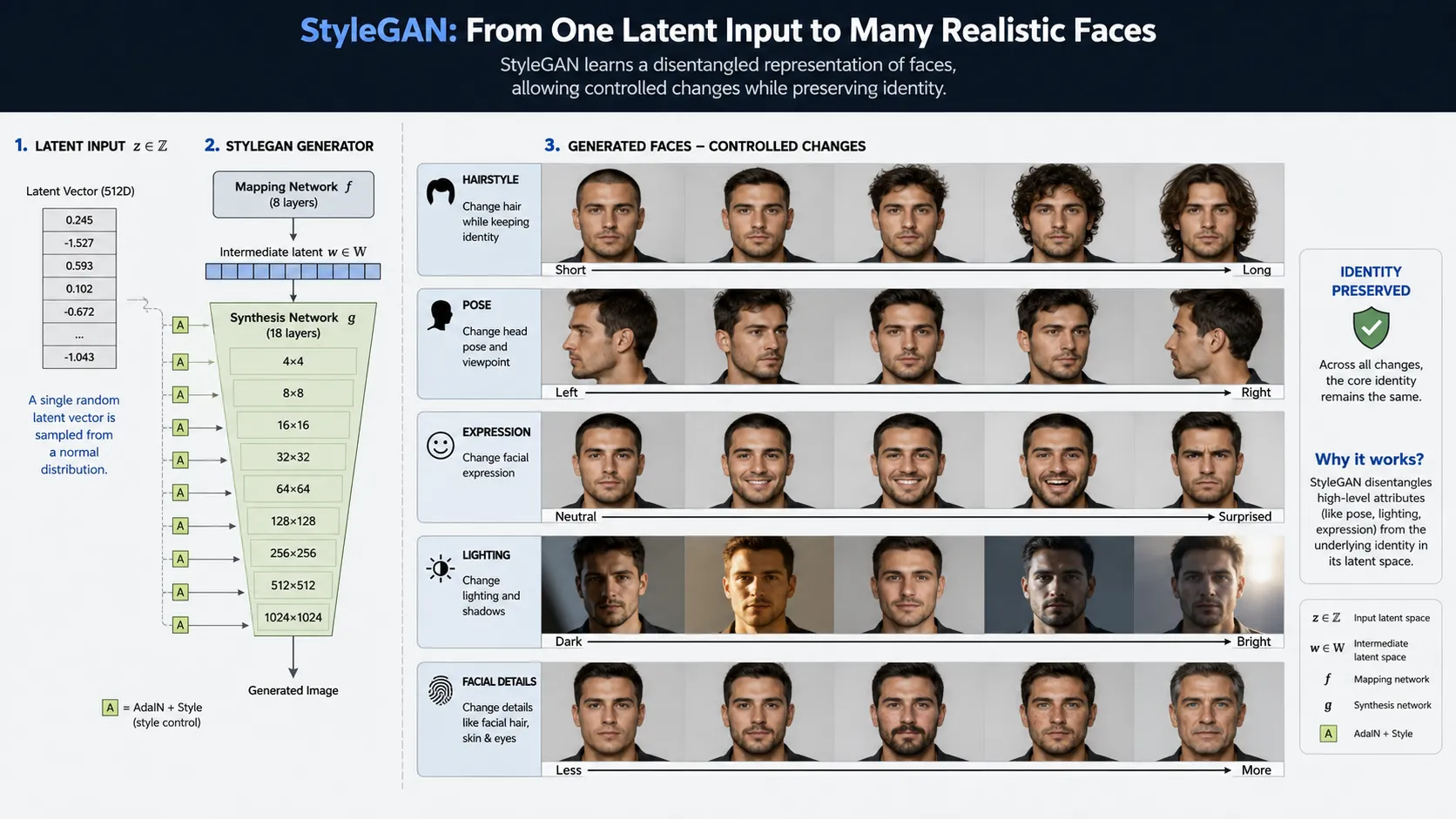
A Simple Example: Creating a New Face With a GAN
Imagine we have trained a face GAN successfully.
Now we want to generate a completely new portrait.
The process begins with random numbers.
The generator receives those numbers and passes them through multiple neural network layers.
Early layers may influence large visual structures.
Later layers add finer details.
Eventually, the generator produces an image.
The final face may contain realistic eyes, skin, hair, shadows, and facial proportions.
If we give the generator another random latent vector, we can get another face.
And another.
And another.
This ability to create many new samples is one of the reasons synthetic data generation with GANs became so important.
But realistic faces are only one application.
GANs can also be used for image editing, image restoration, style transfer, training-data creation, and several other tasks.
And this is where GANs become much more practical than simply creating impressive-looking pictures.
Real-World Applications of GANs
Creating realistic human faces is one of the most popular examples of GANs, but it is far from their only use.
The real power of Generative Adversarial Networks appears when they are used to solve practical problems.
GANs can create synthetic images, improve low-quality pictures, generate training data, restore damaged photos, and even help researchers test ideas without collecting huge amounts of new real-world data.
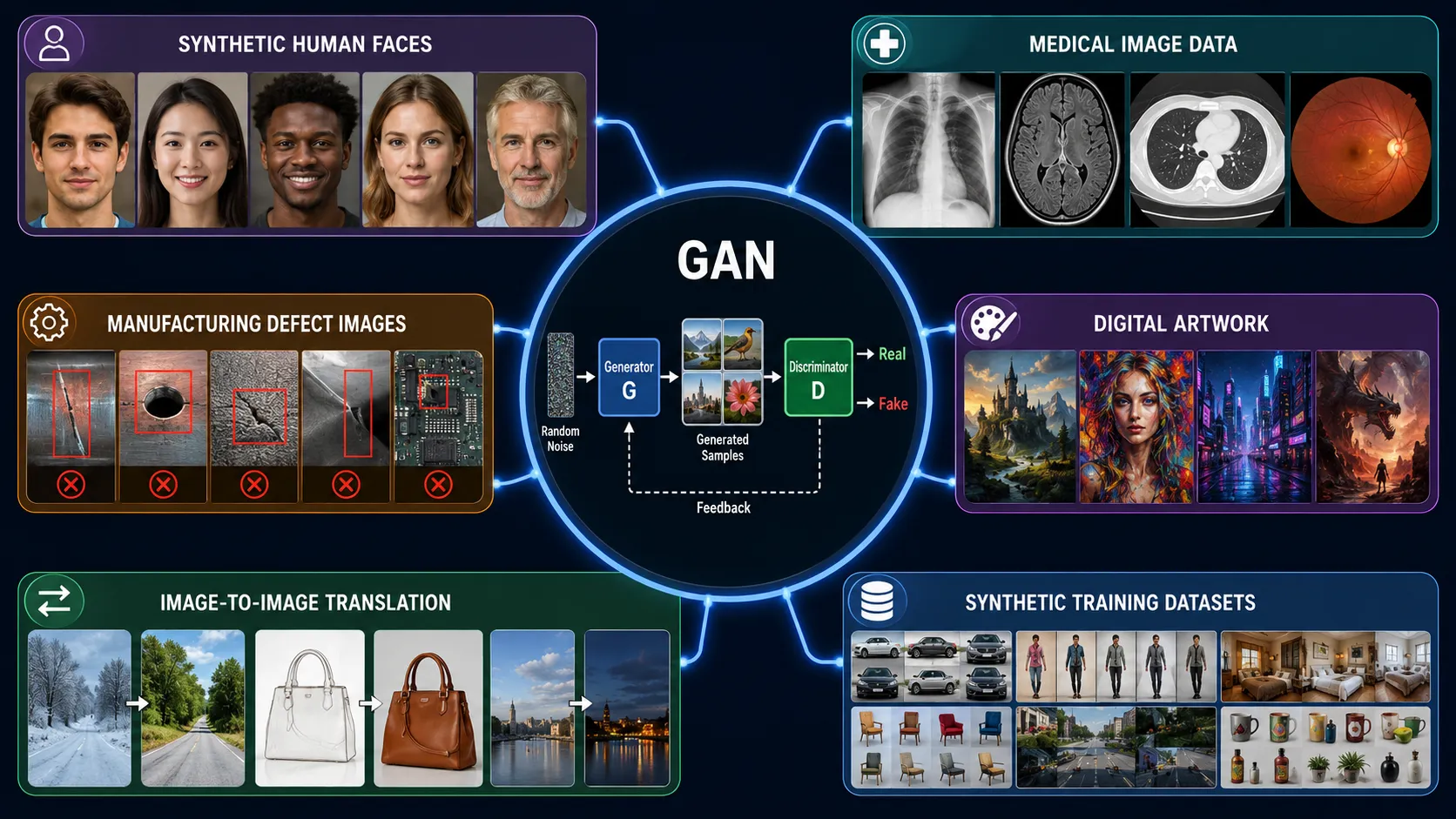
1. Synthetic Data Generation
One of the most useful applications of GANs is synthetic data generation.
Machine learning models usually need large amounts of training data. But collecting real data can be expensive, slow, or difficult.
Imagine a company building a system that detects rare manufacturing defects.
The company may have thousands of images of normal products but only a small number of images showing damaged products.
A GAN can help create additional synthetic defect images that follow patterns found in the original data.
These generated examples can be used to expand a training dataset.
The same idea can be useful in areas such as:
medical imaging, industrial inspection, robotics, autonomous systems, and computer vision research.
However, synthetic data still needs careful checking. If the original dataset contains mistakes or bias, a GAN may learn and reproduce those patterns too.
2. Image-to-Image Translation
GANs can also learn how to transform one type of image into another.
For example, a model may learn to convert:
a simple sketch into a realistic image,
a daytime scene into a nighttime version,
a black-and-white photo into a colorized image,
or a map into a more realistic-looking scene.
This is known as image-to-image translation.
A famous example in GAN research is Pix2Pix, which showed how paired images could be used to learn transformations between different visual styles.
Another approach, CycleGAN, made it possible to learn transformations even when perfectly matched image pairs were not available.
The important idea is simple:
the model learns the visual relationship between two different domains.
3. Image Super-Resolution
Have you ever zoomed into an old image and seen blurred pixels?
GANs have also been used for image super-resolution, where a model attempts to create a higher-resolution version of a low-resolution image.
Instead of simply stretching the existing pixels, the model learns what realistic high-resolution details usually look like.
This can make an image appear sharper and more detailed.
But there is an important limitation.
A generated high-resolution image may contain details predicted by the model rather than details that were truly present in the original photo.
So GAN-based enhancement should not automatically be treated as a perfect reconstruction of reality.
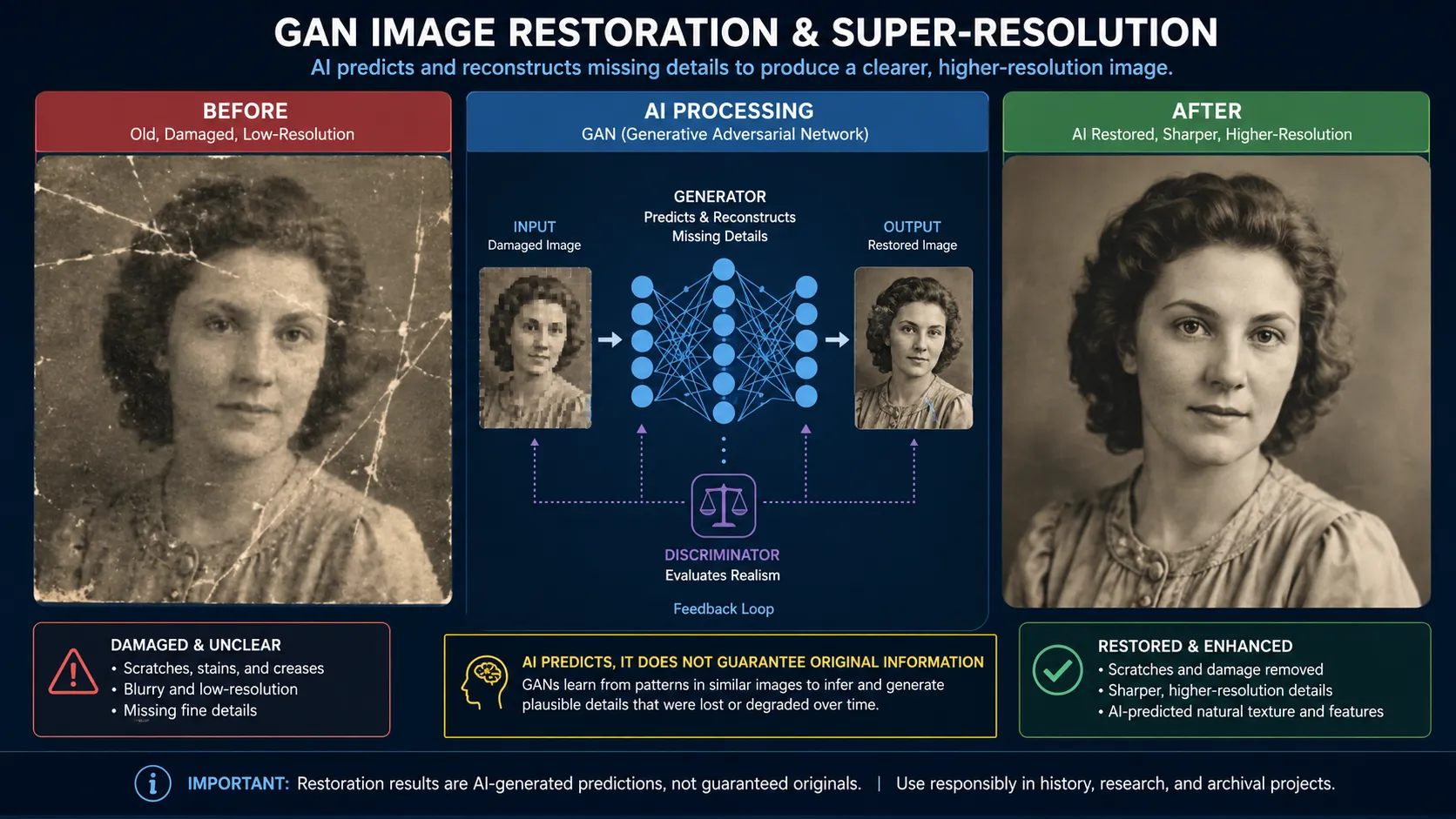
4. Restoring Old or Damaged Images
GAN-based systems can also help with image restoration.
Imagine an old family photograph with scratches, missing areas, faded colors, or damaged sections.
A generative model can estimate what the missing region might look like based on patterns learned from other images.
This technique is often called image inpainting when missing areas are filled.
It can be useful for creative restoration, historical photo repair, and visual editing.
Again, the generated area is an estimate.
The AI is not recovering hidden information that magically existed behind the damage. It is creating a likely replacement based on learned patterns.
5. Creating Art and Design Concepts
GANs have also influenced digital art and creative design.
A designer can use generative models to explore new visual ideas, textures, faces, patterns, or concept images.
Instead of replacing the designer, the technology can act as an idea-generation tool.
For example, a designer working on a fictional game character may generate multiple face concepts and then select or modify the most useful direction.
This shows an important point about GAN applications:
generation does not always have to be the final product.
Sometimes generated content is simply the starting point for human creativity.
Benefits of Generative Adversarial Networks
GANs became important because they demonstrated that neural networks could learn to generate highly realistic data.
One major advantage is their ability to create sharp visual outputs.
They can also learn complex data distributions without requiring a human to manually describe every visual feature.
For image generation tasks, GANs helped push synthetic images toward levels of realism that were once difficult to imagine.
They are also valuable when real-world data is limited.
Synthetic examples can sometimes support experiments and training pipelines when collecting additional real samples is difficult.
Another benefit is flexibility.
GAN concepts have been adapted for faces, landscapes, artwork, medical images, image translation, super-resolution, and many other tasks.
But these benefits come with serious limitations.
Limitations of GANs
GANs can be powerful, but they are not simple models to train.
As we saw earlier, GAN training instability is one major problem.
Because the generator and discriminator are learning against each other, training may fail to reach a useful balance.
Mode collapse can reduce diversity.
The generator may also produce strange artifacts even when most of an image looks realistic.
GANs can require large datasets, strong computing resources, careful architecture choices, and repeated experimentation.
Another problem is evaluation.
With a normal classification model, we can measure how many predictions are correct.
For a generative model, quality is harder to define.
Is an image realistic?
Is it diverse?
Does it represent the full training distribution?
These questions require several evaluation methods rather than one simple accuracy score.
GANs and Deepfakes: Why Responsible Use Matters
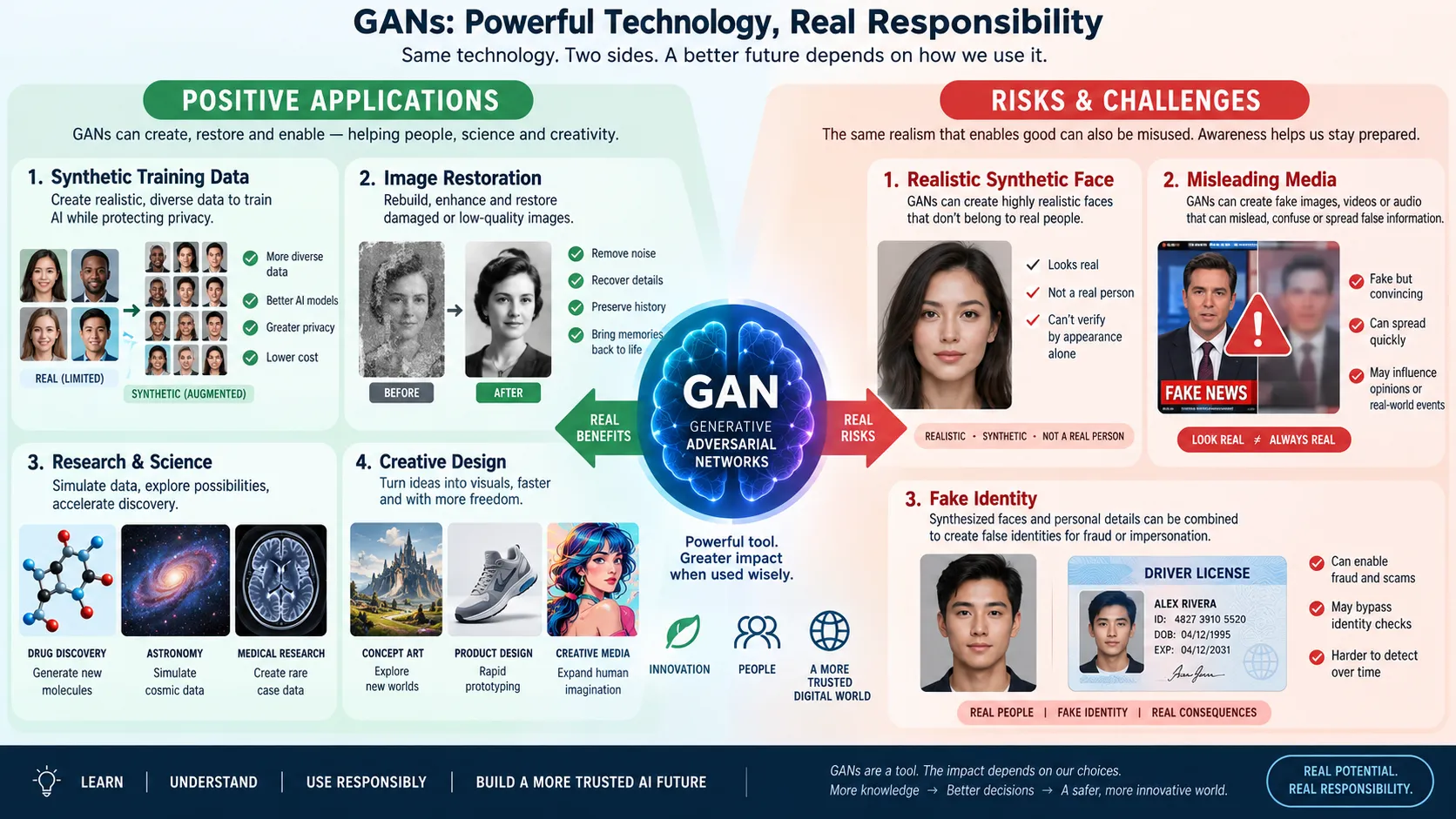
The ability to generate realistic content also creates risks.
GANs and other generative models can contribute to synthetic media that looks real even when the event or person shown never existed.
This can be useful in entertainment, research, and creative work.
But similar technology may also be used to create misleading images or fake identities.
This is why understanding AI-generated images matters.
People should not assume that every realistic-looking face or image online is evidence that something actually happened.
Developers also need to think about consent, dataset quality, copyright, bias, privacy, and misuse when building generative systems.
GANs vs Modern Generative AI Models
GANs are an important part of generative AI history, but they are not the only way to generate content.
Today, you may also hear about diffusion models, transformers, variational autoencoders, and large generative models.
Each approach learns and generates data differently.
GANs are especially known for the competition between a generator and discriminator.
Diffusion models use a different process: they generally learn to recover useful data from progressively added noise.
This difference is important because modern image-generation systems do not all use GANs.
So when you see an AI-generated image online, you should not automatically assume that a GAN created it.
GANs remain important because they introduced one of the most influential ideas in deep learning: two neural networks improving through competition.
Final Thoughts: How GANs Work in Simple Words
If you remember only one thing from this guide, remember this:
A GAN is built around a competition.
The generator creates fake data.
The discriminator checks whether that data looks real.
The generator learns from its failures and keeps improving.
Over many training cycles, this competition can produce surprisingly realistic results.
That simple idea opened the door to synthetic faces, artificial datasets, image translation, restoration, super-resolution, and many creative applications.
But realistic output does not mean perfect understanding.
A GAN learns patterns from data. It does not experience the world like a human, and generated content should still be checked carefully.
For beginners learning deep learning, GANs are valuable because they connect several important ideas in one model: neural networks, loss functions, adversarial training, latent space, image generation, and synthetic data.
And once you understand the generator-versus-discriminator relationship, even advanced GAN architectures become much easier to study.
Frequently Asked Questions About Generative Adversarial Networks
What is a Generative Adversarial Network in simple words?
A Generative Adversarial Network (GAN) is a deep learning system made of two neural networks. The generator creates fake data, while the discriminator checks whether that data looks real. Both improve by competing with each other during training.
How does a GAN work?
A GAN works through repeated competition. The generator creates new samples, such as images, while the discriminator compares them with real training data. When the discriminator detects a fake, the generator learns from that feedback and tries to create a better result next time.
What is the generator in a GAN?
The generator is the creative part of a GAN. It takes random input, often called a latent vector, and converts it into new data such as an image. Its main goal is to create results realistic enough to fool the discriminator.
What is the discriminator in a GAN?
The discriminator acts like a judge. It receives both real training examples and generated examples and tries to decide which are real and which are fake. Its feedback helps the generator improve.
How do GANs create fake human faces?
A GAN can learn visual patterns from a large collection of face images, including facial structure, hair, lighting, skin texture, and expressions. After training, the generator can combine learned patterns to create a new synthetic face that may not belong to any real person.
What is latent space in GANs?
Latent space is a mathematical space used as input for the generator. Different points in this space can produce different outputs. Changing the latent input may change features such as facial expression, hairstyle, pose, or other visual properties.
What is mode collapse in GANs?
Mode collapse happens when a generator keeps creating similar outputs instead of producing enough variety. For example, a face GAN may generate many realistic faces that all have nearly the same pose or appearance.
What are GANs used for?
GANs have been used for synthetic data generation, image generation, image restoration, super-resolution, image-to-image translation, digital art, research, and computer vision experiments. Their exact use depends on the type of GAN and the data it was trained on.
Are GAN-generated images always accurate?
No. A generated image can look realistic while still containing invented or incorrect details. GANs learn patterns from training data and create likely-looking outputs, so generated content should not automatically be treated as evidence of something that really existed.
Are GANs still important in generative AI?
Yes. Modern generative AI also includes diffusion models, transformers, and other approaches, but GANs remain an important part of deep learning because they introduced the powerful idea of training a generator and discriminator through competition.
You want to know how to work AI, Deep learning and machine learning


